El-Yafi A. Kh.*, El-Zein H.
*
Department of Pharmaceutical Technology, Faculty of Pharmacy, Damascus University, Syria.
*Corresponding author’s E-mail: [email protected]
Accepted on: 10-10-2014; Finalized on: 31-01-2015. ABSTRACT
In recent years, engineering the total morphology of pharmaceutical materials particles to desirable shape, size and surface area has long been actively increased because it has many advantages especially for improving physicochemical properties of Active Pharmaceutical Ingredients (APIs). This article therefore considers the potential utility of crystal engineering as a tool for controlling and designing properties of pharmaceutical solid particles in purpose to developing efficacious performance of solid dosage form, fundamentals of crystallization process, applications. In addition, understanding the relationship between molecular recognition, thermodynamic, and kinetics which controls the crystallization process so that it benefits in designing successful experiments to have desirable crystal habit for materials.
Keywords: Crystallization, Nucleation, Crystal growth dispersion, Thermodynamic.
INTRODUCTION
rug molecules with limited micromeritic properties & aqueous solubility are becoming increasingly prevalent in the research and development of new drugs1. Nowadays, increasing energy prices and the inefficient manufacturing have made pharmaceutical companies face cost pressures. Therefore, the primary aim of pharmaceutical material engineering is to improve designed particles of solid pharmaceutical dosage forms which results in improving the efficiency of the manufacturing processes and giving a high degree of functionality to the drug or excipient particles (especially of pharmaceutical materials for direct compression)2 in pharmaceutical products. Materials in the solid state depending on the internal packing of their molecules can be found in either crystalline, polymorphism or amorphous (or a combination of both). It has been shown that they can be packed in a defined order (crystalline), have no long-range three dimensional
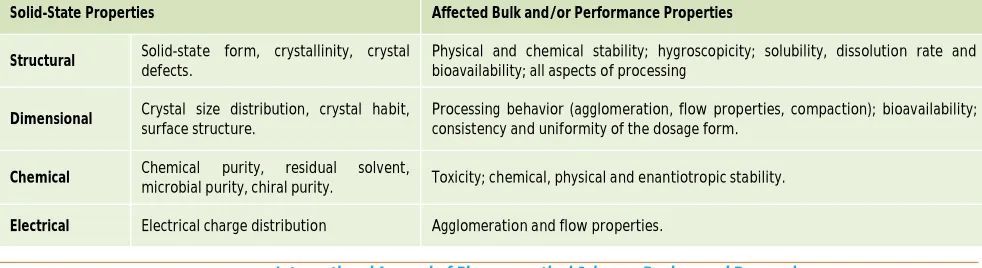
(3-D) order (amorphous) have different repeating packing arrangements (polymorphic crystals) or have solvent included (solvates and hydrates). Each of these changes in internal packing of a solid will give rise to changes in bulk properties such as physiochemical, mechanical, etc.3 For the crystal form, it is possible to change the external shape of a crystal and this is called the crystal habit which is the consequence of the rate at which different faces grow. Changes in internal packing usually (but not always) give an easily distinguishable change in the crystal habit. With any crystalline material, the largest face is always the slowest growing and some crystal faces may have more exposed polar groups and others may be relatively non-polar that are depend on the packing geometry of the molecules into the lattice. In other words, the growth on different faces will depend on the relative affinities of the solute for the solvent and the growing faces of the crystal. It is technically possible to engineer changes in crystal habit by deliberately manipulating the rate of growth of different faces of the crystal4. Crystallization, particularly crystallization from solutions, is the common operation in the production of pharmaceutical solid particles and it benefits in determining the purity (chemical and structure) and the physical properties of a material which are summarized in Table 1.
Table 1: Effect of solid-state properties defined by crystallization process on properties of an API and drug product 5.
Solid-State Properties Affected Bulk and/or Performance Properties
Structural Solid-state form, crystallinity, crystal
defects.
Physical and chemical stability; hygroscopicity; solubility, dissolution rate and bioavailability; all aspects of processing
Dimensional Crystal size distribution, crystal habit,
surface structure.
Processing behavior (agglomeration, flow properties, compaction); bioavailability; consistency and uniformity of the dosage form.
Chemical Chemical purity, residual solvent,
microbial purity, chiral purity. Toxicity; chemical, physical and enantiotropic stability.
Electrical Electrical charge distribution Agglomeration and flow properties.
Technical Crystallization for Application in Pharmaceutical Material Engineering
D
However, changes in crystallization conditions can significantly alter their previous properties followed by thermodynamic and mechanical properties5.
Methods of Particle Production
Powder technology is the base of dosage form design with effective drug delivery. Any particles of pharmaceutical solid materials may be produced by two ways:
Constructive methods
include crystallization, spray-drying, lyophilization, and supercritical fluid techniques.
Destructive methods
include milling and grinding.
In general, crystallization is the most common method of particle production6.
Crystal engineering in properties design of Pharmaceutical Materials
The role of Thermodynamic in the Crystallization Process
The phase change with stability associated with crystallization processes can be explained by rules of physical chemistry and thermodynamic principles. When a substance is transformed from one phase to another, the change in the molar Gibbs free energy (∆Ĝ) of the
transformation, at constant pressure and temperature, is given by:
Solute in phase 1 ↔ Solute in phase 2
(Liquid form in solution) (Crystal + Liquid form in solution)
Where µ1 and µ2 are the chemical potentials of phase 1
and phase 2, respectively. When ∆Ĝ< 0, the transition from phase 1 to 2 is spontaneous under specific conditions (in case of supersaturated solution). Alternatively, when ∆Ĝ> 0, this phase transformation is not thermodynamically possible (in case of unsaturated solution); whereas, ∆Ĝ= 0 defines a condition of
thermodynamic equilibrium in the system, in this situation, the free energy of two phases is the same7 (in case of saturated solution) and the process can divided as follows8:
A supersaturated solution can be achieved in general by under cooling if dCeq / dT > 0 or by evaporation the
solution if dCeq / dT < 0. If T0 is the solute’s saturation
temperature for a given solvent system, then at some temperature T, ∆Ĝ can be demonstrated in terms of heat effects as:
Where ∆Ŝ is the molar entropy and ∆Ĥ is the enthalpy change for the phase transformation. The molar Gibbs free energy can also be expressed in terms of activity as:
Where R is the universal gas constant, T is the absolute temperature, ɑ is the activity of the solute and ɑ0 is the activity of the pure solute in equilibrium with a macroscopic crystal, S is the saturation ratio which is given by:
Where C is the solute concentration and Ceq is the
equilibrium solubility of the solute at the temperature and pressure of the system; from this, the supersaturation ratio can be defined as:
–
= – 1
These thermodynamic considerations describe a driving force for crystallization9.
Crystallization Process and Factors affecting in Crystal Habit
The Crystallization Mechanism
Because of instability of many amorphous materials, most drugs are formulated in the crystalline state3. Crystals are produced by inducing a change from the liquid to the solid state. Crystallization from solution can be considered to be the result of relative rate of the three successive processes:
Supersaturation of the solution.
Formation of crystal nuclei.
Crystal growth round the nuclei9.
Supersaturated Solution Step
the system will adjust in order to move back to the true solubility and to do this the excess solute will precipitate4. This supersaturated solution may be achieved by several methods including7,9:
Methods that produce Supersaturation by increasing the Solute Concentration include:
a. Removing the solvent liquid by evaporation (this is the way sea salt is prepared): for systems (isothermal solution) in which the solubility is not a strong function of temperature.
b. Dissolution of a metastable solid phase like amorphous, anhydrous, more soluble, and salt which transformation to crystalline, hydrate, less soluble polymorph, and free acid or base, respectively.
Methods that produce Supersaturation by decreasing the Solute Solubility include:
a. Cooling the solution, as most materials become less soluble when the temperature is decreased for systems in which solubility increases with temperature.
b. Adding another solvent which will mix with the solution, but in which the solute has a low solubility. This second solvent is often called an anti-solvent (i.e. water).
c. Adding precipitants or by a chemical reaction that change the nature of the solute.
d. pH changing.
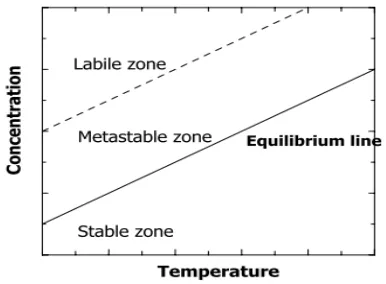
The terms labile (unstable) and metastable zones can classify supersaturated solutions in which spontaneous nucleation would or would not occurs, respectively. These zones are presented in a solubility diagram as shown in Figure 1:
Figure 1: The solubility diagram representing the
metastable zone10.
Above the equilibrium line (solid line): the solution are at supersaturation. In the labile zone, nucleation can occur spontaneously which is called primary nucleation. In metastable zone, no nucleation occurs which means that supersaturation itself is insufficient to cause crystal formation. The crystal embryos must form by collision of molecules of solute in the solution or sometimes by the
addition of breakage of the seed crystals or dust particles or even particles from container walls.
Deliberate seeding is often carried out in industrial processes, seeding crystals are not necessary to be of the substances concerned but may be isomorphous substances (i.e. of the same morphology)10,11.
Nucleation Step
Nucleation is the formation of a small mass on which a crystal can grow4. There are three types of nucleation that can occur in supersaturated solutions. These types are presented in nucleation situations diagram as shown in Figure 2:
Figure 2: The nucleation situations from solution6.
Primary Homogeneous Nucleation
This is spontaneous nucleation where the formation of the solid phase particle is not brought by the presence of any solid phase. It requires very high supersaturation conditions such as in the labile zone7,10,12.
Primary Heterogeneous Nucleation
Is the most primary nucleation where the formation of new solid phase particle is catalyzed by the presence of a foreign solid phase which has lower surface energy than that of a new solute particle. Therefore, it requires lower supersaturation than homogeneous nucleation9,12. However, homogeneous and heterogeneous can be presented in same the nucleation process as follow:
Where: S is a saturation ratio of solution9.
Secondary Heterogeneous Nucleation
It is the most common nucleation event in industrial crystallization and is the mechanism by which formation of the solid phase is initiated when solid phase of solute particle can be present or added to solution. Therefore, this type of nucleation can be found even in the metastable zone where the crystals seemingly only grow9,10,12.
(amorphous) step before ordering into the growth structure to form a three-dimensional lattice structure18.
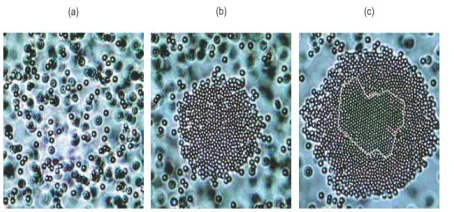
The two steps progression from liquid to crystalline nuclei observed in colloid experiments can be seen in Figure 3. As soon as stable nuclei are formed, they begin to grow into visible crystals17. The macromolecules nucleation such as colloidals, proteins and polymers can be observed by using techniques that are summarized in Table 2. Such as optical microscopy, small-angle neutron scattering and atomic force microscopy (AFM)19-22 which the effective technique to qualitatively study-surface morphology and crystal growth processes23.
In order that there is more chances to control the rate of nucleation step which affects in morphology of crystal particles. As far small molecules, direct measurement and observation of nucleation of nuclei is impossible so crystal particles can be observed only after growth to larger size through growth step22.
Figure 3: Two-step nucleation of colloidal particles. Image
(a) shows the initial diluted liquid phase, (b) shows the amorphous dense droplets are first created from mother phase, followed by (c) the crystalline nuclei are created from the amorphous phase17.
Table 2: Physical approaches for studying
macromolecular crystallization23.
Method Use
Static/quasi-elastic light
scattering Nucleation, phase transitions Michelson
interferometry Growth kinetics Mach-Zehnder
interferometry
Concentration gradients in solutions
Atomic force microscopy Growth mechanisms, kinetics, defect structure, defect density Fluorescence
polarization Nucleation Low angle neutron
scattering Nucleation Osmometry Nucleation
Light microscopy Characterization of crystal Time lapse video
microscopy Growth kinetics
X-ray diffraction Characterization of crystal Numerical
simulation/modeling
Nucleation, growth kinetics, phase transitions.
Crystal Growth Step
Crystal growth is the addition of more solute molecules to the nucleation site or crystal lattice to evolution macroscopic crystal form of defined size and shape4. In other words, particle size distribution and morphologies produced are a result of the relative rates of reaction of nucleation, crystal growth9.
Crystal growth is considered to be a reverse dissolution process and the diffusion theories of Noyes and Whitney, and of Nernst, consider that matter is deposited continuously on a crystal face at a rate proportional to the difference of concentration between the surface and the bulk solution. So an equation (1.1) for crystallization can be proposed in the form:
(1.1)
where m is the mass of solid deposited in time t, A is the surface area of the crystal, Cs is the solute concentration
at saturation and Css is the solute concentration at
supersaturation. As km =D/δ (D being the diffusion coefficient of the solute and δ the diffusion layer thickness), the degree of agitation of the system, which affects δ, also influences crystal growth. Crystals generally dissolve faster than they grow and depend on their initial size11,24, so growth is not simply the reverse of dissolution. It has been suggested that there are two steps involved in growth in addition to those mentioned earlier11.
However, crystal growth process consists of several stages through the growth unit. The growth unit in turn describes the critical elements of how a specific molecular species has assembled in a crystalline state in three dimensions, so that crystal growth depend on strength of the interactions (especially, if there is hydrogen bonding between functional group, Figure 4) between molecules itself and also between growth layers in network structure which would change in overall morphology of the crystal1. These stages include6,22,25,26:
1. Transport of a growth unit (a single molecules, atom, ion, or cluster) from or through the bulk solution to an impingement site on the crystal face by convention and diffusion, which is not necessarily the final growth site (i.e. site of incorporation into the crystal).
2. Adsorption of the growth unit at the impingement site.
3. Diffusion of the growth units from the impingement site to a growth site.
4. Incorporation into the crystal lattice.
5. The latent heat of crystallization is released and transported to the crystal and solution.
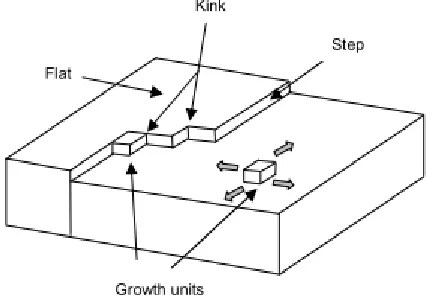
growth unit. In general, three types of crystal surfaces (and thus growth sites created by these surfaces) can be observed when impingement site captured the arriving growth units: Kink, Step, and Flat faces, which provide three, two, and one surface bond(s), respectively (Figure 5)27. As well, any of these steps can be the rate-limiting step in the crystal growth process and which step is rate-limiting will depend on the solvent properties like viscosity7. When the diffusion of molecules from the bulk solution to the impingement site is the rate-limiting step, crystal growth is volume-diffusion controlled whereas if the incorporation of a growth unit into the lattice is the slowest process then crystal growth is surface-integration
controlled7,10,28.
At last, the final shape of crystal is defined by the slowest growing flat faces. Crystal growth studies are therefore concerned with the mechanisms by which these faces grow4.
Figure 4: Representative superior hydrogen bonding in
supramolecular1.
Figure 5: A three-dimensional crystal surface showing
three type of growth sites27.
Factors Affected of Crystal Habit
If the crystallization conditions are changed in any way. Therefore, it is possible that the molecules may start to form crystals with a different packing pattern and different tuning crystal facets from that which occurred when the original conditions were used.
The change in some conditions could be change in the rate and mechanism of crystallization process in crystal growth step, specifically. Hence, the art of crystal facet engineering is determined by numerous factors that
regarded in thermodynamic, kinetics, and molecular
recognition. These factors are summarized in Figure 629.
Figure 6: Schematic diagram showing the interplay
between thermodynamic, kinetic, and molecular recognition phenomena that governs crystallization29.
In general, new drugs are screened to see how many polymorphs exist, and then to identify which one is the most stable. The screening process requires a lot of work in crystallizing from different solvent system, with variations in method and conditions, in order to try to cause different polymorphs to form. The products are then checked with spectroscopy (e.g. Raman) and X-ray diffraction to see if they have different internal packing. Changing in crystal habit to any solid state in crystal and powders of both drugs and pharmaceutical excipients are interested because it can be changed in physicochemical properties for it like surface energy (which can be determined by gravimetric, calorimetric and chromatographic), density, flowability, compressibility,
melting point, solubility, physical & chemical stability
and biopharmaceutical behavior (dissolution,
bioavailability) because these depend on the size and number of crystal faces in crystal habit which affect both
the production of dosage forms and the performance of the finished product4. As mentioned above, many properties can be change when a material is in a different polymorphic form in specific micromeritic properties, such as flowability, and a good reproducible compressibility. At all events, the flowability of needle-shaped or plate-needle-shaped crystals is very poor and these crystals are difficult to handle30.
also capping problems during tableting11; crystallization by a temperature-cooling method31 and by a solvent-change method32 modified the size, shape of particles so it had improved the compressibility and had a higher dissolution rate of tolbutamide, respectively. Paracetamol is a high-dose drug with poor compression properties, which can make it difficult to form into tablets. Consequently, researchers have tried to use different polymorphic forms of paracetamol to find one that is more compressible, for Nichols and Frampton are found this drug was exist in two polymorphic forms according to crystallization method used, a common crystal form is a form I (monoclinic) was described as plate-shape (Thermodynamically stable at room temperature, the commercially used form, and not suitable for direct compression which leads to unstable tablets with high capping tendency) and form II (orthorhombic) was a prismatic crystal show better compression behavior (have a plastic deformation upon compaction so it suggested to use in direct compression)33,34. The disadvantage of the orthorhombic form is the possible transition to form I35.
In general there will be a correlation between the melting point of the different polymorphs and the rate of dissolution, because the one with the lowest melting point will most easily give up molecules to dissolve, whereas the most stable form (highest melting point) will not give up molecules to the solvent4.
A classical example of the importance of polymorphism on bioavailability is that of chloramphenicol palmitate suspensions in the late 1960s. In Figure 7 the blood serum level is plotted as a function of time after dosing. It can be
seen that the stable α-polymorph (have low free energy)
produces low serum levels, whereas the metastable β
-polymorph (have high free energy so have greater solubility, absorption, and bioavailability) yields much higher serum levels when the same dose is administered1,4,36.
Figure 7: Comparison of mean blood serum levels after
the administration of chloramphenicol palmitate suspensions using varying ratios of the stable (α) and the metastable (β) polymorphos. M, 100% α polymorph; N, 25:75 β:α; O, 50:50 β:α; P, 75:25 β:α; L, 100% β
polymorph36.
Growth Rate Dispersion & Factors Affected of it
Crystal growth rate dispersion (GRD) is a phenomenon, known as a great breadth and depth problem in the crystalline product industries, where obviously identical crystals in the same solution under identical conditions (such as temperature, supersaturation levels, and hydrodynamic) grow at different rates. It appears to occur to different extents in all crystallization systems37. GRD was first seen by White and Wright (1971) in sucrose batch crystallization38. Growth rate dispersion broadens the crystal size distribution and hence affects the product quality of industrial crystallizers. Various studies try to explanation this correlation, Judge R. A. grew tetragonal lysozyme crystal and investigate growth rate dispersion of the (110) and (101) crystal faces as a function of sodium chloride concentration, temperature, and solution pH.
They reported that the lysozyme face growth rate was independent of the solution conditions for (110) face in compared with (101) face which was observed to vary systematically with temperature and pH39.
However, there is some poor in understanding physicochemical mechanism of why it occurs and what contributes to it.
According to the literatures, differences in growth rates between same crystals have been attributed to differences in internal crystal structure like internal strains24. Moreover, both the diffusion and surface integration mechanisms are responsible for it10,40,41.
Finally, a knowledge of how crystal grow from the crystal nuclei and the effects of the various factors which may influence crystal growth is not studied from pharmaceutical viewpoint in as much as chemical or physical viewpoints.
So crystal growth for any pharmaceutical ingredients may be in general affected by two factors42:
Rate-Controlling Process for Crystal Growth
The rate at which a crystal grows can be controlled by any of three factors: diffusion from the solution to the crystal nuclei, flow of latent heat away from the growing crystal surface (under cooling stage), or reactions at the crystal-solution interface.
The Stability of Planar Interfaces relative to Cellular Interfaces.
CONCLUSION
This article covers, in brief, the importance of crystal engineering, mechanism of crystallization, methods of preparation of crystals, application of crystallization to modify physicochemical properties of pharmaceutical materials, and phenomenon GRD.
REFERENCES
1. Blagden N., De Matas M., Cavan P. T., York P., Crystal engineering of active pharmaceutical ingredients to improve solubility and dissolution rates, Advanced Drug
Delivery Reviews, 2007, 59, 617-630.
2. Mahanty S., Sruti J., Niranjan Patra Ch., Bhanoji Rao M. E., Particle design of drugs by spherical crystallization techniques, International Journal of Pharmaceutical Sciences and nanotechnology, 3(2), 2010, 912-918. 3. Vippagunta S. R., Brittain H. G., Grant D. J. W., Crystalline
solids, Adv. Drug Delivery Rev., 48(1), 2001, 3-26.
4. Buckton G., Solid-state properties, Aulton’s Pharmaceutics, The science of dosage form design, Aulton M.E., 3rd ed., Churchill livingstone, London, 2007, 110-120.
5. Shekunov B. Y., York P., Crystallization process in pharmaceutical technology and drug delivery design, J. Cryst. Growth, 211, 2000, 122-136.
6. Crowder T. M., Hickey A. J., Louey M. D., Orr N., A guide to pharmaceutical particulate science, by Interpharm/CRC Press, 2003, 9-26.
7. Augustijns P., Brewster M. E., Solvent systems and their selection in pharmaceutics and biopharmaceutics, Volume VI, Borchardt R. T., Russell Middaugh C., Biotechnology: Pharmaceutical Aspects, New York, NY: Springer, 2007, 53-109.
8. Connors K. A., Thermodynamics of pharmaceutical systems: An introduction for students of pharmacy, John Wiley & Sons Inc., Canada, 2002, 116-134.
9. Dirksen J. A., Ring T. A., Fundamentals of crystallization: kinetic effects on particle size distributions and morphology, Chemical Engineering Science, 46(10), 1991, 2389-2427.
10. Mullin J. W., Crystallization, 4th ed., Oxford: Butterworth-Heinemann Ltd, Oxford, 2001.
11. Florence A. T., Attwood D., Physicochemical Principles of Pharmacy, 4th ed., Pharmaceutical Press, London, 2006, 7-33.
12. Garside J., Industrial crystallization from solution, Chem. Eng. Sci., 40, 1985, 3-26.
13. Ten Wolde P. R., Frenkel D., Enhancement of protein crystal nucleation by critical density fluctuations, Science., 277(5334), 1997, 1975-1983.
14. Lomakin A., Asherie N., Benedek G., Liquid-solid transition in nuclei of protein crystals, Proc. Natl. Acad. Sci. U.S.A., 100, 2003, 10254-10257.
15. Pan W., Kolomeisky A. B., Vekilov P. G., Nucleation of ordered solid phases of proteins via a disordered high-density state: Phenomological approach, J. Chem. Phys., 122, 2005, 174905.
16. Liu G., Yu J. C., Lu G. Q., Crystal facet engineering of semiconductor photocatalysts: motivations, advances and unique properties, Chem. Commun., 47, 2011, 6763-6783. 17. Zhang T., Liu X., How does a transient amorphous precursor
template crystallization. J. Am. Chem. Soc., 129(44), 2007, 13520-13526.
18. Kashchiev D., Vekilov P. G., Kolomeisky A. B., Kinetics of two-step nucleation of crystals, J. Chem. Phys., 122, 2005, 244706-244712.
19. Yau S., Vekilov P., Direct observation of nucleus structure and nucleation pathways in apoferritin crystallization, J. Am. Chem. Soc., 123, 2001, 1080.
20. Yu L., Nucleation of one polymorph by another, J. Am. Chem. Soc., 125, 2003, 6380.
21. Balsara N. P., Rappl T. J., Lefebvre A. A., Does conventional nucleation occur during phase separation in polymer blends? J. Poly. Sci., Part B: Polym. Phys., 2004, 42, 1793. 22. Lovette M. A., Browning A. R., Griffin D. W., crystal shape
engineering, Ind. Eng. Chem. Res., 47(24), 2008, 9812-9833.
23. McPherson A., Crystallization of biological macromolecules, Spring Harber Laboratory Press, New York, 1999.
24. Fabian J., Hartel R. W., Ulrich J., Growth and Dissolution Rate Dispersion of Sucrose Crystals. In Proceedings of the International Workshop on Crystal Growth of Organic Materials; August 1995; Washington, D.C.: American Chemical Society, 1996, 216-219.
25. Rodriguez-Hornedo N., Murphy D., Significance of controlling crystallization mechanisms and kinetics in pharmaceutical systems, J. Pharm. Sci., 1999, 88, 651-660. 26. Davey R., Garside J., From molecules to crystallizers: an
introduction to crystallization, Oxford: Oxford University Press.
27. Hartman P., Perdock W. G., On the relations between structure and morphology of crystals, I. Acta. Cryst., 8, 1955, 49-52.
28. Myerson A. S., Handbook of industrial crystallization, Butterworth-Heinemann Ltd, Oxford, 2002.
29. Rodriguez-Spong B., Price C. P., Jayasankar A., Matzger A. J., Rodriguez-Hornedo N., General principles of pharmaceutical solid polymorphism. A supramolecular perspective, Adv. Drug. Deliv. Rev., 56, 2004, 241–274. 30. Eros I., Goczo H., Szabo-Revesz P., Farkas B., Development
of spherical crystals of acetyl salicylic acid for direct tablet making, Chem. Pharm. Bull., 48(12), 2000, 1877-1881. 31. Chakravarty P., Alexander K. S., Riga A. T., Chatterjee K.
Crystal forms of tolbutamide from acetonitrile and 1-octanol: effect of solvent, humidity and compression pressure. Int. J. Pharm., 288(2), 2005, 335–348.
32. Keraliya R.A., Soni T.G., Thakar V.T., and Gandhi T.R., effect of solvent on crystal habit and dissolution behavior of tolbutamide by initial solvent screening, Dissolution Technologies, 2010, 16-21.
33. Nichols G., Frampton C. S., Physicochemical characterization of the orthorhombic polymorph of paracetamol crystallized from solution. J. Pharm. Sci., 87, 1998, 684–693.
35. Rasenack N., Muller B. W., Crystal habit and tableting behavior. Int. J. Pharm., 244, 2002, 45–57.
36. Aguiar A. J., Krc J. Jr., Kinkel A. W., Samyn J. C., Effect of polymorphism on the absorption of chloramphenicol from chloramphenicol palmitate, J. Pharm. Sci., 56(7), 1967, 847-853.
37. Mitrovic M. M., Growth rate dispersion of small KDP crystals, J. Crystal Growth, 265, 1997, 315-319.
38. White E. T., Wright P. G., Magnitude of size dispersion effects in crystallization, J. Crystal Growth, 67, 1971, 81-87. 39. Judge R. A., Forsythe E. L., Pusey M. L., Growth rate
dispersion in protein crystal growth, Crystal Growth & Design, 10, 2010, 3164-3168.
40. Wang S., Mersmann A., Kind M., Verification of the constant crystal growth model for attrition particles and its relevance to the modeling of crystallizers, J. Crystal Growth, 99, 1990, 1104-1107.
41. Randolph A. D., Larson M. A., Theory of particulate processes: Analysis and techniques of continuous crystallization, 2nd ed., California: Academic Press, INC., 1988.
42. Kirkpatrick R. J., Crystal growth from the melt: A review, American Mineralogist, 60, 1975, 798-814.