© 2017, IRJET | Impact Factor value: 5.181 | ISO 9001:2008 Certified Journal
| Page 131
A Review on Fabric Defect Detection Techniques
Minal Patil
1, Mrs. Sarita Verma
2, Mrs. Jaya Wakode
31
Student, Dept. of Communication Engg, MIT, Aurangabad, Maharashtra, India
2Assistant Professor, Dept. of Communication Engg, MIT, Aurangabad, Maharashtra, India
3Assistant Professor, Dept. of Communication Engg, MIT, Aurangabad, Maharashtra, India
---***---Abstract -
In the textile production, defect detection is animportant factor on quality control process. The investment in automated texture defect detection becomes more economical reducing labor cost. The cost of fabric is often affected by the defects of fabrics that represent a major problem to the textile industry. Manual inspections have the problems as lack of accuracy and high time consumption where early and accurate fabric defect detection is an important phase of quality control. Therefore automate fabric inspection i.e. computer vision based inspection is required to reduce the drawbacks discussed above. Robust and efficient fabric defect detection algorithms are required to develop automated inspection techniques. From last two decades so many computer vision based methods have been proposed. This paper attempts to categorize and describe these algorithms. Categorization of fabric defect detection techniques is useful in evaluating the qualities of identified features.
Key Words: fabric defect, automated visual inspection, quality control, defect detection, textile inspection
1. INTRODUCTION
ONE of the important aspects of the textile fabric is quality. To maintain the quality of fabric automated inspection system is required by the textile industry. Fabric defect detection system based on computer vision and artificial intelligence has been developed in the last 20 years. The significant advantages of the automatic defect detection system compared to human inspection are high efficiency, reliability and consistency [1].
It has been observed [2] that price of the textile fabric is reduced by 45% to 65% due to defects. Manual defect detection in a fabric quality control system is a difficult task to be performed by inspectors. The work of an observer is very tedious and time consuming. They have to detect small details that can be located in a wide area that is moving through their visual field. The identification rate is only about 70% [3]. Moreover, the effectiveness of visual inspection decreases earlier with the fatigue. Digital image processing techniques have been increasingly applied to textured sample analysis over the past several years. Nickoloy et al. [4] have shown that the investment in the automated fabric inspection is economically attractive when reduction in the personnel cost and associated benefits are considered. Textile quality control involves, among other
tasks, the detection of defects that cause a distortion of fabric structure of the material, which commonly shows a high degree of periodicity. Inspection of 100% of fabric is necessary first to determine the quality and second to detect any disturbance in the weaving process to prevent defects from reoccurring.
2. TEXTILE DEFECTS
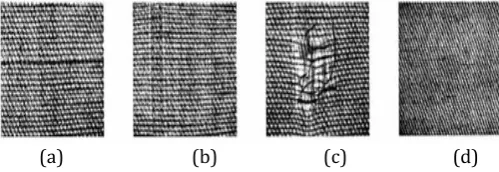
A portion of the textile fabric [5] that has not met the requirement or an attribute of a fabric is said to be a defect which leads to customer dissatisfaction. The fabric quality is affected by yarn quality and loom defects. There are many kinds of fabric defects. Much of them caused by machine malfunctions and has the orientation along pick direction (broken pick yarn or missing pick yarn), they tend to be long and narrow. Other defects are caused by faulty yarns or machine spoils. Slubs are mostly appeared as point defects; machine oil spoils are often along with the direction along the wrap direction and they are wide and irregular. An automated defect detection and identification system enhances the product quality and results in improved productivity to meet both customer needs and to reduce the costs associated with off-quality. Fig. 1 shows some examples of defects in various fabric materials.
(a) (b) (c) (d)
Fig -1: fabric defect samples: (a) double yarn; (b) missing yarn; (c) broken yarn; (d) variation of yarn
3. FABRIC DEFECT INSPECTION METHODS
[image:1.595.309.559.526.612.2]© 2017, IRJET | Impact Factor value: 5.181 | ISO 9001:2008 Certified Journal
| Page 132
3.1 Statistical Approaches
Statistical methods are based on the spatial distribution of gray values [7]. In this method is that the statistics of the defect free regions are stationary and these regions extend over a significant portion of the inspection images. This approach is classified into first order (one pixel), second order (two pixels) and higher order (three or more pixels) statistics based on a number of pixels defining the local features.
3.1.1 Defect Detection using Morphological
operations
Zhang et al. [1] have introduced the morphological approach to detect the defects. It has been reported in recent past that the detection capability is greatly improved by rank-order filtering which is otherwise termed as generalized morphological operations. Mathematical morphology [18] extract useful component is an image for the geometric representation and description of regional shape.
Erosion and dilation are two basic operations in morphological processing for smoothing, sharpening and noise removal. For erosion, the value of the output pixel is the minimum value of the input pixel’s neighborhood. For dilation, the value of the output pixel is the maximum value of the input pixel’s neighborhood. Pixel’s neighborhoods are determined through structure element. It is a matrix consisting of only 0’s and 1’s that can have any arbitrary shape and size. The techniques used in morphological approach are basically nonlinear. The most successful method is an optimal morphological filter designed by Mak et al. [18, 19] for plain and twill fabric defect detection. The method reached accuracies of 97.4% [18] and 94.87% [19] (offline detection). Mak et al. [19] further tested their approach on a real-time inspection with detection accuracy of 96.7%.
3.1.2 Defect Detection using Bi-level Thresholding
To detect high contrast defect gray level thresholding is very simple method. The presence of high contrast defect causes the received signal to rise or fall momentarily, and the resultant peak and trough can be detected by thresholding. Stojanovic et al. [9] have invented a fabric defect detection method that uses thresholding with 86.2% of accuracy, but with 4.3% of false alarm.
3.1.3 Defect Detection using Fractal Dimension
Fractals [20] are proficient and popular to model the statistical qualities like roughness and self-similarity on many natural surfaces. Fractal based methods use more features, both fractal and non-fractal, including fractal matrices [32], higher order fractals [33]. The differential box
counting method [11] used differences in computing non overlapping copies of a set of images and the method gave satisfactory results in all ranges of fractal dimensions. Fractal dimension has many definitions, such as self-similar dimension, box counting dimension, Lyapunov dimension, and correlation dimension etc. in which box counting is most commonly used dimension due to its effectiveness to denote the image surface complexity and irregularity, easy realization by computer, and usefulness for both linear and non-linear fractal images [10]. Conci and Proenca [11] have used to estimate of FD on inspection images to detect fabric defects. They proposed fractal image analysis system using box-counting approach, with an overall detection accuracy of 96%. The approach investigated in [11] is computationally simple but gives very limited experimental results.
3.1.4 Defect Detection using Edge Detection
Edge detection techniques are also very effective in detection of defects. Edges can be detected either as micro edges, using small edge operator masks or as macro edges, using large masks. The distribution of number of edges is the important feature in texture images. In an image point, line and edge defects can be represented using number of gray level transition in an image [6]. These features can be used to detect defects. But this method has also some drawbacks. This approach is only suitable to plain weave fabric images [6]. With these method defects nearby edges are hard to detect.
3.1.5 Defect Detection using Co-occurrence matrix
© 2017, IRJET | Impact Factor value: 5.181 | ISO 9001:2008 Certified Journal
| Page 133
is important. So number of gray values must be reduced tomeet the memory requirements [12]. If the texture features are constructed using large sized primitive than this methods shows poor performance [3]. Two main weaknesses of the CM [7] are poor performance in textures constructed by large sized primitive and intensive computer requirements due to large number of adjacency pixel in calculation.
3.1.6 Defect Detection using Auto-correlation
function
Auto-correlation function measures spatial frequency of image and it gives maxima of that frequency at different locations according to the length of repetitive primitive on image. These maxima will be constant for the primitive that has been perfect throughout the image and different for the primitives that are changed and imperfect in replication. As a result those primitives can be considered as defective [3] for fabric defect detection, Wood [7] utilized a 2D AF to describe the translational and rotational symmetry of an image at plain carpet. However no explicit result was given. This method is mostly used for regular patterned images. It measures regularity and coarseness of pattern. But this method has limitation; it needs reference frame of tonal primitive to carry out analysis of texture.
3.1.7 Defect detection using Eigen Filters
The approaches based on this method are useful in separating pairwise linear dependencies, rather than higher order dependencies, between image pixels. The information content of defect free fabric image can be extracted by registering the variations in an ensemble of macro windows within the image, independent of any judgment of its texture. Unser and Ade [16], [17] used this information to construct eigenfilters for defect detection in textured materials. The appearance based approaches using eigenfilters are highly sensitive to local distortion and background noise, therefore not attractive for online fabric inspection.
3.1.8 Defect Detection using Local Linear
Transforms
To extract local texture properties some popular bidimensional transforms such as Discrete Cosine Transforms (DCT), Discrete Sine Transforms (DST), Discrete Hadamard Transforms (DHT), Karhunen-Loeve transforms (KLT), eigenfiltering can be used. Unser [23] tested different local linear transforms for texture classification and found KLT as the best algorithm. Ade et al. [24] compared law filters, KLT, DCT and DHT for textile defect detection. In their experiments, the KLT performance, particularly on larger window size, was amongst the best. Hadamard transform is primarily defined for sizes, which are in multiples of four [6]. Neubauer [24] has detected fabric defects using texture
energy features from the Laws masks on 10×10 windows of inspection images. In his approach three 5×5 Laws masks corresponding to ripple, edge and weave features [25] are used to extract histogram features from every window of the image. These features are used for the classification of the corresponding window into defect-free of defect class, using a three-layer neural network.
In online fabric inspection, the local transform such as DCT or DST can be directly obtained from the camera hardware using commercially available chips that perform fast and efficient DCT or DST transforms.
3.1.9 Defect Detection using Histogram
Histogram properties include range, mean, harmonic mean, standard deviation, geometric mean, median and variance. These approaches are invariant to translation and rotation, and insensitive to spatial distribution of the color pixels. Due to these features they become ideal for the use in application [26, 27]. Using statistics from local image regions [27, 28], the accuracy of methods based on histograms can be improved. Rank functions and histogram provides exactly same information [6]. Natale [29] has used rank order functions for artificially introduced defects detection in some Brodatz textures [30]. Another method, cumulative histogram for the parquet slab grading is used by H. Kauppines [31]. The texture information about spatial distribution and orientation, etc., is not uniquely determined from the rank order functions [6]. Due to such drawbacks, rank functions or classical histogram analysis is not attractive for further interest for fabric defect detection.
3.1.10 Defect Detection using Local binary pattern
T. Ojala et al. [34] introduced the LBP operator as a shift invariant complementary measure for local image contrast. It uses the gray level of the center pixel of a sliding window as a threshold for surrounding neighborhood pixel. Usually the neighborhood is in circular form and the gray values of the neighbors which do not fall exactly in the center of pixels are estimated by interpolation. Two dimensional distributions of the LBP and local contrast measures are used as texture features.
3.2 Spectral Approaches
© 2017, IRJET | Impact Factor value: 5.181 | ISO 9001:2008 Certified Journal
| Page 134
generalize the spatial placement rules. These techniques arerobust.
3.2.1 Defect Detection using Fourier Transform
To characterize the defects Fourier transform uses frequency domain [3]. Fourier transform is derived from Fourier series [35]. This transform includes the properties like noise immunity, optimal characterization of periodic features and translation invariance. Fourier transform can be categorized in two categories: Discrete Fourier transform and Optical Fourier transform. Tsai and Heish [40] have detected the fabric defects using the combination of DFT and Hough transforms [41]. Chan and G. Pang [36] have given the details of the usage of localized frequency components for the real fabric defect identification. Hoffer et al. [37] has used optical Fourier Transform to identify the defects. Chiu et al. [38] invented Fourier-domain maximum likelihood estimator (FDMLE) has given the significant result which was based on a fractional Brownian motion model for fabric defect detection.
Windowed Fourier transform (WFT) is suggested to localize and analyze the features in spatial and also in frequency domain. Campbell and Murtagh [39] have given the detail about WFT methods to detect the fabric defects.
3.2.2 Defect Detection using Wavelet Transform
Wavelet transform is a multiresolution algorithm and its multiresolution character corresponds to time–frequency multiresolution of human vision [42]. Shu-Guang and Ping-Ge [42] used wavelet transform with BP neural network for plain white fabric. The multiscale wavelet representation has the property of shift invariance and can be used for fabric defect identification. The authors [43] have used lifting wavelet constructed by minimum texture entropy of DB wavelets and lifting scheme and were given the result over 95%. Guan, Yuan and Ke Ma [44] have developed a fabric defect detection system based on wavelet reconstruction with morphological filtering. Scharcanski [45] used the
discrete wavelet transform to classify stochastic texture.
3.2.3 Defect Detection using Gabor filter transform
Gabor filters are a joint or spatial-frequency representation for analyzing textured images. Escofet et al. [47] described the fabric defect detection system based on asset of multi-scale and multi-orientation Gabor filters. Bodnarova et al. [48] invented a fabric defect detection method in which a set of optimal 2D Gabor filters based on Fisher cost function is used. Zhang and Wong [49] applied a system based on 2D Gabor wavelet transform and Elman neural network. In this system, the texture features of the textile fabric are extracted by using an optimal 2D Gabor filter. The recognition rate was 100%. Shu and Tan [46] proposed an algorithm based on
multichannel and multiscale Gabor filtering. It was based on the energy response from the convolution of Gabor filter banks in different frequency and orientation domains. The imaginary part of Gabor filter is odd symmetric, which is used to derive edge detectors [50] and the real part is even symmetric which is used to derive blob detectors [51].
3.3 Model-Based approaches
Texture can be defined by a stochastic or a deterministic model [6]. Model-based approaches are suitable for fabric images with stochastic surface variation. Autoregressive (AR) model belongs to 1-D class of stochastic modeling. Serafim [52, 53] applied a 2D AR model for texture representation. For real time defect detection a 1D AR model is used in [54]. Cohen et al. [55] used Gaussian Markov Random Field (GMRF) to model defect free texture of fabric images, whose parameters are estimated from the training samples observed at a given orientation and scale. Campbell et al. [8] proposed model-based clustering to detect the defects on denim fabric. Kong et al. [56] have applied a new color-clustering scheme for the detection of defects on colored random textured images.
4. CONCLUSION
To ensure the quality level, 100% automated visual inspection is necessary to be performed.In this paper a brief review of the of the automated fabric defect detection approaches is given with about 56 references. These techniques are categorized into three approaches: statistical, spectral and model-based.As the work is vast and diverse, the classifications for the automated fabric inspection approaches are improved. The fundamental ideas of these approaches with their disadvantages were discussed whenever known. To understand the formation and nature of the defects, it is important to be able to accurately localize the defective regions. Unfortunately, with these large numbers of implemented approaches, the perfect approach does not exist yet as each of them have some advantages and disadvantages. The combination of the approaches can give the better results than individually.
REFERENCES
[1] ZhangYF, Bresee RR, “Fabric defect detection and classification using image analysis.” Journal of Textile research,1995, 65(1):1-9.
[2] K.Shrinivasan, P. H. Dastoor, P. Radhakrishnaiah, and S. Jayaraman, “FDAS: A knowledge-based framework for analysis pf defects in woven textile structures”, J. Textile inst., pt. 1, vol. 83, no.3,pp.431-448,1992
© 2017, IRJET | Impact Factor value: 5.181 | ISO 9001:2008 Certified Journal
| Page 135
[4] Nickoloy B. N. and Schmalfub H. (1993) MellindTextilberichte, vol. 73,33-37.
[5] Arivazhagan S., Ganesan L. and Bama S. (2006), “Fault segmentation in fabric images using Gabor wavelet transform”, International Journal of Machine Vision and Appications, Vol. 16, No.6, pp. 356-363
[6] Kumar, “Computer-vision based fabric defect detection:A survay.”, IEEE transactions on Industrial Electronics, vol.55,no.1, pp. 348-363, Jan.2008.
[7] R. M. Haralick, “Stastical and Structural Approaches to texture,” Proc. IEEE, vol. 67, pp. 786-804, 1979.
[8] J. G. Campbell, C. Fraley, F. Murtagh and A. E. Raftery, “Linear flaw detection in woven textiles using model-based clustering,” Dept. Statistics, Univ. Washington, seattle, WA, Tech. Rep. 314, Jul. 1996, pp. 1-15.
[9] R. Stojanovic, P. Mitropuos, C. Koulamas, Y. Karayiannis, S. Koubias and G. Apadopoulos, “Real-time vision-based system for textile fabric inspection,” Real-Time Imaging, vol. 7, no. 6, pp. 507-518, Dec. 2011
[10]K.H.Sager, Fractal Bsaed Classification for color Textural Images, Unpublished doctorate Thesid, university of Baghdad, 2006
[11]A. Conci and C. B. Proenca, “A fractal image analysis system for fabric inspection based on box-counting method,” Comput. Netw. IsDN syst., vol. 30, no. 20, pp. 1887-1895, Nov.1998.
[12]Xianghua Xie, “A Review of Recent Advances in Surface Defect Detection using Texture Analysis Techniques,” Dept. of computer Science, University of Wales Swansea SA2 8PP, United Kingdom, Electonic letters on Computer Vision and Image Analysis 7(3):1-22, 2008
[13]R. M. Harlick, K. Shanmugam and I. Dinstein, “Textural features for image calssification,” IEEE Trans Syst., Man, Cybern., vol.3, no. 6, pp. 610-621
[14]R.W Conners, C. W. McMillan, K. Lin and R. E. Vasquez-Espinosa, “Identifying and locating surface defects in wood: part of an automated lumber processing system,” IEEE trans. Pattern Anal. Mach. Intell., vol. PAMI-5, no. 6,pp. 573-583, Nov. 1983.
[15]R. N. U. Rosler, “Defect Detection in Fabrics by Image Processing,” Melliand-Text.ber., vol. 73, p. E292,1992.
[16]M. U ser and F. Ade, “Featuer exyraction and decision procedure for automated inspection of textured materials,” Pattern Recognit. Lett., vol. 2, no. 3, pp. 181-191, Mar. 1984.
[17]F. Ade, “Application of pricipal component analysis to the inspection of industrial goods,” Proc. SPIE, vol. 397, pp. 216-223, 1983.
[18]K. L. Mak, P. Peng, H. Y. K. Lau, “Optimal morphological filter Design for Fabric Defect Detection,” IEEE Int’I Conf. Industry Technology (ICIT2005), 14-17,Dec. 2005, pp. 799-804
[19]K. L. Mak, P. Peng, K. F. C. Yiu, “Fabric defect detection using morphological filters,” Image and vision computing 27 (10) (2009)
[20]C. H. Chen, L. F. Pau, P. S. P. Wang, Handbook of pattern RECognition and computer vision, @nd ed. World Scientific Publishing Co., 1993.
[21]A. Latif-Amet, A. Ertuzun, A. Ercil, “Texture defect detection using subband domainCo-occurrence matrices,” IEEE Southwest Sym. On Image Analysis and Interpretation, 5-7Apr 1998, pp. 205-208.
[22]A. Latif-Amet, A. Ertuzun, A. Ercil, “An efficient method for texutre defect detection: sub-band domain co-occurrence matrices,” Image and vision computing 18 (2000) 543-553.
[23]Unser M. (1986) signal Processing, 11, 61-79.
[24]C. Neubauer, “segmentation of defects in textile fabric,” in Proc. 11th Int. Conf. Pattern Recog., The Hague, The
Netherlands, Aug. 1992, pp. 688-691.
[25]E. R. Devies, Machine vision: Theory, Algorithms, and Practicalities, 2nd ed. New York: Academic, 1997, pp.
569-572.
[26]C. Boukouvalas, J. Kittler, R. Marik, and M Peyrou, “Color grading of randomly textured ceramic tiles using color histograms,” IEEE Transactions on Industry Electronics, 46(1):219-226,1999.
[27]R. Broadhurst, J. Stough, S. Pizer, and E. Chaney, “Histogram Statistics of local image regions for object segmentation,” In International Workshop on Deep Structure, Singularities, and Computer vision, 2005.
[28]X. Xie, M. Mirmehdi, and B. Thomas, “Color Tonality inspection using Eigenspac features,” Machine Vision and Appliactions, 16(6):364-373, 2006.
[29]F. G. B. De Natale, “Rank-Order functions for the fast dtection of texture faults,” Int. J. Pattern Recogn. Artif. Intell., vol. 10, no. 8, pp. 971-984, 1986.
© 2017, IRJET | Impact Factor value: 5.181 | ISO 9001:2008 Certified Journal
| Page 136
[31]H. Kauppinen, “Atwo stage defect recognition methodfor parquet slab grading,” in Proc. IEEE Conf. Pattern Recog., Barcelona, Spain, 2000, vol. 4, pp.803-806.
[32]F1. Kaneko, “A generalized fractal dimension and its application to texture analysis,” ICASSP Proc., 1711-1714 (1989)
[33]A. Ait-Kheddache and S. A. Rajal, “Texture classification based on higher-order fractals,” ICASSP Proc., 1112-I I IS (198X)
[34]T. Ojala, M. Pietikainen, and D. Harwood, “A comparitive study of texture measures with classification based on featured distribution,” Pattern recognition, 29(1):51-59, 1996.
[35]Mathworld, http://mathworld.wolfram.com/Fourier Series.html2010
[36]C. H. Chan and G. Pang, “Fabric defect detection by Fourier analysis,” IEEE Trans. Ind> Appl., vol. 36, no. 5, pp. 1267-1276, sep./oct. 2000.
[37]L. M. Hoffer, F. Francini, B. Tiribilli, G. Longobardi, “Neural network for the optical recognition of defects in cloth,” Optical Engineering 35 (11) (Nov 1996) 3183-3190.
[38]S. H. Chiu, S. Chou, J. J. Liaw, “Textural defect segmentation using a Fourier-domain maximum likelihood estimation method,” Textile Resarch Journal 72 (3) (2002) 253-258.
[39]J. G. Campbell and F. MUrtagh, “Automatic visual inspection of eoven textiles using a two-stage defect detector,” Opt. Eng., vol. 37, no.9, pp. 2536-2542, Sep. 1998.
[40]D. M. Tsai and C. Y. Heish, “Automated surface inspection for directional textures,” Image Vis. Comput., vol. 18, no. 1, pp. 49-62, Dec 1999.
[41]K. J. Choi, Y. H. Lee, J. W. Moon, C. K. Park and F. Harashima, “Development of an automatic stencl inspection system using modified Hough transform and Fuzzy logic,” IEEE Trans. Ind. Electron., vol. 54, no. 1, pp. 604-611, Feb. 2007.
[42]Liu shu-guang, Qu Ping-Ge, “A computer vision approach for fabric defect inspection”
[43]Shengqi Guan, Xiuhu Shi, Haiying Cui, Yuqin Song, “Fabric defect detection based on wavelet characteristics,” IEEE Pacific-Asia workshop on computational intelligence and industrial application, 2008.
[44]Shengqi Guan, Jianchan,.g Yuan, Ke Ma, “Fabric defect detection based on wavelet reconstruction”
[45]Scharcanski J. (2005) Pattern Recognition letters, 26, 1701-1709.
[46]Yuan Shu, Zheng Tan, “Fabric defects automatic detection using Gabor Filters ,” 5th World Congress on
Intelligent Control and Automation, June 2004, 15-19.
[47]Escofet J. , Navarro R., Millan M. S., Pladelloreans J., “Detection of local defects in textile webs using Gabor filters,” Opt. Eng 1998; 37:2297-307
[48] A. Bodnarova, M. Bennamoun, S. Latham, “Optimal Gabor filter for textile flaw detection,” Pattern recognition 35(2002) 2973-2991.
[49]Y.H. Zhang, C.W.M. Yuen, W. K. Wong, “A new intelligent fabric defect detection and classification system based on Gabor filter and modified Elman Neural Network,” IEEE 2010
[50]Mehrotra R., Namuduri KR, Ranganathan N., “Gabor filter based edge detection,” Pattern Recogn 1992; 25(12):3176-90
[51]Casasent D., Smokelin JS, “Neural net design of macro Gabor wavelet filters for distortion-invariant object detection inclutter,” Opt Eng 1994;33(7):2264-71
[52]A. F. Limas Serafim, “Multiresolution Pyramids for segmetation of natural images based on autoregressive Models”, applicatoin to calf Leather Classification, Proc. IEEE Int’l Conf. Industrial Electronics, Control and Instrumentation (IECON’91), vol. 3, 28 Oct-1 Nov 1991, pp. 1842-1847.
[53]A. F. Limas Serafim, “Segmetation of natural images based on Multiresolution Pyramids Linking of the Parameters of an Autoregressive rotation invariant model,” Proc. IEEE 11th IAPR Int’l Conf. Pattern
Recognition, Conference C: Image, Speech & Signal Analysis, vol. 3, 1992, pp. 41-44
[54]S. H. hajimowlana, R. Muscedere, G. A. Jullien, J. W. Roberts, “1D Autoregressive Modeling fo defect detection in Web Inspection Systems, Proc. IEEE MWSCAS, 9-12 Aug 1998, pp. 318-321.
[55]F. S. CohenZ. G> Fn, S. Attali, “Automated inspection of textile fabric using textural models,” IEEE Trans. Pattern Analysis & Machine Intelligence 13 (8) (Aug 1991) 803-808.