Substring-Searchable Symmetric Encryption
Melissa Chase Microsoft Research [email protected]
Emily Shen
MIT Lincoln Laboratory∗ [email protected] June 18, 2015
Abstract
In this paper, we consider a setting where a client wants to outsource storage of a large amount of private data and then perform substring search queries on the data – given a data stringsand a search stringp, find all occurrences ofpas a substring ofs. First, we formalize an encryption paradigm that we callqueryable encryption, which generalizes searchable symmetric encryption (SSE) and structured encryption. Then, we construct a queryable encryption scheme for substring queries. Our construction uses suffix trees and achieves asymptotic efficiency comparable to that of unencrypted suffix trees. Encryption of a string of lengthntakesO(λn) time and produces a ciphertext of size O(λn), and querying for a substring of length m that occursktimes takesO(λm+k) time and three rounds of communication, whereλis the security parameter. Our security definition guarantees correctness of query results and privacy of data and queries against a malicious, adaptive adversary. Following the line of work started by Curtmola et al. (ACM CCS 2006), in order to construct more efficient schemes we allow the query protocol to leak some limited information that is captured precisely in the definition. We prove security of our substring-searchable encryption scheme against malicious adversaries, where the query protocol leaks limited information about memory access patterns through the suffix tree of the encrypted string.
1
Introduction
In traditional symmetric-key encryption schemes, a user encrypts a message so that only the owner of the corresponding secret key can decrypt it. Decryption is “all-or-nothing”; that is, with the key one can decrypt the message completely, and without the key one learns nothing about the message. However, many settings such as cloud storage call for encryption schemes that support the evaluation of certain classes of queries on the data without decrypting the data. A client may wish to store encrypted data on a cloud server and then be able to issue queries on the data to the server in order to make use of the data without retrieving and decrypting the original ciphertext.
Much work has been done on searchable symmetric encryption (SSE), which considers the set-ting where the data consists of a set of documents that the client wishes to search for combinations of keywords. However, we are interested in applications where one wants to search not for predeter-mined keywords but for arbitrary substrings. For example, suppose a medical research lab wants to store subjects’ genomic data using a cloud storage service. Privacy concerns may require that this
∗
data be encrypted. At the same time, the researchers need to be able to use the data efficiently. Re-searchers may be interested in making substring queries on the genomic data to determine whether a particular cancer marker sequence appears in any of the data or to count whether a certain probe sequence is rare enough to be useful. In addition to protecting the privacy of the data from the cloud provider, researchers would like to ensure that the process of performing queries does not reveal information to the cloud about the queries or the original data.
We note that existing SSE techniques do not solve the substring search problem efficiently; applying SSE by considering every substring of the original string as a separate keyword results in O(n2) storage for a string of lengthn. Our goal is to avoid this storage overhead and achieve ˜O(n) storage (as one would have in the unencrypted scenario).
Queryable encryption In this paper, we first definequeryable encryption, which generalizes the SSE and structured encryption paradigms. A queryable encryption scheme allows for evaluation of some query functionality F that takes as input a message M and a query q and outputs an answer. A client encrypts a message M under a secret key and stores the ciphertext on a server. Then, using the secret key, the client can issue a queryq by executing an interactive protocol with the server. At the end of this protocol, the client learns the value of F(M, q). For example, for substring search queries, a query q is a search string, the message M is a string, and F(M, q) returns the set of indices of all occurrences of q as a substring ofM.
Substring-searchable encryption We give a construction for a queryable encryption scheme
for substring search queries – given a stringsand a search stringp, return all occurrences ofpas a substring ofs. Our construction has asymptotic efficiency comparable to that of substring search on unencrypted data.
We note that general techniques such as fully homomorphic encryption [25, 10, 9, 27] and functional encryption [7, 35, 42] would not achieve our efficiency goals. Instead, we tailor our scheme to the specific functionality of substring search.
To construct a substring-searchable encryption scheme, we use suffix trees, a data structure used to efficiently perform substring search on unencrypted data. We combine basic symmetric-key primitives to develop a method that allows traversal of select edges in a suffix tree in order to efficiently perform substring search on encrypted data, without revealing significant information about the string or the queries.
A suffix tree for a data string of length ntakes O(nlogn) space, and searching for a substring of length m takes O(m+k) time, where k is the number of occurrences of the substring. In our substring-searchable encryption scheme, encryption time and ciphertext size are O(λn), and querying for a substring takes time and communication complexity O(λm+k), where λ is the security parameter. The query protocol takes a constant number of rounds of communication. All operations are based only on symmetric-key primitives.
Security We prove security of our scheme against malicious adversaries. For security, we will
to be revealed (“leaked”) to the server through the ciphertext and the query protocol. Our se-curity definition specifies explicitly what information is leaked and guarantees that an adversary learns nothing more than the specified leakage. This approach of trading off perfect privacy for efficiency has been adopted previously in the case of structured encryption [13] and in recent work on searchable encryption variants [12].
Our definition is similar to previous definitions for structured encryption and SSE. However, while previous definitions focused on document retrieval and the adversary had to learn the list of documents returned, in our definition there are no documents and all that is required is that the client learn the result of the query. Furthermore, most previous definitions have focused on honest-but-curious adversaries. We define security within a malicious adversary model.
2
Related Work
Searchable encryption and structured encryption We draw on related work on symmetric
searchable encryption (SSE) [16] and its generalization to structured encryption [13]. These works take the approach of considering a specific type of query and identifying a data structure that allows efficient evaluation of those queries in an unencrypted setting. The construction then “translates” the data structure into an encrypted setting, so that the user can encrypt the data structure and send the server atoken to evaluate a query on the encrypted structure. This translation is designed to preserve the efficiency of the unencrypted data structure.
Since the server is processing the query, the server can determine the memory access pattern of the queries, that is, which parts of memory have been accessed, and when the same memory block is accessed again.1 The approach to security in SSE and structured encryption is to acknowledge that some information will be leaked because of the memory access pattern, but to clearly specify the leakage and to guarantee that is the only information that the server can learn.
There have been many recent advances in SSE. Cash et al. [12] propose an efficient construction for searches involving multiple keywords. Several works [11, 43, 30, 31] propose schemes that allow updates to the stored documents, and Kurosawa and Ohtaki [38] propose a UC definition. However, all of these works focus on the problem of retrieving documents based on keywords; there has been very little work that considers encrypting more complex types of data structures.
Predicate encryption and fully homomorphic encryption Predicate encryption (a special
case of functional encryption [7]) allows the secret key owner to generate tokens for various predi-cates. One can evaluate a token for a predicatef on an encryption ofmto determine whetherf(m) is satisfied. State-of-the-art predicate encryption schemes (e.g., [35, 42]) support inner-product queries; that is, f specifies a vector v, and f(m) = 1 if hm, vi = 0. Applying an inner product predicate encryption scheme naively to construct a substring-searchable encryption scheme, where the substrings can be of any length, would result in ciphertexts and query time that are O(nn),
wheren is the length of the string s, which is clearly impractical.
Fully homomorphic encryption (FHE), beginning with the breakthrough work of Gentry [25] and further developed in subsequent work, e.g., [10, 9, 26], allows one to evaluate any arbitrary circuit on encrypted data without being able to decrypt. FHE would solve the substring-searchable
1Note that this is true even if we use fully homomorphic encryption (e.g., [25, 10, 9, 27]) or functional encryption [7,
encryption problem (although it would require O(n) query time), but existing constructions are extremely impractical.
Oblivious RAMs The problem of leaking the memory access pattern is addressed in the work
on oblivious RAMs [41], which shows how to implement any query in a way that ensures that the memory access pattern is independent of the query. There has been significant process in making oblivious RAMs more efficient; however, even the most efficient constructions to date (see, e.g., Stefanov et al. [44]) increase the amortized costs of processing a query by a factor of at least logn, where n is the size of the stored data. In our setting, where we assume that the large size of the dataset may be one of the primary motivations for outsourcing storage, a logn overhead may be unacceptable.
Secure two-party computation of substring search There have been several works on secure
two-party or multiparty computation (e.g., [17, 40]) and specifically on secure substring search and other text processing in the two-party setting (see [3, 39, 29, 24, 34, 22, 46]). This is an interesting line of work; however, our setting is rather different. In our setting, the client has outsourced storage of its encrypted data to a server, and then the client would like to query its data with a search string. The server does not have the data string in the clear; it is encrypted. Thus, even ignoring the extra rounds of communication, we cannot directly apply secure two-party substring search protocols.
Memory delegation and integrity checking We consider security against malicious
adver-saries. One way a malicious adversary may misbehave is by returning something other than what was originally stored on the server. Along these lines, there is related work on memory delegation (e.g., [14]) and memory checking (e.g., [18]), verifiable computation (e.g., [6, 23]), integrity check-ing (e.g., [45]), and encrypted computation on untrusted programs (e.g., [21]); the theme of these works is retrieving and computing on data stored on an untrusted server. For our purposes, since we focus on the specific functionality of substring-searchable encryption in order to achieve an effi-cient scheme using simple primitives, we do not need general purpose integrity checking techniques, which can be expensive or rely on more complex assumptions.
3
Preliminaries
In this section, we review notation and definitions of the data structures and cryptographic primi-tives we will use. For formal definitions of the cryptographic primiprimi-tives, we refer the reader to [33].
3.1 Notation
We write x←R X to denote an elementx being sampled uniformly at random from a finite set X, and x←Ato denote the output x of an algorithm A.
Ifxis a string, then|x|refers to the length ofx, andxi denotes theith character ofx. If|x|=n
and aand b are integers 1≤a≤b≤n, thenx[a..b] denotes the substring xa. . . xb. Ifx and y are
If F :K ×D→ R is a family of functions, we write FK for the function defined by FK(x) =
F(K, x). We sometimes writeEncK(m) and DecK(c) for Enc(K, m) and Dec(K, c), respectively.
3.2 Data Structures
A dictionaryDis a data structure that contains key/value pairs. For our construction it is sufficient for a dictionary to support insert and lookup operations. The insert operation takes a key/value pair (k, v) and adds it to the dictionary. The lookup operation takes a key k and returns the associated valuev=D[k].
3.3 Symmetric-Key Encryption
A symmetric encryption scheme Π = (Gen,Enc,Dec) consists of three polynomial-time algorithms. Genis a probabilistic algorithm that takes a security parameterλand outputs a secret keyK. Enc is a probabilistic algorithm takes a keyK and a messageM and outputs a ciphertextCT. Decis a deterministic algorithm that takes a key K and a ciphertextCT and outputs a messageM or the symbol⊥. Correctness requires Dec(K,Enc(K, M)) =M with probability 1 for all K and M.
We use the following security notions for symmetric encryption.
• CPA security requires that ciphertexts reveal no information about plaintexts (other than length) to a PPT adversary that can adaptively query an encryption oracle.
• Ciphertext integrity [5, 36, 4] requires that it be infeasible for any PPT adversary given access to an encryption oracle to construct a new ciphertext that decrypts successfully. A symmetric encryption scheme is authenticated if it has both CPA security and ciphertext integrity. • Key hiding (also known as which-key concealing) [20, 1] requires that it be infeasible for any
PPT adversary given access to two encryption oracles to tell whether they encrypt using the same key or different keys.
3.4 Pseudorandom Functions and Permutations
A pseudorandom function family (PRF) (respectively, pseudorandom permutation family (PRP)) is a familyF of functions such that it is computationally infeasible for any PPT adversary to distin-guish a function chosen randomly fromF from a uniformly random function (resp., permutation). An almost-universal hash function is a family H of hash functions such that for any pair of distinct messages the probability of a hash collision for a hash function chosen randomly from H is negligible.
A PRF composed with an almost-universal hash function results in another PRF. That is, one can evaluate a PRF on a long input by first hashing it using an almost-universal hash function to a short input and then applying a PRF.
4
Queryable Encryption
4.1 Functionality
Definition 4.1. Aqueryable encryption schemesupporting query functionalityF :M×Q → Rfor
message spaceM, query spaceQ, and result spaceRconsists of three probabilistic polynomial-time algorithms.
Gen(1λ)→K: The key generation algorithm takes a security parameter λand generates a secret keyK.
Enc(K, M) → CT: The encryption algorithm takes a secret key K and a message M ∈ M, and outputs a ciphertextCT.
Query(K, q, CT) : The interactive query protocol occurs between a client and a server. The client’s input is the secret keyK and a queryq ∈ Q, and the server’s input is a ciphertextCT. The client’s output is a query result r∈ R; the server has no output.
For correctness we require the following property. For all λ ∈ N, q ∈ Q, M ∈ M, let K ←
Gen(1λ), CT ←Enc(K, M), andr←Query(K, q, CT). Then Pr[r=F(M, q)] = 1−negl(λ).
Substring-searchable symmetric encryption We define substring-searchable encryption as a
special case of queryable encryption.
Definition 4.2. A substring-searchable symmetric encryption scheme for an alphabet Σ is a
queryable encryption scheme for message space M = Σ∗, query space Q = Σ∗, result space R = P(N), and query functionality F, where F(s, p) is the set of indices of all the occurrences
of pas a substring of s. That is, F(s, p) ={i|s[i..i+m−1] =p}, wherem=|p|.
Discussion Note that the definition of a queryable encryption scheme does not include an explicit decryption algorithm. If full decryption is desired, one can include a query in F that returns the entire message.
Note also that typically we expect M to be quite large, while the representation of q and F(M, q) are small, so we would like the query protocol to be efficient relative to the size ofq and F(M, q). Without such efficiency goals, designing a queryable encryption scheme would be trivial: the server could return the entire ciphertext, and the client could decrypt the ciphertext to getM and computeF(M, q) directly.
Related definitions Our queryable encryption definition can be viewed as a generalization of
previous definitions of searchable encryption [16] and structured encryption [13]. Queryable en-cryption allows any general functionalityF. In contrast, the definition of searchable encryption is tied to the specific functionality of returning documents containing a requested keyword. Struc-tured encryption is a generalization of searchable encryption, but the functionalities are restricted to return pointers to elements of an encrypted data structure.
documents in the SSE case, or a (set of) very long string(s) of data (e.g., a genome database) as in this work.2
Also, in queryable encryption we allow the query protocol to be interactive. In structured encryption, functional encryption, and many searchable encryption schemes the query protocol consists of two algorithms T K ← Token(K, q) and A ← Query(T K, CT). The client constructs a query token and sends it to the server, and the server uses the token and the ciphertext to compute the answer to the query, which it sends back to the client. We can think of these schemes as having a one-round interactive query protocol. Our more general definition allows for arbitrary interactive protocols, which may enable better efficiency or privacy.
Finally, in contrast to related searchable encryption notions, we do not require the server to actually learn the answer to the query. After the server’s final message, the client may do some additional computation using its secret key to compute the answer. This can allow stronger privacy guarantees against the server.
4.2 Malicious (L1,L2)-CQA2 Security
We now present our simulation-based security definition against malicious adversaries. Follow-ing [13], we call the definition (L1,L2)-CQA2 security, where the name “CQA2” comes from “cho-sen query attack” because the adversary chooses its queries adaptively. The security definition will be parameterized by two leakage functions L1 and L2. First, L1(M) denotes the information
about the message that is leaked by the ciphertext. Second, for any j, L2(M, q1, . . . , qj) denotes
the information about the message and all queries made so far that is leaked by thejth query. We want to ensure that the information specified by L1 and L2 is the only information that is
leaked to the adversary, even if the adversary can choose the message that is encrypted and then adaptively choose the queries for which it executes a query protocol with the client. To capture this, our security definition requires that the view of any adaptive adversary be simulatable given only the information specified by L1 and L2.
Our definition differs from many previous definitions in that we allow the adversary to be arbitrarily malicious in the protocol. Since our protocol is interactive, this guarantee is important for privacy as well as correctness. We require that the adversary cannot distinguish the honest player’s output from the correct output (or ⊥if the adversary misbehaved in the protocol). This means the honest protocol must always produce the correct output (or ⊥) even in the face of a malicious adversary; thus this definition captures both privacy and correctness.
Definition 4.3 (Malicious (L1,L2)-CQA2 security). Let E = (Gen,Enc,Query) be a queryable
encryption scheme for message space M, query space Q, result space R, and query functionality F :M × Q → R. For functions L1 and L2, adversary A, and simulatorS, consider the following experiments:
RealE,A(λ): The challenger begins by runningGen(1λ) to generate a secret keyK. The adversary
A outputs a message M. The challenger runs Enc(K, M) to generate a ciphertext CT, and sends CT toA. The adversary adaptively makes a polynomial number of queries q1, . . . , qt.
For each query qi, first A interacts with the challenger. The challenger plays the part of the
client in theQueryprotocol with input (K, qi) and sends its output to the adversary. Finally,
Aoutputs a bit b.
2
IdealE,A,S(λ): First,Aoutputs a messageM. The simulatorSis givenL1(M), and outputs a value
CT. The adversary adaptively makes a polynomial number of queries q1, . . . , qt. For each
query qi, the simulator is given L2(M, q1, . . . , qi) and interacts with A. Then the simulator
produces a flag fi; if fi = ⊥, the challenger sends ⊥ to the adversary, otherwise it sends
F(M, qi). Finally,A outputs a bitb.
We say thatE is (L1,L2)-CQA2 secure against malicious adversaries if, for all PPT adversariesA, there exists a simulatorS such that
|Pr[RealE,A(λ) = 1]−Pr[IdealE,A,S(λ) = 1]| ≤negl(λ)
5
Substring-Searchable Encryption Construction
In this section, we construct a substring-searchable encryption scheme – a queryable encryption scheme that supports the functionalityF, whereF(s, p) returns the indices of all occurrences of p as a substring ofs.
5.1 Suffix Trees
Our scheme draws upon substring search algorithms for unencrypted data. Several substring search algorithms exist [37, 8, 32, 2], varying in their preprocessing efficiency and query efficiency. Many algorithms have preprocessing timeO(m) and query timeO(n), wherenis the length of the strings andmis the length of the query substringp. In contrast, suffix trees [47, 19, 28] have preprocessing time O(n) and query time O(m). This is ideal for our applications, where the client stores one string or set of strings on the server, and later performs queries for many search strings. Therefore, we will focus on substring search using suffix trees as the basis for our scheme.
Here we give a brief overview of suffix trees. We follow the terminology of [28].
Definition 5.1. A suffix tree for a string s=s1. . . snis a rooted, directed tree with the following
properties:
• Each edge is labeled with a non-empty substring of s, called its edge label. • Every internal node has at least two children.
• No two edges out of a node have edge labels starting with the same character.
• The tree has n leaves, labeled 1 to n. These are in one-to-one correspondence with the n suffixes to s. Specifically, for each i, the suffix s[i..n] is the concatenation of the edge labels on the path from the root to the leaf labeledi.
Definition 5.2. The path label of a node is the concatenation of the edge labels on the path from the root to that node.
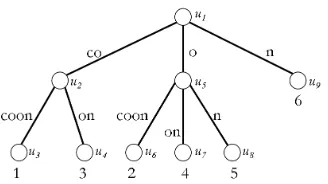
Figure 1 shows a suffix tree for the string “cocoon”.
Figure 1: A suffix tree for the string s =“cocoon”. The six suffixes of “cocoon” correspond to the paths from the root to the six leaves. Each leaf is labeled with the position in s where the corresponding suffix begins. Additionally, the nodes have arbitrary labels that are provided for future reference.
Substring search procedure Searching for a substring using a suffix tree relies on the following key observation: a stringp is a substring of sif and only if it is a prefix of some suffix of s. Thus, to search for pin s, we look for a path from the root whose label matches p.
To do this, match the characters of p sequentially with a path from the root. Since no two edges out of a node start with the same character, this path is unique. Specifically, at each node on the path, find the outgoing edge whose label starts with the next character of p(if one exists) and continue matching along that edge. Continue until either the next character of p does not match, meaning p is not a substring of s, or all ofp has been matched, meaning p is a substring of s. If p is a substring of s, the indices of the occurrences of p as a substring of sare exactly the indices labeling the leaves in the subtree below the end of the matching path.
Efficiency A suffix tree can be constructed in O(n) time for a string of length n[47, 19]. It can be shown that a suffix tree has at most 2n nodes. However, storing the edge label for all edges would require O(n2) storage in the worst case. To represent a suffix tree in O(nlogn) space, one stores for each edge the start and end indices in s of the first occurrence of the edge label as a string ofs, along with a copy of the strings.
Searching for a substringpof lengthmtakesO(m) time to find a single occurrence, orO(m+k) time to find all occurrences, where kis the number of occurrences.
Observations We make a few observations that will be useful for our construction. We can
identify with each nodeu an initial path label, which is the concatenation of the path label of the parent of u and the first character of the edge label from the parent to u. Note that if a string p matches the initial path label of a nodeuand ifpis a substring ofs, then eitherp’s matching path ends somewhere along the edge to u, or it ends somewhere in the subtree rooted at u. Note also that the indices insof occurrences of a node’s path label are exactly the indices of the occurrences of the node’s initial path label.
5.2 Notation
Before we describe our substring-searchable encryption scheme, we introduce some notation. Some of the notation will be relative to a string s and its suffix tree Trees, even though they are not
u: a node inTrees
: the empty string
path(u): the path label of u, i.e., the concate-nation of the edge labels on the path from the root to u. If u is the root, path(u) =.
initpath(u): the initial path label ofu, i.e., the con-catenation of the path label ofu’s par-ent and the first character of the edge label fromu’s parent to u. Ifu is the root,initpath(u) =.
leafi: theith leaf in Trees, where the leaves
are numbered left to right len(u): the length of initpath(u)
ind(u): the index insof the first occurrence of path(u) (equivalently, of initpath(u)). Ifpath(u) =,ind(u) = 0.
leafpos(u): the position (between 1 and n) in the tree of the leftmost leaf in the subtree rooted atu.
num(u): the number of occurrences in s of path(u) (equivalently, of initpath(u)) as a substring. If path(u) = , num(u) = 0. For non-root nodes u, num(u) is equal to the number of leaves in the subtree rooted atu.
To illustrate the notation above, let us look at
the suffix tree in Figure 1 for the string “cocoon”. In this tree, we havepath(u3) = “cocoon”,initpath(u3) =
“coc”,leaf3 =u6,ind(u2) = 1,leafpos(u5) = 3,num(u2) = 2.
5.3 Intuition
Here we provide some intuition and work our way up to the full construction.
We will use a symmetric encryption scheme Π, a PRF F, and a PRP P. The key generation algorithm will generate keys KD,KC,KL for Π, keys K1, K2 for the PRF, and keys K3, K4 for the
PRP. We will explain how the keys are used as we develop the intuition for the construction.
A first attempt We first aim to construct a queryable encryption scheme for a simpler
func-tionality F0, where F0(s, p) returns whether p occurs as a substring in s, and, if so, the index of the first occurrence in s of p. We will also only consider correctness and security against an honest-but-curious server, that is, a server that follows the protocol honestly.
Let Π be a CPA-secure symmetric encryption scheme. We will encrypt a string s=s1. . . snin
the following way. First, construct a suffix tree Trees for s. Then construct a dictionary D that
contains, for each node u, the key/value pair (FK1(path(u)),Π.EncKD(ind(u)). This dictionary is
In the query protocol for a string p, the client sends FK1(p). The server then looks up FK1(p)
in the dictionary. If there is a corresponding value, the server returns it to the client. The client then decrypts usingKD to get the index of the first occurrence insof p.
The problem with this approach is that it only works for search strings that fully match a node’s path label (i.e., end exactly at a node); it does not work for finding substrings that end partway down an edge.
Returning a possible match To address this problem, we will identify each node with its initial path label instead of its path label. Note that if u is the last node (farthest from the root) for which any prefix ofp equalsinitpath(u), then either pis not a substring of s, orpends somewhere on the path tou, and the indices insof the occurrences ofinitpath(u) are the same as the indices of the occurrences ofp.
In the dictionary D, we will now useinitpath(u) instead ofpath(u) as the search key for a node u. We will say that a prefixp[1..i] is amatching prefix ifp[1..i] =initpath(u) for someu; otherwise, we say p[1..i] is a non-matching prefix. The ciphertext will also include an array C of encryptions of each character of s, withC[i] = Π.EncKC(si).
In the query protocol, the client will send T1, . . . , Tm, where Ti = FK1(p[1..i]). The server
finds the entry D[Tj], wherep[1..j] is the longest matching prefix of p. The server will return the
encrypted index Π.EncKD(ind) stored inD[Tj]. The client will then decrypt it to getind, the index of
the first occurrence of the possible match, and requests the server to sendC[ind], . . . , C[ind+m−1]. The client then decrypts the result to check whether the decrypted string is equal to the search string pand thus, whetherp is a substring of s.
Returning all occurrences We would like to return not just the first occurrence or a constant
number of occurrences, but all of the occurrences of the search string. However, in order to keep the ciphertext size O(n), we need the storage for each node to remain a constant size. In a naive approach, in each dictionary entry we would store encryptions of indices of all of the occurrences of the corresponding string. However, this would takeO(n2) storage in the worst case.
To maintain constant storage for each node, we use the fact that the occurrences of a node’s path label (or initial path label) as a substring of sare exactly the occurrences of the path labels of the leaves in the subtree rooted at that node, each of which is a suffix of s.
We construct a leaf array L of size n, with the leaves numbered 1 to n from left to right. Each element L[i] stores an encryption of the index ins of the path label of theith leaf. That is, L[i] = Π.EncKL(ind(leafi)). In the encrypted tuple in the dictionary entry for a nodeuwe also store leafpos(u), the position in the tree of the leftmost leaf in the subtree rooted atu, andnum(u), the number of leaves in the subtree rooted at u. That is, the value in the dictionary entry for a node u is now Π.EncKD(ind(u),leafpos(u),num(u)) instead of Π.EncKD(ind(u)).
In the query protocol, the server will return the encryption ofind(u),leafpos(u),num(u) for the last nodeumatched by a prefix ofp. The client then decrypts this and asks forC[ind], . . . , C[ind+
m−1], decrypts to determine whetherpis a substring ofs, and if so, asks forL[leafpos(u)], . . . , L[leafpos(u)+ num−1] to retrieve all occurrences of pins.
Hiding common non-matching prefixes among queries The scheme outlined so far works; it
to reduce the information that is leaked.
In the scheme sketched so far, the server will learn from the Ti values when any two queries
share a prefix, even if the shared prefix is not a substring of s. Although memory accesses will necessarily reveal when two queries share a matching prefix (contained in the dictionary), but we would like to hide when queries share non-matching prefixes.
To hide when queries share non-matching prefixes, we change each Ti to be an encryption of
f1(i) =FK1(p[1..i]) under the key f
(i)
2 = FK2(p[1..i]). The dictionary entry for a node u will now
also contain valuesf2,ifor its children nodes, wheref2,i=FK2(initpath(vi)) for each of the children
vi of u.
In the query protocol, the server starts at the root node, and after reaching any node, the server tries using each of the f2,i for that node to decrypt each of the next Tj’s, until it either succeeds
and reaches the next node or it reaches the end of the search string.
Hiding node degrees, order of children, and number of nodes in suffix tree Since the
maximum degree of any node is the sizedof the alphabet, we can hide the degree of each node by creating dummy random f2,i values so that there are din total. To hide the order of the children
and hide which of thef2,i are dummy values, we store thef2,i in a random permuted order in the
dictionary entry.
Similarly, since a suffix tree for a string of lengthncontains at most 2nnodes, we will hide the exact number N of nodes in the suffix tree by constructing 2n−N dummy entries in D.
Hiding string indices and leaf positions In order to hide the actual values of the string
indices ind, . . . ,ind+m−1 and the leaf positions leafpos, . . . ,leafpos+num−1, we make use of a pseudorandom permutation familyP of permutations [n]→[n]. Instead of sending (ind, . . . ,ind+ m−1), the client applies the permutation PK3 to ind, . . . ,ind+m−1 and outputs the resulting
values in a randomly permuted order. Similarly, instead of sending (leafpos, . . . ,leafpos+num−1), the client applies the permutation PK4 toleafpos, . . . ,leafpos+num−1 and outputs the resulting
values in a randomly permuted order. Note that while the server does not learn the actual indices or leaf positions, it still learns when two queries ask for the same or overlapping indices or leaf positions.
Handling malicious adversaries The scheme described so far satisfies security against an
honest-but-curious adversary, but not against a malicious adversary; an adversary could poten-tially send malformed or incorrect ciphertexts during the query protocol.
To handle a malicious adversary, we will require Π to be an authenticated encryption scheme. Thus, an adversary will not be able to construct a ciphertext that is not part of the dictionary D or the arrays C orL. We add auxiliary information to the encrypted messages to allow the client to check that any ciphertext returned by the server is the one expected by the honest algorithm. For example, for the characters of s we will encrypt (si, i) instead of just si so that the client
5.4 Construction
Let F :{0,1}λ× {0,1}∗ → {0,1}λ be a PRF, and let P :{0,1}λ ×[n]→[n] be a PRP. Let Π = (Gen,Enc,Dec) be an authenticated, key-hiding symmetric-key encryption scheme. Our substring-searchable encryption schemeE for an alphabet Σ with|Σ|=dis as follows.
Gen(1λ): Choose random strings KD,KC,KL, K1, K2, K3, K4 ← {R 0,1}λ.3 The secret key is
K = (KD,KC,KL, K1, K2, K3, K4).
Enc(K, s): Lets=s1. . . sn∈Σn. Construct a suffix treeTrees fors.
1. Construct a dictionary Das follows.
For any node u, definef1(u) :=FK1(initpath(u)) andf2(u) :=FK2(initpath(u)).
For each node uin Trees (including the root and leaves):
• Letv1, . . . , vj denote the children of u.
• Fori= 1, . . . , j, letg2,i=f2(vi).
• Fori=j+ 1, . . . , d letg2,i← {R 0,1}λ.
• Choose a random permutationπu : [d]→[d].
• Fori= 1, . . . , d, let f2,i(u) =g2,πu(i)(u).
• LetXu= (ind(u),leafpos(u),num(u),len(u), f1(u), f2,1(u), . . . , f2,d(u)), and then let
Wu = Π.EncKD(Xu).
• StoreVu= (f2,1(u), . . . , f2,d(u), Wu) with search keyκu =f1(u) in D.
LetN denote the number of nodes in Trees. Construct 2n−N dummy entries in Das
follows. For each dummy entry, choose random strings f1, f2,1, . . . , f2,d
R
← {0,1}λ, and store (f2,1, . . . , f2,d,Π.EncKD(0)) with search keyf1 inD.
2. Construct an arrayC as follows: for i= 1, . . . , n, set C[PK3(i)] = Π.EncKC(si, i).
3. Construct an arrayL as follows: Fori= 1, . . . , n, setL[PK4(i)] = Π.EncKL(ind(leafi), i).
Output the ciphertextCT = (D, C, L).
Query(K, p, CT): The interactive query protocol between a client withK and pand a server with CT runs as follows.
Letp=p1. . . pm ∈Σm, and let CT = (D, C, L).
1. The client computes, for i = 1, . . . , m, f1(i) = FK1(p[1..i]), f
(i)
2 = FK2(p[1..i]) , and
sets Ti = Π.Encf(i) 2
(f1(i)). Also, compute root = FK1(). The client sends the server
(root, T1, . . . , Tm).
3
2. The server proceeds as follows, maintaining variables f1, f2,1, . . . , f2,d, W. Initialize
(f2,1, . . . , f2,d, W) to equalD[root].
Fori= 1, . . . , m: For j= 1, . . . , d:
Let f1 ← Π.Decf2,j(Ti). If f1 =6 ⊥, update (f2,1, . . . , f2,d, W) to equal D[f1], and
break (proceed to the next value of i). Otherwise, do nothing. At the end, the server sends W to the client.
3. The client runs X ←Π.DecKD(W). If X =⊥, output⊥ and end the protocol. Other-wise, parseX as (ind,leafpos,num,len, f1, f2,1, . . . , f2,d). Check whetherFK1(p[1..len]) =
f1. If not, output⊥and end the protocol. Otherwise, check whether Π.Dec(f2,i, Tj)6=⊥
for any j ∈ {len+ 1, . . . , m} and i∈ {1, . . . , d}. If so, output ⊥ and end the protocol. If ind = 0, output ∅. Otherwise, choose a random permutation π1 : [m] → [m]. For
i= 1, . . . , m, let xπ1(i)=PK3(ind+i−1). The client sends (x1, . . . , xm) to the server.
4. The server setsCi=C[xi] fori= 1, . . . , mand sends (C1, . . . , Cm) to the client.
5. Fori= 1, . . . , m, the client runsY ←Π.DecKC(Cπ1(i)). IfY =⊥, output⊥and end the
protocol. Otherwise, let the result be (p0i, j). Ifj6=ind+i−1, output ⊥. Otherwise, if p01. . . p0m 6=p, then the client outputs ∅as its answer and ends the protocol. Otherwise, the client chooses a random permutation π2 : [num] → [num]. For i = 1, . . . ,num, let
yπ2(i)=PK4(leafpos+i−1). The client sends (y1, . . . , ynum) to the server.
6. The server setsLi =L[yi] fori= 1, . . . ,num, and sends (L1, . . . , Lnum) to the client.
7. Fori= 1, . . . ,num, the client runs Π.DecKL(Lπ2(i)). If the result is⊥, the client outputs
⊥ as its answer. Otherwise, let the result be (ai, j). If j 6= leafpos+i−1, output ⊥.
Otherwise, output the answerA={a1, . . . , anum}.
Extension to multiple data strings While we describe the protocol in terms of a single data
strings, we note that it can easily be extended to support a functionality where the client encrypts a set of strings initially, and then can search for occurrences of a substring within all of them. This is done by building a generalized suffix tree [28] that contains suffixes from multiple strings and then using our encryption scheme. For simplicity, however, in the following analysis we restrict ourselves to the single string version.
5.5 Efficiency
We will make the standard RAM model assumption that values of size O(logn) bits can be read or written in constant time.
We assume encryption and decryption using Π takeO(λ) time. Also, we assume the dictionary is implemented in such a way that dictionary lookups take constant time (using hash tables, for example).
Efficient batch implementation of PRFs Assuming the evaluation of a PRF takes time linear
in the length of its input, in a naive implementation of our scheme, computing the PRFsf1(u) and
f2(u) for all nodesuwould takeO(n2) time, since the sum of the lengths of the strings initpath(u)
can beO(n2). Similarly, computing the PRFs used forT
1, . . . , Tmwould takeO(m2) time. It turns
speed up the batch implementation of the PRFs for all of the nodes of the tree. We will use two tools: thepolynomial hash and suffix links (described below).
The polynomial hash is defined as follows. View a message x as a sequence (x1, . . . , xn) of
`-bit strings. For any k in the finite field GF(2`), the hash function Hk(x) is defined as the
evaluation of the polynomialpx over GF(2`) defined by coefficientsx1, . . . , xn, at the pointk. That
is, Hk(x) = px(k) = Σni=1xiki−1, where all operations are in GF(2`). The polynomial hash is an
almost universal hash function, so to compute the PRF of a string, we can first apply the polynomial hash and then compute the PRF.
First, we use a trick that is used in the Rabin-Karp rolling hash (see Cormen et al. [15],e.g.). (A rolling hash is a hash function that can be computed efficiently on a sliding window of input; the hash of each window reuses computation from the previous window.) The Rabin-Karp hash is the polynomial hash, with each character of the string viewed as a coefficient of the polynomial applied to the random key of the hash.
The key observation is that the polynomial hash H allows for constant-time computation of Hk(x1. . . xn) fromHk(x2. . . xn), and also ofHk(x1. . . xn) fromHk(x1. . . xn−1). To see this, notice
that Hk(x1. . . , xn) = x1+k·Hk(x2. . . xn), and Hk(x1. . . xn) =Hk(x1. . . xn−1) +xnkn−1. Using
this trick, for any stringx of length`, we can compute the hashes Hk(x[1..i]) for alli= 1, . . . , m
in total timeO(λm). Thus, theT1, . . . , Tm can be computed in timeO(λm).
To compute the hashes of initpath(u) for all nodes u in time O(n), we need one more trick. Many efficient suffix tree construction algorithms include suffix links. Each non-leaf node u with associated string path(u) = a||B, where a is a single character, has a pointer called a suffix link pointing to the node u0 such that path(u0) is B. It turns out that connecting the nodes in a suffix tree using the suffix links forms another tree, in which the parent of a node u is the node u0 to which u’s suffix link points.
Since initpath(u) =path(par(u))||u1, where par(u) is the parent of u, we can first compute the
hashes ofpath(u) for all non-leaf nodesu, and then computeinitpath(u) for each nodeuin constant time from path(par(u)). To compute path(u) for all nodes u, we traverse the tree formed by the suffix links, starting at the root, and compute the hash of path(u) for eachu usingpath(u0), where u0 isu’s parent in the suffix link tree. Each of these computations takes constant time, sincepath(u) is the same as path(u0) but with one character appended to the front. Therefore, computing the hashes of path(u) for all non-leaf nodes u (and thus, computing the hashes of initpath(u) for all nodesu) takes total timeO(n).
Encryption efficiency Using the efficient batch implementation of PRFs described above, the
PRFs f1(u) and f2(u) can be computed for all nodesuin the tree in total time O(λn). Therefore,
the dictionary D of 2n entries can be computed in total time O(λn). The arrays C and L each have nelements and can be computed in timeO(λn). The PRPs can actually be implemented by applying a PRF and then sorting the resulting output. Therefore, encryption takes time O(λn) and the ciphertext is of size O(λn).
Query protocol efficiency In the query protocol, the client first computes T1, . . . , Tm. Using
the efficient batch PRF implementation above, computing the f1(i) and f2(i) fori= 1, . . . , m takes total timeO(m), and computing each Π.Enc
f2(i)(f
(i)
1 ) takesO(λ) time, so the total time to compute
To find W, the server performs at most md decryptions and dictionary lookups, which takes total time O(λm). The client then computesx1, . . . , xm and the server retrievesC[x1], . . . , C[xm],
in timeO(m). If the answer is not∅, the client then computesy1, . . . , ynum and the server retrieves
L[y1], . . . , L[ynum] in time O(num), in time O(num). Thus, both the client and the server take computation timeO(λm+num) in the query protocol. (Since we are computing an upper bound on the query computation time, we can ignore the possibility that the server cheats and the client aborts the protocol.) The query protocol takes three rounds of communication, and the total size of the messages exchanged is O(λm+num).
5.6 Security
Before describing the leakage functions for our scheme, we provide some notation.
We first give some notation for the leakage of this scheme. We say that a query pvisits a node u in the suffix treeTrees ifinitpath(u) is a prefix ofp.
Let:
• numi denote the number of occurrences of pi as a substring ofs
• indi denote the index insof the first occurrence of the longest prefix ofpi that is a substring
of s, or 0 if no such prefix exists
• leafposi denote the index in the tree of the leftmost leaf whose path label has pi as a prefix
• ui,j denote the jth node visited by the query forpi
• leni,j denote the length of initpath(ui,j)
• ni denote the number of nodes visited by the query forpi
The leakage from queries includes the query prefix pattern, the index intersection pattern, and the leaf intersection pattern, which we now define.
The query prefix pattern for a query pi indicates, for each node visited for pi, which of the
previous queries also visited that node.
Definition 5.3. The query prefix pattern QP(s, p1, . . . , pi) is a sequence of length ni, where the
jth element is a listlistj of indicesi0< i such that thei0th query also visited ui,j.
The index intersection pattern for a query pi indicates when any of the retrieved indices
indi, . . . ,indi+|pi| −1 are equal to any of the retrieved indices for previous queries.
Definition 5.4. Theindex intersection pattern IP(s, p1, . . . , pi) is a sequence of lengthi, where the
jth element is equal to{r1[indj], . . . , r1[indj+mj−1]}for a fixed random permutationr1 : [n]→[n].
The leaf intersection pattern for a querypiindicates when any of the retrieved leavesleafposi, . . . ,leafposi+
numi−1 are equal to any of the retrieved leaves for previous queries.
Definition 5.5. Theleaf intersection pattern LP(s, p1, . . . , pi) is a sequence of length i, where the
jth element is equal to {r2[leafposj], . . . , r2[leafposj+numj −1]} for a fixed random permutation
r2 : [n]→[n].
• mi =|pi|
• {leni,j}nj=1i
• QP(s, p1, . . . , pi)
• IP(s, p1, . . . , pi)
• LP(s, p1, . . . , pi)
Leakage Example To illustrate the leakage of our scheme, consider the following toy example.
Consider the string s = “cocoon”, whose suffix tree is shown in Figure 1, and a sequence of three queries, p1= “co”, p2= “coco”, and p3 = “cocoa”.
The query for “co” visits node u2, the retrieved indices into s are 1,2, and the retrieved leaf
positions are 1,2. The query for “coco” visits nodes u2 and u3, the indices retrieved are 1,2,3,4,
and the leaf position retrieved is 1. The query for “cocoa” visits nodes u2 and u3, the indices
retrieved are 1,2,3,4,5, and no leaf positions are retrieved (because there is not a match). The leakage L1(s) is n= 6. The leakage L2 from all three queries combined is as follows.
• The lengths of the search strings: 2, 4, and 5,
• The lengths 1 and 3 of the initial paths of the nodes u2 andu3 visited by the three queries,
• The query prefix pattern, which says that p1, p2, p3 visited the same first node, and then p2
and p3 visited the same second node,
• The index intersection pattern, which says that two of the indices returned for p2 are the
same as the two indices returned for p1, and four of the indices returned forp3 are the same
as the four indices returned for p2, and
• The leaf intersection pattern, which says that the leaf returned forp2 is one of the two leaves
returned for p1, and that the queries forp1,p2, andp3 returned two leaves, one leaf, and no
leaves, respectively.
Security Our security theorem is as follows.
Theorem 5.6. Let L1 and L2 be as defined above. If F is a PRF, P is a PRP, and Π is an
au-thenticated, key-hiding, symmetric-key encryption scheme, then the substring-searchable encryption scheme E satisfies malicious(L1,L2)-CQA2 security.
The proof is given in Appendix A.
Discussion As mentioned in Section 1, our work follows a line of work starting with [16] that
allows some information leakage while ensuring that this leakage is formally specified. In all of this work, a major challenge is interpreting the impact of this leakage for any particular application, and this challenge become greater as the schemes become more complex (see e.g. [12] or [31]). Our work presents similar challenges in this respect.
and do some of the query evaluation locally, or by incorporating ORAM techniques. However, it seems difficult to reduce the leakage significantly without reducing the efficiency of the scheme significantly. The leakage in our scheme corresponds roughly to the information an adversary would gain if it were allowed to observe only the memory access pattern when a search is evaluated on an unencrypted suffix tree. In this sense, our leakage seems inherent in any suffix-tree-based approach. Constructing an efficient scheme with significantly less leakage would seem to require a different data structure whose memory access patterns leak less information. We pose the problem of identifying or designing such a data structure as an interesting open problem.
6
Conclusion
We presented a definition of queryable encryption schemes and defined security against malicious adversaries making chosen query attacks. Our security definitions are parameterized by leakage functions that specify the information that is revealed about the message and the queries by the ciphertext and the query protocols.
We constructed an efficient substring-searchable encryption scheme – a queryable encryption scheme that supports finding all occurrences of a search string p as a substring of an encrypted string s. Our approach is based on suffix trees. Our construction uses only basic symmetric-key primitives (pseudorandom functions and permutations and an authenticated, key-hiding encryption scheme). The ciphertext size and encryption time areO(λn) and query time and message size are O(λm+k), where λ is the security parameter, n is the length of the string, m is the length of the search string, andkis the number of occurrences of the search string. Querying requires three rounds of communication.
While we have given a formal characterization of the leakage of our substring-searchable encryp-tion scheme, it is an open problem to analyze the practical cost of the leakage. Given the leakage from several typical queries, what can a server infer about the message and the queries? We believe our scheme provides a worthwhile efficiency/leakage tradeoff for many applications, especially when current alternatives are either no encryption at all or existing searchable encryption schemes that are designed for keyword search but inefficient for substring search.
Acknowledgments
References
[1] Mart´ın Abadi and Phillip Rogaway. Reconciling two views of cryptography (the computational soundness of formal encryption). Journal of Cryptology, 15(2):103–127, 2002.
[2] Alfred V. Aho and Margaret J. Corasick. Efficient string matching: An aid to bibliographic search. Comm. ACM, 18(6):333–340, June 1975.
[3] Joshua Baron, Karim El Defrawy, Kirill Minkovich, Rafail Ostrovsky, and Eric Tressler. 5PM: Secure pattern matching. In Ivan Visconti and Roberto De Prisco, editors, SCN 12, volume 7485 ofLNCS, pages 222–240. Springer, September 2012.
[4] Mihir Bellare and Chanathip Namprempre. Authenticated encryption: Relations among no-tions and analysis of the generic composition paradigm. In Tatsuaki Okamoto, editor, ASI-ACRYPT 2000, volume 1976 ofLNCS, pages 531–545. Springer, December 2000.
[5] Mihir Bellare and Phillip Rogaway. Encode-then-encipher encryption: How to exploit nonces or redundancy in plaintexts for efficient cryptography. In Tatsuaki Okamoto, editor, ASI-ACRYPT 2000, volume 1976 ofLNCS, pages 317–330. Springer, December 2000.
[6] Siavosh Benabbas, Rosario Gennaro, and Yevgeniy Vahlis. Verifiable delegation of computation over large datasets. In Phillip Rogaway, editor,CRYPTO 2011, volume 6841 ofLNCS, pages 111–131. Springer, August 2011.
[7] Dan Boneh, Amit Sahai, and Brent Waters. Functional encryption: Definitions and challenges. In Yuval Ishai, editor,TCC 2011, volume 6597 ofLNCS, pages 253–273. Springer, March 2011. [8] Robert S. Boyer and J. Strother Moore. A fast string searching algorithm. Comm. ACM,
20(10):762–772, 1977.
[9] Zvika Brakerski, Craig Gentry, and Vinod Vaikuntanathan. (leveled) fully homomorphic en-cryption without bootstrapping. In Shafi Goldwasser, editor,ITCS 2012, pages 309–325. ACM, January 2012.
[10] Zvika Brakerski and Vinod Vaikuntanathan. Efficient fully homomorphic encryption from (standard) LWE. In Rafail Ostrovsky, editor, 52nd FOCS, pages 97–106. IEEE Computer Society Press, October 2011.
[11] David Cash, Joseph Jaeger, Stanislaw Jarecki, Charanjit S. Jutla, Hugo Krawczyk, Marcel-Catalin Rosu, and Michael Steiner. Dynamic searchable encryption in very-large databases: Data structures and implementation. InNDSS 2014. The Internet Society, February 2014. [12] David Cash, Stanislaw Jarecki, Charanjit S. Jutla, Hugo Krawczyk, Marcel-Catalin Rosu, and
Michael Steiner. Highly-scalable searchable symmetric encryption with support for boolean queries. In Ran Canetti and Juan A. Garay, editors,CRYPTO 2013, Part I, volume 8042 of
LNCS, pages 353–373. Springer, August 2013.
[14] Kai-Min Chung, Yael Tauman Kalai, Feng-Hao Liu, and Ran Raz. Memory delegation. In Phillip Rogaway, editor, CRYPTO 2011, volume 6841 of LNCS, pages 151–168. Springer, August 2011.
[15] Thomas H. Cormen, Charles E. Leiserson, Ronald L. Rivest, and Clifford Stein. Introduction to Algorithms. The MIT Press, 3rd edition, 2009.
[16] Reza Curtmola, Juan A. Garay, Seny Kamara, and Rafail Ostrovsky. Searchable symmetric encryption: improved definitions and efficient constructions. In Ari Juels, Rebecca N. Wright, and Sabrina De Capitani di Vimercati, editors, ACM CCS 06, pages 79–88. ACM Press, October / November 2006.
[17] Ivan Damg˚ard, Valerio Pastro, Nigel P. Smart, and Sarah Zakarias. Multiparty computation from somewhat homomorphic encryption. In Reihaneh Safavi-Naini and Ran Canetti, editors,
CRYPTO 2012, volume 7417 ofLNCS, pages 643–662. Springer, August 2012.
[18] Cynthia Dwork, Moni Naor, Guy N. Rothblum, and Vinod Vaikuntanathan. How efficient can memory checking be? In Omer Reingold, editor, TCC 2009, volume 5444 of LNCS, pages 503–520. Springer, March 2009.
[19] Martin Farach. Optimal suffix tree construction with large alphabets. In 38th FOCS, pages 137–143. IEEE Computer Society Press, October 1997.
[20] Marc Fischlin. Pseudorandom function tribe ensembles based on one-way permutations: Im-provements and applications. In Jacques Stern, editor, EUROCRYPT’99, volume 1592 of
LNCS, pages 432–445. Springer, May 1999.
[21] Christopher Fletcher, Marten van Dijk, and Srinivas Devadas. A secure processor architecture for encrypted computation on untrusted programs. InSTC 2012, 2012.
[22] Keith B. Frikken. Practical private DNA string searching and matching through efficient oblivious automata evaluation. InDBSec ’09, pages 81–94, 2009.
[23] Rosario Gennaro, Craig Gentry, and Bryan Parno. Non-interactive verifiable computing: Out-sourcing computation to untrusted workers. In Tal Rabin, editor, CRYPTO 2010, volume 6223 ofLNCS, pages 465–482. Springer, August 2010.
[24] Rosario Gennaro, Carmit Hazay, and Jeffrey S. Sorensen. Text search protocols with simulation based security. In Phong Q. Nguyen and David Pointcheval, editors,PKC 2010, volume 6056 ofLNCS, pages 332–350. Springer, May 2010.
[25] Craig Gentry. Fully homomorphic encryption using ideal lattices. In Michael Mitzenmacher, editor, 41st ACM STOC, pages 169–178. ACM Press, May / June 2009.
[26] Craig Gentry, Shai Halevi, and Nigel P. Smart. Fully homomorphic encryption with polylog overhead. In David Pointcheval and Thomas Johansson, editors,EUROCRYPT 2012, volume 7237 ofLNCS, pages 465–482. Springer, April 2012.
[28] Dan Gusfield. Algorithms on Strings, Trees, and Sequences: Computer Science and Computa-tional Biology. Cambridge University Press, 1997.
[29] Carmit Hazay and Yehuda Lindell. Efficient protocols for set intersection and pattern matching with security against malicious and covert adversaries. Journal of Cryptology, 23(3):422–456, July 2010.
[30] Seny Kamara and Charalampos Papamanthou. Parallel and dynamic searchable symmetric encryption. In Ahmad-Reza Sadeghi, editor,FC 2013, volume 7859 ofLNCS, pages 258–274. Springer, April 2013.
[31] Seny Kamara, Charalampos Papamanthou, and Tom Roeder. Dynamic searchable symmetric encryption. In Ting Yu, George Danezis, and Virgil D. Gligor, editors, ACM CCS 12, pages 965–976. ACM Press, October 2012.
[32] Richard M. Karp and Michael O. Rabin. Efficient randomized pattern-matching algorithms.
IBM Journal of Research and Development, 31(2):249–260, March 1987.
[33] J. Katz and Y. Lindell. Introduction to Modern Cryptography. Chapman & Hall/CRC, 2008. [34] Jonathan Katz and Lior Malka. Secure text processing with applications to private DNA matching. In Ehab Al-Shaer, Angelos D. Keromytis, and Vitaly Shmatikov, editors, ACM CCS 10, pages 485–492. ACM Press, October 2010.
[35] Jonathan Katz, Amit Sahai, and Brent Waters. Predicate encryption supporting disjunctions, polynomial equations, and inner products. In Nigel P. Smart, editor, EUROCRYPT 2008, volume 4965 ofLNCS, pages 146–162. Springer, April 2008.
[36] Jonathan Katz and Moti Yung. Unforgeable encryption and chosen ciphertext secure modes of operation. In Bruce Schneier, editor, FSE 2000, volume 1978 of LNCS, pages 284–299. Springer, April 2001.
[37] Donald E. Knuth, James H. Morris Jr., and Vaughan R. Pratt. Fast pattern matching in strings. SIAM Journal on Computing, 6(2):323–350, 1977.
[38] Kaoru Kurosawa and Yasuhiro Ohtaki. UC-secure searchable symmetric encryption. In An-gelos D. Keromytis, editor,FC 2012, volume 7397 ofLNCS, pages 285–298. Springer, Febru-ary / March 2012.
[39] Payman Mohassel, Salman Niksefat, Seyed Saeed Sadeghian, and Babak Sadeghiyan. An efficient protocol for oblivious DFA evaluation and applications. In Orr Dunkelman, editor,
CT-RSA 2012, volume 7178 ofLNCS, pages 398–415. Springer, February / March 2012. [40] Jesper Buus Nielsen, Peter Sebastian Nordholt, Claudio Orlandi, and Sai Sheshank Burra. A
new approach to practical active-secure two-party computation. In Reihaneh Safavi-Naini and Ran Canetti, editors,CRYPTO 2012, volume 7417 ofLNCS, pages 681–700. Springer, August 2012.
[42] Emily Shen, Elaine Shi, and Brent Waters. Predicate privacy in encryption systems. In Omer Reingold, editor,TCC 2009, volume 5444 ofLNCS, pages 457–473. Springer, March 2009. [43] Emil Stefanov, Charalampos Papamanthou, and Elaine Shi. Practical dynamic searchable
encryption with small leakage. InNDSS 2014. The Internet Society, February 2014.
[44] Emil Stefanov, Elaine Shi, and Dawn Xiaodong Song. Towards practical oblivious RAM. In
NDSS 2012. The Internet Society, February 2012.
[45] Emil Stefanov, Marten van Dijk, Ari Juels, and Alina Oprea. Iris: A scalable cloud file system with efficient integrity checks. InACSAC ’12, 2012.
[46] Juan Ram´on Troncoso-Pastoriza, Stefan Katzenbeisser, and Mehmet Celik. Privacy preserving error resilient dna searching through oblivious automata. In Peng Ning, Sabrina De Capitani di Vimercati, and Paul F. Syverson, editors,ACM CCS 07, pages 519–528. ACM Press, October 2007.
[47] Esko Ukkonen. On-line construction of suffix trees. Algorithmica, 14(3):249–260, 1995.
A
Security Against Malicious Adversaries
We now prove that our substring-searchable encryption scheme satisfies malicious-(L1,L2)-CQA2
security for the leakage functions L1 and L2 defined in Section 5.6.
Theorem A.1. Let L1 and L2 be defined as in Section 5.6. If F is a PRF, P is a PRP, and
Π is a key-hiding, authenticated symmetric-key encryption scheme, then the substring-searchable encryption scheme E satisfies malicious (L1,L2)-CQA2 security.
Proof. As explained in Section 4.2, we show that our scheme leaks only L1,L2, by showing that no adversary can distinguish interaction with the real client from interaction with a simulator who does not know sor the queriesqj, but is only given the leakage defined byL1,L2.
We define a simulator S that works as follows. S first chooses random keys KD,KC,KL
R
← {0,1}λ.
Ciphertext GivenL1(s) =n,S constructs a simulated ciphertext as follows.
1. Construct a dictionaryDas follows. Fori= 1, . . . ,2n, choose fresh random valuesκi, f2,1, . . . , f2,d,
R
← {0,1}λ, and then for each i store Vi = (f2,1, . . . , f2,d, W = Π.Enc(KD,0)) with search keyκi
inD.4
2. Choose an arbitrary element σ0 ∈Σ. Construct an array C, whereC[i] = Π.Enc(KC,(σ0,0))
fori= 1, . . . , n.
3. Construct an arrayL, whereL[i] = Π.Enc(KL,0) fori= 1, . . . , n.
Output CT = (D, C, L).
4Throughout our description, we assume each key is only used for a fixed message space. Thus, for example, 0
Tables In order to simulate the query protocol,S will need to do some bookkeeping.
S will maintain two tables T1 and T2, both initially empty. T1 contains all currently defined tuples (i, j, κ) such that the entry in D with search key κ represents the jth node visited by the ith query. We writeT1(i, j) =κ if (i, j, κ) is an entry in T1.
T2 contains all currently defined tuples (κ, f2,flag,flag1, . . . ,flagd), where for the nodeu
repre-sented by the entry D[κ], κ=f1(u), f2 =f2(u), flagindicates whether u has been visited by any
query, and flagi indicates whether child(u, πu(i)) has been visited. The value of each flag is either
“visited” or “unvisited”. We writeT2(κ) = (f2,flag,flag1, . . . ,flagd) if (κ, f2,flag,flag1, . . . ,flagd) is
an entry in T2.
Choose an arbitrary entry (κ∗, V∗) inD to represent the root node ofTrees. In T2(κ∗), set all
flags to “unvisited” and setf2 = 0. (Thef2 for the root node will never be used, so it is fine to set
it to 0.) We implicitly defineT1(i,0) =κ∗ for all i.
Query protocols For the jth token query pj, S is given L2(s, p1, . . . , pj), which consists of
mj =|pj|,{lenj,i}ni=1j , QP(s, p1, . . . , pj), IP(s, p1, . . . , pj), and LP(s, p1, . . . , pj).
Fort= 1, . . . , nj, iflistt= QP(pj, s)[t] is non-empty (i.e., the nodeuj,t was visited by a previous
query), letj0 be one of the indices inlistt. Letκ=T1(j0, t) and let (f2,flag,flag1, . . . ,flagd) =T2(κ).
Tlenj,t = Π.Enc(f2, κ). SetT1(j, t) =κ.
If instead listt is empty, choose a random unused entry (κ, V) inD to represent the node uj,t,
and set T1(j, t) = κ. Let κ0 = T1(j, t−1) and let (f2,flag,flag1, . . . ,flagd) = T2(κ0). Choose a
randomi∈ {1, . . . , d}such thatflagi is “unvisited”, and setflagi to “visited”. Letf2,i beD[κ0].f2,i.
Set Tlenj,t = Π.Enc(f2,i, κ), set T2(κ).f2 = f2,i, set T2(κ).flag to “visited”, and set T2(κ).flagi to
“unvisited” fori= 1, . . . , d.
For anyi6=lent for anyt= 1, . . . , nj, choose a randomf2 R
← {0,1}λ, and letTi = Π.Enc(f2,0).
Let κ∗ be the key chosen for the root entry of the dictionary in the simulated ciphertext. Send (κ∗, T1, . . . , Tm) to the adversary.
Upon receiving a W from the adversary, check whether W =D[T1(j, nj)].W. If not, output⊥
and set the flag fj to ⊥. Otherwise, let (x1, . . . , xm) be a random ordering of the elements of the
set IP(pj, s)[j], and send (x1, . . . , xm) to the adversary. (If IP(pj, s)[j] shows no indices for the jth
query, then end the protocol.)
Upon receiving C1, . . . , Cm from the adversary, check whether Ci = C[xi] for each i. If not,
output ⊥ and set the flag fj to ⊥. Otherwise, let (y1, . . . , ynum) be a random ordering of the
elements of LP(pj, s)[j], and send (y1, . . . , ynum) to the adversary. (If LP(pj, s)[j] shows no leaf
positions for thejth query, then end the protocol.)
Upon receiving L1, . . . , Lnum from the adversary, check whether Li = L[yi] for each i. If not,
output ⊥and set the flagfi to⊥.
This concludes the description of the simulator S.
Sequence of games We now show that the real and ideal experiments are indistinguishable by
any PPT adversary A except with negligible probability. To do this, we consider a sequence of gamesG0, . . . , G17that gradually transform the real experiment into the ideal experiment. We will
show that each game is indistinguishable from the previous one, except with negligible probability.
• The adversary Aoutputs a string sand receivesCT ←Enc(K, s) from the challenger. • A adaptively chooses search strings p1, . . . , pq. For each pi, A first interacts with the
challenger, who is running the client part of Query honestly with input (K, pi). Then
the challenger sends its output fromQuerytoA.
Game G1. This game is the same as G0, except that inG1 the challenger is replaced by a
simu-lator that does not generate keys K1, K2 and replacesFK1 and FK2 with random functions.
Specifically, the simulator maintains tablesR1, R2, initially empty. Whenever the challenger
in G0 computes FKi(x) for some x, the simulator uses Ri(x) if it is defined; otherwise, it
chooses a random value from{0,1}λ, stores it asRi(x), and uses that value.
A straightforward hybrid argument shows thatG1 is indistinguishable from G0 by the PRF
property ofF.
Game G2. This game is the same asG1, except that in G2 the simulator does not generate keys
K3, K4 and replaces PK3 and PK4 with random permutations. Specifically, the simulator
maintains tablesR3 andR4, initially empty. Whenever the simulator inG1 computesPKi(x)
for some x, the simulator in G2 uses Ri(x), if it is defined; otherwise, it chooses a random
value in [n] that has not yet been defined asRi(y) for any y, and uses that value.
A straightforward hybrid argument shows thatG1 andG2 are indistinguishable by the PRP
property ofP.
Game G3. This is the same asG2, except that we modify the simulator as follows. For any query,
when the simulator receives aW from the adversary in response toT1, . . . , Tm, the simulator’s
decision whether to output⊥ will not based on the decryption ofW. Instead, it will output ⊥ifW is not the ciphertext in the dictionary entryD[R1(p[1..i])], wherep[1..i] is the longest
matching prefix ofp. Otherwise, the simulator proceeds as in G2.
We argue that gamesG2 and G3 are indistinguishable by the ciphertext integrity of Π. Lemma A.2. If Πhas ciphertext integrity, thenG2 andG3 are indistinguishable, except with negligible probability.
Proof. We analyze the cases in whichG2 andG3 each output⊥in response to a W.
G2 runs Π.Dec(KD, W) to get either⊥or a tuple X, which it parses as (ind,leafpos,num,len, f1, f2,1, . . . , f2,d). G2 outputs ⊥if any of the following events occur:
• (EventW.1) Π.Dec(KD, W) =⊥, or
• (EventW.2)W decrypts successfully, but f1=6 R1(p[1..len]), or
• (EventW.3)W decrypts successfully andf1 =R1(p[1..len]), but
Π.Dec(f2,i, Tj)=6 ⊥for somei∈ {1, . . . , d},j >len.
G3 outputs⊥ ifW is not the ciphertext in the dictionary entry D[R1(p[1..i])], where p[1..i]
is the longest matching prefix ofp, which is the case if any of the following events occur: • (EventW.10) W is not a ciphertext inD,
• (Event W.30) W is a ciphertext in D for a prefix of p, but there is a longer matching prefix of p. That is, W = D[R1(p[1..i])] for some i, but there exists a j > isuch that
there is an entry D[R1(p[1..j])].
IfG3 outputs⊥in response toW for any query, thenG2 also outputs⊥: If eventW.10occurs,
thenW.1 occurs with all but negligible probability by the ciphertext integrity of Π. If event W.20 occurs, then event W.2 occurs with probability all but at most 1/2λ (the probability thatFK1(p[1..len]) =f1 whenf1 is an independent, random value). If eventW.3
0 occurs, then clearlyW.3 also occurs.
If G2 outputs ⊥, then G3 also outputs ⊥, since if W is the ciphertext in D[R1(p[1..i])],
then W will decrypt successfully, with f1 = R1(p[1..len]), and Π.Dec(f2,k, Tj) = ⊥ for all
k∈ {1, . . . , d}, j > i.
Thus,G2 and G3 are indistinguishable except with negligible probability.
Game G4. This is the same asG3, except that we modify the simulator as follows. For any query,
when the simulator receivesC1, . . . , Cm from the adversary in response to indicesx1, . . . , xm,
the simulator’s decision whether to output⊥ is not based on the decryptions ofC1, . . . , Cm.
Instead, it outputs ⊥ifCi6=C[xi] for anyi. Otherwise, the simulator proceeds as inG3.
We argue that gamesG4 and G3 are indistinguishable by the ciphertext integrity of Π. Lemma A.3. If Πhas ciphertext integrity, thenG3 andG4 are indistinguishable, except with negligible probability.
Proof. We analyze the cases in whichG3 andG4 each output⊥in response to C1, . . . , Cm.
For eachi,G3 outputs⊥if either of the following events occur:
• (EventC.1) Π.Dec(KC, Ci) =⊥, or
• (EventC.2) Π.Dec(KC, Ci) = (p0i, j) wherej is not the correct index.
For eachi,G4 outputs⊥ifCi6=C[xi], which happens if either of the following events occur:
• (EventC.10) Ci is not among C[1], . . . , C[n], or
• (EventC.20) Ci=C[k] wherek6=xi.
IfG4 outputs⊥for someithenG3 outputs⊥except with negligible probability: For anyi, if
eventC.10 occurs, then eventC.1 occurs with all but negligible probability, by the ciphertext integrity of Π. If eventC.20 occurs, then event C.2 occurs, since ifCi =C[k] for somek6=xi,
Ci will decrypt to (sj, j) for an incorrect index j.
IfG3 outputs⊥, if eventC.1 occurred, thenC.10 also occurred, sinceCi will decrypt
success-fully if it is one of C[1], . . . , C[n]. If event C.2 occurred, then either C.10 or C.20 occurred, sinceCi will decrypt to the correct value ifCi =C[xi]. Therefore, if G3 outputs⊥for some
i, so doesG4.