_____________________________________________________________________________________________________ www.sciencedomain.org
A Methodological Study: Validity and Reliability of
the Turkish Version of the Attitudes towards
Cancer Scale
Ummu Kacer Daban
1, Ozden Dedeli
2*and Sezgi Cinar Pakyuz
21Department of Internal Medicine, Celal Bayar University, Hafsa Sultan Hospital, Manisa, Turkey.
2Department of Internal Medicine, Celal Bayar University, School of Health, Manisa, Turkey.
Authors’ contributions
This work was carried out in collaboration between all authors. Author UKD designed the study, wrote the protocol, and wrote the first draft of the manuscript. Author OD managed the literature searches, performed data analysis of the study and author SCP managed the critical analysis of the manuscript. All authors read and approved the final manuscript.
Article Information
DOI: 10.9734/BJMMR/2015/17667
Editor(s):
(1) Jia Xu, University of Texas-M.D. Anderson Cancer Center, Houston, USA.
Reviewers:
(1) Anonymous, Instituto Mexicano Del Seguro Social, Mexico. (2)Xing Li, Department of Health Sciences Research, Mayo Clinic College of Medicine, USA. (3)Vedat Sar, Koç University, Turkey. Complete Peer review History:http://www.sciencedomain.org/review-history.php?iid=1232&id=12&aid=9686
Received 23rd March 2015 Accepted 26th May 2015 Published 9th June 2015
ABSTRACT
Introduction: The 30-item Attitudes Towards Cancer Scale (ATC) is used in English speaking countries to measure attitudes towards cancer patients which has not been validated in Turkish population.
Aims: The aim of this study was to test the validity, reliability, responsiveness and psychometrics of the Turkish ATC (T-ATC) version.
Study Design: It is amethodological study.
Place and Duration of Study: The study took place in a University Hospital, a State Hospital and a Private Hospital in Manisa, Turkey, from April-August 2014.
Methodology: A sample of 300 nurses (263 women, age: 31.5±7.1 years) in three hospitals. The adaptation of the original ATC into Turkish was achieved the guidelines published in the literature. Construct validity was established factor analysis with principal components extraction. Factor analysis with varimax rotation, using Kaiser criterion (eingenvalues > 1.0). The adequacy of
internal consistency reliability of the T-ATC was examined with Cronbach’s alpha (α), Spearman Brown split-half value, inter-item correlation. Inter-item correlation of the T-ATC was examined by intraclass correlation coefficients (ICCs).
Results: One-factor structure of the T-ATC was demonstrated by analysis with principal components extraction. As for, internal consistency of T-ATC, it was supported by Cronbach’s alpha (α=0.68), Spearman Brown split-half value (0.57 for the first half and 0.61 for the second half), inter-item correlation was ranged from 0.21-0.46.
Conclusion: The T-ATC showed initial evidence of the reliability and validity that can be used in Turkish speaking countries in order to measure attitudes towards cancer and patients with cancer.
Keywords: Cancer; attitude; nursing.
1. INTRODUCTION
Cancer as a disease is often associated with distressing images of treatments and of suffering and death [1]. Despite advances in cancer treatment and decreases in mortality rates, cancer is still seen by individuals, the first and foremost, as a death sentence [2]. A fear of possible impending death of their clients with cancer by health care professionals may influence their attitudes towards such clients when making contact with them. These attitudes may, on occasion, be manifested negatively towards the client by the health care Professional, consequently affecting his/her behaviour towards the client’s management [3].
Especially, nurses are involved in caring for patients with cancer who are dying or have a terminal stage and are faced with the process of dying. Working with these patients and their families can be emotionally demanding and challenging [4]. Many cancer nurses describe their work as meningful and rewarding as well as emotionally draining. Despite the emotional demand of the caring process, however, oncology nurses cite other issues as major sources of stress in their work. Organizational variables to setting, staff relationships, available to supports are cited more often as major sources of stress. In particular, feeling inadequately prepared to meet the emotional demands of patients and their families are a significant source of stress for nurses [2]. Nurses’ attitudes towards caring for patients that are terminally ill and dying are influenced by working with these patients on a daily basis. Nurses’ attitudes may be positively or negatively influenced by demographic factors (for example age and years of experience in oncology), work satisfaction and the degree of support in the working environment. If one considers that the role of caring and compassionate nursing staff has consistently been recognised as contributing
to improvements in functional adjustment and quality of life of the patient with cancer [5].
The International Council of Nurses, stress that the nurses’ role is important when dealing with terminally ill patients in reducing suffering and improving the quality of life for patients and their families in the management of physical, social, psychological, spiritual and culturel needs. Nurses play an important role in developing a caring and supportive enviroment that acknowledges cancer in order to help patients and their family members to understand and deal with symptoms [4].
Nurses working with person who have cancer are part of society which regards the disease with fear and dread. As health professionals, they are expected to hold objective views and have the most up-to-date knowledge in order to give the best services possible to their clients. However, little is known about the attitudes of nurses working with cancer patients, in particular those working in medical and surgical wards of distrinct general hospitals. Although these nurses are not expected to have specialist knowledge and skills in cancer care, they must be sufficiently informed, aware and skilled in order to give optimum care and to know when and how to refer patients to appropriate specialist services [1]. Traditionally, oncology units were among the least favoured places for nurses to work in Turkey. Many general nurses have reported not wanting to work with cancer patients due to their negative view of cancer as terminal condition in addition to the comparative lack of support in general for clinical nurses in Turkey [6].
cancer. The ATC is self-administered that are widely used in English speaking countries [7]. The purpose of this study was to test the validity and reliability of the Attitudes Towards Cancer Scale (ATC) in Turkish language.
2. MATERIALS AND METHODS
2.1 Research Design
It is amethodological study.
2.2 Participants, Eligibility and Sample Size
The study was conducted in University Hospital, State Hospital and Private Hospital in Manisa, Turkey. A sampling technique was used to recruit nurses from three hospitals in Manisa Center, Turkey. There were a total of 688 nurses in these three hospitals. Participants were selected according to the following criteria; who had been 18 years of age and over 18, able to speak and read Turkish, to be willing participant. The study subjects were included 145 nurses (48.3%) in University Hospital, 135 nurses (45.0%), in State Hospital, 20 nurses (6.6%) in Private Hospital. The study purpose, procedural details, the participant’s rights and potential benefits and risks of the study were explained and written consent forms were obtained from them.
2.3 Instuments
Nurses completed the following questionnaires:
2.3.1 A general socio-demographic question-naire
A socio-demographic instrument was developed by the authors to capture personal information on age, gender, marital status, educational status, working years, work department, job satisfaction, participation in scientific meeting and in-service training about cancer, status of giving care patients with cancer.
2.3.2 The attitudes towards cancer scale
The Attitudes Towards Cancer Scale (ATC) was initially developed by Tichenor and Rundall (1977). ATC is used in Likert format and it consists of 30 statements expressing both positive and negative sentiments about a person with cancer. ATC consisted of 30 items with six responses (+1, +2, +3, -1, -2, -3) for each
statement. The items were scored in such a way that a score of +3 indicated strong agreement and that of -3 indicated strong disagreements with statement. There was no neutral or zero point provided on the scale, so the respondent had to indicate to some extent either agreement or disagreement with each item [7].
2.4 Procedure
At the beginning of the study, Tichenor, one of the developers of the ATC, was interviewed via the Internet, and his permission and approval were obtained for the use of the scale in this study. Translation and cross-cultural adaptation of the ATC was performed in accordance with the established guidelines [8,9].First, a forward translation of the original ATC into Turkish involving independent translations by a professional native Turkish translator and bilingual Turkish Professor Nursing was obtained. Then, an expert committee including specialists in oncology, internal medicine, and methodology, synthesized the two translations. Finally, two native English translators, who were uninformed about the nature of the study, completed backtranslations of the translated ATC; thereafter, the back-translationswere sent to an expert committee to detect cultural bias. When the T-ATC was deemed free of cultural bias, it wasconsidered complete and suitable for administration to participants. Afterwards examining the content validity, a pilot test for comprehensibility and clarity of the scales were carried out on a sample of 6 volunteer nurses (4 females, 2 males). The respondents were asked if they had any trouble understanding and replying to the items and if they had any suggestions for the questionnaire. The participants reported no specific problems with issues and 30-item Turkish version of the ATC (T-ATC) was finalized. The final stage of T-ATC was used to collect data in this study. The final stage of T-ATC was used to collect data in this study. Completion of the questionnaire took an average of 20 minutes. The data of the pilot study were not used in the statistical analysis of the research data.
2.5 Data Collection and Data Analysis
controls were performed. Data were given as mean ± standard deviation (SD) and percentage (%). Feasibility: The feasibility of the T-ATC was determined by analyzing the number of unanswered questions. Validity: The content validity was reviewed by an expert committee. After examining the content validity, a pilot test for comprehensibility and clarity of the scales was conducted on a sample of 6 volunteer nurses (4 females, 2 males). Construct validity was established through an exploratory factor analysis with principal components extraction. The Kaiser criterion (eigenvalues >1.0) and scree plot were used to determine the number of factors. The value of 0.40 or higher on factor loadings was chosen as the significant criteria for assigning items to factors. The conceptual relevance on the basis of empirical evidence was concerned with assignment of items that had significant loadings on multiple factors [10]. Reliability: Internal consistency was measured with Cronbach’s alpha and Spearman-Brown split half coefficients. Cronbach’s alpha coefficients and Spearman-Brown split half coefficients were considered as high if above 0.80, moderate if between 0.60 and 0.80, and low if below 0.60. Inter-item correlation of the T-ATC was examined by intraclass correlation coefficients (ICCs). Repeatability was assessed by a test-retest method. ICCs between test and retest scores were calculated based on data from nurses (8 females, 6 males). ICCs were classified as high (above 0.60), moderate (between 0.60 and 0.30) or low (below 0.30) in reliability of the scales [11,12,13].A two-tailed
p-value less than 0.05 were considered statistically significant.
3. Ethical Issues
This study was approved by the Research Ethics Committee of the Celal Bayar University Faculty of Medicine at Manisa, Turkey. Participants were informed that they could refuse or withdraw from the study at any time. Participants signed a consent form before questionnaires were administered.
4. RESULTS
4.1 Study Sample Characteristics
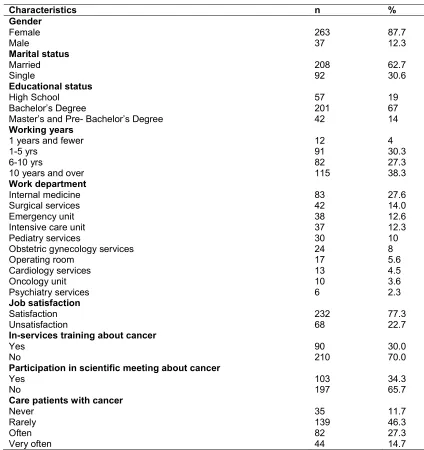
Of the 300 nurses, 263 were women, the majority of whom was married (62.7%). The average age of the nurses was Mean±SD=31.5±7.1 years. The demographic and other characteristics of nurses are shown in the Table 1.
4.2 Validity
4.2.1 Content validity
The content validity was reviewed by an expert committee. They determined that there was no difference between the meanings of the two versions. After examining the content validity, a pilot test for comprehensibility and clarity of the scales were performed on a sample of 6 volunteer nurses (4 females, 2 males). The respondents were asked if they had any trouble understanding and replying to the items and if they had any suggestions for the scale. The participants reported no specific problems with issues and 30-item the T-ATC was finalized.
4.2.2 Construct validity
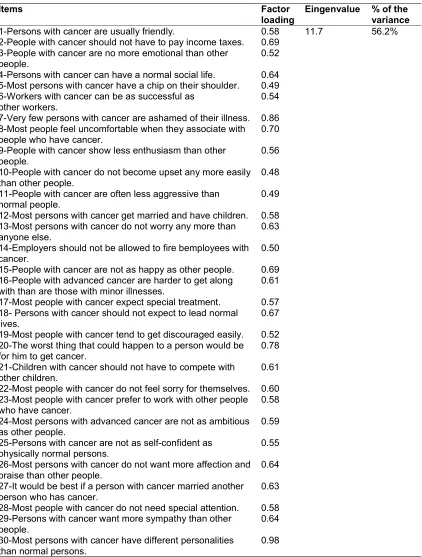
Construct validity was established factor analysis with principal components extraction. Factor analysis with varimax rotation, using Kaiser criterion (eingenvalues > 1.0), and a scree plot revealed that the main component of the T-ATC consists of determinative a factor structure. The factor loading of the items were ranged from 0.86 to 0.98 (Table 2).
4.3 Reliability
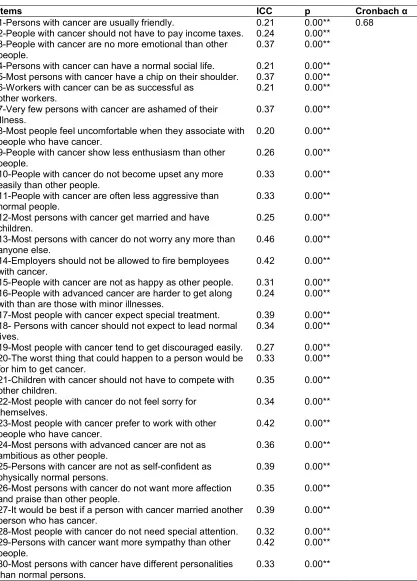
The adequacy of internal consistency of the T-ATC was examined with Cronbach’s alpha, Spearman Brown split-half value (0.57 for the first half) and (0.61 for the second half). We were able to recruit 14 nurses for a test-retest study. Test-retest reliability within eight week was shown to be excellent for T-ATC score (ICC=0.95 p<0.01), which suggests good reproducibility. Item-total correlation coefficients were found to being ranged form 0.21 to 0.46. Cronbach’s alpha and ICC values for seperate 30-item T-ATC are presented Table 3. The mean score of the T-ATC was obtained to be Mean±SD=95.5±14.3.
5. DISCUSSION
any scale which was reliable and valid in Turkey so as to assess nurses’ attitudes and general attitudes towards cancer and cancer patients. The Attitudes Towards Cancer Scale (ATC) was developed by Tichenor & Rundall (1977) in order to measure attitudes towards cancer and patients with cancer.The ATC is self-administered that are widely used in English speaking countries. This scale was utilized in few studies [3,7]. In the current study, we aimed to translate ATC into Turkish language and to establish the validity
and reliability of the Turkish language version of the ATC. This study demonstrated that the T-ATC has good validity and reliability. The content validity was approved by an expert committee and observed by pilot testing for cultural relevance. There is a well-documented sequential process of scale’s adaptation to be used in different cultures and it is well known that translation must be validated to achieve an equivalent scale and to allow comparability of data [8].
Table 1. The study sample characteristics (n=300)
Characteristics n %
Gender Female Male 263 37 87.7 12.3 Marital status Married Single 208 92 62.7 30.6 Educational status High School Bachelor’s Degree
Master’s and Pre- Bachelor’s Degree
57 201 42 19 67 14 Working years
1 years and fewer 1-5 yrs
6-10 yrs
10 years and over
12 91 82 115 4 30.3 27.3 38.3 Work department Internal medicine Surgical services Emergency unit Intensive care unit Pediatry services
Obstetric gynecology services Operating room Cardiology services Oncology unit Psychiatry services 83 42 38 37 30 24 17 13 10 6 27.6 14.0 12.6 12.3 10 8 5.6 4.5 3.6 2.3 Job satisfaction Satisfaction Unsatisfaction 232 68 77.3 22.7 In-services training about cancer
Yes No 90 210 30.0 70.0 Participation in scientific meeting about cancer
Yes No 103 197 34.3 65.7 Care patients with cancer
Table 2. Factor analysis of the T-ATC (n=300)
Items Factor
loading
Eingenvalue % of the variance
1-Persons with cancer are usually friendly. 0.58 11.7 56.2%
2-People with cancer should not have to pay income taxes. 0.69 3-People with cancer are no more emotional than other
people.
0.52
4-Persons with cancer can have a normal social life. 0.64 5-Most persons with cancer have a chip on their shoulder. 0.49 6-Workers with cancer can be as successful as
other workers.
0.54
7-Very few persons with cancer are ashamed of their illness. 0.86 8-Most people feel uncomfortable when they associate with
people who have cancer.
0.70
9-People with cancer show less enthusiasm than other people.
0.56
10-People with cancer do not become upset any more easily than other people.
0.48
11-People with cancer are often less aggressive than normal people.
0.49
12-Most persons with cancer get married and have children. 0.58 13-Most persons with cancer do not worry any more than
anyone else.
0.63
14-Employers should not be allowed to fire bemployees with cancer.
0.50
15-People with cancer are not as happy as other people. 0.69 16-People with advanced cancer are harder to get along
with than are those with minor illnesses.
0.61
17-Most people with cancer expect special treatment. 0.57 18- Persons with cancer should not expect to lead normal
lives.
0.67
19-Most people with cancer tend to get discouraged easily. 0.52 20-The worst thing that could happen to a person would be
for him to get cancer.
0.78
21-Children with cancer should not have to compete with other children.
0.61
22-Most people with cancer do not feel sorry for themselves. 0.60 23-Most people with cancer prefer to work with other people who have cancer.
0.58
24-Most persons with advanced cancer are not as ambitious as other people.
0.59
25-Persons with cancer are not as self-confident as physically normal persons.
0.55
26-Most persons with cancer do not want more affection and praise than other people.
0.64
27-It would be best if a person with cancer married another person who has cancer.
0.63
28-Most people with cancer do not need special attention. 0.58 29-Persons with cancer want more sympathy than other
people.
0.64
30-Most persons with cancer have different personalities than normal persons.
Table 3. ICC values for separate items and cronbach α of the T-ATC (n=300)
Items ICC p Cronbach α
1-Persons with cancer are usually friendly. 0.21 0.00** 0.68 2-People with cancer should not have to pay income taxes. 0.24 0.00**
3-People with cancer are no more emotional than other people.
0.37 0.00**
4-Persons with cancer can have a normal social life. 0.21 0.00** 5-Most persons with cancer have a chip on their shoulder. 0.37 0.00** 6-Workers with cancer can be as successful as
other workers.
0.21 0.00**
7-Very few persons with cancer are ashamed of their illness.
0.37 0.00**
8-Most people feel uncomfortable when they associate with people who have cancer.
0.20 0.00**
9-People with cancer show less enthusiasm than other people.
0.26 0.00**
10-People with cancer do not become upset any more easily than other people.
0.33 0.00**
11-People with cancer are often less aggressive than normal people.
0.33 0.00**
12-Most persons with cancer get married and have children.
0.25 0.00**
13-Most persons with cancer do not worry any more than anyone else.
0.46 0.00**
14-Employers should not be allowed to fire bemployees with cancer.
0.42 0.00**
15-People with cancer are not as happy as other people. 0.31 0.00** 16-People with advanced cancer are harder to get along
with than are those with minor illnesses.
0.24 0.00**
17-Most people with cancer expect special treatment. 0.39 0.00** 18- Persons with cancer should not expect to lead normal
lives.
0.34 0.00**
19-Most people with cancer tend to get discouraged easily. 0.27 0.00** 20-The worst thing that could happen to a person would be
for him to get cancer.
0.33 0.00**
21-Children with cancer should not have to compete with other children.
0.35 0.00**
22-Most people with cancer do not feel sorry for themselves.
0.34 0.00**
23-Most people with cancer prefer to work with other people who have cancer.
0.42 0.00**
24-Most persons with advanced cancer are not as ambitious as other people.
0.36 0.00**
25-Persons with cancer are not as self-confident as physically normal persons.
0.39 0.00**
26-Most persons with cancer do not want more affection and praise than other people.
0.35 0.00**
27-It would be best if a person with cancer married another person who has cancer.
0.39 0.00**
28-Most people with cancer do not need special attention. 0.32 0.00** 29-Persons with cancer want more sympathy than other
people.
0.42 0.00**
30-Most persons with cancer have different personalities than normal persons.
0.33 0.00**
For factor analysis, approximately 5-10 samples per item are considered adequate [18]. Therefore, considering 10 samples per item of the T-ATC with 30 items (i.e., 300 samples) minimum sample size should be 300. With regard to construct validity, we conducted a factor analysis and found that the factor structure. The results of factor analysis yielded that the T-ATC had one-factor structure like the original ATC. None of items of the T-ATC was omitted because the factor loading of the items were ranged from 0.86 to 0.98.
Cronbach’s alpha was found to be moderate level. This is considered a satisfactory value capable to evidence the sound internal consistency of the T-ATC. Test-retest reliability within eight week was shown to be excellent for T-ATC score (ICC=0.95 p<0.01), which suggests good reproducibility. Item-total correlation coefficients were found to being ranged form 0.21 to 0.46. ICC values for T-ATC total score and separate items were found to be moderate level.
6.CONCLUSION
This is the first study, it has been performed in Turkey, to translate, and to test psychometric properties of the ATC for Turkish population. However, current study has limitations. The first limitation of study was conducted only nurses. The second limitation was that this study was performed in Manisa, Turkey (West Anatolian). Despite of these limitations, results of this study demonstrated T-ATC reliable and valid scale in order to assess of attitudes attitudes toward cancer and cancer patients in our population. Nevertheless, this study provides evidence to support the content and constuct validity as well as the internal consistency of the T-ATC. The findings of this study support the validity and reliability of the T-ATC as the instrument to assess of attitudes towards cancer and patients with cancer in Turkish population. Therefore, further studies confirm that our results is recommended. Our findings suggested that the T-ATC should be tested in other population (health professionals, public, etc.) in the way of attitudes towards cancer and cancer patients.
ACKNOWLEDGEMENTS
We would like to thank Chief of Medicine of Celal Bayar University Hafsa Sultan Hospital, Turkey Ministry of Health General Secretary of Manisa Association of Public Hospitals, and nurses who participated in.
COMPETING INTERESTS
Authors have declared that no competing interests exist.
REFERENCES
1. McCaughan E, Parahoo K. Attitudes to cancer of medical and surgical nurse in a district generak hospital. European Journal of Oncology Nursing. 2000;4(3):162-70. 2. Fitch MI. Understanding oncology nurses'
experiences talking about death and dying, 2012.
Available:http://www.cano-acio.ca/~ASSETS/DOCUMENT/Journal/17 .3%20abstract.pdf (Accessed
Date: August 2014).
3. Ogiwara S, Ikezawa Y. Attitudes of health science students towards clients with cancer. J. Phys. Ther. Sci. 2004;16:49-55. 4. Charalambous A, Kaite C. Undergraduate
nursing students caring for cancer patients: Hermeneutic phenomenological insights of their experiences. BMC Health Services Research. 2013;13:63.
5. Dekock F. Factors influencing nurses’ attitudes towards caring for dying patients in oncology settings in the Western Cape Metropole. Master Thesis. University of Stellenbosch; 2011.
6. Usta-Yıldırım Y, Demir Y, Yagmuroglu H. Nurses’ perspective on positive attitudes to cancer patients in Turkey: A qualitative study. Asian Pacific Journal of Cancer Prevention. 2012;13:1225-29.
7. Tichenor CC, Rundall TG. Attitudes of physical therapists toward cancer. Phy. Ther. 1997;57:160-5.
8. Guillemin EG, Bombardier C, Beaton D. Cross cultural adaptation of health related quality of life measures: Literature review and proposed guidelines. Journal of Clinical Epidemiolog. 1993;46(12):1417– 32.
9. Beaton DE, Bombardier C, Guillemin F, Ferraz MB. Guidelines for the process of cross-cultural adaptation of self-report measures. Spine (phila Pa 1976). 2000;25: 3186–91.
10. Campbell DT, Fiske JL. Convergent and discriminant validation by the multitrait-multimethod matrix. Psychological Bulletin. 1959;56(2):85-105.
Archives Physical Medicine and Rehabilitation.2000;81(Suppl 2):15-20. 12. Cronbach LJ. Coefficient alpha and
internal structure of test. Psychometrika. 1951;16 (3):297-334.
13. Bland J, Altman DG. Measuring agreement in method comparison studies. Statistical Methods in Medical Research. 1999; 8(2):135-60.
14. Astrom G, Norberg A, Jansson L. Nurses’ narratives concerning ethically difficult care situations:Interpretation by means of Logstrup’s ethics. Psycho-Oncology. 1994; 3:27-34.
15. Box V, Anderson Y. Cancer beliefs, attitudes and preventative behaviours of
nurses working in the community. European Journal of Cancer Care. 1997;6: 192-208.
16. Corner J. The impact of nurses’ encounters with cancer on their attitudes towards the disease. J Clin Nurs. 1993;32: 363-72.
17. Lange M, Thom B, Kline NE. Assessing nurses' attitudes toward death and caring for dying patients in a comprehensive cancer center. Oncol Nurs Forum. 2008; 35(6):955-59.
18. Devillis RF. Scale development: Theory and applications (2nd ed). Thousand Oaks, CA:Sage Publications; 2003.
© 2015 Daban et al.; This is an Open Access article distributed under the terms of the Creative Commons Attribution License
(http://creativecommons.org/licenses/by/4.0), which permits unrestricted use, distribution, and reproduction in any medium,
provided the original work is properly cited.
Peer-review history:
The peer review history for this paper can be accessed here: