TURKISH ADAPTATION OF THE SUPPORTIVE CARE NEEDS SCALE (SCNS
RELIABILITY AND VALIDITY STUDY
*Gamze TEMIZ and Zehra DURNA
Istanbul Bilim University Florence
ARTICLE INFO ABSTRACT
Purpose:
Scale (SCNS
psychometric properties.
Methods:
data were collected. The sample comprised 450 patients wit was obtained from the patients. Forward
Turkish was conducted. Original English and translated forms were examined by a panel group. After the scope of validity f
people with similar characteristics with patients to be included in the study. Validity was investigated using content, confirmatory factor analysis, and divergent validity. Re
Cronbach α values, item SPSS 20.
Results:
SF34 were clear, conc construct of the SCNS
Reliability results were also satisfactory. Cronbach α values were within id correlation coefficient ranged from .7 to .8. Test
Conclusions:
Turkish SCNS
Copyright©2017, Gamze TEMIZ and Zehra DURNA.
unrestricted use, distribution, and reproduction in any medium, provided the original work is properly cited.
INTRODUCTION
Chemotherapy which is used as a cancer treatment prevents the uncontrolled spread of cancer cells. The purpose of chemotherapy is the treatment of the disease, the extension of the disease-free period, decreasing the symptoms and improving the quality of life (Curtis et al., 2002;
al., 2014; Molly et al., 2017). Symptoms are determinant in the patients' quality of life. The progression of the underlying disease leads to the formation of many physical and psychological symptoms in patients. The increase in these symptoms prevents patient's compliance with the treat Therefore, recognizing, evaluating and controlling the symptoms are very important for the efficiency of the treatment.
*Corresponding author: Gamze TEMIZ
Istanbul Bilim University Florence Nightingale Hospital School of NursingInstructor, Istanbul, Turkey.
ISSN: 0975-833X
Article History:
Received 28th June, 2017
Received in revised form 13th July, 2017
Accepted 10th August, 2017
Published online 30th September, 2017
Citation: Gamze TEMIZ and Zehra DURNA. 2017.
Study”, International Journal of Current Research, 9, (0
Key words:
Nursing, Holistic, Patientcare,
Reliability and Validity.
RESEARCH ARTICLE
TURKISH ADAPTATION OF THE SUPPORTIVE CARE NEEDS SCALE (SCNS
RELIABILITY AND VALIDITY STUDY
Gamze TEMIZ and Zehra DURNA
Florence Nightingale Hospital School of NursingInstructor
ABSTRACT
Purpose: This study aimed to evaluate the reliability and validity of the Supportive Care Needs Scale (SCNS – SF34) in Identification of nursing care needs for cancer patients and examine the psychometric properties.
Methods: Approval of the ethics committee and the institution was taken from the hospital where the data were collected. The sample comprised 450 patients with cancer. Pre
was obtained from the patients. Forward-backward translation of the SCNS
Turkish was conducted. Original English and translated forms were examined by a panel group. After the scope of validity for the final version of the scale, pre-treatment was performed in a group of 50 people with similar characteristics with patients to be included in the study. Validity was investigated using content, confirmatory factor analysis, and divergent validity. Re
Cronbach α values, item-total correlations, and intraclass correlations. Data were analyzed using SPSS 20.
Results: The Cronbach alpha was found.73, which indicated perfect content validity; items in SCNS SF34 were clear, concise, readable, and distinct. Confirmatory factor analysis confirmed the original construct of the SCNS-SF34.All items had factor loadings higher than the recommended level of .40. Reliability results were also satisfactory. Cronbach α values were within id
correlation coefficient ranged from .7 to .8. Test-retests results were found fairly reliable (p<.001).
Conclusions: SCNS-SF34 showed acceptable reliability and validity. We recommend performing the Turkish SCNS-SF34 in determine the need of the cancer patients.
This is an open access article distributed under the Creative Commons Att use, distribution, and reproduction in any medium, provided the original work is properly cited.
Chemotherapy which is used as a cancer treatment prevents the uncontrolled spread of cancer cells. The purpose of is the treatment of the disease, the extension of free period, decreasing the symptoms and ., 2002; Fullerton et
Symptoms are determinant in the patients' quality of life. The progression of the underlying disease leads to the formation of many physical and psychological symptoms in patients. The increase in these symptoms prevents patient's compliance with the treatment. Therefore, recognizing, evaluating and controlling the symptoms are very important for the efficiency of the
Istanbul Bilim University Florence Nightingale Hospital School of
Symptoms identified using various measurement tool are pain, fatigue, nausea, vomiting, loss of appetite, taste and changes in smell, mucositis, diarrhea, constipation, alopecia, anemia and skin-nail problems (Nunnally
Boyes et al., 2009; Molly et al
adverse effects in the treatment process increases the incidence of symptoms and also leads to the termination of the treatment. An efficient symptoms management
Having knowledge about the relationship of common symptoms with the diseases, their reasons, incidence, results and control method encourages the patient and his/her family on the control of symptoms (Yıldırım
2014). All symptoms should be discussed as a whole in symptom management and the patients and their families should also be included in care. The possible reasons as well as the real reasons should also be assessed in the evaluation of the symptoms as they affect patients' quality of life. An effective communication is very important in the control of symptoms in patients.
International Journal of Current Research Vol. 9, Issue, 09, pp.58250-58257, September, 2017
2017. “Turkish Adaptation of the Supportive Care Needs Scale (SCNS , 9, (09), 58250-58257.
TURKISH ADAPTATION OF THE SUPPORTIVE CARE NEEDS SCALE (SCNS – SF34):
Nightingale Hospital School of NursingInstructor, Istanbul, Turkey
This study aimed to evaluate the reliability and validity of the Supportive Care Needs SF34) in Identification of nursing care needs for cancer patients and examine the
Approval of the ethics committee and the institution was taken from the hospital where the h cancer. Pre-implementation approval backward translation of the SCNS-SF34 from English into Turkish was conducted. Original English and translated forms were examined by a panel group. After treatment was performed in a group of 50 people with similar characteristics with patients to be included in the study. Validity was investigated using content, confirmatory factor analysis, and divergent validity. Reliability was assessed using total correlations, and intraclass correlations. Data were analyzed using
The Cronbach alpha was found.73, which indicated perfect content validity; items in SCNS-ise, readable, and distinct. Confirmatory factor analysis confirmed the original
SF34.All items had factor loadings higher than the recommended level of .40. Reliability results were also satisfactory. Cronbach α values were within ideal limits. Item-total
retests results were found fairly reliable (p<.001). SF34 showed acceptable reliability and validity. We recommend performing the
is an open access article distributed under the Creative Commons Attribution License, which permits
Symptoms identified using various measurement tool are pain, fatigue, nausea, vomiting, loss of appetite, taste and changes in smell, mucositis, diarrhea, constipation, alopecia, anemia and
et al., 1994; Curtis et al., 2002;
et al., 2017). Failure to control the
adverse effects in the treatment process increases the incidence of symptoms and also leads to the termination of the treatment. An efficient symptoms management is required to prevent this. Having knowledge about the relationship of common symptoms with the diseases, their reasons, incidence, results and control method encourages the patient and his/her family Yıldırım et al., 2013; Uysal et al., All symptoms should be discussed as a whole in symptom management and the patients and their families should also be included in care. The possible reasons as well as the real reasons should also be assessed in the evaluation of the toms as they affect patients' quality of life. An effective communication is very important in the control of symptoms in
INTERNATIONAL JOURNAL OF CURRENT RESEARCH
Patients and their relatives must be included in the care plan. While preparing the treatment plan, it is necessary to use a language which could be understood by the patients and their relatives and is free of medical terms. What will be explained about the patient care and the prognosis of the disease should be planned before coming together with the family for the treatment and symptom management. The care and treatment to be applied should be constantly revised and updated. Thus, the improvement of symptoms or the formation of new symptoms would have been noticed at an early stage (Curtis et al., 2002; Boyes et al., 2009; Yıldırım et al., 2013).
The communication needs, psychosocial needs, sexuality needs and spiritual needs are the needs that may develop in patients depending on the treatment and these symptoms. Effective communication is a very important factor for the patient diagnosed with cancer and his/her family. Communication should be initiated as soon as the diagnosis is made for the patient and his/her family to cope with the disease and the adverse effects of the treatment during the challenging treatment process. Information requirements should be determined before starting communication. Determining the requirement level of the patient and family. timely and effective use of information require communication skills (Curtis et al., 2002; Boyes et al., 2009; Yıldırım et al., 2013 ). Regarding the information to be given to the diagnosed patient whose treatment has started. which information will be given at which level and what kind of information the patient needs are very important. Information to be shared with the patient and relatives should be open and clear. The sharing of uncertain data can lead patient to have more despair. In addition, at what level the patient would get the information to be shared is also another factor that increases the effectiveness of communication (Bernhardson et al., 2008; Yıldırım et al., 2013 ).
Communication requires continuity. To guide the patient in each case which is uncertain for the patient during the treatment is possible with a good communication. First requirement for effective communication is the use of communication techniques by the person who will guide. Therefore. all staffs who will contact with patient should be trained on communication methods (Bernhardson et al., 2008; Yıldırım et al., 2013 ; Ramani et al., 2013). The information requirements is the first priority of all cancer patients. Boyer
et al. (Boyes et al., 2009) indicated that the majority of
advanced-stage cancer patients have ongoing information requirements during the treatment and care. Adaptation to the treatment protocol increases as the patient and family's level of knowledge increases. The issues that patients mostly need are the issues that will affect all aspects of a patient's life such as what types of symptoms can be seen because of chemotherapy, how to deal with these symptoms, the duration of treatment. what should be regarded during treatment, at what level the disease will affect the patient's life, when patient can start to work after treatment and at what level the social life and family life be affected. All information that the patient can understand about the disease and treatment process will reduce the patient's anxiety level. The patients diagnosed with advanced-stage cancer and their families need information not to learn the disease and treatment process but to understand how much they need to hope (Bernhardson et al., 2008; Yıldırım et al., 2013 ; Ramani et al., 2013; Sevim et al., 2014; Gültekin et al., 2017).
The information requirements are not at the same level for all patients and their families. Socio-cultural differences affect the level of knowledge of patients. In many cultures. there is a family-centered decision-making process instead of patient's autonomy about the treatment process. It is important that the members of the health care team should distinguish these socio-cultural differences well and decide on with whom they will make contact among the patient's family (Bernhardson et al., 2008; Yıldırım et al., 2013 ; Ramani et al., 2013; Sevim et al., 2014; Gültekin et al., 2017). Another important point of contact with the patient is decide on which and what level of information will be shared by the team members. Health care workers needs to receive training on the patient's psychology and accurate communication methods regarding the process of providing information to the patient. Cultural differences also affect the attitudes of the health care workers. What kind of information the health care team will share and at what level they will share have been determined by ethical rules. The right of patients to receive information about the disease and treatment processes have also been determined by the laws. Information given adequately, accurately and timely reduce the anxiety level of the patients and facilitate their compliance with the treatment (Boyes et al., 2009; Fullerton et al., 2014).
Since chemotherapy is a long-term treatment, it affects patients' physiological, psychological and sociological states. Chemotherapy treatment leads to the occurrence of psychological problems such as anxiety, fear and depression in patients. This situation results from the fact that the startling cancer the reasons and consequences of which are not known by the patients reminds of death in patients. The same situation also arise due to the symptoms experienced during chemotherapy treatment. The symptoms such as hair loss, gastrointestinal problems and stomatitis observed in patients because of chemotherapy lead to psychological problems such as despair, anger, anxiety and depression. Therefore, patients cannot adapt to the treatment process, develop personality disorders and their hopes for the future are decreased (Ramani
et al., 2013; Sevim et al., 2014; Gültekin et al., 2017). The
feelings such as probability of loss, inability to be independent and being dependent on someone to be experienced in patients lead to the reduction of physical activities of the individual. increase in anxiety level and in anger against life and disease and hence depression (Harrison et al., 2009; Ramani et al., 2013; Sevim et al., 2014; Gültekin et al., 2017; Charalambous
et al., 2017). Oncology patients go through psychological
processes such as concern, fear and anger after diagnosis and during treatment. It is possible that they can get through this process by means of the psychological support they receive. Patient's compliance to treatment is ensured when these psychological process expected in patients are known in advance and the measures are taken (Harrison et al., 2009; Ramani et al., 2013; Sevim et al., 2014; Gültekin et al., 2017; Charalambous et al., 2017).
For the continuity of psychological well-being of the patients undergoing chemotherapy, the health care team should include a psychologist, all medical staff to be in contact with the patient are required to be educated about this process and coping strategies. Thus, patient's compliance to treatment is ensured and his/her quality of life will be increased (Harrison
et al., 2009; Ramani et al., 2013; Sevim et al., 2014; Yıldırım
et al., 2015; Gültekin et al., 2017; Charalambous et al., 2017).
It is the whole of sexual health; somatic, intellectual, mental, emotional and social aspects. For women, sexuality is appearance, the feeling of being a woman, ability to give birth and ability to perform sexual functions. The chemotherapeutic treatment administered leads to the loss of these functions. Moreover, the women go through the menopause after treatment may have serious problems (Harrison et al., 2009; Ramani et al., 2013; Sevim et al., 2014; Yıldırım et al., 2015; Gültekin et al., 2017; Charalambous et al., 2017). In patients diagnosed with cancer and undergoing chemotherapy the disease and treatment are life threatening and adversely affect the patient's sexual health. In particular. the chemotherapy administered in gynecological cancers leads to the loss of body image, decrease in gender roles and sexual functions, and affects sexual health in terms of fertilization. Therefore, all patients should be informed about the changes related to sexuality as soon as the diagnosis is made and before starting the treatment (Curtis et al., 2002; Ramani et al., 2013; Fullerton et al., 2014; Molly et al., 2017). Spirituality is expressed as the individual's self-understanding, relationships with other people, place in the universe, effort to question and accept the meaning of life. Spiritual care is an important element of the patient-centered care. It is critically important in coping with the disease during treatment. Survival, being able to endure when the disease is recurred or in the terminal period. Meeting the spiritual needs spiritual well-being affect the quality of life (Curtis et al., 2002; Harrison et al., 2009; Ramani et al., 2013; Fullerton et al., 2014; Molly et al., 2017). Spiritual care is very important especially in the advanced stages of cancer. Being together with the family and fulfilling the requirements of religious beliefs are considered to be among the spiritual needs of the patients in this stage. Spiritual approach helps patients to reach peace and to live in the hope of survival. Therefore, meeting these requirements of the patients in the later stages of the treatment will improve the quality of life (Curtis et al., 2002; Harrison et al., 2009; Ramani et al., 2013; Fullerton et al., 2014; Molly et al., 2017). In particular, the religious and spiritual needs of the patients in the terminal stage should be further met. Thus. the person will have the opportunity to say goodbye to his family and inner surroundings by entering into an acceptance process in a more peaceful way. Therefore, patients should be addressed as a whole and their physiological requirements and psychological and spiritual needs should not be ignored during treatment. Hence, showing empathy and the fact that patients are encouraged to express their feelings by determining their spiritual needs, listening to the patients quietly and the use of herapeutic communication techniques ensure that the spiritual care supports the patient's care (Nunnally et al., 1994; Yıldırım
et al., 2013; Uysal et al., 2014; Adem et al., 2015).The purpose
of the study is to examine whether the Turkish form of the Supportive Care Needs Scale (SCNS-SF34), which was created by Boyes et al. (Boyes et al., 2009) to determine the met or unmet needs of the people who had been diagnosed with cancer to plan that they will receive better services, is a valid and reliable scale. This scale was preferred because it addresses the needs of the patients undergoing chemotherapy as a whole with their all dimensions. the fact that in which direction more support is needed with the sub-dimensions is revealed in detail. scoring and application are easy.
METHODS
Study design
Original Research. This was a descriptive study.
Setting and sample
This research was conducted in a Public Education and Research Hospital. Medical Oncology Unit between May 2015- August 2015. Approval of the ethics committee and the institution was taken from the hospital where the data were collected. The study was applied to 450 patients. After receiving Ethics Committee permission, the patients who accepted to participate in research and who had received/were receiving chemotherapy treatment were informed about the research, and their permission was received by the "Informed Consent Form". Informed consent was obtained from all individual participants included in the study. The data were collected by performing the one on one interview method with the patients.
The primitive language of scale is Turkish and it was translated from English to Turkish from Turkish to English by two people independently of one another who know both languages at the native language level. The scale was finalized by combining the translations. and its compliance with the original was examined by translating again by a translator who knows English at the native language level from Turkish to English, English to Turkish. The number of samples in the scale validity and reliability studies should be taken in a way to be 10 times of the number of the items of the scale at the most. Therefore, 450 patients were included within the scope of the sampling to perform the statistical analysis of the scale consisting of 34 item to increase the scale reliability validity at the specified time intervals. and to perform test-retest evaluation.
The proposed study sample consisted of all patients with cancers who met the eligibility criteria. Patients who were above the age of 18, were literate, the patient group of stage II, stage III and stage IV, who received at least 2 cures chemotherapy, were volunteer to participate in the study were included in the study. The perceptional defects and psychiatric disorders preventing communication and unwillingness to participate in research are the exclusion criteria.
Ethical consideration
We conducted the study in accordance with the Helsinki Declaration and obtained approval from the local ethics committee (16032015.12). All participants were informed about the purpose of the study and were assured of confidentiality. Informed written consent was obtained from each patient before participation in the study. We also got permission to use your scale.
Measurements/Instruments
Three intruments including the Basic Information Form. Supportive Care Needs Scale (SCNS-SF34). Informed consent form were used.
Basic information form
Supportive care needs scale (SCNS-SF34)
Supportive Care Needs Scale (SCNS-SF34) consisting of 34 items which was developed by Boyes et al. (Boyes et al., 2009) and the validity and reliability of which was studied with 444 patients consists of the subgroups of psychological needs (10 items), health care and information needs (11 items), physical and daily life needs (5 items), patient care and support needs (5 items), sexuality and problems (3 items). Each question of the scale was numbered from 1 to 5 and 1 point corresponds to the expression of 'I haven't experienced this situation', 2 points corresponds to the expression of 'I have had no support', 3 points corresponds to the expression of 'I have needed some support', 4 points corresponds to the expression of 'I have needed support at the medium level' and 5 points corresponds to the expression of 'I have needed too much support'.
Sub-dimensions of the supportive care needs scale and the items within the dimensions
Sub-Dimensions Items
Psychological Questions 6, 7, 8, 9, 10, 11, 12, 13, 14, 17
Health System Questions 23, 24, 25, 26, 27, 28, 29, 30, 32, 33, 34
Physical and Daily Life Items Questions 1, 2, 3, 4, 5
Patient Care and Support Items Questions 18, 19, 20, 21, 22
Those Related to Sexuality 15, 16, 31
Data collection/Procedure
The study consisted of three stages including translation, validation and reliability testing of the Supportive Care Needs Scale (SCNS-SF34). Translation included a four stage process: (a) forward translation from English into Turkish; (b) backward translation from Turkish into English; (c) examination of the original English. Turkish. and backward translated English forms for discrepancies. meaning errors and resolution of all differences in the forms; and (d) producing the final Supportive Care Needs Scale (SCNS-SF34) Turkish version. After ensuring the appropriateness of the translation the scale was examined in terms of the appropriateness of the translation and content by 6 nurse lecturers who are expert in their field. The suggestions of the experts were scored as "4" if no change was made as "3" if small changes were suggested, and as "2" if major changes were suggested. The scores given by the experts for each item were combined on a form. The answers were collected, content validity ratios (CVR) were calculated. According to the results obtained it was found that the content validity ratio for each item was greater than zero or equal to zero. According to this result. the items were accepted as significant. and they were not eliminated. In the next step. the content validity index was calculated by taking the average of the content validity ratios. The content validity of the scale was found statistically significant as it was greater than KGİ>KGO for all items of the scale. The scale was finalized after the opinions of the experts, and pre-treatment was performed in a group of 50 people having similar characteristics with the patients to be included in the research. No change was made in the scale because each item was found comprehensible during pre-application (12, 15-18). The Validity and Reliability analysis of each item was performed within the scope of study.
It was found that the total Cronbach's α value of the Supportive Care Requirements scale consisting of a total of 34 items was .73, and its internal consistency was at a reliable level. It was
found that the correlations of the all items of the scale with the sub-dimensions were significant (P < .001).
Data analysis
The obtained data were evaluated using SPSS 20 (Statictical Program For Social Sciences) software package. Frequency distribution. percentage. mean and standard deviation Kolmogorov -Smirnov distribution test. Mann-Whitney U test. Kruskal-Wallis test. Spearman correlation analysis were used while evaluating the data. Cronbach's alpha coefficient was calculated for the overall reliability and the reliability of the sub-dimensions. Cronbach's alpha coefficients were evaluated by;
The scale is not reliable between .00 ≤ α < .40
The scale is reliable between .40 ≤ α < .60
The scale is quite reliable between .60 ≤ α < .80
The scale is highly reliable between .80 ≤ α < 1.00
The results were evaluated at 95% confidence interval.
RESULTS
General characteristics of participants
The general characteristics of the participants are shown in Table 1. The mean age of the participants was 54.95±11.39 years, the majority of them were women, married, and had education at primary school level. More than half of the participants 344 (76.4) had evre IV cancer with a beetwen cancer duration of 1-5 years.
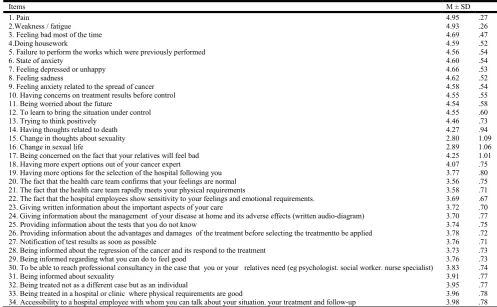
Score distribution of the items of the supportive care needs scale
The distribution of the item scores of the Supportive Care Needs Scale is presented in Table 2. When the findings were examined, it was seen that regarding the levels of agreeing with the items of those who participated in the research: it was 4.95 ± .27 for the 'Pain', 4.93 ± .26 for the ' Weakness /fatigue', 4.69 ± .47 for 'Feeling bad most of the time', 3.58 ± .71 for 'The fact that the health care team rapidly meets your physical requirements', 2.89 ±1.06 for 'Change in sexual life', 2.80 ± 1.09 for 'Change in thoughts about sexuality'.
Distribution of the scores of the sub-dimensions of the supportive care needs scale
The distribution of the scores of the sub-dimensions of the supportive care needs scale is presented in Table 3. When findings were analyzed it was seen that the highest score was obtained from the sub-dimension of the Physical/daily life needs (93.63 ± 8.08), and the lowest score was obtained from the sub-dimension of the Sexuality and problems (55.07 ± 17.92).
Item-sub-dimension scores correlation coefficients and
cronbach's alpha values of the supportive care needs scale
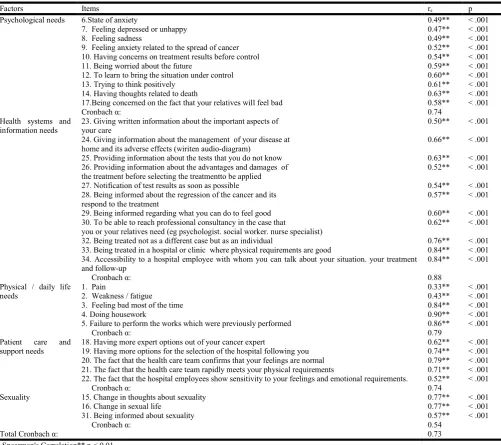
It was found that the internal consistency level of the "Psychological needs" sub-dimension with a total of 10 questions was .74, the internal consistency level of the " Health systems and information needs" sub-dimension with a total of 11 questions was .88, the internal consistency level of the " Physical / daily life needs" sub-dimension with a total of 5 questions was .79, the internal consistency level of the " Patient care and support needs" sub-dimension with a total of 5 questions was .74, the internal consistency level of the "Sexuality" sub-dimension with a total of 3 questions was .54 (Table 4).
[image:5.595.98.493.73.219.2]While the internal consistencies of the sub-dimensions of the psychological needs, health systems and information needs. Physical/daily life needs and patient care and support needs of the supportive care need scale were at the reliable level the sub-dimension of sexuality was found to be low reliability because the patients did not want to answer the relevant questions. When the item correlation of the 'psychological needs' sub-dimension of the Supportive Care Need Scale was analyzed, it was found that the correlations of all items with all items varied between .47 and .63 and were significant (p < .001).
Table 1. General Characteristics of Sample (N = 450)
CharacteristicsClassification M ± SD or n (%)
Age (yr) 54.95 ± 11.39
Gender Male 173 (38.4)
Female 277 (61.6)
Maritalstatus Married 367 (81.6)
Single 83 (18.4)
Educationallevel ≤ High school 369 (82.0)
≥ College 81 (18.0)
II 26 (5.8)
Evre of cancer III 80 (17.8)
IV 344 (76.4)
0-1 year 22 (4.9)
Duration of treatment 1-5 year 344 (76.4)
5-10 year 80 (17.8)
[image:5.595.44.542.254.561.2]Over10 years 4 (0.9)
Table 2. Score Distribution of theItems of the Supportive Care Needs Scale(N= 450)
Items M ± SD
1. Pain 4.95 .27
2.Weakness / fatigue 4.93 .26
3. Feeling bad most of the time 4.69 .47
4.Doing housework 4.59 .52
5. Failure to perform the works which were previously performed 4.56 .54
6. State of anxiety 4.60 .54
7. Feeling depressed or unhappy 4.66 .53
8. Feeling sadness 4.62 .52
9. Feeling anxiety related to the spread of cancer 4.58 .54
10. Having concerns on treatment results before control 4.55 .55
11. Being worried about the future 4.54 .58
12. To learn to bring the situation under control 4.55 .60
13. Trying to think positively 4.46 .73
14. Having thoughts related to death 4.27 .94
15. Change in thoughts about sexuality 2.80 1.09
16. Change in sexual life 2.89 1.06
17. Being concerned on the fact that your relatives will feel bad 4.25 1.01
18. Having more expert options out of your cancer expert 4.07 .75
19. Having more options for the selection of the hospital following you 3.77 .80
20. The fact that the health care team confirms that your feelings are normal 3.56 .75
21. The fact that the health care team rapidly meets your physical requirements 3.58 .71
22. The fact that the hospital employees show sensitivity to your feelings and emotional requirements. 3.69 .67
23. Giving written information about the important aspects of your care 3.72 .70
24. Giving information about the management of your disease at home and its adverse effects (written audio-diagram) 3.70 .77
25. Providing information about the tests that you do not know 3.74 .75
26. Providing information about the advantages and damages of the treatment before selecting the treatmentto be applied 3.78 .72
27. Notification of test results as soon as possible 3.76 .71
28. Being informed about the regression of the cancer and its respond to the treatment 3.73 .73
29. Being informed regarding what you can do to feel good 3.76 .73
30. To be able to reach professional consultancy in the case that you or your relatives need (eg psychologist. social worker. nurse specialist) 3.83 .74
31. Being informed about sexuality 3.91 .77
32. Being treated not as a different case but as an individual 3.95 .77
33. Being treated in a hospital or clinic where physical requirements are good 3.96 .78
34. Accessibility to a hospital employee with whom you can talk about your situation. your treatment and follow-up 3.98 .78
Table 3. Distribution of the Scores of the Sub-Dimensions of the Supportive Care Needs Scale (N = 450)
Dimension M ± SD
F1. Psychological needs 87.62 9.34
[image:5.595.187.408.602.667.2]When the item correlation of the Health system and information needs sub-dimension of the scale was analyzed, it was found that the correlations of all items with all items varied between .50 and .84 and were significant (p< .001). When the item correlation of the Physical/daily life sub-dimension of the scale was analyzed. it was found that the correlations of all items with all items varied between .33 and .90 and were significant (p < .001). When the item correlation of the patient care and support sub-dimension of the scale was analyzed. it was found that the correlations of all items with all items varied between .52 and .79 and were significant (p < .001). When the item correlation of the sexuality sub-dimension of the scale was analyzed, it was found that the correlations of all items with all items varied between .57 and .77 and were significant (p < .001).
Supportive care needs scale testing - re-test
The results of two measurements performed to evaluate the invariance of the Supportive Care Needs Scale and its sub dimensions are presented in Table 5. When the things were analyzed. the variance of these two measurements was homogeneous and normally distributed.
[image:6.595.47.549.72.517.2]The mean scores results obtained from test - retest measurement were compared by the t-test. there was no significant difference between the two measurements. It was determined that the correlation coefficients of the first and second measurement results were a high level of statistical significance between the scores (p < .001).
Table 4. Item-Sub-dimension Scores Correlation Coefficients and Cronbach's Alpha Values of the Supportive Care Needs Scale (N = 450)
Factors Items rs p
Psychological needs 6.State of anxiety 0.49** < .001
7. Feeling depressed or unhappy 0.47** < .001
8. Feeling sadness 0.49** < .001
9. Feeling anxiety related to the spread of cancer 0.52** < .001
10. Having concerns on treatment results before control 0.54** < .001
11. Being worried about the future 0.59** < .001
12. To learn to bring the situation under control 0.60** < .001
13. Trying to think positively 0.61** < .001
14. Having thoughts related to death 0.63** < .001
17.Being concerned on the fact that your relatives will feel bad 0.58** < .001
Cronbach α: 0.74
Health systems and information needs
23. Giving written information about the important aspects of your care
0.50** < .001
24. Giving information about the management of your disease at home and its adverse effects (wiriten audio-diagram)
0.66** < .001
25. Providing information about the tests that you do not know 0.63** < .001 26. Providing information about the advantages and damages of
the treatment before selecting the treatmentto be applied
0.52** < .001
27. Notification of test results as soon as possible 0.54** < .001
28. Being informed about the regression of the cancer and its respond to the treatment
0.57** < .001
29. Being informed regarding what you can do to feel good 0.60** < .001
30. To be able to reach professional consultancy in the case that you or your relatives need (eg psychologist. social worker. nurse specialist)
0.62** < .001
32. Being treated not as a different case but as an individual 0.76** < .001 33. Being treated in a hospital or clinic where physical requirements are good 0.84** < .001 34. Accessibility to a hospital employee with whom you can talk about your situation. your treatment
and follow-up
0.84** < .001
Cronbach α: 0.88
Physical / daily life needs
1. Pain 0.33** < .001
2. Weakness / fatigue 0.43** < .001
3. Feeling bad most of the time 0.84** < .001
4. Doing housework 0.90** < .001
5. Failure to perform the works which were previously performed 0.86** < .001
Cronbach α: 0.79
Patient care and support needs
18. Having more expert options out of your cancer expert 0.62** < .001
19. Having more options for the selection of the hospital following you 0.74** < .001 20. The fact that the health care team confirms that your feelings are normal 0.79** < .001 21. The fact that the health care team rapidly meets your physical requirements 0.71** < .001 22. The fact that the hospital employees show sensitivity to your feelings and emotional requirements. 0.52** < .001
Cronbach α: 0.74
Sexuality 15. Change in thoughts about sexuality 0.77** < .001
16. Change in sexual life 0.77** < .001
31. Being informed about sexuality 0.57** < .001
Cronbach α: 0.54
Total Cronbach α: 0.73
rs : Spearman's Correlation** p < 0.01
Table 5. Supportive Care Needs Scale Testing - Re-Test (N = 50)
Sub-dimension of the SCNS Before After t p rs p
M ± SD M ± SD
Psychological needs 83.05 ± 10.95 83.20 ± 10.96 -1.00 > .001 0.99 < .001 Health Systems and Information needs 73.86 ± 16.29 73.79 ± 16.36 1.54 > .001 1.00 < .001 Physical / daily life needs 88.90 ± 13.25 88.98 ± 13.13 -1.43 > .001 0.99 < .001 Patient care and support 73.30 ± 17.10 73.22 ± 17.00 0.75 > .001 0.99 < .001
Sexuality 70.17 ± 15.25 70.17 ± 15.26 -0.27 > .001 1.00 < .001
[image:6.595.94.504.542.613.2]DISCUSSION
Supportive Care Scale used in our study (SCNS-SF34) was developed by Boyes et al. (4). Supportive Care Needs Scale (SCNS-SF34) consisting of 34 items which was developed by Boyes et al. (4) and the validity and reliability of which was studied with 444 patients consists of the subgroups of psychological needs (10 items), health care and information needs (11 items), physical and daily life needs (5 items), patient care and support needs (5 items), sexuality and problems (3 items). Each question of the scale was numbered from 1 to 5, and 1 point corresponds to the expression of 'I haven't experienced this situation', 2 points corresponds to the expression of 'I have had no support', 3 points corresponds to the expression of 'I have needed some support', 4 points corresponds to the expression of 'I have needed support at the medium level', and 5 points corresponds to the expression of 'I have needed too much support'. Cronbach's alpha value of each of sub-dimension of the Supportive Care Needs Scale was calculated, and the total Cronbach's α value was found as .73 According to this value, the internal consistency was found to be at a reliable level.
According to our study, it was seen that the issues which were mostly needed by the patients who participated in the research were pain (4.95± .27), weakness / fatigue (4.93±0.26), feeling bad most of the time (4.69± .47), the fact that the health care team rapidly meets your physical requirements (3.58 ± .71), change in sexual life (2.89 ± 1.06), change in thoughts about sexuality (2.80 ± 1.09) (Table 2). It was seen that the highest score was obtained from the physical/everyday life needs from the sub-dimensions of the scale (93.63 ± 8.08), and the lowest score was obtained from the sub-dimensions of sexuality and problems (55.07 ± 17.92) (Table 3). Cronbach's α value of the scale is.73, its internal consistency is reliable (Table 4).
Higher level of significance was determined by the test-retest results (Table 5). In the study carried out by Gültekin et al.(17), it was determined that 30(76.2) of patients expect from their doctors to relieve their pains, 5(10.4) of them expect from nurses to relieve their pain and uneasiness, 4(9.8) of them expect from their psychologist to decrease their sadness, 2(1.6) of them expect from nutritionist to have a support for weight control, 1(1.3) of them expect from social service experts to improve their relations with the family and friends, 3(6.) of them expect from physiotherapist to improve their muscle weakness. In their study, Charalambous et al (13) stated that the patients diagnosed with cancer have communication disturbances. the emotional processes such as uncertainty and fear lead to the increase in social support needs. According to the study of Harrison et al. (14), oncology patients are also in need of requirements for support. These requirements are physical requirements, activities of daily life requirements, economic, psychological, psychosocial, spiritual needs and communication and information needs, respectively. These findings in the literature show parallelism with our study.
Clinical perspectives
This scale was preferred because it addresses the needs of the patients undergoing chemotherapy as a whole with their all dimensions, the fact that in which direction more support is needed with the subdimensions is revealed in detail, scoring and application are easy.
Conclusion
In this study in which the validity and reliability of the Supportive Care Needs Scale were examined for the conditions of our country, the implementation studies were carried out in accordance with the international scientific methods, and it was found that the Turkish version of the scale meet the validity and reliability criteria. The original scale factor structure is compatible with the factor structure in the Turkish form, and Turkish version reliability values were found similar to the original scale, and it was concluded that the scale can be used in nursing practice and researches in our country. According to the study, the symptoms experienced by patients undergoing chemotherapy, respectively; fatigue, unwillingness, disruption of sleep patterns, decreased interest in sex, difficulty in concentrating and hair loss was identified. It was found that the most support is needed by the patient issues; pain, weakness / fatigue, often feel bad, sadness, concerns swings, difficulty in doing things related to home, fears about the spread of cancer, the inability to control the situation, worry about the future, fear of death, worrying that it will upset their relatives, to be in need of information regarding sexual life.
According to these results, the higher the incidence of symptoms in patients with increased support requirements the quality of life are reduced in parallel. As a result, the evaluation of symptoms at frequent intervals, to meet the needs identified, measure the quality of care and efficiency at frequent of intervals and giving advice on everything they need for patients is recommended.
Conflict of ınterest
No conflict of interest has been declared by the authors. This research received no specific grant from any funding agency in the public, commercial, or not-for-profit sectors.
Acknowledgements
The authors would like to thank all participants for their involvement.
REFERENCES
Adem B., 2015. Turkısh adaptatıon, valıdıty and relıabılıty study of the sentıments, attıtudes and concerns about ınclusıve educatıon scale revısed (SACIE-R). Turkish
Studies 10(3), 175-186.
Bernhardson BM, Tishelman C, Rutqvist LE., 2008. Self-reported taste and smell changes during cancer chemotherapy. Support Care Cancer 16, 275-283.
Boyes A, Girgis A, Lecathelinais C., 2009. Brief assessment of adult cancer patients' perceived needs: development and validation of the 34-item supportive care needs survey (SCNS-SF34). J Eval Clin Pract. 15 (4), 602-606.
Charalambous, A, Molassiotis A., 2017. Preliminary validation and reliability of the short form chronic respiratory disease questionnaire in a lung cancer population. Eur J Cancer. 26 (1), 1-8.
Fullerton B, Jeitler K, Seitz M et al., 2014. Intensiveglucose control versus conventional glucose control for type 1 diabetes mellitus.Cochrane Database Syst Rev. 14, 1-70. Gültekin Z, Pınar G., 2017. Health-related quality of life and
health care services expectations of the patients with lung cancer 27(1): 99-106.
Harrison JD. Young JM. Price MA et al., 2009. What are the unmet supportive care needs of people with cancer, a systematic review. Support Care Cancer 17, 1117-28. Molly H, Sylvie M., 2017. Demographic, medical, and
psychosocial predictors of benefit finding among caregivers of childhood cancer survivors. Psycho-Oncology 1,125-132.
Nunnally JC, Bernstein IA., 1994. Psychometric theory. 3rd rev. ed. McGraw Hill. New York: Scribd, 243-65.
Ramani A, Ferguson C., 2014. Supportive needs of Iranian cancer patients. Indian J Palliat Care 20(3), 224-228.
Sevim O., 2014. Developıng the academıc ethıcs values scale: the relıabılıty and valıdıty study. Turkish Studies 9(6), 943-957.
Sharma S, Mukherjee S, Kumar A et al., 2005. A simulation study to investigate the use of cutoff values for assessing model fit in covariance structure models. 58, 935-43.
Uğur O., 2014. Symptom management of cancer patients. Turk J Oncol. 29(3), 125-135.
Uysal N. Senel G. Karaca S et al., 2014. Symptoms seen in inpatient palliative care and impact of palliative care unit on symptom control. Pain 27(2), 104-11.
Yıldırım B., 2015. Sciences learning anxiety scale: validation study. Anemon. 3(1), 33-43.
Yıldırım N.K. Kaçmaz N. Ozkan M., 2013. Unmet care needs in advanced stage cancer patients. J Psy Nurs., 4(3),153-158.