Universally Composable Key-Management
(full version)
Steve Kremer1, Robert K¨unnemann2, and Graham Steel2 1
LORIA & INRIA Nancy – Grand-Est, France 2 INRIA Paris – Rocquencourt, France
Table of Contents
Universally Composable Key-Management (full version) . . . 1
Steve Kremer, Robert K¨unnemann, and Graham Steel 1 Introduction . . . 2
2 Background: GNUC . . . 3
2.1 Preliminaries . . . 3
2.2 Machines and interaction . . . 4
2.3 Defining security via ideal functionalities . . . 4
3 An ideal key management functionality and its implementation . . . 5
3.1 Architecture . . . 6
3.2 Key-usage (KU) functionalities . . . 7
3.3 Policies . . . 8
3.4 The key-management functionality and reference implementation . . . 8
4 Proof overview . . . 14
5 Realizing key-usage functionalities for a static key-hierarchy . . . 15
6 Conclusions and outlook . . . 16
A Initialisation and Setup . . . 17
A.1 Initialisation phase . . . 17
A.2 Handling of the setup phase inFKMandSTi. . . 17
A.3 Setup assumptions for the implementation . . . 18
B Security Token Network . . . 18
C Proof for Theorem 1 . . . 19
D Proofs for Lemma 1 and Lemma 2 . . . 20
E The signature functionality . . . 34
F An example implementation ofFach . . . 34
G Proof for Lemma 4 . . . 35
1
Introduction
Security critical applications often store keys on dedicated hardware security modules (HSM) or key-management servers to separate highly sensitive cryptographic operations from more vulnerable parts of the network. Access to such devices is given to protocol parties by the means ofSecurity APIs. Examples of such APIs are the RSA PKCS#11 standard [1], IBM’s CCA [2] and the trusted platform module (TPM) [3] API. Building on the work of Longley and Rigby [4] and Bond and Anderson [5] on API attacks, several recent papers have investigated the security of APIs on the logical level adapting symbolic techniques for protocol analysis [6–8], finding many new attacks. More recent work has tried to define appropriate security notions for APIs in terms of cryptographic games [9, 10]. This approach has two major disadvantages: first, it is not clear how the security notion will compose with other protocols implemented by the API. Second, it is difficult to see whether a definition covers the attack model completely, since the game may be tailored to a specific API. Since security APIs are foremost used as building blocks in other protocols, composability is crucial. In this work, we adapt the more general approach to API security of Kremer et al. [10] to a framework that allows for composition.
Contributions. We present, to the best of our knowledge, the first composable definition of secure key-management in the form of a key-management functionalityFKM. It assures that keys are transferred correctly from one Security token to another, that the global security policy is respected (even though the keys are distributed on several tokens) and that operations which use keys are computed correctly. The latter is achieved by describing operations unrelated to key-management by so-called key-usage functionalities.FKMis parametric in the policy and the set of key-usage functionalities, which can be arbitrary. This facilitates revision of security devices, because changes to operations that are not part of the key-management or the addition of new functions do not affect the emulation proof. In order to achieve this extensibility, we investigate what exactly a “key” means in simulation-based security. Common function-alities in such settings do not allow two parties to share the same key, in fact, they do not have a concept of keys, but a concept of “the owner of a functionality” instead. The actual key is kept in the internal state of a functionality, used for computation, but never output. Dealing with key-management, we need the capability to export and import keys and we propose an abstraction of the concept of keys, that we callcredentials. The owner of a credential can not only compute a cryptographic operation, but he can also delegate this capacity by transmitting the credential. We think this concept is of independent interest, and as a further contribution, subsequently introduce a general proof method that allows the substitution of credentials by actual keys when instantiating a functionality. Some aspects of the ideal functionalityFcryptoby K¨usters et al. [13] are similar to our key-management functionality in that they both provide cryptographic primitives to a number of users and enjoy composability. However, theFcryptoapproach aims at abstracting a specified set of cryptographic operations on client machines to make the analysis of protocols in the simulation-based security models easier, and addresses neither key-management nor policies.
Limitations.Our key-management functionality is tightly coupled with the employment of a deterministic, sym-metric authenticated encryption scheme that is secure against key-dependant messages for key export and import. While deterministic, symmetric authenticated encryption is indeed typically used to transfer keys (see, e. g., RFC 3394), it restricts the analysis to security devices providing this kind of encryption. We have not yet covered asymmet-ric encryption of keys inFKM(but we cover asymmetric encryption of user-supplied data), althoughFKMcould be extended to support this. Second, adaptive corruption of parties, or of keys that produce an encryption, provokes the well-known commitment problem [14], so we place limitations on the types of corruptions that the environment may produce.
2
Background: GNUC
The GNUC (“GNUC is Not UC”) framework was recently proposed by Hofheinz and Shoup [11] as an attempt to address several known shortcomings in UC. In particular, in UC the notion of a poly-time protocol implies that the interface of a protocol has to contain enough input padding to give sub-protocols of the implementation enough running time, hence the definition of an interface that is supposed to be abstract depends on the complexity of its implementation. Moreover, the proof of the composition theorem is flawed due to an inadequate formulation of the composition operation [11], though here the authors remark that, “none of the objections we raise point to gaps in security proofs of existing protocols. Rather, they seem artifacts of the concrete technical formulation of the underlying framework”.These shortcomings are also addressed to a greater or lesser extent by other altenative frameworks [15– 17]: we chose GNUC because it is similar in spirit to the original UC yet rigorous and well documented. We now give a short introduction to GNUC and refer the reader to [11] for additional details.
2.1 Preliminaries
LetΣbe some fixed, finite alphabet of symbols. We noteηthe security parameter.
Definition 1 (probabilistic polynomial-time).We say that a probabilistic programAruns in polynomial-time, if the probability thatA’s runtime on an input of lengthnis bounded by a polynomial innis 1. If so, we say such a program is PPT.
Definition 2 (Computationally indistinguishable).LetX :={Xη}η andY := {Yη}η be two families of random
indistinguishable, writtenX≈Y, if for every PPT programDthat takes as input a string overΣwe have that |Pr[D(x) = 1|x←Xη]−Pr[D(y) = 1|y←Yη]|
is negligible inη.
2.2 Machines and interaction
In GNUC a protocolπis modeled as a library of programs, that is, a function from protocol names to code. This code will be executed by interactive Turing machines. There are two distinguished machines, the environment and the adversary, thatπdoes not define code for. All other machines are calledprotocol machines. Protocol machines can be divided into two subclasses: regular andidealprotocol machines. They come to life when they are called by the environment and are addressed using machine ids. A machine id<pid,sid>contains two parts: the party idpid, which is of the form <reg,basePID> for regular protocol machines and<ideal>for ideal protocol machines, and the session id sid. Session ids are structured as pathnames of the form < α1, . . . , αk>. The last
component αk must be of the particular form protName,sp. When the environment sends the first message to a
protocol machine, a machine running the code defined by the protocol name protName is created. The code will often make decisions based on the session parameterspand the party id. A machineM, identified by its machine id
<pid, < α1, . . . , αk>>, can call a subroutine, i.e., a machine with the machine id<pid, < α1, . . . , αk, αk+1>>.
We then say thatM is thecallerwith respect to this machine. Two protocol machines, regular or ideal, arepeersif they have the same session id. Programs have to declare which other programs they will call as subroutines, defining a static call graph which must be acyclic and have a programrwith in-degree 0 – then we say that the protocol is rooted atr.
GNUC imposes the following communication constraints on a regular protocol machine M: it can only send messages to the adversary, to its ideal peer (i. e., a machine with party id <ideal>and the same session id), its subroutines and its caller. As a consequence, regular protocol machines cannot talk directly to regular peers . They can communicate via the adversary, which models an insecure network, or via the ideal peer. This ideal peer is a party that can communicate directly with all regular protocol parties and the adversary.
The code of the machines is described by a sequence of steps similarly to [11,§12]. Each step is defined by a block of the form
name [conditions]: P
nameis the label identifying the step. The logical expression [conditions] is aguard that must be satisfied to trigger a step. We omit the guard when it is true. A step name in the guard expression evaluates to true if the corresponding step has been triggered at some previous point.Pis the code (whose semantics we expect to be clear) to be executed whenever the guard evaluates to true. In particularPmay containaccept-clausesthat describe the form of the message that can be input. The accept clause, too, might have logical conditions that must be satisfied in order to continue the execution of the step. Any message not triggering any step is processed by sending an error message toA.
2.3 Defining security via ideal functionalities
As in other universal composability frameworks, the security of a protocol is specified by a so-calledideal function-ality, which acts as a third party and is trusted by all participants. Formally, an ideal functionality is a protocol that defines just one protocol name, sayr. The behavior defined for this protocol name depends on the type of machine: all regular protocol machines act as “dummy parties” and forward messages received by their caller (which might be the environment) to their ideal peer. The ideal protocol machine interacts with the regular parties and the adversary: using the inputs of the parties, the ideal functionality defines a secure way of computing anything the protocol shall compute, explicitly computing the data that is allowed to leak to the attacker.
ready−sender: accept<ready>fromP; send<sender-ready>toA
ready−receiver[¬ready-sender]: accept<ready>fromQ; send<ready-receiver-early>toA
ready−receiver[ready-sender]: accept<ready>fromQ; send<receiver-ready>toA;
send[ready-receiver]: accept<send,x>fromP;
x←x; send<send,x>toA
done[send]: accept<done>fromA; send<done>toP
deliver[send]: accept<deliver,x>fromAwherex=x; send<deliver,x>toQ
Listing 1:Fach with session parameters< Ppid, Qpid,label >. Note that in this example, every step can only be executed once.
We see that a functionality is completely defined by the code run on the ideal protocol machine.
Now we can define a second protocol, which is rooted atr, and does not necessarily define any behaviour for the ideal party, but for the regular protocol machines. The role of the environment Z is to distinguish whether it is interacting with the ideal system (dummy users interacting with an ideal functionality) or the real system (users executing a protocol). We say that a protocolπemulatesa functionalityFif for all attackers interacting withπ, there exists an attacker, the simulatorSim, interacting withF, such that no environment can distinguish between interacting with the attacker and the real protocolπ, or the simulation of this attack (generated bySim) andF. It is actually not necessary to quantify over all possible adversaries: the most powerful adversary is the so-called dummy attackerAD
that merely acts as a relay forwarding all messages between the environment and the protocol [11, Theorem 5]. LetZbe a program defining an environment, i. e., a program that satisfies the communication constraints that apply to the environment (e. g., it sends messages only to regular protocol machines or to the adversary). LetAbe a program that satisfies the constraints that apply to the adversary (e. g., it sends messages only to protocol machines (ideal or regular) it previously received a message from). The protocolπtogether withAandZ defines a structured system of interactive Turing machines (formally defined in [11,§4]) denoted[π, A, Z]. The execution of the system on external input1η is a randomized process that terminates ifZ decides to stop running the protocol and output a string inΣ∗. The random variableExec[π,A, Z](η)describes the output ofZ at the end of this process (orExec[π,A, Z](η) = ⊥if it does not terminate). Let Exec[π,A, Z]denote the family of random variables {Exec[π,A, Z](η)}∞
η=1. An environmentZis well-behaved if the data-flow fromZto the regular protocol participants and the adversary is limited by a polynomial in the security parameterη. We say thatZ is rooted atr, if it only invokes machines with the same session identifier referring to the protocol namer. We do not define the notion of apoly-time protocoland a bounded adversary here due to space constraints and refer the reader to the definition in [11,§6].
Definition 3 (emulation w.r.t. the dummy adversary).Letπandπ0be poly-time protocols rooted atr. We say that
π0emulatesπif there exists an adversarySimthat is bounded forπ, such that for every well-behaved environmentZ
rooted atr, we have
Exec[π,Sim, Z]≈Exec[π0,AD, Z].
where≈is the usual notion of computational indistinguishability.
3
An ideal key management functionality and its implementation
3.1 Architecture
An ideal functionality should provide the required operations in a way that makes security obvious. This means its design must be as simple as possible in order for this security to be clear. However, there are subtle issues in such designs: obtaining a satisfactory formulation of digital signature took years because of repeated revisions caused by subtle flaws making the functionality unrealizable. The functionality we define will at some point need to preserve authenticity in a similar way to this signature functionality, but in a multi-session setting. So we must expect a key-management functionality to beat leastas complex. Nonetheless we aim to keep it as simple as possible, and so justify the inclusion of each feature by discussing what minimum functionality we expect from a key-management system.
Policies. The goal of key-management is to preserve some kind ofpolicyon a global level. Our policies express two kinds of requirements: usage policies of the form “key A can only be used for tasks X and Y”, and dependency policies of the form “the security of key A may depend on the security of keys B and C”. The need for the first is obvious. The need for the second arises because almost all non-trivial key management systems allow keys to encrypt other keys, or derive keys by, e. g., encrypting an identifier with a master key. Typically, the policy definesrolesfor keys, i. e., groups of tasks that can be performed by a key, andsecurity levels, which define a hierarchy between keys.The difficulty lies in enforcing this policy globally when key-management involves a number of distributed security tokens that can communicate only via an untrusted network. Our ideal key-management functionality considers a distributed set of security tokens as a single trusted third party. It makes sure that every use of a key is compliant with the (global) policy. Therefore, if a set of well-designed security tokens with a sound local policy emulates the ideal key-management functionality, they can never reach a state where a key is used for an operation that is contrary to the policy. This implies that, in general, the key should be kept secret from the user, as the user cannot be forced to comply with the policy. Thus, keys are only accessed via an interface that executes only operations on the key permitted by the policy. The functionality associates some meta-data, anattribute, to each key. This attribute defines the key’s role, and thus its uses. Existing industrial standards [1] and recent academic proposals [9, 10] are similar in this respect.
Sharing Secrets. A key created on one security token isa priorionly available to users that have access to this token (since it is hidden from the user). Many cryptographic protocols require that the participants share some key, so in order to be able to run a protocol between two users of different security tokens, we need to be able to “transfer” keys between devices without revealing them. There are several ways to do this but we will opt for the simplest, key-wrapping (the encryption of one key by another). While it is possible to define key-management with a more conceptual view of “transferring keys” and allow the implementation to decide for an option, we think that since key-wrapping is relevant in practice (it is defined in RFC 3394), the choice for this option allows us to define the key-management in a more comprehensible way. We leave the definition of a notion more general in this regard for future work.
Secure Setup. The use of key-wrapping requires some initial shared secret values to be available before keys can be transferred. We model the setup in the following way: a subset of users,Room, is assumed to be in a secure environment during a limited setup-phase. Afterwards, the only secure channel is between a userUi, and his security
tokenSTi. The intruder can access all other channels, and corrupt any party at any time, as well as corrupt keys, i. e.,
learn the value of the key stored inside the security token. This models the real world situation where tokens can be initialised securely but then may be lost or subject to, e. g., side channel attacks once deployed in the field.
3.2 Key-usage (KU) functionalities
We now define an abstract notion of a functionality making use of a key which we call a key usage (KU) functionality. This will allow us to define our ideal key management functionalityFKMin a way that is general with respect to a large class of cryptographic functionalities.For every KU operation,FKMcalls the corresponding KU functionality, receives the response and outputs it to the user. We defineFKM for arbitrary KU operations, and consider a security token secure, with respect to the implemented KU functionalities, if it emulates the ideal functionalityFKMparametrized by those KU functionalities. This allows us to provide an implementation for secure key-management independent of which KU functionalities are used.
Credentials. Many existing functionalities, e. g., [12], bind the roles of the parties, e. g., signer and verifier, to a machine IDencoded in the session parameters. In implementations, however, the privilege to perform an operation is linked to the knowledge of a key rather than a machine ID. While for most applications this is not really a restriction, it is forkey-management. The privilege to perform an operation of a KU functionality must be transferable as some piece of information, which however cannot be the actual key: a signing functionality, for example, that exposes its keys to the environment is not realizable, since the environment could then generate dishonest signatures itself. Our solution is to generate a key, but only send out acredential, which is a hard-to-guess pointer that refers to this key. We actually use the key generation algorithm to generate credentials.
Our approach imposes assumptions on the KU functionalities, as they need to be implementable in a key-manageable way.
Definition 4 (key-manageable implementation). A key-manageable implementation Iˆ is defined by (i) a set of commands Cmds that can be partitioned into private and public commands, as well as key-generation, i. e., C = Cpriv] Cpub] {new}, and (ii) a set of PPT algorithms implementing those commands,{impl
C}C∈C, such that for the key-generation algorithmimplnewit holds that
– for allk,Pr[k0 =k|(k0, p)←implnew(1η)]is negligible inη, and,
– Pr[|k1| 6=|k2||(k1, p1)←implnew(1 η); (k
2, p2)←implnew(1
η)]is negligible inη.
ˆ
I is a protocol in the sense of [11, §5], i. e., a run-time library that defines only one protocol name. The session parameter encodes a machine idP. When called on this machine, the code below is executed. If called on any other machine no message is accepted. From now on in our code we follow the convention that the response to a query (Command,sid, . . .)is always of the form(Command•,sid, . . .), or⊥.
new: accept <new>from parentId; (key,public)←implnew(1
η
);(credential,<ignore>)←implnew(1 η
);
L←L∪ {(credential,key)}; send<new•,credential,public>to parentId command: accept<C,credential, m>from parentId;
if (credential,key)∈Lfor somekeysend<C•,implC(key, m)>to parentId public_command: accept<C,public, m>from parentId;
send<C•,implC(public, m)>to parentId
corrupt: accept<corrupt,credential>from parentId;
if (credential,key)∈Lfor somekeysend<corrupt•, key>to parentId inject: accept<inject,k>from parentId;
(c,<ignore>)←implnew(1 η
);L←L∪ {(c, k)}; send<inject•,c>to parentId
The definition requires that each commandCcan be implemented by an algorithmimplC. IfCis privateimplCtakes
the key as an argument. Otherwise it only takes public data (typically the public part of some key, and some user data) as arguments. In other words, an implementationIˆemulatingFis, once a key is created, stateless w.r.t. queries concerning this key.
3.3 Policies
Since all credentials on different security tokens in the network are abstracted to a central storage,FKM can imple-ment a global policy. Every credential inFKMis associated to an attribute from a set of attributesAand to the KU functionality it belongs to (which we will call its type). Keys that are used for key-wrapping are marked with the type KW.
Definition 6 (Policy).Given the KU functionalitiesFi,i∈ {1, . . . , l}and corresponding sets of commandsCi, a
pol-icyis a quaternary relation Π⊂ {F1, . . . ,Fl,KW} × ∪i∈{1,...,l}C priv
i ∪ {new,wrap,unwrap,attribute change} × A×A.
FKMis parametrized by a policyΠ. If(F, C, a, a0)∈Πand if
– C=new, thenFKMallows the creation of a new key for the functionalityFwith attributea.
– F =FiandC∈ Cpriv, thenFKMwill permit sending the commandCtoF, if the key is of typeFand has the attributea.
– F = KWandC = wrap, thenFKM allows the wrapping of a key with attributea0 using a wrapping key with attributea.
– F =KWandC =unwrap, thenFKMallows to unwrapping a wrap with attributea0using a wrapping key with attributea.
– ifC=attribute change, thenFKMallows the changing of a key’s attribute fromatoa0.
Note thata0is only relevant for the commandswrap,unwrapandattribute change. Because of the last command, a key can have different attributes set for different users ofFKM, corresponding to different security tokens in the real word.
Example 2. To illustrate the definition of policy consider the case of a single KU
functionality for encryption Fenc. The set of attributes A
F Cmd attr1attr2
KW new 1 *
Fenc new 0 *
KW attribute change 1 1
Fencattribute change 0 0
KW wrap 1 0
KW unwrap 1 0
Fenc enc 0 *
Fig. 1: Security policy
is {0,1}: intuitively a key with attribute 1 is allowed for wrapping and a key with attribute0for encryption. The fol-lowing table describes a policy that allows wrapping keys to wrap encryption keys, but not other wrapping keys, and allows encryption keys to perform encryption on user-data, but nothing else – even decryption is disallowed. The policy
Π consists of the following 4-tuples (F,Cmd,attr1,attr2) defined in Figure 1.
3.4 The key-management functionality and reference implementation
We are now in a position to give a full definition ofFKMtogether with an implementation. We give a description ofFKMin the Listings 3 to 8. At the same time, to illustrate our definition and demonstrate its use, we present the implementation of a Security API showing that it is possible to implement a Security API for key-management that is independent of the KU functions it provides. For book-keeping purposesFKM maintains a setKcorof corrupted keys and a wrapping graph W whose vertices are the credentials. An edge(c1, c2) is created whenever (the key corresponding to)c1is used to wrap (the key corresponding to)c2. In Section 4, we show that this implementation is a realization ofFKM. We emphasize that extendingFKMand the implementation by a new KU functionality does not require a new proof.
Structure. FKMacts as a proxy service to the KU functionalities. It is possible to create keys, which means that FKMasks the KU functionality for the credentials and stores them, but outputs only ahandlereferring to the key. This handle can be the position of the key in memory, or a running number – we just assume that there is a way to draw them such that they are unique. When a commandC ∈ Cipriv is called with a handle and a message,FKMsubstitutes the handle with the associated credential, and forwards the output toFi. The response fromFiis forwarded unaltered.
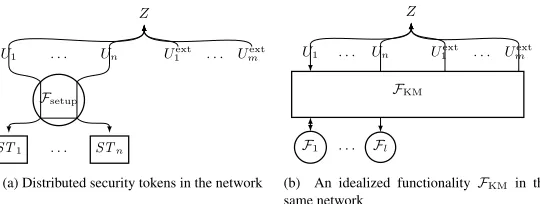
Z
U1 . . . Un U1ext . . . U ext
m
Fsetup
ST1 . . . STn
(a) Distributed security tokens in the network
Z
U1 . . . Un U1ext . . . Umext
ST1
F1 . . . Fl
FKM
(b) An idealized functionality FKM in the same network
Fig. 2: Distributed security tokens in the network (left-hand side) and idealized functionalityFKMin the same network (right-hand side).
Definition 7 (Parameters to a security token network).We summarize the parameters of a security token Network as two tuples, (U,Uext,ST ,Room) and (F,C, Π). The first tuple definesnetwork parameters:
– U ={U1, . . . , Un}are the party IDs of the users connected to a security token – Uext = {Uext
1 , . . . , Umext} are the party IDs of external users, i. e., users that do not have access to a security
token.
– ST ={ST1, . . . ,STn}are the party IDs of the security tokens accessed byU1, . . . , Un.
– Room ⊂ U.
The second tuple defineskey-usage parameters: – F ={F1, . . . ,Fl}, and
– C = {C1, . . . ,Cl} are key-manageable functionalities with corresponding sets of commands. Note thatKW 6∈
{F1, . . . ,Fl}, and that eachCi ∈ C is partitioned into the privateCipriv and public commandsC
pub
i , as well as
the singleton set consisting ofnew.
– Π is a policy forF(cf. Definition 6) and a membership test onΠcan be performed efficiently.
Network setup. Figure 2 shows the network of distributed users and security tokens on the left, and their abstraction FKMon the right. There are two kinds of users:U1, . . . , Un =:U, each of whom has access to exactly one security tokenSTi, and external usersU1ext, . . . , Umext=:Uext, who cannot access any security token. The security tokenSTi
can only be controlled via the userUi. The functionalityFsetupin the real world captures our setup assumptions, which need to be achieved using physical means. Among other things,Fsetupassures a secure channel between each pair (Ui,STi). The necessity of this channel follows from the fact thata) GNUC forbids direct communication between
two regular protocol machines (indirect communication viaAis used to model an insecure channel) andb)U1, . . . , Un can be corrupted by the environment, whileST1, . . . ,STnare incorruptible.
The session idsidis of the form<α1,. . .,αk−1,<prot-fkm,sp>>, where the session parameterspis some encoding of the network parametersU,Uext,ST ,Room. The code itself is parametric in the KU parametersF,C, Π. When we refer toFKMas a network identity, we mean the machine id<ideal,sid>.
Similarly, each security token STi ∈ {ST1, . . . ,STn} is addressed via the machine id<STi,sid>. We will
abuse notation by identifying the machine id withSTi, whenever the session id is clear from the context. The
ses-sion parameter withinsidencodes the network parametersU,Uext,ST ,Room.ST
i makes subroutine calls to the
functionalityFsetupwhich subsumes our setup assumptions.Fsetupprovides two things: 1. a secure channel between each pairUiandSTi, 2. a secure channel between some pairsSTiandSTjduring thesetup phase(see below).STi
receives commands from a machineUi ∈ U, which is defined in Definition 10, and relays arbitrary commands sent by the environment viaFsetup. The environment cannot talk directly toSTi, but the attacker can send queries on behalf
of any corrupted user, given that the user has been corrupted previously (by the environment).
used during the setup phase. Once the setup phase is finished, the expressionsetup finishedevaluates to true and the functionality enters the run phase. During the run phase,Fsetupprovides only a secure channel between a user
Ui, which takes commands from the environment, and his security tokenSTi.When we say thatSTicallsFsetup, we mean that it sends a message to the machine id<STi,<sid,<prot-fsetup,<U,Uext,ST ,Room>>>>.
Implementation. The implementationST is inspired by [10] and is parametric on the KU parametersF,C, Πand the implementation functionsImpl:={ImplF}F ∈F. It is composable in the following sense: if a device performs the key-management according to our implementation, it does not matter how many, and which functionalities it enables access to, as long as those functionalities provide the amount of security the designer aims to achieve (cf. Corollary 1). In Section 5, we show how to instantiate those KU functionalities to fully instantiate a “secure” security token, and howFKMfacilitates analysis of this configuration.
From now on, when we say thatFKMcallsF, we mean that it sends a message to a regular peer that callsF as a sub-protocol and relays the answers. Formally,FKMsends a message to the machine idF =<<reg,F >,sid>, who in turn addresses<<reg,F >,<sid,<F,F>>>as a dummy party. This is necessary since Condition C6 in [11,§4.5] disallows ideal parties from making sub-routine calls. Note first that, for unambiguity, we use the codeF as the party id for this user. Note secondly thatFuses the session parameterF to identifyF as the only machine id it accepts messages from.
Executing commands inCpriv. If the policyΠpermits execution of a commandC ∈ Cpriv,F
KMcalls the corre-sponding functionality as a sub-protocol, substituting the handle by the correcorre-sponding credential. Similarly,STiuses
the corresponding key to compute the output of the implementation functionimplCof the commandC(Listings 3.4
and 2).
command[finish_setup]: accept<C∈ Cipriv,h,m>fromU ∈ U;
if Store[U, h]=<Fi,a,c>and<Fi,C,a,*>∈ΠandFi6=KW
call Fiwith<C,c,m>; accept<C•,r>fromFi; send<C•,r>toU
command[finish_setup]: accept<C∈ Cipriv0 ,h,m>fromFsetup; if Store[Ui,h]=<Fi0,a,k>and<Fi0,C,a,*>∈ΠandFi0 6=KW
send<C•,implC(k, m)>toFsetup
Listing 2: Executing commandCon a handlehwith datam(FKMabove,STibelow).
Creating keys. A user can create keys of typeF and attributeausing the command<new,F,a>. InFKM, the functionalityFis asked for a new credential and some public information. The credential is stored with the meta-data at a freshly chosen positionhin the store. Similarly,ST stores an actual key, instead of a credential. BothFKMand ST output the handlehand the public information given byF, or produced by the key-generation algorithm.FKM treats wrapping keys differently: it calls the key-generation function forKW. It is possible to change the attributes of a key in future, if the policy permits (Listing 6).
new[ready]: accept<new,F,a>fromU ∈ U; if <F,new,a,*>∈Π
if F =KWthen(c,public)←implKWnew (1 η
)
else call Fwith<new>; accept<new•,c,public>fromF
if c∈ K ∪ Kcorthen send<error>toA
else create h; Store[U,h]←<F,a,c>;K:=K ∪ {c}; send<new•,h,public>toU
new[ready]: accept<new,F,a>fromFsetup; if <F,new,a,*>∈Π
(k,public)←implFnew(1 η
); createh; Store[Ui,h]←<F,a,k>;
send<new•,h,public>toFsetup
Listing 3: Creating keys of typeF, and attributea(FKMabove,STibelow).
wrapping key. The wrapping key must of course be on both security tokens prior to that.U1will receive the wrap from ST1and forward it to the environment, which in turn instructsU2to unwrap the data it just received fromU1. The implementationSTi just verifies if the wrapping confirms the policy, and then produces a wrapping ofc2 underc1, with additionally authenticated information: the type and the attribute of the key, plus a user-chosen identifier that is bound to a wrapping in order to identify which key was wrapped. This could, e. g., be a key digest provided by the KU functionality the key belongs to.
wrap[finish_setup]: accept<wrap,h1,h2,id>fromU∈ U;
if Store[U, h1]=<KW,a1,c1>and Store[U, h2]=<F2,a2,c2>and<KW,wrap,a1,a2>∈Π if ∃w.<c2,<F2,a2,id>,w>∈encs[c1]
send<wrap•,w>toU
else
W ← W ∪ {(c1, c2)}; if c1∈ Kcor
for all c3reachable fromc2inWcorruptc3;
w←wrap<F2,a2,id>(c
1,key[c2]) else
w←wrap<F2,a2,id>(c
1,$|c2|)
encs[c1]←encs[c1]∪{<c2,<F2,a2,id>,w>}; send<wrap•,w>toU
wrap[finish_setup]: accept<wrap,h1,h2,id>fromFsetup; if Store[Ui,h1]=<KW,a1,k1>and Store[Ui,h2]=<F2,a2,k2>
and <KW,wrap,a1,a2>∈Π
w←wrap<F2,a2,id>(k
1, k2); send<wrap•,w>toFsetup
Listing 4: Wrapping keyh2under keyh1with additional informationid(FKMabove,STibelow).
When a wrapped key is unwrapped using an uncorrupted key,FKMchecks if the wrapping was produced before, using the same identifier. Furthermore,FKM checks if the given attribute and types are correct. If this is the case, it creates another entry inStore, i. e., a new handleh0 for the userU pointing to thecorrectcredentials, type and attribute type of the key. This way,FKMcan guarantee the consistency of its database for uncorrupted keys, see the following Theorem 1. If the key used to unwrap is corrupted, this guarantee cannot be given, but the resulting entry in the store is marked corrupted. It is possible to inject keys by unwrapping a key that was wrappedoutside the device. Such keys could be generated dishonestly by the adversary, that is, not using their respective key-generation function. unwrap[finish_setup]: accept<unwrap,h1,w,a2,F2,id>fromU∈ U;
if Store[U,h1]=<KW,a1,c1>and<KW,unwrap,a1,a2>∈Π,F2∈ F if c1∈ Kcor
c2←unwrap<F2,a2,id>(c1, w); if c26=⊥andc26∈ K
if F2=KW
create h2; Store[U,h2]←<F2,a2,c2>; key[c2]=c2;Kcor← Kcor∪ {c2} else
call F2with<inject,c2>; accept<inject•,c0>; if c06∈ K ∪ Kcor
create h2;
Store[U,h2]←<F2,a2,c0>; key[c0]=c2;Kcor← Kcor∪ {c0}; send <unwrap•,h>toU
else if c26=⊥ ∧c2∈ K ∧c2 ∈ Kcor
create h2; Store[U,h2]←<F2,a2,c2>; send<unwrap•,h>toU else // (c2=⊥ ∨c2∈ K \ Kcor)
send <error>toA
else if ( c1∈ K/ corand∃!c2.<c2,<F2,a2,id>,w>∈encs[c1]) create h2; Store[U,h2]←<F2,a2,c2>; send<unwrap•,h>toU
if Store[Ui,h1]=<KW,a1,k1>andF2∈ Fand<KW,unwrap,a1,a2>∈Π andk2=unwrap<F2,a2,id>(k1, w)6=⊥
create h2; Store[U,h2]←<F2,a2,k2>; send<unwrap•,h>toFsetup
Listing 5: Unwrappingwcreated with attributea2,F2andidusing the keyh1. The symbol∃!in∃!x.p(x)means there is exactly onexsuch thatp(x)(FKMabove,STibelow).
There is an improvement that became apparent during the proof of emulation ( 2 below ). Namely, when unwrap-ping with a corrupted key, FKM checks the attribute that is going to be assigned to the (imported) key against the policy, instead of just accepting that a corrupted wrapping-key might just import any wrapping the attacker generated. This prevents, for example, a corrupted wrapping-key of low security fromcreatinga high-security wrapping-key by unwrapping dishonestly produced wrappings. This detail in the definition ofFKMenforces a stronger implementation than the one in [10]:ST validates the attribute given with a wrapping, enforcing that it is at least sound according to the policy, instead of blindly trusting the authenticity of the wrapping mechanism. Hence our implementation is more robust.
Changing attributes of keys . : The attributes associated with a key with handle h can be updated using the command<attr change,h,a0>.
attr_change[finish_setup]: accept<attr_change,h,a0>fromU∈ U; if Store[U, h]=<F,a,c>and<F,attr_change,a,a0>∈Π
Store[U, h]=<F,a0,c>; send<attr_change•>toU
attr_change[finish_setup]: accept<attr_change,h,a0>fromFsetup; if Store[Ui,h]=<F,a,k>and<F,attr_change,a,a0>∈Π
Store[Ui,h]=<F,a0,k>; send<attr_change•>toFsetup
Listing 6: Changing the attribute ofhtoa0(FKMabove,STibelow).
Corruption. Since keys might be used to wrap other keys, we would like to know how the loss of a key to the adversary affects the security of other keys. When an environment “corrupts a key” inFKM, the adversary learns the credentials to access the functionalities. Since corruption can occur indirectly, via the wrapping command, too, we factored this out into Listing 7.ST implements this corruption by outputting the actual key to the adversary.
procedure for corrupting a credentialc:
Kcor← Kcor∪ {c}
for any Store[U, h]=<F,a,c> if F =KW
key[c]←c; send<corrupt•,h,c>toA
else
call F with<corrupt,c>; accept<corrupt•,k>fromF
key[c]←k; send<corrupt•,h,k>toA
Listing 7: Corruption procedure used in stepscorruptandwrap
corrupt[finish_setup]: accept<corrupt,h>fromU ∈ U; if Store[U, h]=<F,a,c>
for all c0reachable fromcinWcorruptc0
corrupt[finish_setup]: accept<corrupt,h>fromFsetup; if Store[Ui,h]=<F,a,k>send<corrupt•,h,k>toA
Listing 8: Corruptingh(FKMabove,STibelow).
information. In the case where participants in a high-level protocol make use of, e. g., signature verification, but nothing else, the protocol can be implemented without requiring those parties to have their own security tokens. Note thatFKM relays this call to the underlying KU functionality unaltered, and independent of its store and policy (see Figure 9). public_command: accept<C,public,m>fromU∈ U ∪ Uext
; if C∈ Ci,pub
call Fiwith<C,public,m>; accept<C•,r>fromFi; send<C•,r>toU
Listing 9: Computing the public commandsCusingpublicandm(FKM, note thatSTidoes not implement this step).
The implementationSTidoes not implement this step, sinceUi,UiextcomputeimplC(public, m)themselves.
Before we give the formal definition ofFKM, note thatFKMis not an ideal protocol in the sense of [11,§8.2], since not every regular protocol machine runs the dummy party protocol – the party<reg,Fi>relays the communication
with the KU functionalities.
Definition 8 (FKM).Given the KU parametersF,C, Π, let the ideal protocolsFp+1, . . . ,Flbe rooted atprot-Fp+1,. . . , prot-Fl. In addition to those protocols names, FKM defines the protocol name prot-fkm. For prot-fkm, the protocol defines the following behaviour: a regular protocol machine with machine id<<reg,Fi>,sid>for
Fi∈ {F1, . . . ,Fl}runs the following code:
ready: accept<ready>from parentId send<ready>to<ideal,sid>(=FKM)
relay_to: accept<m>from<ideal,sid>(=FKM)
send<m>to<<reg,Fi>,<sid,<prot-Fi,<>>>(=Fi)
relay_from: accept<m>from<<reg,Fi>,<sid,<prot-Fi,<>>> send<m>to<ideal,sid>(=FKM)
The ideal party runs the logic forFKMdescribed in Listings 3 to 8.
Remark 1:Credentials for different KU functionalities are distinct. It is nonetheless possible to encrypt and decrypt arbitrary credentials using<wrap>and<unwrap>. Suppose a designer wants to prove a Security API secure which uses shared keys for different operations. One way or another, she would need to prove that those roles do not interfere. For this case, we suggest providing a functionality that combines the two KU functionalities, and proving that the implementation of the two operations combined emulates the combined functionality. It is possible to assign different attributes to keys of the same KU functionality, and thus restrict their use to certain commands, effectively providing different roles for credentials to the same KU functionality. This can be done by specifying two attributes for the two roles and defining a policy that restricts which operation is permitted for a key of each attribute.
Remark 2:Many commonly used functionalities are notcaller-independent, often the access to critical functions is restricted to a network party that is encoded in the session identifier. However, we think that it is possible to con-struct caller-independent functionalities for many functionalities, if the implementation relies on keys but is otherwise stateless. A general technique for transforming such functionalities into key-manageable functionalities that preserves existing proofs is work in progress.
Remark 3:Constraint C6 in [11,§8.2] requires each regular machine to send a message toFsetupbefore it can ad-dress it. The initialization procedure and the parts of the definition ofFKM,ST andFsetupthat perform this procedure are explained in detail in Appendix A.
Properties. In order to identify some properties we get from the design ofFKM, we introduce the notion of an attribute policy graph:
Definition 9. We define a family of attribute policy graphs(AΠ,F), one for each KU functionalityF and one for key-wrapping (in which caseF=KW) as follows:
– ais a node inAΠ,Fif(F, C, a, a0)∈Πfor someC, a0. – ais additionally markednewif(F,new, a, a0)∈Π.
Example 3. For the policyΠdescribed in Example 2, the attribute policy graphAΠ,KWcontains one node1connected to itself and markednew. Similarly, the attribute policy graphAΠ,Fenc contains one node0 connected to itself and markednew.
The following theorem shows that, first, the set of attributes an uncorrupted key can have inFKMis determined by the attribute policy graph, second, there are exactly three ways to corrupt a key, and third, KU-functionalities receive thecorruptmessage only if a key is corrupted. The formal proof of these claims can be found in Appendix C. Theorem 1 ( Properties ofFKM). Every instance ofFKMwith parametersF,C, Πand session parametersU,Uext, ST ,Roomhas the following properties:
(1) At any step of an execution of[FKM,AD, Z], the following holds forFKM: for allStore[U, h] =< F, a, c > such thatc 6∈ Kcor, there is a nodea0 markednewin the attribute policy graphAΠ,F such thatais reachable froma0inAΠ,Fand there was a stepnewwhereStore[U0, h0] =<F, a0, c >was added.
(2) At any step of an execution of[FKM,AD, Z], the following holds forFKM: allc∈ Kcorwere either
(a) directly corrupted:there was acorrupttriggered by a query<corrupt,h>fromUwhileStore[U,h]=<
F, a, c >, or indirectly, that is,
(b) corrupted via wrapping:there isc0∈ Kcorsuch that at some point thewrapstep was triggered by a message <wrap,h0,h,id>fromU whileStore[U, h0]=<KW, a0, c0>,Store[U,h]=<F, a, c >, or
(c) corrupted via unwrapping (injected): there is c0 ∈ Kcor such that at some point the unwrap step was triggered by a message <unwrap,h0,w,a,F,id> from U while Store[U,h0]=< KW, a0, c0 > and
c=unwrap<F,a,c0 id>(w)for somea, F andid.
(3) At any step of an execution of[FKM,AD, Z], the following holds: whenever an ideal machineFi=<ideal,<sid,<Fi,F>>>, F =<<reg,F >,<sid>>, accepts the message<corrupt,c>for somecsuch thatFKMin sessionsidhas
an entryStore[U, h]= <Fi,a,c>, thenc∈ KcorinFKM.
4
Proof overview
We show that, for arbitrary KU parametersF,C, Π, the networkπF,C,Π,Impl, consisting of the set of usersUconnected to security tokens ST, the set of external usersUext and the functionality F
setup, emulates the key-management functionalityFKM. We will only give a proof sketch here, the complete proof can be found in the full version [18].
LetπF,C,Π,Impl(in the following:π) denote the network consisting of the programsπ(prot−fkm)andπ(prot−fsetup).
π(prot−fkm)defines the behaviours for users inU,UextandST. Parties inU ∪ Uextwill act according to the con-vention on machine corruption defined in [11,§8.1], while parties inST will ignore corruption requests (security tokens are assumed to be incorruptible).π(prot−fkm)istotally regular, that is, for other machines, in particular ideal machines, it responds to any message with an error message to the adversary. The protocolπis aFsetup-hybrid protocol.
The proof thatπimplementsFKMproceeds in several steps: making use of the composition theorem, the last func-tionalityFlinFKMcan be substituted by its key-manageable implementationIˆL. Then,FKMcan simulateIˆinstead of calling it. LetF{Fl/Iˆl}
KM be the resulting functionality. In the next step, calls to this simulation are substituted by calls to the functions used inIˆ,implCfor eachC ∈ Cl. The resulting, partially implemented functionalityF
{Fl/ImplFl}
KM saves keys rather than credentials (forFl). We repeat the previous steps untilFKMdoes not call any KU functionalities anymore, i. e., we haveF{F1/ImplF1,...,Fn/ImplFn}
KM . Then we show that the network of distributed tokenπemulates the monolithic blockF{F1/ImplF1,...,Fn/ImplFn}
KM that does not call KU functionalities anymore, using a reduction to the security of the key-wrapping scheme. This last step requires the restriction of the set of environments to those which guarantee that keys are not corrupted after they have been used to wrap. The notion of aguaranteeing environment, and the predicatecorrupt-before-wrapare formally defined in Appendix D.
The first four steps are the subject of Lemma 1, the last step is Lemma 2:
Lemma 1. Let F,C, Π be KU parameters such that allF ∈ F are key-manageable. LetImplF
i be the functions defining the key-manageable implementationIiˆ ofFi. ThenF
F1/ImplF
1,...,Fl/ImplFl
Lemma 2. For any KU parameterF,C, Πand set of sets of PPT algorithmsImpl, letFimpl
KM :=F
F1/ImplF1,...,Fl/ImplFl
KM
be the partial implementation ofFKMwith respect to all KU functionalities inF. IfKW = (implKWnew,wrap,unwrap)
is a secure and correct key-wrapping scheme (Definition 12) thenπF,C,Π,ImplemulatesFimpl
KM for environments that guaranteecorrupt-before-wrap.
The main result follows from the transitivity of emulation and Lemmas 1 and 2:
Corollary 1. LetF,C, Π be KU parameters such that allF ∈ F are key-manageable. LetImplFi be the functions defining the key-manageable implementationIiˆ ofFi. IfKW = (implKWnew,wrap,unwrap) is a secure and correct
key-wrapping scheme, thenπF,C,Π,ImplemulatesFKMfor environments that guaranteecorrupt-before-wrap.
5
Realizing key-usage functionalities for a static key-hierarchy
To demonstrate the use of Corollary 1, we equip the security token with the functionalitiesF1 =FRandandF2 = FSIG described below. The resulting security token STFRand,FSIG is able to encrypt keys and random values and sign user-supplied data. It is not able to sign keys, as this task is part of the key-management. The first functionality, FRand, is an unusual functionality, but demonstrates what can be done within the design of FKM, as well as it’s limitations: It models how random values can be stored as keys, with tests of equality and corruption, which means here that the adversary learns the value of the random value. Since our framework requires a strict division between key-management and usage, they can be transmitted (using wrap) and compared, but not appear elsewhere, since other KU functionalities shall not use them. We defineFRandas follows:
new: accept <new>from parentId (=:p);
c← {0,1}η
;L←L∪ {(c,0)}; send<new•,c,>top
command: accept<equal,c,n>fromp; if (c, k)∈Lfor somek
if k6∈ Kcorsend<equal•,false>top else if n=ksend<equal•,true>top
corrupt: accept<corrupt,c>fromp; if (c,0)∈L
k← {0,1}η
;L←(L\ {(c,0)})∪ {(c, k)};Kcor=Kcor∪ {k}; send<corrupt•, k>toA
inject: accept<inject,n>fromP; (c,<ignore>)←KG(1η);K
cor← Kcor∪ {n};L←L∪ {(c, n)}; send<inject•,c>to parentId
( for new:)implnewon input1η
n← {0,1}η; output (n,\)
( for command:)implequalon inputn, n 0
output n=n0
Due to space restrictions, the signature functionalityFSIG is presented in Appendix E. In the following, we will considerFKMfor the parametersF ={FRand,FSIG},C={{equal},{sign,verify}}and a static key-hierarchy
Π, which is defined as the relation that consists of all 4-tuples (F,Cmd,attr1,attr2) such that the conditions in one of the lines in the following table holds. Note that we omit the “=” sign when we mean equality and “*” denotes that no condition has to hold for the variable.
F Cmd attr1 attr2
KW new >0 *
6=KW new 0 *
* attribute change a a
KW wrap >0 attr1>attr2
KW unwrap >0 attr1>attr2
Theorem 1 allows immediately to conclude some useful properties on this instantiation of FKM: from (1) we conclude that all keys with c /∈ Kcor have the attribute they were created with. This also means that the same credential has the same attribute, no matter which user accesses it. From (2), we can see that for each corrupted credentialc ∈ Kcor, there was either a query <corrupt,h>, whereStore[U,h]=< F, a, c >, or there ex-istsStore[U,h0]=<KW, a0, c0 >,Store[U,h]=<F, a, c >and a query<wrap,h0,h,id>was emitted, for
c0 ∈ Kcor, or an unwrap query<unwrap,h0,w, a, F,id>for ac∈ Kcorwas emitted. By the definition of the strict key-hierarchy policy, in the latter two case we have thata0 > a. It follows that, for any credentialcforF, such that Store[U,h]=<F, a, c >for someU, handa,c6∈ Kcor, as long as every corruption query<corrupt,h∗>atU was addressed to a different key of lower or equal rank key, i. e.,Store[U,h∗]=<KW, a∗, c∗>,c∗6=canda∗≤a. By(3), those credentials have not been corrupted in their respective functionality, i. e., it has never received a message <corrupt,c>.
6
Conclusions and outlook
We have presented a provably secure framework for key management in the GNUC model. In further work, we are currently developing a technique for transforming functionalities that use keys but are not manageable into key-manageable functionalities in the sense of Definition 4. This way, existing proofs could be used to develop a secure implementation of cryptographic primitives in a plug-and-play manner. Investigating the restrictions of this approach could teach us more about the modelling of keys in simulation-based security.
References
1. RSA Security Inc.: PKCS #11: Cryptographic Token Interface Standard v2.20. (June 2004)
2. IBM: CCA Basic Services Reference and Guide. (October 2006) Available online at http://www-03.ibm.com/ security/cryptocards/pdfs/bs327.pdf.
3. Trusted Computing Group: TPM Specification version 1.2. Parts 1–3, revision 103. http://www. trustedcomputinggroup.org/resources/tpm\_main\_specification(2007)
4. Longley, D., Rigby, S.: An automatic search for security flaws in key management schemes. Computers and Security11(1) (March 1992) 75–89
5. Bond, M., Anderson, R.: API level attacks on embedded systems. IEEE Computer Magazine (October 2001) 67–75
6. Bortolozzo, M., Centenaro, M., Focardi, R., Steel, G.: Attacking and fixing PKCS#11 security tokens. In: Proc. 17th ACM Conference on Computer and Communications Security (CCS’10), Chicago, Illinois, USA, ACM Press (October 2010) 260– 269
7. Cortier, V., Keighren, G., Steel, G.: Automatic analysis of the security of XOR-based key management schemes. In: Tools and Algorithms for the Construction and Analysis of Systems (TACAS’07). Number 4424 in LNCS (2007) 538–552
8. Delaune, S., Kremer, S., Steel, G.: Formal analysis of PKCS#11 and proprietary extensions. Journal of Computer Security 18(6) (November 2010) 1211–1245
9. Cachin, C., Chandran, N.: A secure cryptographic token interface. In: Proc. 22th IEEE Computer Security Foundation Sym-posium (CSF’09), IEEE Comp. Soc. Press (2009) 141–153
10. Kremer, S., Steel, G., Warinschi, B.: Security for key management interfaces. In: Proc. 24th IEEE Computer Security Foun-dations Symposium (CSF’11), IEEE Comp. Soc. Press (2011) 66–82
11. Hofheinz, D., Shoup, V.: GNUC: A new universal composability framework. Cryptology ePrint Archive, Report 2011/303 (2011)http://eprint.iacr.org/.
12. Canetti, R.: Universally composable security: A new paradigm for cryptographic protocols. Cryptology ePrint Archive, Report 2000/067 (December 2005) Updated version of [19]http://eprint.iacr.org/.
13. K¨usters, R., Tuengerthal, M.: Ideal Key Derivation and Encryption in SimulationBased Security. In: Topics in Cryptology -CT-RSA’11. Volume 6558 of LNCS., Springer (2011) 161–179
14. Hofheinz, D.: Possibility and impossibility results for selective decommitments. J. Cryptology24(3) (2011) 470–516 15. Backes, M., D¨urmuth, M., Hofheinz, D., K¨usters, R.: Conditional reactive simulatability. International Journal of Information
Security (IJIS) (2007)
16. K¨usters, R.: Simulation-Based Security with Inexhaustible Interactive Turing Machines. In: Proc. 19th IEEE Computer Security Foundations Workshop (CSFW’06), IEEE Comp. Soc. Press (2006) 309–320
18. Kremer, S., K¨unnemann, R., Steel, G.: Universally composable key-management. IACR Cryptology ePrint Archive (2012) 19. Canetti, R.: Universally composable security: A new paradigm for cryptographic protocols. In: Proc. 42nd Annual Symposium
on Foundations of Computer Science (FOCS’01), IEEE Computer Society Press (October 2001) 136–145
20. Rogaway, P., Shrimpton, T.: Deterministic authenticated encryption: A provable-security treatment of the keywrap problem. In: Advances in Cryptology — EUROCRYPT’06. Volume 4004 of LNCS., Springer (2006) 373–390
21. K¨usters, R., Tuengerthal, M.: Joint State Theorems for Public-Key Encryption and Digitial Signature Functionalities with Local Computation. In: Proc. 21st IEEE Computer Security Foundations Symposium (CSF’08), IEEE Comp. Soc. Press (2008) 270–284
A
Initialisation and Setup
A.1 Initialisation phase
All regular protocol machines that shall accept messages fromFKMneed to send a message toFKMfirst [11,§4.5]. A similar behaviour needs to be emulated by Fsetup in the network with the actual tokens. The involved protocol machines areM:=U ∪ ST ∪ {F1, . . . ,Fl}, whereFi denotes the regular protocol machine that makes subroutine
calls toFi, identified with the machine id<<reg,Fi>,sid >.
We add the following part to the definition ofFKM: ready−P: accept<ready>fromP ∈ M
send<ready•,P>toA
ready [ready-P ∀P∈ M ]
Listing 10: Initilisation (FKM). We add the following part to the definition ofST:
ready [¬ ready]:
accept <ready>from parentId call Fsetupwith<ready>
Listing 11: Initilisation (STi).
A.2 Handling of the setup phase inFKMandSTi
The following listings describe the setup phase, introduced on page 9: share[¬finish_setup∧ready]: accept<share,h1,U2>fromU1∈ U;
if Ui, U2∈Room
create h2; Store[U2,h2]=Store[U1,h1]; send<share•,h2>toU2
Listing 12: The setup phase: sharing keys (FKM).
share[¬finish_setup∧ready]: accept<share,h1,U2>fromFsetup; if Store[U,h1]=scallFsetupwith<send,s,U2>
import[¬finish_setup∧ready]:accept<deliver,s,U1>fromFsetup if U1∈Roomcreateh2; Store[Ui,h2]=s; send<share•,h2>toFsetup
Listing 13: The setup phase: sharing keys (STi).
finish_setup[¬finish_setup∧ready]: accept<finish_setup>fromU ∈ U; send<finish_setup•>toA
finish_setup[¬finish_setup∧ready]: accept<close>fromFsetup; send<close•>toFsetup
Listing 15: The setup phase: terminating the setup phase (STi).
A.3 Setup assumptions for the implementation
The setup assumption used forSTis subsumed in the setup functionalityFsetup, which is defined as follows: ready−Ui: accept<ready,STi>fromUi∈ U
send<ready•,Ui>toA
ready−P: accept<ready>fromP ∈ M \ U
send<ready•,P>toA
ready [ready-P ∀P∈ M]
share[ready∧ ¬finish_setup]: accept<send,x,STj>fromSTi
if Ui, Uj∈Room
send<deliver,x,STi>toSTj
else
send<⊥,STi>toUi
finish_setup[ready∧¬finish_setup]: accept <finish_setup>fromU ∈ U
fromi:=1 to n
send<close>toSTi; accept<close•>fromSTi
send<finish_setup•>toA
relay receive[ready]: accept<x,STi>fromUi; send<x>toSTi
relay send[ready]: accept<x>fromSTi;send<x,STi>toUi
B
Security Token Network
Definition 10 (Security token network).For KU parametersF,C, Πand implementation functionsImpl:={ImplF}F∈F, define the protocolπF,C,Π,Implas follows:πF,C,Π,Impldefines onlyπF,C,Π,Impl(prot−fkm)andπF,C,Π,Impl(prot−fsetup). The session parameter is expected to be an encoding of the network parametersU,Uext,ST ,Room. The code executed
depends on the party runningπF,C,Π,Impl(prot−fkm): if the party has identity<<reg,u-i>,sid>, the following codeUiis executed:
relay_to: accept<m>from parentId call Fsetupwith<m, STi>
relay_from: accept<m,STi>or<m=⊥>fromFsetup
send<m>to parentId
public_command:
accept <C,public,m>from parentId if C∈ Ci,pub
send<C•,implC(public, m)>to parentId
If the party has identityext-u-i, the following codeUext
i is executed:
public_command:
accept <C,public,m>from parentId if C∈ Ci,pub
send<C•,implC(public, m)>to parentId
ready: accept<ready>from parentId call Fsetupwith<ready>
All other regular protocol machines run the code of the dummy adversary. If the party has identity<<reg,st-i>,sid>, thenSTi is executed. The code forSTi is given in Section 3.4 and in Appendix A. For parties with the identities
<<reg,u-i>,sid>or <<reg,ext-u-i>,sid>,πF,C,Π,Impl will act according to the convention on machine corruption defined in [11,§8.1], while for<<reg,st-i>,sid>, it will ignore corruption request (security tokens are assumed to be incorruptible). For other machines, including ideal machines, it responds to any message with an er-ror message to the adversary, i. e.,πF,C,Π,Impl(prot−fkm)istotally regular.πF,C,Π,Impl(prot−fkm)declares the use ofprot-fsetupas a subroutine.πF,C,Π,Impl(prot−fsetup)runsFsetup, i. e.,πF,C,Π,Implis aFsetup-hybrid protocol.
C
Proof for Theorem 1
Theorem 1 ( Properties ofFKM).Every instance ofFKMwith parametersF,C, Πand session parametersU,Uext, ST ,Roomhas the following properties:
(1) At any step of an execution of[FKM,AD, Z], the following holds forFKM: for allStore[U, h] =< F, a, c > such thatc 6∈ Kcor, there is a nodea0 markednewin the attribute policy graphAΠ,F such thatais reachable froma0inAΠ,Fand there was a stepnewwhereStore[U0, h0] =<F, a0, c >was added.
(2) At any step of an execution of[FKM,AD, Z], the following holds forFKM: allc∈ Kcorwere either
(a) directly corrupted:there was acorrupttriggered by a query<corrupt,h>fromUwhileStore[U,h]=<
F, a, c >, or indirectly, that is,
(b) corrupted via wrapping:there isc0∈ Kcorsuch that at some point thewrapstep was triggered by a message <wrap,h0,h,id>fromU whileStore[U, h0]=<KW, a0, c0>,Store[U,h]=<F, a, c >, or
(c) corrupted via unwrapping (injected): there is c0 ∈ Kcor such that at some point the unwrap step was triggered by a message <unwrap,h0,w,a,F,id> from U while Store[U,h0]=< KW, a0, c0 > and
c=unwrap<F,a,c0 id>(w)for somea, F andid.
(3) At any step of an execution of[FKM,AD, Z], the following holds: whenever an ideal machineFi=<ideal,<sid,<Fi,F>>>, F =<<reg,F >,<sid>>, accepts the message<corrupt,c>for somecsuch thatFKMin sessionsidhas
an entryStore[U, h]= <Fi,a,c>, thenc∈ KcorinFKM.
Proof. (1) Proof by induction over the number of epochs sinceFKM’s first activation,t: ift= 0,Storeis empty.t > 0: since the property was true in the previous step, there are only three steps we need to look at: if a key<F,a,c>
is added toStoreat stepnew, then it is created only if the policy contains an entry(F,new,a), i. e.,aitself is anew
node. If a key<F,a,c>is added toStoreat stepunwrap, let<unwrap,h1,w,F,id>be the arguments sent by a userU, andStore[U,h1]=<KW,aw,cw>. Ifc 6∈ Kcor, thencw 6∈ Kcor, too, and thus there is an entry< c, <F, a,id >, w >∈encs[cw].encsis only written inwrap, therefore there was a position[U0, h0]
in the store, such thatStore[U0,h0]=<F,a,c>. Using the induction hypothesis, we see thatais reachable in the attribute policy graph. The third and last step where the store is written to isAttributeChange. If this step alters the attribute froma0toa, there must have been an entry(F,attribute change, a0, a)∈Π. By induction hypothesis,a0is reachable from anewnode, thereforea0is, too.
(2) A credentialcis only added to the setKcorin three steps: if it is added incorrupt, then a message<corrupt,h> was received fromU ∈ U andStore[U,h]=< F, a, c >. If it was added inwrap, then a message<wrap,
h1,h2> must have been received from U ∈ U while Store[U,h1]=< KW, a1, c1 >, and c was reach-able fromc1. Let c0 be the last node on the path to c.c0 ∈ Kcor because it is reachable from c1, too. Since (c0, c) ∈ W, there was another wrapping query<wrap,h0,h,id>withStore[U,h0]=< KW, a0, c0 >and Store[U,h]=<F, a, c >. Since entries in the store are never deleted (only the attribute can be altered), and credentials are never removed fromKcor, the property holds in this case. If it was added inunwrap, thenc6∈ K at this point in time, andc =unwrap<F,a,c0 id>(w)6= ⊥. Furthermore, we observe that the conditionals prior to
(3) Iiˆ accepts only messages coming from the partyF, andF in turn only accepts messages coming from FKM. Therefore, we can conclude from the definition of stepcorruptinFKMthatc∈ Kcor.
D
Proofs for Lemma 1 and Lemma 2
The static call graph has only an edge fromprot-fkmtoprot-fsetup,πF,C,Π,Implis thus rooted atprot-fkm. Lemma 3. For all KU parametersF,C, Π,πF,C,Π,Implis a poly-time protocol.
Proof. By Definition 2 in [11,§6], we need to show that there exists a polynomialpsuch that for every well-behaved environmentZthat is rooted atprot-fkm, we have:
Pr[TimeπF,C,Π,Impl[πF,C,Π,Impl,AD, Z](η)
> p(FlowZ→πF,C,Π,Impl,AD[πF,C,Π,Impl,AD, Z](η))]
= negl(η).
Letpmaxbe a polynomial such that for allFiandC∈ C, the algorithmimplCterminates in a running time smaller
thanpmax(n), wherenis the length of the input.implFnewis always called on input of lengthη, thus all keys have a
length smallerpmax(η). In stepnew,Fandaare provided by the environment (as input toUi, which then asksFsetupto relay the request toSTi). Since messages have at least lengthη, we can overapproximate by saying thatStoregrows
at most by some polynomialpgrowth−new in the length of the environment’s input. Similarly, an<unwrap,...> query cannot grow the Store by more thanpgrowth−unwrap. Therefore, at any point in timet(we simply count the num-ber of epochs, i. e., activations of the environment), the store is smaller thanp0(FlowZ→πF,C,Π,Impl,AD[πF,C,Π,Impl,AD, Z](η))
for a polynomialp0.
We observe that there is not a single activation of a machine inπF,C,Π,Impl, neither aUi, anSTinorFsetup, where the running time is not polynomial in the environment’s input and the length of theStore.ADmight corrupt user U ∈ U ∪ Uext, but they do not have any state. Thus, we have for the running time ofπ
F,C,Π,Impl at pointt, i. e.,
TimeπF,C,Π,Impl,t[πF,C,Π,Impl,AD, Z](η),
TimeπF,C,Π,Impl,t[πF,C,Π,Impl,AD, Z](η)
= TimeπF,C,Π,Impl,t−1[πF,C,Π,Impl,AD, Z](η)+
p0(FlowZ→πF,C,Π,Impl,AD[πF,C,Π,Impl,AD, Z](η))
≤t·p0(FlowZ→πF,C,Π,Impl,AD[πF,C,Π,Impl,AD, Z](η))
≤p00(FlowZ→πF,C,Π,Impl,AD[πF,C,Π,Impl,AD, Z](η))
for another polynomialp00, because
t <FlowZ→πF,C,Π,Impl,AD[πF,C,Π,Impl,AD, Z](η)).
The proof thatπimplementsFKMproceeds in several steps: making use of the composition theorem, the last func-tionalityFlinFKMcan be substituted by its key-manageable implementationILˆ . Then,FKMcan simulateIˆinstead of calling it. LetF{Fl/Iˆl}
KM be the resulting functionality. In the next step, calls to this simulation are substituted by calls to the functions used inIˆ,implCfor eachC ∈ Cl. The resulting, partially implemented functionalityF
{Fl/ImplFl}
KM saves keys rather than credentials (forFl). We repeat the previous steps untilFKMdoes not call any KU functionalities anymore, i. e., we haveF{F1/ImplF1,...,Fn/ImplFn}
KM . Then we show that the network of distributed tokenπemulates the monolithic blockF{F1/ImplF1,...,Fn/ImplFn}
KM that does not call KU functionalities anymore, using a reduction to the security of the key-wrapping scheme.
Definition 11 (FKMwith partial implementation).Given the KU parametersF,C, Π, and functions(implKWnew,wrap,unwrap),
letImplFibe the algorithms defining the keymanageable implementationIiˆ ofFi∈ {F1, . . . ,Fp} ⊂ F. We will define
the partial implementation ofFKMwith respect to the KU functionalitiesF1, . . . ,Fp, denotedF
{F1/ImplF1,...,Fp/ImplFp}
KM ,
Let the ideal protocolsFp+1, . . . ,Flbe rooted atprot-Fp+1,. . . ,prot-Fl. In addition to those protocols names,
F{F1/ImplF1,...,Fp/ImplFp}
KM , defines the protocol nameprot-fkm. Forprot-fkm, the protocol defines the following behaviour: a regular protocol machine with machine id<<reg,Fi>,sid>forFi∈ {F1, . . . ,Fl}runs the following
code:
ready: accept<ready>from parentId send<ready>to<ideal,sid>(=FKM)
relay_to: accept<m>from<ideal,sid>(=FKM)
send<m>to<<reg,Fi>,<sid,<prot-Fi,<>>>(=Fi)
relay_from: accept<m>from<<reg,Fi>,<sid,<prot-Fi,<>>> send<m>to<ideal,sid>(=FKM)
The ideal party runs the logic forFKMdescribed in Section-3.4, with the following alteration of the corrupt macro used in thecorruptandwrapstep:
Kcor← Kcor∪ {c}
for any Store[U, h]=<F,a,c>
if F ∈ {KW,F1, . . . ,Fp} key[c]←c
send<corrupt•,h,c>toA
else
call F with<corrupt,c>
accept <corrupt•,k>fromF
key[c]←k
send<corrupt•,h,k>toA
Listing 16: procedure for corrupting a credentialc
and in thenew, command, public commandandunwrapsteps:
new[ready]: accept<new,F,a>fromU ∈ U
if <F,new,a,*>∈Πthen if F ∈ {F1, . . . ,Fp}
(k,public)←implF new(1
η)
create h; Store[U,h]←<F,a,k>
K ← K ∪ {k}
send<new•,h,public>toU
else if F=KW
(k,public)←implKWnew (1 η
)
if k∈ K ∪ Kcor
send <error>toA
else
create h; Store[U,h]←<F,a,k>
K ← K ∪ {k}
send <new•,h,public>toU
else
call F with<new>
accept <new•,c,public>fromF
if c∈ K ∪ Kcor
send <error>toA
else
create h; Store[U,h]←<F, a, c>
send <new•,h,public>toU
command[finish_setup]: accept <C,h,m>fromU ∈ U
if Store[U,h]=<F,a,c>and<F,C,a,*>∈Π
if F ∈ {F1, . . . ,Fp}
send <C•,implC(c, m)>toU else if F6=KW
call Fwith<C,c,m>
accept <C•,r>fromF
send <C•,r>toU
public_command:
accept <C,public,m>fromU ∈ U
if C∈ Ci,pub
if F ∈ {F1, . . . ,Fp}
send <C•,implC(public, m)>toU else
call Fiwith<C,public,m> accept <C•,r>fromFi send <C•,r>toU
unwrap[finish_setup]: accept <unwrap,h1,w,a2,F2,id>
fromU ∈ U
if Store[U,h1]=<KW,a1,c1>and
<KW,unwrap,a1,a2>∈Π,F2∈ F
if c1∈ Kcor
c2=unwrap<F2,a2,id>(c1, w)
if c26=⊥andc26∈ K
Kcor← Kcor∪ {c2}
if F2∈ {KW,F1, . . . ,Fp} create h2
Store[U,h2]←<F2,a2,c2>
key[c2]=c2
else
call F2with<inject,c2>
accept <inject•,c0>
if c06∈ K ∪ Kcor
create h2
Store[U,h2]←<F2,a2,c0>
key[c0]=c2
send <unwrap•,h>toU
else if c26=⊥,c2∈ Kandc2∈ Kcor
create h2
Store[U,h2]←<F2,a2,c2>
send <unwrap•,h>toU
else // (c2=⊥ ∨c2∈ K \ Kcor)
send <error>toA
else if ( c1∈ K/ corand
∃!c2.<c2,<F2,a2,id>,w>∈encs[c1])
create h2
Store[U,h2]←<F2,a2,c2>
send<unwrap•,h>toU