Sampling Big Sagebrush for Phytomass
D. W. URESK, R. 0. GILBERT, AND W. H. RICKARD
Highlight: A double sampling procedure was employed for obtaining more reliable weight estimates for leaves, flowering stalks, live wood, dead wood, various combinations of the preced- ing, and total phytomass of sagebrush shrubs. Easily obtained dimension measurements were related to harvest categories using regression analyses. Volume (length x width x height) and length measurements were the most highly correlated to phytomass. Double sampling reduced the variance of the mean phytomass estimates ranging from 33% to 80% for the various categories assuming optimum allocation. The precision achieved by com- bining dimension measurements with harvesting is significantly higher than by harvests without supporting dimensional measure- ments.
Efforts to obtain reliable phytomass estimates for rangeland shrubs by harvest methods are time consuming and costly. One approach is to establish a relationship between one or a few easily obtained plant measurements and harvest data. This approach has been termed double sampling or dimension analysis.
Aboveground phytomass has seldom been measured in desert shrubs. Harniss and Murray (1976) found a relationship be- tween foliage of big sagebrush and the independent variables, circumference, and height of plant. A correlation (Z?’ = 0.93) was obtained with the developed dry weight predictor to
determine total phytomass estimates of sagebrush. Chew and Chew (1965) determined shrub weights of creosotebush (Larrea divaricata) in Arizona, and Ludwig et al. (1975) used a double sampling method involving dimension analysis to estimate phytomass on eight species of desert shrubs in New Mexico. The results show that volume and canopy area were generally suitable estimators. Medin (1960) used a crown diameter- weight relationship to predict foliage phytomass in mountain- mahogany (Cercocarpus montanus) shrubs on Colorado mule deer range. There appears to be little published data on phytomass sampling in big sagebrush (Artemisia tridentutu) in
the Pacific Northwest (Daubenmire 1970).
Authors are research scientist and senior research scientists, Battelle, Pacific North- west Laboratories, Richland, Washington 99352.
Work was performed under contract EY-76-C-06-1830 with the U.S. Energy Research and Development Administration and National Science Foundation Grant GB-3 1862X2 to the Grassland Biome, U.S. International Biological Program for “Analysis of Structure, Function, and Utilization of Grassland Ecosystems.”
Thanks are extended to V. D. Charles and H. A. Sweany for their technical assistance in the field. Appreciation is expressed to C. A. Lee for hand separating the phytomass categories of big sagebrush.
Manuscript received August 28, 1976.
This paper presents the results of a double sampling pro- cedure to obtain more reliable phytomass estimates of leaves, flowering stalks, live wood, leaves + live wood, dead wood, live wood + dead wood, flowering stalks + leaves, miscellane- ous fragments, and total phytomass for big sagebrush, the most abundant shrubby species in the shrub-steppe region of south- eastern Washington.
Study Area and Methods
The study site is located on the Arid Lands Ecology (ALE) Reserve on the United States Energy Research and Development Administra- tion’s Hanford Reservation. Topographically, the site is located on the low, east-facing slopes of the Rattlesnake Hills at an elevation of about 1,300 feet above mean sea level. The vegetation of the area representative of the Artemisia tridentata/Agropyron spicatum associ- ation (Daubenmire 1970). Prior to the initiation of the study reported here, there had been little or no grazing by domestic livestock since
1943 (Rickard et al. 1975).
In November 1974, a total of 20 (n) big sagebrush shrubs were selected within a 300 x 300-m experimental pasture. The shrubs were not selected in a strictly random manner; instead, attempts were made to obtain a sample of different sized shrubs varying from smallest largest. For each of the D shrubs the following dimensions were measured: (1) longest diameter of the canopy, (2) longest diameter the canopy measured at right angles to the above dimension, and (3) maximum heights. The individual shrubs were then cut off at ground level and oven-dried weights obtained for the following hand- separated categories: leaves, livewood, flowering stalks, dead wood, dead leaves, and miscellaneous parts. These dimensions were also taken on all sagebrush shrubs (n’) rooted within eight I5 X 30-m plots located at random within the larger 300 X 300-m pasture.
The objective of this sampling design was to minimize the variance of the estimated mean phytomass for each category for a fixed cost. The sampling procedure involved double sampling in conjunction with linear regression (Cochran 1963, p. 327-354). Double sampling is a combination of two different methods for estimating phytomass: (1) clipping, separating, and obtaining dry weights of total shrubs and shrub parts, and (2) taking height, length, width, or volume (length width X height) dimension measurements on shrubs, including those harvested. Double sampling can be effective in reducing the variance of mean phytomass estimates if the linear correlation p between phytomass and dimension measurements is sufficiently near 1, and the cost (Cn’) of making dimension measurements on a shrub is sub-
stantially less than the cost (cn) of clipping, drying, and weighing. Cochran’s (1963) Figure 12.1 (page 338) gives the relation between Cn/cn’ and p for fixed values of the relative precision of double and single sampling.
Dimension and oven-dry weight measurements were obtained for the n clipped shrubs. These data were used to estimate a linear legression (calibration) equation relating phytomass (dependent variable) with all shrub dimensions (independent variable). A separate equation was estimated for each phytomass category. The additional information contained in the dimension measurements obtained on each of the II’ shrubs within the eight 15 X 30-m plots were used in conjunction with the regression equation to estimate the mean phyto- mass per shrub (ydS; d.s stands for double sampling) for each category. The equation is
where r, is the mean phytomass per shrub based on the n = 20 clipped shrubs, 2, is the mean volume of the 20 clipped shrubs, b is the estimated slope of the regression of biomass per shrub on volume per shrub, and Xnr is the mean volume per shrub of the n’ = 568 shrubs in the eight plots. Volume was usually chosen as the independent variable because it generally had the highest estimated correlation b with all biomass categories.
The variance of pdS was estimated using the approximate formula
Var (YdS) = PY_x [ fi + . -
where ,PYax is the residual variance about the regression line, s2, is the variance-of the 20 biomass data points, _.
20
c (Xi - X,)’ i=l
is the sum of squared deviations of the 20 volume measurements from their mean &,-n is the number of shrubs for which both biomass and volume measurements were made (n = 20), and n’ is the number of shrubs for which only dimension measurements were taken (n’ = 568).
The average biomass per shrub ydlr is multiplied by the average number of shrubs per square meter, 2, to
biomass of sagebrush/m’, i.e.,
approximate i’, the _ average
(3)
The standard error of? is approximated by the following (Kempthorne and Allmorus 1965):
Double sampling is an effective technique if the variance of rdS is
less than the variance of the mean biomass estimate ES (g/bush) that one would obtain if the entire effort had been devoted to clipping shrubs and obtaining dry weights, with total cost C remaining the same as for the double sampling procedure (see equation 7 for the assumed cost function). The ratio of Var (p& to Var (r,), assuming the optimum number of samples and n’ were used in the double sampling
scheme, can be estimated using the equation (Cochran 1963, pages 337-339):
Var (rds(opt)) v, + V,f $’ + 2 -
Var (ES) - SLY (5)
where V, = Pyax and V,l = Fy - Pyox.
The optimum ratio of n’ to n can be estimated using
1 n’ =
i Vnlcn
n V&n
(6)
as given by Cochran (1963, equation 12.9). For comparison purposes, we assumed that cn/cn’ was equal to 120/ 1, i.e., a clipped estimate of phytomass is 120 times as expensive to obtain as are the dimension measurements on a shrub.
The ratio 120: 1 is appropriate if estimates on all plant parts are desired. If estimates on only a few or a single plant part are needed, the cost ratio would be smaller due to lower harvesting costs. To illustrate the effect of a lower ratio, we have computed equations 5 and 6 when an estimate of only total phytomass is needed, assuming a cost ratio of 1O:l.
Results and Discussion
Dimension data were collectedon live and275 dead shrubs (Table 1). These data showed that dead shrubs are smaller on the average for length, width, height, and volume (length x width
X height). Shrub density was estimated at 2,342 + 246 (2 SE) shrubs/ha of which 1,577 2 261 and 765 + 100 are live and dead, respectively. Dimension measurements obtained on the20 clipped shrubs are given in Table 2. The average dimension measurements in Table 2 tend to be greater than those in Table
1. Since these 20 shrubs were not chosen at random, there may have been a selection bias toward larger shrubs.
Phytomass estimates obtained via clipping and drying were highly correlated (linearly) with volume and length (Table 3). Various combinations of length, width, and height were cor- related to the various phytomass categories. Only those that showed the highest correlations are presented here. For most categories, volume (length x width x height) had the highest correlation. In estimating phytomass, volume (V) was chosen as the independent variable for all phytomass categories except for flowering stalks, and a miscellaneous category when the inde- pendent variable length was used. The Rz (square of the linear correlation coefficient) values ranged from a low of 0.45 for miscellaneous to a high of 0.86 for total phytomass.
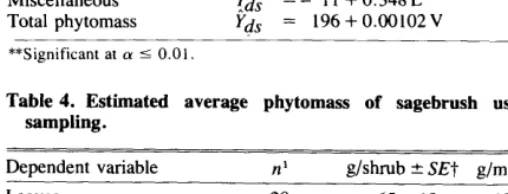
The estimates of phytomass obtained in this study using double sampling are presented in Table 4. Equation I was used to estimate the mean phytomass on a per-shrub basis. These were converted to g/m’ using equation 3. These results indicate that wood makes up approximately 62% of the total phytomass of sagebrush. Dead wood accounted for 11% of the phytomass, while leaves and floral parts made up 14 and 8% of the total, respectively. Total phytomass of sagebrush was estimated to be 69 g/m’.
Double sampling has apparently reduced the variance associ- ated with mean phytomass values. This occurred because of the high cost ratio (= 120: 1) and the good correlation between phy- tomass estimates (Y) and dimension measurements (x). Table 5 shows that reduction in the variance of the phytomass estimates ranged from 33 to 80% for the various categories. Hence, it appears that double sampling as used here was effective in obtaining more precise estimates of sagebrush phytomass than would have been the case if only harvesting had been employed.
When estimating total phytomass only and not considering the cost of separating it to the various categories, a reduction in variance of 56% was estimated assuming a cost ratio of 10: 1 (Table 5). These results show that double sampling was more effective than harvesting shrubs alone to obtain total phytomass of big sagebrush.
Table 1. Dimension measurements (cm) of live and dead sagebrush shrubs. Dimension Length Width Height Volume’ X+-SE
53 2 1.2 35 2 0.9 36 “- 0.7 86248 +- 5796
Dead (n = 275)
Range 10 - 128 lo- 88 12-73 23 10 - 739200
CV’ J?kSE
37 71 + 1.2 42 48 2 0.9 31 49 2 0.8 111 238848 & 12817
Live (n = 568)
Range
14 - 199 10 - 131 12- 117 2880 - 2190384
cv
41 45 41 128
’ Coefficient of variation = (SE x 4-n / X, x 100. 2 Volume (cm”) = length x width x height.
Table 2. Dimension measurements (cm) for 20 live sagebrush shrubs.
Dimension XkSE Range
Length 86 +- 8 30 - 185 Width 68 + 6 27 - 142
Height 70 + 5 28-104
Volume2 536500 + 134403 22680 - 2732100
’ Coefficient of variation = (SE x fi/‘X, x 100. ’ Volume (cm:‘) = length x width x height.
CV’
39 -
39 31 112
Table 5. Estimated optimum ratio n’:n of sample sizes and the estimated reduction in variance obtained using double sampling assuming a cost ratio of 12O:l.
Table 3. Estimated regression equations for estimating phytomass (g/ shrub) using volume (V) measurements (length x width x height) or length (L).
Dependent variable Estimated equation
Leaves !d.s = 43 + 0.0000907 v Live wood rds = 128 + 0.000603 V Leaves + live wood rds = 171 + 0.00694V Flowering stalks 5(ds = -128 + 2.269 L Dead wood yds = - 26 + 0.000197 V
Live wood + dead wood rds = 128+0.0008llV Flowering stalks + leaves rdS = 59 -I- 0.000193 V Miscellaneous rd.s =- 11 +0.348L Total phytomass Y& = 196 + 0.00102V
**Significant at LY 5 0.01.
R2 .68** .80** .82** .52** .80** .77** .66** .45** .86**
Reduction in variance Estimated optimum (%) under optimum Category ratio n’ :n * allocation2
Leaves 16:l 58
Live wood 23: 1 73
Leaves + live wood 24: 1 75
Flowering stalks 12:l 42
Dead wood 1O:l 33
Live wood + dead wood 21:1 69 Flowering stalks + leaves 16:l 56
Miscellaneous 1O:l 35
Total phytomass 28: 1 80
Total phytomass:’ 8:1 56
’ Obtained using equation (6). ’ Obtained using equation (5).
’ Assuming a cost ratio of IO: I.
Table 4. Estimated average phytomass of sagebrush using double sampling.
Dependent variable n’ g/shrub + SET g/m2 2 SEtt
Leaves 20 65 + 10 102 2
Live wood 20 272 2 48 43 -t 10
Leaves + live wood 20 337 + 53 53 2 12 Flowering stalks 19 33 * 19 5+ 3
Dead wood 19 49*40 8? 7
Live wood + dead wood 20 322 + 72 512 14 Flowering stalks + leaves 20 105 + 22 162 4
Miscellaneous 20 132 3 2+ 1
Total phytomass 20 440270 69+ 16
‘n = clipped shrubs + dimension measurements; n’ = 568 plants for dimension measurements only.
t Obtained using equations (I) and (2). v Obtained using equations (3) and (4).
+ dimension measurements) and n’ (only dimension measure- ments taken) can be determined if some prior knowledge of these parameters is known. Cochran ( 1963) considers the case where the cost of the two samples is
C = nCn -I- n’Cn’ (7)
where C is the total cost and cn and cn’ are the costs of obtaining clipped and dimension measurements, respectively. If we assume the total cost C to be $1,000 and cn:cn’ = 120: 1 as out- lined earlier and using the optimum ratio for the total phytomass (n’:n) of 28: 1, then sample sizes for n and n’ can be determined. From equation 7 we have that
$1,000 = 120n + n’.
From the optimum ratio we obtain n’ = 28n.
By substituting for n’ we obtain $1,000 = 120n + 28n, or n = 6.8.
Solving of n’
For the fixed cost ratio cn:cn’ = 120: 1, the ratio n’:n of sample sizes is presented in Table 5. The ratio ranges from 28: 1 to 10: 1 for the various tissue categories. The various categories with lower ratios require a greater proportion of clipped plots. For example (assuming cn = cn’ for the moment), if one examines a total of 100 shrubs, a ratio of 10: 1 indicates about 9 shrubs would be clipped (dimension measurements also being taken), and 9 1 shrubs would be measured for dimensions only. Having a ratio of 20: 1 would reduce the clipped number of
shrubs by approximately one-half (to about 5) while increasing to 95 the number of shrubs where only dimension measurements are taken.
$1,000 = 120(6.8) + n’, or n’ = 184.
Assuming a cost of $1,000, one would clip and take dimension measurements of 7 shrubs plus obtain dimension measurements of 184 shrubs.
In double sampling, cost is a major factor to consider. Once this has been determined, then the number of samples n (clipped
Concerning the design of future sampling plans for esti- mating sagebrush phytomass, we see from Table 5 that the optimum ratio n’ :n ditters for each plant part. This occurs due to changes in Vn and Vnl (equation 6) since cn:cn’ was held constant at 120: 1. Hence, the optimum n andn’ will vary foreach plant part. This suggests that when planning a double sampling study with several variables (plant parts), it will not be possible to obtain the maximum reduction in variance for all variables simultaneously. One approach is to use the n and n’ that will achieve the maximum reduction in variance for the most
important variable (perhaps total phytomass). More generally, n and n’ could be estimated for each plant part and a compromise made based on the relative importance of achieving maximum reduction in variance for the plant parts.
Also note from equation (2) that Var (ydS) can be reduced if x, and xn’ (the mean dimension measurements on the n and n’
shrubs, respectively) are in close agreement. In these data, the two means are rather far apart (Tables 1 and 2), which may be due to a biased selection process for the 20 shrubs. This bias might have been less had the 20 shrubs been selected by using some kind of a random selection process. However, we also note that the variance of double sampling will decrease if
. 20
c
(Xi -X,)’
i=l
is large, i.e., if small as well as large shrubs are included in the 20 selected shrubs. By random selection of shrubs for clipping and volume measurements, we would have to take whatever shrubs were randomly selected so that a large sum of squared deviations would not necessarily result. One approach to this problem would be to divide the population of shrubs into non- overlapping size categories and obtain random samples from each group.
The data examined here suggest that double sampling can be an effective technique in reducing the variance of the mean phytomass estimates of the various phytomass categories of big sagebrush. The precision achieved by combining dimension
analysis with clipping and harvesting is significantly higher than by only harvesting shrubs when cost is held constant.
One of the major benefits of this double sampling procedure is that it is nondestructive when determining phytomass esti- mates of the various categories of sagebrush. Once a relation-
ship between clipped shrub values and dimension measure- ments has been established, then repeated phytomass inven- tories may be conducted on various sites by obtaining dimension measurements only, assuming the calibration relationship does not change.
Literature Cited
Chew, R. M., and A. E. Chew. 1965. The primary productivity of a desert- shrub (Larrea rridenrutu) community. Ecol. Monogr. 35:355-375.
Cochran, W. G. 1963. Sampling techniques. John Wiley and Sons, Inc., New York. 413 p.
Daubenmire, R. 1970. Steppe vegetation of Washington. Wash. Agr. Exp. Sta. Tech. Bull. 62. 131 p.
Harniss, R. O., and R. B. Murray. 1976. Reducing bias in dry leaf weight estimates of big sagebrush. J. Range Manage. 29:430-432.
Kempthorne, O., and R. R. Allmaras. 1965. Errors of observation. In: Methods of Soil Analysis, Part 1. (Black, ed.). Amer. Sot. Agr. Inc., Madison, Wise.
Ludwig, J. A., J. F. Reynolds, and P. D. Whitson. 1975. Size-biomass relationships of several Chihuahuan Desert shrubs. Amer. Midland Natur. 94:451-461.
Medin, D. E. 1960. Physical site factors influencing annual production of true mountain mahogany, Cercocurpus monrunus. Ecology 41:454-460.
THESIS: OREGON STATE UNIVERSITY
Responses of Vegetation and Sheep to Three Grazing Pressures, by Frank Oren Thetford, Jr., PhD, Rangeland Resources, 1975.
A study was conducted over a 2-year period, 1973 through 1974, dry matter intake, protein, and energy requirements throughout on perennial ryegrass-subclover pastures with stocking rates of 7.4 both years. The data indicated that during the fall (1973) and (moderate), 9.9 (heavy), and 12.4 (overstocked) ewes per hectare summers (1973, 1974) diets of animals from overstocked pastures to establish guidelines on stocking intensity for dryland improved were deficient in dry matter intake, crude protein, and digestible pastures in western Oregon. Climatic conditions varied annually energy. Digestibility of dry matter in the diets increased from 77% and caused variation in growth of the vegetation and differences in both years in early spring to 55% during the summers; also, there stocking dates among treatments. Grazing significantly depressed was no difference among treatments. Annually, during early spring total forage yields in each year. However, there was no significant ewes on all treatments gained weight at the same rate. Ewes from difference noted between years for total forage yields. Ryegrass moderately stocked pastures lost the least weight in the summer; yields remained the same for both years in all treatments. The yield ewes on the overstocked treatment lost the most. Weight gains of of other grasses (primarily annuals) increased in heavily stocked ewes and lambs were higher in 1973 than in 1974. There were no and overstocked treatments during the period of this study, but not significant differences among treatments for the rate of gain of in the moderately stocked pastures. Moderately stocked pastures lambs. Likewise, no noticeable differences were observed in the bad more ryegrass available per head per day than the other total number of lambs born on each treatment. The results from the treatments in all seasons. Nutritive value of the herbage followed heavily stocked treatment were highly variable and sometimes they normal seasonal trends. Herbage in 1974 was of lower nutritive were similar to either the moderate or the overstocked treatment. value than in 1973. Animals in moderately stocked pastures were Therefore, data indicate that 7.4 ewes per hectare may be the
able to obtain sufficient forage of good quality to meet or exceed proper spring through fall stocking rate for these pastures.