Volume 5, No. 2, March 2014 (Special Issue)
International Journal of Advanced Research in Computer Science
RESEARCH PAPER
Available Online at www.ijarcs.info
A Realistic And Efficient Information Gathering In Tree Based Wireless Sensor
Networks
M.Chilakarao1 D. Ravi Babu
Department of CSE,
SVECW Engg. College, Affiliated to JNTUK, Bhimavaram, W.G.District, A.P. INDIA,
Department of CSE,
3
S.R.K.R. Engg. College, Affiliated to Andhra University, Bhimavaram, W.G.District, A.P. INDIA,
R. Shiva Shankar
Abstract: How fast can information are collected from a wireless sensor network organized as tree? We evaluate a number of different techniques using realistic simulation models under the many-to-one communication paradigm known as converge cast. Consider time scheduling on a single frequency channel with the aim of minimizing the number of time slots required to complete a converge cast. Next, we combine scheduling with transmission power control to mitigate the effects of interference, and show that while power control helps in reducing the schedule length under a single frequency, scheduling transmissions using multiple frequencies is more efficient. We give lower bounds on the schedule length when interference is completely eliminated, and propose algorithms that achieve these bounds. Then, the data collection rate no longer remains limited by interference but by the topology of the routing tree. we construct degree-constrained spanning trees and capacitated minimal spanning trees, and show significant improvement in scheduling performance over different deployment densities.
2
Department of CSE,
S.R.K.R Engg. College, Affiliated to Andhra University, Bhimavaram, W.G.District, A.P. INDIA,
I. INTRODUCTION
Converge cast, namely the collection of data from a set of sensors toward a common sink over a tree based routing topology, is a fundamental operation in wireless sensor networks (WSN). In many applications, it is crucial to provide a guarantee on the delivery time as well as increase the rate of such data collection. For instance, in safety and mission-critical applications where sensor nodes are deployed to detect oil/gas leak or structural damage, the actuators and controllers need to receive data from all the sensors within a specific deadline, failure of which might lead to unpredictable and catastrophic events. This falls under the category of one-shot data collection. On the other hand, applications such as permafrost monitoring require periodic and fast data delivery over long periods of time, which falls under the category of continuous data collection.
“How fast can data be streamed from a set of sensors to a sink over a tree based topology?” There are two types of data collection: (i) aggregated converge cast where packets are aggregated at each hop, and (ii) raw-data converge cast where packets are individually relayed toward the sink. Aggregated con-verge cast is applicable when a strong spatial correlation exists in the data, or the goal is to collect summarized information such as the maximum sensor reading. Raw data converge cast, on the other hand, is applicable when every sensor reading is equally important, or the correlation is minimal. These two types correspond to two extreme cases of data collection. The problem of applying different aggregation factors, i.e., data compression factors, was studied, and the latency of data collection was shown to be within the performance bounds of the two extreme cases of no data compression and full data
free TDMA schedules even under the Simple graph-based interference model has been proved to be NP-complete.
A. Impact of Routing Trees:
We investigate the effect of network topology on the schedule length, and show that for aggregated converge cast the performance can be improved by up to 10 times on degree constrained trees using multiple frequencies as compared to that on minimum-hop trees using a single frequency. For raw-data converge cast, multi-channel scheduling on capacitated minimal spanning trees can reduce the schedule length by 50%.
B. Impact of Channel Models and Interference:
Under the setting of multiple frequencies, one simplifying assumption often made is that the frequencies are orthogonal to each other. We evaluate this assumption and show that the schedules generated may not always eliminate interference, thus causing considerable packet losses. We compare the two most commonly used interference models:
(i) The graph-based protocol model, and
(ii) The SINR (Signal-to-Interference-plus-Noise Ratio) based physical model.
II. LITERATURE
© 2010-14, IJARCS All Rights Reserved CONFERENCE PAPER 54
support. This support can be obtained from senior programmers, from the system the above consideration are taken into account for developing the proposed system.
Fast data collection with the goal to minimize the schedule length for aggregated convergecast has been studied by us in [7] and [9], and also by others in [5]. We experimentally investigated the impact of transmission power control and multiple frequency channels on the schedule length, while the theoretical aspects were discussed in [9], where we proposed constant factor and logarithmic approximation algorithms on geometric networks. We also compare the efficiency of different channel assignment methods and interference models, and propose schemes for constructing specific routing tree topologies that enhance the data collection rate for both aggregated and raw-data convergecast. The use of orthogonal codes to eliminate interference has been studied by Annamalai et al. [10], where nodes are assigned time slots from the bottom of the tree to the top such that a parent node does not transmit before it receives all the packets from its children.
Therefore, if minimizing latency is also a requirement, then further optimization, such as constructing bounded-degree, bounded-diameter trees, is needed. A study along this line with the objective to minimize the maximum latency is presented by Pan and Tseng [15], where they assign a beacon period to each node in a Zigbee network during which it can receive data from all its children. For raw-data convergecast, Song et al. [12] presented a time-optimal, energy-efficient packet scheduling algorithm with periodic traffic from all the nodes to the sink. Once interference is eliminated, their algorithm achieves the bound that we present here; however, they briefly mention a 3-coloring channel assignment scheme, and it is not clear whether the channels are frequencies, codes, or any other method to eliminate interference. Moreover, simple interference model where each node has a circular transmission range and cumulative interference from concurrent multiple senders is avoided. Different from their work, we consider multiple frequencies and evaluate the performance of three different channel assignment methods together with evaluating the effects of transmission power control using realistic interference and channel models.
III. IMPLEMENTATION
Implementation is the stage of the project when the theoretical design is turned out into a working system. Thus it can be considered to be the most critical stage in achieving a successful new system and in giving the user, confidence that the new system will work and be effective.
The implementation stage involves careful planning, investigation of the existing system and it’s constraints on implementation, designing of methods to achieve changeover and evaluation of changeover methods.
A. System Architecture
Figure: 1
A system architecture or systems architecture is the conceptual design that defines the structure and/or behaviour of a system. An architecture description is a formal description of a system, organized in a way that supports reasoning about the structural properties of the system. It defines the system components or building blocks and provides a plan from which products can be procured, and systems developed, that will work together to implement the overall system. This may enable one to manage investment in a way that meets business needs. The fundamental organization of a system, embodied in its components, their relationships to each other and the environment, and the principles governing its design and evolution. The composite of the design architectures for products and their life cycle processes. An allocated arrangement of physical elements which provides the design solution for a consumer product or life-cycle process intended to satisfy the requirements of the functional architecture and the requirements baseline. Architecture is the most important, pervasive, top-level, strategic inventions, decisions, and their associated rationales about the overall structure (i.e., essential elements and their relationships) and associated characteristics and behavior.
a. Input Design:
The input design is the link between the information system and the user. The input is designed in such a way so that it provides security and ease of use with retaining the privacy. Input Design considered the following things:
(a). What data should be given as input? (b). How the data should be arranged or coded?
(c). The dialog to guide the operating personnel in providing input.
(d). Methods for preparing input validations and steps to follow when error occur.
B. Modules:
a) Periodic Aggregated Converge cast. b) Transmission Power Control c) Aggregated Data Collection d) Raw Data Collection
e) Tree-Based Multi-Channel Protocol
a. Module description:
a) Periodic Aggregated Converge cast.
Data aggregation is a commonly used technique in WSN that can eliminate redundancy and minimize the number of transmissions, thus saving energy and improving network lifetime. Aggregation can be performed in many ways, such as by suppressing duplicate messages; using data compression and packet merging techniques; or taking advantage of the correlation in the sensor readings
We consider continuous monitoring applications where perfect aggregation is possible, i.e., each node is capable of aggregating all the packets received from its children as well as that generated by itself into a single packet before transmitting to its parent. The size of aggregated data transmitted by each node is constant and does not depend on the size of the raw sensor readings.
We evaluate the impact of transmission power control, multiple channels, and routing trees on the scheduling performance for both aggregated and raw-data convergecast. Although the techniques of transmission power control and multi-channel scheduling have been well studied for eliminating interference in general wireless networks, their performances for bounding the completion of data collection in WSNs have not been explored in detail in the previous studies. The fundamental novelty of our approach lies in the extensive exploration of the efficiency of transmission power control and multichannel communication on achieving fast converge cast operations in WSNs.
c) Aggregated Data Collection:
We augment their scheme with a new set of rules and grow the tree hop by hop outwards from the sink. We assume that the nodes know their minimum-hop counts to sink.
d) Raw Data Collection:
The data collection rate often no longer remains limited by interference but by the topology of the network. Thus, in the final step, we construct network topologies with specific properties that help in further enhancing the rate. Our primary conclusion is that, combining these different techniques can provide an order of magnitude improvement for aggregated converge cast, and a factor of two improvement for raw-data converge cast, compared to single-channel TDMA scheduling on minimum-hop routing trees.
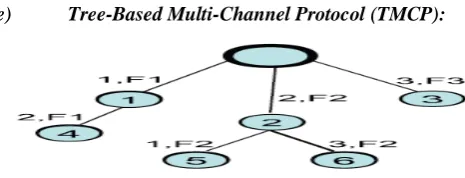
e) Tree-Based Multi-Channel Protocol (TMCP):
Figure 1.1: Schedule generated with TMCP
TMCP is a greedy, tree-based, multi-channel protocol for data collection applications. It partitions the network into multiple sub trees and minimizes the intra tree interference by assigning different channels to the nodes residing on different branches starting from the top to the bottom of the tree. Here, the nodes on the leftmost branch is assigned frequency F1, second branch is assigned frequency F2 and the last branch is assigned frequency F3 and after the channel assignments, time slots are assigned to the nodes with the BFSTimeSlotAssignment algorithm.
b. Advantage:
Advantage of TMCP is that it is designed to support converge cast traffic and does not require channel switching. However, contention inside the branches is not resolved since all the nodes on the same branch communicate on the same channel
C. Algorithm:
Algorithm 1
BFS-TIMESLOTASSIGNMENT
a. Input: T = (V, ET )
c. e← next edge from ET in BFS order
d. Assign minimum time slot t to edge e respecting adjacency and interfering constraints
e. ET ← ET \ {e} f. end while
Algorithm 2:
LOCAL-TIMESLOTASSIGNMENT a. node.buffer = full
b. if{node is sink} then
c. Among the eligible top-subtrees, choose the one with the largestnumber of total (remaining) packets, say top-subtreei
d. Schedule link (root(i), s) respecting interfering constraint
e. else
f. if{node.buffer == empty} then
g. Choose a random child c of node whose buffer is full h. Schedule link (c, node) respecting interfering
constraint i. c.buffer = empty j. node.buffer = full k. end if
l. end if
IV. RESULTS
© 2010-14, IJARCS All Rights Reserved CONFERENCE PAPER 56
Figure: 3
Figure:4
Figure:5
Figure: 6
V. CONCLUSION
In this paper, we convergecast in WSN where nodes communicate using a TDMA protocol to minimize the schedule length. We addressed the fundamental limitations due to interference and half-duplex transceivers on the nodes and explored techniques to overcome the same. We found that while transmission power control helps in reducing the schedule length, multiple channels are more effective. We also observed that node-based (RBCA) and link-based (JFTSS) channel assignment schemes are more efficient in terms of eliminating interference as compared to assigning different channels on different branches of the tree (TMCP). Once interference is completely eliminated, we proved that with half-duplex radios the achievable schedule length is lower-bounded by the maximum degree in the routing tree for aggregated converge cast, and by max (2nk
− 1, N) for raw-data converge cast. Through extensive simulations, we demonstrated up to an order of magnitude reduction in the schedule length for aggregated, and a 50% reduction for raw-data converge cast. In future, we will explore scenarios with variable amounts of data and implement and evaluate the combination of the schemes considered.
VI. REFERENCES
[1]. S. Gandham, Y. Zhang, and Q. Huang, “Distributed time optimal scheduling for convergecast in wireless sensor networks,” Computer Networks, vol. 52, no. 3, pp. 610–629, 2008.
[2]. K. K. Chintalapudi and L. Venkatraman, “On the design of mac protocols for low-latency hard real-time discrete control applications over 802.15.4 hardware,” in IPSN ’08, pp. 356– 367.
[3]. I. Talzi, A. Hasler, S. Gruber, and C. Tschudin, “Permasense: investigating permafrost with a wsn in the swiss alps,” in EmNets ’07, Cork, Ireland, pp. 8–12.
[5]. T. Moscibroda, “The worst-case capacity of wireless sensor networks,” in IPSN ’07, Cambridge, MA, USA, pp. 1–10.
[6]. T. ElBatt and A. Ephremides, “Joint scheduling and power control for wireless ad-hoc networks,” in INFOCOM ’02, Jun, pp. 976–984.
[7]. O. D. Incel and B. Krishnamachari, “Enhancing the data collection rate of tree-based aggregation in wireless sensor networks,” in SECON ’08, San Francisco, CA, USA,
[8]. Y. Wu, J. Stankovic, T. He, and S. Lin, “Realistic and efficient multi-channel communications in wireless sensor networks,” in INFOCOM ’08, pp. 1193–1201.
[9]. A. Ghosh, O. D. Incel, V. A. Kumar, and B. Krishnamachari,“Multi-channel scheduling algorithms for fast aggregated convergecast in sensor networks,” in MASS ’09, Macau, China.
[10]. V. Annamalai, S. Gupta, and L. Schwiebert, “On tree-based convergecasting in wireless sensor networks,” in WCNC ’03, vol. 3, pp. 1942–1947.