Volume 5, No. 3, March-April 2014
International Journal of Advanced Research in Computer Science
RESEARCH PAPER
Available Online at www.ijarcs.info
Economic Trust Model in Grid Computing Systems for Resource Selection
Khazar salehi tabrizi Department of Computer Engineering
Islamic Azad University Tabriz, Iran
Neda Azari Khosroshahi Department of Computer Engineering
Islamic Azad University Tabriz, Iran
Abstract: Grid technology provides the sharing different types of resources to get huge computational power, immense data and better services. Since resources are heterogeneous and widely geographical distributed in grid environments, resource selection and economy are the important challenges. This paper presents an economic trust model which aims at achieving a unique model incorporating various criteria that are important for the calculation of trust values and the decision whether or not to trust an entity. Among the existent criteria, cost trade off, test result, self defence capability, direct trust and reputation are exploited. A fuzzy method using Multi Criteria Decision Making is applied. The obtained results show better performance of the presented method with respect to the number of failed requests and waiting time, but it needs more execution time.
Keywords: trust, economy, cost trade off, reputation, multi criteria decision making
I. INTRODUCTION
Grid computing is positioned as a system that scales up to internet size environments with use of machines distributed across administrative domains and multiple organizations. Resource management in grid is challenging due to: resource heterogeneity, geographical distribution of resources, grid domains using different access and cost models, autonomously administrated grid domains having their own resource policies [12]. In grid computing systems, with distributed owners for tasks and resources, it is very important to mention Quality Of Service and security while selecting resources. This paper focuses on secure resource selection which has been recognized as an important factor of security.
Grid provides a virtual framework for sharing resources across institutional boundaries. Unfortunately, the opinion of having a virtual framework is not pleasant for entities because of the risk of being related with the notion of “sharing” services and resources. This concern forces the entities to use their own closed-box resources, instead of the utilization of grid system. That is an inefficient way to utilize resources [13]. To overcome this problem, trust based solutions are applied [20]. Azzedin and Maheswaran defined trust as follows [10,13]:
Trust is the firm belief in the competence of an entity to act as expected such that this firm belief is not a fixed value associated with the entity, but rather it is subject to the entity's behavior and applies only within a specific context at a given time. The firm belief is a dynamic value and spans over a set of values ranging from very trustworthy to very untrustworthy.
In this paper we present a new Economic Trust Model. ETM is the extended version of our previous model MCTM, and aims at achieving a complete model incorporating various criteria that are important for the calculation of trust. Among the incorporated criteria are cost trade off, test result, self defense capability, direct trust and reputation. ETM uses fuzzy multi criteria decision making method [14-17], to calculate the trust factor. To achieve a relatively complete trust model, we have compared ETM and MCTM
in term of the number of failed requests, execution time and waiting time.
The rest of the paper is structured as follows: in section 2 the related literature in the area of reputation and trust is reviewed and compared. In section 3 the proposed Economic Trust Model is presented. In section 4 the simulation results appear. Finally in section 5 we conclude the whole paper.
II. REVIEWOFTHERELATEDLITERATURE
In this section, the literature related to reputation and trust-based security solutions are reviewed. Song et al. [1] presented a trust model based on fuzzy logic in order to secure grid resources. This model secures grid resources by propagating and updating trust values among different grid sites. In order to reduce vulnerability of platforms, they incorporated fuzzy trust with their model, and defended various sites. Also, they developed a SeGo scheduler, to optimize the computation power while assuring security under restricted budgets. In another work, Song et al. [2] proposed a trust model based on fuzzy theory in order to handle the uncertainties or fuzziness behind all trust attributes.
obtained by direct interactions. Moreover, Castelfranchi et al [6,7] proposed a trust model using fuzzy maps. In this model, two classifications of attributes are used: internal and external attributes and four types of belief sources are considered including reputation, categorization, reasoning and direct experiences. A new method was developed by
Vijayakumar et al. [8,11] to provide trust and reputation aware security for choosing resources in Grid computing. Self-defense capability and reputation weightage are used to calculate trust factor. Abdual Rahman et al [9] developed a model based on reputation and experiences in which the entities
Tabel 1. Comparison of previous trust models with ETM
Model specifications [1] [2] [3] [4] [5] [6] [7] [8] [9] [10] [21] ETM
Trust propagation × × × × × × × × × × × ×
Reputation × × × × × × × × × × × ×
Self defense capability × × × ×
Test result × × ×
Cost Trade off ×
Response time × ×
Result of interaction × × × × × × × × × × × ×
Fuzzy techniques × × × × × × × ×
Can decide on the trustworthiness of other entities. A nominal definition of trust and reputation is proposed by Azzedin and Maheswaran [10]; they also discussed a model for incorporating trust in grid systems. Khosroshahi et al. [21] proposed a new Multi Criteria Trust Model which aggregated three criterions such as trust, reputation, and self defense to select a secure resource by using a fuzzy method.
Table 1 shows a summary of the criteria that have been used in the models discussed above. Since these trust models only consider some criteria therefore in this paper a comprehensive trust model, Economic Trust Model (ETM), is proposed which considers all the basic and necessary criteria.
III. ECONOMICTRUSTMODEL
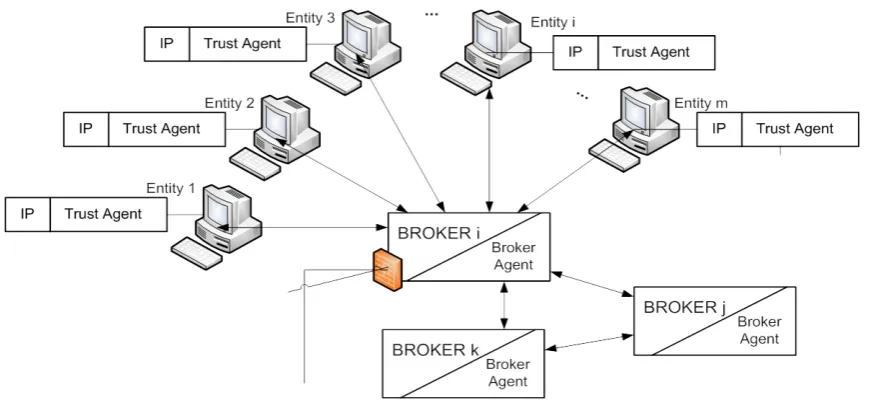
A new multi criterion Economic Trust Model (ETM), in grid computing systems is presented. This model uses the grid architecture which is shown in Fig. 1. According to this figure, all entities which include service providers and users have interaction via broker. When an entity forwards a request to the broker, the broker matches the entities which are able to perform the requests by using a common resource discovery method. By using fuzzy multi criteria decision making method one of the resource providers is selected and the job is sent to be done. Each entity includes a trust agent and the trust agent maintains a direct trust table which includes the direct trust level between the entity and the other entities for context c.
A. Decision criteria:
The proposed model considers five important criteria consisting of cost trade off, test result, self defense capability, direct trust and reputation in the selection phase which are discussed as follows.
a. Cost trade off:
In ETM model, service providers sell CPU time slots on their own resources and users for running their applications buy these time slots. Our economic system scenario is formulated with three main participants [22].
a) Service providers: each resource can be considered as a service provider such as CPU time slot. The
parameters of each CPU time slot are number of processors and also the time that they are available. At each site, service providers satisfy the requests of the local users and also the requests of grid users that arrive through the broker. By advanced reservation, providers assign CPUs for monopolized use of the broker and offer information about the accessibility of CPUs and cost of usage per second at specified intervals. The considered economic system is cooperative, which means the participants trust each other by collaborating with each other. Therefore, the facility of supplying malicious and wrong information is discounted.
b) Users: users send their applications to the broker for execution at grid resources. The most important require of users is that their applications be executed in an economic and efficient manner. Also the users most set a trade off factor to show the importance of cost factor over execution time. If not, it will be provided by the broker. The user can compute the trade off factor on the basis of budget and urgency for executing the application [23].
c) Broker: the most important aim of broker is studying the information supplied by the users and service providers so that it could match the jobs to the best services. In other words, broker must schedule the applications such that both cost and time are minimized for application execution. The final negotiation by service providers and users for resource time slots is initiated after allocating application to resources.
Cost and processing time are two QoS requirements which users mention for executing their applications. Users like their applications get executed in minimum time at the lowest possible cost. Thus, trade off factor shows the importance of cost over time for users [22].
Assume that application i wants to get executed on resource j. in this case, the response time of application i on resource j is defined as
) , ( ) , ( ) ,
(i j = f i j −s i j
α
(1)
(2)
ETC (Estimated Time to Compute) values of applications are known based on experimental data, profiling, user supplied applications or other techniques. By using performance estimation techniques such as historical data, analytic modeling we can achieve the performance estimation for resource services to foretell task execution time. As a result, the execution time for application can be obtained for various resources. In our model for obtaining the ETC value, a standard application is used. By receiving
a request to the broker, a unique standard application is sent to the entities so the estimated time is calculated for each of them based on the CPU, RAM, job and bandwidth. m, is the total number of available service providers and R, is the set of available service providers during the scheduling interval. The cost spent for executing application i on resource j is given by
(3)
[image:3.595.35.474.193.394.2]
Figure. 1. Grid architecture
Cj is the cost of using a CPU on resource j per unit
time.
The average cost to execute application i is given by
(4)
The cost and time trade off for ith user application is given by
(5)
is the trade off factor for all user applications. Therefore the objective of this algorithm is to minimize the total trade off metric for all user applications. In other
words, minimize
The broker calculates the time and cost trade off for all users and the results are maintained in the broker (Table 2) and are used for decision making.
Table 2. Cost trade off for entities
CT entity 1 entity 2 … entity m-1 entity m
context 1 …
context 2 …
… … … … … …
context i …
b. Test Result:
Each entity contains several resources and based on these resources offers some services. Entering a new entity to the grid system, the broker will subject that entity to an initial test period. In order to test the newly joined entity the broker forwards some standard applications randomly to that entity and checks the obtained results considering the predefined criteria to evaluate the quality and correctness of that entity. The test duration time is indeterminate for the entity; therefore, the entity cannot guess the duration of the test period to indicate a good behavior during test time and then, misbehave after the test is over. These tests are often repeated in unspecified intervals randomly. The test results are maintained in the broker and are used for decision making. A threshold is considered for test results. The entities which earn less than threshold will not participate in the grid for a while.
c. Self Defense Capability:
[image:3.595.48.268.712.784.2]∑
=∗ = 3
1
) ( ) (
i
i A i W SDC
(6)
W(i) is the weight assigned to each factor and A(i) is the value of factor i. The values of SDCs are kept in the broker and used in the decision making process [21].
d. Direct Trust Level (DTL):
[image:4.595.377.495.54.200.2]After having interaction between two entities, a trust level based on the satisfaction of requester entity is stored and updated in its own DTL table, for example Table 3 shows the direct trust level for entity m. The satisfaction value depends on considered factors by the requester entity via comparing the obtained results and their expectations [21].
Table 3. Direct trust table for entity m
DTL entity 1 entity 2 entity 3 … entity m-1
context 1 …
context 2 …
… … … … … …
context i …
e. Reputation:
According to Azzedin and Maheswaran, “The reputation of an entity is an expectation of its behavior based on other entities’ observations or information about the entity’s past behavior within a specific context at a given time” [10]. In our model for calculating the reputation of a specific entity, the broker forwards a message to all the entities that have subscription with that specific entity and requests the direct trust of that entity. By receiving the request, the direct trust table of that entity which is maintained in trust agent is checked. Trust level of that entity within a specific context is obtained from the direct trust table and ultimately is forwarded to the broker. All the trust values are gathered by the broker and the reputation levels are calculated by (7), and the results are maintained in Table 3 at the broker [21].
) , , ( , 1 ) ,
( c
j E i E m
j i j
DTL c
i E
RL ∑
≠ = =
(7)
[image:4.595.37.280.236.364.2]By considering the criteria which are mentioned above, the secure resource is selected using multi criteria decision making as follows.
Table 4. Reputation table
RL entity 1 entity 2 … entity m-1 entity m
context 1 …
context 2 …
… … … … … …
context i …
B. Secure resource selection using multi criteria decision making:
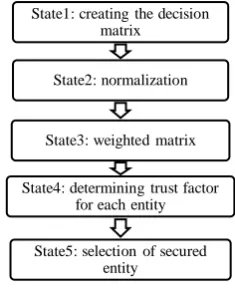
The main problem of decision making is the process of finding the best choice among all alternatives [18]. The states of this flowchart are discussed as follows:
Figure. 2. A flowchart for MCDM method
State 1: Creating the decision matrix :
For selecting a secure resource we suppose m alternative entities Ei, i=1…m, which has been found by the broker, and based on the discussion in section 2.1, five criteria, consisting of cost, test result, self defense capability, direct trust and reputation are used respectively as
j
C , j=1…5. The ETM model is expressed by (8) and (9)
as follows [21]:
C1 C2 C5
=
5 ~ 2
~ 1 ~
25 ~ 22
~ 21
~ 15
~ 12
~ 11 ~
2 1 ~
m d m
d m d
d d
d
d d
d
m E E E
D
(8)
] 5 ... 2 1
[w w w
W=
(9) D~is referred to a decision matrix where d~ij is the fuzzy
rating of entity Ei with respect to criteria Cj , W is the
weight vector in which wj represents the fuzzy weight of
j C
(j=1,2,...,5). In general, criteria can be
classified as either a or b:
a) Benefit criterion: (where the higher value of dij is
better for the decision maker). In ETM C2,C3,C4
andC5 are benefit criteria.
b) Cost criterion: (where the lower value of dij is
better for the decision maker). In ETM C1is cost criterion.
ij
d~ is a fuzzy triangular number which is represented
by a triplet
(
d1ij,dij2,dij3)
. The membership function ispresented as (10) as follows [18]: State1: creating the decision
matrix
State2: normalization
State3: weighted matrix
State4: determining trust factor for each entity
[image:4.595.42.269.615.726.2] ≤ ≤ − − ≤ ≤ − − = otherwise ij d x ij d ij d ij d x ij d ij d x ij d ij d ij d ij d x x ij d , 0 3 2 , ) 2 3 ( ) 3 ( 2 1 , ) 1 2 ( ) 1 ( ) ( ~ µ (10)
Fuzzy triangular number is based on three values: dij1
is the minimum possible value, dij2 is the most possible
value and dij3 is the maximum possible value.
State2: Normalization:
Since d~ij =
(
d1ij,dij2,dij3)
is generated in various scales, a normalization process is done by using (11) or (12). If Cj is a benefit criterion, (11) is applied, otherwise (12)will be used.
) 3 , 2 , 1 ( ~ M ij d M ij d M ij d ij
n = (11)
) 1 , 2 , 3 ( ~ M ij d M M ij d M M ij d M ij n − − − = (12)
Where dij3
i Max M = .
[ ]
nijN~= ~ is the normalized matrix of D~=
[ ]
d~ij which will be used as normalized decision matrix. It’s obvious that(
3)
, 2 , 1 ~ ij n ij n ij n ij
n = .
State 3: Weighted matrix:
Assuming thatN~=
[ ]
n~ij ,N~W =[ ]
n~ijw , is the weighted matrix. The weighted matrix is constructed by substituting the normalized matrix and the weight vector in (13).(
nij wj nij wj nij wj)
nijw *
3 , * 2 , * 1
~ = , i=1,2,...,m and
5 ,..., 2 , 1 =
j (13)
It’s obvious that n~ijw is a fuzzy triangular number,
thereforen~w
(
nijw1,nijw2,nijw3)
ij = .
State4: Determining trust factor for each entity:
Trust factor of entity i is calculated as (14) as follows, where 5 is the number of criteria.
10 / ) 5
( i i*
i d d
TF = − + − , i=1,2,...,m (14)
Assume that p~*j =
( )
1,1,1 and~p−j =(
0,0,0)
. By usingvertex method [19] * i
d , di− are obtained by (15) and (16) respectively.
(
)
∑
{
[
(
) (
) (
)
]
}
∑
= = − + − + − = = 5 1 2 1 2 3 2 2 2 1 5 1 * * 3 / 1 1 1 ~ , ~ j w ij w ij w ij j j w iji d n p n n n
d
, i=1,2,...,m (15)
(
)
∑
{
[
(
) (
) (
)
]
}
∑
= =
−
−= = 5 − + − + −
1 2 1 2 3 2 2 2 1 5 1 3 / 0 0 0 ~ , ~ j w ij w ij w ij j j w ij
i dn p n n n
d
, i=1,2,...,m (16) State 5: Selection of secured entity:
By forwarding a request to the broker, a set of entities that are able to satisfy it are chosen. For each member of this set, trust factor is calculated. According to (17) the entity with higher trust factor, SE, is selected for the interaction [21]. i m i
TF
Max
SE
1 ==
(17)IV. SIMULATIONVERIFICATION
To show the performance and ability of the presented model we have simulated ETM using MATLAB software and also we have compared our model with MCTM. To evaluate the performance of the presented model we setup three experiments: number of failure jobs, execution time and waiting time.
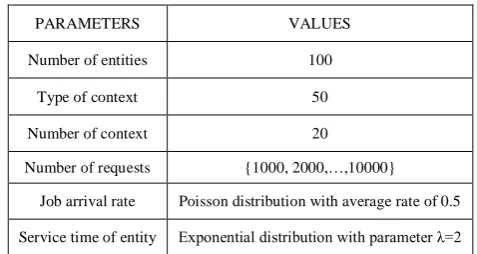
In order to assess the effectiveness of ETM and MCTM trust models in grid systems, a network with one hundred entities is simulated. Table 5 shows the simulation parameters.
The criteria considered in this model are triangle fuzzy numbers that are based on three-value judgment: minimum possible value, most possible value, and maximum possible value. The initial numbers of cost trade off, self defense capability and test result are generated randomly at the beginning of the simulation. For determining the reputation of specific entity, Eq. (7) is used. The values of direct trust table are updated as time passes. Jobs are generated randomly as requests which follow Poisson distribution with average rate of 0.5 and the service time follows Exponential
distribution with parameter λ which equals 2. Offline/Online
[image:5.595.317.556.519.646.2]rate of resources follow Poisson distribution with average rate of 0.01.
Table 5. Simulation parameters
PARAMETERS VALUES
Number of entities 100
Type of context 50
Number of context 20
Number of requests {1000, 2000,…,10000}
Job arrival rate Poisson distribution with average rate of 0.5
Service time of entity Exponential distribution with parameter λ=2
After creating the decision matrix (D~) a normalization process is applied. By this method the ranges of normalized triangular fuzzy numbers are preserved to [0,1]. Creating the weighted matrix by substituting the normalized matrix and the weight vector is the next phase. All entities based on their contribution to security, give a weight to all the five criteria. In this paper we suppose that all weights are equal sowj =0.2, for
j
=
1
,
2
,...,
5
. Finally, according to (14-16),Simulation process is terminated based on the number of requests which will be received as an entry at the beginning of the simulation. The result of simulation is evaluated based on the number of requests as 1000,2000,…,10000. Performance of the models is evaluated in term of failure jobs, execution time and waiting time.
[image:6.595.321.556.55.242.2]The first experiment evaluates the number of failure jobs in term of request numbers, for the ETM and MCTM. As shown in fig. 3, ETM reduces the number of failure jobs to %7.99 compared with MCTM
Figure. 3. Average number of failure jobs
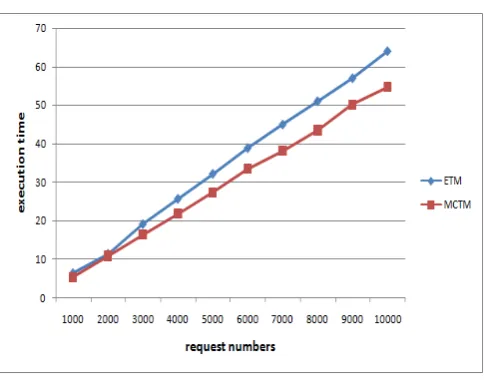
[image:6.595.39.284.182.343.2]The second experiment tests the execution time of the two models in term of number of requests. Fig. 4 shows that ETM demands more execution time than MCTM model. ETM increases execution time %0.08 compared with MCTM.
Figure. 4. Average execution time
[image:6.595.39.284.422.613.2]The third experiment is shown in Fig. 5, which compares the waiting time of ETM and MCTM. The results show that ETM reduces the waiting time in the queues. ETM reduces the waiting time to %9.35 compared with MCTM.
Figure. 5. Average waiting time
V. CONCLUSION
In this paper, we presented an economic trust model which aggregates five basic criteria including cost trade off, test result, self defense capability, direct trust, and reputation to select secure resources. Fuzzy multi criteria decision making is used to calculate trust factor. Based on the interaction values the decision is made on whether to trust or not. ETM has been simulated in MATLAB by use of fuzzy toolbox. The obtained results show that the presented method has better performance according to the number of failed requests and waiting time. In order to achieve this level of performance, a little time is required.
VI. REFERENCES
[1] S.Song, K.Hwang and M.Macwan, "Fuzzy Trust Integration for Security Enforcement in Grid Computing", IFIP International Symposium on Network and Parallel Computing (2004), pp.18-22.
[2] S.Song, K.Hwang and Yu-K, "Trusted Grid Computing with Security Binding and Trusted Integration", Journal of Grid Computing, (2005).
[3] Ayman.Tajeddine, Ayman.Kayssi, Ali.Chehab, Hassan.Artail "Fuzzy Reputation-based Trust Model", Applied Soft Computing Journal (2011) pp.345-355.
[4] A. Tajeddine, A. Kayssi, A. Chehab, H. Artail, "PATROL: a comprehensive reputation-based trust model", International Journal of Internet Technology and Secured Transactions 1 (2007) 108–131.R. Nicole, “Title of paper with only first word capitalized,” J. Name Stand. Abbrev., in press.
[5] S.D. Ramchurn, N.R. Jennings, C. Sierra, L. Godo, "Devising a trust model for multi-agent interactions using confidence and reputation", Applied Artificial Intelligence 18 (2004) 833–852.M. Young, The Technical Writer’s Handbook. Mill Valley, CA: University Science, 1989.
[7] R. Falcone, G. Pezzulo, C. Castelfranchi, "Quantifying belief credibility for trust based decision", in: Proceedings of the Workshop on Deception, Fraud, and Trust in Agent Societies at AAMAS-02, Bologna, Italy, (2002), pp. 41–48.
[8] V.Vijayakumar, R.S.D. Wahida Banu, "Secured Resource Selection in Grid Computing: Secured Resource selection Sentient Scheme", springer-verlay belin Heidelberg (2002), pp.169-183.
[9] A. Abdul-Rahman and S. Hailes, "Supporting trust in virtual communities", Hawaii Int’l Conference on System Sciences, (2000).
[10] F.Azzedin, M.Maheswaran, "Towards Trust-Aware Resource Management in Grid Computing Systems" In: 2nd IEEE/ACM International Symposium on Cluster Computing and the Grid (2002), pp.452.
[11] V.Vijayakumar, R.S.D. Wahida Banu, "performance analysis in secured grid resource selection based on trust and reputation”, International Journal of Computer Applications (0975-8887), volume 31-No.1, October (2011).
[12] R. Buyya, S. Venugopal, "A Gentle Introduction to Grid Computing and Technologies", in: Computer Society of India (CSI), vol. 29, no. 1, (2005), pp. 9-19
[13] F.Azzedin, M.Maheswaran, "Evolving and Managing Trust in Grid Computing Systems” Proceedings of the 2002 IEEE Canadian Conference on Electrical Computer Engineering 0-7802 xxxx-x/02/$10 c 2002 IEEE
[14] S.J. Chen, C.L. Hwang, "Fuzzy Multiple Attribute Decision Making Methods and Applications", Springer-Verlag, Berlin, Heidelberg, (1992).
[15] C.C. Robert, R. Fulle´r, "Fuzzy multiple criteria decision making: recent developments", Fuzzy Sets and Systems 78 (1996), pp.139–153.
[16] R.E. Bellman, L.A. Zadeh, "Decision-making in a fuzzy environment", Management Science 17 (1970), pp.141– 164.
[17] R.A. Ribeiro, "Fuzzy multiple attribute decision making: A review and new preference elicitation techniques", Fuzzy Sets and Systems 78, (1996), pp.155–181.
[18] Fenton, N., Wang, W., "Risk and confidence analysis for fuzzy multi criteria decision making", Knowledge-Based Systems 19, Elsevier, (2006), pp.430–437.
[19] Chen, C.T., Extensions of the TOPSIS for group decision-making under fuzzy environment, Fuzzy Sets and Systems 114, (2000), pp.1–9.
[20] Cody, E., Sharman, R., Rao, R.H., Upadhyaya, s., "Security in grid computing", Decision Support Systems 44, (September 2007), pp. 749–764.
[21] A.Habibi zadnavin, N.Azari Khosroshhi and A.Pourhaji Kazem, " Multi Criteria Trust Model in Grid Computing Systems ", International Journal of Advanced Research in Computer Science, 4 (2), Jan –Feb, 2013, pp.55-59.
[22] S.K. Garg, R. Buyya, H.J. Siegel, (2010), Time and cost trade-off management for scheduling parallel applications on utility grids, Future Generation Computer Systems 26, pp. 1344–1355.