Using Shallow Syntax Information
to Improve Word Alignment and Reordering for SMT
Josep M. Crego
TALP Research Center Universitat Polit`ecnica de Catalunya
08034 Barcelona, Spain [email protected]
Nizar Habash
Center for Computational Learning Systems Columbia University
New York, NY 10115, USA [email protected]
Abstract
We describe two methods to improve SMT accuracy using shallow syntax information. First, we use chunks to refine the set of word alignments typically used as a starting point in SMT systems. Second, we extend anN -gram-based SMT system with chunk tags to better account for long-distance reorderings. Exper-iments are reported on an Arabic-English task showing significant improvements. A human error analysis indicates that long-distance re-orderings are captured effectively.
1 Introduction
Much research has been done on using syntactic in-formation in statistical machine translation (SMT). In this paper we use chunks (shallow syntax infor-mation) to improve anN-gram-based SMT system. We tackle both the alignment and reordering prob-lems of a language pair with important differences in word order (Arabic-English). These differences lead to noisy word alignments, which lower the ac-curacy of the derived translation table. Addition-ally, word order differences, especially those span-ning long distances and/or including multiple levels of reordering, are a challenge for SMT decoding.
Two improvements are presented here. First, we reduce the number of noisy alignments by using the idea that chunks, like raw words, have a transla-tion correspondence in the source and target sen-tences. Hence, word links are constrained (i.e., noisy links are pruned) using chunk information. Second, we introduce rewrite rules which can han-dle both short/medium and long distance reorder-ings as well as different degrees of recursive applica-tion. We build our rules with two different linguistic annotations, (local) POS tags and (long-spanning)
chunk tags. Despite employing an N-gram-based SMT system, the methods described here can also be applied to any phrase-based SMT system. Align-ment and reordering are similarly used in both ap-proaches.
In Section 2 we discuss previous related work. In Section 3, we discuss Arabic linguistic issues and motivate some of our decisions. In Section 4, we describe theN-gram based SMT system which we extend in this paper. Sections 5 and 6 detail the main contributions of this work. In Section 7, we carry out evaluation experiments reporting on the accuracy re-sults and give details of a human evaluation error analysis.
2 Related Work
In the SMT community, it is widely accepted that there is a need for structural information to account for differences in word order between different lan-guage pairs. Structural information offers a greater potential to learn generalizations about relationships between languages than flat-structure models. The need for these ‘mappings’ is specially relevant when handling language pairs with very different word or-der, such as Arabic-English or Chinese-English.
Many alternatives have been proposed on using syntactic information in SMT systems. They range from those aiming at harmonizing (monotonizing) the word order of the considered language pairs by means of a set of linguistically-motivated reorder-ing patterns (Xia and McCord, 2004; Collins et al., 2005) to others considering translation a syn-chronous parsing process where reorderings intro-duced in the overall search are syntactically moti-vated (Galley et al., 2004; Quirk et al., 2005). The work presented here follows the word order harmo-nization strategy.
Collins et al. (2005) describe a technique for pre-processing German to look more like English syn-tactically. They used six transformations that are applied on German parsed text to reorder it before passing it on to a phrase-based system. They show a moderate statistically significant improvement. Our work differs from theirs crucially in that our pre-processing rules are learned automatically. Xia and McCord (2004) describe an approach for transla-tion from French to English, where reordering rules are acquired automatically using source and target parses and word alignment. The reordering rules they use are in a context-free constituency represen-tation with marked heads. The rules are mostly lexi-calized. Xia and McCord (2004) use source and tar-get parses to constrain word alignments used for rule extraction. Their results show that there is a positive effect on reordering when the decoder is run mono-tonically (i.e., without additional distortion-based reordering). The value of reordering is diminished if the decoder is run in a non-monotonic way.
Recently, Crego and Mari˜no (2007b) employ POS tags to automatically learn reorderings in train-ing. They allow all possible learned reorderings to be used to create a lattice that is input to the decoder, which further improves translation accu-racy. Similarly, Costa-juss`a and Fonollosa (2006) use statistical word classes to generalize reorder-ings, which are learned/introduced in a transla-tion process that transforms the source language into the target language word order. Zhang et al. (2007) describe a similar approach using unlexi-calized context-free chunk tags (XPs) to learn re-ordering rules for Chinese-English SMT. Crego and Mari˜no (2007c) extend their previous work using syntax trees (dependency parsing) to learn reorder-ings on a Chinese-English task. Habash (2007) applies automatically-learned syntactic reordering rules (for Arabic-English SMT) to preprocess the in-put before passing it to a phrase-based SMT decoder.
As in (Zhang et al., 2007), (Costa-juss`a and Fonollosa, 2006) and (Crego and Mari˜no, 2007b), we employ a word graph for a tight coupling be-tween reordering and decoding. However, we differ on the language pair (Arabic-English) and the rules employed to learn reorderings. Rules are built using both POS tags and chunk tags in order to balance the higher generalization power of chunks with the higher accuracy of POS tags. Additionally, we in-troduce a method to use chunks for refining word
alignments employed in the system.
3 Arabic Linguistic Issues
Arabic is a morpho-syntactically complex language with many differences from English. We describe here three prominent syntactic features of Arabic that are relevant to Arabic-English translation and that motivate some of our decisions in this work.
First, Arabic words are morphologically complex containing clitics whose translations are represented separately in English and sometimes in a different order. For instance, possessive pronominal encli-tics are attached to the noun they modify in Ara-bic but their translation precedes the English trans-lation of the noun: kitAbu+hu1 ‘book+his → his book’. Other clitics include the definite article Al+
‘the’, the conjunction w+ ‘and’ and the preposition
l+ ‘of/for’, among others. We use the Penn
Ara-bic Treebank tokenization scheme which splits three classes of clitics only. This scheme is compatible with the chunker we use (Diab et al., 2004).
Secondly, Arabic verb subjects may be: pro-dropped (verb conjugated), pre-verbal (SVO), or post-verbal (VSO). The VSO order is quite challeng-ing in the context of translation to English. For small noun phrases (NP), small phrase pairs in a phrase ta-ble and some degree of distortion can easily move the verb to follow the NP. But this becomes much less likely with very long NPs that exceed the size of phrases in a phrase table.
Finally, Arabic adjectival modifiers typically fol-low their nouns (with a small exception of some su-perlative adjectives). For example, rajul Tawiyl (lit. man tall) translates as ‘a tall man’.
These three syntactic features of Arabic-English translation are not independent of each other. As we reorder the verb and the subject NP, we also have to reorder the NP’s adjectival components. This brings new challenges to previous implementations of N -gram based SMT which had worked with language pairs that are more similar than Arabic and English, e.g., Spanish and English. Although Spanish is like Arabic in terms of its noun-adjective order; Spanish is similar to English in terms of its subject-verb or-der. Spanish morphology is more complex than En-glish but not as complex as Arabic: Spanish is like Arabic in terms of being pro-drop but has a smaller
1
number of clitics. We do not focus on morphology issues in this work. Table 1 illustrates these dimen-sions of variations. The more variations, the harder the translation.
Morph. Subj-Verb Noun-Adj AR hard VSO, SVO, pro-drop N-A, A-N
ES medium SVO, pro-drop N-A
EN simple SVO A-N
Table 1: Arabic (AR), Spanish (ES) and English (EN) linguistic features.
4 N-gram-based SMT System
The baseline translation system described in this paper implements a log-linear combination of six models: a translation model, a surface target
lan-guage model, a target tag lanlan-guage model, a word bonus model, a source-to-target lexicon model, and
a target-to-source lexicon model. In contrast to stan-dard phrase-based approaches, the translation model is expressed in tuples, bilingual translation units, and is estimated as an N-gram language model (Mari˜no et al., 2006).
4.1 Translation Units
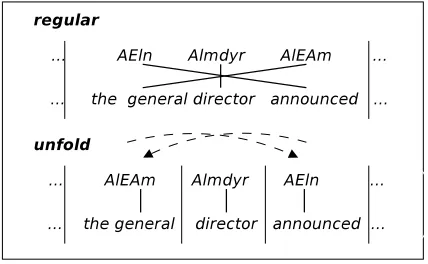
[image:3.612.78.292.496.628.2]Translation units (or tuples) are extracted after re-ordering source words following the unfold method for monotonizing word alignments (Crego et al., 2005). Figure 1 shows an example of tuple extrac-tion with the original source-side word order result-ing in one tuple (regular); and after reorderresult-ing the source words resulting in three tuples (unfold).
Figure 1: Regular Vs. Unfold translation units.
In general, the unfold extraction method out-performs the regular method because it produces smaller, less sparse and more reusable units, which
is specially relevant for languages with very dif-ferent word order. On the other hand, the unfold method needs the input source words to be reordered during decoding similarly to how source words were reordered in training. If monotonic decoding were used with unfolded units, translation hypotheses would follow the source language word order.
4.2 Reordering Framework
In training time, a set of reordering rules are au-tomatically learned from word alignments. These rules are used in decoding time to provide the de-coder with a set of reordering hypotheses in the form of a reordering input graph.
Rule Extraction
Following the unfold technique, source side re-orderings are introduced into the training corpus in order to harmonize the word order of the source and target sentences. For each reordering produced in this step a record is taken in the form of a reorder-ing rule: ‘s1, ..., sn → i1, ..., in’, where ‘s1, ..., sn’ is a sequence of of source words, and ‘i1, ..., in’ is a sequence of index positions into which the source words (left-hand side of the rule) are reordered. It is worth noticing that translation units and reordering rules are tightly coupled.
The reordering rules described so far can only handle reorderings of word sequences already seen in training. In order to improve the generalization power of these rules, linguistic classes (POS tags, chunks, syntax trees, etc.) can be used instead of raw words in the left-hand side of the rules. For example, the reordering introduced to unfold the alignments of the regular tuple ‘AEln Almdyr AlEAm → AlEAm Almdyr AEln’ in Figure 1 can produce the rule: ‘V BD N N J J → 2 1 0’, where the left-hand side of the rule contains the sequence of POS tags (‘verb noun adjective’) belonging to the source words involved in reordering.
Search Graph Extension
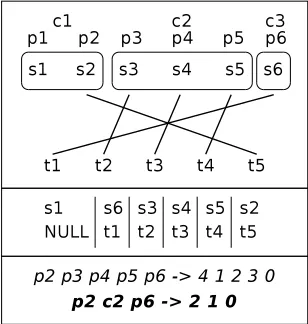
Figure 2: Linguistic information, reordering graph and translation composition of an Arabic sentence.
addition of a reordering path. Figure 2 shows an ex-ample of an input search graph extension (middle). The monotonic search graph is expanded following three different reordering rules.
5 Rules with Chunk Information
The generalization power of POS-based reordering rules is somehow limited to short rules (less sparse) which fail to capture many real examples. Longer rules are needed to model reorderings between full (linguistic) phrases, which are not restricted to any size. In order to capture such long-distance reorder-ings, we introduce rules with tags referring to arbi-trary large sequences of words: chunk tags. Chunk-based rules allow the introduction of chunk tags in the left-hand side of the rule. For instance, the rule: ‘V P N P → 1 0’ indicates that a verb phrase ‘V P’ preceding a noun phrase ‘N P’ are to be swapped. That is, the sequence of words com-posing the verb phrase are reordered at the end of the sequence of words composing the noun phrase.
In training, like POS-based rules, a record is taken in the form of a rule whenever a source reordering is introduced by the unfold technique. To account for chunk-based rules, a chunk tag is used instead of the corresponding POS tags when the words composing the phrase remain consecutive (not necessarily in the same order) after reordering. Notice that rules are built using POS tags as well as chunk tags. Since both approaches are based on the same reorderings introduced in training, both POS-based and chunk-based rules collect the same number of training rule instances.
[image:4.612.349.503.243.405.2]Figure 3 illustrates the process of POS-based and chunk-based rule extraction. Here, the reordering
Figure 3: POS-based and chunk-based Rule extrac-tion: word-alignments, chunk and POS information (top), translation units (middle) and reordering rules (bottom) are shown.
rule is applied over the sequence ‘s2 s3 s4 s5 s6’, which is transformed into ‘s6s3 s4 s5 s2’. As for the chunk rule, the POS tags ‘p3 p4 p5’ of the POS rule are replaced by the corresponding chunk tag ‘c2’ since words within the phrase remain con-secutive after being reordered. The vocabulary of chunk tags is typically smaller than that of POS tags. Hence, in order to increase the accuracy of the rules, we always use the POS tag instead of the chunk tag for single word chunks. In the example in Figure 3, the resulting chunk rule contains the POS tag ‘p6’ instead of the corresponding chunk tag ‘c3’.
af-ter applying three reordering rules. The best path is drawn in bold arcs. It is important to notice that rules are recursively applied on top of sequences of already reordered words. Chunk rules are applied over phrases (sequences of words) which may need additional reorderings. Larger rules are applied be-fore shorter ones in order to allow for an easy im-plementation of recursive reordering. Rules are al-lowed to match any path of the permutation graph consisting of a sequence of words in the original or-der. For example, the sequence ‘Almdyr AlEAm’ is reordered into ‘AlEAm Almdyr’ following the rule ‘N N J J → 1 0’ on top of the monotonic path as well as on top of the path previously reordered by rule ‘V P N P P P P P N P → 1 2 3 4 0’. In Fig-ure 2, the best reordering path (bold arcs) could not be hypothesized without recursive reorderings.
6 Refinement of Word Alignments
As stated earlier, the Arabic-English language pair presents important word order disparities. These strong differences make word alignment a very dif-ficult task, typically producing a large number of noisy (wrong) alignments. TheN-gram-based SMT approach suffers highly from the presence of noisy alignments since translation units are extracted out of single alignment-based segmentations of training sentences. Noisy alignments lead to large translation units, which cause a loss of translation information and add to sparseness problems.
We propose an alignment refinement method to reduce the number of wrong alignments. The method employs two initial alignment sets: one with high precision, the other with high recall. We use the Intersection and Union (Och and Ney, 2000) of both alignment directions2 as the high precision and high recall alignment sets, respectively. We will study the effect of various initial alignment sets (such as grow-diag-final instead of Union) in the future. The method is based on the fact that linguis-tic phrases (chunks), like raw words, have transla-tion correspondences and can therefore be aligned. We use chunk information to reduce the number of allowed alignments for a given word. The sim-ple idea that words in a source chunk are typically aligned to words in a single possible target chunk is used to discard alignments which link words from
2
We use IBM-1 to IBM-5 models (Brown et al., 1993) im-plemented with GIZA++ (Och and Ney, 2003).
distant chunks. Since limiting alignments to one-to-one chunk links is perhaps too strict, we extend the number of allowed alignments by permitting words in a chunk to be aligned to words in a target range of words. This target range is computed as a projection of the source chunk under consideration. The re-sulting refined set contains all the Intersection align-ments and some of the Union.
t1 t2 t3 t4 t5 t6 t7 t8 s3 s4 s5 s6 s7 s8 s9 s1 s2
c2’ c2
c1 c3 c4
c1’
[image:5.612.315.540.168.321.2]c3’ c4’
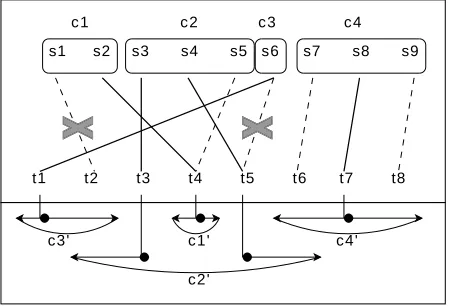
Figure 4: Chunk projection: solid link are Intersection
links and all links (solid and dashed) are Union links.
We outline the algorithm next. The method can be decomposed in two steps. In the first step, using the Intersection set of alignments and source-side chunks, each chunk is projected into the target side. Figure 4 shows an example of word alignment re-finement. The projectionc′
kof the chunkckis com-posed of the sequence of consecutive target words
[tlef t, tright]which can be determined as follows:
• All target words tj contained in Intersection links(si, tj)with source wordsi withinckare considered projection anchors. In the exam-ple in Figure 4, source words of chunk (c2) are aligned into the target side by means of two In-tersection alignments,(s3, t3)and(s4, t5), and producing two anchors (t3andt5).
• For each source chunkck,tlef t/tright is set by extending its leftmost/rightmost anchor in the left/right direction up to the word before the next anchor (or the first/last word if at sentence edge). In the example in Figure 4, c′
1, c′2, c′3 and c′
4 are respectively [t4, t4],[t2, t6],[t1, t2] and[t6, t8].
source wordsito a target wordtjthat falls out of the projection of the chunk containing the source word. Notice that all the Intersection links are contained in the resulting refined set. In the example in Fig-ure 4, the link(s1, t2)is discarded ast2falls out of the projection of chunkc1 ([t4, t4]).
A further refinement can be done using the chunks of the target side. The same technique is applied by switching the role of source and target words/chunks in the algorithm described above and using the out-put of the basic source-based refinement (described above) as the high-recall alignment set, i.e., instead of Union.
7 Evaluation
7.1 Experimental Framework
All of the training data used here is available from the Linguistic Data Consortium (LDC).3We use an Arabic-English parallel corpus4 consisting of 131K sentence pairs, with approximately 4.1M Arabic to-kens and 4.4M English toto-kens. Word alignment is done with GIZA++ (Och and Ney, 2003). All evalu-ated systems use the same surface trigram language model, trained on approximately 340 million words of English newswire text from the English Giga-word corpus (LDC2003T05). Additionally, we use a 5-gram language model computed over the POS tagged English side of the training corpus. Language models are implemented using the SRILM toolkit (Stolcke, 2002).
For Arabic tokenization, we use the Arabic Tree-Bank tokenization scheme: 4-way normalized seg-ments into conjunction, particle, word and pronom-inal clitic. For POS tagging, we use the collapsed tagset for PATB (24 tags). Tokenization and POS tagging are done using the publicly available Mor-phological Analysis and Disambiguation of Arabic (MADA) tool (Habash and Rambow, 2005). For chunking Arabic, we use the AMIRA (ASVMT) toolkit (Diab et al., 2004). English preprocessing simply included down-casing, separating punctua-tion from words and splitting off “’s”. The English side is POS-tagged with TNT(Brants, 2000) and chunked with the freely available OpenNlp5tools.
3
http://www.ldc.upenn.edu
4
The parallel text includes Arabic News (LDC2004T17), eTIRR (LDC2004E72), English translation of Arabic Treebank (LDC2005E46), and Ummah (LDC2004T18).
5http://opennlp.sourceforge.net/
We use the standard four-reference NIST MTE-val data sets for the years 2003, 2004 and 2005 (henceforth MT03, MT04 and MT05, respectively) for testing and the 2002 data set for tuning.6 BLEU-4 (Papineni et al., 2002), METEOR (Banerjee and Lavie, 2005) and multiple-reference Word Error Rate scores are reported. SMT decoding is done us-ing MARIE,7 a freely available N-gram-based de-coder implementing a beam search strategy with dis-tortion/reordering capabilities (Crego and Mari˜no, 2007a). Optimization is done with an in-house im-plementation of the SIMPLEX (Nelder and Mead, 1965) algorithm.
7.2 Results
In this section we assess the accuracy results of the techniques introduced in this paper for alignment re-finement and word reordering.
Alignment Refinement Experiment
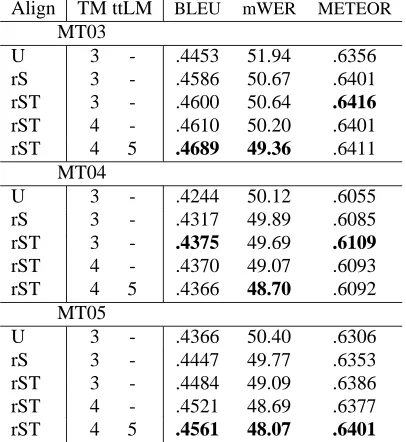
We contrast three systems built from different word alignments: (a.) the Union alignment set of both translation directions (U); (b.) the refined alignment set, detailed in Section 6, employing only source-side chunks (rS); (c.) the refined alignment set employing source as well as target-side chunks (rST). For this experiment, the system employs ann -gram bilingual translation model (TM) withn = 3
andn= 4. We also vary the use of a5-gram target-tag language model (ttLM). The reordering graph is built using POS-based rules restricted to a maximum size of6tokens (POS tags in the left-hand side of the rule). The results are shown in Table 2.
Results from the refined alignment (rS) system clearly outperform the results from the alignment union (U) system. All measures agree in all test sets. Results further improve when we employ target-side chunks to refine the alignments (rST), although not statistically significantly. BLEU 95% confidence intervals for the best configuration (last row) are
±.0162,±.0210and±.0135respectively for MT03,
MT04 and MT05.
As anticipated, the N-gram system suffers un-der high reorun-dering needs when noisy alignments produce long (sparse) tuples. This can be seen by the increase in translation unit counts when refined links are used to alleviate the sparseness problem. The number of links of each alignment set over all
6
http://www.nist.gov/speech/tests/mt/
Align TM ttLM BLEU mWER METEOR MT03
U 3 - .4453 51.94 .6356
rS 3 - .4586 50.67 .6401
rST 3 - .4600 50.64 .6416
rST 4 - .4610 50.20 .6401
rST 4 5 .4689 49.36 .6411 MT04
U 3 - .4244 50.12 .6055
rS 3 - .4317 49.89 .6085
rST 3 - .4375 49.69 .6109
rST 4 - .4370 49.07 .6093
rST 4 5 .4366 48.70 .6092
MT05
U 3 - .4366 50.40 .6306
rS 3 - .4447 49.77 .6353
rST 3 - .4484 49.09 .6386
rST 4 - .4521 48.69 .6377
[image:7.612.85.290.54.277.2]rST 4 5 .4561 48.07 .6401
Table 2: Evaluation results for experiments on
transla-tion units, alignment and modeling.
training data is 5.5M (U), 4.9M (rS) and 4.6M (rST). Using the previous sets, the number of unique extracted translation units is 265.5K (U),346.3K (rS) and407.8K (rST). Extending the TM to order
4 and introducing the ttLM seems to further boost the accuracy results for all sets in terms of mWER and for MT03 and MT05 only in terms of BLEU.
Chunk Reordering Experiment
We compare POS-based reordering rules with chunk-based reordering rules under different max-imum rule-size constraints. Results are obtained us-ing TMn= 4, ttLMn=5 and rST refinement align-ment. BLEU scores are shown in Table 3 for all test sets and rule sizes. Rule size7Rindicates that chunk rules are used with recursive reorderings.
BLEU 2 3 4 5 6 7 8 7R
MT03
POS .4364 .4581 .4656 .4690 .4689 .4686 .4685 -Chunk .4426 .4637 .4680 .4698 .4703 .4714 .4714 .4725
MT04
POS .4105 .4276 .4332 .4355 .4366 .4362 .4368 -Chunk .4125 .4316 .4358 .4381 .4373 .4372 .4373 .4364
MT05
POS .4206 .4465 .4532 .4549 .4561 .4562 .4565 -Chunk .4236 .4507 .4561 .4571 .4574 .4575 .4575 .4579
Table 3: BLEU scores according to the maximum size of
[image:7.612.86.289.56.277.2]rules employed.
Table 4 measures the impact of introducing re-ordering rules limited to a given size (Y axis) on the permutation graphs of input sentences from the MT03 data set (composed of663sentences contain-ing18,325 words). Column Total shows the num-ber of additional (extended) paths introduced into the test set permutation graph (i.e.,2,971additional paths of size3POS tags were introduced). Columns
3to8show the number of moves made in the1-best translation output according to the size of the move in words (i.e.,1,652moves of size2words appeared when considering POS rules of up to size3words). The rows in Table 4 correspond to the columns as-sociated with MT03 in Table 3. Notice that a chunk tag may refer to multiple words, which explains, for instance, how42moves of size4appear using chunk rules of size2. Overall, short-size reorderings are far more abundant than larger ones.
Size Total 2 3 4 [5,6] [7,8] [9,14] POS rules
2 8,142 2,129 - - - -
-3 +2,971 1,652 707 - - - -4 +1,628 1,563 631 230 - - -5 +964 1,531 615 210 82 - -6 +730 1,510 604 200 123 - -7 +427 1,497 600 191 121 24 -8 +159 1,497 599 191 120 26
-Chunk rules
2 9,201 2,036 118 42 20 1 0 3 +4,977 1,603 651 71 42 5 2 4 +1,855 1,542 593 200 73 7 0 5 +1,172 1,514 578 187 118 15 1 6 +760 1,495 573 178 130 20 5 7 +393 1,488 568 173 129 27 10 8 +112 1,488 568 173 129 27 10 7R +393 1,405 546 179 152 54 25
Table 4: Reorderings hypothesized and employed in the
1-best translation output according to their size.
Differences in BLEU (Table 3) are very small across the alternative configurations (POS/chunk). It seems that larger reorderings, size7 to14, (shown in Table 4) introduce very small accuracy variations when measured using BLEU. POS rules are able to account for most of the necessary moves (size2to
[image:7.612.317.539.297.489.2] [image:7.612.74.301.557.671.2]long moves when considering recursive chunks (7R) means that longer chunk rules provide only valid re-ordering paths if further (recursive) rere-orderings are also considered. The corresponding BLEU score (Table 3, last column) indicates that the new set of moves improves the resulting accuracy. The gen-eral lower scores and inconsistent behavior of MT04 compared to MT03/MT05 may be a result of MT04 being a mix of genres (newswire, speeches and edi-torials).
7.3 Error Analysis
We conducted a human error analysis by compar-ing the best results from the POS system to those of the best chunk system. We used a sample of 155 sentences from MT03. In this sample, 25 sentences (16%) were actually different between the two an-alyzed systems. The differences were determined to involve 30 differing reorderings. In all of these cases, the chunk system made a move, but the POS system only moved (from source word order) in 60% of the cases. We manually judged the relative qual-ity of the move (or lack thereof). We found that 47% of the time, chunk moves were superior to POS choice. In 27% of the time POS moves were better. In the rest of the time, the two systems were equally good or bad. The main challenge for chunk reorder-ing seems to be the lack of syntactic constraints: in many cases of errors the chunk reordering did not go far enough or went too far, breaking up NPs or pass-ing multiple NPs, respectively. Additional syntactic features to constrain the reordering model may be needed.
8 Conclusions and Future Work
In this work we have described two methods to improve SMT accuracy using shallow syntax in-formation. First, alignment quality has been im-proved (in terms of translation accuracy) by prun-ing out noisy links which do not respect a chunk-to-chunk alignment correspondence. Second, rewrite rules built with two different linguistic annotations, (local) POS tags and (long-spanning) chunk tags, can handle both short/medium and long distance re-orderings as well as different degrees of recursive application. In order to better assess the suitability of chunk rules we carried out a human error analy-sis which confirmed that long reorderings were ef-fectively captured by chunk rules. However, the er-ror analysis also revealed that additional syntactic
features to constrain the reordering model may be needed. In the future, we plan to introduce weights into the permutations graph to more accurately drive the search process as well as extend the rules with full syntactic information (parse trees).
Acknowledgments
The first author has been partially funded by the Spanish Government under the AVIVAVOZ project (TEC2006-13694-C03) the Catalan Government un-der BE-2007 grant and the Universitat Polit`ecnica de Catalunya under UPC-RECERCA grant. The sec-ond author was funded under the DARPA GALE program, contract HR0011-06-C-0023.
References
S. Banerjee and A. Lavie. 2005. METEOR: An Auto-matic Metric for MT Evaluation with Improved Cor-relation with Human Judgments. In Proceedings of
the Association for Computational Linguistics (ACL) Workshop on Intrinsic and Extrinsic Evaluation Mea-sures for Machine Translation and/or Summarization.
T. Brants. 2000. TnT – a statistical part-of-speech tagger. In Proceedings of the 6th Applied Natural Language
Processing Conference (ANLP’2000).
P. Brown, S. Della Pietra, V. Della Pietra, and R. Mercer. 1993. The mathematics of statistical machine trans-lation: Parameter estimation. Computational
Linguis-tics, 19(2):263–311.
T. Buckwalter. 2004. Buckwalter Arabic Morphologi-cal Analyzer Version 2.0. Linguistic Data Consortium, University of Pennsylvania, 2002. LDC Cat alog No.: LDC2004L02, ISBN 1-58563-324-0.
M. Collins, P. Koehn, and I. Kucerova. 2005. Clause Restructuring for Statistical Machine Translation. In
Proceedings of ACL’05.
M.R. Costa-juss`a and J.A.R. Fonollosa. 2006. Statistical machine reordering. Proceedings of the 2006
Confer-ence on Empirical Methods in Natural Language Pro-cessing (EMNLP).
J.M. Crego and J.B. Mari˜no. 2007a. Extending marie: an n-gram-based smt decoder. Proceedings of ACL’07). J.M. Crego and J.B. Mari˜no. 2007b. Improving
statisti-cal mt by coupling reordering and decoding. Machine
Translation, 20(3):199–215.
J.M. Crego and J.B. Mari˜no. 2007c. Syntax-enhanced N-gram-based SMT. In Proceedings of the Machine
Translation Summit (MT SUMMIT XI).
M. Diab, K. Hacioglu, and D. Jurafsky. 2004. Automatic tagging of arabic text: From raw text to base phrase chunks. In Proceedings of HLT-NAACL’04.
M. Galley, M. Hopkins, K. Knight, and D. Marcu. 2004. What’s in a translation rule? In Proceedings of
HLT-NAACL’04.
N. Habash and O. Rambow. 2005. Arabic Tokeniza-tion, Part-of-Speech Tagging and Morphological Dis-ambiguation in One Fell Swoop. In Proceedings of
ACL’05.
N. Habash. 2007. Syntactic Preprocessing for Statistical MT. In Proceedings of MT SUMMIT XI.
J.B. Mari˜no, R.E. Banchs, J.M. Crego, A. de Gispert, P. Lambert, J.A.R. Fonollosa, and M.R. Costa-juss`a. 2006. N-gram based machine translation.
Computa-tional Linguistics, 32(4):527–549.
J.A. Nelder and R. Mead. 1965. A simplex method for function minimization. The Computer Journal,
7:308–313.
F. J. Och and H. Ney. 2000. Improved statistical align-ment models. In Proceedings of ACL.
F. Och and H. Ney. 2003. A Systematic Comparison of Various Statistical Alignment Models. Computational
Linguistics, 29(1):19–52.
K. Papineni, S. Roukos, T. Ward, and W. Zhu. 2002. BLEU: a Method for Automatic Evaluation of Ma-chine Translation. In Proceedings of ACL’02
C. Quirk, A. Menezes, and C. Cherry. 2005. Dependency Treelet Translation: Syntactically Informed Phrasal SMT. In Proceedings of ACL’05
A. Stolcke. 2002. SRILM - an Extensible Language Modeling Toolkit. In Proceedings of the International
Conference on Spoken Language Processing (ICSLP).
F. Xia and M. McCord. 2004. Improving a statistical mt system with automatically learned rewrite patterns. In
Proceedings of the 20th International Conference on Computational Linguistics (COLING 2004).
Y. Zhang, R. Zens, and H. Ney. 2007. Chunk-level re-ordering of source language sentences with automati-cally learned rules for statistical machine translation. In Proceedings of HLT-NAACL Workshop on Syntax