Volume 3, No. 3, May-June 2012
International Journal of Advanced Research in Computer Science
RESEARCH PAPER
Available Online at www.ijarcs.info
ISSN No. 0976-5697
MASP A Model for Business Processes Analysis and Specification
Ghenima Sini*
Université Mouloud Mammeri Département Informatique B.P. 17, 15000, Tizi-Ouzou, Algérie
Catherine Comparot
Université de Toulouse le Mirail 5 Allées Antonio Machado
31047 Toulouse, France [email protected]
Malik SI-Mohammed
Université Mouloud Mammeri Département Informatique B.P. 17, 15000, Tizi-Ouzou, Algérie.
Abstract: Specification of an organizational process entails the collection and analysis of a particular knowledge that is examined, for example in order to detect possible anomalies. It is then readjusted to reach a process supposed to be "prescriptive", facilitating by this way the implementation of a workflow.
This paper deals with the possibility of using the concept of ontology, to obtain a more formal modeling of a given process in order to facilitate its analysis. A review of the best known methodologies that incorporate an approach for process specification shows that they hardly take into consideration the analysis stage, even though it appears that this stage is often fundamental, especially in areas such as Information Systems (IS). We precisely locate our current research in this framework.
What follows is a description of our MASP (Model for business processes analysis and specification) model which is based on an ontological modeling of organizational processes (we call them I.S processes). One of the advantages of this modeling is to allow the gradual acquisition and, later, the graphical representation of all concepts and transitions used in the related domain, as they could be collected as part of the analysis by a human expert. The fundamental assumption on which we rely here is that any organizational process can be described through a limited set of concepts, hence the importance of an ontological approach for its formalization.
After a brief review of the literature dedicated to the specification of I.S. processes, we describe the MASP modeling, its objectives, its main features and the opportunities it offers. In particular, we show how ontological modeling can allow one to represent both of static and dynamic aspects of a process and how it can be used to improve the analysis approach.
Keywords: Knowledge Engineering, Information Systems, Process, Ontology, Specification, Workflow.
I. INTRODUCTION
According to ISO 9000, "a process is a system of activities that uses resources to transform inputs into output elements". In particular, we may consider that an organizational process (or I.S. process) to be "a stream of planned tasks that are performed by actors using resources and informational material so as to obtain a result included in the realization of a given objective”.
The notion of process is more and more closely associated with the economic activity of enterprises. This relatively explains the recent emergence of business processes, defined as “a process related with the core business and the know-how skills of a company (business core). This type of process lays the foundation for the company collaborative systems.” [1].
The widespread of Information Technology in the economic world and the increasing dependence of the economic activity over the use of I.T. has directly impacted the nucleus of most business enterprises, so that information is now considered as a strategic resource by decision-makers; hence, the increasing automation has fostered the development of business workflows. Thus, "a workflow consists of the mechanization of all or a portion of a business process, through which information and documents move from one participant to another in order to be
processed in accordance with a set of procedural rules"[2]. Let us retain for the moment this breaking down of any activity into processes that is one of the basic elements of our approach, since it barely affects, in our point of view, the conventional development of automated Information Systems.
Thus, as for an automated IS, the life cycle of a workflow typically involves a number of steps that are organized around its “analysis, specification, verification, configuration and its deployment, control and adaptation” [3]. As it happens, the most frequently encountered work in the literature dealing with the implementation of workflows covers partially, more or less, all these steps, but have in common to generally overlook the analysis stage for existing processes, which consists of a collection followed by an evaluation of the whole knowledge used to describe and/or implement related processes.
Many tools such as YAWL [4], W4 [5] or FlowMind [6] available in this area, confirm this fact by offering no support for the analysis stage. Similarly, many I.S. design methods, such as OSSAD [7] [3] or older as MERISE [8], are generally inadequate in relation to this issue of the analysis of existing processes, as they just provide some proposals for graphical notations, generally highlighting the different activities, actors and other relevant resources.
only that one describing processes themselves, but also the expertise that is carried out by humans in charge of business processes analysis. This issue is that on we focus in this paper, through the introduction of a model called MASP (Model for business processes analysis and specification), based on knowledge gathered through interviews or documents study, in order to more formally represent a set of processes, that it could ultimately be implemented through a workflow.
II. ONTOLOGIES FOR DESCRIBING A BUSINESS PROCESS
In computer science, an ontology is defined as “a representation of the general properties of what exists, in a formalism supporting a rational treatment”[9]. This is the result of a comprehensive and rigorous formulation of the conceptualization of a domain. This conceptualization is often described as incomplete by authors, for it is illusory to believe to be able to capture the full complexity of a given domain in any formalism.
Ontology is also defined as “development and implementation of an explicit representation of a shared conceptualization in a given area”. For instance, members of an organization can emit different perspectives on the same subject; therefore, it seems important to eliminate conceptual and terminological confusion and move towards a shared understanding. According to [10], ontologies are “a means of representing knowledge”. These representations of knowledge finally correspond to "an explicit and formal specification of a shared conceptualization".
For [11], an ontology “provides a reference for communication not only between machines but between humans and machines too, by defining the route of the objects”. This is done first through symbols (words or phrases) that designate and characterize these objects, and then through a formal or structured representation of the role of each object in the concerned domain. In [12], ontology is described as “an explicit and formal specification of a common conceptualization of a domain”. Becoming essential for many applications involving knowledge, it is fully admitted that ontologies provide a common vocabulary that reflects a shared understanding of a given field.
In fact, data collected by and/or from human experts are in most cases incomplete, insufficient or inconsistent (omissions, “piled” knowledge or supposed wrongly-known, lack of cooperation, difficulty to verbalize...). This is particularly true in Information Systems Development, in which we have generally to collect huge human expertise to design a new I.S. The difficulty lays in adequate understanding of business processes implemented to reach the heart of expertise, that is most of the time a collective expertise resulting from a long coexistence and a strong interaction of several – more or less harmoniously coexisting – individual expertise within the organization.
It clearly appears then that defining an intermediate model could allow the expert himself, or the knowledge engineer in charge of the collection, not only to proceed with greater ease, but also to better express the expertise gathered. Indeed, to run collected informations, it is necessary to interpret them (in terms of objectives, for example), which requires to organize (or structure) and then to abstract concepts. This makes particularly interesting the fact of having a descriptive model of the knowledge
gathered. In fact, this issue is therefore “less a problem of extraction than it deals with organizing and structuring knowledge” [13]. For us, given the nature of empirical knowledge generally implemented in an Organizational Information System, this gives using of ontologies all its relevance in this context.
III. HOW TO CHARACTERIZE A PROCESS?
First, we consider a process model to be “a symbolic representation of all related operations or activities, including, for example, highlighting the roles played by different actors and the data necessary for the execution of this process”. Referred to this definition, a process model should highlight the objective(s) of this process, the various involved tasks and the different actors (roles) to ensure these tasks. Interactions between tasks, mainly consisting of informational exchange (communication) between the corresponding roles and their sequence, can be represented by rules governing the process in time.
The first modeling/conceptualization corresponds to the multi-view characterization of a business process [14]. It is therefore necessary to consider six (06) views in order to guarantee the completeness of description:
a. an intentional view that represents goals of the process,
b. a functional view that represents the different performed tasks,
c. an informational view that represents all the associated information to the process,
d. an interactional view that represents exchange of information between tasks,
e. a behaviorist view that represents the behavior of a task when it is executed,
f. an organizational view that represents different roles involved in each task, including actors playing these roles.
The advantage of this modeling appears in the opportunity it offers to proceed to the collection of descriptive knowledge of organizational processes through an organized framework and a more structured approach. This can allow one to proceed to verification during the collection process, in order to guarantee the completeness and consistency of the gathered knowledge. Although they are not specifically dealing with the acquisition of expertise related to business processes, a number of models or tools exist in the literature dealing with the general problem of knowledge acquisition which seems interesting to discuss in what follows.
IV. KNOWLEDGE ACQUISITION
Knowledge engineering increasingly interests industrial and commercial world in providing a means to solve specific problems related to the company know-how management [15] [16][19], which is held in its business processes.
extracted is “likely to be inaccurate, incomplete or inconsistent” [17] [18]. Many techniques of verbalization and support for interviews have been developed to "extract" the subconscious or implicit knowledge of an expert [19] [15]. These are often inspired from research in cognitive psychology, such as interviews, verbal protocol analysis, introspection, and direct observation or other.
In all cases, one of the challenges is to represent the knowledge and / or expertise gathered in a structured way. Obviously, a structured representation of a generally disparate and informal knowledge, as arising from the implementation of mental processes often transparent to the expert himself, would allow us to consider organized storage structures, allowing the implementation of the review process accurately defined, and then to provide help to identify inconsistencies and / or incompleteness. Such results are almost impossible to reach through a trivial consideration of comprehensive knowledge gathered in the rough. In our sense, the concept of ontology seems to be an interesting way to fix this issue, by providing a means to represent any organizational reality through a limited set of concepts, making it easier to be examined within a more rigorous analysis.
V. FUNDAMENTALS OF MASP MODEL
The MASP model that we propose to present here is intended to provide support for a more comprehensive methodology, which is set as a long term goal, and to support the automation of an unstructured organizational process. We consider that such an approach appears to be organized in three stages:
a) The acquisition of a process descriptive knowledge through a pre-structured architecture around a specific set of concepts, taking into account the multi-view approach mentioned above,
b) The analysis of the process by a number of criteria to be defined in view of the same structured architecture,
c) The graphical representation of a normative related process, using notation such as BPMN, in order to prepare for the translation of " objects" that can be implemented by a workflow engine.
We limit ourselves in this paper to examine the first of these three steps which is meant, therefore, to illustrate an organizational process (as an organizational reality) using a finite number of concepts. If we refer to the definition used in 1, we can highlight the concepts of:
a. Task: defined as an elementary process of
transformation of data, provided by a speaker, within a process (which is therefore defined as a set of tasks),
b. Role: representing an intervention to ensure execution of one or more tasks gathered in a certain degree of coherence. One speaker in the physical sense can play several roles in a single process or in different processes,
c. Actor: the sense of a physical player (man or machine) providing a role (speaker),
d. Data: as a basic processed or simply retransmitted information. One has to notice here that we are not interested in the consolidation of data on media, be it documents or files, where each data is being observed in terms of an autonomous entity of any
support. So our only need for the moment is to model its interaction relationship with other data from the sole point of view of semantic links or coexistence that can associate them.
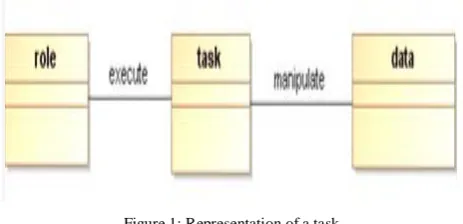
Recalling that only information flows are of interest here, any organizational reality will be seen, within the meaning MASP, as a set of processes, where processes are seen as sets of tasks and where a task is the most basic process that can exist. The tasks therefore consist in processing / communicating data by or between roles, played by human or automatic players. This decomposition allows obtaining a first model as shown in the following UML (Figure 1):
Figure 1: Representation of a task
It clearly appears that only “static” aspects are represented in this model of the given reality. In fact, we also need to address "dynamic” aspects, initially limited to the three following points:
a) Semantic relation between data or coexistence of data,
b) Conditions under which tasks are executed, c) How each task impacts each data if it does.
Concerning the first point, we limit ourselves to the existence of a semantic link between data, regardless of the nature of this link, which we intend to examine in following works. Similarly, we are interested in the coexistence of data necessary to express the simultaneous existence of two or more as input data for a task, allowing us to ignore the physical media supporting each data. On the other hand, conditions for performing tasks express the synchronization between them, within the meaning of the sequence or parallelism when either one exists. Finally, regarding how each task can impact a given data, it is possible to consider that the only possible operations are the creation, modification, deletion or archiving. During the execution of tasks by roles, handled topics can be archived (A), deleted (S), consumed (CS) (as an input for a task), or produced (P) [20].
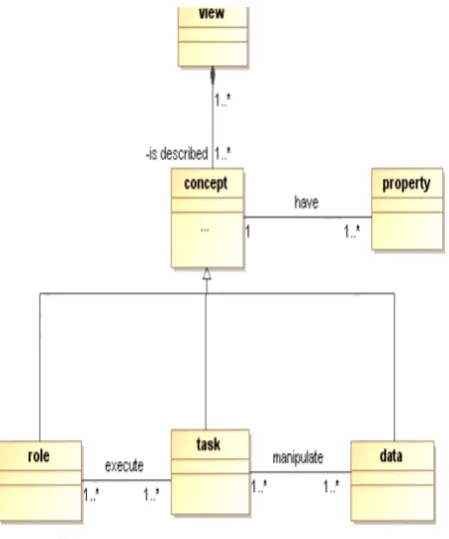
As described above, each organizational process may be represented by a set of views reconstructed from elements which we call concepts. As explained before, a concept can be a processed data, an intervening role in the considered reality, a performed task... It can also be characterized by properties that complement its description.
To illustrate this by an example, let’s consider the case of the procurement process in any commercial organization. To be supplied with consumables, a service of logistics does the following:
department and the officer. Goods are accompanied by a delivery note and an invoice is delivered later on by the supplier after receipt of the order form.
In this example, considered documents of the purchase order, good delivery and invoice account can be considered as "instantiations" of the concept of data, that allows us to describe informational view of the process. The various stakeholders, such as the manager, provider or financial service are the different roles in this process. Are these same roles that manipulate data said by running a set of operations (treatment of data), that we consider as clusters of tasks.
Based on what has been said and remaining within the limits of our concerns, this model provides a comprehensive description of an overall organizational reality structured by processes, highlighting any existing process through the previously views as indicated.
Ontological modeling that we propose to apply in UML is represented in Figure 2.
Figure. 2: An ontological modeling for an organizational process
VI. THE META-MODEL MASP
In [7], a process meta-model was presented, which characterizes processes in a generic way. As far as we are concerned, the previous study leads us to describe a business process following a set of concepts related to each other. This notion of link is fundamental [13], that is a link between concepts used to define an interaction involving the concepts in question. These links show in particular that any process takes place within an organization and has three essential components that are data, operations (tasks) and roles.
Taking into consideration these results and combined with previous findings allow us to propose an enriched meta-model for process description. By using UML diagram of classes [22][23][24][8] and following the work presented in [21], we obtain the meta-model presented in figure 3 as follows:
Figure 3: A mea-model for process description
VII. MASP APPROACH
Given the three steps outlined in paragraph 5, the MASP implementation process can be synthesized as shown in the following diagram.
Figure: 4 Implementing MASP approach
VIII. THE PROCESS ANALYSIS IN MASP
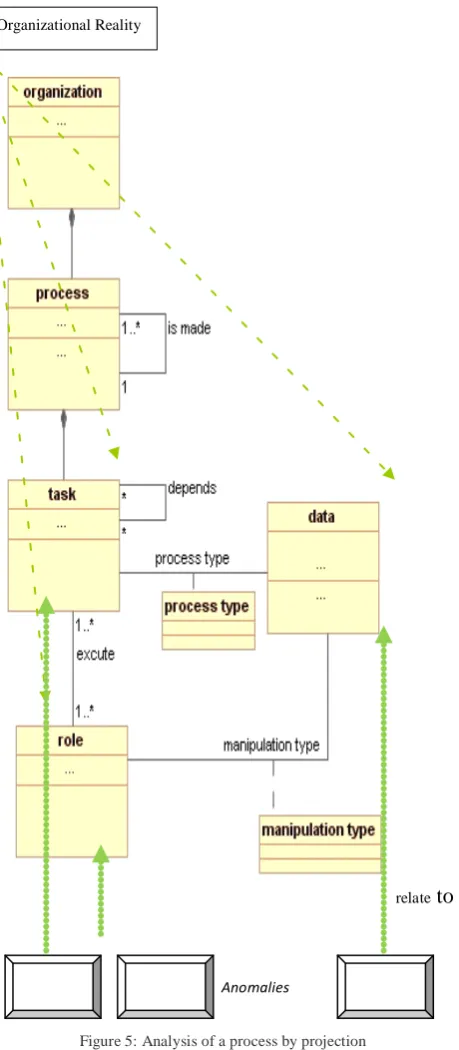
One of the main interests of the previous meta-model is that its instantiation based on knowledge gained through an empirical gathering process can be used to describe an organizational reality in a more structured way. In a second step, a review of the "pending", as obtained organizational reality, using the meta-model (Figure 5) through a comparative process that we call "projection", must lead to a qualitative examination of the process.
terms of evaluation of organizational processes, it seems interesting to show that the approach we have presented here suggests some prospects in this field. Thus, similar to what is presented in [25], it seems possible to analyze a process through its "projection" of the meta-model schematically shown in UML. This is one of the directions in which our work is moving ahead.
relate to
Anomalies
Figure 5: Analysis of a process by projection
The following perspective would then lead to an anomaly-free standard-setting process, including a BPMN representation [26][27][28][29][30], that would be submitted to a workflow engine. For example, as a start of our work to deal with this issue, we’ve considered a process of connecting a new customer to a company supplying electricity, and developed BPMN representation, before submitting it for execution to open source YAWL workflow system. The following screen illustrates the dynamics of this
process by highlighting its activities completed (which can be broken down into tasks) and their sequence.
Figure 6: An example of process modeling with YAWL editor
IX. CONCLUSION
We presented in this paper a proposal of modeling to facilitate the collection, analysis and structuring of a knowledge describing organizational processes, through a limited set of concepts. In particular, we were able to show how it was possible to draw on the works of modeling to create an ontological meta-model that can help to collect and describe any organizational reality in terms of information flows.
The use of these concepts and inclusion of links between them allowed us to obtain a meta modeling approach that can support a comprehensive way to specification.
Even if the issue of qualitative evaluation of processes still have to be fixed, as well as we have to define how to build the domain-ontology for organizational business knowledge, these results seem encouraging in the sense of a more rigorous formalization of an organizational reality. Beyond answering these questions that are seen as a perspective to our work, we are also considering, in the longer term and similarly to what is presented in [30], to examine the possibility of introducing a more
formal modeling , using a mathematical model to be
defined.
X. REFERENCES
[1] C. Yves, « Urbanisation et BPMN : le point de vue d’un
DSI », Dunod Eds, 2006.
[2] WFMC-TC-1011 v3 (1999) “Workflow terminology &
[3] S.K. Levan, « Le projet workflow », 2nd édition, Eyrolles, 2000.
[4] W.P.V.D. Aalst, A.H.M.T. Hofstede, M. Adams, N.
Russel,, “Modern Business Process Automation: YAWL and its Support Environment”, Yawl Foundation, éditions, 2011.
[5] C.K. Ames, S.C. Burleigh, J.M. Stephen, “WWW
Workflow: World Wide Web based Workflow”, Jet Propulsion Laboratory Proceedings of The Thirtieth Annual Hawwaii International Conference on System Sciences ISBN 0- 8186-7862-3/97 1997 IEEE.
[6] T. Courtois, « Flow Mind 3.1 se met au service du B to B»,
Décision Micro (n°0450), Janvier 2001.
[7] C. Morley, C., J. Hugues, B. Leblanc, O. Hugue,
« Processus métiers et SI : évaluation, modélisation, mise en œuvre.», Dunod 2006.
[8] G. Panet,, R. Letouchais., « Merise/2, modèles et
techniques avancés. », Les éditions d’organisation, 1994.
[9] C. WELTY, N. GUARINO, “Supporting ontological
analysis of taxonomic relationships”, Data et Knowledge Engineering (39), 2001, pp 51- 74
[10] R. Studer, V.R. Benjamins, D. Fensel, “Knowledge
Engineering: Principes and Methods. Data and Knowledge Engineering”, Volume 25, Issues 1–2, March 1998
[11] N. Aussenac, J. Mothe, « Ontologies as background
knowledge to explore document collections », In Actes de la Conférence sur la Recherche D’Information Assistée par ordinateur (RIAO), Avignon, France, 2004, pp 129- 142.
[12] T. Gruber,
International
Journal of Human-Computer Studies, Volume 43, Issue 5, 1995, pp. 907- 928.
[13] J.P. Krivine, J.M. David, «L’acquisition des connaissances
vue comme un processus de modélisation : méthodes et outils.», Intellectica, n°12,1991
[14] .A. Ben cheikh, D. Rieu, A. Front, « Une méthode de
réingénierie des processus métier basés sur un méta- modèle multi-vues. », in Proc. Inforsid Congress, Toulouse, France, Mai 2009.
[15] E. Brunet , C. Toussaint and M. Toyé., "Ascopa et Sadse : exemples d'application industrielle de la méthode KADS", Conference Avignon-91, Vol. 1, pp 393- 406.
[16] B. Leroux, « Elément d’une approche constructive de
modélisation et de la réutilisation en acquisition des connaissances », Research Report, Laforia, 1994.
[17] R. Dieng, O. Corby, F. Gandon,, A. Giboin,, J.
Golbiowska, N. Matta, M. Ribière, « Méthodes et outils pour la gestion des connaissances - Une approche pluridisciplinaire du Knowledge Management » , Dunod 2001.
[18] R. Dieng, " Méthodes et outils d'acquisition des
connaissances ", INRIA Research reports, n°1319, 1990, pp 245- 271
[19] R. Hoffman, «A survey of methods for eliciting the
knowledge of Experts » in Sigarts newsletter, knowledge acquisition special issue, Vol 108, 19-27, April 1989.
[20] M. Si-Mohammed, « Systèmes experts et conception des
systèmes d’information : assistance à l’étude de l’existant. », Ph. D Thesis, UPS Toulouse, France, 1990.
[21] G. Sini, M. Si-Mohammed, «Progressive knowledge
acquisition for processes formalization. », Proceeding of the 2010 International Joint Conferences on CASE and e-Technology, January 25-27, pp 2962- 2973.
[22] G. Booch, J. Rumbaugh, I. Jacobson, « Le guide de
l’utilisateur UML », Eyrolles, 2003.
[23] A. Stephen, “Introduction to BPMN.” BPM architect,
IBM, Octobre 2006.
[24] F. Bouarab - Dahmani, M. Si-Mohammed, C. Comparot,
and P.J. Charrel, “ Teaching domain representation and learner’s evaluation in a plateform relational databases e-learning”, Proceedings of the 2010 International Joint Conferences on e-CASE and e-Technology, January 25-27, 2010.
[25] G. Sini, M. Si-Mohammed, « Capitalisation du savoir-faire
de l’entreprise par la modélisation des processus-métier », Conférence A.F.M.E. Les nouvelles frontières de l’entreprise. Organiser son core Business, 2006 UQAM Montreal, Canada
[26] J. Raumauch,, M. Blaha, F. Eddy., W. Premerlani., W.
Lorensen., W. « Modélisation et conception orientée objet », Masson Eds., Paris, 1995.
[27] Omg, « Business Process Definition Meta-model
Specification. », Technical report
[28] Omg, « Business process modeling notation
specification. », Technical report
[29] T. Quatrani, « Modélisation UML avec Rationnel
Rose 2000 », Eyrolles Eds., Septembre 2000.
[30] K. Manolis, P. Dimitris, « Business Process Modeling and
design: a formal model and methodology. », Greece, 2009.