S. Werner (ed.),Proceedings of the 15th NODALIDA conference, Joensuu 2005, Ling@JoY 1, 2006, pp. 47–56
Johan Hall and Joakim Nivre
Växjö University
School of Mathematics and Systems Engineering
{jha,nivre}@msi.vxu.se
Abstract
We present a software architecture for data-driven dependency parsing of unrestricted natural language text, which achieves a strict modularization of parsing algorithm, feature model and learning method such that these parameters can be varied indepen-dently. The design has been realized in MaltParser, which supports several parsing algorithms and learning meth-ods, for which complex feature models can be defined in a special description language.
1
Introduction
One of the advantages of data-driven ap-proaches to syntactic parsing is the relative ease with which they can be ported to new languages or domains, provided that the nec-essary linguistic data resources are available. Thus, the parser of Collins (1999), originally de-veloped for English and trained on Wall Street Journal data, has been successfully applied to languages as different as Czech (Collins et al., 1999) and Chinese (Sun and Jurafsky, 2004). However, most available systems for data-driven syntactic parsing lack another kind of flexibility, namely the possibility to combine different parsing algorithms with different fea-ture models and learning methods.
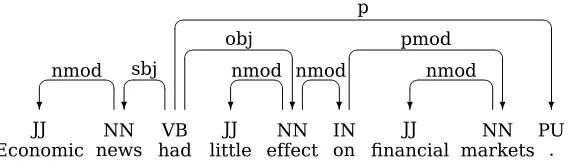
Data-driven dependency parsing has recently been explored as a robust and efficient method for syntactic parsing of unrestricted natural language text (Yamada and Matsumoto, 2003; Nivre et al., 2004). Dependency parsing means that the goal of the parsing process is to con-struct a dependency graph, of the kind depicted in Figure 1. The methodology is based on three essential components:
1. Deterministic parsing algorithms for build-ing dependency graphs (Yamada and Mat-sumoto, 2003; Nivre, 2003)
2. History-based feature models for predict-ing the next parser action (Black et al., 1992)
3. Discriminative machine learning to map histories to parser actions (Yamada and Matsumoto, 2003; Nivre et al., 2004)
Given the restriction imposed by these compo-nents, we present a software design for data-driven dependency parsing of unrestricted nat-ural language text. The most important fea-ture of the design is a clean separation of pars-ing algorithms, feature models, and learnpars-ing methods, so that these components can be var-ied independently of each other. Moreover, the design makes it possible to use the same ba-sic components both for inducing a model from treebank data in the learning phase and for us-ing the model to parse new data in the parsus-ing phase. This architecture has been realized in the MaltParser system.1
This paper is structured as follows. Section 2 gives the necessary background and introduces the framework ofinductive dependency parsing (Nivre, 2005). Section 3 presents the generic architecture for data-driven dependency pars-ing, and section 4 describes its realization in the MaltParser system. Finally, conclusions are presented in section 5.
2
Inductive dependency parsing
Given a set R of dependency types, we de-fine a dependency graph for a sentence x = (w1, . . . , wn)to be a labeled directed graphG=
JJ
Figure 1: Dependency structure for English sentence
(V, E, L), where V is the set of input tokens
w1, . . . , wn, extended with a special root node
w0and ordered by a linear precedence relation
<; E ⊆ V ×V is a set of directed arcs; and
L:E→Ris a function that labels arcs with de-pendency types. A dede-pendency graphGis well-formed iff (i) the node w0 is a root of G, (ii)G
is connected, (iii) every node inGhas an inde-gree of at most 1, and (iv)Gis acyclic. Depen-dency parsing is the task of mapping sentences to well-formed dependency graphs.
Inductive approaches to natural language parsing can in general be defined in terms of three essential components:
1. A formal model M defining permissible representations for sentences (such as the model of dependency graphs defined above).
2. A parameterized stochastic model MΘ, defining a scoreS(x, y)for every sentence
xand well-formed representationy.
3. An inductive learning algorithm L for es-timating the parameters Θ from a repre-sentative sampleTt = (x1 :y1, . . . , xn :yn)
of sentences with their correct representa-tions (normally a treebank sample).
Inductive dependency parsing is compatible with a variety of different models, but we fo-cus here onhistory-based models (Black et al., 1992; Magerman, 1995; Ratnaparkhi, 1997; Collins, 1999), which can be defined in three steps:
1. Define a one-to-one mapping between syn-tactic representations y and decision se-quences D = (d1, . . . , dm) such that D
uniquely determinesy.
2. Define the score S(x, y) , for every sen-tence x and representation y, in terms of
each decision di in the decision sequence
D = (d1, . . . , dm), conditioned on the his-toryH= (d1, . . . , di−1).
3. Define a function Φ that groups histories into equivalence classes, thereby reducing the number of parameters inΘ.
In a conditional history-based model, the score
S(x, y)defined by the model is the conditional probability P(y|x)of the analysis y given the sentence x, which means that the input sen-tence is a conditioning variable for each deci-sion in the decideci-sion sequence:
P(y|x) =P(d1, . . . , dm|x) = m
Y
i=1
P(di|Φ(d1, . . . , di−1, x))
The parameters of this model are the condi-tional probabilities P(d|Φ(H, x)), for all possi-ble decisions d and non-equivalent conditions
Φ(H, x).
Given a conditional history-based model, the conditional probability P(yj|x) of analysis yj
given input xcan be used to rank a set of al-ternative analyses{y1, . . . , yk}of the input sen-tence x, derived by a nondeterministic parser. If the model allows a complete search of the analysis space, we can in this way be sure to find the analysis yj that maximizes the proba-bilityP(yj|x)according to the model:
With a deterministic parsing strategy, we in-stead try to find the most probable analysisyj
without exploring more than one decision se-quence, based on the following approximation:
max
m Y
i=1 max
i P(di|Φ(d1, . . . , di−1, x))
A deterministic parsing strategy is in this con-text a greedy algorithm, making a locally op-timal choice in the hope that this choice will lead to a globally optimal solution (Cormen et al., 1990). The main problem with the greedy strategy is that it may not lead to a globally opti-mal solution. The main advantage of the greedy strategy is that it improves parsing efficiency by avoiding an exhaustive search of the analy-sis space, but an additional advantage is that it reduces the effective number of parameters of the stochastic model, since only the mode of the distributionP(di|Φ(H, x))needs to be esti-mated for each distinct conditionΦ(H, x). This also means that a larger class of learning meth-ods can be used, including purely discrimina-tive methods.
With a discriminative learning method we can reduce the learning problem to a pure clas-sification problem, where aninput instance is a parameterized history Φ(H, x), which is repre-sented by a feature vector, and anoutput class is a decision d. Using a supervised learning method, our task is then to induce a classifierC
given a set of training instancesT, derived from a treebank sample, whereO is an oracle func-tion that predicts the correct decision given the gold standard treebank:
T ={(Φ(H, x), d)|O(H, x) =d, x∈Tt}
In order to construct a specific instance of the inductive dependency parser, we therefore need to specify three things:
1. A deterministic parsing algorithm used to derive dependency graphs, which defines the set Dof permissible decisions, as well as the oracle function O that determines the correct decision given a certain history
H and input sentencex.
2. A parameterization functionΦused to de-fine equivalence classes of histories and sentences in terms of a feature vector
Φ(1,p)= (φ1, . . . , φp), where each featureφi
is a function that maps a token to its part-of-speech, lexical form or dependency type (in the partially built dependency graph). We callΦ(1,p)afeature model.
3. A discriminative learning algorithm used to approximate the mode function
f(Φ(H, x)) = arg maxdP(d|Φ(H, x)) given
a setT of training instances.
We will now turn to the description of an archi-tecture that allows the user to construct such an instance in an efficient and flexible manner, given a suitable sample of a dependency tree-bank.
3
A generic architecture
We propose an architecture with a strict ularization of parsing algorithms, feature mod-els and learning methods, thereby giving max-imum flexibility in the way these components can be varied independently of each other. The architecture can be seen as a data-driven parser-generator framework, which constructs a parser without rebuilding the framework given a treebank and a specified parsing al-gorithm, feature model, learning method. The idea is to give the user the flexibility to exper-iment with the components in a more conve-nient way, although there are still dependencies between components, in the sense that not all combinations will perform well with respect to accuracy and efficiency.
The design of the architecture deals also with the fact that the parser can be executed in two different phases: the learning phase and the parsing phase. In the learning phase, the system uses a treebank to learn a model; in the parsing phase, it takes a previously learnt model and uses this to parse new and unseen data. Although these two tasks have a differ-ent structure, they often involve similar or even identical subproblems. For instance, learning normally requires the construction of a gold standard parse derivation in order to estimate the parameters of a model, which is exactly the same kind of derivation that is constructed dur-ing parsdur-ing.
The architecture consists of three main com-ponents:
1. Parser, which derives the dependency graph for a sentence (during both learning and parsing) using a deterministic parsing algorithm.
3. Learner, which is responsible for inducing a model during learning time and for us-ing this model to guide the Parser to make decisions at all nondeterministic choice points during the parsing phase.
In addition to the three main components the framework includes input/output components and an overall control structure. These com-ponents are responsible for reading a text S = (x1, . . . , xn) and invoking the Parser for each sentence xi ∈ S. When the Parser has con-structed the dependency graphGi, the depen-dency graph should be outputted in a suitable format. The next three subsections describe the main components in more detail.
3.1 Parser
The Parser is responsible for the derivation of a well-formed dependency graph Gi for a sentence x = w1, . . . , wn, given a set R =
{r0, r1, . . . , rm}of dependency types (r0is a spe-cial symbol for dependents of the root). To per-form this derivation we need a parsing algo-rithm that can map a dependency graph into a sequence of decisions D = (d1, . . . , dm)during learning time by using the gold standard. Each decision will be passed on to the Guide as an example of a correct decision. During parsing time the parsing algorithm constructs a depen-dency graph by asking the Guide for each non-deterministic decisiondi. During both learning and parsing time, theparser configuration will be updated according to the decision. We can define aparser configuration forxas a sextuple
c= (σ, τ, υ, p, h, l), where:
1. σis a stack of partially processed tokens.
2. τ is a list of remaining input tokens.
3. υis a stack of unattached tokens occurring between the token on top of the stack σ
and the next input token, called the context stack.
4. p is the part-of-speech function, where
p(wi)is the part-of-speech of the tokeni.
5. his the head function defining the partially built dependency structure, where h(wi)
is the syntactic head of the token i (with
h(wi) = 0 if i is not yet attached to a head). hg is the gold standard head func-tion, wherehg(wi)is the syntactic head of the tokeni, taken from a treebank.
6. l is the dependency function labeling the partially built dependency structure, wherel(wi)is the dependency typeri link-ing the token i to its syntactic head (with
l(wi) =r0ifiis not yet attached to a head).
lg is the gold standard dependency func-tion, where lg(wi)is the dependency type labeling the token i to its syntactic head, taken from a treebank.
Moreover, one of the main ideas of the Parser component is that it should be capable of in-corporating several parsing algorithms, which allow the user of the system to choose a suit-able algorithm for a specific purpose. Not all parsing algorithms are of course applicable for this architecture and therefore we need to de-fine the restrictions that the parsing algorithm must fulfil:
1. It must be able to operate the configuration
c= (σ, τ, υ, p, h, l)of the form defined above for each sentencex.
2. It must only assign a dependency relation between the token on top of the stackσand the next input token in the listτ.
3. It must be deterministic, in the sense that it always derives a single analysis for each sentence x. However, the algorithm can be nondeterministic in its individual choice points such as adding a dependency arc be-tween two tokens or shifting a new token onto its stack. This implies that the algo-rithm must be able to break down the pars-ing problem into a sequence of decisionsD. However, not all decisions have to be non-deterministic, for example when the stack
σis empty we can only shift the next token on to the stack.
4. It must be capable to make a gold stan-dard parse given a training corpus Tt =
{x1, . . . , xn} in the learning phase. In this way, the algorithm derives the correct de-cision in all nondeterministic choice points using an oracle function. This function defines the mapping between the depen-dency graphGiand the decision sequences
D = (d1, . . . , dm)such thatD uniquely de-termines the dependency graphGi.
5. It must define a set Dc of permissible
that it does not perform an illegal decision. For example, if the stack σ is empty then it is not possible to pop the stack. To com-ply with the requirement of robustness, it must therefore provide a default decision according to the current state of the sys-tem if an illegal decision is proposed by the guide.
3.2 Guide
The Guide is responsible for constructing a set of training instances T for the Learner dur-ing the learndur-ing phase, and for passdur-ing the Learner’s predictions to the Parser during the parsing phase.
At learning time, the Guide constructs one training instance Φ((H, x), d) for each decision
di passed from the Parser, where Φ(H, x) is the current vector of feature values (given the parameterization function Φ and the current state of the system), and passes this on to the Learner. At parsing time, the Guide constructs a feature vector Φ(H, x)for each request from the Parser, sends it to the Learner and passes on the predicted decision d from the Learner to the Parser. In this way, the feature model is completely separated from the Parser, and the Learner only has to learn a mapping from fea-ture vectors to decisions, without knowing ei-ther how the features are extracted or how the decisions are to be used. Moreover, the feature extraction is performed in exactly the same way during both learning and parsing.
The feature extraction uses the parameteri-zation functionΦ, which is defined in terms of a feature vectorΦ(1,p), where each featureφiis a
function, defined in terms of three simpler func-tions: anaddress function aφi, which identifies
a specific token in a given parser configuration, anattribute functionfφi, which picks out a
spe-cific attribute of the token, and amapping func-tion mφi, which defines equivalence classes of
attribute values.
1. For everyi,i ≥0,σ[i],τ[i]andυ[i]are ad-dress functions identifying thei+1th token from the top of the stackσ, the start of the input listτ, and the top of the stackυ, re-spectively. (Hence, σ[0] is the top of the stack, τ[0]is the next input token andυ[0]
is the top of the context stack.)
2. Ifαis an address function, thenh(α),lc(α),
rc(α), ls(α) and rs(α) are address
func-tions, identifying the head (h), the leftmost child (lc), the rightmost child (rc), the next left sibling (ls) and the next right sibling (rs), respectively, of the token identified by
α (according to the partially built depen-dency graphGi).
3. Ifαis an address function, thenp(α),w(α)
and l(α) are feature functions, identifying the part-of-speech (p), word form (w) and dependency type (l) of the token identified by α (where the dependency type, if any, is given by the partially built dependency graphGi). We callp,wandlattribute func-tions.
Given a feature function β, we can also de-fine a mapping function that maps each value of β to a new value. For example, a mapping function can be used to restrict the value of a lexical feature (w(α)) to the lastncharacters of the word form.
Given this parameterization function Φ, the Guide will extract a parser state si = (v1, . . . , vp)and passes this to the learner, where thevj is extracted value for the corresponding featureφj. During learning it also provide the decisiondi , or request thedi during parsing.
3.3 Learner
The Learner, finally, is responsible for induc-ing a classifier g from the set of training in-stancesT by using a learning algorithmL. The learned function g is an approximation of the true oracle O. The set of possible decisions is discrete and finite, and therefore we can view this asclassification problem. The classifiergis used to predict parser decisions given a parser state during the parsing phase. In practice, the Learner will normally be an interface to a stan-dard machine learning package.
3.4 The learning and parsing phase
To conclude this section we will summarize the architecture by illustrating the data flow during the learning and parsing phase.
Parser(τ, hg, lg)
di+1=O(ci, hg, lg)
ci+1=di+1(ci)
Guide(x,Φ)
si= Φ(ci, x)
Learner(L)
Ti+1=Ti∪ {(si, di+1)}
g=L(T)
-(ci, di+1)
-(si, di+1)
Figure 2: The data flow in the architecture during the learning phase.
Parser(τ)
ci+1=di+1(ci)
Guide(x,Φ)
si= Φ(ci, x)
Learner(g)
di+1=g(si)
ci
di+1
si
di+1
Figure 3: The data flow in the architecture during the parsing phase.
Genom pp 3 ADV
skattereformen nn.utr.sin.def.nom 1 PR
införs vb.prs.sfo 0 ROOT
individuell jj.pos.utr.sin.ind.nom 5 ATT
beskattning nn.utr.sin.ind.nom 3 SUB
( pad 5 IP
särbeskattning nn.utr.sin.ind.nom 5 APP
) pad 5 IP
av pp 5 ATT
arbetsinkomster nn.utr.plu.ind.nom 9 PR
. mad 3 IP
as input a feature model Φ, and a sentencexi. For each nondeterministic decision, the Guide uses the feature modelΦto extract the parser state si. Finally, the Learner collects the in-stance (si, di+1) passed from the Guide in the training set T. When all training instances are collected the learning algorithmLis applied to induce a classifierg.
The architecture during the parsing phase is shown in figure 3. The Parser takes as input a list of input tokensτ. For each nondeterminis-tic decision the Parser requests a prediction of the next decision from the Guide and updates the configuration according to di+1, which re-sults in the next configurationci+1. The Guide acts as a middle layer between the Parser and the Learner by extracting the parser statesi = Φ(ci, x)in the same way as in the learning phase and passing di+1 from Learner to the Parser. The Learner uses the induced classifiergto pre-dict the decisiondi+1.
4
Implementation
The architecture described in section 3 has been realized in the MaltParser system, which can be applied to a labeled dependency tree-bank in order to induce a labeled dependency parser for the language represented by the treebank.
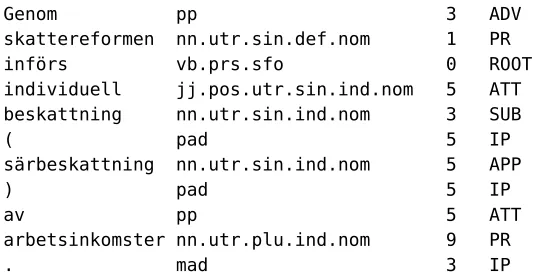
The system takes as input a file in the Malt-TAB format, there each token is represented on one line, with attribute values being sepa-rated by tabs and each sentence sepasepa-rated by a blank line. Figure 4 shows an example of the Malt-TAB format. During the learning phase the parser requires all four columns, but dur-ing parsdur-ing it only needs the first two columns, i.e. the word form and the part-of-speech. The output of the MaltParser system is a sequence of labeled dependency graphs in the Malt-TAB format or the Malt-XML format. The latter is an XML version of the Malt-TAB format.
In the sections below, we describe the main components in the architecture from the point of view of how they are implemented in the MaltParser system.
4.1 Parser
The user of MaltParser can choose between several deterministic parsing algorithms, in-cluding the algorithms described by Nivre (2003; 2004) and the incremental parsing algo-rithms described by Covington (2001).
Nivre’s algorithm is a linear-time algorithm limited to projective dependency structures. It can be run inarc-eager or arc-standard mode (cf. (Nivre, 2004)).
Covington’s algorithm is a quadratic-time algorithm for unrestricted dependency struc-tures, which proceeds by trying to link each new token to each preceding token. It can be run in aprojective mode, where the linking op-eration is restricted to projective dependency structures, or in a non-projective mode, al-lowing non-projective (but acyclic) dependency structures.
4.2 Guide
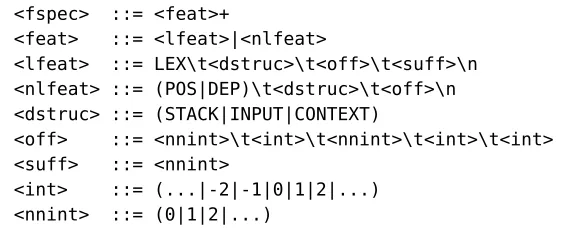
The MaltParser system comes with a formal specification language for feature functions, which enables the user to define arbitrar-ily complex feature models in terms of ad-dress functions, attribute functions and map-ping functions (cf. section 3.2). Each fea-ture model is defined in afeature specification file, which allows users to define feature mod-els without rebuilding the system. The feature specification uses the syntax described in Fig-ure 5. Each featFig-ure is specified on a single line, consisting of at least two tab-separated columns. Below follows a description of each column:
1. Defines the feature type to be part-of-speech (POS), dependency (DEP) or word form (LEX), corresponding to the attribute functionsp,landwin section 3.
2. Identifies one of the main data structures in the parser configuration: STACK (corre-sponding to σ), INPUT (corresponding toτ
or CONTEXT(corresponds to υ). The third alternative, CONTEXT, is relevant only to-gether with Covington’s algorithm in non-projective mode.
3. Defines a list offsetiwhich can only be pos-itive and which identifies thei+ 1th token in the list/stack specified in the second col-umn (i.e. σ[i],τ[i]orυ[i]).
4. Defines a linear offset i, which can be positive (forward/right) or negative (back-ward/left) and which refers to (relative) to-ken positions in the original input string.
5. Defines an offsetiin terms of the function
<fspec> ::= <feat>+
<feat> ::= <lfeat>|<nlfeat>
<lfeat> ::= LEX\t<dstruc>\t<off>\t<suff>\n <nlfeat> ::= (POS|DEP)\t<dstruc>\t<off>\n <dstruc> ::= (STACK|INPUT|CONTEXT)
<off> ::= <nnint>\t<int>\t<nnint>\t<int>\t<int> <suff> ::= <nnint>
<int> ::= (...|-2|-1|0|1|2|...) <nnint> ::= (0|1|2|...)
Figure 5: The syntax for defining a feature model in an external feature specification.
which specifiesiapplications of theh func-tion to the token identified through preced-ing offsets.
6. Defines an offsetiin terms of the functions
lc (the leftmost child) orrc (the rightmost child), which can be negative (|i| applica-tions of lc), positive (i applications of rc), or zero (no applications).
7. Defines an offsetiin terms of the functions
ls(the next left sibling) orrs(the next right sibling), which can be negative (|i| applica-tions of ls), positive (i applications of rs), or zero (no applications).
8. If the first column specifies the attribute function w (LEX), the eighth column, de-fines a mapping function which specifies a suffix of length n of the word form w. By convention, if n = 0, the entire word form is included; otherwise only the n last char-acters are included in the feature value.
As syntactic sugar, any feature definition can be truncated if all remaining integer values are zero. Let us consider an example:
POS INPUT DEP STACK 0 0 1 LEX INPUT 1
The first feature is the part-of-speech of the to-ken located first in the list τ of remaining in-put tokens, i.e. p(τ[0]). The feature defined on the second line is the dependency type of the head of the token located at the top of the stack
σ (zero steps down the stack, zero steps for-ward/backward in the input string, one step up to the head), i.e. l(h(σ[0])). Finally, the third feature is the word form of the token immedi-ately after the next input token, i.e. w(τ[1]).
When the Guide extracts the features accord-ing to the specification, it stores the feature val-ues in a dedicated data structure. The Learner later iterates through this data structure in a linear fashion and outputs each feature in the format by a specific machine learning package.
4.3 Learner
In the current implementation this component is actually a set of interfaces to machine learn-ing packages. The interfaces prepare the set of training instances, provided by the Guide, for the specific package and invoke the appropriate functions to learn a model or predict a decision. MaltParser comes with two different learning algorithms: Memory-based learning and Sup-port Vector Machines (SVMs), each with a wide variety of parameters.
Memory-based learning and classification is based on the assumption that a cognitive learn-ing task to a high degree depends on direct ex-perience and memory, rather than extraction of an abstract representation. Solving new prob-lems is achieved by reusing solutions from sim-ilar previously solved problems (Daelemans et al., 1999). During learning time, all training instances are stored and at parsing time a vari-ant ofk-nearest neighbor classification is used to predict the next action. MaltParser uses the software package TiMBL (Tilburg Memory-Based Learner) (Daelemans and Van den Bosch, 2005) to implement this learning algorithm, and supports all the options provided by that package.
processing, SVMs have been used for exam-ple for text categorization (Joachims, 1998) and syntactic dependency parsing (Kudo and Mat-sumoto, 2000). SVMs rely on kernel functions to induce a maximum-margin hyperplane classi-fier at learning time, which can be used to pre-dict the next action at parsing time. MaltParser uses the library LIBSVM (Wu et al., 2004) to implement this algorithm with all the options provided by this library.
5
Conclusion
We have presented a generic architecture for data-driven dependency parsing that provides a strict modularization of parsing algorithm, fea-ture model and learning method. The main ad-vantage of this design is that these three di-mensions can be varied independently of each other, but the design also enables the reuse of components between the learning and the pars-ing phase. The design has been implemented in the MaltParser system, which is freely avail-able for research and educational purposes, and which supports several parsing algorithms and learning methods, as well as a specification language for feature models that lets the user specify complex combinations of different types of features.
References
E. Black, F. Jelinek, J. Lafferty, D. Magerman, R. Mercer, and S Roukos. 1992. Towards history-based grammars: Using richer mod-els for probabilistic parsing. InProceedings of the 5th DARPA Speech and Natural Lan-guage Workshop, pages 31–37.
Michael Collins, Jan Hajiˇc, Lance Ramshaw, and Christoph Tillmann. 1999. A statistical parser for Czech. InProceedings of the 37th Annual Meeting of the Association for Com-putational Linguistics, pages 505–512.
Michael Collins. 1999. Head-Driven Statistical Models for Natural Language Parsing. Ph.D. thesis, University of Pennsylvania.
Thomas H. Cormen, Charles E. Leiserson, and Ronald L. Rivest. 1990.Introduction to Algo-rithms. MIT Press.
Michael A. Covington. 2001. A fundamental al-gorithm for dependency parsing. In Proceed-ings of the 39th Annual ACM Southeast Con-ference, pages 95–102.
Walter Daelemans and Antal Van den Bosch. 2005. Memory-Based Language Processing. Cambridge University Press.
Walter Daelemans, Antal van den Bosch, and Jakub Zavrel. 1999. Forgetting exceptions is harmful in language learning. Machine Learning, 34(1-3):11–41.
Jan Einarsson. 1976. Talbankens skriftspråk-skonkordans. Lund University, Department of Scandinavian Languages.
T. Joachims. 1998. Text categorization with support vector machines. InProceedings of the 10th European Conference on Machine Learning (ECML’98), pages 137–142.
Taku Kudo and Yuji Matsumoto. 2000. Japanese Dependency Structure Analysis Based on Support Vector Machines. In Em-pirical Methods in Natural Language Pro-cessing and Very Large Corpora, pages 18– 25.
D. M. Magerman. 1995. Statistical decision-tree models for parsing. In Proceedings of the 33rd Annual Meeting of the Association for Computational Linguistics (ACL), pages 276–283.
Joakim Nivre, Johan Hall, and Jens Nilsson. 2004. Memory-based dependency parsing. In Hwee Tou Ng and Ellen Riloff, editors, Pro-ceedings of the 8th Conference on Computa-tional Natural Language Learning (CoNLL), pages 49–56.
Joakim Nivre. 2003. An efficient algorithm for projective dependency parsing. In Gert-jan van Noord, editor,Proceedings of the 8th International Workshop on Parsing Technolo-gies (IWPT), pages 149–160.
Joakim Nivre. 2004. Incrementality in de-terministic dependency parsing. In Frank Keller, Stephen Clark, Matthew Crocker, and Mark Steedman, editors, Proceedings of the Workshop in Incremental Parsing: Bringing Engineering and Cognition Together (ACL), pages 50–57.
Joakim Nivre. 2005. Inductive Dependency Parsing of Natural Language Text. Ph.D. the-sis, Växjö University.
Honglin Sun and Daniel Jurafsky. 2004. Shal-low semantic parsing of Chinese. In Proceed-ings of the Human Technology Conference of the North American Chapter of the Asso-ciation for Computational Linguistics (HLT-NAACL), pages 249–256.
V. Vapnik. 1979. Estimation of dependences based on empirical data. Technical report, Nauka, Moscow.
T.-F. Wu, C.-J. Lin, and R. C. Weng. 2004. Prob-ability estimates for multi-class classification by pairwise coupling. Journal of Machine Learning Research, 5:975–1005.