The Upside of the Downside:
How Utilising Defensive Dynamics can Support Learning in Groups
Simpson, P., French, R. and Vince, R. (2000) “The Upside of the Downside. How Utilising Defensive Dynamics can Support Learning in Groups” Management Learning 31(4):483-497
Abstract
In this paper we suggest that it is important in management education to work with the defensive dynamics in learning groups. Through a consideration of the dynamics within complex systems, we argue that the ways in which these defensive dynamics are worked with may determine the levels of learning attained. This work requires a recognition that defensive dynamics within groups can limit learning, an awareness of the nature of such dynamics, and skill in adopting appropriate strategies in relation to them. Both staff and learners can contribute to this work.
Introduction
One way to define learning is as engagement with not-knowing. The aim of learning is, therefore, to come to know what is not-known (see, for example, Raab, 1997). Engagement with the experience of not-knowing does, however, generate uncertainty, and this uncertainty, in turn, stimulates a variety of responses some of which are conducive to learning whilst others may inhibit learning.
Dynamics that can limit learning are a feature common to all learning groups. Behaviours such as indifference, excessive dependency, lack of co-operation, and even hostility towards the tutor or other group members are familiar to all of us, and may be highly disruptive and demotivating. A learning group which exhibits such dynamics to any noticeable extent tends to be labelled by the tutor as a ‘difficult’ or ‘bad’ group.
Typical responses include attempts by the tutor to increase (or regain) control over the group, or even reciprocal behaviours such as anger or a lack of care towards the group. Group
members, on the other hand, may react through absence, or some other form of withdrawal, or through the formation of sub-groups with their own agendas. Such responses too frequently arise from a denial of the processes at play within the situation: they are, themselves, defensive routines (Argyris, 1990) which fail to address the learning task.
Although these destructive processes can threaten the functioning of the group, they are integral to group learning. Engaging effectively with the learning task therefore involves discovering ways of working effectively with these limiting forces in the learning process, as well as with more overt and creative dynamics.
In order to work with the defensive dynamics that are set up in this way, there is a need to develop an awareness of their characteristics and to become skilled in adopting appropriate strategies in relation to them. This involves finding ways of conceptualising defensive group dynamics and then being prepared to engage with them. We are suggesting that this is an essential element in the art of good teaching (see, for example, Bickford and Vleck, 1997; Dehler and Welsh, 1997).
These ideas are already worked with extensively by those with a commitment to
psychodynamics and group relations. From these perspectives, which have had a significant influence upon our thinking, there are many theoretical frameworks that could contribute to the questions raised here, such as Bion’s notions of basic assumption and work groups (Bion, 1961; Lawrence, Bain and Gould, 1996) or Agazarian’s work on system-centred group work (Agazarian, 1994; 1997). We are also aware of a considerable volume of work done from more humanistic perspectives that address the ideas explored in this paper (for example Reason 1994, Heron 1999).
However, our aim is to make the case that these ideas are relevant in all forms of management learning and education, and for all educators whatever their discipline or pedagogical
preference. To do this, we argue that learning groups are complex systems. The underlying principles of complex systems suggest that to work effectively with a learning group it is important to identify and work with the interrelating patterns of positive and negative feedback loops. In this context, the key pattern that requires our attention is the relationship between, on the one hand, processes that tend to amplify learning and, on the other hand, the defensive dynamics that are provoked by the anxiety of engaging with not-knowing.
The ability to hold onto the tension between these opposing dynamics is an important aspect of the creative impulse towards learning. This process requires the adequate containment of anxiety; that is, the need to find ways of holding together apparently contradictory forces in such a way that the creative tension leads to learning rather than collapsing into defensive processes.
Having described our theoretical position in more detail, we illustrate our ideas by means of two case examples. We conclude with a discussion of the different levels at which this work with defensive dynamics may be attempted, suggesting that the ability to utilise defensive dynamics in learning groups should be an essential element in the training of educators.
Understanding Learning Groups as Complex Systems
Learning groups are systems characterised not by predictable patterns of behaviour and stable equilibrium but by amplifying and balancing feedback processes; that is, learning groups are complex systems (Levy, 1994; Stacey, 1996). They involve a complexity in relations,
relationships and inter-relationships - between group members, sub-groups, ideas, emotions, systems, activities, expectations, conceptual frameworks and experiential backgrounds - which is one of the delights, and the dilemmas, of the education process.
Stacey (1996: 296-297) outlines three basic principles of complex systems:
thinking, there is a clear and immediate link between defensive dynamics and ‘bad’ experiences - that is, ones which we do not enjoy or appreciate; the link between these dynamics and learning is less obvious and, probably, less immediate.
2. In complex systems the links between cause and effect may be distant in time and space. For example, learning may not appear to occur within an event, but may arise some time later -during a lunch break, overnight, a week, a month or even several years on. The link may, in fact, not be apparent. This clashes head-on with the dominant culture of ‘performativity’ in learning - ‘efficiency measured according to an input-output ratio’ (Lyotard, 1984: 88) - as demonstrated in the ubiquitous phrase: ‘By the end of this module/unit, you will be able to...’.
3. Complex systems are highly sensitive to some changes, but remarkably insensitive to many others. The primary difficulty is that there is no way of determining with any certainty which category possible changes fall into. For example, widely used interventions, such as improving the structure and content of teaching (better handouts, smarter OHPs, funnier jokes), may have little or no impact upon learning. By contrast, giving direct attention to manifest resistance to learning, by identifying and working with the underlying defensive group dynamics, can release considerable potential for learning within the group.
In learning contexts, process complexity is commonly managed by avoidance, that is by utilising simplifying assumptions and by assuming conditions approximating to stable
equilibrium. In other words, staff seek to create a learning system that will behave as though it is not complex. This is attempted, for instance, through introducing control strategies, such as a high degree of structure in design and process and ever more closely defined learning outcomes and assessment procedures, through developing an appropriately directive staff style and through offering a clear rationale for all activities. These strategies serve primarily to suppress the manifestations of defensive dynamics. Their effectiveness is dependent upon the skill of the staff.
The simplifying assumptions of stable equilibrium are summarised in Table 1 and contrasted with the principles of complexity.
The first two principles of complex systems are worked with consciously or intuitively by most competent staff. The first principle suggests that to understand the learning group as a
Principles of Complexity Assumptions of Stable Equilibrium Actions within complex systems often
produce unexpected or counter-intuitive results.
It is possible to manage the learning process in such a way as to achieve desired
outcomes. In complex systems the links between cause
and effect may be distant in time and space. It is possible to achieve these learning outcomes through predictable, measurable means (Easterby-Smith, 1986).
Complex systems are highly sensitive to some changes, but remarkably insensitive to many others.
Identifying actions for improvement and change is relatively unproblematic: the major difficulties are in relation to constraints, such as resource limitations.
complex system is to expect the unexpected. No matter how well the programme has been designed, or how skilled the staff, the learning process might develop in surprising ways. The skill of the staff is to perceive and respond effectively to the need to deviate from the original design created by the defensive dynamics within the group.
In relation to the second principle, we recognise, from our experience as teachers and learners, that the potential for learning is often realised well beyond the content or time frame of the programme. Thus, even the most trying and difficult teaching experience may not be as pointless as it might at first seem. Where defensive dynamics appear to have detracted from the learning process, it is not impossible that some unexpected benefit has been gained. For example, in a postgraduate class taught recently by one of the authors, a high degree of competitiveness effectively silenced three quarters of the group in discussions: their anxiety levels were so high that many did not dare to speak. However, this same competitive spirit contributed to a high level of work outside of the classroom, with the result that this group achieved the best assignment averages of any class that had ever taken the module.
The third principle of complex systems is of particular importance in our exploration of the group dynamics that can limit learning. This principle encourages staff to consider which interventions within a learning group are more likely to lead to significant change and to increase learning. This question will be considered in greater depth in the following sections.
Patterns of Not-Knowing
In the terminology of systems thinking, interventions that might lead to significant change are said to offer ‘high leverage’. Senge suggests that ‘the high leverage changes in human systems [are] non-obvious until we understand the forces at play in those systems’ (1990: 65). A key feature of complex systems is that, despite the fact that individual behaviours and events are unpredictable, the overall system will exhibit a particular pattern or patterns. The task for anyone wishing to intervene in or manage the system is therefore to identify the influential pattern or patterns within the system - what Bateson (1980: 15ff.) called ‘the pattern which connects’.
This issue is central to this paper. It suggests that there may be ways of managing learning groups which do not rely solely on assuming conditions of stable equilibrium.
In a learning system, the patterns of dynamics are influenced, above all, by one experience. It is the uncertainty which is stimulated by facing the experience of not-knowing. If there is no sense of not-knowing, however transient or vague, there is no stimulus to learn. To learn is to engage with not-knowing. As a result, one of the dominant responses to the engagement with learning - on the part of both teacher and learner - is uncertainty, frequently accompanied by the emotional experience of anxiety or even fear (French, 1997; Salzberger-Wittenberg et al., 1983).
limit learning (Vince and Martin, 1993). Bion’s work on groups focused specifically on these tensions. He demonstrated how the emotions generated by the engagement with not-knowing can either be harnessed in pursuit of the task, in what he called the ‘work group’, or, when not well enough contained, can stimulate all kinds of anti-task/anti-learning activity, in the ‘basic assumption group’ (Bion, 1961; Lawrence, Bain and Gould, 1996).
The Amplifying and Balancing Cycles which Promote or Limit Learning
A number of common patterns have been identified that offer an understanding of complex system dynamics. In the following discussion, we focus on one of these patterns - known as the ‘limits to growth’ pattern - which helps us to understand the limits to growth in learning that may be caused by defensive group dynamics.
The ‘limits to growth’ pattern is defined in terms of two linked cycles. The first cycle - an ‘amplifying process’ or virtuous cycle - describes a dynamic within which a particular condition is caused to grow. This growth creates the conditions for further growth, which, if left unchecked, would continue to amplify ad infinitum.
However, this amplifying process will create a ‘limiting condition’ which sets in motion a second - vicious - cycle, a ‘balancing process’ which limits growth. The balancing process acts as a ‘brake’ on the amplifying process. For example, population growth can set up both amplifying and balancing processes by creating, on the one hand, the conditions for continued growth through a larger breeding population, and, on the other, decreased growth, through the limiting ‘brake’ of diminishing resources per head of population.
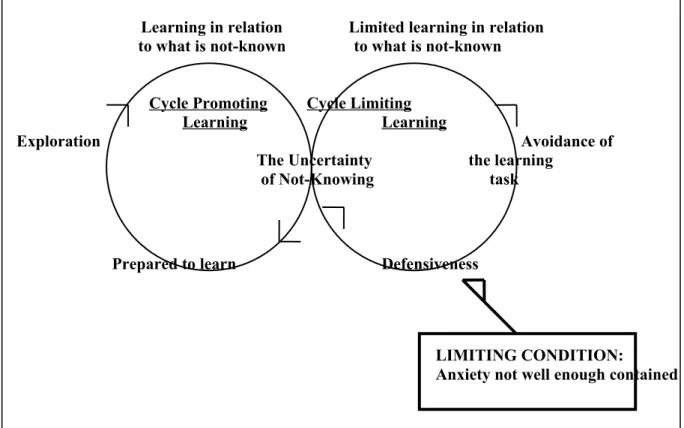
These ideas inform the description which follows of balancing and amplifying processes in relation to the learning process, especially in groups. The two cycles describe opposed dynamics which can arise from engagement with not-knowing: the first cycle promotes and the second limits learning.
It is important to note that the starting point is the same for both cycles, that is: the experience of uncertainty resulting from engaging with not-knowing. The cycle promoting learning is likely to develop when the uncertainty and consequent anxiety are well enough contained by the group/system. As a result, the group is prepared to learn, leading to personal and collective exploration and to the generation of learning in relation to what is not-known. This creative growth cycle provides the impetus and desire for more learning - to engage further with what is not-known. Greater risks are taken, deeper levels are explored. However, the limiting condition is activated when the learning group over-reaches itself and it is no longer possible to contain the anxiety created by the uncertainty of not-knowing.
The cycle limiting learning is stimulated by this failure to contain anxiety sufficiently well. In this case, the uncertainty of not-knowing provokes defensive behaviours, such as fight,
The model in Figure 1 summarises the complex relations between these two cycles, that is between the dynamics that promote and those that limit learning in relation to the uncertainty of not-knowing.
This leads us to ‘the upside of the downside’: what is generally believed to be an irritant can, in fact, be the key to growth because ‘leverage lies in the balancing process - not the
amplifying process’ (Senge, 1990: 101). In other words, whether one wishes to promote or to limit growth, it is the work done on the cycle limiting learning that is important.
This is an excellent example of the counter-intuitive nature of complex systems. The common (-sense) approach to increasing learning is focused on the amplifying process: we try harder, we castigate ourselves for being lazy or for taking too few risks. However, if we consider the analogy of the balancing process as a brake and the amplifying process as the accelerator, then anyone who drives a car knows that if the brake is on then the key to achieving greater speed is not best found in pressing harder on the accelerator.
Limiting dynamics are a brake on the learning process. This is eminently clear to those who are the source of these dynamics. Resistance to learning is a response to not-knowing that says, ‘Wait a minute - I am not sure that this is a good thing’. Sometimes this is exactly what is needed in learning situations: what is being offered is not a good thing. However, at other times, the brake is being applied because the learning group cannot deal with the uncertainty and anxiety - or competitiveness, rivalry, anger, fear, envy or desire - provoked by not-knowing. In such situations there is a need to engage with these dynamics in such a way as to ease the braking pressure in order to allow learning to grow.
Learning in relation
Limited learning in relation
to what is not-known
to what is not-known
Cycle Promoting Cycle Limiting
Learning Learning
Exploration
Avoidance of
The Uncertainty the learning
of Not-Knowing task
Prepared to learn Defensiveness
LIMITING CONDITION:
Anxiety not well enough contained
Working with the group dynamics that limit learning is thus a potentially important way to promote learning. Rather than indicating failure in the learning process, manifestations of dependency, fight or flight, of denial, avoidance or resistance, can all indicate potential points of leverage for learning within the group. To take advantage of this possibility of leverage, however, attention must be given to the limiting condition, that is, the failure to contain adequately the anxiety within the learning group. If this can be done more effectively, then an amplifying process can be released which will promote growth in learning. Through an awareness of these dynamics, therefore, staff and learners may find creative and powerful means of supporting the learning process.
We will explore this further by means of two case illustrations.
Case Examples of Working with Defensive Group Dynamics
Illustration One
The learning group was in the fourth session of the ‘Understanding Organizations’ module of a full-time Postgraduate Diploma in Personnel Management. The group comprised thirty two participants who had been together for only two weeks. The participants sat around tables in groups of five or six which had already become fairly established. They were working in these groups on a structured activity addressing the topics of organizational structure and culture. One of the groups had gone to work in another room.
After forty minutes one member of this group came in to ask the tutor to go to see them. The tutor went in to find the group extremely unhappy: ‘You know we’re just spending far too long on this sort of stuff and we’re not getting anything out of it. We don’t understand what’s going on.’ The tutor replied forcefully, ‘It sounds like you are blaming me.’ Immediately, two of them countered, defensively, ‘No, no, that’s not what we are saying.’ ‘What we’re saying is - we don’t know what we are getting out of this.’ Another member continued, ‘We look at some of the other groups and they just get on with this stuff and they seem to get loads out of it. We’re not getting anything and we feel stuck in this group. What we would like is to move into some of the other groups a bit more and work with different people, but we’re not allowed to.’ One group member said, ‘I went in there just now and went up to a table and Kevin looked at me and said ‘What do you want?’. All I wanted was to go and say ‘Hi’ but he just told me to ‘Get lost’. That’s what the group is like.’
Back in the large group in the review session this small group were unable to express their strength of feeling, merely commenting ‘It would be quite nice to move around a bit. We’re really happy in our group.’
Defensive dynamics are difficult for both participants and staff to manage. In their difficulty, the group resorted to dependency on the tutor - and then attacked him. The tutor’s response was also defensive and expressed in the form of a counter-attack - ‘don’t blame me’. While this did have the positive effect of stopping the group from using the attack on the staff to cover up their difficulties, it also fitted into a broader limiting pattern, whereby the group had already experienced a direct attack from another group (who may themselves - via Kevin - have perceived the approach by a member of this group as an attack). Participants and staff took up defensive positions and were unable to say what they felt. The dynamic was punishing and had the effect of cutting off communications on both sides.
Simplifying strategies such as these, and the missed opportunity they represent, are, of course, common. Our hypothesis is that a greater understanding and awareness of the ‘downside’ - of the ways in which the defensive dynamics may have been limiting the learning - and of the ‘upside’ - of the potential for releasing learning by engaging with and re-conceptualising these limiting dynamics - might have provided the tutor with greater insight on which to base his interventions. Rather than becoming defensive, he might have seen this situation as a learning opportunity and focused on the episode rather than playing it down.
In a way that is so common as to be almost paradigmatic, the theme of the session - the relationship between structure and culture in organizations - had surfaced in the dynamic of the teaching-learning situation itself. Thus, the learning might have been greatly enhanced by an explicit acknowledgement and analysis of the divisive structure which had either created, or developed out of, a culture of attack/defence. This might have been enough to contain a problematic and destructive experience, thereby releasing the brake of the limiting cycle and initiating instead an amplifying dynamic. Downside might have turned into upside. At the least, it would have been an interesting case study, helping to make sense of the session, and
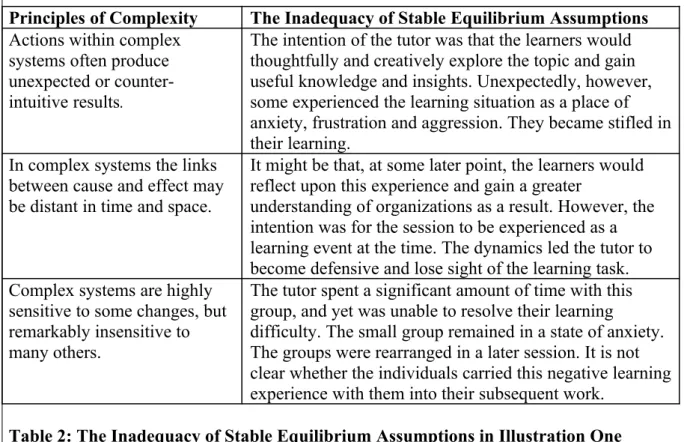
Principles of Complexity The Inadequacy of Stable Equilibrium Assumptions Actions within complex
systems often produce unexpected or counter-intuitive results.
The intention of the tutor was that the learners would thoughtfully and creatively explore the topic and gain useful knowledge and insights. Unexpectedly, however, some experienced the learning situation as a place of anxiety, frustration and aggression. They became stifled in their learning.
In complex systems the links between cause and effect may be distant in time and space.
It might be that, at some later point, the learners would reflect upon this experience and gain a greater
understanding of organizations as a result. However, the intention was for the session to be experienced as a learning event at the time. The dynamics led the tutor to become defensive and lose sight of the learning task. Complex systems are highly
sensitive to some changes, but remarkably insensitive to many others.
The tutor spent a significant amount of time with this group, and yet was unable to resolve their learning
difficulty. The small group remained in a state of anxiety. The groups were rearranged in a later session. It is not clear whether the individuals carried this negative learning experience with them into their subsequent work.
thereby limiting the damaging experience of confusion and incompetence. At the most, it could have transformed the theme from being a set of ideas to be learned about into a significant learning experience.
A further example in a different setting offers a less speculative illustration of our point. Illustration Two
A learning group of eight middle managers within a civil service organization were given the task of planning the organization’s annual management conference. This was a significant task that had previously been undertaken by a small team of senior
managers. However, cultural changes within the organization, emphasising
empowerment and development through delegation, had led to the activity being re-framed as an action learning project. The group were required to design and manage the two-day residential conference that would include all senior and middle managers - over eighty participants.
Past conferences had received mixed feedback. The opportunity for all managers to come together was generally seen as valuable, but the formal aspects of the conference (whether presentations or workshops) were frequently subjected to heavy criticism. The challenge for this group was to design a programme that that would be of interest to managers from a wide range of work disciplines. The overall theme - ‘Change’ - had already been chosen by the chief executive. This was viewed positively within the group because it addressed a common experience for everyone, following several years of pervasive strategic and cultural change. The detail of the design was more problematic.
At the first meeting the discussion was frenetic with many ideas being thrown around. Sub-groupings began to form: some proposing creative and thoughtful ideas; others quickly dismissing these ideas as having failed in the past. Those who had been energised soon became frustrated. Those who had been more critical became more confirmed in their cynicism. Alongside aggression, frustration and a growing sense of apathy and depression, the level of anxiety within the group increased noticeably.
The facilitator observed that the group was becoming stuck in a growing cycle of negativity. However, it was not immediately clear how to nudge the group towards a more positive engagement with the task. He worked hard at resisting the desire to intervene. After listening carefully for twenty minutes, the insight grew in the facilitator’s mind that there was a common confusion in relation to the task, most noticeable in the use of the terms ‘conference’ and ‘workshop’ as synonyms. The
facilitator intervened. ‘It appears that you are unclear about the expectations upon you. A conference is frequently characterised by the expectation that experts will provide answers. This seems to be the dominant expectation that you have of yourselves in organizing this conference. In contrast, the idea of a workshop is being used to describe participants working together to explore important issues and difficulties. This might be a more realistic set of expectations to work towards.’ This provoked requests for
clarification followed by considerable discussion.
participants with a range of opportunities to meet and explore important issues together. This clarification of the task brought about by the intervention was later recalled by the group as a significant step forward in their work together.
This intervention helped the learning group to contain their anxiety by giving them permission to accept, rather than to avoid, their experience of not-knowing. The facilitator used his own experience and awareness of defensive group dynamics as a basis for developing insight and taking remedial action.
In this situation the facilitator showed respect for the limiting dynamics as a real and difficult aspect of the learning process, and resisted the temptation to try to remove these dynamics and ‘make things better’. This involved taking a non-directive, listening role, and allowing
sufficient time to develop appropriate insights.
It was also important that the facilitator did not take on responsibility for solving the problems of the group or attempt to manage this task for them. Rather than giving an answer, the facilitator reframed the question for the group in a way that allowed them to find a shared position based on an acceptance and tolerance of not-knowing. As a result they were able to move beyond their earlier conflictual position, which had involved differences in levels of optimism or pessimism, enthusiasm or cynicism, and different ideas and opinions.
Levels of Working with Defensive Dynamics
Working with defensive group dynamics can be viewed as taking place on three levels: damage limitation; direct engagement with the defensive dynamic for the sake of the learning task in hand; direct engagement with the limiting dynamic as itself the primary focus of the learning.
1. Damage limitation. Defensive dynamics can retard, even reverse, personal and group learning, as well as causing emotional pain and damage to the learners’ confidence. The learning task is, therefore, served by an ability to restrict the manifestation of these dynamics to a manageable level, or to make necessary repairs. The importance of this form of work is illustrated in the first example above, and is a minimum requirement in all learning situations. The essence of damage limitation is that students are enabled to make sense of the learning experience in a manner appropriate to them, and to the learning context, rather than being left with feelings of confusion and incompetence.
An awareness of defensive dynamics is therefore always essential for staff. It can be
beneficial, but is not always necessary, for students. With sufficient awareness and skill, the staff can create a ‘good enough’ learning environment by limiting the destructive aspects of
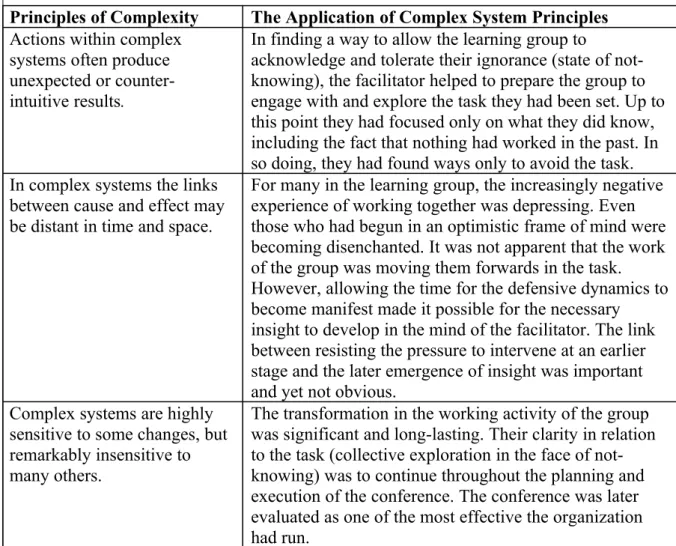
Principles of Complexity The Application of Complex System Principles Actions within complex
systems often produce unexpected or counter-intuitive results.
In finding a way to allow the learning group to
acknowledge and tolerate their ignorance (state of not-knowing), the facilitator helped to prepare the group to engage with and explore the task they had been set. Up to this point they had focused only on what they did know, including the fact that nothing had worked in the past. In so doing, they had found ways only to avoid the task. In complex systems the links
between cause and effect may be distant in time and space.
For many in the learning group, the increasingly negative experience of working together was depressing. Even those who had begun in an optimistic frame of mind were becoming disenchanted. It was not apparent that the work of the group was moving them forwards in the task. However, allowing the time for the defensive dynamics to become manifest made it possible for the necessary insight to develop in the mind of the facilitator. The link between resisting the pressure to intervene at an earlier stage and the later emergence of insight was important and yet not obvious.
Complex systems are highly sensitive to some changes, but remarkably insensitive to many others.
The transformation in the working activity of the group was significant and long-lasting. Their clarity in relation to the task (collective exploration in the face of not-knowing) was to continue throughout the planning and execution of the conference. The conference was later evaluated as one of the most effective the organization had run.
these processes without needing to name them or work with them explicitly. (See, for example, French, 1997).
2. Engagement with defensive dynamics for the sake of the learning task. The second level goes beyond merely limiting the potential damage caused by defensive dynamics; it embraces them actively, recognising them as a source of insight that might be utilised in the learning process. The second illustration demonstrates this. The defensive dynamics evoked within the planning group pointed towards key areas of learning because they arose from the group’s immediate engagement with the not-known of the task. The work in support of learning was to struggle in the face of these difficult dynamics to gain the insight and authority that might take the group forward. An awareness of the need to struggle with these issues is potentially invaluable for staff who seek to interpret and intervene in the learning process. Illustration two indicates that these positive learning outcomes can be facilitated without awareness on the part of the learners, although such an awareness would clearly be valuable for those who wish to manage their own learning more effectively.
3. Engagement with the defensive dynamics as the learning task. The third level focuses actively on developing an awareness of the defensive dynamics within the learners
themselves. Indeed, in a learning context of this kind, this might even be considered to be the primary learning task, as, for example, on group relations conferences (Colman and Geller, 1985; Knights, 1995; Ramsay, 1999) or in dialogue events (Isaacs, 1993; Schein, 1993). Generally speaking, we are socialised to avoid these potentially destructive processes because they are portrayed as, and can indeed be experienced as, unpleasant, dangerous and difficult. As a consequence, they are typically avoided in group situations, and we are systematically taught to deny the reality that defensive dynamics are an integral and inevitable aspect of any group process.
The learning that can be generated by focusing directly on these dynamics can therefore potentially be transformational because it can become paradigmatic: the learners’ engagement with the reality of social situations is challenged at a fundamental level. What was once ‘bad’, is now considered neither ‘good’ nor ‘bad’; rather, it becomes a reality that is replete with possible interpretations and meanings. Habitual behaviours, thoughts and emotions that had previously made sense are found to be irrelevant or misleading; learned responses that can be un-learned. Working in this way is, however, not easy for participants or staff. Defensive routines come into play that are an expression of the conscious and, more importantly,
unconscious drives to avoid the pain and struggle of confronting not-knowing and the difficult dynamics within the group, which such experiences evoke.
It will be clear from the preceding discussion that it is our belief that all staff involved in directing learning programmes would benefit from effective experiences of this third level of working as learners themselves. This would contribute to their ability to identify and to manage the dynamics within their own learning groups. However, the need for such training for teachers, lecturers, facilitators and consultants is only rarely recognised and hence seldom given the priority it deserves.
We conclude with a warning and an encouragement. Firstly, a warning in relation to working in the manner described in this paper. The powerful learning that can be released by the third level of working is seductive, and yet we believe not always appropriate. Whilst we have argued that there is a potentially significant upside to the downside of defensive dynamics, the downside should be treated with caution and with due respect.
The creative implications of paying more attention to defensive dynamics must be tempered by an awareness of the learning context, and in particular the manner in which learning is supported within the legitimate domain of the organization or institution. There are, for example, many situations in which the existing system of power relations can make it extremely hard, if not impossible, for staff and/or learners to hold in creative tension the dynamics that may be evoked if, in an attempt to work with the defensive dynamics within the group itself, existing power relations are challenged.
If the dynamics cannot be held well enough in creative tension, then it is likely that the balancing process (the limiting dynamics) will come to dominate. It is an act of prudence in such situations to adopt a conscious and deliberate strategy of limiting learning goals by working only at the first or second levels. Generally in management education, as it currently operates in business and management schools, the aims of the learning process will not allow the extended and explicit attention to the vicious cycle of defensiveness that is required at the third level of working (see French and Grey, 1996). Furthermore, the educator may well be working within fairly short timescales (perhaps thirty hours of contact with the group), with limited resources (particularly limited staff time or skill), or in an overall course structure and context where such work would be severely counter-cultural. Such issues create particular problems or restrictions in relation to the unpredictable nature of the dynamics and learning that inevitably arise with work of this kind.
References
Agazarian, Y. M. (1994) ‘The Phases of Group Development and the Systems-Centred Group’, in V. L. Schermer and M. Pines (eds) Ring of Fire: Primitive Affects and Object Relations in Group Psychotherapy, pp. 36-85. London: Routledge.
Agazarian, Y. M. (1997) Systems-Centered Therapy for Groups. New York: The Guilford Press.
Argyris, C. (1990) Overcoming Organizational Defenses: Facilitating Organizational Learning. Boston: Allyn & Bacon, Prentice-Hall.
Bateson, G. (1980) Mind and Nature: A Necessary Unity. London: Fontana.
Bickford, D. J. and Van Vleck, J. (1997) ‘Reflections on Artful Teaching’, Journal of Management Education 21/4: 448-72.
Bion, W. R. (1961) Experiences in Groups. London: Tavistock.
Colman, A. D. and Geller, M. H. (1985) Group Relations Reader 2 Washington DC: A.K. Rice Institute.
Dehler, G. E. and Welsh, M. A (1997) ‘Discovering the Keys: Spirit in Teaching and the Journey of Learning’, Journal of Management Education 21/4: 496-508.
Easterby-Smith, M. (1986) Evaluation of Management, Education, Training and Development. Aldershot: Gower.
French, R. (1997) ‘The Teacher as Container of Anxiety: Psychoanalysis and the Role of Teacher’, Journal of Management Education 21/4: 483-95.
French, R. and Grey, C. (eds) (1996) Rethinking Management Education. London: Sage.
Heron, J. (1999) The Complete Facilitator’s Handbook. London: Kogan Page.
Isaacs, W. N. (1993) ‘Taking Flight: Dialogue, Collective Thinking, and Organizational Learning’, Organizational Dynamics 22/2: 24-39.
Knights, B. (1995) ‘Group Processes in Higher Education: the Uses of Theory, Studies in Higher Education 20/2: 135-46.
Lawrence, W. G., Bain, A. and Gould, L. (1996) ‘The Fifth Basic Assumption’, Free Associations 6/1, No. 37: 28-55.
Levy, D. (1994) ‘Chaos Theory and Strategy: Theory, Application, and Managerial Implications’, Strategic Management Journal 15: 167-78, Special Issue, Summer.
Menzies Lyth, I. E. P. (1990) ‘Social Systems as a Defense against Anxiety’ (revised), in E. Trist and H. Murray, The Social Engagement of Social Science, Vol. 1. London: Free
Association Books.
Nitsun, M. (1996) The Anti-Group. London: Routledge.
Raab, N. (1997) ‘Becoming an Expert in Not Knowing. Reframing Teacher as Consultant’, Management Learning 28/2: 161-75.
Ramsay, S. (1999) ‘After the Conference is Over’, in R. French and R. Vince (eds) Group Relations, Management, and Organization. Oxford: Oxford University Press.
Reason, P. (1994) Participation in Human Inquiry. London: Sage.
Salzberger-Wittenberg, I., Henry, G. and Osborne, E. (1983) The Emotional Experience of Learning and Teaching. London: Routledge.
Schein, E. H. (1993) ‘On Dialogue, Culture and Organizational Learning’, Organizational Dynamics 22/2: 40-51.
Senge, P. (1990) The Fifth Discipline. New York: Doubleday
Stacey, R.D. (1996) Strategic Management and Organisational Dynamics London: Pitman