Volume 2007, Article ID 21825,7pages doi:10.1155/2007/21825
Research Article
Performance of Distributed CFAR Processors in
Pearson Distributed Clutter
Zoubeida Messali and Faouzi Soltani
D´epartement d’Electronique, Facult´e des Sciences de l’Ing´enieur, Universit´e de Constantine, Constantine 25000, Algeria
Received 30 November 2005; Revised 17 July 2006; Accepted 13 August 2006
Recommended by Douglas Williams
This paper deals with the distributed constant false alarm rate (CFAR) radar detection of targets embedded in heavy-tailed Pear-son distributed clutter. In particular, we extend the results obtained for the cell averaging (CA), order statistics (OS), and censored mean level CMLD CFAR processors operating in positive alpha-stable (P&S) random variables to more general situations, specif-ically to the presence of interfering targets and distributed CFAR detectors. The receiver operating characteristics of the greatest of (GO) and the smallest of (SO) CFAR processors are also determined. The performance characteristics of distributed systems are presented and compared in both homogeneous and in presence of interfering targets. We demonstrate, via simulation results, that the distributed systems when the clutter is modelled as positive alpha-stable distribution offer robustness properties against multiple target situations especially when using the “OR” fusion rule.
Copyright © 2007 Z. Messali and F. Soltani. This is an open access article distributed under the Creative Commons Attribution License, which permits unrestricted use, distribution, and reproduction in any medium, provided the original work is properly cited.
1. INTRODUCTION
In radar detection, the goal is to automatically detect a tar-get in a nonstationary noise and clutter while maintaining a constant probability of false alarm. Classical detection using a matched filter receiver and a fixed threshold is no longer ap-plicable due to the nonstationary nature of the background noise. Indeed, a small increase in the total noise power re-sults in a corresponding increase of several orders of mag-nitude in the probability of false alarm. Therefore, adaptive threshold techniques are needed to maintain a constant false alarm rate. Hence, CFAR detectors have been designed to set the threshold adaptively according to local information on the background noise. More specifically, CFAR detectors es-timate the characteristics of the noise by processing a win-dow of reference cells surrounding the cell under test. The CA approach is such an adaptive procedure. However, the CA detector has a severely degraded performance in
clut-ter edge and inclut-terfering targets echoes [1,2]. Rohling
modi-fied the common CA-CFAR technique by replacing the arith-metic averaging estimator of the clutter power by a new
mod-ule based on order statistics (OS) [3]. The OS-CFAR
pro-cedure protects against nonhomogeneous situations caused by clutter edges and interfering targets (which is of inter-est in this paper). Target detectability and robustness against
interfering targets can also be enhanced using distributed
de-tection [4,5]. However, the design of a distributed
detec-tion is strongly affected by the clutter model assumed.
Ac-tual data, such as active sonar returns [6], sea clutter
mea-surements [7], and monostatic clutter from the US Air Force
Mountaintop Database [8], have been successfully modelled
with heavy-tailed distributions; the tails of these distribu-tions showed a power-law or algebraic asymptote, which is characteristic of the so-called alpha-stable family and was
contrasted with the exponentially decaying tails of theK
dis-tribution [9] and Weibull families. Indeed, alpha-stable
pro-cesses have to be effective in modelling many real-life
engi-neering problems such as outliers and impulsive signals [10].
The probability density function (pdf) of alpha-stable
pro-cesses does not have a closed form except for the casesα=1
(Cauchy distribution), α = 1/2 (Levy or Pearson
distribu-tion) andα=2 (Gaussian distribution), whereαis the
char-acteristic exponent of the distribution. For this main reason, Pearson is the distribution of interest here. This is further justified by the fact that Pierce showed that the Pearson dis-tribution closely models the modulation of certain sea clutter
returns [7]. Tsakalides et al. [11] studied the design and
Input signal Square law
detector
Y
Test cell
X1 XN/2 XN/2+1 XN
Z1=N2
i
Xi Z2=N2
i
Xi
Decision Logic selection
ZCA=Z1+Z2
ZCAGO=max(Z1,Z2)
ZCASO=min(Z1,Z2) S
X Z
DesiredPfa ComputeT
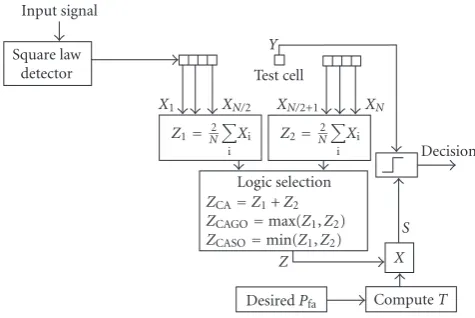
Figure1: Block diagram of the CA, CAGO, and CASO-CFAR de-tector structure.
detector for Pearson distributed heavy-tailed output signals.
Our contribution extends the results found in [11] to more
general situations. Namely, we consider two identical and dif-ferent CFAR distributed detectors assuming positive alpha-stable distributed data in interfering targets environment and using the fusion rules “AND” and “OR.” The organization of
this paper is as follows: in Section 2, we briefly review the
development and the computation structure of CFAR
tech-niques. InSection 3, we derive the false alarm probabilities
of the CAGO and CASO CFAR processors for Pearson dis-tributed heavy-tailed output signals. The detection
probabil-ities are computed by simulation method. InSection 4, we
study the distributed CFAR system with different
combina-tions in both absence and presence of three interfering tar-gets. Finally, the results and conclusions are provided in
Sec-tions5and6, respectively.
2. BASIC ASSUMPTION AND PROBLEM FORMULATION
CFAR technique is a signal processing technique used in au-tomatic radar detection system to control the false alarm rate when the clutter parameters are unknown or slowly time varying. The CFAR algorithm adjusts the detection thresh-old on a cell by cell basis, so that, in clutter or noise interfer-ence environments, the false alarm probability is kept
con-stant. InFigure 1, the local CA-CFAR detector block diagram
is shown. For a system where square-law detects the output of a matched filter to obtain the test statistic, the problem can be modelled as the following hypothesis testing problem:
H1(target present) :Y=s+c,
H0(target absent) :Y=c,
(1)
wheresandcare the signal and clutter components,
respec-tively.
Implementing a generalized likelihood ratio test, the
de-cision forH0orH1is realized by the following thresholding
operation:
e(Y)=
⎧ ⎨ ⎩
target present ifY≥S,
target absent ifY< S. (2)
The thresholdSis calculated as the product
S=T·Z, (3)
whereZ is the estimate of the average clutter strength and
Tis a scaling factor used to achieve a derivedPfa. We briefly
recall the single CA-CFAR results for the case of Pearson dis-tributed data. Then, we extend the results to single greatest of CAGO and single smallest of CASO CFAR for the same case.
3. ANALYSIS OF SINGLE DETECTORS
The analytical results for the probability of false alarm of sin-gle CA, CAGO, and CASO-CFAR, when the cell samples fol-low the Pearson distribution, are derived as folfol-lows.
3.1. Single CA-CFAR for Pearson distributed data
The output measurements follow the Pearson distribution. It has been demonstrated that the CA-CFAR processor in
Figure 1is a CFAR processor for Pearson distribution data by
showing that the false alarm probabilityPfais independent of
the dispersionγof the measurements [11].
3.1.1. Probability of false alarmPfa
Assume thatX1,. . .,XNfollow the Pearson distribution with
probability density function (pdf) given by [11]
pXi(x)=
⎧ ⎪ ⎨ ⎪ ⎩
γ √
2π
1 x3/2e−γ
2/2x
, x≥0,
0 otherwise,
(4)
whereγis the scale parameter of the distribution.Pfa
indi-cates the probability that a noise random variableY0 is
in-terpreted as target echo during the thresholding decision (2).
This probability is given by
Pfa=Pr
Y0≥T·Z
. (5)
The cell averaging (CA) CFAR method selects the average of
the reference cell values as a measure of the clutter levelZ,
that is,
Z=ZCA= 1
N
N
i=1
Xi. (6)
ThePCA
fa is expressed as
PCA fa =
2N
π
∞
0 erf
y √
2T
e−N y2/2
dy, (7)
where
erf(y)=√2
π
y
0 e −t2
The important conclusion from (7) is that the false alarm
probability is controlled by the scaling factorT and it does
not depend on the dispersion parameterγof the Pearson
dis-tributed parent population. As a consequence, the CA CFAR method may be considered as a CFAR method for Pearson background.
3.1.2. Probability of detection
We consider the case of a Rayleigh fluctuating target with
parameter σs2 in a heavy-tailed background noise scenario
when the CFAR processor is presented by a square-law de-tector. The probability of detection is given by
PCAd =Pr
Y1≥TZ
=
∞
0 Pr
Y1≥Tz
pZCA(z)dz. (9) Exact analytical evaluation of this expression is not easy. In
fact, to specifyY1underH1would require specifying the
in-phase and quadrature components of both the clutter and the useful signal, whereas only their amplitudes pdfs are given. Therefore, we have to resort to computer simulation. Hence, the test-cell measurement is considered as a scalar product of the two vectors: the clutter and the useful signal, respectively. So that
Y1=s+c+
√
s·c·cos(ϕ), (10)
whereϕis the angle between the vectorssandcand is
uni-formly distributed in [0,2π], andsandcare the signal and
clutter components, respectively.
Notice that, the detection probability is a function of the
clutter dispersionγand the power parameter of the Rayleigh
fluctuation targetσs.
3.2. Greatest-of (CAGO) CFAR
In this section, the clutter level is estimated by selecting the greatest of the leading and lagging sets of the reference cells.
Therefore the statisticZCAGOis given by
ZCAGO=max
Z1,Z2
, (11)
whereZ1is the average of the leading reference window, that
is,
Z1=
2 N
N/2
i=1
Xi, (12)
andZ2is the average of the lagging reference window, that is,
Z2=
2 N
N
i=N/2
Xi. (13)
Likewise, Z1 andZ2 are Pearson distributed random
vari-ables since these are the average of the sum ofN/2 Pearson
distributed random variables, respectively. The dispersion of
Z1,Z2is equal toγZ1=
√
N/2γXi. Hence, the pdf ofZ1(Z2) is
given by
pZ1(z)= ⎧ ⎪ ⎨ ⎪ ⎩ √ N/2γ √
2π
1 z3/2e−Nγ
2/4z
, z≥0,
0 otherwise,
(14)
and the corresponding pdf ofZ1(Z2) is
PZ1(z)=
⎧ ⎪ ⎪ ⎨ ⎪ ⎪ ⎩ 2
1−φ
√ Nγ √
2z
, z≥0,
0 otherwise.
(15)
In this case, the pdf ofZCAGOhas the following formula [12]:
pZCAGO(z)=2pZ1(z)PZ1(z). (16)
The evaluation of the probability of false alarmPfafor this
scheme gives
PCAGO fa =Pr
Y0≥TZ
=
∞
0 Pr
Y0≥Tz
pZCAGO(z)dz,
(17)
PCAGO
fa =2 N
π ∞ 0 erf y √ 2T ×
1−erf
√ N
2 y
e−N(y2/4) dy.
(18)
As we can see from (18), the false alarm probability is
con-trolled by the scaling factor T and it does not depend on
the dispersion parameterγ of the Pearson distributed
par-ent population. As a consequence, the CAGO-CFAR method may be considered as a CFAR method for Pearson back-ground.
3.3. Smallest-of (CASO) CFAR
In the CASO-CFAR scheme, the clutter level estimate is the smallest of the sums of the leading and lagging sets of the reference cells. That is,
ZCASO=min
Z1,Z2
. (19)
In this case, the pdf ofZCASOis given by [12]
pZCASO(z)=2pZ1
1−PZ1(z)
. (20)
The corresponding probability of false alarm is
PCASO fa =Pr
Y0≥TZ
=
∞
0 Pr
Y0≥Tz
pZCASO(z)dz,
(21)
PCASO fa =2
N π ∞ 0 erf y √ 2T erf √ N 2 y
e−N(y2/4) dy.
(22)
From (22), we see that CASO is also a CFAR method for
Pear-son background.
Radar space
Y1,X1 Y2,X2 YM,XM
Detector F1 Detector F2 . . . Detector FM
Fusion center
H1,H0
Figure2: Decentralized detection scheme.
study the distributed CFAR systems and analyze their
perfor-mance. Namely, we consider two identical or different
con-stant false alarm rate (CFAR) distributed detectors assum-ing positive alpha-stable distributed data in both the absence and presence of interfering targets and using the fusion rules “AND” and “OR.” The rational is to study the resistance of
the “OR” and “AND” fusion rules to undesired effects. It is
worth observing, via simulation results, that the
combina-tion of two different CFAR processors, such as CA-CAGO
gives larger gain and robustness against multiple targets.
4. DECENTRALIZED CFAR DETECTORS FOR PEARSON DISTRIBUTED DATA
The scheme under consideration is depicted in Figure 2,
where the relevant symbols are also introduced. Specifically, for i = 1,. . .,M, with M the number of local detectors
employed, Fi is theith local detector,Yi is the square
en-velope of the return from the test cell to the ith
detec-tor. It is assumed to follow a positive alpha-stable
distri-bution under Hypothesis H0, and Rayleigh fluctuating
tar-get plus a positive alpha-stable noise under HypothesisH1
(presence of a target). Xi is the vector whose components
are the Ni square envelopes of the returns from the cells
in the reference window to theith detector; the “AND”
de-cision rule consists of declaring the presence of a target when all the remote sensors decide in favor of target
pres-ence while in the “OR” logic the overall decision is H1 if
any of the M detectors decides for the presence of a
tar-get.
If the fusion centre makes a decision according to the “AND” logic, the overall system performance is
Pfa=
M
i=1
Pfai,
Pd= M
i=1
Pdi.
(23)
When adopting the “OR” logic, it is
Pfa=1−
M
i=1
1−Pfai
,
Pd=1− M
i=1
1−Pdi
.
(24)
We assume that the generalized signal-to-noise ratio (GSNR)
is the same at each sensor. The GSNR is defined in [11] as
GSNR=20 logσs
γ, (25)
whereσsis the parameter of the Rayleigh fluctuating target.
Let us consider the case of two distributed CA-CFAR system operating in homogeneous Pearson distributed data,
with the same characteristics, that is, pCA
fa 1 = pCAfa 2 = 10−4.
So thatT1=T2 =T. The probability of false alarm of each
sensor is
PCA fa 1=
2N1
π
∞
0 erf
y1
2T1
e−N1y12/2dy
1,
Pfa 2CA=
2N2
π
∞
0 erf
y2
2T2
e−N2y22/2dy
2,
(26)
whereN1,N2are the number of reference cells in the two CA
CFAR detectors, respectively. By substituting (26) into (23)
we get the overall probability of false alarm for the “AND” fusion rule; that is,
Pfa=
2N1
π
∞
0 erf
y1
√
2T
e−N1y12/2dy
1
× 2N2
π
∞
0 erf
y2
√
2T
e−N2y22/2dy
2
= 2
π
N1N2 ∞
0 erf
y1
√
2T
e−N1y12/2dy
1
×
∞
0 erf
y2
√
2T
e−N2y22/2dy
2.
(27)
The overall probability of detection is the product of the two
partially detection probabilities PdCA1 and PdCA2 as shown in
(23):
Pd=PCAd1PdCA2, (28)
wherePCA
d1 andPdCA2 are calculated by the simulation method
discussed above.
Likewise, when employing the “OR” fusion rule for the
same case and by applying (24), we find the overall
probabil-ity of false alarm and the overall probabilprobabil-ity of detection. Similarly, we examine the performance of other combi-nations, namely we consider two distributed CFAR systems
such that the detectors are different; notably the CA-CAGO
for the “AND” and “OR” fusion rules are found by using (23)
and (24), respectively.
We note here that there does not seem to be a clear ad-vantage in designing a distributed CFAR system using
dif-ferent sample sizes. However, the combination of different
sensors offers performance improvements and better
robust-ness against interfering targets. It is worth noting that almost no gain is achieved when the “AND” fusion rule is used even if we adopt a larger reference windows. Conversely, with the “OR” logic a consistent gain can be attained. Also, we notice that the combination and the increase in the number of
sen-sors are more effective than enlarging the reference windows,
as far as the detection probability is concerned. Hence, a large number of detectors operating in homogeneous or nonho-mogeneous positive alpha-stable background behave consid-erably better than a single sensor when the “OR” fusion rule is adopted.
5. RESULTS AND DISCUSSIONS
To investigate the effectiveness of the analytical results, a
sim-ulation study based on Monte-Carlo counting procedure is
conducted. In Figure 3 the probabilities of detection PCAd ,
PdCAGO, andPCASOd are plotted versus the generalized
signal-to-noise ratio (GSNR) for the probabilities of false alarm PCA
fa =PfaCAGO =PCASOfa =10−4, operating in homogeneous
Pearson distributed clutter. For the sake of comparison be-tween the single CA, CAGO, and CASO-CFAR detectors, we assume that these detectors have identical characteristics,
that is, equalNi.
As expected, the CASO CFAR detector achieves better tection probability than both the CA and CAGO CFAR de-tectors, the performance of the CA is better than the CAGO
CFAR. At a GSNR> 90 dB, CA and CAGO-CFAR give the
same results. In the presence of three interfering targets with equal generalized interference signal-to-noise ratio (GINR),
GINR1 =GINR2 =GINR3 = 50 dB, the performances of
the above detectors are evaluated when the probabilities of
false alarm equalPfaCA = PfaCAGO = PfaCASO = 10−4. The
de-tection probabilities as a function of the primary GSNR are
shown inFigure 4. From this figure, we notice that an
in-tolerable performance degradation occurs in the CAGO and CA schemes. This is due to an over estimation of the mean power of the background, the CASO scheme has the best per-formance in a multiple target situation. Therefore, the CASO processor is capable of resolving multiple targets in the refer-ence window when all the interfering targets appear in either side of the cell under test. We notice here that the
thresh-old multipliersTiare determined on the assumption that no
interfering targets are present in the cells of reference
win-dow. The threshold multipliers used to achieve a desiredPfa
(PCA
fa =PfaCAGO =PCASOfa =10−4) for the three detectors are
computed by solving numerically (7), (18), and (22),
respec-tively. The results are summarised inTable 1.Table 1
demon-strates that the CAGO exhibits the lowest threshold.
The performances under homogeneous Pearson environ-ments, for two distributed CA CACFAR and the
combina-tion CA CAGOCFAR systems, are shown in Figures5 and
50 60 70 80 90 100 110 120 130
0 0.2 0.4 0.6 0.8 1
GSNR (dB)
P
robabilit
y
o
f
d
et
ection
CA GO SO
Figure3: Probability of detection of CA, CAGO, and CASO CFAR processors in homogeneous Pearson background as a function of GSNR = 20 log(σs/γ). Reference window size isN = 32,PfaCA = PCAGO
fa =PfaCASO=10−4.
60 80 100 120
0 0.2 0.4 0.6 0.8 1
GSNR (dB)
P
robabilit
y
o
f
d
et
ection
CA CASO CAGO
Figure4: Probability of detection of CA, CAGO, and CASO CFAR processors in homogeneous Pearson background and in presence of three interfering targets (GINR1 =GINR2 =GINR3 = 50 dB) as a function of GSNR. Reference window size isN =32.PCA
fa = PCAGO
Table1: The threshold multipliersTiof the detectors CA, CAGO,
and CASO.
Detectors CA CAGO CASO
ThresholdsTi 1.560×10⁶ 7.250×10⁵ 9.885×10⁵
50 60 70 80 90 100 110 120 130
0 0.2 0.4 0.6 0.8 1
GSNR (dB)
P
robabilit
y
o
f
d
et
ection
AND OR
Figure5: Probability of detection of two distributed CA-CACFAR system in homogeneous Pearson background, adopting the “AND” and “OR” fusion rules.N1=32,N2=32.Pfa=10−4.
6, respectively, in terms of the detection probability versus
the generalized signal-to-noise ratio (GSNR). The latter is as-sumed to be equal at each sensor. A comparison between the two classical fusion rules, “AND” and “OR,” reveals that the “OR” logic is superior to the “AND” logic for all proposed distributed system.
We can easily see, fromFigure 7, that the robustness of
distributed CA CACFAR system against interfering targets is better than the single CACFAR. These figures highlight that it does not seem to be a clear advantage in
design-ing a distributed CFAR system usdesign-ing different samples sizes.
However, the combination of different sensors produces a
better performance than identical detectors and better ro-bustness against interfering targets. It is worth noting that almost no gain is achieved with the “AND” fusion rule, nei-ther by adopting larger reference windows, nor by increasing
M (number of sensors). Conversely, with the “OR” logic a
consistent gain can be attained. We see also that the
combi-nation of different sensors is more effective than enlarging
the reference windows, as far as the detection probability is concerned. Hence a large number of detectors, operating in homogeneous Pearson background and in the presence of
50 60 70 80 90 100 110 120 130
0 0.2 0.4 0.6 0.8 1
GSNR (dB)
P
robabilit
y
o
f
d
et
ection
AND OR
Figure6: Probability of detection of two distributed CA CAGOC-FAR system in homogeneous Pearson background adopting the “AND” and “OR” fusion rules.N1=N2=32.Pfa=10−4.
60 80 100 120
0 0.2 0.4 0.6 0.8 1
GSNR (dB)
P
robabilit
y
o
f
d
et
ection
AND OR
Figure 7: Probability of detection of two distributed CA CAC-FAR system in homogeneous Pearson background and in pres-ence of three interfering targets in one detector (GINR1=GINR2
=GINR3 = 50 dB) adopting the “AND” and “OR” fusion rules. N1=32,N2=16.Pfa=10−4.
interfering targets, behave considerably better than a single sensor when the “OR” fusion rule is adopted.
6. CONCLUSIONS
operating environment and in the presence of interfering
tar-gets. The local sensors are assumed to be identical or different
CFAR processors taking their own decisions about the pres-ence of a target. Such binary information is subsequently sent to a fusion centre for the final decision which is taken
accord-ing to “AND” or “OR” fusion logic. In [11], the performance
of single CFAR detectors is addressed for the case of homo-geneous Pearson background. However, as in many practical situations, the radar system is expected to work in nonnom-inal disturbance situations. This has motivated us to investi-gate the performances in more general scenarios and extend their results to distributed CFAR systems. Thus, we have con-sidered the presence in the local sensor reference windows of spurious targets. The performances assessment, conducted via Monte Carlo simulations have shown that the distributed
systems, especially the combination of different CFAR
pro-cessors when the clutter is modelled as positive alpha-stable
measurements and using OR fusion rule, offer robustness
proprieties against multiple targets.
REFERENCES
[1] F. Gini, F. Lombardini, and L. Verrazzani, “Coverage area anal-ysis for decentralized detection in weibull clutter,”IEEE Trans-actions on Aerospace and Electronic Systems, vol. 35, no. 2, pp. 437–444, 1999.
[2] R. Srinivasan, “Robust radar detection using ensemble CFAR processing,” IEE Proceedings: Radar, Sonar and Navigation, vol. 147, no. 6, pp. 291–296, 2000.
[3] H. Rohling, “Radar CFAR thresholding in clutter and multi-ple target situations,”IEEE Transactions on Aerospace and Elec-tronic Systems, vol. 19, no. 4, pp. 608–621, 1983.
[4] M. Barkat and P. K. Varshney, “Decentralized CFAR signal de-tection,”IEEE Transactions on Aerospace and Electronic Sys-tems, vol. 25, no. 2, pp. 141–149, 1989.
[5] A. R. Elias-Fuste, A. Broquetas-Ibars, J. Antequera, and J. Yuste, “CFAR data fusion center with inhomogeneous re-ceivers,”IEEE Transactions on Aerospace and Electronic Systems, vol. 28, no. 1, pp. 276–285, 1992.
[6] P. Tsakalides, R. Raspanti, and C. L. Nikias, “Angle/Doppler estimation in heavy-tailed clutter backgrounds,”IEEE Trans-actions on Aerospace and Electronic Systems, vol. 35, no. 2, pp. 419–436, 1999.
[7] R. D. Pierce, “Application of the positive alpha-stable distri-bution,” inProceedings of IEEE Signal Processing Workshop on Higher-Order Statistics (SPW-HOS ’97), pp. 420–424, Banff,
Alberta, Canada, July 1997.
[8] P. Tsakalides and C. L. Nikias, “Robust space-time adaptive processing (STAP) in non-Gaussian clutter environments,”
IEE Proceedings: Radar, Sonar and Navigation, vol. 146, no. 2, pp. 84–93, 1999.
[9] M. V. Amiri and H. Amindavar, “A new maximum a posteri-ori CFAR based on stability in sea clutter state-space model,” inProceedings of IEEE International Conference on Acoustics, Speech and Signal Processing (ICASSP ’05), vol. 5, pp. 601–604, Philadelphia, Pa, USA, March 2005.
[10] C. L. Nikias and M. Shao,Signal Processing with Alpha-Stable Distributions and Applications, John Wiley & Sons, New York, NY, USA, 1995.
[11] P. Tsakalides, F. Trinic, and C. L. Nikias, “Performance assess-ment of CFAR processors in Pearson-distributed clutter,”IEEE Transactions on Aerospace and Electronic Systems, vol. 36, no. 4, pp. 1377–1386, 2000.
[12] A. Papoulis,Probability Random Variables and Stochastic Pro-cesses, McGraw-Hill, New York, NY, USA, 3rd edition, 1991.
Zoubeida Messaliwas born in Constantine, Algeria, on November 1972, she received the B.S. degree in electronic engineering in 1995 and the Master degree in signal and image processing in 2000, from Constantine University, Algeria. Since 2002, she has been working as a Teaching Assistant in the De-partment of Electronics at M’sila University, Algeria. She is currently a candidate for the Ph.D. degree in signal processing. Her
re-search interests include distributed detection networks, multireso-lution and wavelet analysis, estimation theory, and image process-ing.
Faouzi Soltani was born in Constantine (Algeria) on October 1962. He received his Dipl ˆome d’Ing´enieur in 1985 from Algiers Polytechnic, his M.Phil. (Eng.) degree in 1989 from Birmingham University (UK), and his Ph.D. degree in 1999 from Constan-tine University, all in electronic engineer-ing. Since 1989 he has been working at the Electronic Engineering Department (Con-stantine University) as an Assistant