Iterative Source-Channel Decoding: Improved System
Design Using EXIT Charts
Marc Adrat
Institute of Communication Systems and Data Processing, Aachen University of Technology (RWTH), 52056 Aachen, Germany Email:[email protected]
Peter Vary
Institute of Communication Systems and Data Processing, Aachen University of Technology (RWTH), 52056 Aachen, Germany Email:[email protected]
Received 1 October 2003; Revised 5 April 2004
The error robustness of digital communication systems using source and channel coding can be improved by iterative source-channel decoding (ISCD). Theturbo-like evaluation of natural residual source redundancy and of artificial channel coding redun-dancy makes step-wise quality gains possible by several iterations. The maximum number of profitable iterations is predictable by an EXIT chart analysis. In this contribution, we exploit the EXIT chart representation to improve the error correcting/concealing capabilities of ISCD schemes. We propose new design guidelines to select appropriate bit mappings and to design the channel coding component. A parametric source coding scheme with some residual redundancy is assumed. Applying both innovations, the newEXIT-optimizedindex assignment as well as the appropriately designedrecursive nonsystematic convolutional(RNSC) code allow to outperform known approaches to ISCD by far in the most relevant channel conditions.
Keywords and phrases:iterative source-channel decoding, turbo principle, soft-input/soft-output decoding, softbit source de-coding, extrinsic information, EXIT charts.
1. INTRODUCTION
The design and development guidelines for today’s digital communication systems are inspired by the information the-oretic considerations of C. E. Shannon. His fundamental statements indicate that, in order to find the most error re-sistant realization of a communication system, the transmit, respectively, receive operations are in principle separable into source coding and channel coding. However, the achieve-ment of the global optimum using this two-stage process is possibly subject to impractical computational complexity, to unlimited signal delay, and to stationary source signals. Tak-ing realistic constraints of real-world communication sys-tems into account, a separate treatment of source and chan-nel coding usually inflicts a loss of optimality. Joint source-channel coding allows to narrow the gap to the global opti-mum.
The present contribution addresses a novel concept for joint source-channel coding. A new method is proposed to
This is an open access article distributed under the Creative Commons Attribution License, which permits unrestricted use, distribution, and reproduction in any medium, provided the original work is properly cited.
improve the error robustness of existing or emerging dig-ital mobile communication systems like GSM (global sys-tem for mobile communications) or UMTS (universal mo-bile telecommunications system), or the digital audio/video broadcasting systems (DAB/DVB). In these systems the source coding part extracts characteristic parameters from the original speech, audio, or video signal. Usually, these source codec parameters exhibit considerable natural resid-ual redundancy such as a nonuniform parameter distribu-tion or correladistribu-tion. The utilizadistribu-tion of this residual redun-dancy at the receiver helps to cope with transmission errors.
Besides several other concepts utilizing residual redun-dancy at the receiver to enhance the error robustness, two outstanding examples are known as source-controlled chan-nel decoding (SCCD) [1,2,3,4] and as softbit source decod-ing (SBSD) [5]. On the one hand, SCCD exploits the natural residual redundancy during channel decoding for improved error correction. On the other hand,softbit source decoding
Source encoder uτ Quantizer
& bit mapping
xτ
Φ ˜xτ Channelencoder yτ
n
+ zτ
Figure1: Transmitter for iterative source-channel decoding (Φ: in-terleaver).
the artificial channel coding redundancy and the natural residual source redundancy, is not feasible due to the sig-nificantly increased complexity demands. Therefore, a low-complexity approximation has recently been proposed in terms of iterative source-channel decoding (ISCD) [3,6,7,
8,9,10,11].
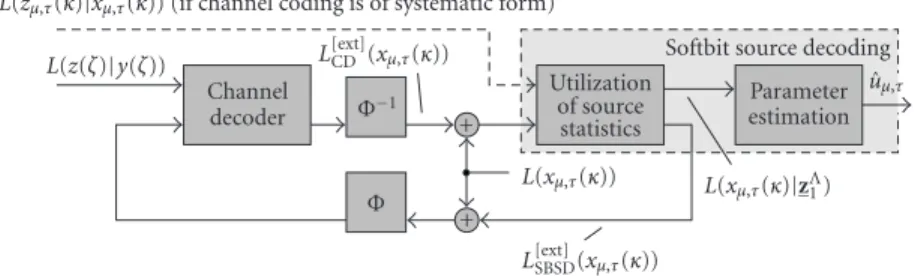
In an ISCD scheme a soft-input/soft-output (SISO) channel decoder and a (derivative of a)softbit source decoder
are concatenated. The first decoder exploits the artificial re-dundancy which has explicitly been introduced by channel encoding, and the second one mainly utilizes the natural mutual dependencies of the source codec parameters due to their residual redundancy. The reliability gains due to both terms of redundancy are exchanged iteratively in a turbo -like process [12,13,14]. In literature, the reliability gains are also referred to asextrinsic information. This information can usually be extracted from the soft-output values provided by any SISO decoder.
In order to evaluate the number of iterations allowing noteworthy improvements of error robustness a powerful analysis tool has recently been proposed in terms of extrin-sic information transfer (EXIT) charts [15,16]. This method had already been applied to an ISCD scheme in [10,11]. However, the EXIT chart representation of ISCD schemes also reveals some new design and development guidelines which are the topic of this paper.
This paper is organized as follows. InSection 2, we give a comprehensive review of iterative source-channel decoding (ISCD). Next, we define a new, clear classification of ISCD approaches intoseriallyandparallelconcatenated schemes. Afterwards, we apply the EXIT chart analysis to ISCD in
Section 3. Based on this EXIT chart analysis we develop new design guidelines for ISCD schemes inSection 4, which pro-vide higher error correcting/concealing capabilities. Finally, the improved error robustness of these schemes is demon-strated by simulation.
2. ITERATIVE SOURCE-CHANNEL DECODING
2.1. System overview—transmitter site
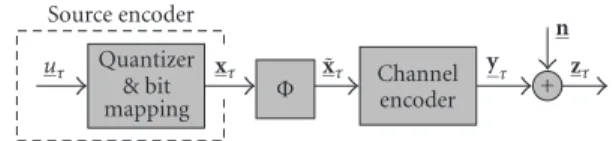
At time instant τ a source encoder extracts a set uτ of M scalar source codec parameters uµ,τ from a short segment of the original speech, audio, or video signal (seeFigure 1). The indexµ=1,. . .,M denotes the position within the set uτ = (u1,τ,. . .,uM,τ). For instance, in GSM speech
com-munication the setuτ comprises the coefficients of a linear filter describing the spectral envelope of a 20 millisecond seg-ment of a speech signal as well as some parameters
repre-senting the excitation of this filter. Each value uµ,τ, which is continuous in magnitude but discrete in time, is indi-vidually quantized by 2Kµ reproduction levels ¯u(µi) withi = 0,. . ., (2Kµ −1). The reproduction levels are invariant with respect toτ and the whole quantizer code-book is given by Uµ = {u¯(0)µ ,. . ., ¯u(2µKµ−1)}. To each indexiof a quantizer re-production level ¯u(µi)specified at time instantτ, a unique bit patternxµ,τof lengthKµis assigned. The complete frame of
M bit patternsxµ,τ specified at time instantτ is denoted as xτ =(x1,τ,. . .,xM,τ). A particular data bit of the bit pattern
xµ,τis addressed by an additional indexκwritten in paren-theses, that is,xµ,τ(κ) withκ=1,. . .,Kµ. For convenience, in the following we assume that the code-booksUµ of ¯u(µi) are the same for all parametersuµ,τin the setuτ, that is,Uµ=U
andKµ=Kfor allµ=1,. . .,M.
A (source-related) bit interleaverΦscrambles the set of data bits xτ to ˜xτ using a deterministic mapping. In GSM, for example, the data bits are rearranged according to their individual importance with respect to the subjective speech quality. The reordering performs some kind of classification for unequal error protection. This helps to cope with annoy-ing artifacts in the reconstructed speech signal if residual bit errors remain after channel decoding.
If there is no danger of confusion, the following notation will always refer to the deinterleaved domain. That means, even though bit interleaving changes the actual position of xµ,τ(κ) in the sequence of data bits˜xτ, we keep the notation.
The interleaver might be sized such that T + 1 consecutive setsxτwithτ =Λ−T,. . .,Λare rearranged in common. To simplify notation, such time series of sequences ˜xτare also denoted by the compact expression˜xΛΛ−T. The deterministic mappingΦof the bit interleaver has to be designed in a way that (at the receiver site) the reliability gains resulting from softbit source decoding and from channel decoding can be considered as independent. Thus, the (source-related) bit in-terleaver plays a new key role in ISCD schemes (namely pro-vidingindependent reliability gains) as compared to the orig-inal purpose ofunequal error protectionas in GSM.
As the reliability gain of source coding is due to the resid-ual redundancy of source codec parameters uµ,τ,
indepen-dence will be ensured if channel encoding is performed over bitsxµ,τ(κ) of (more or less) mutually independent bit pat-terns xµ,τ, for example, across different positions µ. Such
channel encoding may be realized either on a single-bit se-quence ˜xτat timeτ, or with respect to the interleaverΦon multiple ˜xτ withτ = Λ−T,. . .,Λ. Channel codes of code raterexpand the sequences˜xΛΛ−Tof bit patterns to a sequence yΛΛ−
Tof code bitsy(ζ) withζ=1,. . ., (1/r)·(T + 1)·M·K. Note, if terminated convolutional codes of rater and mem-oryJare applied, there exist (1/r)·Jadditional code bits. If channel encoding of thesystematic formis assumed, the indi-vidual data bitsxµ,τ(κ) ofxτare present in the code sequence
yΛ Λ−T.
L(zµ,τ(κ)|xµ,τ(κ)) (if channel coding is of systematic form) L(z(ζ)|y(ζ))
Channel decoder
L[ext] CD (xµ,τ(κ))
Φ−1
Φ +
+
Utilization of source
statistics L(xµ,τ(κ))
L[ext] SBSD(xµ,τ(κ))
Softbit source decoding Parameter estimation
ˆ uµ,τ
L(xµ,τ(κ)|zΛ1)
Figure2: Receiver for iterative source-channel decoding (Φ: interleaver,Φ−1: deinterleaver).
interleaver is assumed to be sized sufficiently large so that the equivalent transmission channel can be considered as mem-oryless and AWGN (additive white Gaussian noise).
2.2. Receiver site
2.2.1. Transmission model for binary phase shift keying
At the receiver, reliability information about the single data bitsxµ,τ(κ) is generated from the possibly noisy received se-quence zΛΛ−T corresponding to yΛ
Λ−T. In this respect, it is most convenient to express reliability information in terms oflog-likelihood ratiosor shortL-values, for example, [13]. For instance, if the transmission channel is considered to be AWGN, thechannel-relatedL-value is given by [13]
Lz(ζ)|y(ζ)=4·NEs
0 ·z(ζ)
(1)
for all y(ζ). The termEsdenotes the energy per transmit-ted BPSK-modulatransmit-ted (binary phase shift keying) code bit y(ζ) and N0/2 the double-sided power spectral density of the equivalent AWGN channel. The possibly noisy received value z(ζ) ∈ R denotes the real-valued counterpart to the originally transmitted BPSK-modulated code bit y(ζ) ∈ {−1, +1}.
Time variant signal fading can easily be considered as well. For this purpose, a factorahas to be introduced on the right-hand side of (1). The specific probability distribution (e.g., Rayleigh or Rice distribution) of the random processa represents the characteristics of the signal fading. However, in the following we neglect signal fading, that is,a=1 con-stantly.
2.2.2. Receiver model
The aim of theiterative source-channel decodingalgorithm is to jointly exploit the channel-relatedL-values of (1), the arti-ficial channel coding redundancy as well as the natural resid-ual source redundancy. The combination yields a posteriori L-valuesL(xµ,τ(κ)|zΛ1) for single data bitsxµ,τ(κ) given the
(entire history of) received sequenceszτ withτ = 1,. . .,Λ (seeFigure 2). This a posterioriL-value can be separated ac-cording to Bayes’ theorem into four additive terms, if a mem-oryless transmission channel (and channel encoding of the
systematic form, see below) is assumed:
Lxµ,τ(κ)|zτ1
=Lzµ,τ(κ)|xµ,τ(κ)
+Lxµ,τ(κ)
+L[ext]CD
xµ,τ(κ)
+L[ext]SBSD
xµ,τ(κ)
. (2)
The first term in (2) represents the channel-related L-value of the specific data bit xµ,τ(κ) under test. Of course,
this term is only available if channel encoding is of the sys-tematic form. In this case, the data bit xµ,τ(κ) corresponds to a particular code bit y(ζ) and thus, the channel-related L-valueL(zµ,τ(κ)|xµ,τ(κ)) is identical to one of theL-values determined in (1). Note, with respect to the correspondence ofxµ,τ(κ) andy(ζ), we used two different notations for the
same received value, that is,zµ,τ(κ)=z(ζ). If channel
encod-ing is of thenonsystematic form, the termL(zµ,τ(κ)|xµ,τ(κ)) cannot be separated fromL(xµ,τ(κ)|zτ1). In this case it can be considered to beL(zµ,τ(κ)|xµ,τ(κ))=0 in (2) constantly.1
The second term in (2) represents the a priori knowledge about bit xµ,τ(κ). Note, this a priori knowledge comprises
natural residual source redundancy onbit-level. Both terms in the first line markintrinsicinformation aboutxµ,τ(κ).
In contrast to these intrinsic terms, the two terms in the second line of (2) gain information about xµ,τ(κ) from
re-ceived values other thanzµ,τ(κ). These terms denote so-called extrinsic L-values which result from the evaluation of one of the two particular terms of redundancy. In the following, whenever the magnitude of these extrinsicL-values increases by the iterations we refer to this asreliability gain.
2.3. Determination of extrinsic information 2.3.1. Soft-input/soft-output channel decoder
The SISO channel decoder (CD) inFigure 2determines ex-trinsic information L[ext]CD (xµ,τ(κ)) mainly from the artificial redundancy which hasexplicitlybeen introduced by channel encoding. For this purpose, the SISO decoder combines the channel-related soft-input valuesL(z(ζ)|y(ζ)) for the code bitsy(ζ) with a priori informationL(xµ,τ(κ)) about the data bitsxµ,τ(κ). The valid combinations are precisely described by the channel encoding rule. The a priori information
1This notation doesnotimply that channel-related knowledge remains
L(xµ,τ(κ)) can be improved by additional a priori informa-tion which is provided by the other constituent decoder in terms of its extrinsic information L[ext]SBSD(xµ,τ(κ)) (feedback line inFigure 2). TheseL[ext]SBSD(xµ,τ(κ)) are usually initialized with zero in the first iteration step. As the determination rules of extrinsic L-valuesL[ext]CD (xµ,τ(κ)) of channel decoding are already well known, for example, in terms of the log-MAP algorithm [13,17], we refer the reader to literature.
2.3.2. Softbit source decoder
The second decoder in the ISCD scheme is a (derivative of a) softbit source decoder (SBSD) [5]. The softbit source de-coder determines extrinsic information mainly from the nat-ural residual source redundancy which typically remains in the bit patternsxµ,τafter source encoding. Such residual
re-dundancy appears onparameter-level, for example, in terms of a nonuniform distribution P(xµ,τ), in terms of correla-tion, or in any other possible mutual dependency in time2τ. The latter terms of residual redundancy are usually approx-imated by a first-order Markov chain, that is, by the condi-tional probability distribution P(xµ,τ|xµ,τ−1). These source statistics can usually be measured once in advance for a rep-resentative signal data base.
The technique how to combine this a priori knowledge on parameter-level with the soft-input valuesL[ext]CD (xµ,τ(κ)), L(xµ,τ(κ)) on bit-level, and (if channel encoding is of the
sys-tematicform) withL(zµ,τ(κ)|xµ,τ(κ)) is not widely common
so far. However, the algorithm how to compute the extrin-sicL-valueL[ext]SBSD(xµ,τ(κ)) of SBSD has been derived in, for
example, [8,9,10,11]. It is briefly reviewed inAppendix B. After several iterative refinements of L[ext]CD (xµ,τ(κ)) and
L[ext]
SBSD(xµ,τ(κ)) the bit-level a posteriori L-values of (2) are
utilized for estimation of parameters ˆuµ,τ. For this purpose, at first parameter-oriented a posteriori knowledge is deter-mined and secondly combined with quantizer reproduction levels to provide the parameter estimates ˆuµ,τ.
Parameter-oriented a posteriori knowledge likeP(xµ,τ|zΛ1) can easily be measured either from the bit-wise a posterioriL-values of (2) or from the intermediate results of (B.5) (seeAppendix B), for example, by
Pxµ,τ|zΛ1=
C·βτxµ,τ
·Θxµ,τ·
xµ,τ−1
Pxµ,τ|xµ,τ−1·ατ−1
xµ,τ−1.
(3)
The termCdenotes a constant factor which ensures that the
total probability theorem is fulfilled. Thus, if the minimum mean squared error (MMSE) serves as fidelity criterion, the
2For convenience, we neglect any possibly available mutual dependency
in positionµlike cross-correlation of adjacent parametersuµ,τanduµ−1,τ. However, it is straightforward to extend the following formulas such that mutual dependencies in positionµcan be exploited by ISCD as well [11].
individual estimates are given by [5]
ˆ uµ,τ=
¯
u(i) µ∈Uµ
¯ u(i)
µ ·Pxµ,τ=ˆi|zΛ1
. (4)
If a delay is acceptable, that is, T + 1>1, (4) performs inter-polation of source codec parameters due to the look-ahead ofΛ−τparameters. Otherwise, if T + 1=1 andΛ=τ, (4) performs parameter extrapolation.
2.4. Realization schemes
In connection with the turbo principle, typically two dif-ferent realization schemes have to be regarded. If two con-stituent encoders operate on the same set of bit patterns (ei-ther directly onxτ or on the interleaved sequence ˜xτ), this kind of turbo scheme is commonly called a parallel code con-catenation. A parallel code concatenation implies that at the receiver site, channel-related knowledge is available about all code bits of both decoders. In contrast to this, in a serially concatenated turbo scheme theinnerencoder operates on the code words provided by theouterone. If the inner code is of the nonsystematic form, no channel-related information is available to the outer decoder.
In ISCD schemes, the constituent coders are the source and the channel encoder while the respective decoders are the channel decoder and the “utilization of source statistics” block (seeFigure 2). With respect to the above considerations the amount of channel-related information which is available at both SISO decoders allows a classification into parallel, re-spectively, serially concatenated ISCD schemes.
(i) Parallel concatenated ISCD scheme. We define an ISCD scheme to be parallel-concatenated if channel-related information is available about all code bits to both con-stituent decoders. This is the case if channel encoding is of the systematic form.
(ii) Serially concatenated ISCD scheme. If channel en-coding is of the nonsystematic form, channel-related knowl-edge is only available to the inner decoder. The outer de-coding step, that is, the utilization of residual redundancy, strongly depends on the reliability information provided by the inner channel decoder.
From the above definition it follows that all formerly known approaches to ISCD, for example, [6,7,8,9,10], have to be classified as parallel concatenated as in these contribu-tions channel codes of the systematic form are used. How-ever, albeit our definition sometimes the denotation serial
concatenationhas been used as a source and a channel
en-coder are arranged in a cascade.
3. CONVERGENCE BEHAVIOR
L(zµ,τ(κ)|xµ,τ(κ))
L[ext] In (xµ,τ(κ))
+
L(xµ,τ(κ)) Soft-output
decoder
L(xµ,τ(κ)|zΛ1)
L[ext] out (xµ,τ(κ)) Figure 3: Generalized soft-input/soft-output decoder using L -values.
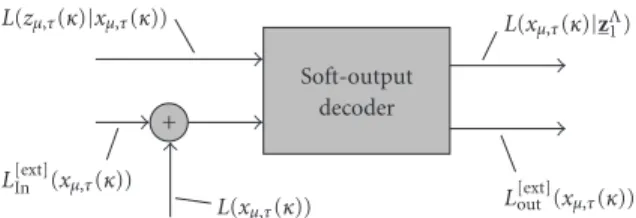
relations of decoders in case of a parallel ISCD scheme (com-pare to “channel decoder” and “utilization of source statis-tics” inFigure 2).
On the one hand, the information exhibited by the over-all a prioriL-value, and on the other hand, the information comprised in the extrinsicL-values after soft-output decod-ing is closely related to the information content of the origi-nally transmitted data bitsxµ,τ(κ). For convenience, we define the simplified notations:
(i) I[apri] quantifies the mutual information between the data bit xµ,τ(κ) and the overall a priori L-value L(xµ,τ(κ)) +L[ext]In (xµ,τ(κ)),
(ii) I[ext]denotes the mutual information betweenx
µ,τ(κ)
and the extrinsic informationL[ext]Out(xµ,τ(κ)).
If needed, an additional subscript “CD”, respectively, “SBSD” will be added to differentiate between channel decoding and softbit source decoding. The upper limit for both measures is constrained to the entropyH(X) (the data bitxµ,τ(κ) is
considered to be a realization of the random process X). Note, the entropyH(X), respectively, the mutual informa-tion measuresI[apri],I[ext] depend on the bit positionκ. To simplify matters, in the following we consider only the re-spective mean measures which are averaged over all bit posi-tionsκ=1,. . .,K.
3.1. Extrinsic information transfer characteristics
The mutual information measureI[ext]at the output of the decoder depends on the input configuration. The channel-related input valueL(zµ,τ(κ)|xµ,τ(κ)), is mainly determined by theEs/N0value (compare to (1)). For the overall a priori input valueL(xµ,τ(κ)) +L[ext]In (xµ,τ(κ)) it has been observed by simulation [15,16] that this input can be modeled by a Gaus-sian distributed random variable with variance σL2 = 4/σ2
n
(withσ2
n=N0/2) and meanµL=σL2/2·xµ,τ(κ). As both terms
depend on a single parameterσ2
L, the a priori relationI[apri]
can directly be evaluated for arbitraryσ2
Lby numerical
inte-gration. Thus, the EXIT characteristicsT of SISO decoders are defined as [15,16]
I[ext]=T
I[apri], Es N0
. (5)
If specific settings forI[apri], respectively,σ2
L and forEs/N0 are given, I[ext] is quantifiable by means of Monte-Carlo simulation. Note, in case of a serially concatenated ISCD
scheme, the EXIT characteristic (5) of the outer SBSD be-comes (more or less) independent of theEs/N0value because L(zk,t( ˘κ)|xk,t( ˘κ))=0 in (B.1) (seeAppendix B) constantly.
While the EXIT characteristics of various channel codes have already been extensively discussed, for example, in [15,
16], in the following we extend our investigation here to the EXIT characteristics of SBSD [10,11].
3.2. EXIT characteristics of softbit source decoding
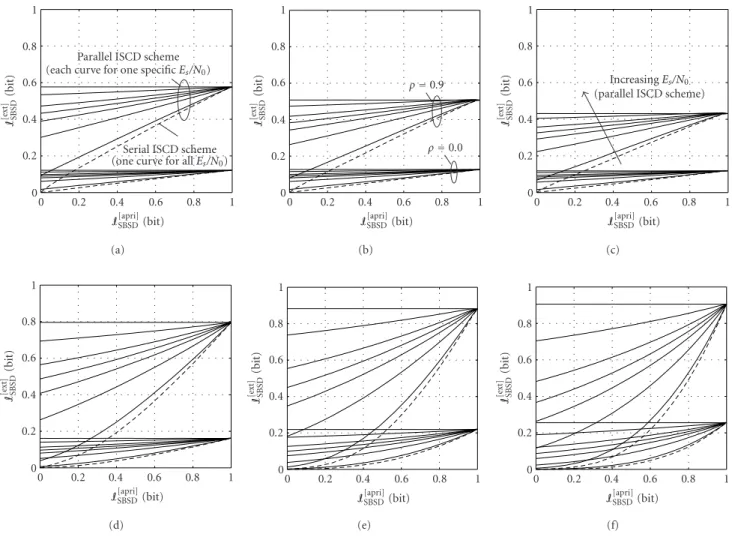
Figure 4 depicts EXIT characteristics of SBSD if either the nonuniform distribution of the source codec parametersuµ,τ
or additionally correlation is exploited. The uµ,τ are mod-eled by a first-order Gauss-Markov process with correlation ρ = 0.0 or ρ = 0.9 and quantized by a Lloyd-Max quan-tizer usingK=3 (Figures4aand4d), 4 (Figures4band4e), or 5 bits/parameter (Figures4cand4f). As index assignment servesnatural binary(Figures4a–4c), respectively, an EXIT-optimizedmapping (Figures4d–4f) as proposed inSection 4. Each subplot shows 16 simulation results for the case where SBSD is applied to a parallel-concatenated ISCD scheme. The lower subset of 8 EXIT characteristics is de-termined for an uncorrelated and nonuniformly distributed parameter, that is, ρ = 0.0. The upper subset of 8 EXIT characteristics results if in addition correlation is utilized, for example, ρ = 0.9. Due to correlation, more informa-tion about xµ,τ(κ) is available and thus, mutual informa-tionI[ext]SBSDincreases. The single curves of each set represent different channel conditions (from bottom to topEs/N0 =
{−100,−10,−3,−1, 0, 1, 3, 10}dB).
If in a parallel-concatenated ISCD scheme the channel quality decreases utterly, then the channel-related L-values become negligibly small, that is,L(zµ,τ(κ)|xµ,τ(κ))≈0. This
resembles a serially concatenated ISCD scheme where the outer softbit source decoder is (more or less) independent of theEs/N0 value. Thus, the dashed curves in the different subplots are valid for both situations: for a very bad chan-nel condition likeEs/N0= −100 dB in case of a parallel ISCD scheme as well as for all channel conditionsEs/N0in a serially concatenated scheme.
The simulation results depicted in all subplots reveal the same two apparent properties. Firstly, for a fixed but arbi-trary parameter configuration, all curves merge in a single point ifI[apri]SBSD →1 bit. Secondly, in contrast to sophisticated SISO channel decoding, none of the curves reach entropy I[ext]
SBSD=H(X)≈1 bit even if the information at the a priori input can be considered as error free, that is,ISBSD[apri]≈1 bit. Thus, perfect reconstruction of the data bitxµ,τ(κ) by solely studying the extrinsic outputL-value (B.5) of SBSD is im-possible.
Moreover, in case of the natural binary index assignment, it can be stated for all EXIT characteristics that the mu-tual information at the output increases approximately lin-ear with the mutual information at the input. Thereby, the slope is usually rather flat. The EXIT characteristics for the EXIT-optimized bit mapping are discussed in more detail in
Parallel ISCD scheme (each curve for one specificEs/N0)
Serial ISCD scheme (one curve for allEs/N0)
1 0.8 0.6 0.4 0.2 0
I
[e
xt]
SBSD
(bit)
0 0.2 0.4 0.6 0.8 1
I[apri] SBSD(bit)
(a)
ρ=0.9
ρ=0.0 1
0.8 0.6 0.4 0.2 0
I
[e
xt]
SBSD
(bit)
0 0.2 0.4 0.6 0.8 1
I[apri] SBSD(bit)
(b)
IncreasingEs/N0
(parallel ISCD scheme) 1
0.8 0.6 0.4 0.2 0
I
[e
xt]
SBSD
(bit)
0 0.2 0.4 0.6 0.8 1
I[apri] SBSD(bit)
(c) 1
0.8 0.6 0.4 0.2 0
I
[e
xt]
SBSD
(bit)
0 0.2 0.4 0.6 0.8 1
I[apri] SBSD(bit)
(d)
1 0.8 0.6 0.4 0.2 0
I
[e
xt]
SBSD
(bit)
0 0.2 0.4 0.6 0.8 1
I[apri] SBSD(bit)
(e)
1 0.8 0.6 0.4 0.2 0
I
[e
xt]
SBSD
(bit)
0 0.2 0.4 0.6 0.8 1
I[apri] SBSD(bit)
(f)
Figure4: EXIT characteristics of SBSD for various index assignments. ((a), (b), and (c) natural binary mapping; (d), (e), and (f) EXIT-optimized mapping), quantizer code-book sizes 2K: ((a), (d)K =3 bits/parameter; (b), (e)K =4 bits/parameter; and (c), (f)K =5 bits/parameter), correlation (in each subplot upper subset:ρ=0.9, lower subset:ρ=0.0), and channel conditions (for each configuration from bottom to topEs/N0= {−100,−10,−3,−1, 0, 1, 3, 10}dB). The measuresI[apri]SBSD,I
[ext]
SBSDare averaged over allκ=1,. . .,K.
3.3. Theoretical upper bound onI[ext]SBSD
For every configuration of index assignment, correlation ρ, quantizer code-book size 2K, and look-aheadΛ−τthe maxi-mum mutual information valueI[ext]SBSD,maxcan also be quanti-fied by means of analytical considerations [10,11]. Whenever the input relationI[apri]SBSD increases toH(X) (or the channel
quality is higher than Es/N0 ≈ 10 dB), the termsΘ(xµ[ext],τ ), ατ−1(xµ,τ−1), andβτ(xµ,τ) of (B.5) (seeAppendix B) are
gen-erally valued such that all summations in the numerator and denominator degenerate to single elements. In consequence, the theoretically attainable L[ext]SBSD(xµ,τ(κ)) are given for all
possible combinations ofxµΛ,τ+1,x[ext]µ,τ ,xµτ−,Λ1−T−1by
L[ext] SBSD
xµ,τ(κ)
=logP
x[ext]µ,τ |xµ,τ−1,xµ,τ(κ)=+1·Pxµ,Λ−T−1 Λ
t=Λ−T,t=τPxµ,t|xµ,t−1
Px[ext]µ,τ |xµ,τ−1,xµ,τ(κ)= −1·Pxµ,Λ−T−1 Λ
t=Λ−T,t=τPxµ,t|xµ,t−1
. (6)
After the discrete probability distribution of all attainable valuesL[ext]SBSD(xµ,τ(κ)) is quantified, the evaluation of mutual
Table1: Theoretical bounds onI[ext]SBSD,max(FS: full search, BSA: binary switching algorithm).
K ρ=0.0 ρ=0Autocorrelation.7 ρρ=0.8 ρ=0.9
3 bits
Natural binary 0.123 0.330 0.429 0.577
Folded binary 0.036 0.213 0.293 0.430
Gray-encoded 0.054 0.226 0.299 0.415
SNR opt. [18] 0.111 0.465 0.588 0.732
EXIT opt. (FS) 0.163 0.487 0.622 0.796
EXIT opt. (BSA) 0.123 0.472 0.607 0.791
4 bits
Natural binary 0.127 0.298 0.380 0.507
Folded binary 0.043 0.190 0.260 0.388
Gray-encoded 0.068 0.208 0.270 0.374
SNR opt. [18] 0.201 0.529 0.649 0.785
EXIT opt. (BSA) 0.221 0.566 0.706 0.882
5 bits
Natural binary 0.118 0.259 0.326 0.430
Folded binary 0.044 0.165 0.225 0.335
Gray-encoded 0.069 0.183 0.234 0.323
SNR opt. [18] 0.207 0.574 0.691 0.808
EXIT opt. (BSA) 0.257 0.613 0.758 0.905
Table 1 summarizes the upper bounds for the example situations with K = 3, 4, 5 bits/parameter and some fre-quently used index assignments: natural binary,folded bi-nary, and Gray-encoded bit mapping. To simplify matters, softbit source decoding is restricted to parameter extrapola-tion, that is,Λ−T=1 andΛ=τ. Thus, the evaluation of L[ext]
SBSD(xµ,τ(κ)) of (6) reduces to an evaluation of all
combina-tions ofxµ[ext],τ ,xµ,τ−1.
The theoretical upper bounds for natural binary confirm the corresponding simulation results ofFigure 4. Compared to folded binary and Gray-encoded, the natural binary bit mapping provides higherI[ext]SBSD,max for all configurations of quantizer code-book size and correlation.
Recently an advanced bit mapping for ISCD has been proposed by Hagenauer and G¨ortz [18]. By considering sim-plified constraints like single-bit errors and by neglecting pa-rameter correlation, the optimization is realized such that the best possible parameter signal-to-noise ratio (SNR) between the original codec parameteruµ,τand its reconstruction ˆuµ,τ is reached. If the theoretical upper boundI[ext]SBSD,max is eval-uated for this SNR-optimized mapping, further substantial gains of I[ext]SBSD,max can be observed for most configurations (seeTable 1).
The theoretical upper bounds I[ext]SBSD,max for the EXIT-optimized bit mapping are discussed in more detail in
Section 4.1.
3.4. EXIT chart of iterative source-channel decoding
The combination of the two EXIT characteristics of both soft-output decoders in a single diagram is referred to as EXIT chart [16]. The main contribution of EXIT charts is that an analysis of the convergence behavior of a concate-nated scheme is realizable by solely studying the EXIT char-acteristics of the single components. Both EXIT
characteris-tics are plotted into the EXIT chart considering swapped axes because the extrinsic output of the one constituent decoder serves as additional a priori input for the other one and vice versa (seeFigure 2).
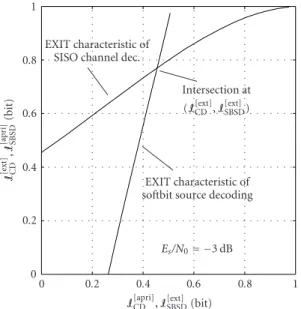
Figure 5shows an exemplary EXIT chart of a parallel ap-proach to iterative source-channel decoding for a channel condition of Es/N0 = −3 dB. The source codec parameters uµ,τ are assumed to exhibit correlation ofρ = 0.9. The
pa-rameters are quantized by a Lloyd-Max quantizer usingK=
4 bits/parameter each, and natural binary serves for index assignment. Thus, the EXIT characteristic of SBSD is taken fromFigure 4b. For channel encoding a rater =1/2, mem-oryJ=3 recursive systematic convolutional (RSC) code with generator polynomialG=(1, (1 +D2+D3)/(1 +D+D3)) is used.
Usually, the best possible error correcting/concealing ca-pabilities of an iterative source-channel decoding process are limited by an intersection of both EXIT characteristics [10].
4. DESIGN OF IMPROVED ISCD SCHEMES
The primary objective of iterative turbo-algorithms is to gain as much information from the refinements of extrinsic L -valuesL[ext]SBSD(xµ,τ(κ)) andL[ext]CD (xµ,τ(κ)) as possible. This goal implies that the intersection of the EXIT characteristics of the constituent decoders is located at the highest possible
(I[ext]CD ,I[ext]SBSD)pair3in the EXIT chart.
3In the two-dimensional (I[ext]
CD ,I[ext]SBSD) space, that specific intersection
of EXIT characteristics is considered to provide the “highest possible pair” which maximizes (Ψ−1(I[ext]CD ))2+ (Ψ−1(I[ext]
SBSD))2. In this sum, the term
Ψ−1(·) denotes the inverse function toΨ(·) which is an approximation
I[apri]=Ψ(σ2
EXIT characteristic of SISO channel dec.
Intersection at (I[ext]CD ,I[ext]SBSD)
EXIT characteristic of softbit source decoding
Es/N0= −3 dB
1
0.8
0.6
0.4
0.2
0
I
[e
xt]
CD
,
I
[apr
i]
SBSD
(bit)
0 0.2 0.4 0.6 0.8 1
I[apri]
CD ,I
[ext] SBSD(bit)
Figure5: Exemplary EXIT chart of iterative source-channel decod-ing.
Thus, an ISCD scheme with improved error cor-recting/concealing capabilities might be given if the (I[ext]CD , I[ext]
SBSD) pair is maximized. Next, this maximization will be realized in a two-stage process. Firstly, we propose a new concept on how to design an optimal index assignment. For this purpose the highest possible I[ext]SBSD,max value serves as optimality criterion. Secondly, we search for an appropri-ate channel coding component which ensures that the EXIT characteristic of CD crosses that one of SBSD at the highest possibleICD[ext].
4.1. Optimization of the index assignment
In a first straightforward approach, the theoretical upper limitI[ext]SBSD,maxhas to be evaluated for all 2K! possible assign-ments of 2K-bit patternsxµ,τ to the valid quantizer repro-duction levels ¯u(µi)withi=0,. . ., (2K−1) of quantizer code-bookU. That specific realization of all examined assignments which provides the maximum value forI[ext]SBSD,max marks the optimal mapping. Of course, such a full search (FS) is only manageable if the size of the quantizer code-bookUis rea-sonably small, that is, K ≤ 3 bits/parameter. Otherwise, if K ≥4 bits/parameter, a full search is almost impossible be-cause there exist 2K! ≥ 24! = 2.09E+ 13 different assign-ments.
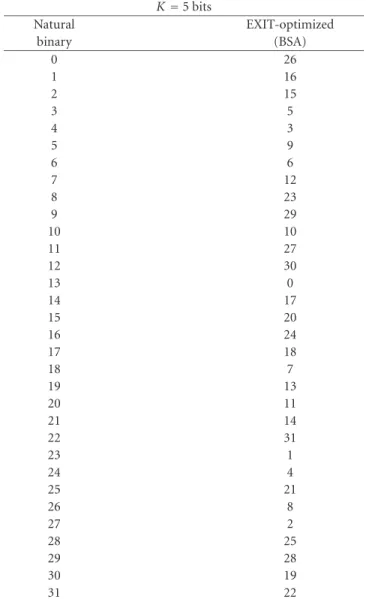
For the optimization of the index assignment withK≥4 bits/parameters, we propose a low-complexity approxima-tion which resembles4the binary switching algorithm (BSA) [19]. Starting from an initial index assignment (e.g., the nat-ural binary mapping), that bit pattern which is assigned to
¯ u(i)
µ withi=0 is exchanged on a trial basis with every other
4In contrast to [19], the BSA proposed here does not pay attention to the
individual contributions of each index to an overall cost function.
bit pattern for the indices j=0,. . ., (2K−1) (including the unmodified arrangementi = j). From the 2K possible ar-rangements, that combination is selected for further exami-nation which provides the maximumISBSD,max[ext] . Afterwards, this kind of binary switching is repeated for the other in-dicesi = 1,. . ., (2K −1). Whenever a rearrangement pro-vides a higherI[ext]SBSD,maxvalue, the iterative search algorithm is restarted with i = 0, that is, the last-determined rear-rangement serves as new initial index assignment. Usually, after several iterative refinements a steady-state is reached. The finally selected arrangement serves as EXIT-optimized index assignment. Some examples are listed in Table 2 in
Appendix A.
The highest I[ext]SBSD,max values for the EXIT-optimized mappings are also listed inTable 1. Compared to the classi-cal index assignments like natural binary, folded binary, and Gray-encoded, the extrinsic mutual information at the out-put of the softbit source decoder has significantly been in-creased by the optimization. Notice that the EXIT-optimized mapping found by the BSA approximation may only be considered as a local optimum. As shown for K = 3 bits/parameter, the global optimum obtained by the full searchis usually more powerful.
In addition, the theoretical analysis also reveals substan-tial gains inI[ext]SBSD,maxover the SNR-optimized mapping [18]. The key advantage over this approach is that correlation of the source codec parametersuµ,τcan easily be taken into
ac-count during the optimization process. As a consequence, the gap inI[ext]SBSD,max between the SNR-optimized mapping and the EXIT-optimized mapping increases with higher terms of correlation. The major drawback is that the instrumen-tal quality measure parameter SNR is not explicitly included in the optimization. Moreover, the boundsI[ext]SBSD,maxdo not comprise information about the adverse effects of different mappings on instrumental quality measures like the parame-ter SNR. In certain situations, a higher parameparame-ter SNR might be available even if theI[ext]SBSD,maxis smaller. Thus, it has to be confirmed by simulation if the EXIT-optimized bit mapping is able to provide a noteworthy gain in error robustness (see
Section 5).
4.2. Optimization of the channel coding component of ISCD
Table2: EXIT-optimized index assignment for correlationρ=0.9.
K=3 bits
Natural EXIT-optimized
binary (FS) (BSA)
0 4 2
1 7 7
2 1 4
3 2 3
4 5 0
5 6 5
6 0 6
7 3 1
K=4 bits
Natural EXIT-optimized
binary (BSA)
0 4
1 13
2 14
3 8
4 3
5 5
6 6
7 15
8 9
9 0
10 10
11 12
12 7
13 1
14 11
15 2
for the feed-back partH(D). The number of possible realiza-tions ofH(D) is lower than that ofF(D) because the present feed-back value is usually directly applied to the undelayed input value, that is, the termD0=1 is always given inH(D). Thus,F(D) andH(D) offer (in maximum) 2J+1×2J
com-binatorial possibilities to design the EXIT characteristic of a rater = 1/2, memoryJ RSC code. The effective number of reasonable combinations is even smaller, because in some casesF(D) andH(D) exhibit a common divisor and thus, the memory of the RSC encoder is not fully exploited.
We expect improved error correcting/concealing capabil-ities from ISCD schemes if the RSC code is replaced by a recursive nonsystematic convolutional (RNSC) code. These ISCD schemes are serially concatenated. At the same code rate r and constraint length J + 1 such RNSC codes of-fer higher degrees of combinatorial freedom. As the ma-trixG(D)= (F1(D)/H(D),F2(D)/H(D)) exhibits two feed-forward parts F1(D) and F2(D) and one feed-back part H(D), there exist (less than) 2J+1×2J+1×2Jreasonable
combi-nations. The RNSC code degenerates to an RSC code if either F1(D) orF2(D) is identical toH(D).
Hence, in our two-stage optimization process for im-proved ISCD schemes we have to find the most appropriate
Table2: Continued.
K=5 bits
Natural EXIT-optimized
binary (BSA)
0 26
1 16
2 15
3 5
4 3
5 9
6 6
7 12
8 23
9 29
10 10
11 27
12 30
13 0
14 17
15 20
16 24
17 18
18 7
19 13
20 11
21 14
22 31
23 1
24 4
25 21
26 8
27 2
28 25
29 28
30 19
31 22
combination ofF1(D),F2(D), andH(D). The EXIT charac-teristic of the RNSC code with this specific combination will guarantee that the intersection with the EXIT characteristic of SBSD is located at the highest possible (I[ext]CD ,I[ext]SBSD) pair. Remember, in the first step of this processISBSD,max[ext] had been maximized by an optimization of the index assignment.
even be reduced to some ten. After having found some of the best possible RSC codes, for each of these combinations of F2(D) andH(D) the formerly fixedF1(D) is altered. In total, a few hundred of EXIT characteristics need to be measured to find the (at least) locally optimum RNSC code.
In the next section, it will be demonstrated by simulation that due to the higher degrees of combinatorial freedom, the usage of RNSC codes instead of RSC codes reveals remark-able benefits for the error correcting/concealing capabilities of iterative source-channel decoding.
Finally, we have to remark that due to thenonsystematic
form of RNSC codes there is no channel-related reliability in-formation available about the data bits. The additional infor-mation which is given in the extrinsicL-valuesL[ext]SBSD(xµ,τ(κ)) andL[ext]CD (xµ,τ(κ)) due to the higher intersection in the EXIT chart must be (at least) higher than the information content ofL(zµ,τ(κ)|xµ,τ(κ)) of (2).
5. SIMULATION RESULTS
The error correcting/concealing capabilities and the con-vergence behavior of the conventional parallel approach to ISCD and the new improvedserialapproach using the EXIT-optimized index assignment as well as channel codes of the nonsystematic form will be compared by simulation. Instead of using any specific real-world speech, audio, or video en-coder, we consider a generic model for the source codec pa-rameter setuτ. For this purpose,Mcomponentsuµ,τare
in-dividually modeled by first-order Gauss-Markov processes with correlationρ =0.9. The parametersuµ,τ are individu-ally quantized by a scalar 16-level Lloyd-Max quantizer using K=4 bits/parameter each.
After the natural binary5 index assignment (parallel ISCD scheme), respectively, after the EXIT-optimized in-dex assignment (serial ISCD scheme), apseudorandom, suffi -ciently large-sized bit interleaverΦof sizeK×M×(T + 1)=
2000 serves for spreading of data bits. For convenience, with respect to K = 4 bits/parameter, we set M = 500 and T + 1=1. In practice, a smallerMmight be sufficient if bit interleavingΦis either realized jointly over several consecu-tive parameter sets or if an appropriately designed (nonran-dom) bit interleaver is applied. Here, pseudorandom bit in-terleaving is realized according to the so-calledS-random de-sign guideline [14]. A random mapping is generated in such a way that adjacent input bits are spread by at least S posi-tions. To simplify matters, theS-constraint is given byS=4 positions.
For channel encoding terminated memoryJ =3 recur-sive (non-)systematic convolutional codes are used. In case of the parallel ISCD scheme it turns out that the RSC code with G=(1, (1 +D2+D3)/(1 +D+D3)) is best suited. Notice, the same channel code has been standardized for turbo channel
5We use the natural binary index assignment as reference instead of
folded binary or Gray-encoded, because in line with our optimization cri-terion inSection 4, natural binary reveals the highestI[ext]SBSD,maxvalues (see
Table 1).
decoding in UMTS. In case of the new serial ISCD scheme, an RNSC code with the same constraint length and withG= ((1+D2+D3)/(1+D+D2+D3), (1+D+D3)/(1+D+D2+D3)) provides the best results. For termination, J = 3 tail bits are appended to each block of 2000 data bits which force the encoder back to zero state. The overall code rate of both ISCD schemes amounts to r = 2000/4006. A log-MAP de-coder which takes the recursive structure of RSC, respec-tively, RNSC codes into account [12,13] serves as component decoder for the channel code.
5.1. Convergence behavior—EXIT charts
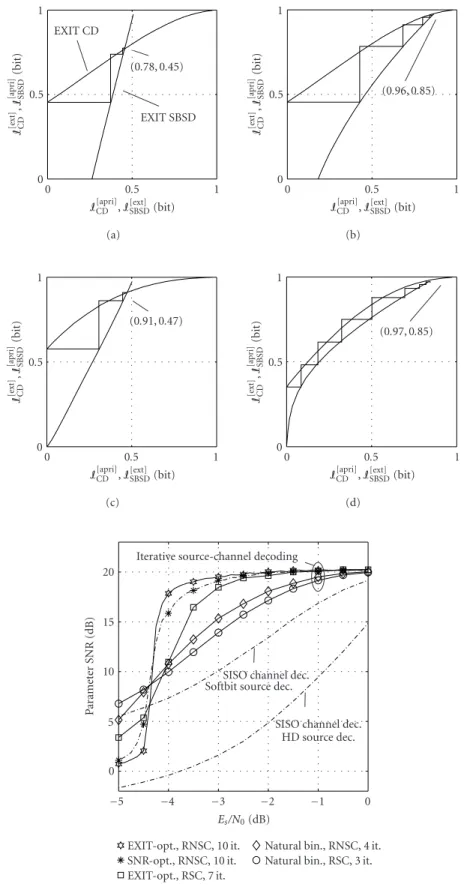
Figures 6a–6d show the EXIT charts of the different ap-proaches to ISCD either with or without the innovations pro-posed inSection 4. Each EXIT chart is measured for a partic-ular channel conditionEs/N0.
In the remainder, that specific approach to parallel ISCD using natural binary index assignment and the RSC chan-nel code is referred to asreference approach(Figure 6a). The EXIT characteristic of SBSD is taken from Figure 4b, but with swapped axes. Both EXIT characteristics specify an en-velope for the so-called decoding trajectory[10,11,15,16]. The decoding trajectory denotes the step curve, and it visu-alizes the increase in both terms ofextrinsic mutual informa-tionI[ext]CD , respectively,ISBSD[ext] being available in each iteration step.
Decoding starts with the log-MAP channel decoder while the a priori knowledge amounts to I[apri]CD = 0 bit. Due to the reliability gain of SISO decoding, the decoder is able to provide I[ext]CD = 0.45 bit. This information serves as a priori knowledge for SBSD, that is, I[apri]SBSD = I[ext]
CD , and thus the extrinsic mutual information of SBSD reads I[ext]
SBSD = 0.37 bit. Iteratively executing both SISO decoders allows to increase the information content step-by-step. No further information is gainable, when the intersection in the enveloping EXIT characteristics is reached. In ISCD schemes intersections typically appear due to the upper boundI[ext]SBSD,max.
Using the reference approach 3 iterations are required to achieve the highest possible (I[ext]CD ,I[ext]SBSD)=(0.78, 0.45) at a channel condition ofEs/N0= −3 dB.
If the natural binary index assignment is exchanged by the EXIT-optimized mapping as proposed in Section 4.1, then the EXIT characteristic of SBSD has to be replaced by the corresponding curve of Figure 4e. Due to the higher I[ext]
SBSD,max, the intersection in the EXIT characteristics is lo-cated at a remarkably higher (ICD[ext],I[ext]SBSD) = (0.96, 0.85). This intersection can be reached quite closely by the decod-ing trajectory after 6 iterations.
EXIT CD
(0.78, 0.45)
EXIT SBSD 1
0.5
0
I
[e
xt]
CD
,
I
[apr
i]
SBSD
(bit)
0 0.5 1
I[apri]
CD ,I[ext]SBSD(bit)
(a)
(0.96, 0.85) 1
0.5
0
I
[e
xt]
CD
,
I
[apr
i]
SBSD
(bit)
0 0.5 1
I[apri]
CD ,I[ext]SBSD(bit)
(b)
(0.91, 0.47) 1
0.5
0
I
[e
xt]
CD
,
I
[apr
i]
SBSD
(bit)
0 0.5 1
I[apri]
CD ,ISBSD[ext] (bit)
(c)
(0.97, 0.85) 1
0.5
0
I
[e
xt]
CD
,
I
[apr
i]
SBSD
(bit)
0 0.5 1
I[apri]
CD ,I[ext]SBSD(bit)
(d)
Iterative source-channel decoding
SISO channel dec. Softbit source dec.
SISO channel dec. HD source dec. 20
15
10
5
0
Pa
ra
m
et
er
S
N
R
(d
B
)
−5 −4 −3 −2 −1 0
Es/N0(dB)
EXIT-opt., RNSC, 10 it. SNR-opt., RNSC, 10 it. EXIT-opt., RSC, 7 it.
Natural bin., RNSC, 4 it. Natural bin., RSC, 3 it.
(e)
Figure6: EXIT chart representation of the various approaches to iterative source-channel decoding: (a) natural binary , RSC,Es/N0= −3
dB; (b) EXIT-optimized, RSC,Es/N0= −3 dB; (c) natural binary, RNSC,Es/N0= −3 dB; and (d) EXIT-optimized, RNSC,Es/N0= −4 dB.
anymore. Once again, if compared to the reference, a higher (I[ext]CD ,I[ext]SBSD)=(0.91, 0.47) can be reached by the decoding trajectory after 3 iterations.
Finally, both innovations will be introduced to the ref-erence at the same time (Figure 6d). In order to illuminate the particular features of this approach the channel condi-tion is reduced to Es/N0 = −4 dB. It can be seen that the EXIT characteristic of the RNSC channel code matches very well to the EXIT characteristic of SBSD. Both characteris-tics span a small tunnel through which the decoding tra-jectory can pass. Up to 10 iterations reveal gains in both terms of extrinsic mutual information. The highest possible (I[ext]CD ,I[ext]SBSD) pair (0.97, 0.85) is higher than for all the other approaches mentioned heretofore. This is even true although the channel quality had been decreased by ∆Es/N0 = 1 dB (Es/N0= −4 dB instead of−3 dB).
In certain situations the decoding trajectory exceeds the EXIT characteristic of SISO channel decoding. The reason is that the distribution of the extrinsicL-valuesL[ext]SBSD(xµ,τ(κ))
of SBSD is usually non-Gaussian in particular if no channel-related reliability information is given. Thus, the model which was used to determine the EXIT characteristics of SISO channel decoding (see Section 3.1) does not hold strictly anymore. However, even if the precise number of re-quired iterations cannot be predicted from the EXIT chart, the intersection of the EXIT characteristics still remains to be the limiting constraint for the iterative process.
5.2. Error robustness—parameter signal-to-noise ratio
The simulation results in Figure 6e depict the parameter signal-to-noise ratio (SNR) of the originally determined source codec parameteruµ,τand the corresponding estimate
ˆ
uµ,τ as a function of the channel qualityEs/N0. For the first basic considerations, we use the same system configuration as for the reference approach introduced before, that is, we apply the natural binary index assignment and the RSC chan-nel code. For every approach to ISCD, the number of it-erations is chosen such that the best possible error robust-ness is reached in the entire range ofEs/N0 =[−5, 0] dB. A higher number of iterations does not yield any noteworthy increase/decrease in the parameter SNR.
The lowest curve shows the error robustness of a con-ventional noniterative receiver using SISO channel decod-ing and classical source decoddecod-ing by hard decision and ta-ble lookup. If this hard decision (HD) source decoder is re-placed by a conventional softbit source decoder [5] the uti-lization of residual redundancy permits to outperform the classical approach significantly. The maximum gain in pa-rameter SNR amounts to∆SNR=8.76 dB at a channel condi-tion ofEs/N0 = −2.5 dB. Notice, the latter approach resem-bles an ISCD scheme without any iteration.
A turbo-like refinement of the extrinsic information of both SISO decoders makes further substantial quality im-provements possible. Mainly one additional iteration reveals remarkable quality gains in terms of the parameter SNR by up to ∆SNR = 3.96 dB at Es/N0 = −2.5 dB. No
notewor-thy larger improvements in error robustness are achievable by higher numbers of iterations as can be confirmed by the EXIT chart analysis (see, e.g.,Figure 6awithEs/N0= −3 dB). However, in the entire range of channel conditions the refer-ence approach to iterative source-channel decoding is supe-rior to (or at least on a par with) the noniterative schemes marked dash-dotted.
As proposed inSection 4the EXIT chart representation can be used to optimize the index assignment and/or the channel coding component in view of the iterative eval-uation. If either of both innovations (each optimized for Es/N0 = −3.0 dB) is introduced, further remarkable qual-ity improvements can be realized in the most interesting range of moderate channel conditions. Compared to the reference approach, additional gains in parameter SNR of
∆SNR =4.54 dB are determinable atEs/N0 = −3.0 dB if the natural binary index assignment is replaced by the EXIT-optimized mapping. The gain amounts to ∆SNR = 1.43 dB at Es/N0 = −3.0 dB if the RSC code is substituted by the RNSC code. A quality degradation has to be accepted in case of heavily disturbed transmission channels.
If both innovations are introduced at the same time, al-most perfect reconstruction of the source codec parameters becomes possible down to channel conditions of Es/N0 =
−3.8 dB. If the channel condition becomes worse, the param-eter SNR drops down in a waterfall-like manner. The rea-son for this waterfall-like behavior can be found by the EXIT chart analysis (seeFigures 6d). As long as the channel con-dition is better thanEs/N0 = −4.5 dB, there exists a tunnel through which the decoding trajectory can pass to a rela-tively high (I[ext]CD ,I
[ext]
SBSD) pair. If the channel becomes worse, the tunnel disappears and the best possible (ICD[ext],I
[ext] SBSD) pair takes relatively small values. In view of an implementation in a real-world cellular network like the GSM or UMTS system, theEs/N0of the waterfall region might be a new design crite-ria which has to be guaranteed at the cell boundaries. Here, a handover might take place and the loss of parameter SNR in channel qualities ofEs/N0<−4.5 dB is not relevant anymore. Finally, it has to be mentioned that the combination of the SNR-optimized mapping [18] with an RNSC code to a serially concatenated ISCD scheme also reveals remark-able improvements in error robustness. However, the EXIT-optimized mapping remains to be more powerful as correla-tion of the source codec parameters can be included in the optimization process.
6. CONCLUSIONS
substantial quality gains in terms of the parameter SNR in the most interesting range of channel conditions. Formerly known parallel approaches to ISCD are outperformed by far by the new serial arrangement.
APPENDICES
A. EXIT-OPTIMIZED BIT MAPPINGS
Table 2 summarizes the EXIT-optimized bit mappings for various quantizer code-book sizes 2K and correlationρ = 0.9.
B. EXTRINSIC L-VALUE OF SBSD
The determination rules for the extrinsic L-value L[ext]
SBSD(xµ,τ(κ)) of SBSD have been derived in [8,9,10,11].
They will briefly be reviewed next. At the end, a slight modification is proposed which allows to omit a quality loss due to an approximation.
(1) Merge the bit-wise soft-inputs L(zµ,τ(κ)|xµ,τ(κ)), L(xµ,τ(κ)), and L[ext]CD (xµ,τ(κ)) of single data bits xµ,τ(κ) to parameter-oriented soft-input informationΘ(xµ,τ) about bit
patternsxµ,τ. For this purpose, determine for all 2K possible
permutations of each bit patternxk,tat a specific time instant
t = Λ−T,. . .,Λand positionk = 1,. . .,M excluding the index pair (k,t)=(µ,τ) (see below) the term [10,11]
Θxk,t=exp
˘
κ=1,...,K
xk,t( ˘κ) 2
·L[ext] CD
xk,t( ˘κ)
+Lxk,t( ˘κ)
+Lzk,t( ˘κ)|xk,t( ˘κ).
(B.1)
The summation runs over the bit index ˘κ=1,. . .,K. In case of the index pair (k,t) = (µ,τ), the bit index ˘
κ=κof the desired extrinsicL-valueLSBSD[ext](xµ,τ(κ)) has to be excluded from the summation. Thus, in this case the terms
Θ(xµ[ext],τ ) have to be computed for all 2K−1possible permuta-tions of bit patternx[ext]µ,τ by summation over all ˘κ=1,. . .,K,
˘
κ=κ. For convenience,x[ext]µ,τ denotes that specific part of the patternxµ,τwithoutxµ,τ(κ). Thus,xµ,τcan also be separated into (x[ext]µ,τ ,xµ,τ(κ)).
(2) Combine this parameter-oriented soft-input infor-mation with the a priori knowledge about the source codec parameters. If the parameters uµ,τ, respectively, the corre-sponding bit patternsxµ,τexhibit a first-order Markov prop-ertyP(xµ,τ|xµ,τ−1) in time, past and (possibly given) future bit patternsxµ,twitht=Λ−T,. . .,Λ,t=τ, can efficiently be evaluated by aforward-backwardalgorithm. Both
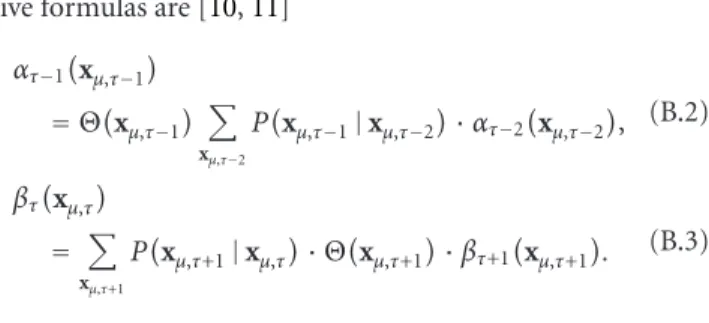
recur-sive formulas are [10,11]
ατ−1
xµ,τ−1
=Θxµ,τ−1 xµ,τ−2
Pxµ,τ−1|xµ,τ−2
·ατ−2
xµ,τ−2
, (B.2)
βτxµ,τ
=
xµ,τ+1
Pxµ,τ+1|xµ,τ·Θxµ,τ+1·βτ+1
xµ,τ+1. (B.3)
The summation of theforwardrecursion (B.2), respectively,
backward recursion (B.3) is realized over all 2K permuta-tions of xµ,τ−2, respectively, xµ,τ+1. For initialization serve α0(xµ,0)=P(xµ,0) andβΛ(xµ,Λ)=1.
With respect to the defined size of the interleaver Φ, throughout the refinement of bit-wise log-likelihood values T + 1 consecutive bit patternsxµ,τ (withτ =Λ−T,. . .,Λ)
of a specific codec parameter are regarded in common. In consequence, the forward recursion does not need to be re-calculated from the very beginningα0(xµ,0) in each iteration. All termsxΛµ,1−T−1, which are scheduled before the first inter-leaved bit patternxµ,Λ−T, will not be updated during the iter-ative feedback of extrinsic information and can be measured once in advance.
(3) Finally, the intermediate results of (B.1), (B.2), and (B.3) have to be combined as shown in (B.5).
The inner summation of (B.5) has to be evaluated for all 2K permutations ofxµ,τ−1and the outer summation for the 2K−1permutations ofx[ext]
µ,τ . With respect to the 2K per-mutations ofxµ,τ, the set of backward recursionsβτ(xµ,τ) of (B.3) as well as the set of parameter a priori knowledge val-ues P(xµ,τ|xµ,τ−1) are separated into two subsets of equal size. In the numerator only these βτ(x[ext]µ,τ ,xµ,τ(κ)),
respec-tively, P(x[ext]µ,τ ,xµ,τ(κ)|xµ,τ−1) are considered where the de-sired data bit takes the valuexµ,τ(κ)=+1, and in the
denom-inatorxµ,τ(κ) = −1, respectively. Moreover, in order to
ex-tract the bit-wise a prioriL-valueL(xµ,τ(κ)) of (2) from the parameter-oriented a priori knowledge we use the approxi-mation
Px[ext]µ,τ ,xµ,τ(κ)|xµ,τ−1
=Px[ext]µ,τ |xµ,τ−1,xµ,τ(κ)
·Pxµ,τ(κ)|xµ,τ−1
≈Px[ext]µ,τ |xµ,τ−1,xµ,τ(κ)
·Pxµ,τ(κ)
.
(B.4)
This approximation can be omitted if the bit-wise a priori L-value and the extrinsic information of SBSD are not treated separately as in (2), but jointly by their sum L(xµ,τ(κ)) +
L[ext]
SBSD(xµ,τ(κ)).
L[ext] SBSD
xµ,τ(κ)
=log x
[ext] µ,τ βτ
x[ext]µ,τ ,xµ,τ(κ)=+1·Θx[ext]µ,τ xµ,τ−1P
x[ext]µ,τ |xµ,τ−1,xµ,τ(κ)=+1·ατ−1
xµ,τ−1
x[ext]µ,τ βτ
xµ[ext],τ ,xµ,τ(κ)= −1·Θx[ext]µ,τ xµ,τ−1P
x[ext]µ,τ |xµ,τ−1,xµ,τ(κ)= −1·ατ−1
xµ,τ−1
![Table 1: Theoretical bounds on I [ext] SBSD,max (FS: full search, BSA: binary switching algorithm)](https://thumb-us.123doks.com/thumbv2/123dok_us/1137676.1142705/7.900.78.825.135.453/table-theoretical-bounds-sbsd-search-binary-switching-algorithm.webp)