Volume 2011, Article ID 913189,15pages doi:10.1155/2011/913189
Research Article
Signal Processing by Generalized Receiver in
DS-CDMA Wireless Communication Systems with Optimal
Combining and Partial Cancellation
Vyacheslav Tuzlukov
School of Electronics Engineering, College of IT Engineering, Kyungpook National University, Room 407A, Building IT3, 1370 Sankyuk-dong, Buk-gu, Daegu 702-701, Republic of Korea
Correspondence should be addressed to Vyacheslav Tuzlukov,[email protected] Received 2 June 2010; Revised 25 November 2010; Accepted 5 February 2011 Academic Editor: Kostas Berberidis
Copyright © 2011 Vyacheslav Tuzlukov. This is an open access article distributed under the Creative Commons Attribution License, which permits unrestricted use, distribution, and reproduction in any medium, provided the original work is properly cited.
Symbol error rate (SER) of quadrature subbranch hybrid selection/maximal-ratio combining (HS/MRC) scheme for 1-D modulations in Rayleigh fading under employment of the generalized receiver (GR), which is constructed based on the generalized approach to signal processing (GASP) in noise, is investigated. N diversity input branches are split into 2N in-phase and quadrature subbranches.M-ary pulse amplitude modulation, including coherent binary phase-shift keying (BPSK), with quadrature subbranch HS/MRC is investigated. GR SER performance for quadrature HS/MRC and HS/MRC schemes is investigated and compared with the conventional HS/MRC receiver. Comparison shows that the GR with quadrature subbranch HS/MRC and HS/MRC schemes outperforms the traditional HS/MRC receiver. Procedure of partial cancellation factor (PCF) selection for the first stage of hard-decision partial parallel interference cancellation (PPIC) using GR employed by direct-sequence code-division multiple access (DS-CDMA) systems under multipath fading channel in the case of periodic code scenario is proposed. Optimal PCF range is derived based on Price’s theorem. Simulation confirms that the bit error rate (BER) performance is very close to potentially achieved one and surpasses the BER performance of real PCF for DS-CDMA systems discussed in the literature.
1. Introduction
In this paper, we investigate the generalized receiver (GR), which is constructed based on the generalized approach to signal processing (GASP) in noise [1–5], under quadra-ture subbranch hybrid selection/maximal-ratio combining (HS/MRC) for 1-D modulations in multipath fading channel and compare its symbol error rate (SER) performance with that of the traditional HS/MRC scheme discussed in [6,7]. It is well known that the HS/MRC receiver selects the L
strongest signals from N available diversity branches and coherently combines them. In a traditional HS/MRC scheme, the strongest L signals are selected according to signal-envelope amplitude [6–12]. However, some receiver imple-mentations recover directly the in-phase and quadrature components of the received branch signals. Furthermore,
the optimal maximum likelihood estimation (MLE) of the phase of a diversity branch signal is implemented by first estimating the in-phase and quadrature branch signal components and obtaining the signal phase as a derived quantity [13,14]. Other channel-estimation procedures also operate by first estimating the in-phase and quadrature branch signal components [15–18]. Thus, rather than N
available signals, there are 2N available quadrature branch signal components for combining. In general, the largest 2L
of these 2Nquadrature branch signal components will not be the same as the 2Lquadrature branch signal components of theLbranch signals having the largest signal envelopes.
HS/MRC combining scheme for 1-D signal modulations in multipath fading channel. At GR discussed in [19], the N
diversity branches are split into 2N in-phase and quadra-ture subbranches. Then, the GR with HS/MRC scheme is applied to these 2N subbranches. Obtained results show the better performance is achieved by this quadrature sub-branch HS/MRC scheme in comparison with the traditional HS/MRC scheme for the same value of average signal-to-noise ratio (SNR) per diversity branch.
Another problem discussed is the problem of partial cancellation factor (PCF) in a DS-CDMA system with multipath fading channel. It is well known that the multiple access interference (MAI) can be efficiently estimated by the partial parallel interference cancellation (PPIC) procedure and then partially be cancelled out of the received signal on a stage-by-stage basis for a direct-sequence code-division multiple access (DS-CDMA) system [20]. To ensure a good performance, PCF for each PPIC stage needs to be chosen appropriately, where the PCF should be increased as the reliability of the MAI estimates improves. There are some papers on the selection of the PCF for a receiver based on the PPIC. In [21–23], formulas for the optimal PCF were derived through straightforward analysis based on soft decisions. In contrast, it is very difficult to obtain the optimal PCF for a receiver based on PPIC with hard decisions owing to their nonlinear character. One common approach to solve the nonlinear problem is to select an arbitrary PCF for the first stage and then increase the value for each successive stage, since the MAI estimates may become more reliable in later stages [20,24,25]. This approach is simple, but it might not provide satisfactory performance.
In this paper, we use Price’s theorem [26,27] to derive a range of the optimal PCF for the first stage in PPIC of DS-CDMA system with multipath fading channel employing GR based on GASP [1–5], where the lower and upper boundary values of the PCF can be explicitly calculated from the processing gain and the number of users of DS-CDMA system in the case of periodic code scenario. Computer simulation shows that, using the average of these two boundary values as the PCF for the first stage, we are able to reach the bit error rate (BER) performance that is very close to the potentially achieved one [28] and surpasses the BER performance of the real PCF for DS-CDMA systems discussed, for example in [20].
With this result, a reasonable PCF can quickly be determined without using any time-consuming Monte Carlo simulations. It is worth mentioning that the two-stage GR considered in [29] based on the PPIC using the proposed PCF at the first stage achieves the BER performance compa-rable to that of the three-stage GR based on the PPIC using an arbitrary PCF at the first stage. In other words, at the same BER performance, the proposed approach for selecting the PCF can reduce the GR complexity based on the PPIC. The PCF selection approach is derived for multipath fading channel cases discussed in [19,30].
The paper is organized as follows. In Section 2, we describe the multipath fading channel model and provide system models for selection/maximal ratio combining and synchronous DS-CDMA, and recall the main functioning
principles of GR. We carry out the performance analysis in Section 3where we obtain a symbol error rate expression in the closed form and define a marginal moment generating function of SNR per symbol of a single quadrature branch. InSection 4, we determine the lower and upper PCF bounds based on the processing gain N and the number of users
K under multipath fading channel model in DS-CDMA system employing GR. Finally, simulation results are given inSection 5, and some conclusions are made inSection 6.
2. System Model
2.1. Multipath Fading Channel Model. Let the transfer func-tion for userks channel be
Wk(Z)= M
i=1
αk,iZ−τk,i. (1)
As we can see from (1), the number of paths is M and the channel gain and delay for ith channel path are αk,i
andτk,i, respectively. We use two vectors to represent these
parameters:
τk=
τk,1,τk,2,. . .,τk,L T
,
αk=
αk,1,αk,2,. . .,αk,L T
.
(2)
Let
τk,1≤τk,2≤ · · · ≤τk,L (3)
and the channel power is normalized
L
i=1
α2
k,i=1. (4)
Without loss of generality, we may assume thatτk,1=0 for each user and L is the maximum possible number of paths. When a user’s path number, sayM1, is less thanM, we can let all the elements inτk,iandαk,ibe zero if the following
condition is satisfied
M1+ 1≤i≤M. (5)
We may also assume that the maximum delay is much smaller than the processing gainN[23]. Before our formula-tion, we first define a (2N−1)×Lcomposite signature matrix
Akin the following form
Ak=
ak,1,ak,2,. . .,ak,L
, (6)
whereak,i is a vector containingith delayed spreading code
for userk. It is defined as
ak,i= ⎡ ⎢ ⎣
τk,i
0,. . ., 0,aTk,
N−τk,i−1
0,. . ., 0,
⎤ ⎥ ⎦ T
. (7)
Since a multipath fading channel is involved, the current received bit signal will be interfered by previous bit signal. As mentioned above, the maximum path delay is much smaller than the processing gain. The interference will not be severe and for simplicity, we may ignore this effect. Let us denote the channel gain for multipath fading as
H-S/MRC generalized detector
r Splitte Splitter Splitter
H-S/MRC combiner
2Lout of 2N quadrature
branches Output
x1(t)
x2(t)
xN(t)
x1I(t)
x1Q(t) x2I(t)
x2Q(t)
xNI(t)
xNQ(t) .
. .
Figure 1: Block diagram receiver based on GR with quadrature subbranch HS/MRC and HS/MRC schemes.
2.2. Selection/Maximal-Ratio Combining. We assume that there are N diversity branches experiencing slow and flat Rayleigh fading, and all of the fading processes are indepen-dent and iindepen-dentically distributed (i.i.d.). During analysis, we consider only the hypothesisH1 “a yes” signal in the input stochastic process. Then the equivalent received baseband signal for thekth diversity branch takes the following form:
xk(t)=hk(t)s(t−τk) +nk(t), k=1,. . .,N, (9)
where s(t−τk) is a 1-D baseband transmitted signal that,
without loss of generality, is assumed to be real, hk(t) is
the complex channel gain for thekth branch subjected to Rayleigh fading, τk is the propagation delay along the kth
path of the received signal, andnk(t) is a zero-mean complex
AWGN with two-sided power spectral densityN0/2 with the dimension W/Hz. At GR front end, for each diversity branch, the received signal is split into its in-phase and quadrature signal components. Then, the conventional HS/MRC scheme is applied over all of these quadrature branches, as shown in Figure 1.
We can presenthk(t) given by (1)–(8) as i.i.d. complex
Gaussian random variables assuming that each of the L
branches experiences slow, flat, Rayleigh fading
hk(t)=αk(t) exp
−jϕk(t)
=αkexp
−jϕk
, (10)
whereαk is a Rayleigh random variable andϕkis a random
variable uniformly distributed within the limits of the interval [0, 2π). Owing to the fact that the fade amplitudes are Rayleigh distributed, we can presenthk(t) as
hk(t)=hkI(t) +jhkQ(t) (11)
andnk(t) as
nk(t)=nkI(t) +jnkQ(t). (12)
The in-phase signal componentxkI(t) and quadrature signal
componentxkQ(t) of the received signalxk(t) are given by
xkI(t)=hkI(t)a(t−τk) +nkI(t),
xkQ(t)=hkQ(t)a(t−τk) +nkQ(t).
(13)
Sincehk(t) (k=1,. . .,K) are subjected to i.i.d. Rayleigh
fad-ing, we can assume that the in-phasehkI(t) and quadrature
hkQ(t) channel gain components are independent zero-mean
Gaussian random variables with the same variance [18]
σ2
h =
1 2E
h2
k(t)
, (14)
where E[·] is the mathematical expectation. Further, the in-phase nkI(t) and quadraturenkQ(t) noise components are
also independent zero-mean Gaussian random processes, each with two-sided power spectral density N0/2 with the dimension W/Hz [13]. Due to the independence of the in-phase hkI(t) and quadrature hkQ(t) channel gain
components and the in-phasenkI(t) and quadraturenkQ(t)
noise components, the 2N quadrature branch received signal components conditioned on the transmitted signal are i.i.d.
We can reorganize the in-phase and quadrature compo-nents of the channel gainshkand Gaussian noisenk(t) when k=1,. . .,Nasgkandvk, given, respectively, by
gk(t)= ⎧ ⎨ ⎩
hkI(t), k=1,. . .,N,
h(k−N)Q(t), k=N+ 1,. . ., 2N;
(15)
vk(t)= ⎧ ⎨ ⎩
nkI(t), k=1,. . .,N,
n(k−N)Q(t), k=N+ 1,. . ., 2N.
(16)
The GR output with quadrature subbranch HS/MRC and HS/MRC schemes according to GASP [1–5] is given by
ZgQBHS/MRC(t)=s2(t) 2N
k=1
ck2gk2(t)
+ 2N
k=1
c2
kgk2(t)
v2
kAF(t)−v 2
kPF(t)
,
(17)
wherev2
kAF(t)−v 2
kPF(t) is the background noise forming at the GR output for thekth branch;ck ∈ {0, 1}and 2Lof theck
equal 1.
2.3. Generalized Receiver (GR). For better understanding (17), we recall the main functioning principles of GR. The simple model of GR in form of block diagram is represented inFigure 2. In this model, we use the following notations: MSG is the model signal generator (local oscillator), the AF is the additional filter (the linear system), and the PF is the preliminary filter (the linear system). A detailed discussion of the AF and PF can be found in [2, pages 233–243 and 264– 284] and [5]. Consider briefly the main statements regarding the AF and PF.
×
×
×
×
+
+
+
+
+ +
−
−
−
MSG AF
PF
Sampling quantization
Sampling quantization
Sampling quantization
Integrator
Output Input
Figure2: Principal block diagram model of the GR.
and noise can be appeared at the PF output and the only noiseis existed at the AF output. It is well known, if a value of detuning between the AF and PF resonant frequencies is more than 4÷5Δfa, whereΔfa is the signal bandwidth,
the processes forming at the AF and PF outputs can be considered as independent and uncorrelated processes (in practice, the coefficient of correlation is not more than 0.05). In the case of signal absence in the input process, the statistical parameters at the AF and PF outputs will be the same, because the same noise is coming in at the AF and PF inputs, and we may think that the AF and PF do not change the statistical parameters of input process, since they are the linear GR front end systems. For this reason, the AF can be considered as a generator of reference sample witha prioriinformationa “no” signal is obtained in the additional reference noiseforming at the AF output.
There is a need to make some comments regarding the noise forming at the PF and AF outputs. If the Gaussian noise
n(t) comes in at the AF and PF inputs (the GR linear system front end), the noise forming at the AF and PF outputs is Gaussian, too, because the AF and PF are the linear systems and, in a general case, takes the following form:
vkPF(t)=
∞
−∞hPF(τ)vk(t−τk)dτ,
vkAF(t)=
∞
−∞hAF(τ)vk(t−τk)dτ.
(18)
If, for example, AWGN with zero mean and two-sided power spectral density N0/2 is coming in at the AF and PF inputs (the GR linear system front end), then the noise forming at the AF and PF outputs is Gaussian with zero mean and variance given by [4, pages 264–269]
σ2
n=
N0ω02 8ΔF
, (19)
where, in the case the AF (or PF) is the RLC oscillatory circuit, the AF (or PF) bandwidth ΔF and resonance
frequencyω0are defined in the following manner
ΔF=πβ, ω0= 1 √
LC, whereβ= R
2L. (20)
The main functioning condition of GR is the equality over the whole range of parameters between the model signal
s∗k(t) at the GR MSG output for userkand expected signal
sk(t) forming at the GR input liner system (the PF) output,
that is,
sk(t)=s∗k(t). (21)
How we can satisfy this condition in practice is discussed in detail in [2, pages 669–695] and [5]. More detailed discussion about a choice of PF and AF and their amplitude-frequency responses is given in [2,5] (see also http://www .sciencedirect.com/science/journal/10512004, click “Volume 8, 1998”, “Volume 8, Issue 3”, and “A new approach to signal detection theory”).
2.4. Synchronous DS-CDMA System. Consider a synchro-nous DS-CDMA system employing the GR with K users, the processing gain N, the number of frame L, the chip durationTc, the bit durationTb =N Tc/Rwith information
bit encoding rateR. The signature waveform of the userkis given by
ak(t)= N
i=1
akipTc(t−iTc), (22)
where {ak1,ak2,. . .,akN}is a random spreading code with
each element taking value on±1/√Nequiprobably,pTc(t) is the unit-amplitude rectangular pulse with durationTc. The
baseband signal transmitted by the userkis given by
sk(t)=Ak(t) L
i=1
bk,iak(t−iTb), (23)
whereAk(t) is the transmitted signal amplitude of the userk.
The following form can present the received baseband signal:
x(t)=
K
k=1
hk(t)sk(t) +n(t)
=
K
k=1
L
i=1
Sk(t)bk,iak(t−iTb) +n(t), t∈[0,Tb],
(24)
where, taking into account (1)–(8) and (10) and as it was shown in [31],
is the received signal amplitude envelope for the userk,n(t) is the complex Gaussian noise with zero mean with
E
nk(t)
nj(t)
∗
=
⎧ ⎨ ⎩
2α2
kσn2, if j=k
2α2
kσn2ρk j, if j /=k,
(26)
ρk jis the coefficient of correlation.
Using GR based on the multistage PPIC for DS-CDMA systems and assuming the userkis the desired user, we can express the corresponding GR output according to GASP (see Figure 2) and the main functioning condition of GR given by (21) as the first stage of the PPIC GR:
Zk(t)=
Tb
0
2xk(t)s∗k(t−τk)−xk(t)xk(t−τk)
dt
+
Tb
0
α2
kvkAF(t)vkAF(t−τk)dt,
(27)
wheres∗k(t) is the model of the signal transmitted by the user
k(see (21));τk is the delay factor that can be neglected for
simplicity of analysis. For this case, we have
Zk=Sk(t)bk+ K
j=1,j /=k
Sj(t)bjρk j+ζk
=Sk(t)bk+Ik(t) +ζk(t)
=hk(t)Ak(t)bk+Ik(t) +ζk(t),
(28)
where the first term in (28) is the desired signal,
ρk j =
Tb
0 sk
(t)sj(t)dt (29)
is the coefficient of correlation between signature waveforms of thekth and jth users; the third term in(28)
ζk=
Tb
0 α 2
k
v2
kAF(t)−v 2
kPF(t)
dt (30)
is the total noise component at the GR output; the second term in(28)
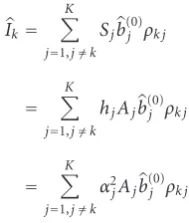
Ik= K
j=1,j /=k Sjbjρk j
=
K
j=1,j /=k
hjAjbjρk j
=
K
j=1,j /=k
α2jAjbjρk j
(31)
is the MAI. The conventional GR makes a decision based onZk. Thus, MAI is treated as another noise source. When
the number of users is large, MAI will seriously degrade the system performance. GR with partial interference cancella-tion, being a multiuser detection scheme [8], is proposed to alleviate this problem.
Denoting the soft and hard decisions of the GR output for the userkby
b(0)k =Zk, b(0)k =sgn(Zk), (32)
respectively, the output of the GR with the first PPIC stage with a partial cancellation factor equal to p1can be written as [20]
bk(1)=p1
Zk−Ik
+1−p1b(0)k
=Zk−p1Ik,
(33)
whereb(1)k denotes the soft decision of userkat the GR output with the first stage of PPIC and
Ik=
K
j=1,j /=k
Sjb(0)j ρk j
=
K
j=1,j /=k
hjAjb(0)j ρk j
=
K
j=1,j /=k
α2jAjb(0)j ρk j
(34)
is the estimated MAI using a hard decision.
3. Performance Analysis
3.1. Symbol Error Rate Expression. Letqkdenote the
instan-taneous SNR per symbol of thekth quadrature branch (k= 1,. . ., 2N) at the GR output under quadrature subbranch HS/MRC and HS/MRC schemes. In line with [2,23] and (1)– (8) and (10), the instantaneous SNRqkcan be defined in the
following form:
qk= Ebα2k
2σ2
n
, (35)
where Eb is the average symbol energy of the transmitted
signals(t).
Assume that we choose 2L(1 ≤ L ≤ N) quadrature branched out of the 2Nbranches. Then, the SNR per symbol at the GR output under quadrature subbranch HS/MRC and HS/MRC schemes may be presented as
qQBHS/MRC= 2L
k=1
q(k), (36)
whereq(k)are the ordered instantaneous SNRsqkand satisfy
the following condition
q(1)≥q(2)≥ · · · ≥q(2N). (37)
Using the moment generating function (MGF) method discussed in [10,18], SER ofM-ary pulse amplitude modu-lation (PAM) system conditioned onqQBHS/MRCis given by
Ps
qQBHS/MRC
=2(M−1)
Mπ 0.5π
0
exp −gM-PAM
sin2θ qQBHS/MRC !
dθ, (38)
where
gM-PAM= 3
M2−1. (39)
Averaging (38) overqQBHS/MRC, the SER ofM-ary PAM system is determined in the following form:
Ps=2(M−1) Mπ
0.5π
0
∞
0 exp −
gM-PAM sin2θ q
! fqQBHS/MRC
qdq dθ
=2(M−1)
Mπ 0.5π
0
ϕqQBHS/MRC −
gM-PAM sin2θ
! dθ,
(40)
where
ϕq(s)=Eq
expsq (41)
is the MGF of random variableq,Eq{·}is the mathematical
expectation of MGF with respect to SNR per symbol. A finite-limit integral for the Gaussian Q-function, which is convenient for numerical integrations is given by [32]
Q(x)=
⎧ ⎪ ⎪ ⎪ ⎪ ⎪ ⎨ ⎪ ⎪ ⎪ ⎪ ⎪ ⎩
1
π 0.5π
0 exp
#
− x2 2sin2θ
$
dθ, x≥0,
1−1
π 0.5π
0 exp
#
− x2 2sin2θ
$
dθ, x <0.
(42)
The error function can be related to the GaussianQ-function by
erf (x)=√2
π
x
0 exp
−t2dt
=1−2Q√2x.
(43)
The complementary error function is defined as erfc(x) = 1−erf (x) so that
Q(x)= 1 2erfc
x
√ 2
!
or erfc(x)=2Q√2x, (44)
which is convenient for computing values using MATLAB since erfc is a subprogram in MATLAB but the GaussianQ -function is not (unless you have aCommunications Toolbox). Note that the GaussianQ-function is the tabulated function. Now, let us compare (38) and (42) to obtain the closed form expression for the SER of M-ary PAM system
employing the GR with quadrature subbranch HS/MRC and HS/MRC schemes. We can easily see that taking into account (14), (15), (35), (36), and (39), the SER of M-ary PAM system employing the GR with quadrature subbranch HS/MRC and HS/MRC schemes can be defined in the following form
Ps
qQBHS/MRC
=2M−1
M Q
⎛ ⎝
'
6
M2−1qQBHS/MRC
⎞
⎠.
(45)
Thus, we obtain the closed form expression for the SER of M-ary PAM system employing the GR with quadrature subbranch HS/MRC and HS/MRC schemes that agrees with (8.136) and (8.138) in [33]. If M = 2, the average BER performance of coherent binary phase-shift keying (BPSK) system using the quadrature subbranch HS/MRC and HS/MRC schemes under GR implementation can be determined in the following form:
Pb=
1
π 0.5π
0 ϕqQBHS/MRC − 1 sin2θ
!
dθ. (46)
3.2. MGF of qQBHS/MRC. Since all of the 2N quadrature branches are i.i.d., the MGF ofqQBHS/MRCtakes the following form [12]:
ϕqQBHS/MRC(s)
=2L ⎛
⎝2N
2L ⎞
⎠∞
0 exp
sqfqϕs,q2L−1Fq2(N−L)dq, (47)
wheref(q) andF(q) are, respectively, the probability density function (pdf) and the cumulative distribution function (cdf) ofq, the SNR per symbol, for each quadrature branch, and
ϕs,q=
∞
q
exp(sx)f(x)dx (48)
is the marginal moment generating function (MMGF) of SNR per symbol of a single quadrature branch.
Since gk and gk+N (k = 1,. . .,N) follow a zero-mean
Gaussian distribution with the varianceσ2
hgiven by (14), one
can show that qk andqk+N follow the Gamma distribution
with pdf given by [26]
fq=
⎧ ⎪ ⎪ ⎪ ⎨ ⎪ ⎪ ⎪ ⎩
1 √qexp
*
−q
q +
,
πq, q≥0,
0, q≤0,
(49)
where
q=Ebσh2 σ2
n
(50)
be determined in the following form:
ϕs,q=, 1
1−sqerfc *'
1−sq q q
+
. (51)
Moreover, the cdf ofqbecomes
Fq=1−ϕ0,q=1−erfc
*' q q +
. (52)
4. PCF Determination
4.1. AWGN Channel. In this section, we determine the PCF at the GR output with the first stage of PPIC. From [20], the linear minimum mean square error (MMSE) solution of PCF for the first stage of PPIC is given by
p1,opt=
σ2
2,0−ρ1σ1,1σ2,0
σ2
1,1+σ2,02 −2ρ1σ1,1σ2,0
, (53)
where
σ2 1,1=E
-Ik+ζk−Ik
2.
(54)
is the power of residual MAI plus the total noise component forming at the GR output at the first stage,
σ2 2,0=E
/
(Ik+ζk)2 0
(55)
is the power of true MAI plus the total noise component forming at the GR output (also called the 0th stage), and
ρ1σ1,1σ2,0=E
/
Ik+ζk−Ik
(Ik+ζk) 0
(56)
is a correlation between these two MAI terms. It can be rewritten as
p1,opt=
E/(Ik+ζk)Ik 0
E/Ik20
= 1
(1/N)1Ku /=lS2u+
1K
u /=l
1K
v /=l,uSuSvE /
ρulρvlb(0)u b(0)v 0
×
⎧ ⎨
⎩N1
K
u /=l A2
u
1−2Pe,u
+
K
u /=l K
v /=l,u SuSvE
/
ρulρvlb(0)u b(0)v 0
+
K
v /=l SvE
/ ρvlζlb(0)v
0⎫⎬ ⎭
=E
/1K
j=1,j /=kα2jAjbjρk j+ 5Tb
0 α2k
v2
kAF(t)−v 2
kPF(t)
dt 1Kj=1,j /=kα2
jAjb(0)j ρk j 0
E-1Kj=1,j /=kα2jAjb(0)j ρk j
2.
= 1
(1/N)1Ki /=kα4
iA2i + 1K
i /=k 1K
j /=k,iα2iAiα2jAjE /
ρikρjkb(0)i b
(0)
j 0
×
⎧ ⎨ ⎩
1
N K
i /=k α4iA2i
1−2Pe,i
+
K
i /=k K
j /=k,i
α2iAiα2jAjE /
ρikρjkb(0)i b(0)j 0
+
K
j /=k α2
jAjE 6
ρjkb(0)j
Tb
0
α2
k
v2
kAF(t)−v 2
kPF(t)
dt
7⎫⎬
⎭,
(57)
where Pe,i is the BER of user i at the corresponding GR
output;
E/b(0)i b(0)i 0=1−2Pe,i, E /
ρ2
ik 0
=N−1. (58) The PCF p1,opt can be regarded as the normalized correlation between the true MAI plus the total noise component forming at the GR output and the estimated MAI. Assume that
b= {bk}Kk=1 (59)
is the dataset of all users;
ρ=ρik K
i,k=1 (60)
is the correlation coefficient set of random sequences;
fb(0)i |b,ρ
bi(0)|b,ρ=NE/b(0)i |b,ρ0, 4α4σ4
n
(61)
is the conditional normal pdf of b(0)i given b and ρ and
fb(0)i ,b (0) j |b,ρ(
Following the derivations in [20], the expectation terms with hard decisions in (57) can be evaluated based on Price’s theorem [26] as follows
E/ρikρjkb(0)i b
(0)
j 0
=E/E/E/ρikρjkb(0)i b
(0)
j |b,ρ 0
|ρ00
=E/E/ρikρjkb(0)i
2Qj−1
|ρ00,
(62)
E/ρjkζkb(0)j 0
=E/E/E/ρjkζkb(0)j |b,ρ 0
|ρ00
=4α4σ4
nE
-E
-ρ2
jkfb(0)j |b,ρ
0|b,ρ|ρ..,
(63)
E/ρulρvlb(0)u b(0)v 0
=E/E/E/ρikρjkb(0)i b
(0)
j |b,ρ 0
|ρ00
=E
-E
-ρikρjk
16ρi jα4σn4fb(0)i ,b (0) j |b,ρ
0, 0|b,ρ
+(2Qi−1)
2Qj−1
|ρ.., (64)
where
Qk=Q ⎛
⎝−M
/
bk(0)|b,ρ0 2α2σ2
n ⎞
⎠,
varζk
=4α4kσn4
(65)
is the total background noise variance forming at the GR output taking into account multipath fading channel;σ2
n is
the additive Gaussian noise variance forming at the PF and AF outputs of GR linear tract; the Gaussian Q-function is given by (42).
Although numerical integration in [20, 21] can be adopted for determining the optimal PCFp1,optfor the first stage based on (57)–(64), it requires huge computational complexity. To simplify this problem, we assume that the total background noise forming at the GR output can be considered as a constant factor and may be small enough such that theQfunctions in (62) and (64) are all constants and (63) can be approximated to zero. That is
4α4kσn4 min
{αkAk,ρ}
E/b(0)i |b,ρ
02
=4α4mA2mN−2, (66)
where [34]
α2mAm=minα2kAk;
K
k /=m
α2kAkbkρkl= −α2mAmbmρmk;
minρmk−ρmk=
2
N.
(67)
With this, we can rewrite (62) and (64) as follows:
E/E/ρikρjkb(0)i
2Qj−1
|ρ00
=B1E
/ ρikρjk
0
E/b(0)i |ρ0=0,
(68)
E
-E
-ρikρjk
16ρikα4σn4fb(0)i ,b(0)j |b,ρ
0, 0|b,ρ
+(2Qi−1)
2Qj−1 |ρ.. =E -E
-16α4σn4ρikρjkρi jfb(0)i ,b(0)j |b,ρ
0, 0|b,ρ|ρ
..
+B2E
/
E/ρikρjk|ρ 00
=E
-E
-4α4σ4
nρikρjkρi jfb(0)i ,b (0) j |b,ρ
0, 0|b,ρ|ρ..,
(69)
where B1 and B2 are constants. According to assumptions made above,fbu(0),bv(0)|b,ρ(0, 0|b,ρ) can be expressed by
fb(0)i ,b (0) j |b,ρ
0, 0|b,ρ =exp
−0.5mTbB−b1mb
8πα4σ4
n 8
1−ρ2i j
, (70)
where
mb=
E/b(0)i |b,ρ 0
,E/b(0)j |b,ρ
0T
Bb=E
b−mb
b−mb
T. (71)
with
b=b(0)i ,b(0)j T
. (72)
SinceB−1
b is a positive semidefinite matrix, that is,
mT
bB−b1mb≥0, (73)
we can have
0< fb(0)i ,b (0) j |b,ρ
0, 0|b,ρ≤ max
ρi j
ρi j= ±/ 1
1 8πα4σ4
n 8
1−ρ2
i j
. (74)
With the above results,
min
ρi j,ρi j= ±/ 1
8
1−ρ2
i j=
2√N−1
N , (75)
where [34]
ρi j=1−2N−1 or −1 + 2N−1,
E/ρikρjkρi j 0
=
N
m=1
N
p=1
N
q=1
E/cimckmcj pck pciqcjq 0
=
N
m=1
N−3=N−2.
Thus, we can derive a range ofp1,optas follows:
1K
i /=kα4iA2i
1−2Pe,u
1K
i /=kα4iA2i +
1/π√N−1 1Ki /=k
1K
j /=l,iα2iAiα2jAj
≤p1,opt<1−
21Ki /=kα4iA2iPe,u
1K
i /=kα4iA2i .
(77)
If the power control is perfect, that is,
α2
iAi=α2jAj=α2A, Pe,i=Pe (78)
andPeis approximated by the BER of high SNR case, that is,
theQ(,N/(K−1)) function [35,36], (77) can be rewritten as
1−2Q,N/(K−1)
1 + (K−2)/π√N−1 ≤p1,opt<1−2Q
⎛ ⎝
' N K−1
⎞
⎠.
(79)
It is interesting to see that the lower and upper boundary values can be explicitly calculated from the processing gain
Nand the number of usersK.
4.2. Multipath Channel. Based on representation in (8), we can obtain the received signal vector in the following form:
x(t)=
K
k=1
Ak(t)bkhk+n(t). (80)
Introduce the following notation for the correlation coeffi -cient
jk=hTjhk, k=kk. (81)
In commercial DS-CDMA systems, the users’ spreading codes are often modulated with another code having a very long period. As far as the received signal is concerned, the spreading code is not periodic. In other words, there will be many possible spreading codes for each user. If we use the result derived above, we then have to calculate the optimum PCFs for each possible code and the computational complexity will become very high. Since the period of the modulating code is usually very long, we can treat the code chips as independent random variables and approximate the correlation coefficient jk given by (81) as a Gaussian
random variable.
In this case, the GR output for the first stage can be presented in the following form:
Zk(t)=Ak(t)bkhTkhk+ K
j=1,j /=k
Aj(t)bjhTjhk+ζk(t)
=Ak(t)bkk+ K
j=1,j /=k
Aj(t)bjk+ζk(t),
(82)
where the background noiseζk(t) forming at the GR output
is given by (30).
Evaluating the GR output process given by (82), based on the well-know results, for example, discussed in [37], we can define the BER performance for the userkin the following form:
P(bk)=0.5P(Zk|bk=1) + 0.5P(Zk|bk= −1)
=P(Zk|bk=1).
(83)
In (83), we assume that the occurrence probabilities forbk=
1 andbk= −1 are equal, and that the error probabilities for bk = 1 and bk = −1 are also equal. As we can see from
(82), there are three terms. The first term corresponds to the desired user bit. If we letbk = 1, it is a deterministic
value. The third term in (82) given by (30) corresponds to the GR background noise interference which pdf is defined in [2, Chapter 3, pages 250–263, 324–328]. The second term in (82) corresponds to the interference from other users and is subjected to the binomial distribution. Note that correlation coefficients in (82) are small and DS-CDMA systems are usually operated in low SNR environments. The variance of the second term is then much smaller in comparison with the variance of the third term. Thus, we can assume thatZk
conditioned onbk = 1 can be approximated by Gaussian
distribution, as shown in [2, Chapter 3, pages 250–263, 324– 328] and [31]. Then, the BER performance takes a form
P(Zk)=Q ⎧ ⎪ ⎨ ⎪ ⎩ 9 : : :
;EL
/
M(l)
k 0
EL/Vk(l)0 ⎫ ⎪ ⎬ ⎪
⎭, (84)
where EL{·} denotes the expectation operator over the spreading code setLandM(kl),Vk(l)are the expected squared mean and variance ofZk, respectively, given thelth possible
code inL. Letting
Rk=
j /=k
qj, Λk=
j /=k 2
jk, (85)
whereqj is defined in (35), consideringjk as a Gaussian
random variable, we obtain
EL/Mk(l)0=A2kEL/k(l)0−pkEL /
Λ(l)
k
02
=A2
k
1−pkEL /
Λ(l)
k
02
,
(86)
and the variance as
EL/Vk(l)0=4σ4
n
EL/Ω(1,l)k0p2
k−2EL /
Ω(l) 2,k 0
pk+EL /
Ω(l) 3,k
0 .
(87)
coefficientjkgiven by (81). The coefficients ofEL{Vk(l)}are
represented by
Ω(l) 1,k=Rk
⎡
⎣
j /=k jkj+
j /=k
m /=j,k jmmk
⎤ ⎦ 2 + ⎡ ⎣
j /=k 2
jkj+
j /=k
m /=j,k
jmmkjk ⎤
⎦,
(88)
Ω(l) 2,k=Rk
⎡
⎣
j /=k 2
jkj+
j /=k
m /=j,k
jmmkjk ⎤ ⎦
+
j /=k 2jk,
(89)
Ω(l) 3,k=Rk
j /=k 2
jk+k. (90)
The optimal PCF for the userkcan be found as
pk,opt=arg max
pk ⎧ ⎨ ⎩ EL /
M(l)
k 0
EL/Vk(l)0 ⎫ ⎬ ⎭ = ⎧ ⎨
⎩pk,opt:EL
/
V(l)
k
0dEL/M(kl)0 dpk
−EL/M(kl)0dEL /
V(l)
k 0
dpk =
0
⎫ ⎬
⎭.
(91)
Substituting (86)–(90) into (91) and simplifying the result, we obtain the following equation
pk,opt=
EL/Ω(2,l)k0−EL/Ω3,(l)k0EL/Λ(kl)0
EL/Ω(1,l)k0−EL/Ω2,(l)k0EL/Λ(kl)0. (92)
Unlike that in AWGN channel, the result for the aperiodic code scenario is more difficult to obtain because there are more correlation terms in (85)–(91) to work with. Before evaluation of the expectation terms in (92), we define some function as follows:
αjk(m,n)=αj,mαk,n,
τjk(m,n)=τj,m−τk,n,
ψjk(m,n)=aTj,mak,n.
(93)
Thus, (93) define some relative figures between the mth channel path of the jth user and the nth channel path of thekth user. The notationαjk(m,n) denotes the path gain
product, τjk(m,n) is the relative path delay, and ψjk(m,n)
is the code correlation with the relative delay τjk(m,n).
Expanding (93), we have seven expectation terms to evaluate.
For purpose of illustration, we show how to evaluate the first term,EL{2jk}here. By definition, we havejkas
jk=hTjhk
= ⎧ ⎨ ⎩ L
m=1
aj,mαj,m ⎫ ⎬ ⎭
T⎧⎨
⎩ L
n=1
ak,nαk,n ⎫ ⎬ ⎭ = L
m=1
L
n=1
αj,mαk,naTj,mak,n
=
L
m=1
L
n=1
αjk(m,n)ψjk(m,n).
(94)
The expectation of jk over all possible codes can be
presented in the following form:
EL / 2 jk 0 =E ⎧ ⎨ ⎩ L
m1=1
L
n1=1
L
m2=1
L
n2=1
αjk(m1,n1)
×ψjk(m1,n1)αjk(m2,n2)ψjk(m2,n2)
⎫ ⎬ ⎭ = L
m1=1
L
n1=1
L
m2=1
L
n2=1
αjk(m1,n1)αjk(m2,n2)
×E/ψjk(m1,n1)ψjk(m2,n2)
0 .
(95)
Introduce the following function
Gjk(m1,n1,m2,n2)=B2E
/
ψjk(m1,n1)ψjk(m2,n2)
0 .
(96)
The coefficientB2in (96) is only the normalization constant. Since the spreading codes are seen as random, only if
τjk(m1,n1) is equal toτjk(m2,n2) willGjk(m1,n1,m2,n2) be nonzero. Consider a specific set of{m1,n1,m2,n2}such that
τjk(m1,n1)=τjk(m2,n2)=τ, τ≥0. (97)
In this case, we have
Gjk(m1,n1,m2,n2)=B2
N−τ−1
ν=0
E/a2
j,ν+τa2k,ν
0
=N−τ.
(98)
At τ < 0, we have the same result except that the sign of τ in (98) is plus. We can conclude that the function
Gjk(m1,n1,m2,n2) in (96) can be written in the following form:
Gjk(m1,n1,m2,n2)
=
⎧ ⎨ ⎩
N− |τ|, ifτjk(m1,n1)=τjk(m2,n2)=τ
0, otherwise.
Using (95), (96), and (98), we can evaluateEL{2jk}in (88)– (90). The formulations from the other six expectation terms can be obtain by mathematical transformation that is not difficult.
We now provide a simple example to show the multipath effect on the optimal PCFs. Introduce the following nota-tions that are satisfied for allk:
τk=[0,T]T, αk=
β,δT, β2+δ2=1. (100)
Using (100) and taking into consideration that in the case of AWGN channel
EL/Λ(kl)0=K−1
N , (101)
at given thelth possible code inL, we can write for the case of the multipath channel
EL/Λ(kl)0=K−1
N +
2(N−T)β2δ2(K−1)
N2 , (102)
EL /
Ω(l) 1,k 0
=EL ⎧ ⎪ ⎨ ⎪
⎩R
(l)
k ⎧ ⎨ ⎩
K
j=1,j /=k ρ(jkl)+
K
j=1,j /=k K
m=1,m /=j,k ρ(jml)ρ
(l)
mk ⎫ ⎬ ⎭
2
+
K
j=1,j /=k
ρ(jkl)2+
K
j=1,j /=k K
m=1,m /=j,k
ρ(jml)ρ(mkl)ρ(jkl) ⎫ ⎪ ⎬ ⎪ ⎭
+ 2(N−T)β2δ2
×RkN−4
N2+ 10N+ 4(N−T)β2δ2
+2(K−2)(4N+ 3K+ (N−T)β2δ2+ 1
+(K−1)N−3(N+ 3K−2) + 4(N−2T)β4δ4RkKN−4+ 6K−12
+RkN−4(6N−10T)β4δ4,
(103)
EL/Ω(2,l)k0
=EL ⎧ ⎨ ⎩R(kl)
⎧ ⎨ ⎩
K
j=1,j /=k
ρ(jkl)2+
K
j=1,j /=k K
m=1,m /=j,k
ρ(jml)ρ(mkl)ρ(jkl) ⎫ ⎬ ⎭
+
K
j=1,j /=k
ρ(jkl)2 ⎫ ⎬ ⎭
+ 2(N−T)β2δ2RkN−3(N+ 3K−2) + (k−1)N−2
, (104)
EL/Ω(3,l)k0
=EL ⎧ ⎨
⎩Rk
K
j=1,j /=k
ρ(jkl)2+ 1
⎫ ⎬
⎭+ 2(N−T)β2δ2RkN−2.
(105)
100
10−2
10−4
10−6
10−8
SER
Average SNR per symbol per diversity branch (dB)
0 5 10 15 20
Traditional receiver GR-BPSK GR-PAM
GR with traditional MRC
−L=1,N=4
−L=2,N=4
−L=3,N=4
Figure3: Average SER of coherent BPSK and 8-PAM for GR with quadrature subbranch HS/MRC and HS/MRC schemes versus the average SNR per symbol per diversity for various values of 2Lwith 2N=8.
Note that the first terms in (102)–(105) correspond to the optimal PCFs in AWGN channel. Other terms are due to the multipath effect. It is evident to see that ifδ=0, we have the case of an AWGN channel.
5. Simulation Results
5.1. Selection/Maximal-Ratio Combining. In this section, we discuss some examples of GR performance with quadrature subbranch HS/MRC and HS/MRC schemes and compare with the conventional HS/MRC receiver. The average SER of coherent BPSK and 8-PAM signals under processing by the GR with quadrature subbranch HS/MRC and HS/MRC schemes as a function of average SNR per symbol per diversity branch for various values of 2L and 2N = 8 is presented inFigure 3. It is seen that the GR SER performance with quadrature subbranch HS/MRC and HS/MRC schemes at (L,N) = (3, 4) achieves virtually the same performance as the GR with traditional MRC, and that the performance at (L,N)=(2, 4) is typically less than 0.5 dB in SNR poorer than that of GR with traditional MRC in [19]. Additionally, a comparison with the traditional HS/MTC receiver in [6,7] is made. The advantage of GR implementation in DS-CDMA systems is evident.
SER
Average SNR per symbol per diversity branch (dB)
0 5 10 15 20
10−6
10−5
10−4
10−3
10−2
10−1
100
GR
Traditional receiver BPSK
PAM
−L=2,N=2
−L=2,N=4
−L=2,N=8
Figure4: Average SER of coherent BPSK and 8-PAM for GR with quadrature subbranch HS/MRC and HS/MRC schemes versus the average SNR per symbol per diversity for various values of 2Nwith 2L=4.
2L=4 is shown inFigure 4. We note the substantial benefits of increasing the number of diversity branchesNfor fixedL. Comparison with the traditional HS/MRC receiver is made. The advantage of GR using is evident.
Comparative analysis of average BER as a function of the average SNR per bit per diversity branch of coherent BPSK signals employing GR with quadrature subbranch HS/MRC and HS/MRC schemes and GR with traditional HS/MRC scheme for various values of L with N = 8 is presented inFigure 5. To achieve the same value of average SNR per bit per diversity branch, we should choose 2L quadrature branches for the GR with quadrature subbranch HS/MRC, HS/MRC schemes, andLdiversity branches for the GR with traditional HS/MRC scheme. Figure 5 shows that the GR BER performance with quadrature subbranch HS/MRC and HS/MRC schemes is much better than that of the GR with traditional HS/MRC scheme, about 0.5 dB to 1.2 dB, when
L is less than one half N. This difference decreases with increasingL.
This is expected because when L = N, we obtain the same performance. Some discussion of increases in GR complexity and power consumption is in order. We first note that GR with quadrature subbranch HS/MRC and HS/MRC schemes requires the same number of antennas as GR with traditional HS/MRC scheme. On the other hand, the former requires twice as many comparators as the latter, to select the best signals for further processing. However, GR designs that process the quadrature signal components will
100
10−2
10−4
10−6
10−8
Average SNR per symbol per diversity branch (dB)
0 5 10 15 20
BER
GR with quadrature HS/MRC GR with traditional HS/MRC
−L=1,N=8
−L=3,N=8
−L=8,N=8
Figure5: Comparison of the average BER of coherent BPSK and 8-PAM for GR with quadrature subbranch HS/MRC and HS/MRC schemes versus the average SNR per symbol per diversity for various values of 2LwithN=8.
require 2Lreceiver chains for either the GR with quadrature subbranch HS/MRC and HS/MRC schemes or the GR with traditional HS/MRC scheme. Such receiver designs will use only a little additional power, as GR chains consume much more power than the comparators.
On the other hand, GR designs that implement cophas-ing of branch signals without splittcophas-ing the branch signals into the quadrature components will require L receiver chains for GR with traditional HS/MRC scheme and 2L receiver chains for GR with quadrature subbranch HS/MRC and HS/MRC schemes, with corresponding hardware and power consumption increases.
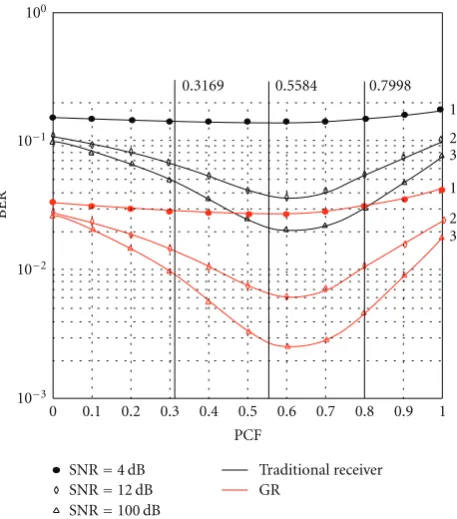
0 0.1 0.2 0.3 0.4 0.5 0.6 0.7 0.8 0.9 1 100
10−1
10−2
10−3
BER
PCF
GR
Traditional receiver
0.5584 0.7998
0.3169
1
2 3
1
2 3
SNR=4 dB SNR=12 dB SNR=100 dB
Figure6: The BER performance of the single-state GR based on PPIC with hard decisions for different SNRs and PCFs.
DS-CDMA systems with the conventional detector in [20] is presented. These results show us a great superiority of the GR employment over the conventional detector in [20].
Figure 7shows the BER performance at each stage for the three-stage GR based on the PPIC using different PCFs at the first stage, that is, the average value and an arbitrary value. PCFs for these two three-stage cases are
(a1,a2,a3)=(0.5584, 0.8, 0.9) and (0.7, 0.8, 0.9), (106)
respectively. The results demonstrate that the BER perfor-mances of GR employed by DS-CDMA systems of the cases using the proposed PCF at the first stage outperform ones of GR implemented in DS-CDMA system using arbitrary PCF at the first stage. Furthermore, the GR BER performance at the second stage for the case using the proposed PCF at the first stage achieves the BER performance of the GR comparable to that of the three-stage GR based on PPIC using an arbitrary PCF at the first stage. Comparison between the AWCN and multipath channels is also presented inFigure 7. We see that in the case of multipath channel, the BER performance is deteriorated. This fact can be explained by the additional correlation terms in (102)–(105).
Figure 8demonstrates the optimal PCF versus the num-ber of users both for the synchronous AWGN and for the multipath channels. We carry out simulation for the AWGN channel under the following conditions: the Gold codes, SNR = 12 dB, the spreading codes are the periodic, and
SNR (dB)
0 2 4 6 8 10 12
With arbitrariness With proposed PCF 1st stage
2nd stage 3rd stage AWGN
Multipath 100
10−1
10−2
10−3
BER
Figure7: The BER performance at each stage for three-stage GR based on the PPIC with hard decisions for different PCFs at the first stage, that is, the average value and an arbitrary value: AWGN and multipath channels.
PCF
K
5 10 15 20 25 30 35 40
0.2 0.25 0.3 0.35 0.4 0.45 0.5 0.55 0.6 0.65 0.7 0.75 0.8
AWGN Multipath
Figure8: Optimal PCF versus the number of users: the AWGN and multipath channels.
perfect power control. The multipath channel assumed is a two-ray channel with the transfer function
Wk(Z)=0.762 + 0.648Z−2 (107)
6. Conclusions
The GR performance with quadrature subbranch HS/MRC and HS/MRC schemes for a 1-D signal modulation in Rayleigh fading was investigated. The SER ofM-ary PAM, including coherent BPSK modulation, was derived. Results show that the GR with quadrature subbranch HS/MRC and HS/MRC schemes performs substantially better the GR with traditional HS/MRC scheme, particularly, whenLis smaller than one half N, and much better than the traditional HS/MRC receiver.
We have also derived the optimal PCF range for GR first stage based on the PPIC, which is employed by DS-CDMA system, with hard decisions in multipath fading channel. Computer simulation shows that the BER performance of the GR employed by DS-CDMA system with multipath fading channel in the case of periodic code scenario and using the average of the lower and upper boundary values is close to that of the GR of the case using the real optimal PCF, whether the SNR is high or low. It has also been shown that GR employment in a DS-CDMA system with multipath fading channel in the case of periodic code scenario allows us to observe a great superiority over the conventional receiver discussed in [20]. The procedure discussed in [20] is also acceptable for GR employment by DS-CDMA systems. It has also been demonstrated that the two-stage GR based on PPIC using the proposed PCF at the first stage achieves such BER performance comparable to that of the three-stage GR based on PPIC using an arbitrary PCF at the first stage. This means that at the same BER performance, the number of stages (or complexity) required for the multistage GR based on PPIC could be reduced when the proposed PCF is used at the first stage. It can be shown that the proposed PCF selection approach is applicable to multipath fading cases at GR employment in DS-CDMA systems even if no perfect power control is assumed, but this is a subject of future work. We have also compared the BER performance at the optimal PCF in the case of AWGN and multipath channels and presented a sensitivity of the BER performance to the values of PCF for both cases.
Acknowledgments
This paper was supported by Kyungpook National University Research Grant, 2009. Additionally, the author would like to thank the anonymous reviewers for the comments and suggestions that helped to improve the quality of this paper.
References
[1] V. Tuzlukov,Signal Processing in Noise: A New Methodology, IEC, Minsk, Belarus, 1998.
[2] V. Tuzlukov,Signal Detection Theory, Springer, New York, NY, USA, 2001.
[3] V. Tuzlukov,Signal Processing Noise, CRC Press, Boca Raton, Fla, USA, 2002.
[4] V. Tuzlukov, Signal and Image Processing in Navigational Systems, CRC Press, Boca Raton, Fla, USA, 2004.
[5] V. P. Tuzlukov, “A new approach to signal detection theory,” Digital Signal Processing, vol. 8, no. 3, pp. 166–184, 1998.
[6] M. Z. Win and J. H. Winters, “Analysis of hybrid selection/ maximal-ratio combining in Rayleigh fading,”IEEE Transac-tions on CommunicaTransac-tions, vol. 47, no. 12, pp. 1773–1776, 1999. [7] M. Z. Win and J. H. Winters, “Virtual branch analysis of symbol error probability for hybrid selection/maximal-ratio combining in Rayleigh fading,” IEEE Transactions on Communications, vol. 49, no. 11, pp. 1926–1934, 2001. [8] N. Kong and L. B. Milstein, “Average SNR of a generalized
diversity selection combining scheme,”IEEE Communications Letters, vol. 3, no. 3, pp. 57–79, 1999.
[9] M. S. Alouini and M. K. Simon, “Performance of coherent receivers with hybrid SC/MRC over Nakagami-m fading channels,”IEEE Transactions on Vehicular Technology, vol. 48, no. 4, pp. 1155–1164, 1999.
[10] M. S. Alouini and M. K. Simon, “An MGF-based performance analysis of generalized selection combining over Rayleigh fading channels,”IEEE Transactions on Communications, vol. 48, no. 3, pp. 401–415, 2000.
[11] R. K. Mallik and M. Z. Win, “Analysis of hybrid selection/maximal-ratio combining in correlated Nakagami fading,”IEEE Transactions on Communications, vol. 50, no. 8, pp. 1372–1383, 2002.
[12] A. Annamalai and C. Tellambura, “A new approach to performance evaluation of generalized selection diversity receivers in wireless channels,” inProceedings of the 54th IEEE Vehicular Technology Conference (VTC ’01), vol. 4, pp. 2309– 2313, October 2001.
[13] J. G. Proakis, Digital Communications, McGraw-Hill, New York, NY, USA, 4th edition, 2001.
[14] U. Mengali and A. N. D. Andrea,Synchronization Techniques for Digital Receivers, Plenum, New York, NY, USA, 1997. [15] L. Tong and S. Perreau, “Multichannel blind identification:
from subspace to maximum likelihood methods,”Proceedings of the IEEE, vol. 86, no. 10, pp. 1951–1968, 1998.
[16] J. K. Tugnait, L. Tong, and Z. Ding, “Single-user channel estimation and equalization,”IEEE Signal Processing Magazine, vol. 17, no. 3, pp. 17–28, 2000.
[17] K. Abed-Meraim, W. Qaiu, and Y. Hua, “Blind system identification,”Proceedings of the IEEE, vol. 85, no. 8, pp. 1310– 1322, 1997.
[18] M. S. Alouini, “A unified approach for calculating error rates of linearly modulated signals over generalized fading channels,”IEEE Transactions on Communications, vol. 47, no. 9, pp. 1324–1334, 1999.
[19] V. Tuzlukov, W.-S. Yoon, and Y. D. Kim, “Wireless sensor networks based on the generalized approach to signal process-ing with fadprocess-ing channels and receive antenna array,”WSEAS Transactions on Circuits and Systems, vol. 10, no. 3, pp. 2149– 2155, 2004.
[20] D. Divsalar, M. K. Simon, and D. Raphaeli, “Improved parallel interference cancellation for CDMA,”IEEE Transactions on Communications, vol. 46, no. 2, pp. 258–268, 1998.
[21] P. G. Renucci and B. D. Woerner, “Optimisation of soft interference cancellation for DS-CDMA,”Electronics Letters, vol. 34, no. 8, pp. 731–733, 1998.
[22] D. Guo, Linear Parallel Interference Cancellation in CDMA, M.S. thesis, National University of Singapore, 1998.
[23] Y. T. Hsieh and W. R. Wu, “Optimal two-stage decoupled par-tial PIC receivers for multiuser detection,”IEEE Transactions on Wireless Communications, vol. 4, no. 1, pp. 112–127, 2005. [24] M. Ghotbi and M. R. Soleymani, “Multiuser detection of
[25] K. M. Wu and C. L. Wang, “Soft-input soft-output partial parallel interference cancellation for DS-CDMA systems,” in Proceedings of the International Conference on Communications (ICC ’01), pp. 1172–1176, Helsinki, Finland, June 2000. [26] A. Papoulis and S. U. Pillai,Probability, Random Variables and
Stochastic Processes, McGraw-Hill, New York, NY, USA, 4th edition, 2002.
[27] G. Xue, J. F. Weng, T. Le-Ngoc, and S. Tahar, “An analytical model for performance evaluation of parallel interference cancellers in CDMA systems,”IEEE Communications Letters, vol. 4, no. 6, pp. 184–186, 2000.
[28] J. H. Kim, V. Tuzlukov, W. S. Yoon, and Y. D. Kim, “Gener-alized detector under nonorthogonal multipulse modulation in remote sensing systems,”WSEAS Transactions on Signal Processing, vol. 2, no. 1, pp. 203–208, 2005.
[29] V. Tuzlukov, W. S. Yoon, and Y. D. Kim, “Adaptive beam-former generalized detector in wireless sensor networks,” in Proceedings of the IASTED International Conference on Parallel and Distributed Computing and Networks (PDCN ’04), pp. 195–200, Innsbruck, Austria, February 2004.
[30] J. H. Kim, V. Tuzlukov, W. S. Yoon, and Y. D. Kim, “Macrodi-versity in wireless sensor networks based on the generalized approach to signal processing,” WSEAS Transactions and Communications, vol. 4, no. 8, pp. 648–653, 2005.
[31] V. Tuzlukov, “Multiuser generalized detector for uniformly quantized synchronous CDMA signals in AWGN channels,” Telecommunications Review, vol. 20, no. 5, pp. 836–848, 2010. [32] J. W. Craig, “A new, simple and exact result for calculating the probability of error for two-dimensional signal constellations,” inProceedings of the IEEE Military Communications Conference (MILCOM ’91), vol. 2, pp. 571–575, McLean, Va, USA, November 1991.
[33] R. E. Ziemer and W. H. Tranter,Principles of Communications: Systems, Modulation, and Noise, John Wiley & Sons, New York, NY, USA, 6th edition, 2010.
[34] R. K. Morrow Jr. and J. S. Lehnert, “Bit-to-bit error depen-dence in slotted DS/SSMA packer systems with random signature sequences,”IEEE Transactions on Communications, vol. 37, no. 10, pp. 1052–1061, 1989.
[35] J. C. Liberti Jr. and T. S. Rappaport, Smart Antennas for Wireless Communications: IS-95 and Third Generation CDMA Applications, Prentice Hall, Upper Saddle River, NJ, USA, 1999.
[36] D. R. Brown III and C. R. Johnson Jr., “SINR, power efficiency, and theoretical system capacity of parallel interference cancel-lation,”Journal of Communications and Networks, vol. 3, no. 3, pp. 228–237, 2001.
[37] S. Manohar, V. Tikiya, R. Annavajjala, and A. Chockalingam, “BER-optimal linear parallel interference cancellation for multicarrier DS-CDMA in Rayleigh fading,”IEEE Transactions on Communications, vol. 55, no. 6, pp. 1253–1265, 2007. [38] V. Tuzlukov, “Selection of partial cancellation factors in