Learning Translation Boundaries for Phrase-Based Decoding
Deyi Xiong, Min Zhang, Haizhou Li Human Language Technology Institute for Infocomm Research
1 Fusionopolis Way, #21-01 Connexis, Singapore 138632. {dyxiong, mzhang, hli}@i2r.a-star.edu.sg
Abstract
Constrained decoding is of great importance not only for speed but also for translation qual-ity. Previous efforts explore soft syntactic con-straints which are based on constituent bound-aries deduced from parse trees of the source language. We present a new framework to es-tablish soft constraints based on a more nat-ural alternative: translation boundary rather than constituent boundary. We propose sim-ple classifiers to learn translation boundaries for any source sentences. The classifiers are trained directly on word-aligned corpus with-out using any additional resources. We report the accuracy of our translation boundary clas-sifiers. We show that using constraints based on translation boundaries predicted by our classifiers achieves significant improvements over the baseline on large-scale Chinese-to-English translation experiments. The new constraints also significantly outperform con-stituent boundary based syntactic constrains.
1 Introduction
It has been known that phrase-based decoding (phrase segmentation/translation/reordering (Chi-ang, 2005)) should be constrained to some extent not only for transferring the NP-hard problem (Knight, 1999) into a tractable one in practice but also for im-proving translation quality. For example, Xiong et al. (2008) find that translation quality can be signif-icantly improved by either prohibiting reorderings around punctuation or restricting reorderings within a 15-word window.
Recently, more linguistically motivated con-straints are introduced to improve phrase-based de-coding. (Cherry, 2008) and (Marton and Resnik,
2008) introduce syntactic constraints into the stan-dard phrase-based decoding (Koehn et al., 2003) and hierarchical phrase-based decoding (Chiang, 2005) respectively by using a counting feature which ac-cumulates whenever hypotheses violate syntactic boundaries of source-side parse trees. (Xiong et al., 2009) further presents a bracketing model to include thousands of context-sensitive syntactic constraints. All of these approaches achieve their improvements by guiding the phrase-based decoder to prefer trans-lations which respect source-side parse trees.
One major problem with such constituent bound-ary based constraints is that syntactic structures of the source language do not necessarily reflect trans-lation structures where the source and target lan-guage correspond to each other. In this paper, we investigate building classifiers that directly ad-dress the problem of translation boundary, rather than extracting constituent boundary from source-side parsers built for a different purpose. A trans-lation boundary is a position in the source sequence which begins or ends atranslation zone1 spanning multiple source words. In a translation zone, the source phrase is translated as a unit. Reorderings which cross translation zones are not desirable.
Inspired by (Roark and Hollingshead, 2008) which introduces classifiers to decide if a word can begin/end a multi-word constituent, we build two discriminative classifiers to tag each word in the source sequence with a binary class label. The first classifier decides if a word can begin a multi-source-word translation zone; the second classifier decides if a word can end a multi-source-word translation
1
We will give a formal definition of translation zone in Sec-tion 2.
zone. Given a partial translation covering source se-quence(i, j) with start wordci and end wordcj 2, this translation can be penalized if the first classifier decides that the start wordcican not be a beginning translation boundary or the second classifier decides that the end wordcjcan not be an ending translation boundary. In such a way, we can guide the decoder to boost hypotheses that respect translation bound-aries and therefore the common translation structure shared by the source and target language, rather than the syntactic structure of the source language.
We report the accuracy of such classifiers by com-paring their outputs with “gold” translation bound-aries obtained from reference translations on the de-velopment set. We integrate translation boundary based constraints into phrase-based decoding and display that they improve translation quality signif-icantly in large-scale experiments. Furthermore, we confirm that they also significantly outperform con-stituent boundary based syntactic constraints.
2 Beginning and Ending Translation Zones
To better understand the particular task that we ad-dress in this paper, we study the distribution of classes of translation boundaries in real-world data. First, we introduce some notations. Given a source sentencec1...cn, we will say that a wordci(1< i < n) is in the classBy if there is a translation zoneτ spanningci...cj for somej > i; andci ∈ Bn oth-erwise. Similarly, we will say that a wordcj is in the classEy if there is a translation zone spanning ci...cjfor somej > i; andcj ∈Enotherwise.
Here, a translation zone τ is a pair of aligned source phrase and target phrase
τ = (cji, eqp)
whereτmust be consistent with the word alignment M
∀(u, v)∈M, i≤u≤j↔p≤v≤q
By this, we require that no words inside the source phrase cji are aligned to words outside the target phrase eqp and that no words outside the source phrase are aligned to words inside the target phrase.
2
In this paper, we usecto denote the source language ande the target language.
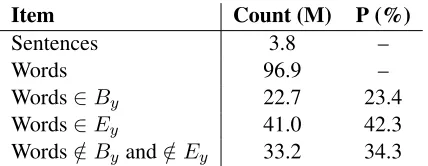
Item Count (M) P (%)
Sentences 3.8 –
Words 96.9 –
Words∈By 22.7 23.4
Words∈Ey 41.0 42.3
[image:2.612.321.535.54.137.2]Words∈/ By and∈/ Ey 33.2 34.3
Table 1: Statistics on word classes from our bilingual training data. All numbers are calculated on the source side. P means the percentage.
This means, in other words, that the source phrase cji is mapped as a unit onto the target phraseeqp.
When defining the By andEy class, we also re-quire that the source phrasecji in the translation zone must contain multiple words (j > i). Our interest is the question of whether a sequence of consecu-tive source words can be translated as a unit (i.e. whether there is a translation zone covering these source words). For a single-word source phrase, if it can be translated separately, it is always translated as a unit in the context of phrase-based decoding. Therefore this question does not exist.
Note that the first word c1 and the last wordcn are unambiguous in terms of whether they begin or end a translation zone. The first wordc1 must begin
a translation zone spanning the whole source sen-tence. The last wordcnmust end a translation zone spanning the whole source sentence. Therefore, our classifiers only need to predict the othern−2words for a source sentence of lengthn.
Classification Task Avg. Accuracy (%)
By/Bn 46.9
[image:3.612.87.279.55.96.2]Ey/En 52.2
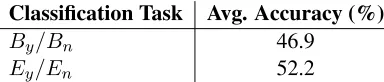
Table 2: Average classification accuracy on the develop-ment set when we treat constituent boundary deducer (ac-cording to source-side parse trees) as a translation bound-ary classifier.
based syntactic constraints can improve translation quality. We pair the source sentences of our devel-opment set with each of the reference translations and include the created sentence pairs in our bilin-gual training corpus. Then we obtain word align-ments on the new corpus (see Section 5.1 for the de-tails of learning word alignments). From the word alignments we obtain translation boundaries (see de-tails in the next section). We parse the source sen-tences of our development set and obtain constituent boundaries from parse trees.
To make a clear comparison with our transla-tion boundary classifiers (see Sectransla-tion 3.3), we treat constituent boundaries deduced from source-side parse trees as output from beginning/ending bound-ary classifiers: the constituent beginning boundbound-ary corresponds toBy; the constituent ending boundary corresponds toEy. We have four reference transla-tions for each source sentence. Therefore we have four translation boundary sets, each of which is pro-duced from word alignments between source sen-tences and one reference translation set. Each of the four translation boundary sets will be used as a gold standard. We calculate classification accuracy for our constituent boundary deducer on each gold standard and average them finally.
Table 2 shows the accuracy results. The average accuracies on the four gold standard sets are very low, especially for theBy/Bnclassification task. In section 3.3, we will show that our translation bound-ary classifiers achieve higher accuracy than that of constituent boundary deducer. This suggests that pure constituent boundary based constraints are not the best choice to constrain phrase-based decoding.
3 Learning Translation Boundaries
In this section, we investigate building classifiers to predict translation boundaries. First, we
elabo-rate the acquisition of training instances from word alignments. Second, we build two classifiers with simple features on the obtained training instances. Finally, we evaluate our classifiers on the develop-ment set using the “gold” translation boundaries ob-tained from reference translations.
3.1 Obtaining Translation Boundaries from Word Alignments
We can easily obtain constituent boundaries from parse trees. Similarly, if we have a tree covering both source and target sentence, we can easily get translation boundaries from this tree. Fortunately, we can build such a tree directly from word align-ments. We use (Zhang et al., 2008)’s shift-reduce al-gorithm (SRA) to decompose word alignments into hierarchical trees.
Given an arbitrary word-level alignment as an in-put, SRA is able to output a tree representation of the word alignment (a.k.a decomposition tree). Each node of the tree is a translation zone as we defined in the Section 2. Therefore the first word on the source side of each multi-source-word node is a be-ginning translation boundary (∈ By); the last word on the source side of each multi-source-word node is an ending translation boundary (∈Ey).
Figure 1a shows an example of many-to-many alignment, where the source language is Chinese and the target language is English. Each word is indexed with their occurring position from left to right. Figure 1b is the tree representation of the word alignment after hierarchical analysis using SRA. We use ([i, j],[p, q]) to denote a tree node, where i, j andp, q are the beginning and ending index in the source and target language, respectively. By check-ing nodes which cover multiple source words, we can easily decide that the source words{过去,五,
因故} are in the classBy and any other words are in the classBnif we want to train aBy/Bn classi-fier with class labels{By, Bn}. Similarly, the source words{次,飞行,都,失败}are in the classEy and any other words are in the classEnwhen we train a Ey/Enclassifier with class labels{Ey, En}.
过 去 次 飞 行 都 因 故 失 败
The last five flights all failed due to accidents 五
1 2 3 4 5 6 7
1 2 3 4 5 6 7 8 9
([1, 7], [1, 9])
([6, 7], [6, 9])
([6, 6], [7, 9]) ([7, 7], [6, 6]) ([1, 5], [1, 5])
([1, 4], [1, 4]) ([5, 5], [5, 5])
([1, 3], [1, 3]) ([4, 4], [4, 4])
([1, 1], [1, 2]) ([2, 3], [3, 3])
[image:4.612.77.535.58.244.2]a) b)
Figure 1: An example of many-to-many word alignment and its tree representation produced by (Zhang et al., 2008)’s shift-reduce algorithm.
3.2 Building Translation Boundary Classifiers
We build two discriminative classifiers based on Maximum Entropy Markov Models (MEMM) (Mc-Callum et al., 2000). One classifier is to predict the word classζ ∈ {By, Bn}for each source word. The other is to predict the word class ζ ∈ {Ey, En}. These two classifiers are separately trained using training instances obtained from our word-aligned training data as demonstrated in the last section.
We use features from surrounding words, includ-ing 2 before and 2 after the current word position (c−2, c−1, c+1, c+2). We also use class features to
train models with Markov order 1 (including class feature ζc−1), and Markov order 2 (including class
featuresζc−1, ζc−2).
3.3 Evaluating Translation Boundary Classifiers
How well can we perform these binary classifica-tion tasks using the classifiers described above? Can we obtain better translation boundary predictions than extracting constituent boundary from source-side parse trees? To investigate these questions, we evaluate our MEMM based classifiers. We trained them on our 100M-word word-aligned corpus. We ran the two trained classifiers on the development set separately to obtain theBy/Bnwords andEy/En words. Then we built our four gold standards using four reference translation sets as described in
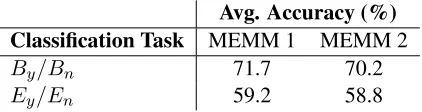
Sec-Avg. Accuracy (%) Classification Task MEMM 1 MEMM 2 By/Bn 71.7 70.2 Ey/En 59.2 58.8
Table 3: Average classification accuracy on the develop-ment set for our MEMM based translation boundary clas-sifiers with various Markov orders.
tion 2. The average classification accuracy results are shown in Table 3.
Comparing Table 3 with Table 2, we find that our MEMM based classifiers significantly outperform constituent boundary deducer in predicting transla-tion boundaries, especially in the By/Bn classifi-cation task, where our MEMM basedBy/Bn clas-sifier (Markov order 1) achieves a relative increase of 52.9% in accuracy over the constituent bound-ary deducer. In theEy/En classification task, our classifiers also perform much better than constituent boundary deducer.
[image:4.612.322.533.306.362.2]Classification Task Avg. Accuracy (%)
By/Bn 80.6
[image:5.612.87.279.55.96.2]Ey/En 75.7
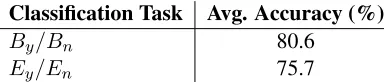
Table 4: Average classification accuracy on the develop-ment set when treating each reference translation set as a boundary classifier.
generate very different translation boundaries. We can measure these differences in reference transla-tions using the same evaluation metric (classification accuracy). We treat each reference translation set as a translation boundary classifier while the other three reference translation sets as gold standards. We calculate the classification accuracy for the cur-rent reference translation set and finally average all four accuracies. Table 4 presents the results.
Comparing Table 4 with Table 3, we can see that the accuracy of our translation boundary classifica-tion approach is not that low when considering vast divergences of reference translations. The question now becomes, how can classifier output be used to constrain phrase-based decoding, and what is the impact on the system performance of using such constraints.
4 Integrating Translation Boundaries into Decoding
By running the two trained classifiers on the source sentence separately, we obtain two classified word sets:By/Bnwords, andEy/Enwords. We can pro-hibit any translations or reorderings spanningci...cj (j > i) whereci ∈/ By according to the first classi-fier orcj ∈/ Ey according to the second classifier. In such a way, we integrate translation boundaries into phrase-based decoding as hard constraints, which, however, is at the risk of producing no translation covering the whole source sentence.
Alternatively, we introduce soft constraints based on translation boundary that our classifiers pre-dict, similar to constituent boundary based soft con-straints in (Cherry, 2008) and (Marton and Resnik, 2008). We add a new feature to the decoder’s log-linear model: translation boundary violation count-ing feature. This counting feature accumulates whenever hypotheses have a partial translation span-ningci...cj (j > i) whereci ∈/ By orcj ∈/ Ey. The
LDC ID Description
LDC2004E12 United Nations LDC2004T08 Hong Kong News LDC2005T10 Sinorama Magazine LDC2003E14 FBIS
LDC2002E18 Xinhua News V1 beta LDC2005T06 Chinese News Translation LDC2003E07 Chinese Treebank
LDC2004T07 Multiple Translation Chinese
Table 5: Training corpora.
weightλv of this feature is tuned via minimal error rate training (MERT) (Och, 2003) with other feature weights.
Unlike hard constraints, which simply prevent any hypotheses from violating translation bound-aries, soft constraints allow violations of translation boundaries but with a penalty of exp(−λvCv) where Cv is the violation count. By using soft constraints, we can enable the model to prefer hypotheses which are consistent with translation boundaries.
5 Experiment
Our baseline system is a phrase-based system us-ing BTGs (Wu, 1997), which includes a content-dependent reordering model discriminatively trained using reordering examples (Xiong et al., 2006). We carried out various experiments to evaluate the im-pact of integrating translation boundary based soft constraints into decoding on the system performance on the Chinese-to-English translation task of the NIST MT-05 using large scale training data.
5.1 Experimental Setup
Our training corpora are listed in Table 5. The whole corpora consist of 96.9M Chinese words and 109.5M English words in 3.8M sentence pairs. We ran GIZA++ (Och and Ney, 2000) on the par-allel corpora in both directions and then applied the “grow-diag-final” refinement rule (Koehn et al., 2005) to obtain many-to-many word alignments. From the word-aligned corpora, we extracted bilin-gual phrases and trained our translation model.
[image:5.612.322.532.56.179.2]con-sist of 33.3M Chinese words and 35.8M English words. We built a four-gram language model us-ing the SRILM toolkit (Stolcke, 2002), which was trained on Xinhua section of the English Gigaword corpus (181.1M words).
To train our translation boundary classifiers, we extract training instances from the whole word-aligned corpora, from which we obtain 96.9M train-ing instances for the By/Bn andEy/En classifier. We ran the off-the-shelf MaxEnt toolkit (Zhang, 2004) to tune classifier feature weights with Gaus-sian prior set to 1 to avoid overfitting.
We used the NIST MT-03 evaluation test data as our development set (919 sentences in total, 27.1 words per sentence). The NIST MT-05 test set in-cludes 1082 sentences with an average of 27.4 words per sentence. Both the reference corpus for the NIST MT-03 set and the reference corpus for the NIST MT-05 set contain 4 translations per source sen-tence. To compare with constituent boundary based constraints, we parsed source sentences of both the development and test sets using a Chinese parser (Xiong et al., 2005) which was trained on the Penn Chinese Treebank with an F1-score of 79.4%.
Our evaluation metric is case-insensitive BLEU-4 (Papineni et al., 2002) using the shortest reference sentence length for the brevity penalty. Statistical significance in BLEU score differences was tested by paired bootstrap re-sampling (Koehn, 2004).
5.2 Using Translation Boundaries from Reference Translations
The most direct way to investigate the impact on the system performance of using translation boundaries is to integrate “right” translation boundaries into de-coding which are directly obtained from reference translations. For both the development set and test set, we have four reference translation sets, which are named ref1, ref2, ref3 and ref4, respectively. For the development set, we used translation bound-aries obtained from ref1. Based on these boundbound-aries, we built our translation boundary violation counting feature and tuned its feature weight with other tures using MERT. When we obtained the best fea-ture weightsλs, we evaluated on the test set using translation boundaries produced from ref1, ref2, ref3 and ref4 of the test set respectively.
Table 6 shows the results. We clearly see that
us-System BLEU-4 (%)
[image:6.612.367.485.53.137.2]Base 33.05 Ref1 33.99* Ref2 34.17* Ref3 33.93* Ref4 34.21*
Table 6: Results of using translation boundaries obtained from reference translations. *: significantly better than baseline (p <0.01).
ing “right” translation boundaries to build soft con-straints significantly improve the performance mea-sured by BLEU score. The best result comes from ref4, which achieves an absolute increase of 1.16 BLEU points over the baseline. We believe that the best result here only indicates the lower bound of potential improvement when using right translation boundaries. If we have consistent translation bound-aries on the development and test set (for example, we have the same 4 translators build reference trans-lations for both the development and test set), the performance improvement will be higher.
5.3 Using Automatically Learned Translation Boundaries
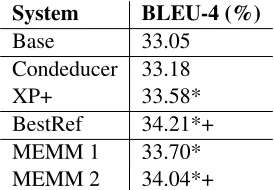
The success of using translation boundaries from reference translations inspires us to pursue trans-lation boundaries predicted by our MEMM based classifiers. We ran our MEMM1 (Markov order 1) and MEMM2 (Markov order 2)By/BnandEy/En classifiers on both the development and test set. Based on translation boundaries output by MEMM1 and MEMM2 classifiers, we built our translation boundary violation feature and tuned it on the de-velopment set. The evaluation results on the test set are shown in Table 7.
From Table 7 we observe that using soft con-straints based on translation boundaries from both our MEMM 1 and MEMM 2 significantly outper-form the baseline. Impressively, when using outputs from MEMM 2, we achieve an absolute improve-ment of almost 1 BLEU point over the baseline. This result is also very close to the best result of using translation boundaries from reference translations.
System BLEU-4 (%)
Base 33.05
Condeducer 33.18
XP+ 33.58*
[image:7.612.117.254.55.150.2]BestRef 34.21*+ MEMM 1 33.70* MEMM 2 34.04*+
Table 7: Results of using automatically learned trans-lation boundaries. Condeducer means using pure con-stituent boundary based soft constraint. XP+ is another constituent boundary based soft constraint but with dis-tinction among special constituent types (Marton and Resnik, 2008). BestRef is the best result using reference translation boundaries in Table 6. MEMM 1 and MEMM 2 are our MEMM based translation boundary classifiers with Markov order 1 and 2. *: significantly better than baseline (p < 0.01). +: significantly better than XP+ (p <0.01).
Condeducer which uses pure constituent bound-ary based syntactic constraint: any partial transla-tions which cross any constituent boundaries will be penalized. The other is the XP+ from (Marton and Resnik, 2008) which only penalizes hypotheses which violate the boundaries of a constituent with a label from{NP, VP, CP, IP, PP, ADVP, QP, LCP, DNP}. The XP+ is the best syntactic constraint among all constraints that Marton and Resnik (2008) use for Chinese-to-English translation.
Still in Table 7, we find that both syntactic con-straint Condeducer and XP+ are better than the base-line. But only XP+ is able to obtain significant im-provement. Both our MEMM 1 and MEMM 2 out-perform Condeducer. MEMM 2 achieves significant improvement over XP+ by approximately 0.5 BLEU points. This comparison suggests that translation boundary is a better option than constituent bound-ary when we build constraints to restrict phrase-based decoding.
5.4 One Classifier vs. Two Classifiers
Revisiting the classification task in this paper, we can also consider it as a sequence labeling task where the first source word of a translation zone is labeled “B”, the last source word of the trans-lation zone is labeled “E”, and other words are la-beled “O”. To complete such a sequence labeling
task, we built only one classifier which is still based on MEMM (with Markov order 2) with the same features as described in Section 3.2. We built soft constraints based on the outputs of this classifier and evaluated them on the test set. The case-insensitive BLEU score is 33.62, which is lower than the per-formance of using two separate classifiers (34.04).
We calculated the accuracy for class “B” by map-ping “B” toByand “E” and “O” toBn. The result is 67.9%. Similarly, we obtained the accuracy of class “E”, which is as low as 48.6%. These two accura-cies are much lower than those of using two separate classifiers, especially the accuracy of “E”. This sug-gests that theBy andEy are not interrelated tightly. It is better to learn them separately with two classi-fiers.
Another advantage of using two separate classi-fiers is that we can explore more constraints. A word ckcan be possibly labeled asByby the first classifier andEy by the second classifier. Therefore we can build soft constraints on span(ci, ck)(ci ∈By, ck∈ Ey) and span(ck, cj) (ck ∈ By, cj ∈ Ey). This is impossible if we use only one classifier since each word can have only one class label. We can build only one constraint on span(ci, ck)or span(ck, cj).
6 Related Work
Various approaches incorporate constraints into phrase-based decoding in a soft or hard manner. Our introduction has already briefly mentioned (Cherry, 2008) and (Marton and Resnik, 2008), which utilize source-side parse tree boundary violation counting feature to build soft constraints for phrase-based de-coding, and (Xiong et al., 2009), which calculates a score to indicate to what extent a source phrase can be translated as a unit using a bracketing model with richer syntactic features. More previously, (Chi-ang, 2005) rewards hypotheses whenever they ex-actly match constituent boundaries of parse trees on the source side.
which violate punctuation based constraints. Non-linguistic constraints are also widely used in phrase-based decoding. The IBM and ITG con-straints (Zens et al., 2004) are used to restrict re-orderings in practical phrase-based systems.
(Berger et al., 1996) introduces the concept ofrift
into a machine translation system, which is similar to our definition of translation boundary. They also use a maximum entropy model to predict whether a source position is a rift based on features only from source sentences. Our work differs from (Berger et al., 1996) in three major respects.
1) We distinguish a segment boundary into two categories: beginning and ending boundary due to their different distributions (see Table 1). However, Berger et al. ignore this difference.
2) We train two classifiers to predict beginning and ending boundary respectively while Berger et al. build only one classifier. Our experiments show that two separate classifiers outperform one classifier.
3) The last difference is how segment bound-aries are integrated into a machine transla-tion system. Berger et al. use predicted rifts to divide a long source sentence into a series of smaller segments, which are then translated sequentially in order to increase de-coding speed (Brown et al., 1992; Berger et al., 1996). This can be considered as a hard integration, which may undermine trans-lation accuracy given wrongly predicted rifts. We integrate predicted translation boundaries into phrase-based decoding in a soft manner, which improves translation accuracy in terms of BLEU score.
7 Conclusion and Future Work
In this paper, we have presented a simple approach to learn translation boundaries on source sentences. The learned translation boundaries are used to con-strain phrase-based decoding in a soft manner. The whole approach has several properties.
• First, it is based on a simple classification task that can achieve considerably high accuracy when taking translation divergences into ac-count using simple models and features.
• Second, the classifier output can be straightfor-wardly used to constrain phrase-based decoder.
• Finally, we have empirically shown that, to build soft constraints for phrase-based decod-ing, translation boundary predicted by our clas-sifier is a better choice than constituent bound-ary deduced from source-side parse tree.
Future work in this direction will involve trying different methods to define more informative trans-lation boundaries, such as a boundary to begin/end a swapping. We would also like to investigate new methods to incorporate automatically learned trans-lation boundaries more efficiently into decoding in an attempt to further improve search in both speed and accuracy.
References
Adam L. Berger, Stephen A. Della Pietra and Vincent J. Della Pietra. 1996. A Maximum Entropy Approach to Natural Language Processing. Computational Lin-guistics, 22(1):39-71.
Peter F. Brown, Stephen A. Della Pietra, Vincent J. Della Pietra, Robert L. Mercer, and Surya Mohanty. 1992. Dividing and Conquering Long Sentences in a Translation System. InProceedings of the workshop on Speech and Natural Language, Human Language Technology.
Colin Cherry. 2008. Cohesive Phrase-based Decoding for Statistical Machine Translation. InProceedings of ACL.
David Chiang. 2005. A Hierarchical Phrase-based Model for Statistical Machine Translation. In Pro-ceedings of ACL, pages 263–270.
Michael Collins, Philipp Koehn and Ivona Kucerova. 2005. Clause Restructuring for Statistical Machine Translation. InProceedings of ACL.
Kevin Knight. 1999. Decoding Complexity in Word Re-placement Translation Models. InComputational Lin-guistics, 25(4):607–615.
Philipp Koehn, Franz Joseph Och, and Daniel Marcu. 2003. Statistical Phrase-based Translation. In Pro-ceedings of HLT-NAACL.
Philipp Koehn. 2004. Statistical Significance Tests for Machine Translation Evaluation. In Proceedings of EMNLP.
Yuval Marton and Philip Resnik. 2008. Soft Syntactic Constraints for Hierarchical Phrase-Based Translation. InProceedings of ACL.
Andrew McCallum, Dayne Freitag and Fernando Pereira 2000. Maximum Entropy Markov Models for Infor-mation Extraction and Segmentation. InProceedings of the Seventeenth International Conference on Ma-chine Learning 2000.
Franz Josef Och and Hermann Ney. 2000. Improved Statistical Alignment Models. InProceedings of ACL 2000.
Franz Josef Och. 2003. Minimum Error Rate Training in Statistical Machine Translation. InProceedings of ACL 2003.
Kishore Papineni, Salim Roukos, Todd Ward and Wei-Jing Zhu. 2002. BLEU: a Method for Automatically Evaluation of Machine Translation. InProceedings of ACL 2002.
Brian Roark and Kristy Hollingshead. 2008. Classifying Chart Cells for Quadratic Complexity Context-Free In-ference. InProceedings of COLING 2008.
Andreas Stolcke. 2002. SRILM - an Extensible Lan-guage Modeling Toolkit. In Proceedings of Interna-tional Conference on Spoken Language Processing, volume 2, pages 901-904.
Chao Wang, Michael Collins and Philipp Koehn 2007. Chinese Syntactic Reordering for Statistical Machine Translation. InProceedings of EMNLP.
Dekai Wu and Cindy Ng. 1995. Using Brackets to Im-prove Search for Statistical Machine Translation In
Proceedings of PACLIC-IO, Pacific Asia Conference on Language, Information and Computation.
Dekai Wu. 1997. Stochastic Inversion Transduction Grammars and Bilingual Parsing of Parallel Corpora.
Computational Linguistics, 23(3):377-403.
Deyi Xiong, Shuanglong Li, Qun Liu, Shouxun Lin, Yueliang Qian. 2005. Parsing the Penn Chinese Tree-bank with Semantic Knowledge. In Proceedings of IJCNLP, Jeju Island, Korea.
Deyi Xiong, Qun Liu and Shouxun Lin. 2006. Maxi-mum Entropy Based Phrase Reordering Model for Sta-tistical Machine Translation. InProceedings of ACL-COLING 2006.
Deyi Xiong, Min Zhang, Ai Ti Aw, Haitao Mi, Qun Liu and Shouxun Lin. 2008. Refinements in BTG-based Statistical Machine Translation. In Proceedings of IJCNLP 2008.
Deyi Xiong, Min Zhang, Ai Ti Aw, and Haizhou Li. 2009. A Syntax-Driven Bracketing Model for Phrase-Based Translation. In Proceedings of ACL-IJCNLP 2009.
Richard Zens, Hermann Ney, Taro Watanabe and Eiichiro Sumita 2004. Reordering Constraints for Phrase-Based Statistical Machine Translation. InProceedings of COLING.
Hao Zhang, Daniel Gildea, and David Chiang. 2008. Extracting Synchronous Grammars Rules from Word-Level Alignments in Linear Time. In Proceeding of COLING 2008.
Le Zhang. 2004. Maximum Entropy Model-ing Tooklkit for Python and C++. Available at http://homepages.inf.ed.ac.uk/s0450736