Forensic Schedule Delay Analysis in
Construction Projects Using Primavera
Tooba Batool 1, Prof. M.C. Paliwal 2, Prof. Subrat Roy3
M.Tech Student (C.T.M.), Department of Civil and Environmental Engineering, NITTTR, Bhopal, India1
Associate Professor, Department of Civil and Environmental Engineering, NITTTR, Bhopal, India2
Professor, Department of Civil and Environmental Engineering, NITTTR, Bhopal, India3
ABSTRACT: In major construction projects, Forensic schedule delay analysis is a method to study and investigate the activities/events that cause delays. Delays lead to unwanted disputes and claims between the owner, contractor and other involved parties. If disputes and claims do not settle down amongst the parties themselves, then arbitrator needs to get involved. Therefore, proper analysis and documentation of the project is necessary as it forms the basis on which disputes and claims are sorted out by the arbitrator/ jury.In real time execution of projects, delays are inevitable and that affects the financial budget of the project. Causes of delays, their impact on the construction progress and liability of involved people is a debatable issue. Proper analysing and examination of construction progress in different stages however helps to find out reasons and responsibility of delays being caused. Arbitrators, boards, Courts and agencies in many jurisdictions prefer the use of forensic schedule analysis in determining legal claims for delays caused during the course of construction. Also with use of management softwares like MS PROJECT and PRIMAVERA etc., it becomes easier to monitor the different construction stages and find out delay causing events which can be brought to the notice of concerned parties. This leads to much needed transparency amongst different organizations involved in the same project. Furthermore, forensic analysis involves delay analysis techniques like time impact analysis, window analysis, impacted as planned analysis etc. Which makes it all the more convenient to find out critical activities/ events causing delays and the party/ parties responsible for causing them. This helps in settlement of claims and disputes.
KEYWORDS:Forensic, Project, Management, Activities, Construction, Delays, Analysis.
I.INTRODUCTION
The objectives of this paper are:
To investigate the delay factors by revealing problems that affect construction project performance.
To determine general causes of construction delays through a literature survey.
To identify ‘types of delays’ and adopting proper ‘delay analysis techniques’ in forensic schedule analysis of a project.
To improve planning strategy, control and study the delay factor of construction projects by using smart Current programming software like primavera.
II. LITERATURE REVIEW
Sadi A. Assaf, Member, Mohammed Al-Khalil ,Muhammad Al-Hazmi in their paper (Large Building Construction Projects Delay causes), chose samples of projects from different contractors. A study was undertaken and after monitoring and discussions with individual personnel, finances were find out to be leading cause of disputes and environment as least. Architects, engineers , managers, labourers were asked to rate different causes according to their on field experience.
Nuhu Braimah, in his paper (delay analysis techniques – application issues review and need for improvement),
has aimed at explaining delay analysis techniques. He has explained each delay analysis technique with help of a case study project. He also explains that although delay analysis techniques help in analysing delays but practically their use is limited due to lack of knowledge and awareness of these techniques amongst the involved personnel. This is a prime reason for these techniques not being used and the claims and disputes remain on hold. Proper knowledge of these techniques is of utmost importance. He uses delay analysis techniques on a case study project and cite out issues often not addressed by these techniques and hence scope for improvement prevails.
In the paper (Critical path effect based delay analysis method for construction projects) the authors ( Jyh-BinYang, Chih-KueiKao) have put forward the fact that existing analysis techniques have certain advantages and disadvantages. So they have devised their own analysis techniques based on amalgamation of existing techniques and used critical path method as basic scheduling tool. The new technique proposed by them is “EDAM- effect based delay analysis technique. In this analysis activities affecting critical path are taken into account.
Nuhu Braimah and Issaka Ndekugri in their paper “Consultants’ Perceptions on Construction Delay Analysis Methodologies ” have explained that delay claims settlement remain unresolved efficiently because of :
insufficient record keeping ,
improper use of critical path method
Lack of knowledge regarding delay analysis techniques. Internal politics
In this study , the author also create awareness regarding violation of enginnering ethics wherein subsidiaries tend to favour their own boss. For example, the quantity surveyor tends to favour the owner. So internal politics makes it all the more difficult for analysis to be done accurately.
speculation. These failures are widely propagated but they do tell what should be done and what should be avoided to prevent repetition of existing failures to a considerable extent.
Steve Scott; Richard Anthony Harris; and David Greenwood in their paper titled (Assessing the New United Kingdom Protocol for Dealing with Delay and Disruption)
have given details and benefits of society of construction law protocol. After analyzing that forensic analysis are not being carried out properly, and existing delay analysis techniques not being implemented efficiently, the engineering society of United Kingdom has come up with a protocol called society of construction law protocol. This protocol hands out rules which are fair concerning all parties. It also gives guidelines on how the project should be handled, how finances and personnel should be managed. It helps the jury to take favourable decisions regarding claims, disputes and extension of time requests.
Vishal Annappa Nimbal, Prof. Balasaheb Jamadar in their paper (Planning, Scheduling and Allocation of Resources for Multi-Storied Structure using Oracle’s Primavera P6 software)Have emphasised using of modern developing technologies in all construction projects, big or small. The author used Primavera software to show construction progress of a multinational (8 storey) building in Pune. The authors have recommended use of advance softwares like primavera for planning, scheduling, and resource allocation of the project. They explained how proper use of software can help in efficient management of projects. They also emphasised that in India , computer based management is often discouraged especially in small projects and in big projects, it is not used effectively leading to uprising of contentious issues.
III.METHODOLOGY
The project considered is a gulf based project. The delays have been analyzed using Time Impact analysis wherein a stop-action picture of the project is developed each time it experiences a major delay situation. The schedule is then updated at this delay period and the effect of the delay is analyzed to establish a new completion date. The difference between the new completion date and the date prior to the exercise gives the delay caused by that particular impact. A “fragnet” or sub networks are sometimes prepared to depict the impact of the delay event, e.g., change orders on the schedule. It is an effective technique because the delays are analyzed using real time CPM (critical path model). With help of primavera as planned schedule, as planned finish dates were considered and compared to as built completion dates. From this, duration of delays was calculated of major delay events. The event with maximum duration of delay was presented for claiming extension of time by the contractor.
Forensic analysis methodology
Construction delay background and claims information should be available.
Identification of delays (excusable, compensable, non excusable , non compensable)
Mitigation of delays
Project information source and software used should be taken into account.
AACE Recommended Practice review and applied wherever needed.
Choosing of Delay analysis methodology
Impacted As-Planned method As planned but for method Collapsed As-Built method Window Analysis method Time impact method
Delay analysis for exploring the cause, duration and responsibility of the delay
Settling of disputes and claims using rules set up by SCL protocol and clauses mentioned in the contract.
Brief description about the project
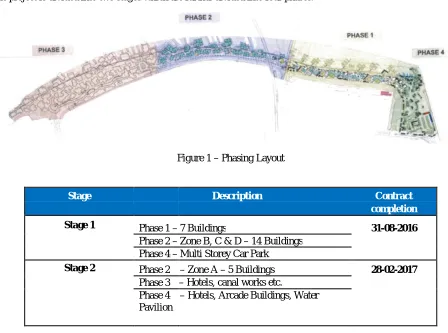
The project is divided into two stages which are further divided into four phases.
Figure 1 – Phasing Layout
Stage Description Contract
completion
Stage 1 Phase 1 – 7 Buildings 31-08-2016
Phase 2 – Zone B, C & D – 14 Buildings Phase 4 – Multi Storey Car Park
Stage 2 Phase 2 – Zone A – 5 Buildings 28-02-2017
Phase 3 – Hotels, canal works etc.
Phase 4 – Hotels, Arcade Buildings, Water Pavilion
Table 1 - Stage Completion Dates as per Primavera Schedule of Contract
IV. RESULT ANALYSIS
Contract. The document is issued as a Claim for an Extension of Time for Project Completion. Reimbursement of Prolongation, Disruption and Acceleration Costs will be addressed separately. This document will demonstrate the:
Cause of delays to progress;
Effect of delays upon progress of the Works, Claim justification through reasoned argument,
Entitlement under the Contract.DELAY
EVENT DESCRIPTION
STAGE MILESTONE BASELINE COMPLETION IMPACTED COMPLETION DELAY (CD)
DE04 Delay to PH3 Shoring
Stage 2
28-Feb-17
11-Mar-18
376
DE 03
Delay in PH4 works due to service
diversion
Stage 1
31-Aug-16
09-Apr-17
222
Stage 2
28-Feb-17
04-Oct-17
219
DE 08
Delay to Phase 2 & 3 due to
Concrete Walkway decks
Stage 1
31-Aug-16
04-Apr-17
217
Stage 2
28-Feb-17
28-Sep-17
213
DE-11
Delay due to Hybrid wall
Stage 1
31-Aug-16
07-Jun-17
281
Stage 2
28-Feb-17
02-Dec-17
278
DE-12
Delay due to Structural Steel
Decking
Stage 1
31-Aug-16
08-Aug-17
343
Stage 2
18-Feb-17
28-Feb-18
376
DE-14
Delay due to Cathodic Protection
Stage 1
31-Aug-16
29-Mar-17
211
Stage 2
28-Feb-17
14-Sep-17
199
DE-10
Delay in infrastructure due to
Design NOC’s
Stage 1
31-Aug-16
28-Jan-17
150
Stage 2
28-Feb-17
05-Apr-17
36
DE-09
Delay to Phase 4 due to late issue of
GFC DD
Stage 1
31-Aug-16
04-Jan-17
126
Stage 2
28-Feb-17
27-Jun-17
119
DE-13
Delay due to Precast beam and
hollow core slabs
Stage 1
31-Aug-16
01-Apr-17
214
Stage 2
28-Feb-17
05-Oct-17
220
DE-15
Delay due to late issue of Design
Information & Design NOC’s
Stage 1
31-Aug-16
06-Mar-17
188
Liability for the event:
The liability for the above delay events belongs to the Engineer/Client as the event triggered due to design change.
Contract Provisions:
The Contractor has notified the Engineer and sought Extension of Time for the Completion of Works based on the following provisions of Contract:
The Contractor is entitled to an extension of Time for the Completion of Works pursuant to the Conditions of Contract.
Statement of the claim :
Contractor hereby claims an Extension of Time and associated prolongation costs as follows:
343 calendar days on Stage 01 completion extending the baseline date from 31st August 2016 to 08thAugust 2017.
376 calendar days on Stage 02 completion extending the baseline date from 28th February 2017 to 11th March 2018.
V. CONCLUSION
Failure to provide good forensic schedule delay analysis is a leading cause of disputes, creating problems to resolve claims in a timely manner.
Timely and comprehensive forensic schedule delay analysis, accessible in a lucid and persuasive approach can offer thorough calculated evaluation of quantum and accountability which helps resolve conflicts & issues in early discussions/negotiations.
Forensic schedule delay analysis is not only imperative just in claims on concluded projects, but just as vital to resolve delays that have been engrossed into the schedule during the course of the project.
At whatever time a project delay causes a project to finish behind schedule, somebody spends funds; the Contractor pays liquidated damages expenses or the Owner pays extended conditions costs. The hefty values allied with these fees pooled with the complication of analysis makes forensic schedule delay analysis very essential.
The Challenges
Schedulers / Planners are often asked to classify and analyze delays and perform forensic schedule delay analysis devoid of having appropriate understanding of analysis methodologies and techniques.
Most Project Control professionals do not have prescribed training in forensic delay analysis.
Construction industry deals with complex projects which include large schedules & need powerful monitoring & controlling of the project. It is preferable to use Primavera software in construction projects. However this software requires an extensive training to understand & practical use.
Pro active advice for professionals associated with project management:
Insist on a CPM schedule.
Establish systems to ensure schedule is updated accurately. Integrate schedule into day to day operation of project. Integrate schedule review into project meetings.
Act immediately to halt source of delay and search for ways to mitigate while it is still possible. Make sure you accurately report status of activity, if incomplete, as of update to allow detection of
inefficiency or productivity issues. Make use of free float effectively.
Support all your work with evidence and exact citations from software used preferably PRIMAVERA.
Ascertain the Delay analysis methodologies to be used with approval of all the involved parties in case of claims and delay disputes.
All data, records, reports (manual and software based) should be accurately preserved for forensic delay analysis experts.
REFERENCES
1. Levy, S. M. (2006) ―Project Management in Constructionǁ, McGrawHill, USA.
2. NuhuBraimah, (2013) ―construction delay analysis techniques—A review of application Issues and improvement needsǁ Buildings 2013, civil engineering department , Brunel University.
3. Assaf, S., Al-Khalil, M., and Al-Hazmi, M. (1995). Causes of Delay in Large Building Construction 4. Ashley &Jaselskis (1987), Determinants of construction project success, Project Management Journal, Vol. 18
5. Wells J. (1986), The Construction Industry in Developing Countries: Alternative Strategies for Development. Croom Helm Ltd, London 6. Ruben I.M. &Seeling W. (1967), Experience as a factor in the selection and performance of project managers. IEEE Trans Eng Management,
Vol. 14 (3), pp. 131 – 134.
7. David B. Ashley, Clive S. Lurie, and Edward J. Jaskelskis ―Determinants of construction project success ― Project management Journal , Vol. 9, No.2 June 1987.
8. Alkass, S., Mazerolle, M., and Harris, F. (1996). ―Construction delay analysis techniques.ǁ Constr. Manage. Econom., 14, 375–394. 9. Winter, R. MS Project for Construction Schedulers. In Proceedings of the AACE International 55th Annual Meeting, Anaheim, CA, USA, 19–
22 June 2011.
10. Kim, Y., Kim, K., and Shin, D. (2005). ―Delay analysis method using delay section.ǁ Journalof Construction Engineering and Management, ASCE, 131(11), 1155-1164.
11. McCredie. J. (2002). Resolving Construction Disputes, The Forensic Accountant, Available: http//www.eotprotocol.com/press.shtml (Accessed 2004, May 20).
12. AACE International. (2007). Recommended Practice No 29R-03: Forensic Schedule Analysis, TCM Framework: 6.4 – Forensic Performance Assessment, AACE International, Inc.
13. Australian Government (2007). National Statement on Ethical Conduct in Human Research, October 2007 reprint. Australian Government, National Health and Medical Research Council, Australian Research Council.
14. Ward. P. (2006). “Suitability of the SOCL’s Protocol’s Provisions for Dealing with Concurrency on Australian Construction Projects”. Proceedings of the CIB W89 International Conference on Building Education and Research. Hong Kong. 10th – 13th April 2006