ABSTRACT
ZHAO, YUE. Lowering Knowledge Barriers for HPC: From Representations to Infrastructures and Acquisitions. (Under the direction of Xipeng Shen.)
With software becoming more and more complex and hardware evolving rapidly, tasks in the high performance computing (HPC) become increasingly complex. As a result, modern HPC development requires multiple levels of knowledge, ranging from application domain expertise to algorithms, numerical analysis, software systems, and computer architecture.
This thesis work examines HPC development from a knowledge engineering perspective, point-ing out that the essential barrier for modern HPC development is on how to effectively acquire, represent, accumulate, share and exploit HPC knowledge.
© Copyright 2018 by Yue Zhao
Lowering Knowledge Barriers for HPC: From Representations to Infrastructures and Acquisitions
by Yue Zhao
A dissertation submitted to the Graduate Faculty of North Carolina State University
in partial fulfillment of the requirements for the Degree of
Doctor of Philosophy
Computer Science
Raleigh, North Carolina
2018
APPROVED BY:
Min Chi Guoliang Jin
Chunhua Liao External Member
Huiyang Zhou
Xipeng Shen
DEDICATION
BIOGRAPHY
Yue Zhao was born in ShanXi, China. He earned his Bachelor’s degree in Information Engineering from the Shanghai Jiao Tong University in 2009 and his M.Phil. (Master of Philosophy) degree from the Hong Kong Polytechnic University in 2012.
ACKNOWLEDGEMENTS
First, I want to thank my advisor, Dr. Xipeng Shen, for his guidance and support throughout my Ph.D. studies. His academic advice and patience is essential to the completion of my Ph.D. degree. Moreover, his enthusiasm and attitude to the research sets a positive example beyond the completion of my Ph.D studies.
Next, I would like to thank the rest of my dissertation committees – Dr. Min Chi, Dr. Guoliang Jin, Dr. Chunhua Liao, Dr. Frank Mueller and Dr. Huiyang Zhou – for their time and effort to attend my exams. Their insightful comments and suggestions are important to this thesis.
My sincere thanks also go to Dr. Chunhua Liao, for his mentoring during my internship in the Lawrence Livermore National Laboratory and our collaboration.
I will not forget to extend my gratitude to Dr. George Rouskas, Ms. Kathy Luca and all others in the graduate school for their helps during my Ph.D study.
In addition, I would like to thank all other friends including but not limited to my group mates and colleagues for their help.
TABLE OF CONTENTS
LIST OF TABLES . . . .viii
LIST OF FIGURES. . . ix
I Prologue 1 Chapter 1 Introduction. . . 2
1.1 Motivation . . . 2
1.2 Overview of the Proposed Solutions . . . 3
II Ontology-based Knowledge Engineering for High Performance Computing 5 Chapter 2 Introduction to Ontology and Logic Programming . . . 6
2.1 Ontology . . . 6
2.2 Logic Programming . . . 7
Chapter 3 PATO - Program Analysis through Ontology . . . 10
3.1 Problem Statement . . . 10
3.2 Overview of the PATO System . . . 13
3.3 Challenges and Solutions . . . 16
3.3.1 Ontology Design . . . 17
3.3.2 Knowledge Generation . . . 19
3.3.3 Knowledge Utilization . . . 21
3.3.4 Framework Design and PATO . . . 22
3.4 Experience with PATO . . . 24
3.4.1 Canonical Loop Analysis . . . 24
3.4.2 Pointer Analysis . . . 27
3.4.3 Other Experience . . . 29
3.5 Related Work . . . 30
Chapter 4 OpenK - An Open Infrastructure for the Accumulation, Sharing and Reuse of HPC Knowledge . . . 32
4.1 Problem Statement . . . 32
4.2 Scope and Design Considerations . . . 35
4.3 Overall of the OpenK System . . . 36
4.4 Internals of OpenK . . . 39
4.4.1 HPC Knowledge Representation . . . 39
4.4.2 HPC Knowledge Submission . . . 41
4.4.3 HPC Knowledge Derivation . . . 42
4.4.4 Knowledge Quality Control . . . 43
4.5 Experience with OpenK . . . 45
4.5.1 Case I: Stencil Computation Optimizations . . . 45
4.5.2 Case II: Enabling Cooperations Among Software Tools . . . 48
4.5.3 Case III: GPU Data Placement . . . 50
4.6 Related Work . . . 53
III Knowledge Acquisition and Capitalization through Machine Learning 56 Chapter 5 Sparse Matrix Format Selection For SpMV. . . 57
5.1 Problem Statement . . . 57
5.2 Background . . . 58
5.2.1 Sparse Matrix Storage Format . . . 58
5.2.2 Convolutional Neural Networks (CNN) . . . 59
Chapter 6 Bridging the Gap between Deep Learning and Sparse Matrix Format Selection 62 6.1 Motivation . . . 62
6.2 Overview of the CNN based Solution . . . 64
6.3 Input Representations . . . 65
6.3.1 Representation from Traditional Methods . . . 65
6.3.2 Augmentation with Density Representation . . . 66
6.3.3 Distance Histogram Representation . . . 67
6.4 CNN Structure Designs . . . 68
6.4.1 Insufficiency of Common Structures . . . 68
6.4.2 Late-merging Structure . . . 69
6.5 Cross-Architecture Adaptations . . . 70
6.5.1 Concept and Two-fold Contributions . . . 70
6.5.2 Options Explored . . . 71
6.6 Evaluations . . . 72
6.6.1 Methodology . . . 72
6.6.2 Speedup . . . 75
6.6.3 Model Migrations . . . 76
6.6.4 Impact of CNN Structures . . . 77
6.6.5 Discussion . . . 78
6.7 Insights . . . 79
6.8 Related Work . . . 79
Chapter 7 Overhead-Conscious Sparse Matrix Format Selection . . . 81
7.1 Motivation . . . 81
7.2 Design Choices and Challenges . . . 83
7.2.1 Implicit Versus Explicit Treatment . . . 83
7.2.2 Challenges . . . 85
7.3 Overhead-Conscious Predictor . . . 86
7.3.1 Learning Method . . . 86
7.3.3 The Second-Stage Prediction and Feature Selection . . . 89
7.4 Evaluations . . . 91
7.4.1 Methodology . . . 91
7.4.2 Impact of the Overhead on Format Selection . . . 92
7.4.3 Performance Comparison of Primary Predictors . . . 93
7.4.4 Performance on Entire Applications . . . 95
7.5 Related work . . . 99
IV Epilogue 101 Chapter 8 Conclusions and Future Directions. . . .102
8.1 Conclusions . . . 102
8.2 Future Studies . . . 103
LIST OF TABLES
Table 3.1 Constraints in Andersen’s pointer analysis. . . 28
Table 4.1 The speedup of different optimizations. The stars (*) mark the ones suggested by the OpenK (size-1: 5123, size-2: 10242×512, CSE: common subexpression elimination). . . 48
Table 6.1 Hardware platforms used in the experiments. . . 72 Table 6.2 Prediction quality on Intel®CPU (bottom decimals show overall accuracies) . . 74 Table 6.3 Prediction results on the GPU platform. . . 75
Table 7.1 The full set of feature candidates of a matrix. . . 90 Table 7.2 Hardware platforms used in the experiments. . . 91 Table 7.3 The conversion (CSR to other formats) time normalized by a single SpMV on
CSR. . . 93 Table 7.4 The number of matrices that favor each of the formats in the conversion
LIST OF FIGURES
Figure 2.1 An example ontology on Robotics. . . 7
Figure 3.1 Overview of using ontology for program analysis. . . 14
Figure 3.2 Specification of a canonical loop (derived from OpenMP manual[Ope13].) . . 15
Figure 3.3 Top-level ontology for C program analysis. . . 18
Figure 3.4 Structure of PATO. . . 22
Figure 3.5 Time comparison of the canonical loop analysis. The X-axis shows the bench-mark names and their numbers of source-code lines. . . 27
Figure 4.1 Overall structure of OpenK. . . 36
Figure 4.2 Part of the HPC knowledge taxonomy. . . 40
Figure 4.3 An example of stencil computations. . . 45
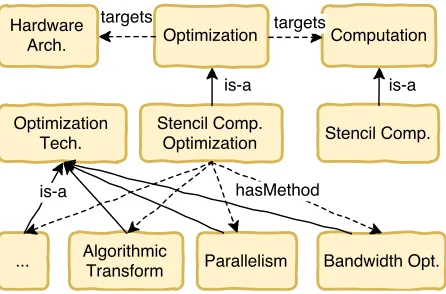
Figure 4.4 Part of the ontology of stencil computation optimizations. . . 46
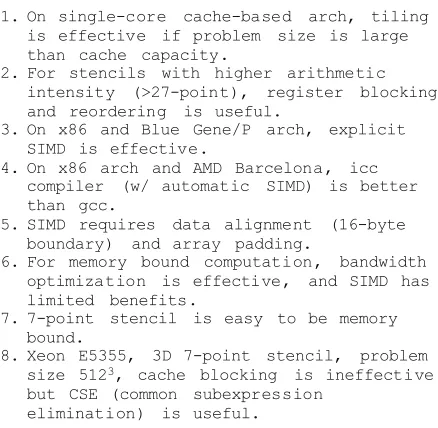
Figure 4.5 Some insights on optimizing stencil computations. . . 47
Figure 4.6 Enhancement of Liveness analysis by leveraging ontology to combine the results from the Liveness analysis in LLVM Clang and ROSE. (Dots show out-liers). Left bars: the enhancement over LLVM Clang results; right bars: the enhancement over ROSE results. . . 50
Figure 4.7 Part of the GPU hardware ontology. . . 51
Figure 4.8 Speedup of benchmarks on Tesla K20c. . . 54
Figure 5.1 Sparse matrix storage formats and their corresponding SpMV pseudo-code (adapted from[Li13]). . . 59
Figure 5.2 Illustration of CNN. . . 61
Figure 6.1 Overview of the model construction process. . . 64
Figure 6.2 Image scaling loses some subtle but critical information for matrices. . . 66
Figure 6.3 The density representation and histogram representation of the matrix in Figure 6.2(a). . . 66
Figure 6.4 Traditional CNN structure that merges the info from different channels at the early stage of the networks. . . 68
Figure 6.5 Proposed late-merging CNN structure. . . 69
Figure 6.6 Speedups from CNN over DT-based predictions. . . 76
Figure 6.7 Prediction accuracies of different retraining methods on a new platform (AMD®platform). (Accuracies at x=0 are without retraining.) . . . 77
Figure 6.8 CNN late-merging structure (layer shapes in parentheses). . . 77
Figure 6.9 Comparison of the loss function convergence for two different structural designs. . . 78
Figure 7.2 The histogram of the overall speedups of program
PageRank
when it uses a previous decision tree-based predictor with an idealized 100% accuracy (for minimizingTe in Figure 7.1). The annotated numbers indicate percentage of samples with speedup<1,=1,>1 respectively;<1 means slowdown. CSR is the default format. . . 83 Figure 7.3 The two-stage prediction system. . . 87 Figure 7.4 The comparison of speedups based onSpMVframe. The baseline is theper-formance on the default CSR format. . . 95 Figure 7.5 Feature ranking forTs p m v of DIA format. . . 96 Figure 7.6 Feature ranking forTs p m v of BSR format. . . 96 Figure 7.7 The histogram of the overall speedups of program
PageRank
when it usesPart I
CHAPTER
1
INTRODUCTION
1.1
Motivation
With software and hardware systems being more and more complex, modern HPC development is increasingly challenging. Tasks in HPC such as program analysis and optimization usually require multiple levels of knowledge ranging across software, hardware and domain expertise. However, there exists a barrier that hinder the full utilization of the wide range of HPC knowledge. This thesis points out that the essential barrier is on how to effectively acquire, represent, accumulate, share and exploit HPC knowledge. Therefore, the major focus of this thesis is on how to lower this barrier.
To address the problem, this thesis explores novel techniques in three aspects. First, this thesis proposes to leverage the knowledge engineering techniques to standardize and represent the wealth of information in the HPC community. Second, this thesis discusses the experience to construct the infrastructure to facilitate the knowledge management in the HPC domain. Last, this thesis shows that machine learning is a viable complementary approach for acquisition and capitalization of the HPC knowledge. It can be used to synthesize raw or semantically-enriched content to yield insights. With the sparse matrix format selection problem as a case study, this thesis inspects the special challenges and explores the essential techniques to bridge the gap between the machine learning and HPC tasks.
1.2
Overview of the Proposed Solutions
Knowledge engineering through ontology
In high performance computing (HPC), program analysis is fundamental for program optimization, debugging, and many other tasks. Developing program analyses is challenging and error-prone. To ease the program analysis, a promising methodology is the declarative program analysis. However, current declarative program analysis is subject to some critical limitations in supporting cooperation among analysis tools and guiding program optimizations. It also often requires much effort for repeated program preprocessing.
To break through these limitations, we leverage the ontology-centered knowledge engineering to standardize the definitions of concepts and the representation of the knowledge in the domain. As a result, we developed a prototype called PATO for conducting program analysis based on the ontology-based program representation.
Furthermore, for HPC applications, applying the right optimizations in the appropriate con-text often requires a wide range of knowledge about the domain, the software application and the hardware architecture. However, in today’s practice, such knowledge has been expressed and managed in an ad-hoc manner by each individual. With software and hardware evolving rapidly, such ad-hoc representation of the HPC knowledge becomes a barrier to accumulate and reuse the HPC knowledge.
As an attempt to lower the barrier, we propose the OpenK system as an open infrastructure for the systematic accumulation, sharing and reuse of the knowledge across the HPC domain. The foundation of the OpenK centers around the ontology-based knowledge engineering.
In Chapter 3 and Chapter 4, we discuss the challenges and solutions of designing the PATO system and OpenK system, respectively. Our experience with the two systems confirm the potential of ontology for complementing existing declarative program analysis, promoting cooperative analysis between compilers, and effectively guiding optimizations.
Knowledge engineering through machine learning – the case study of the matrix format selec-tion for SpMV
Sparse matrix vector multiplication (SpMV) is an important kernel in many applications and is often the major performance bottleneck. Among many optimizations, the storage format of sparse matrices critically affects the performance of the SpMV. The sparse matrix format selection problem is to determine the best storage format for a matrix to maximize the performance of the SpMV. However, due to the complex interactions between the SpMV application, the runtime system and other factors, this task is challenging for programmers.
empirically understand the complex systems. From the viewpoint of the knowledge engineering, however, there exists gap between the machine learning techniques and the effective knowledge acquisition and capitalization for the problem.
In Chapter 6, we present a systematic exploration on the promise and special challenges of deep learning for the SpMV format selection problem. We describe how to effectively bridge the gap between deep learning and the special needs of the HPC problem through a set of techniques on matrix representations, deep learning structures, and cross-architecture model migrations. The proposed solution cuts format selection errors by two thirds, and improves SpMV performance by 1.73×on average over the state-of-the-art work.
Previous studies on selecting the appropriate format for a given matrix have ignored the influence of runtime prediction overhead and format conversion overhead. For many common uses of SpMV, such overhead is part of the execution time and may outweigh the benefits of new formats. Ignoring them frequently makes the predictions sub-optimal and sometimes inferior. On the other hand, the overhead is difficult to consider, as it, along with the benefits of having a new format, varies from matrix to matrix, and from application to application.
Part II
CHAPTER
2
INTRODUCTION TO ONTOLOGY AND
LOGIC PROGRAMMING
2.1
Ontology
Ontology is a concept originating in Philosophy, referring to the study of the nature of being, as well as the basic categories of being and their relations[NM01]. In recent decades, it has become a branch in Information Science for representing the knowledge in a particular domain. In this context, an ontology is a formal explicit description of a domain’s knowledge, including concepts (or classes), properties of each concept (or relations) and individuals (or instances of classes)[SS13].
Ontology is embodied with a defined vocabulary, which users can take as the standard terminol-ogy to formally express the knowledge in that domain. The expression of a piece of knowledge can state explicitly the relations between these individuals and the classes defined in the ontology. An ontology or ontology-based expression can be visualized as Figure 2.1 illustrates. Each node in the graph represents a concept or instance, and each edge carries a property indicating the relations between the two nodes it connects. In Figure 2.1, the edge between “Robot” and “Arm” indicates that the latter is a part of the former.
Figure 2.1An example ontology on Robotics.
Framework (RDF) is a commonly used simple format of OWL for knowledge representation. Each piece of knowledge is represented as a triple,(subject, property, object). For instance,(“Tatooine”, instanceOf, “Planet”), states that “Tatooine” is an instance of “Planet”. Another popular variant is in the form ofproperty(subject, object). So the previous example can also be written asinstanceOf (“Tatooine”,“Planet”).
Developing an ontology for a domain has many benefits, including 1) making domain knowledge explicit to expose what is known and what is unknown, 2) enabling knowledge interoperability by providing a common taxonomy and vocabulary, 3) providing knowledge reuse since the ontology is a persistent knowledge base, and 4) facilitating knowledge validation and reasoning using existing inference engines (or reasoners).
Ontology has been used in the Semantic Web, software meta data management, Robotics, and some other fields outside HPC. The last several decades have witnessed some rapid development of ontology-related techniques. A large body of tools (e.g., Stanford Protégé[Gen03], SWI-Prolog Semantic Web Library[Wie12], and HermiT[Gli14]) have been developed for creating ontologies and automatic reasoning upon an ontology-based knowledge base, which enables automatic questions-and-answers, consistency check of the knowledge base, derivation of new knowledge, and so on.
2.2
Logic Programming
Listing 2.1Example of Prolog rules 1 reachable(X, Y) :- link(X, Y).
2 reachable(X, Y) :- link(X, Y), reachable(Z, Y). 3 % the following is a query
4 reachable(X, Y)?
ofaxiomsto describe a knowledge base. For instance, an axiomPerson(Alex)describes that “Alex” is an instance of class “Person”, andPersonwHumandescribes the subsumption relationship between conceptPersonand conceptHuman. DL languages could use different grammars. Conventionally, a simple yet uniform format to represent axioms is(subject, property, object)triple. Axioms in DL languages can all be mapped to such a format. For instance, inPerson(Alex), “Alex” is the subject, “instance of” is the property, and “Person” is the object. Visually, it is an “instance of” edge flowing
from the “Alex” node to the “Person” node in an ontology graph.
Through decades of development, a large body of tools (e.g., Stanford Protégé[Gen03], SWI-Prolog Semantic Web Library[Wie12], etc.) have been developed for creating ontologies and auto-matic reasoning upon an ontology-based knowledge base, which enables autoauto-matic questions-and-answers, consistency check of the knowledge base, derivation of new knowledge, and so on.
Like declarative program analysis, most of these tools leverage logic programming languages (e.g., Prolog) for inferences.
In Prolog, the program logic is expressed in terms of relations, represented as facts and rules, and a computation is a query over these relations. To begin, the basic concepts in Prolog are the termandatom. Term is the single data type in Prolog. It can be a constant or a variable1. Anatom is a predicate with a list of terms as the arguments. It has the form ofp(X1,X2, . . . ,Xn), wherep is a predicate symbol that represents some statement andXi are terms. Aground atomorfactis a predicate with all its arguments constant. In Prolog, atoms are a way to describe relations and a set of facts form an instance of database.
In addition, Prolog rules can express logical inferences. A rule is of the form
A: - B1,B2, . . . ,Bn.
which reads “B1andB2and ... andBnimpliesA”. The form also suggests how computation should be carried out as “in order to compute A, we first need to computeB1, ...”. The Prolog rule can describe recursive relations. As an example, List 2.1 shows the rule to compute thereachability relation between all pairs of nodes in a graph. The
link
defines a set of facts somewhere else.A Prolog program is a collection of rules, which can be applied to an instance of the database
(i.e., a set of facts). The results are the set of facts inferred by applying the rules.
The features that the Prolog can define recursive relations and recursive queries naturally make it well-suited for querying graphs and relational structures. Besides, the high level abstraction capability and the simple syntax help rapid prototyping the complex analysis system. In our problem, we can describe the logical semantics of the operations in the dataflow model as facts or rules, and the analysis algorithm as the logic inference rules.
CHAPTER
3
PATO - PROGRAM ANALYSIS THROUGH
ONTOLOGY
3.1
Problem Statement
Program analysis[Nie04]is a common way for deriving various properties of a program from its code. It is fundamental for many aspects of modern computing, including program optimizations, vectorization and parallelization, performance or correctness bug identification, task scheduling, and so on.
There are mainly two ways to implement a program analysis. A traditional way is imperative, in which, thousands of lines of code (often in some imperative programming languages) is developed based on some compiler framework for analyzing program constructs, types, control or data flows to infer certain properties of the target program. Programmers typically need to go through some steep learning curve about the structure and internal details of a complex compiler, while the results are often unsatisfactory: The code is often difficult to maintain, and bugs are common[Yan11]. The analysis, being specific to a particular compiler, is hard to extend, to compose, or to reuse for other compilers.
that govern the relations or properties of interest. Some automatic tools can then automatically do the inferences over a certain representation of some relations in the target program to find out the wanted relations or properties of the program. Experiments have shown that, with this approach, the code size of a program analysis often reduces by orders of magnitude compared to the imperative approach, and the analyses become easier to maintain and extend[BS09]. Moreover, with the sub-stantial improvement in optimizations of the logic processing engines (e.g., bddbddb[Wha05]and numerous optimizations to inference engines[Wie12]), the performance and scalability concerns of declarative program analyses have been largely resolved.
To further improve this promising paradigm of program analysis, particularly, we need to inves-tigate solutions to three most important limitations of the current declarative program analysis:
• Cooperations.By expressing the analysis at a high level, different analysis tools could po-tentially reuse an analysis, and different analyses could get composed together into a more sophisticated analysis. However, in practice, these benefits have been difficult to achieve in general, due to the differences in the analysis-specific representations of programs and relations. In one analysis, the domain may be variable names and heap addresses, and the relation may be “assigning one address to a variable”; in another analysis, the domain may be expressions and the relation may be “calculated before a program point”. To compose the two analyses, the variable names and heap addresses in the first analysis may have to be mapped to the expressions in the second domain, which would require much code development (likely entwined with the code in the compilers), especially if the two analyses were developed by different users based on different compilers that use different intermediate representations (IRs).
• Optimizations.So far, explorations of declarative program analysis have been focused on understanding program behaviors (largely for the purpose of debugging), for which, program-level knowledge has been enough. It is, however, insufficient for another important purpose of program analysis, guiding program optimizations. For the multi-facet dependence of perfor-mance, program optimizations often need knowledge from various sources: the program itself, the hardware, the algorithms, the program input datasets, and various domain-specific or problem-specific knowledge. Consequently, to provide useful optimization guidance, declara-tive program analysis must support the representations of the various kinds of knowledge, and allow easy linkage among them, even if the various kinds of knowledge may come from different sources. The analysis-specific nature of the current declarative analysis designs offers poor support to these needs.
the productivity benefits of this approach: As it is usually tightly coupled with some compiler framework, it is tedious and error-prone to develop. What makes this especially problematic is that different program analyses oftenuse different relations or ways to define the same or similar relations. As a result, preprocessing needs to be developed for almost every newly
de-veloped program analysis, seriously throttling the productivity benefits of declarative program analysis.
In our work, we advocate using Ontology-based knowledge engineering to address the three limitations all together. Our proposal comes from the observation that all the three major limi-tations essentially stem from a single fundamental shortcoming in current declarative program analysis: the lack of a systematic conceptual framework to govern the definition, representation, and organization of the various kinds of knowledge (relations in a program, rules, domains, hardware configurations, etc.) related with program analysis. The ad-hoc analysis-specific approach used in today’s designs of declarative program analysis is the fundamental reason for the much effort required for preprocessing, and the barriers for supporting cooperations and optimizations.
The key idea in our proposal is to leverage ontology to help standardize the definitions of domains, relations, and other concepts in program analysis, and to establish a single flexible repre-sentation of program constructs as well as other kinds of knowledge related with program analysis and its usage. With that, knowledge from various sources may be linked seamlessly as long as they follow the standardized representation. Sharing the same conceptual framework and set of terminology, different program analyses will be easy to compose and inter-operate together. The standardization will also make it possible to develop a single comprehensive database of the re-lations of a program to serve for various program analyses, removing the needs for the separate development of preprocessing for each analysis.
Ultimately, it would be desirable to establish a standard Program Analysis ontology to describe programs, analysis, and related concepts—liken how the Semantic Sensor Network ontology by W3C[Com12]facilitates the work in the sensor network domains. Reaching that goal would require the coordinated effort from the community and goes beyond the scope of this paper.
This work first focuses on the following four-fold objectives:
• To introduce the idea of integrating ontology into program analysis, and explain the concept ofontology-based program analysisand its potential benefits.
• To investigate the feasibility of having a single representation of a program in ontology to facilitate various program analyses and hence reduce the much effort for developing program preprocessing as required in current declarative program analysis.
program optimizations.
• To confirm the benefits of ontology for facilitating easy cooperations of different analysis tools.
To reach the four objectives, we have developed a prototype framework named PATO (which stands for Program Analysis Through ontology). In this prototype, we explore the use of several principles to define a concept-proof ontology for C program representations. Based on it, we have developed five program analyses: canonical loop analysis, pointer analysis, control flow graph construction, data access pattern analysis, and GPU data placement guidance. These analyses differ in domains, relations, scopes, and intended usage. Our experiments show that a single ontology-based representation can successfully support all these analyses (without separate preprocessing per analysis). The analyses inherit the productivity benefits of declarative program analysis, reducing the lines of code by tens of times compared to imperative implementations. Using the liveness analysis on two compilers (ROSE[Ros]and LLVM[LA04]), we confirm the benefits of ontology for promoting cooperations among different analysis tools. And using GPU data placement optimization, we demonstrate the seamless linkage of various sources of knowledge (programs, domain experts, and hardware) enabled by ontology, and reveal the potential of ontology-based program analysis for guiding program optimizations.
3.2
Overview of the PATO System
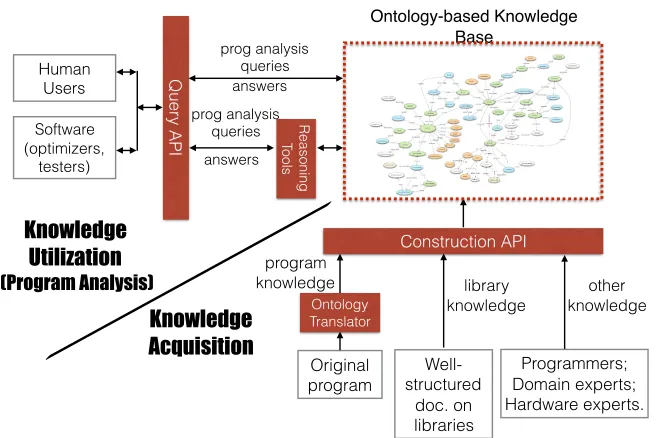
By offering a generic way to represent the knowledge in a domain, ontology simplifies the accumu-lation and share of various kinds of knowledge among people or software agents. At the same time, it allows automatic analysis and utilization of knowledge through high-level declarative logic pro-gramming, thanks to its description logic foundation. These properties make it potentially valuable for facilitating program analysis which is essentially about reasoning about the knowledge related to a program.
Original program Ontology Translator Construction API Programmers; Domain experts; Hardware experts. Human Users Quer y API Software (optimizers, testers) Reasoning Tools prog analysis queries answers answers other knowledge program knowledge Knowledge Utilization (Program Analysis) Knowledge Acquisition Ontology-based Knowledge Base Well-structured doc. on libraries library knowledge prog analysis queries
Figure 3.1Overview of using ontology for program analysis.
Built upon description logic, ontology-based program analysis keeps the conveniences of declar-ative program analysis. Rather than writing thousands of lines of code inside a complex compiler, users can simply write some logic queries about the kind of properties (e.g., which loops are canoni-cal loops) of the program that they want to know. These queries should follow some ontology query APIs. The APIs will then return the answers that are automatically obtained from the ontology-based knowledge base. For complex queries, it can leverage many existing ontology reasoning tools[Wie12; TH06]. Users of the ontology-based knowledge base can be humans or software agents (e.g., tools for program optimizations or testing.)
We use canonical loop analysis to illustrate how the idea of ontology-based program analysis works. A canonical loop is a type of well-structured loop conforming to specifications as shown in Figure 3.2. Because of its regular structure, it has been the focus of many studies on parallelization and loop optimizations[Kan99; Lia10; DM13].
The goal ofcanonical loop analysisis to recognize whether a loop is in a canonical form. Tra-ditional implementations of the analysis (e.g., the implementation in the ROSE compiler[Ros]) contains hundreds of lines of code for examining the IR of a loop. The code is tied to a particular internal data structure of the chosen compiler, hard to port to another compiler or maintain.
Figure 3.2Specification of a canonical loop (derived from OpenMP manual[Ope13].)
Listing 3.1Example C code fragment
0 // s.c 1 int a = 0; 2 int foo() {
3 for (int i = 0; i < 10; i++) {
4 a = a + i;
5 }
6 return 0;
7 }
over some intermediate representation of the whole program, which may need the development of thousands of lines of code. For example, in the ROSE compiler[Ros](a source-to-source compiler broadly used in High Performance Computing), the pass works on an Abstract Syntax Tree (AST). To analyze the code at that level, a programmer needs to implement many lines of code written in procedural languages (C/C++). The canonical loop analysis in the ROSE compiler consists of 380 lines of source code for examining the representations of the structure of each loop and check them against the conditions in Figure 3.2.
Listing 3.2Sample ontology for C snippet (“x rdf:type y” indicates thaty is the type of the code segment in the rangex)
1 (’3:1,5:1’, rdf:type, ’ForStatement’) 2 (’3:6,3:14’, rdf:type, ’VariableDecl’) 3 (’3:6,3:10’, rdf:type, Variable’) 4 (’3:1,5:1’, ’hasForInit’, ’3:6,3:14’) 5 (’3:1,5:1’, ’hasForTest’, ’3:17,3:22’) 6 (’3:1,5:1’, ’hasForIncr’, ’3:25,3:27’) 7 (’3:1,5:1’, ’hasBody’, ’3:30,5:1’)
and ending positions of a language construct in the source code. (Next section explains the triples in the example in details.) The different program constructs can be easily extracted by Prolog queries like those in Listing 3.3.
Listing 3.3Sample analysis rules
1 isForStatement(Loop)
:-2 rdf(Loop, rdf:type, c:ForStatement). 3 hasForInit(Loop, InitExpr)
:-4 rdf(Loop, c:hasForInit, InitExpr).
Allowing the use of logic programming, ontology-based program analysis inherits the productiv-ity benefits of declarative program analysis. More importantly, it overcomes the three aforemen-tioned shortcomings of existing declarative program analysis by leveraging ontology for standard-izing the concept definitions in a domain and the flexible representation of various sources of knowledge.
3.3
Challenges and Solutions
3.3.1 Ontology Design Challenges
To create an ontology for any domain, the first primary task is to define the vocabulary to be used in the domain. That includes the definition of the concepts, properties, and restrictions in the domain. These definitions establish the conceptual terms and their relations of the ontology-based knowledge base for the domain. Even though there are some de facto procedures on designing an ontology[NM01], program analysis has some special challenges. Program analysis has a large variety of tasks (e.g., loop analysis, data access pattern analysis, alias analysis, dependence analysis, liveness analysis, busy expression analysis, etc.) involving a huge set of diverse concepts and relations. Even a larger variety exists in the input programs. So the first question to use ontology for program analysis is how to design an intuitive, efficient and flexible ontology that can facilitate the various program analyses and input programs.
Solutions
In this work, we focus on the design of ontology for representing programs of a particular pro-gramming language (C). The design of the complete ontology of program analysis is left to future work.
Through our explorations, we have found the following three principles helpful.
• Language standard-oriented design.When designing the vocabulary of an ontology, it helps if one starts with reusing language constructs and their categorizations defined in the standard of the programming language of the target programs. Despite the variety of the input programs, they are all artifacts following the particular programming language. With the constructs and their categorizations of the programming language covered, we can easily express programs using the language in the ontology-based knowledge base. This approach helps achieve a good coverage of the input programs with a vocabulary familiar to users. For example, to model C programs in an ontology, we followed the standard of C99 and enumerate all program constructs and concepts in a top-down fashion. Figure 3.3 shows a fraction of the top-level ontology for C programs. The main concepts in the domain include variables, expressions, statements, and so on. The “construct” on the edges indicate these vocabularies are the basic constructs in the C program domain.
Figure 3.3Top-level ontology for C program analysis.
and encode semantic meanings into concepts whenever possible. That allows the possible use of a small set of properties and their combinations to express a large number of possible properties in a program. For example, when describingan identifier has static storage class, one approach is to define a propertyhasStaticStorageand use it like(someVar hasStaticStorage true). Alternatively, we may define the conceptStorageas a class and use a simpler property hasStorageas(someVar hasStorage static), wherestaticis a member ofStorage. There are several benefits for this second choice. First, using generic properties makes the set of property vocabularies small and thus easy to manage. For example,hasStorageis used to describe all storage classes instead of creating specific properties for each storage class. Second, stripping semantics from property make writing logic rules more flexible. For example, the knowledge of(someVar hasStorage static)can be queried by the keywordhasStorage. Otherwise, users may need to use many specific keywords ashasStaticStorage,hasExternStorage, and so on.
• Continuous enrichment.In our exploration, we find that continuous enrichment of the on-tology vocabulary can be helpful. For instance, in a canonical loop analysis, a user gives the description of the concept of a canonical loop. If that concept turns out to be needed fre-quently (by many users), the concept could then be integrated into the ontology framework to save the need for repeated descriptions. Given that the program analysis ontology is intended to be used by a community, a complexity is that different users may use different names for a single user-defined relation (e.g., canonical loop), making the detection of the repeated use of a user-level concept difficult. Ontology-based logic reasoners come in handy. As the descrip-tions of user-defined reladescrip-tions all use the vocabulary in the same ontology, the reasoners can easily do a logic reasoning on the descriptions to decide whether two user-defined relations are equivalent. After recognizing the frequently needed user-level concepts, such concepts can be added into the standard ontology for future reuse.
3.3.2 Knowledge Generation Challenges
Building up a knowledge base is essential for any application of ontology. For program analysis, the knowledge base shall include the important knowledge related with the to-be-analyzed program. There are several main questions to answer.
• Ontology converter.How to construct an ontology converter that can automatically convert a given program into the ontology representation needed by many common program analyses.
• Naming.A program may contain functions, statements, expressions, variables, and so on. Any of them may appear many times in different locations. A challenge is what naming scheme the ontology should use to reference each reference to avoid ambiguity.
• Mapping.One of the objectives of ontology-based program analysis is to facilitate the cooper-ations among different compilers and other program analysis tools. A difficulty is that they may have different internal representations of a program. To make them able to interact based on the program ontology, the instances of program constructs in the knowledge base should be possible to map to some common ground meaningful to the different tools. One intuitive choice of such common ground would be the source code of the program. That will also make it easy for human to collaborate with program analysis tools. A complexity in using source code for references is how to make the naming robust to code changes.
• Space.The knowledge about a program can be tremendous. Besides the basic knowledge directly driven from the program, there could be many other kinds of higher-level knowledge such as canonical loops, data dependences among statements, and so on. The higher-level knowledge is derivable from the lower-level knowledge. The derivation through reasoning may take non-trivial time. But if all this knowledge is saved in the knowledge base, the space cost could be large. How to strike a good balance is important for practical usage of this new program analysis paradigm.
Solutions
We come up with the following solutions to these challenges.
constructs are represented as individuals (i.e. instances) of some of the classes defined in the language ontology. Relations between them are represented by properties.
• Naming and Mapping.In our naming scheme, we borrow theinternationalized resource iden-tifiers (IRIs)[Hit09]that OWL uses. It helps avoid name conflicts. For the ontology of C program language, names of concepts are built directly from the corresponding terms used in the C lan-guage standard1. For example, the concepttypeis referenced asc:Type. An example IRI for the concept of types in a C program domain can look like “http://example.com/owl/CProgram:Type”. Some aliases can be defined as short names for the prefix strings of a domain.
More care needs to be taken for designing the naming scheme for representing the instances of a program construct. Named constructs such as types, variables, functions can use the C++qualified name concept to uniquely identify them. For an unnamed construct (e.g., an assignment statement) or a reference to named construct (e.g., variable reference), a com-mon intuitive approach is to use its location in the source code of the program, such as file url,start location,end locationwhere the location is a pair of (line number,column num-ber). For instance, “http://my.com/file1.c, 3:1, 5:1” could refer to a loop that spans from the beginning of the third line to the beginning of the fifth line of file1.c. The problem with this scheme is that some minor changes to the original program may invalidate all the names of the constructs after the modification point.
We findscoped IRIuseful to restrict the impact of a code change to the names. Inscoped IRI, a name is composed of some qualified names and some relative locations in the source
code. For constructs like functions, structures, global variables, we add their scopes before their names. Other constructs within these constructs are named by their locations, while the line numbers are relative to the start line number of their surrounding constructs rather than the beginning of the source-code file. Using this method, a global variable declared in the first line of a file “s.c” (from column 5 to 6) can be named ass.c::1:5,1:6, while a variable declared on the first line inside a function foo in file “s.c” (from column 6 to 10) can be named ass.c::foo()::1:6,1:10. Thus, if there is some change of the code, only the names in the same scope as the changing point is need to be updated.
• Space.To address the space challenge of putting everything into a knowledge base, we split the knowledge base into a core knowledge base and multiple loadable supplemental knowledge bases. The core knowledge base is always loaded and others are loaded as needed. We also design a cache-like management mechanism to alleviate the problem. It maintains a buffer to store derived supplemental knowledge. When the upper limit of the buffer gets reached, it starts to evict some of the stored knowledge (which would need to be rederived when
needed). For the eviction policy, there can be multiple choices: least-recently-used (LRU), least-frequently-used (LFU), and their variants.
3.3.3 Knowledge Utilization Challenges
Some challenges also exist in the utilization of the knowledge base for program analysis.(1) Efficiency. In many cases (e.g., analyzing a large program), the runtime efficiency of conducting a program analysis could be important. A question to answer is whether the improved productivity of the new paradigm hurts the runtime efficiency and if so, how to improve the efficiency.(2) Generality.Using declarative programming languages could be awkward for some usage cases, especially when they involve some mathematical computations. Such cases however do exist in some program analysis and optimizations, for instance, when they relate with some performance models (an example is the data placement optimizations Section 3.4 will describe). Effectively overcoming such limitations is important for the general applicability of ontology-based program analysis.
Solutions
We address these issues by both creating some shortcuts and leveraging the features of existing ontology tools.
• Efficiency.Recent years have seen some significant improvement of the performance of logic reasoners[TH06; Bas06]. Many optimizations have been developed. For instance, in SWI-Prolog, the ontology is stored as relation triples of(subject property object)with C extensions and some indices are built for each element in the triples. So a search of a particular element can be done in constant time. Additional optimizations can be applied to queries. For instance, Prolog provides thecutoperator (i.e., the ! symbol) to avoid unwanted backtracking in search. We find that following some existing guidelines when writing queries[Bra01]can be quite helpful for quickly narrowing down the reasoner’s search space.
In scenarios where the relevant knowledge base is simple and consists of straightforward facts in triples (e.g., some memory configurations), one may construct a customized lightweight parser in high performance languages, which can further help achieve good performance than going through a heavy-weight logic reasoner.
special ontology entity that can attach procedures to some classes or properties. When the deduction rule queries the individuals of one of the classes or the properties, the associated procedures are invoked to compute individuals for the target class or property. The procedure can be written in a wide range of programming languages (e.g., C, C++, Python).
Besides allowing the direct input of queries by users written in logic programming languages, ontology-based program analysis also allows queries coming from a third-party software (which could be written in even imperative languages like C, C++or Java.) For such cases, the ontology can be processed with libraries for those languages (e.g., the OWL API[HB11] or Prolog interface to foreign languages[BC02]). That offers the conveniences for existing software tools (e.g., a compiler) to easily leverage ontology for program analysis.
3.3.4 Framework Design and PATO
The final challenge is how to organize the various components together into a unified framework for program analysis. It includes choosing the DL language and the reasoner that suit the needs of program analysis, designing and implementing the APIs for both knowledge base construction and queries, and integrating all the components together into a complete cohesive framework that offers effective support to various program analyses.
Protege
Direct query interface
Computables
Semantic weblib
Prolog
reasoning engine
PATO
API
Parser w/ scoped IRITranslator users/
software
program
user
Use
Build
Knowledgebase in memory (Prolog internal
store)
Knowledge base in OWL
files
w/ computables
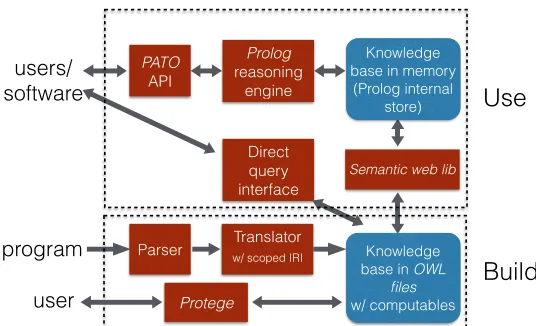
To answer these questions, we have developed a prototype framework named PATO, which integrates all the aforementioned solutions to the various challenges, and leverages the power of existing ontology tools.
Figure 3.4 outlines the main components of PATO. The knowledge base in PATO can be in two forms, represented by the two round-corner boxes on the right part of the figure. On the disk, the knowledge is stored as OWL files. Each entry in the files is in an OWL triple(subject, property, object). For instance,(var1, hasValue, 0)means a variable has a constant value of 0. The reason for selecting this form is that OWL triple is one of the standard (and space-efficient) formats for ontology representations and is accepted by many ontology tools. Another part of the knowledge base is thecomputables, which are attached to the concepts and properties in the triple collection. The cache-like buffering mechanism is used for the space efficiency of the knowledge base.
Two of the primary ways to add knowledge into the knowledge base are shown at the bottom of Figure 3.4. In the first way, there is a parser (based on ROSE[Ros]) for converting an input program code into an AST preserving source level information. We have also developed a translator that translates the basic program knowledge on the AST into OWL triples and stores them into the knowledge base. During the translation, the translator uses the scoped IRI as the naming scheme. In the second way, we adopt Stanford ProtÃl’gÃl’[Gen03], an interactive tool for ontology creation and manipulation. Through its GUI, a user can intuitively add entries into the knowledge base. The plugins of ProtÃl’gÃl’ also provide many other features to the users, such as visualization, validation, and querying.
There are two ways to use the knowledge base. The first is shown at the top of Figure 3.4. It is through the SWI-Prolog reasoning engine. To use the knowledge base in this way, at the beginning, the OWL files are loaded into memory; through it, the OWl files are converted into an internal knowledge base through the existing Semantic Web Library[Wie12]. The in-memory organization of the knowledge base features some efficient indexing schemes. When seeing a query from a user or software agent, the Prolog engine would start working on the internal knowledge base to provide the answers. Prolog provides a general interface for input logic rules and queries. We have further developed a higher-level set of API tailored to represent some common terms used in program analysis tasks (e.g., loops, functions, etc.), through them, the users may write even more concise descriptions.
knowledge (e.g., derived in a previous program analysis) into the knowledge base.
It is worth noting that the rich set of available tools on ontology proves helpful in our devel-opment and usage of PATO. Besides the aforementioned usage of ProtÃl’gÃl’[Gen03]for ontology development, we find the FaCT++reasoner[TH06]helpful for checking the consistency of the ontologies, the Prologysemweblibrary[Wie]useful for loading, parsing, and manipulating ontology-based knowledge bases, and the Prolog engine[Wie12]a convenient tool for inferences upon the knowledge bases.
3.4
Experience with PATO
This section describes our experience of using PATO for program analysis. To examine the feasibility of using a single ontology to support multiple different program analyses efficiently, we implement five types of program analysis on PATO: canonical loop analysis, pointer analysis, control flow graph construction and data access pattern analysis. They differ in domains, relations, scopes, and intended uses.
For the interest of space, our description concentrates on the canonical loop analysis, the pointer analysis. We briefly cover the other analyses and the GPU data placement experiment at the end. Without noting otherwise, each reported timing result is the average of 10 times of repeated measurements collected on a machine equipped with Intel Core-i5 CPU of 3.2GHz (8GB DRAM, 500Gb HDD hard drive) running Ubuntu 14.04. For the results that show large variances, we also report the statistics on the variances. The Prolog used is SWI Prolog, and the primary compiler is the ROSE compiler (EDG 4x-Based versoin)[Ros].
3.4.1 Canonical Loop Analysis
We first explain the Prolog code for canonical loop analysis. As mentioned earlier, canonical loop analysis (CLA) checks whether a loop is in a predefined canonical form. Our experiment uses thecanonical loop formdefined in the OpenMP specification[Ope13], shown in Figure 3.2. The specification of an OpenMP canonical loop can be written as declarative Prolog rules as shown in Listing 3.4. We use italic font to distinguish variable from normal symbols.
Listing 3.4Prolog specification of an OpenMP canonical loop (italic upper-case for variables, lower-case for properties)
1 % top level rule to find canonical loop 2 canonicalLoop(Loop)
:-3 isForStatement(Loop), !, %’!’ prevents backtracking 4 hasForInit(Loop, InitExpr), %’,’ means logic AND 5 canonicalInit(InitExpr, LoopVar),
6 hasForTest(Loop, TestExpr), 7 canonicalTest(TestExpr, LoopVar), 8 hasForIncr(Loop, IncrExpr), 9 canonicalIncr(IncrExpr, LoopVar), 10 (
11 hasType(LoopVar, ’IntType’); %’;’ means logic OR 12 hasType(LoopVar, ’PointerType’)
13 )
14 hasBody(Loop, ForBody), 15
16 % supportive rules to find canonical init-exp 17 canonicalInit(Init, LoopVar)
:-18 hasOperator(Init, AssignOperator), !, 19 hasLeftOperand(AssignOperator, VarRef), 20 referTo(VarRef, LoopVar),
21 hasRightOperand(AssignOperator, LB). 22
23 % rules with same heading: combined using logic OR 24 canonicalInit(Init, LoopVar)
:-25 hasVarDecl(Init, LoopVar),
26 hasInitializer(Init, Initializer), 27 hasValue(Initializer, LB),
triples. ThencanonicalInit(InitExpr, LoopVar)checks if the found initial expression individuals conform to the language specification. The query also returns the loop variableLoopVarif it can find it.
The analysis further checks whether the loop’s init construct conforms to the specification. The first rule handles thevar = lbstyle while the second rule deals with other styles. Different rules with the same head name form the logic disjunction (OR operation). Thecutoperator (i.e., the ! symbol) is used to prevent unwanted backtracking. It means that, as long as the first rule matches the formhasOperator(Init, AssignOperator), there’s no need to check the second rule of the variable declaration form. Line 11 to 12 are the rules to do the type checking of loop variables. The(;)means logic disjunction (equivalent to two separated rules).
The ontology in PATO successfully supports the analysis. We compare it with the imperative implementation in the ROSE compiler. The algorithm in ROSE traverses the AST tree of a program to findforstatement nodes and check whether their sub-tree are in the canonical form. The code is written in C++and is specific to the ROSE AST’s internal data structures. The time complexity is O(n), wherenis the number of AST nodes.
The code length of PATO-based analysis is about half of the imperative implementation in the ROSE compiler (190 versus 380 lines). We use the NAS Parallel Benchmarks (NPB)[Bai91]for the measurement.
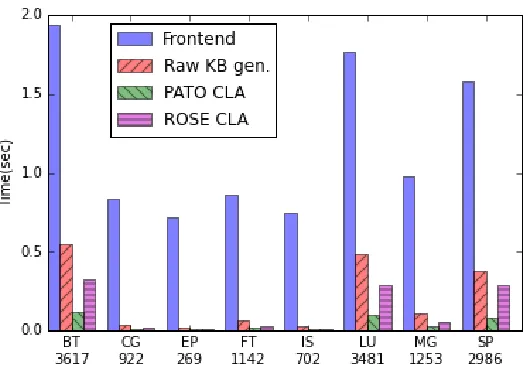
The results are shown in Figure 3.5. The frontend time corresponds to the parsing time of the parserin Figure 3.4. PATO uses the same frontend as the ROSE implementation. The time of program knowledge generation (KB gen) represents the time taken by the ontology translator in the PATO framework. Finally, the other two bars are the time of the canonical loop analysis with PATO and ROSE respectively.
For the canonical loop analysis alone, we can see that the PATO declarative approach even beats the native implementation for most cases. It is slower only when the line number is small. One reason is that the ROSE’s imperative implementation traverses the whole AST tree to find all for loops. For PATO’s declarative implementation, theisForStatementrelation information is stored explicitly and can be efficiently accessed by the hash-indexed keyword implementation of Prolog. The ontology-based declarative analysis does have an obvious overhead: It needs an extra step to traverse the AST tree and build the initial knowledge base. However, as shown in the figure, the overhead is smaller than the frontend time. Besides, for the PATO system, the generated knowledge base can be reused for different program analyses (e.g., control flow graph analysis).
Figure 3.5Time comparison of the canonical loop analysis. The X-axis shows the benchmark names and their numbers of source-code lines.
own random access iterators. A conventional solution to extend an imperative CLA implemen-tation is to store the known random access iterators, including the custom-defined ones, into a container for the compiler implementation to look up. The ad-hoc solution imposes barriers for exchanging the knowledge with other tools or developers. In PATO, adding such a support is simpler. One can easily add the conceptRandomAccessIteratorin the ontology and define it as is-a(Iterator)∧has(RandomAcess). The knowledge ofis-a(Iterator)property can be gained by the knowledge builder while the knowledgehas(RandomAcess)can be inserted into the knowledge base using the standard OWL API, either automatically by tools or manually by developers. The analysis rules can then reason about random access iterators. The resulting ontology can be then shared and reused by different analyses.
3.4.2 Pointer Analysis
This part describes our experience in implementing Andersen’s pointer analysis in PATO. Andersen’s pointer analysis is a well-known inclusion based analysis[And94]. The analysis result is typically represented as the points-to setpts(x)for each pointer variable x. It is flow-insensitive and does not distinguish different program execution points but computes what the pointers may refer to at any time of program execution.
illustrated in Table 3.1 (for C programs).
The analysis consists of two steps. The first step preprocesses the target program to produce a simplified intermediate representation, which keeps only the statements that involve pointer manipulations. Each kind of the assignments involving pointers is represented with a special no-tation. For example,p=&b is represented asstackLoc(p, b),p =m a l l o c(...)is represented as h e a p L o c(p, ...),p=∗p p becomesload(p, pp), and∗p p=qturns intoload(pp, q).
The second step propagates the points-to relations based on those constraints and solves the problem by computing graph transitive closures through an iterative worklist algorithm[And94].
Table 3.1Constraints in Andersen’s pointer analysis.
Constraint type Statement Propagation rule Base p=&b l o c(b)∈p t s(p) Simple p=q p t s(p)⊇p t s(q)
Complex p=∗p p ∀v∈p t s(p p)·p t s(p)⊇p t s(v) Complex ∗p p=q ∀v∈p t s(p p)·p t s(v)⊇p t s(q)
In our implementation on PATO, the preprocessing step is done on the program ontology representation through some simple pattern matching rules. For example, the address taken pattern (p=&b) is matched by the following:
Listing 3.5The Prolog rule to match the address-taken instruction
1 matchAddressTaken(RHS) :- hasOperator(RHS, AddressOp), 2 hasOperand(RHS, LocRef), referTo(LocRef, Var).
The implementation breaks complex statements into simple ones by introducing temporary vari-ables. For example,∗p =∗q becomest m p =∗q;∗p = t m p. Structures are analyzed in a field-sensitive manner, while an array is regarded a single data object as done in most previous stud-ies[And94; HT01; BS09].
For the analysis step, the propagation rules in Table 3.1 can be directly mapped into logic rules in Prolog as shown in Listing 3.6.
However, our experiments show that Prolog inferences based on these rules are not efficient. It evaluates the rules in a top-down manner with deep recursions and costly search through a large space. Inspired by previous work[BS09; Wha05], we instead implement the classic worklist algorithm in Prolog as illustrated as follows:
Listing 3.7The worklist algorithm for pointer analysis in Prolog
:-Listing 3.6The Prolog rules for the points-to computation 1 % p = &a; p = malloc()
2 pointsTo(P, Loc) :- stackLoc(P, Loc); heapLoc(P, Loc). 3 % p = q
4 pointsTo(P, X) :- copy(P, Q), pointsTo(Q, X). 5 % p = *pp
6 pointsTo(P, X) :- load(P, PP), pointsTo(PP, V), pointsTo(V, X). 7 % *pp = q
8 pointsTo(V, X) :- pointsTo(PP, V), store(PP, Q), pointsTo(Q, X).
2 select(WorkList, V), 3 propLoad(V); propStore(V);
4 propFieldLoad(V); propFieldStore(V); 5 propEdge(V),
6 andersenPtr. % itratively execute the analysis 7
8 propLoad(V) :-9 load(P, V),
10 pts(V, A), % for each A in pts(V)
11 (\+ edge(A, P) -> assertz(edge(A, P)), add(WorkList, A)). 12 % others are omitted
Line 11 in the listing means that as soon as Prolog finds out that there is no edge from A to P, it stops search and instead add A into the worklist and continue with nextA’inpts(V, A’). The use of→ enables an early stop of useless searches, bringing large performance benefits.
The entire implementation takes less than 500 lines of code, about 300 lines of which are for the preprocessing step. When being applied to the NPB benchmarks, the analysis takes no more than 2 seconds on a program. We have also applied the analysis to three programs[Mor]with more pointer operations: bzip2 (7K lines of source code), gzip (8.6K lines), and oggenc (58K lines). The analysis times are 2.1 sec, 3 sec, and 36 sec respectively.
3.4.3 Other Experience
For the interest of space, we briefly describe two other experiments.
lines of source code. PATO, on the other hand, only needs 180 declarative rules to implement that analysis.
The second is to write code for control flow graph construction. It requires the examination of control flows of the whole program. On PATO, it is done through a set of simple rules based on the algorithm of inductive graph constructions[Fis09]. We compare our PATO implementation with the implementations of ROSE and Clang[Lat08], which also use the inductive construction algorithm but differ in the internal data structures and implementations. The PATO version uses only 400 lines of code, up to 8.75X shorter than the traditional compiler implementations (1200 and 3500 lines for ROSE and Clang respectively). The speed of the PATO analysis is similar to that of the Clang, and is 10-40% faster than that of the ROSE thanks to its efficient storage and query of the knowledge base.
3.5
Related Work
Ontology has been used to build various knowledge bases in different domains, including Biol-ogy[Ash00], Ambient Intelligence[Duc01; Pre04; Rod14], Robotics[TB09], and others[Mat06; NP01; Pea02]. This work was enlightened by these studies, but concentrates on the special challenges facing program analysis.
In the software domain, ontology has been introduced, but mainly for software management and teaching of programming concepts, rather than program analysis. Specifically, Software ontology (SWO)[Mal14]in the domain of software engineering focuses on the meta information of software (e.g., licenses, publishing processes, data formats). COPS[Lan07]offers a sub-ontology for managing the knowledge related with image processing. Eden and others[ET07]have provide some theoretical discussions on the unique aspects in designing an ontology for programs, but without exploring the use of ontology for program analysis. There are several ontology designs for teaching some programming languages[SG06; Gan11]. This current work, to our best knowledge, is the first proposal on a systematic integration of ontology into program analysis.
There are some prior efforts trying to ease the difficulties in the development of program analysis. We discuss them in two aspects.
program-related data into a knowledge base, and allows the use of Datalog to write a program analysis that analyzes the program by querying the knowledge base. There are some other work[Haj06; BS09; Wha05]falling into the same category.
The second aspect is in the representation of a program. Some prior work has tried to develop a common software exchange format (SEF) for representing a program to facilitate the interoperation of software analysis and refactoring tools. Such a format needs both a schema (or called metamodel) that describes the objects and relationships, and a syntax that describes how model elements are to be stored and transmitted. The Dagstuhl Middle Metamodel (DMM)[Let04]is a representative of the former. DMM consists of a set of models that capture program elements and their relations. It follows some prior efforts such as Columbus[Fer02]for C++and the UML metamodel[Boo05]. There are some other metamodels developed, such as Program Element Fact (PEF) developed in JTransformer[Kni07], and DIMPLE[BF07]. Graphs are the most popular format for storing program elements in memory. TA[Hol97]and TGraphs[Ebe08]are two examples, which are both based on typed graphs (i.e., directed graphs with attributes on both nodes and edges). GXL[Hol00]was introduced as a generic way to use XML to represent such graphs. JunGL[Ver06]uses some special graphs along with abstract syntax trees.
CHAPTER
4
OPENK - AN OPEN INFRASTRUCTURE
FOR THE ACCUMULATION, SHARING
AND REUSE OF HPC KNOWLEDGE
4.1
Problem Statement
Software optimization on a program often requires a wide range of knowledge, from the program code, to the algorithm it implements, the domain, the underlying hardware, properties of various op-timizations, their interactions, and so on. The problem is especially important for High Performance Computing (HPC), where, some performance-critical applications run on some large, complex supercomputers or clusters. Optimizing these applications is especially difficult, due to the high requirement of the desired performance and energy efficiency, as well as the growing complexity in HPC software and hardware.
effectively accumulate, share, and reuse HPC knowledge.
Take optimizations of stencil computation as an example. Stencil codes are a class of iterative kernels which update array elements according to some fixed patterns, called stencils. As the core computing pattern in many scientific simulations, high-performance stencil computing has drawn many studies in the last decades. Just an incomplete counting on Google Scholar shows that there are 1,640 research documents published on the topic “stencil computations” in the last five years, some on GPU memory performance, some on non-uniform memory access (NUMA), and some on thread scheduling or other optimizations. In addition, our interactions with U.S. DOE National Labs show that even more empirical studies on the topic have left undocumented.
A survey of the practices in U.S. National Labs shows that despite the large volume of prior work, there are still many explorations going on the topic everyday. Many of them are simple repetitions of some others’ explorations due to the unawareness of the prior work or the unavailability of their results. For example, a number of groups have spent a lot of man power in finding out the influence of different loop tilings on some stencil computations on NUMA systems. Many of the experiments are repetitions of the (some formally documented, some not) explorations already done by some other groups on identical or very similar platforms and have ended up with the same conclusions or insights.
A fundamental reason for the redundant efforts is the difficulty in systematically collecting and leveraging prior experiences. That takes time and is sometimes even infeasible. For instance, collect-ing some major works on optimizcollect-ing stencil computations and summarizcollect-ing the main contributions of each took a substantial part of a thesis work[Dat09]. Even today, with the help of modern search engines, it still takes the lead author of this paper about two months to find a modest set of relevant papers, read and digest them.
The observations on stencil computations represent a fundamental issue facing HPC—the lack of a flexible, open infrastructure for the HPC community to effectively share, accumulate, and reuse HPC knowledge.
Developing such an infrastructure is the goal of this work. There have been some scholarly re-search databases[Kra10; Val14; Spa14], digital libraries, or technical forums (e.g., stackoverflow.com). However, they cannot meet the needs. For instance, none of them allow automatic inference tools to be built upon the knowledge base, none of them offer a structural representation of the deep knowledge such that automatic software optimization agents can easily leverage, and none of them allow the representation of computing programs or extensions to their infrastructures. There are some knowledge managing systems in other domains, such as Google Knowledge Graph[Goo] and GoKB[Gok]. These systems are either for general knowledge or a domain (e.g., e-resource library) without the special properties and requirements of HPC (e.g., program code representations, systematic support for program optimizations, etc.).


![Figure 5.1 Sparse matrix storage formats and their corresponding SpMV pseudo-code (adapted from[Li13]).](https://thumb-us.123doks.com/thumbv2/123dok_us/1554613.1190861/71.612.203.429.131.479/figure-sparse-matrix-storage-formats-corresponding-pseudo-adapted.webp)