University of Windsor University of Windsor
Scholarship at UWindsor
Scholarship at UWindsor
Electronic Theses and Dissertations Theses, Dissertations, and Major Papers
2008
An Improved Approach For Multi-Robot Localization
An Improved Approach For Multi-Robot Localization
Huaicheng Su University of Windsor
Follow this and additional works at: https://scholar.uwindsor.ca/etd
Recommended Citation Recommended Citation
Su, Huaicheng, "An Improved Approach For Multi-Robot Localization" (2008). Electronic Theses and Dissertations. 8121.
https://scholar.uwindsor.ca/etd/8121
An Improved Approach For Multi-Robot Localization
by
Huaicheng Su
A Thesis
Submitted to the Faculty of Graduate Studies through Computer Science
in Partial Fulfillment of the Requirements for the Degree of Master of Science at the
University of Windsor
Windsor, Ontario, Canada
2008
1*1
Library and
Archives Canada
Published Heritage
Branch
395 Wellington Street Ottawa ON K1A0N4 Canada
Bibliotheque et
Archives Canada
Direction du
Patrimoine de I'edition
395, rue Wellington Ottawa ON K1A0N4 Canada
Your file Votre reference ISBN: 978-0-494-47036-7 Our file Notre reference ISBN: 978-0-494-47036-7
NOTICE:
The author has granted a
non-exclusive license allowing Library
and Archives Canada to reproduce,
publish, archive, preserve, conserve,
communicate to the public by
telecommunication or on the Internet,
loan, distribute and sell theses
worldwide, for commercial or
non-commercial purposes, in microform,
paper, electronic and/or any other
formats.
AVIS:
L'auteur a accorde une licence non exclusive
permettant a la Bibliotheque et Archives
Canada de reproduire, publier, archiver,
sauvegarder, conserver, transmettre au public
par telecommunication ou par Plntemet, prefer,
distribuer et vendre des theses partout dans
le monde, a des fins commerciales ou autres,
sur support microforme, papier, electronique
et/ou autres formats.
The author retains copyright
ownership and moral rights in
this thesis. Neither the thesis
nor substantial extracts from it
may be printed or otherwise
reproduced without the author's
permission.
L'auteur conserve la propriete du droit d'auteur
et des droits moraux qui protege cette these.
Ni la these ni des extraits substantiels de
celle-ci ne doivent etre imprimes ou autrement
reproduits sans son autorisation.
In compliance with the Canadian
Privacy Act some supporting
forms may have been removed
from this thesis.
Conformement a la loi canadienne
sur la protection de la vie privee,
quelques formulaires secondaires
ont ete enleves de cette these.
While these forms may be included
in the document page count,
their removal does not represent
any loss of content from the
thesis.
Bien que ces formulaires
Author's Declaration of Originality
I hereby certify that I am the sole author of this thesis and that no part of this
thesis has been published or submitted for publication.
I certify that, to the best of my knowledge, my thesis does not infringe upon
anyone's copyright nor violate any proprietary rights and that any ideas, techniques,
quotations, or any other material from the work of other people included in my thesis,
published or otherwise, are fully acknowledged in accordance with the standard
referencing practices. Furthermore, to the extent that I have included copyrighted
material that surpasses the bounds of fair dealing within the meaning of the Canada
Copyright Act, I certify that I have obtained a written permission from the copyright
owner(s) to include such material(s) in my thesis and have included copies of such
copyright clearances to my appendix.
I declare that this is a true copy of my thesis, including any final revisions, as
approved by my thesis committee and the Graduate Studies office, and that this thesis
Abstract
Cooperative multi-robot localization techniques use sensor measurements to
estimate poses (locations, orientations) of robots relative to a given map of the
environment. Existing approaches update a robot's pose instantly whenever it detects
another robot. However, such instant update may not be always necessary and
effective, since both robots' pose estimates could be highly uncertain at the time of the
detection. In this thesis, we develop a new information exchange mechanism to
collaborative multi-robot localization. We also propose a new scheme to calculate how
much information is contained in a robot's belief by using entropy. Instead of updating
beliefs whenever detection occurs, our approach first compares the beliefs of the
robots which are involved in the detection, and then decide whether the information
exchange is necessary. Therefore, it avoids unnecessary information exchange
whenever one robot perceives another robot. On the other hand, this approach does
allow information exchange between detecting robots and such information exchange
always contributes positively to the localization process, hence, improving the
effectiveness and efficiency of multi-robot localization. The technique has been
implemented and tested using two mobile robots as well as simulations. The results
indicate significant improvements in localization speed and accuracy when compared
to the single mobile robot localization.
Dedication
This thesis is dedicated to my parents who have supported me all the way since
the beginning of my studies.
This thesis is specially dedicated to the people who lost their lives in SICHUAN
earthquake, May, 2008.
Also, this thesis is dedicated to my fiancee Yihan Wang who has been a great
source of motivation and inspiration.
Acknowledgements
First of all, I would like to express my deep and sincere gratitude to my supervisor,
Dr. Dan Wu, for his invaluable guidance and advices, for his enthusiastic
encouragement and his great patience to me. Without his help, the work presented
here would not have been possible.
Secondly, I would also like to thank my external reader, Dr. Jonathan Wu, my
internal reader, Dr. Alioune Ngom, and my thesis committee chair, Dr. Jessica Chen
for spending their precious time to review this thesis and putting down their comments,
suggestions on the thesis work.
Thirdly, I want to acknowledge my friends. Their wisdom guidance helped me
solve many difficult problems during my research.
Finally, I am very grateful for my parents, Wei Wang and Luqun Su. During these
two years' study, they gave me great confidence and solid support whenever I met any
kind of problems. They always stand by my side and back me up no matter what
happens. This is the most valuable asset in my life. Especially, I would like to give my
special thanks to my fiancee Yihan Wang whose patient love enabled me to complete
TABLE OF CONTENTS
AUTHOR'S DECLARATION OF ORIGINALITY iii
ABSTRACT iv
DEDICATION v
ACKNOWLEDGEMENTS vi
LIST OF TABLES ix
LIST OF FIGURES x
CHAPTER
1. INTRODUCTION 1 1.1 Motivation 3 1.2 Contributions 5 1.3 Guide to the Thesis 6
2. BACKGROUND KNOWLEDGE 8 2.1 Uncertainty in Robotics 8 2.2 Probabilistic Robotics 9
2.2.1 State 10 2.2.2 Robot Environment Interaction 12
2.2.3 Belief 13 2.2.4 Probabilistic Laws 14
2.2.5 The Bayes Filter Algorithm 15
2.3 Mobile Robot Localization 17 2.3.1 Classification of Localization Problems 18
2.3.2 The map representation 20
2.3.3 Related Works 21 2.3.4 Monte Carlo Localization 22
2.3.5 Multi-Robot Localization 27
3. AN IMPROVED APPROACH FOR MULTI-ROBOT LOCALIZATION 31
3.1 Limitation of Existing Method 31
3.2 The Proposed Method 32 3.2.1 Problem Statement 35 3.2.2 Explanations of Proposed Method 35
3.7 Components of MCL 49 3.7.1 Motion Model 49 3.7.2 Measurement Model 53
3.7.3 Resampling 54
3.8 Summary 54
4. IMPLEMENTATION AND EXPERIMENTAL RESULTS 56
4.1 Implementation Details 56 4.1.1 Hardware Platform 56 4.1.2 Programming Environment 60
4.1.3 Implementations of Motion Model and Measurement Model 63
4.2 Experimental Results 65 4.2.1 Verification of an Assumption 66
4.2.2 Experiments Using Real Robots 68
4.2.3 Simulation Experiments 73
4.3 Summary 84
5. CONCLUSION AND FUTURE WORK 86
5.1 Conclusion 86 5.2 Future Work 87
BIBLIOGRAPHY 90
APPENDIX A: iRobot Roomba Open Interface (ROI) Specification 98
1. Roomba Open Interface Commands Quick Reference 98 2. Roomba Open Interface Sensors Quick Reference 99
LIST OF TABLES
2.1 The Bayes filter algorithm 17
2.2 The particle filter algorithm 23
2.3 The algorithm of Monte Carlo localization 25
3.1 The proposed approach for multi-robot localization 34
3.2 The sample odometry motion model algorithm 52
4.1 The experimental results for real robots 73
4.2 The simulation experimental results in symmetric environment 78
4.3 The simulation experimental results in asymmetric environment 81
LIST OF FIGURES
2.1 The Stanley 10
2.2 Robot environment interaction 12
2.3 The dynamic Bayes network that characterizes the evolution of controls, states,
and measurements 15
2.4 Graphical model of mobile robot localization 18
2.5 The map representation for robot localization 20
2.6 Global localization of a mobile robot using MCL 26
3.1 The scenario one of proposed method 38
3.2 The scenario two of proposed method 40
3.3 The scenario three of proposed method 41
3.4 The additional constrain of proposed method 48
3.5 The examples of the motion model 50
3.6 The odometry motion model 51
3.7 The examples of the sample odometry motion model 52
3.8 Sampling approximation of a robot's belief 53
4.1 Location of Roomba sensors 57
4.2 RooTooth adapter. 59
4.3 Roomba ROI connector Mini DIN 60
4.4 Roomba ROI state diagram 62
4.5 The iRobot Create and iRobot Discovery. 65
4.6 Experimental environment for single mobile robot localization 67
4.7 Experiments of single real robot localization in symmetric environment 68
4.8 Experimental environment for real multiple robots localization 69
4.9 Experiments of real multi-robot localization in symmetric environment 70
4.10 Simulation experiments for verifying one of the assumptions 71
4.11 Simulation experiments of single robot localization in symmetric environment.
4.12 Simulation experiments of multi-robot localization in symmetric environment.
76
4.13 Simulation experiments of multi-robot localization in asymmetric environment.
79
4.14 Simulation experiments of multi-robot localization in more complex environment.
Chapter 1
Introduction
Most mobile robot tasks require a robot to have accurate information about its
localization through its sensors. Therefore, sensor-based mobile robot localization has
been recognized as one of the fundamental problems in the research of mobile
robotics [13]. More formally, mobile robot localization is the problem of estimating a
robot's pose (location, orientation) in a global coordinate system, given a map of its
environment and the history of its sensory and odometry readings [14]. The mobile
robot localization problem comes in many different flavors [3, 15]. The most simple
localization problem which has received by far the most attention in the literature
-is position tracking [3, 5, 81]. Here the initial pose of the robot -is known, and the
problem is to compensate incremental errors in a robot's odometry. More challenging
is the global localization problem [5, 22, 41], where a robot is not given its initial pose
but instead has to determine it from scratch. Significant efforts have been put to solve
the global localization problem and a variety of effective techniques have been
developed [6, 10, 23, 41]. Thereinafter, the proposed method in this thesis will focus
on global localization.
Kalman Filters (KF) [19, 24, 33, 52], Extended Kalman Filters (EKF) [8, 22, 40,
41], Markov localization [6, 15, 21, 23, 26, 34, 36] and Monte Carlo Localization
(MCL) [10, 57] are all well known approaches to solve the localization problem. In
position tracking where the uncertainty of the position of a robot can be modeled
using a unimodal distribution, Kalman and Extended Kalman Filters can be used
effectively for localization. However, in the problem of global localization, using a
unimodal distribution will fail. Monte Carlo localization has proven to be effective in
dealing with problems where multimodal distributions are required to model the
position of the robot [10]. A multi-robot system has some apparent advantages over a
multiple sensory information from different robots in the system.
Most of the existing works virtually address localization of a single robot only.
The problem of cooperative multi-robot localization is not fully explored. At first
glance, one could solve the problem of localizing N robots by localizing each robot
independently [13]. Nonetheless, if robots can detect each other, there is an
opportunity to do better. When a robot detects the location of another robot relative to
itself, both robots can refine their internal beliefs based on the other robot's estimate
by exchanging information, hence improve their localization accuracy respectively.
The ability to exchange information during localization is particularly attractive within
the context of global localization, where the detection of one robot can possibly
reduce the uncertainty of the other robot in the estimated location dramatically.
To solve the multi-robot localization problem, researchers have proposed some
methods. Amongst them, a probabilistic approach to collaborative multi-robot
localization [13] is one of the most important ones, because the probabilistic nature of
this approach makes it possible that teams of robots perform global localization in a
real time fashion [13]. This method is based on Markov localization, a family of
probabilistic approaches that have been applied with great success to single robot
localization [4, 15, 28, 59]. Moreover, their approach uses sampling based
representation [2, 10], which is able to approximate complex, multi-modal belief
representations in real time. The authors also emphasize that information exchange
between robots is important for cooperative multi-robot localization. To transfer
information across different robots, probabilistic "detection model" is used to model
the robots' abilities to recognize each other. When one robot detects another, these
detection models are used to synchronize the individual robot's belief, thereby
reducing the uncertainty of both robots during localization.
The above probabilistic method of cooperative multi-robot localization updates a
update may not contribute positively to the localization process. For example, if one
robot detects another one and both robots' internal beliefs are highly uncertain, it
might be more appropriate to delay the update or information exchange [13]. If later
on one of the robots becomes much more certain and it detects another robot, then
updating the belief of the detected robot could possibly speed up the localization of
the detected robot.
In the following, the motivation of the thesis is first presented, after which the
contributions of this thesis are highlighted, and the structure of the remaining chapters
are outlined.
1.1 Motivation
Nearly all tasks of mobile robots require a robot to have accurate knowledge
about its location. In order for a mobile robot to autonomously navigate, it must be
able to localize itself. In other words, knowledge of position and orientation in the
context of its surrounding is necessary for avoiding obstacles and developing path
plans. Moreover, without knowledge of position, a mobile robot can not accurately
execute its commands.
Recently, it has been noted that research efforts have been shifted from single
robot to multi-robot systems. Multi-robot systems have been proposed for a variety of
applications including space exploration, search and rescue, military surveillance, and
hazardous cleanup [63]. One of the first problems that one needs to tackle in a
multi-robot system is to localize each robot in the system. A multi-robot system has
some obvious advantages over a single robot system. For instance, a multi-robot
system can collect and integrate multiple sensory information from different robots in
the system [42]. By integrating these multiple sensory data (also called sensor fusion);
fusion are three-folded. Firstly, multi-robot can share their sensor information, which
will increase the robustness of the localization algorithm for each robot. Secondly, the
robots can exchange their pose estimates with each other, and use their geometric
relationship to derive more reference information for localization [53]. Thirdly,
different robots can be equipped with different type of sensors, so that the whole
system can achieve more comprehensive environment characterization.
Most of the current research addresses localization of a single robot only. The
problem of cooperative multi-robot localization is not fully explored. However, there
are still some research works on multi-robot localization. The most commonly used
approaches include Kalman Filters [43] and portable landmarks [38]. Most of the
other research works are based on these works. In 2002, a new approach to
collaborative multi-robot localization is presented by Fox and Thrun [13]. Each robot
in its system maintains a probability distribution modeling its own uncertainty. When
a robot detects the location of another robot relative to itself, both robots can possibly
refine their internal beliefs based on the other robot's estimate, hence improve their
localization accuracy. Nevertheless, the authors point out several limitations of their
approach at the end of the paper. One of the limitations is that their method updates a
robot's pose immediately whenever it perceives another robot. Because of this
limitation, two robots will exchange their pose estimates in any case as long as they
detect each other. However, this instant update may not contribute positively to the
localization process. For example, if one robot detects another one and both robots'
internal beliefs are highly uncertain, it might be more appropriate to delay the update
or information exchange. If later on one of the robots becomes much more certain and
it detects another robot, then updating the belief of the detected robot could possibly
speed up the localization of the detected robot. In other words, if both robots have
blurry knowledge of their poses at the detection time, it is not necessary to exchange
their internal beliefs. Therefore, this approach suffers from the problem of delayed
information exchange (also called delayed integration in [13]). This presents
that can yield better localization results than conventional, single robot localization.
1.2 Contributions
This thesis is concerned with the problem of cooperative multi-robot localization
in small-scale, particularly indoor, environments. The principal contributions of this
thesis are as follows:
The primary contribution of this thesis is that we develop a new information
exchange mechanism for collaborative multi-robot localization. We also propose a
new scheme to calculate how much information is contained in a robot's belief by
using entropy. In our approach, we study the problem of how multiple robots first
compare with their beliefs, and then decide whether the information exchange is
necessary. Our approach therefore avoids unnecessary information exchange
whenever one robot perceives another robot. On the other hand, this approach does
allow information exchange between detecting robots which contributes positively to
the localization process, hence, improving the effectiveness and efficiency of
multi-robot localization. Experimental results, carried out in real and simulated
environments, demonstrate that our approach can reduce the uncertainty in
localization significantly, when compared to conventional, single robot localization at
lower sensor costs and relatively small communication overhead.
The second important contribution of this thesis is to overcome the sensor
limitations of the given robots for implementing our proposed approach to multi-robot
localization. Our approach extends the early work on Monte Carlo localization for
single mobile robot localization. The Monte Carlo localization algorithm has been
already successfully implemented by using many of the real robot platforms which are
equipped with very powerful sensors, such as laser range finder, sonar and
much easier with more accuracy. In our proposed approach, the low-cost vacuum
cleaning robots iRobot Discovery [65] and iRobot Create [66] are used. Both are the
third generation iRobot robots which support the programming interface available for
research and education. Comparing with a robot which equips with different powerful
sensors, Roomba is only equipped with bumper sensors and virtual wall sensors for
detecting the external environment and detecting other robots within this environment.
Under the limit sensor's help, the implementation of our proposed approach would be
a challenge. Therefore, the successful implementation of our method provides a
cost-effective solution to apply complex robotic algorithms to these inexpensive robot
platforms.
The third contribution of this thesis is that we develop a software application to
carry out the proposed approach. The experimental results obtained through this
application indicate feasibility of our approach in real and in simulation robots.
1.3 Guide to the Thesis
This thesis is organized as follows.
Chapter 2: Background. This chapter provides an introduction to the subjects that
the proposed method builds upon. After explaining the idea of probabilistic robotics
and uncertainty, the method of single mobile robot localization will be given. The
Monte Carlo localization is specifically emphasized, since they constitute the core of
the proposed approach. The attention then moves to the discussion of multi-robot
localization.
Chapter 3: The Approach. The proposed multi-robot localization method based on
Monte Carlo localization is presented in detail in this chapter. First the definition of
Chapter 4: Experiments. The detailed information of the implementation and the
experimental results will be described. The results section is divided into two main
parts: experiments on the real robots and experiments in simulation. Finally, these
experimental results are used for comparing with experimental results of single robot
localization and the evaluations are obtained.
Chapter 5: Conclusion. This final chapter brings conclusion of the thesis and
Chapter 2
Background Knowledge
This chapter provides the background knowledge on which the proposed method
is based. After explaining the idea of probabilistic robotics, we will address the
problem of single mobile robot localization. We then explain one of the most
important probabilistic algorithms for single mobile robot localization, namely, the
Monte Carlo localization (MCL) algorithm. The MCL algorithm is the core of the
proposed approach. Finally, current multi-robot localization methods are reviewed.
2.1 Uncertainty in Robotics
Robotics is the science of perceiving and manipulating the physical world through
computer controlled devices [60]. Examples of successful robotic systems include
mobile platforms for space navigation, search and rescue, and cars that drive by
themselves [60], and many more. Robotic systems in the physical world are able to
perceive information in their environment through sensors and manipulate through
physical forces. The idea of intelligent manipulating devices has an enormous
potential to better our life. Would not it be great if all the cars were able to safety
travel by themselves, making car accidents a conception of the past? Would not it be
wonderful if robots would take care of all the high risk tasks instead of human being?
To be intelligent, in real world robotic applications, robots have to be able to
accommodate a number of uncertainties [25] which exist in the physical world.
There are several elements that contribute to a robot's uncertainty [60]. First of all,
robot environments are highly unpredictable. Second of all, sensors are restricted in
what they can perceive. The resolution and range of a sensor is subject to physical
limitations. Third, robot motion which involves motors is unpredictable. Uncertainty
uncertainty may be caused by the robot's software application. All the internal models
of the world are approximate. Models are abstraction of the real world. Therefore,
they can only partially model the processes of the robot and its environment. Model
errors are a source of uncertainty in robotics. Finally, uncertainty is further created
through approximations of robotic algorithm. Because robots are real time systems,
many robotic algorithms are approximations for achieving timely response by
sacrificing accuracy. As robotics is more and more popular nowadays, managing
uncertainty has become one of the most important steps for designing robust real
world robot systems. This raises the question as how to deal with uncertainty [55] in
robotics. What type of internal world models should robots use? And how should
robots make decisions even if they are uncertain about their external world?
2.2 Probabilistic Robotics
The probabilistic approach to robotics addresses above questions. Probabilistic
robotics is a fairly new approach to robotics which deals with uncertainty in robot
observation and action. The key idea in probabilistic robotics is to represent
uncertainty probabilistically. In particular, world models in the probabilistic approach
are conditional probability distributions, which describe the dependence of certain
variables on others in probabilistic terms. A robot's internal knowledge is also
represented by probability distributions, which are derived by integrating sensor
measurements into the probabilistic world models given to the robot [55]. Hence,
probabilistic robotics provides an appropriate mechanism for coping with uncertainty.
As the result, they surpass alternative techniques in many real world applications [12,
58, 62].
Probabilistic robotics has already achieved a great success in the field of robotics.
For example, the 2005 DARPA Grand Challenge [67] was a prize competition for
(DARPA) [68], the most prominent research organization of the United Stated
Department of Defense. The Grand Challenges [69] was the first long distance
competition for driverless cars in the world. The U.S. congress authorized DARPA to
offer prize money ($1 million) for the first Grand Challenge to facilitate robotic
development. The prize money had been increased to US $2 million for the second
Grand Challenge. This competition required each team of players to create the fully
autonomous ground vehicles capable of completing a substantial off-road course
within a limited time. Stanley [61] shown in Figure 2.1 is such kind of autonomous
vehicle created by Stanford University's Stanford Racing Team. It competed in, and
won, the 2005 DARPA Grand Challenge, earning the Stanford Racing Team the US $2
million dollar prize, the largest prize money in robotic history. Here, many of the
probabilistic robotic algorithms are used to build the controller of the Stanley.
Figure 2.1: Stanley, the winner of the 2005 DARPA Grand Challenge. [70]
2.2.1 State
In probabilistic robotics, the world of a robot, or environment, is a dynamical
state which can be defined as the collection of all aspects of the robot and its
environment that can impact the future. Throughout this thesis, state will be denoted
x. The state at time t will be denoted x,. Typical state variables used in this thesis are:
(a) the robot's pose includes its location and orientation relative to a global coordinate.
For mobile robots exploring in planar environments, the pose is usually given by three
variables including its two location coordinates in the plane and its heading direction;
(b) the location and features of surrounding objects in the environment are also state
variables. An object may be a table, a wall or a door. Features of such objects may be
their color or texture. For the problem studied in this thesis, the location of objects
will be static; (c) in robot manipulation, the pose includes variables for the
configuration of the robot's actuators. The robot configuration is often referred to as
kinematics state. There are many other state variables that may impact a robot's
operation. The list of potential state variables is endless. In most cases of robotic
problems, state changes over time. Time, in this thesis, will be discrete, that is, all
events will take place at discrete time steps t = 0,1,2.... If a robot starts its operation
at a distinct point in time, we will denote this time as t = 0.
In most of the robotic applications, determining what to do is easy if one knows
certain quantities [60]. For instance, moving a mobile robot is simple if the accurate
position of the robot and all close by obstacles are known. Unfortunately, these
variables are not directly measurable. Instead, a robot has to rely on its sensors to
gather such kind of information. However, sensors carry only partial information
about these quantities, and their measurements are noisy. As the result, the robot needs
to maintain an internal knowledge respect to the state of its environment. Therefore,
Estimating state from sensor data is the core issue of probabilistic robotics. State
estimation addresses the problem of estimating quantities from sensor data that are not
directly observable, but that can be inferred [60]. Thus, state estimation aims to
2.2.2 Robot Environment Interaction
The robot can also influence its environment through its actuators. Each control
action affects both the environment state, and the robot's internal knowledge with
respect to this state. There are two basic types of interactions between a robot and its
environment [35] shown in Figure 2.2: The robot is capable of gathering information
about the state through its sensors, and it is also able to influence the state of its
environment through its sensors. The first type of interaction is the process by which
the robot uses its sensors to obtain information about the state of its surrounding. For
example, a robot may take a camera image, a range scan or even use the bumper to
touch the obstacle to obtain information about the state of the environment. The result
of such an interaction called a measurement or an observation. The second type of
interaction can be defined as the control actions which change the state of the world.
Examples of control actions include robot motion and the manipulation of objects. A
robot might keep all past sensor measurements and control actions. We will call such a
collection as the data. In accordance to the two types of environment interaction, the
robot has two different data streams.
t • A . * * "
orid model, belief
Perceptual/action (fata
Control ^.viicrn
Actions
Figure 2.2: Robot environment interaction. [60]
momentary of the environment. The measurement data at time t will be denoted as
z,. In this thesis, we assume the robot takes one measurement or observation at a time.
The notation z,.t = z, ,ztJ.,z, ^,...,z, denotes a collection of all measurements
obtained from time tl to time t2, where tl <t2. The second stream is control data
which carries information about the change of the state in the environment. One
source of control data is odometer. Odometers are sensors that measure the revolution
of a robot's wheel. Even though odometers are sensors, it is customary to treat it as the
control data, because they measure the effect of the control action [60]. Control data
will be denoted as u,. As measurement data, we denote sequence of control data by
u,^, where t{ <t2 ut u = ut ,ut+lut+2,—,uh . Both measurement data and control
data play totally different roles in robotic system. Observation data provides
information about the environment's state, thus it tends to increase the robot's
knowledge. On the other hand, control data tends to bring a loss of knowledge due to
the uncertainty in robot actuation and robot environment.
2.2.3 Belief
The above two different data streams can be used to estimate another important
concept in probabilistic robotics, namely, belief. The belief reflects a robot's
knowledge about the state of the environment. Probabilistic robotics represents beliefs
using conditional probability distributions. Belief distributions are posterior
probabilities over state variables conditioned on the data including measurement data
and control data. We denote belief over the state variable xt by bel(xt) which is a
short form for the posterior bel(xt) = p{xt I zu, uv.t). This posterior is the probability
distribution over the state x, at time t, conditioned on all past measurements zhl
2.2.4 Probabilistic Laws
As described in the above section, the belief is used to represent a robot's
knowledge about the state of its environment. Then the next question one may ask is
how to evaluate the state? The evolution of state is controlled by probabilistic laws
[60]. The state x, is generated from the state xtA. At first glance, the state xt may
be conditioned on all past states, measurements, and controls. Therefore, the
probabilistic law characterizing the evolution of state can be given by a probability
distribution of the following form p(jc, I *,),_,,£,.,_,,«,.,) . An import fact is the
following: If the state x is complete then it is a sufficient summary of all that
happened in previous time steps [60]. In particular, JC,_, is a sufficient statistic of all
previous measurements and controls up to this point in time, that is, i/1:/_, and zx,t_x.
For all the variables in the expression above, only the control data ut effects if we
know the state x,_,. In terms of probabilistic, this fact can be represented by the
equation [60]
p(Xt I JCftM.ZtM.Mt,) = P(X, I X,_y,Ut). (1)
The key point expressed by this equation is an example of conditional
independence which states that the state variable xt is independent of uht_t and
zx.,_{ if one knows the values of the previous state variable JC,_, and control data ut,
the conditioning variables. Based on the above description, one can also model the
process by which how measurements are generated. If the state xt is known, we have
another important conditional independence equation [60]
This equation shows that the measurement z, is only conditioned on the state
variable xt. Knowledge of any other variable such as previous measurements,
controls, and previous states is not relevant.
We call p(xt I xM, ut) in Equation (1) as the state transition probability or
motion model [60]. It specifies how state evolves over time with respect to robot
control ut and previous state xt_x . The p(z, I xt) in Equation (2) is called the
measurement probability or measurement model [60]. It specifies the measurements
z, which are generated from the current state xt. The state transition probability and
the measurement probability together describe the complete system of the robot and
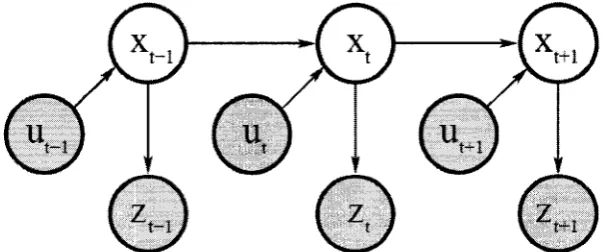
its environment. Figure 2.3 illustrates the evolution of the state and measurements
defined by these two conditional probabilities. The state at time t is dependent on
the state at time t-l and control u,. The measurement z, depends on the state at
time t. Such kind of generative model is also known as dynamic Bayes network [18].
Figure 2.3: The dynamic Bayes network (DBN) which characterizes the evolution of states, controls, and measurements. [60]
2.2.5 The Bayes Filter Algorithm
are commonly used to estimate the belief in probabilistic robotics, and the basic
algorithm for estimating beliefs in probabilistic robotics is using Bayes filter
algorithm [60]. This algorithm calculates the belief distribution given measurement
data and control data. Table 2.1 shows the basic algorithm of Bayes filter in pseudo
code. From the table we know that the Bayes filter is recursive, by which the belief
bel{xt) at time t is calculated from the belief bel(xt_x) at time t-\. Its input is
the belief at time t -1, along with the most recent control ut and the most recent
measurement z,. Its output is the belief at time t. The Bayes filter algorithm
includes two important steps. In line 3, it handles the control ut. By doing so, it
calculates a belief over the state xt_x and the control ut. One may notice that the
equation in line 3 involving the state transition probability which transit the state from
x,_, to state x,. And we call this update equation as the control update. The
probability distribution bel(xt) is often referred to as prediction in the context of
probabilistic robotics [60]. It reflects the fact that bel{xt) predicts the state at time t
based on the previous state posterior, before incorporating the measurement at time t.
The second important step of the Bayes filter is called the measurement update in line
4 in which the measurement probability is involved. It does so for each posterior xt.
By incorporating the state transit probability and measurement probability, one can
calculate the final belief bel(x,) which is returned in line 6 of Bayes filter algorithm.
To determine the posterior belief recursively, the Bayes filter algorithm requires an
initial belief bel(x0) at time t = 0. The initial belief characterizes the initial
knowledge about the environmental state. In this thesis, we assign a uniform
distribution to bel(x0).
In probabilistic robotics, Bayes filter algorithm is implemented in many different
based on different assumptions of the measurement probability, the state transition
probability, and the distribution of the belief [60]. In many robotic problems, beliefs
have to be approximated because of real-time response requirement. Therefore,
designing a suitable approximation algorithm is usually a challenging problem. When
choosing an approximation, one has to trade off many different properties such as
computational efficiency, approximation accuracy, and ease of implementation.
1:
?•3:
4:
5:
6:
Algorithm Biwsjfittfrf&elfa'i.j), % %):
for all xt do
W(l() = j p{l, u't.A-i) foii'/j_i) dl
bd{xt) = ijpi:t f
t)bd\r,j
endfof
i t a W ! / j j
Table 2.1: The Bayes filter algorithm. [60]
2.3 Mobile Robot Localization
There are many existing implementations of Bayes filter. One of the important
ones is the algorithm of mobile robot localization. Mobile robot localization is the
problem of determining a robot's pose (localization, orientation) relative to the given
map of the environment. The localization problem is a core problem in mobile
robotics. It plays an important role in a variety of successful mobile robot systems [9,
17, 31, 39, 50]. Nearly all robotic tasks require knowledge about the location of the
robot and the location of objects that are being manipulated. Thus, the mobile robot
localization has been referred to as the most fundamental problem for providing a
mobile robot with autonomous capabilities [7]. Figure 2.4 illustrates a graphical model
environment and its target is to determine its pose relative to this given map. In this
Figure, the value of shaded nodes are known: the map m, the measurements z , and
the controls u. The goal of localization is to infer the robot pose variable x.
Figure 2.4: Graphical model of mobile robot localization. [60]
2.3.1 Classification of Localization Problems
The mobile robot localization problem comes in many different flavors. This
classification divides localization problems along a number of important dimensions
such as the property of the environment and the initial knowledge which a robot might
have.
The first dimension to classify localization problems is by the type of knowledge
that is available at the initial time to a robot. There are two cases under this dimension.
The most simple localization problem is position tracking. Here the initial knowledge
of robot's pose is known, and the problem is to compensate incremental errors in a
robot's odometry. Algorithms of position tracking often rely on the assumption that
the pose error is small. Within the context of position tracking, the pose uncertainty is
often approximated by a uniform distribution like a Gaussian distribution. More
challenging one is the global localization problem, where a robot is not given its initial
pose but instead has to determine it by its own. The global localization problem is
As a result, a robot should be able to handle multiple, distinct hypotheses.
The second dimension is the environment which has a substantial impact on the
difficulty of localization. Environments can be static or dynamic. Static environments
are environments where the only variable quantity is the robot's pose. Only the robot
moves in this environment while other objects remain at the same location at the same
time. Dynamic environments possess objects other than the robot whose location or
configuration changes over time [60]. Examples of such changes are: people, doors,
and movable objects. Obviously, localization in dynamic environments is more
difficult than localization in static ones. In this thesis, we focus on static environment.
The third dimension is whether or not the localization algorithm controls the
motion of the robot. There are two cases. The first one is called passive localization
[14], where the localization module only monitors the robot operating. The robot is
controlled through some methods, and the robot's motion is not aimed at speeding up
the process of localization. For instance, the robot may move randomly. The other one
is called active localization [60] which controls the robot so as to minimize the
localization error. This thesis entirely considers passive localization algorithm.
The fourth dimension is related to the number of robots in the problem. Single
mobile robot localization is the most studied localization problem. It handles a single
mobile robot only. Single robot localization collects all data at a single robot platform,
and there is no communication involved. The multi-robot localization problem
involves more than one robot. The research on multi-robot localization raises
interesting problems such as representation of beliefs of multiple robots and the
communication between a group of robots [13, 29, 43].
The above four dimensions describe the four important aspects of the mobile
2.3.2 The map representation
The problem of mobile robot localization is based on a given map, which means
that the map is initially known to the robot. In this section, we briefly explain the map
representation within the context of mobile robot localization.
The problem of localization has been developed for a set of map representations.
A map is a list objects in the environments along with its properties. Within the
context of mobile robot localization, the most common used map representations are
feature-based map and localization-based map. Feature-based maps can only specify
the shape of the environment at the specific locations, that is to say the locations of the
objects contained in the map. On the other side, location-based maps afford a label for
any location in the environment. It keeps information not only about objects in the
environment, but also about the absence of the objects like free space. In some
problems, objects will be in the form of landmarks [13], which are distinct, stationary
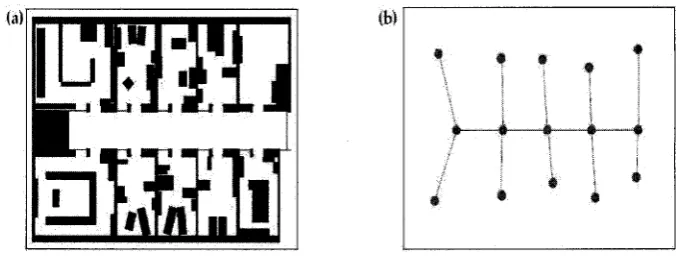
features of the environment that can be acknowledged reliably. Figure 2.5 shows the
example of the location-based map and feature-based map respectively. In location
based map (Figure 2.5(a)), the black areas are obstacles, and the white areas are free
space. In feature based map (Figure 2.5(b)), the black dots mean landmarks, and the
thin linkages indicate the topology of these landmarks.
(«)
2.3.3 Related Works
Because localization is a fundamental problem in the field of mobile robot, there
are many existing probabilistic approaches to address the problem of single mobile
robot localization. However, the majority of existing algorithms address only the
position tracking problem. Among them, most of the earlier approaches employ
Kalman filter [19, 24, 33, 52] based algorithms. These approaches are based on the
assumption that the uncertainty in the robot's pose can be represented by a unimodal
Gaussian distribution. They also exploit a range of restrictive assumptions such as
Gaussian distributed noise and Gaussian distributed initial uncertainty. Under these
assumptions Kalman filters provides extremely robust and efficient algorithm for the
problem of position tracking. Nevertheless, the uncertainty in the robot's pose needs to
be represented by multi-modal distribution in the global localization problem. Since
the above Kalman filter algorithms can not represent multi-modal probability
distributions, which makes inapplicable to global localization problem. This is one of
the limitations for Kalman filter based algorithms.
This limitation is overcome by different approaches which have used increasingly
richer schemes to represent uncertainty. These different approaches can be
distinguished by the type of representation for the state space. Extended Kalman
filters [8, 22, 40, 41] represent beliefs by using mixtures of Gaussians, thus enabling
them to handle multiple, distinct hypotheses, each of which is represented by a
separated Gaussian. Nevertheless, this approach inherits from Kalman filters which
also exploit a range of restrictive assumptions such as Gaussian distributed noise. To
meet this kind assumption, all practical implementations only extract low dimensional
features from the sensor data, so discarding lots of the information acquired by the
robot's sensor. Grid based Markov localization [15] can handle multi-modal and non
Gaussian probability distribution at a fine resolution. Grid based methods perform
by piecewise constant functions like histograms over the space of all possible poses.
Grid based methods are powerful, but suffer from excessive computation overhead
and a priori commitment to the size and resolution of the state space. The
computational requirements have an effect on accuracy as well, since not all
measurements can be processed in real-time, and valuable information about the state
space might be discarded.
It is noted that all the above algorithms share the same idea of probabilistic theory.
They all estimate posterior distribution over the robot's poses under certain
independence assumptions which will also be the case for the method illustrated in
this thesis.
2.3.4 Monte Carlo Localization
Previous approaches were either computationally cumbersome, or had to resort to
extremely coarse-grained resolutions. In this section, we review one of the latest and
commonly used probabilistic approaches to single mobile robot localization called
Monte Carlo localization (MCL). MCL constitutes the core of the proposed approach.
MCL solves the global localization problem in an extremely effective and efficient
way. Although it is relatively young, MCL has already become one of the most
popular localization algorithms in robotics. It is easy to implement and works well
across a broad range of localization problems.
The key idea of MCL is to represent the belief by a set of samples, drawn
according to the posterior distribution over the robot's poses. That is to say, rather than
approximating posteriors in parametric form such as Kalman filter, MCL represents
the posterior by a collection of weighted samples which approximates the desired
probability distribution. The idea of estimating state space recursively through
Within the context of localization, the particle representation has a range of
characteristics: (a) Particle filters can accommodate arbitrary sensor characteristics
and noise distributions, (b) Particle filters are universal density approximations which
weaken the restrictive assumptions on the shape of the posterior density when
compared to previous parametric algorithms such as Kalman filters, (c) Particle filters
focus computational resources in areas that are most relevant, (d) Particle filters
control the number of samples online, which can adapt to available computational
resources, (e) Finally, particles filters are easy to implement, which makes them an
appealing pattern for mobile robot localization. The particle filter is a nonparametric
implementation of the Bayes filter. The key idea of particle filter is to represent the
posterior bel{xt) by a set of random state samples draw from this posterior. Such a
representation is approximate, but it is nonparametric, and thus can represent a much
broader space of distributions than Gaussian based algorithms. In particle filters, the
samples of the posterior distribution are called particles and are denoted as
X, = xlti],x[t2],...,xltMi. Each particle jcjra| (withl < m < M ) is a concrete instance of
the state at time t. M denotes the number of particles in the particle set Xt. In other
words, a particle is a hypothesis as to what the true world state may be at time t.
1: 2:
3; 4: 5: 6: 7: 8: 9: 10: 11: 12:
Algorithm Particle J i t t e r ^ _ l, uf, %): Xt — Xt = $
for m = 1 to M db
sample xf1- ~~ pi ,r, u,, ,r}^)
endfor
for ffi = 1 to M db
draw i with probability oc t*4 add xf' to Xt
eadfor return A%
Because the intuition behind particle filters is to approximate the belief bel(x,)
by the set of particles Xt, the probability for a state hypothesis x, will be
proportional to its posterior bel(xt) x\m] ~ p(xt I zhl,ux.t) [60]. As the result, the more
the number of samples falls in the region of the state space, the more likely it is the
true state falls into this region. Because the particle filter is a recursive Bayes filter, it
constructs the belief bel{xt) recursively from the previous belief fee/(xr_,). Since
beliefs are represented by a set of particles, particle filters construct the particle set
Xt recursively from the set Xt_Y. Table 2.2 shows the particle filter algorithm. The
input of this algorithm is the particle set X,_,, along with the most recent control data
u, and the most recent measurement data z, • Line 4 generates a hypothetical state
x,1'"1 for time t based on the particle jtj™! and control u,. This step involves
sampling from the state transition distribution p(xt \xt_x,ut). Line 5 calculates the
importance factor for each particle x\m]. The importance factor [44] is non-negative
numerical parameters for determining the weight (importance) of each sample,
denoted w\m]. Importance factors are used to incorporate the measurement z, into
the particle set. So the importance is the probability of the measurement z, under the
particle x\m]. From line 8 to line 11, this algorithm implements what is known as
resampling or importance sampling [51]. Resampling transforms a particle set of M
particles into another particle set by incorporating the importance weights into the
resampling process, the distribution of the particle change. The resampling step is a
probabilistic implementation of the Darwinian idea of survival of the fittest [60]. It
refocuses the particle set to regions in the state space with high posterior probability.
By doing so, it focuses the computational resources to regions in the state space where
Table 2.3 shows the basic MCL algorithm which is obtained by substituting the
probabilistic motion model and measurement model into the particle filter algorithm.
The basic MCL algorithm represents belief bel(xt) by a set of M particles
Xt = {x[t>], x\2] ,...x\M]}. The input of this algorithm is the particle set Xt_x, along with
the most recent control data ut, the most recent measurement data z,, and the given
map of the environment. The initial set of samples represents the initial belief
bel(x0) about the state of the whole system. For instance, in global mobile robot
localization, the initial belief is a set of poses drawn according to a uniform
distribution over the robot's universe, annotated by the uniform importance factor —
M
to each particle. The line 4 samples from probability motion model by using particles
from previous belief as a starting point. The probability measurement model is then
applied in line 5 to determine the importance factor (weight) of that particle. The
above sampling process is repeated m times, producing a set of m weighted
samples x]'](i = l,2,...m) for current state space. Line 8 to line 11 is the resampling
routine for MCL algorithm.
1: <j. 3: 4: 5: 6: 7: 8: 9: 10: 11: 12:
Algorithm MCL(*^_j, %, zt, m):
Xt = Xt = $
for m = 1 to M do
a;f'* = sample_motioia_n).odel('8|:, xfjt) tt'| = measurement; jrunlcjl^j.JFi.m)
endfar
form = 1 taiWdfo
fat;
draw i with probability ex. «?|s
addaf'to^
esdfer retom Xt
(a)
'Si •
' • • '
.i.
;•';„-.'•.-State* p&»»t * ' "'
« • ; " : ' • ' .
\
;V .
•;• I *
•%'•
.X
• $ ' # *
,U;,
¥
<'r '.,"'.'' '
. Sfc"
;"Jfe
£U&#
, ' -1 . •?
*iffi?
&jp
' • • : " ' •i : "
r"» /
.wS.
^ '
• i • .<? • . * • ' ' (
<f
4;4#'
,, "' ;.
• "J"1. •
••uy
Robot pcsvSoa
(b)
(c)
RofeorjmSnoa
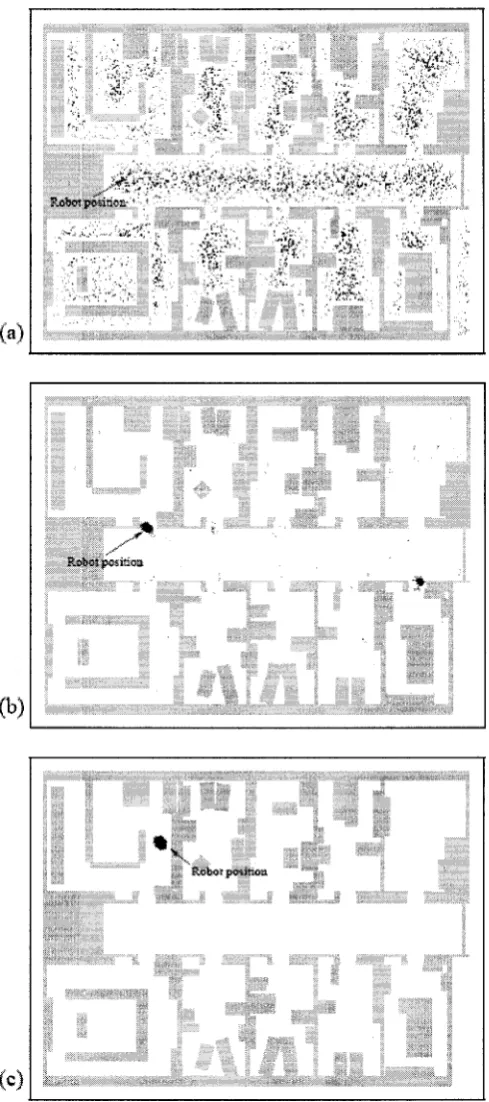
Figure 2.6 shows an example of MCL within the context of global localization for
single mobile robot in an office environment. This robot is equipped with laser range
finders. It is also given a map of the environment. In Figure 2.6(a), the robot is
initially globally uncertain; hence all the particles are spread uniformly through the
free space. Figure 2.6(b) shows the particle set after approximately 1 meters of robot
motion. Due to the symmetry of the environment, MCL has disambiguated the robot's
pose centered on two locations. Finally, Figure 2.6(c) illustrates that after another 1
meter of robot motion, the robot has entered into one room. The ambiguity is resolved,
and the robot knows where it is. The majority of samples are now centered closely on
the correct position.
2.3.5 Multi-Robot Localization.
Recently, it has been noted that research efforts have been shifted from single
robot to multi-robot systems. Multi-robot systems have been proposed for a variety of
applications including space exploration, search and rescue, military surveillance, and
hazardous cleanup [63]. One of the first problems that one needs to tackle in a
multi-robot system is to localize each robot in the system. A multi-robot system has
some obvious advantages over a single robot system. For instance, a multi-robot
system can collect and integrate multiple sensory information from different robots in
the system [42]. By integrating these multiple sensory data (also called sensor fusion);
the system can possibly obtain better localization performance. The benefits of sensor
fusion are three-folded. Firstly, multi-robot can share their sensor information, which
will increase the robustness of the localization algorithm for each robot. Secondly, the
robots can exchange their pose estimates with each other, and use their geometric
relationship to derive more reference information for localization [53]. Thirdly,
different robots can be equipped with different type of sensors, so that the whole
There are some existing algorithms addressing the problem of multi-robot
localization. The most commonly used approaches include Kalman filters [19, 24, 33,
52] and portable landmarks [29, 38]. Most of the early works focus on the question of
how to reduce the odometry error using a cooperative team of robots. One popular
approach to cooperative robot localization is to use the mover and observer strategy,
where two groups of robot are involved, a stationary one and a moving one. The
measurements are then used to correct the odometry error accumulated by the moving
robots. In some cases, odometry data is discarded and localization relies only on
observations by the stationary robots. Within this context, Kurazume [29] introduced
the notion of regarding robots as the portable landmarks. A similar method is
presented in [38]. The authors deal with the problem of exploration of unknown
environment using two mobile robots. In order to reduce the odometry error, one robot
is equipped with a camera tracking system that allow it to determines its relative
position and orientation with respect to a second robot which carries a helix target
pattern and acting as a portable landmark. Although the mover and observer approach
has proven successful, all approaches have the following limitation: (a) only one robot
or a team of robots is allowed to move at a certain time instant; (b) the two robots or
teams of robots must maintain visual contact at all the time; (c) this kind of approach
slows down the overall speed. However, all these approaches only seek to reduce the
odometry error. None of them incorporates environmental feedback into the
estimation, and consequently they are unable to localize robots relative to each other,
or relative to their environments. Even if the initial localizations of all robots are
known, they will be getting lost ultimately.
Another approach is to allow all the robots to move at the same time. As an
example of the method, the extended Kalman filter (EKF) approach to robot
localization has been applied to cooperative localization by Roumeliotis and Bekey
[43]. They present an approach to multi-robot localization in which sensor data from a
heterogeneous collection of robots are combined through a single Kalman filter to
Kalman filter can be broken down into n separate Kalman filters, one for each robot
to allow for distributed processing. Their distributed approach allows a robot to store
sensor information when not in contact with the group and to incorporate it whenever
encounters happen. The motion model of the robots ensures propagation of position
estimate and associated uncertainty when the robot can not observe any other robot, as
well as consistent data fusion in case of a relative measurement. Therefore, this
approach enables the group of robots to move continuously without having to be
stayed within visible range at all the time.
Fox et al. [13] propose a statistical method for collaborative multi-robot
localization. This approach extends their earlier work on MCL single mobile robot
localization. Their method uses a sample based version of Markov localization,
capable of localizing mobile robots in the real time fashion. To avoid exponential
complexity in the number of robots, a factorial representation is used where each robot
in their system maintains a probability distribution describing its own pose. When a
robot determines the location of another robot relative to its own, both robots can
refine their internal beliefs based on the other robot's estimate, thus improving their
localization accuracy. The ability to exchange information during localization is
particularly attractive in the context of global localization. To transfer information
across different robots, the probabilistic detection model was proposed to model the
robot's ability to recognize each other. When one robot detects another, these detection
models are used to refine the individual robot's belief, consequently possibly reducing
the uncertainty of both robots during localization. In [13], a combination of camera
images and laser range scans are used to determine another robot's relative location.
The reliability of the detection process is modeled by learning a parametric detection
model from data, using the maximum likelihood estimator. During localization,
detections are used to introduce additional probabilistic constraints which tie one
robot's belief to another robot's belief. To combine sample sets generated at different
robots in which each robot's belief is represented by a separated sample set, their
sample sets by piecewise constant density functions. These trees are then used to help
to refine the importance factors (weight) of other robot's belief, thus reducing their
uncertainty in response to the detection. As the result, the robots are able to localize
Chapter 3
An Improved Approach For Multi-Robot
Localization
3.1 Limitation of Existing Method
As reviewed in chapter2, Fox et al. [13] proposed a statistical method to
collaborative multi-robot localization using MCL. This approach extends their earlier
work on MCL for the single mobile robot localization [14]. Their approach in [13]
uses a sample based version of Markov localization, capable of localizing mobile
robots in a real time fashion. When teams of robots localize themselves in the same
environment, probabilistic methods are used to refine each robot's belief whenever
one robot detects another. However, the authors point out several limitations of their
method in [13]. One of the limitations is that robots update their belief estimates
constantly whenever one robot perceives another robot. Because of this limitation, two
robots will exchange their pose estimates in any case as long as they detect each other.
However, this instant update may not contribute positively to the localization process.
For example, if one robot detects another one and both robots' beliefs are highly
uncertain, it might be more appropriate to delay the update or information exchange.
If later on one of the robots becomes much more certain and it detects another robot,
then updating the belief of the detected robot could possibly speed up the localization
of the detected robot. In other words, if both robots have blurry knowledge of their
poses at the detection time, it is not necessary to exchange their internal beliefs.
Therefore, this approach suffers from the problem of delayed information exchange
3.2 The Proposed Method
In this chapter, we propose an approach to address the delayed information
exchange problem. It is our belief that robots do not have to exchange information
whenever they detect each other. Such information exchange should only occur when
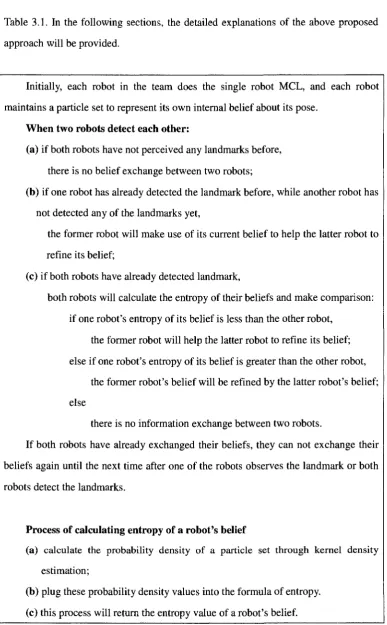
this exchange will benefit the localization process. Therefore, in our method, when
one robot detects another robot, we first compare their beliefs to see which robot is
more certain about its location, and then, based on the result of the comparison, we
decide whether information exchange is necessary. In our approach, we assume that
there is only a remote chance that more than two robots detect each other
simultaneously, which happens rarely and will be ignored when it happens. In order to
solve the problem of delayed information exchange, Fox et al. in [13] suggested that
the robots are required to keep track of their actions and measurements after detecting
other robots and landmarks. Following this suggestion, in the proposed approach we
use a status variable of landmark detection to separate all robots within a team into
two situations:
(a) The first situation is that a robot has already detected a landmark in the
environment (the status variable of landmark detection is set to true). In this situation,
a robot's belief usually becomes more certain by gathering some information of its
pose relative to the environment through landmark detection.
(b) The second situation is that a robot has not yet detected any of the landmarks
in the environment (the status variable of landmark detection is set to false). In this
situation, a robot's belief about its pose is normally highly uncertain.
Based on the above two situations, our method divides the events of robots'
![Figure 2.2: Robot environment interaction. [60]](https://thumb-us.123doks.com/thumbv2/123dok_us/1469886.1180096/24.614.161.507.476.641/figure-robot-environment-interaction.webp)
![Table 2.2: The particle filter algorithm. [60]](https://thumb-us.123doks.com/thumbv2/123dok_us/1469886.1180096/35.614.160.499.486.671/table-the-particle-filter-algorithm.webp)
![Table 2.3: The algorithm of Monte Carlo localization. [60]](https://thumb-us.123doks.com/thumbv2/123dok_us/1469886.1180096/37.616.154.507.471.682/table-algorithm-monte-carlo-localization.webp)