Analytical Study on the Effect of Axial
Loading on the Cold Formed Steel Fluted
Column
Poomari D 1*, Manu S.S 2**
PG Student, Department of Civil Engineering, Valliammai Engineering College, Chennai, India 1*
Assistant Professor, Department of Civil Engineering, Valliammai Engineering College, Chennai, India 2**
ABSTRACT: In this project, an attempt has been made to use cold formed steel member as a column with a modification of flutes on steel tube which enhances the aesthetics and development area of sheet so that the moment of inertia gets increased. Cold-Formed Steel Columns (CFSC) has its usefulness in the structural applications like individual structural framing members and panel decks. High strength-to-weight ratio is also achieved by using cold-rolled products. since the hollow columns (HC) have lesser seismic mass with high strength and stiffness of the fluted columns in combination, makes cold rolled steel structures much safer than conventional steel structures. A detailed study is conducted on this hollow circular fluted columns with modification of the number of flutes (trapezoidal shape), to improve the load carrying capacity of hollow circular columns. The column sections is designed according to IS 801:1975 Code of practice used for Cold-Formed Light Gauge steel sections. A analysis of the local and post local buckling behaviour of different sections like four, five and six numbers of trapezoidal fluted column sections is studied by the finite element analysis software (ANSYS 18.2) and the axial load behaviour of light gauge steel hollow fluted column is analysed.
KEYWORDS: light gauge steel, compression member, fluted column, hollow circular fluted column
I. INTRODUCTION
Cold-formed steel (CFS) is the common term for products made by rolling or pressing steel into semi-finished or finished goods at relatively low temperatures (cold working). Cold-formed steel goods are created by the working of steel billet, bar, or sheet using stamping, rolling (including roll forming), or presses to deform it into a usable product. Cold-worked steel products, such as cold-rolled steel (CRS) bar stock and sheet, are commonly used in all areas of manufacturing of durable goods, such as appliances or automobiles, but the phrase cold-formed steel is most prevalently used to describe construction materials. In building construction, cold-formed steel products can be classified into three categories: members, panels, and prefabricated assemblies. Typical cold-formed steel members such as studs, purlins, girds and angles are mainly used for carrying loads while panels and decks constitute useful surfaces such as floors, roofs and walls, in addition to resisting in-plane and out of-plane surface loads. Prefabricated cold-formed steel assemblies include roof trusses, panellized walls or floors, and other prefabricated structural assemblies.. In recent years researchers have been developing various cross sections to use cold formed steel as a load bearing structural member. One such is the hollow circular light gauge steel column with number of trapezoidal flutes that it is incorporated with the typical hollow circular steel column.Hollow columns as they have less seismic mass, and thus make the superstructure comparatively safer. Also, this type of structural member may be in some cases, economically viable when compared to usual solid members. By using hollow columns the cost can be controlled efficiently since the area used is very less. Also by using hollow columns, the entire weight of the structure is significantly reduced.
II.LITERATURES
Dr. B. R. Niranjan, H. Eramma (2013) [4] 'Effect of Shape of Cross Section and its Performance for Concrete Filled Steel Fluted Columns (CFSFC)'.Here, the CFSFC were tested with different shapes of flutes like rectangular and triangular fluting which enhances aesthetics and increases moment of inertia. It is observed that the moment of inertia gets increased from 17%-40% and 9%-23% for rectangular and triangular flutings respectively. Also the load resistance capacity of rectangular fluted column is more when compared to triangular fluted column.
K.S. Neeraj Prasanna, C.Krishnaveni, Dr.S.Sethil selvan [3] (2017)
"Analytical Study On Light Gauge Steel Hollow Fluted Columns Under Axial Loading"The behavior of columns is evaluated both theoretically and analytically using ANSYS and the results are compared. In the analytical work, nine sections were axially loaded and their corresponding axial shortening values are noted. From the results it is evident that at any particular load, the sections with flutes will have less axial shortening than sections without flutes and the axial shortening for rectangular fluted column (RFC) is less when compared to triangular fluted columns (TFC). The hollow circular columns with flutes is behaving better when compared to hollow circular column without flutes and the columns with rectangular flutes is found to have increased strength to the hollow circular columns with triangular flutes.
Katie Chu (2014), 'Axial load behaviour of steel tube columns in-filled with high-performance concretes', International Journal of Civil Engineering and Technology. This research concentrates on the axial load behaviour of circular, square and rectangular concrete filled steel tube (CFST) columns incorporating high-performance concretes such as ultra-high strength concrete (UHSC), lightweight concrete (LWC), and crumb rubber concrete (CRC).From experimental investigations, it is found that concretes without coarse aggregates including UHSC proved less effective at enhancing axial strength of filled tube columns confinement.
Dr. B. R. Niranjan, Eramma. H (2014), 'Comparison of Experimental values with Analytical Evaluation of Concrete Filled Steel Triangular Fluted Columns for Concentric Load', Journal of Civil Engineering. Both experimental and analytical investigation using ANSYS have been performed on 2500 mm long with 0.8 mm thick core. These cores placed with #8 diameter rods of Fe415 as reinforcement and filled with M20 grade self compacting concrete. Behaviour of concrete filled steel fluted columns have been investigated on thirteen columns experimentally. The parameters are varying three L/D ratios of 15, 20 and 25. The columns were placed on smooth plates at both the ends and the columns were axially loaded and have been analysed for its stiffness and strength. The percentage increase in strength from ANSYS specimens were 6.25%, 6.02% and 12.59% respectively. Axial deformation obtained from experiments in stiffness for L/D ratios of 15, 20 and 25 are 70.61%, 62.69% and 63.18% increased as compared to ANSYS.
S RamanaGopal and P DevadasManoharan(2004), 'Experimental behavior of eccentrically loaded slender circular hollow steel columns in-filled with fiber reinforced concrete', International Journal of Civil Engineering and Technology. This paper was on experimental study of slender steel tubular columns of cross sections filled with fiber reinforced and plain concrete. The slenderness ratio was considered to be the main test parameter. From the experimental results, it is found that the use of fiber reinforced concrete as infill material has a considerable effect on the strength and behavior of slender composite columns.
III.SUMMARY OF LITERATURE REVIEW
load when compared to triangular flutes. In this project, an attempt is made to study the behaviour of Light gauge steel hollow trapezoidal fluted column under axial loading.
IV.SECTION SPECIFICATION
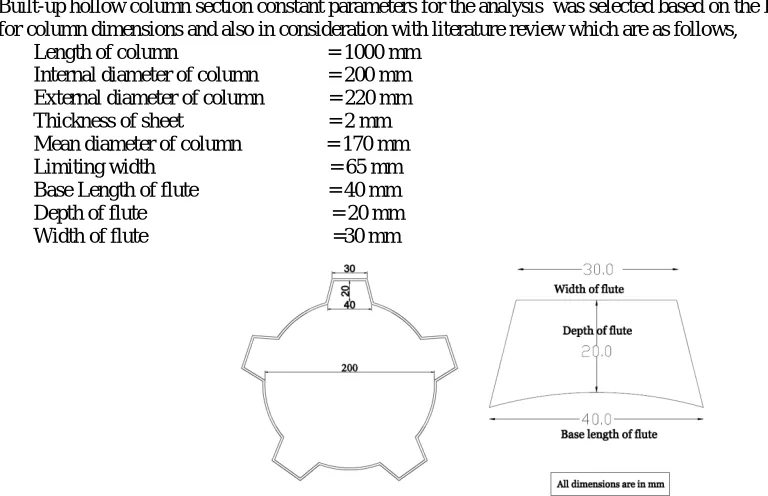
Built-up hollow column section constant parameters for the analysis was selected based on the IS 801-1975 standards for column dimensions and also in consideration with literature review which are as follows,
Length of column = 1000 mm Internal diameter of column = 200 mm External diameter of column = 220 mm Thickness of sheet = 2 mm Mean diameter of column = 170 mm Limiting width = 65 mm Base Length of flute = 40 mm Depth of flute = 20 mm Width of flute =30 mm
Figure 1 Cross section of hollow circular fluted column
IV.ANSYS SOFTWARE
The software creates simulated computer models of structures, electronics, machine components to simulate strength, toughness, elasticity, temperature distribution, electromagnetism, fluid flow, and other attributes. ANSYS is used to determine how a product will function with different specifications, without building test products or conducting crash tests. Most ANSYS simulations are performed using the ANSYS Workbench software, which is one of the company's main products. Typically ANSYS users break down larger structures into small components that are each modelled and tested individually. A user may start by defining the dimensions of an object, and then adding weight, pressure, temperature and other physical properties. Finally, the ANSYS software simulates and analyses movement, fatigue, fractures, fluid flow, temperature distribution, electromagnetic efficiency and other effects over time.
SOFTWARE ANALYSIS
Fig 2 Axial shortening of Hollow Column without Flutes
Fig 3 Axial shortening of Hollow Column With 4 Numbers of Flutes
Fig 5 Axial shortening of Hollow Column with 6 Numbers of Flutes
V.RESULTS AND DISCUSSIONS
Analytical investigations were carried out to make a comparative studyuonutheubehavioruof light gauge cold-formed hollow circular columnuwithuand without flutes and following conclusions were drawn. The stress and strain values acquired from the corresponding load cases are tabulated in the below table
Where,
TFC 0- Hollow circular column without flutes TFC 4- Hollow circular column with 4 numbers of trapezoidal flutes
TFC 5- Hollow circular column with 5 numbers of trapezoidal flutes
TFC 6- Hollow circular column with 6 numbers of trapezoidal flutes
The LOAD VS AXIAL DEFORMATION graph in Figure 6 is to show the axial deformation values of hollow circular columns with and without trapezoidal flutes of steel core thickness 2 mm
Fig 6 LOAD Vs AXIAL DEFORMATION graph of with and without trapezoidal Flutes 0
50 100 150 200 250
0 2 4 6 8
Ultimate load (kN)
Axial deformation (mm)
TFC 0
TFC 4
TFC 5
TFC 6 S.NO Name of the
specimen
Stress (MPa)
The stress value of TFC 0 is 5.81%, 16.33% and 25.36% less than TFC 4 ,TFC 5 and TFC 6 respectively.
And the strain value of TFC 0 is 6.19%, 13.11% and 19.6% more than TFC 4 ,TFC 5 and TFC 6 respectively.
For a steel core of thickness 2 mm, the ultimate load carrying capacity of hollow circular column without flutes are 7.84%, 40.38%,and 72.88% more than columns with 4 numbers of trapezoidal flutes , 5 numbers of trapezoidal flutes and 6 numbers of trapezoidal flutes respectively.
The stress values obtained for hollow circular column without flutes is lesser than the hollow circular columns with trapezoidal flutes.
The strain values obtained shows that the hollow circular column with flutes is found to have lesser strain as compared to the columns without flutes.
For a steel core of thickness 2 mm, the axial deformation of hollow circular column without flutes is 6.2%, 14.1%,and 27% more than the columns with 4 numbers of trapezoidal flutes , 5 numbers of trapezoidal flutes and 6 numbers of trapezoidal flutes respectively.
From the analytical results, the maximum axial deformation values obtained for the hollow circular column with trapezoidal flutes is always lesser than the hollow circular column without flutes.
From the above results trapezoidal fluted column with 6 flutes have achieved more load bearing capacity with lesser value in axial deformation when compared with the hollow circular column without trapezoidal flutes.
REFERENCES
[1] IS 801:1975, 'Code of Practice For Use of Cold-Formed Light Gauge Steel Structural Member’s In General Building Construction'. [2] IS 811: 1987 'Specification for cold formed light gauge structural steel sections'.
[3] NeerajPrasanna KS, Krishnaveni C, Dr.SenthilSelvan S, Dr.Thamilarasu (2017) ,'Analytical Study on Light Gauge Steel Hollow Fluted Column Under Axial Loading', International Journal of Civil Engineering and Technology. Volume 8, Issue 3, March 2017, pp. 965–972.
[4] Dr. B. R. Niranjan and H. Eramma Effect of Shape of Cross Section and its Performance for Concrete Filled Steel Fluted Columns.
[5] ArtiomasKuranovas, AudronisKazimeirasKvedaras (2007), 'Behaviour of hollow concrete-filled steel tubular composite elements', Journal of Civil Engineering and Management 2007,Vol XIII, No 2,131-141.
[6] Kalavagunta S, Naganathan S et al. (2012). Cold formed steel in construction: A review of research, challenges and opportunities, ASEA-SEC-1, Perth, 359-363.
[7] Johansson M, Gylltoft K. (2001), 'Structural behaviour of slender circular steel concrete composite columns under various means of load application. Steel and composite structures',1:393-410.
[8] Chitawadagi, M. V., Narasimhan, M. C., &Kulkarni, S. M. (2010). 'Axial strength of circular concrete-filled steel tube columns'. Journal of Constructional Steel Research, 66(10), 1248-1260.
[9] Ben Young &EhabEllobody, (2006),'Experimental Investigation of concrete-filled cold-formed high strength stainless tube columns', Journal of SteelResearch, 62 (2006) pp 484-492.
[10] Ge HB, Usami T (1992), 'Strength of concrete filled thin walled steel box columns experiments', Journal of Structural Engineering, ASCE, 118 (11).
[11] Schneider SP (1998),' Axially loaded concrete filled steel tubes', Journal of Structural Engineering, ASCE, 124(10): 1125-1138.