Abstract
ZHENG, JIANG. In Regression Testing without Code. (Under the direction of Dr. Laurie Williams.)
Software products are often built from commercial-off-the-shelf (COTS) components. When new releases of these components are made available for integration and testing, source code is usually not provided by the COTS vendors. Various regression test selection techniques have been developed and have been shown to be cost effective. However, the majority of these test selection techniques rely on source code for change identification and impact analysis. This dissertation presents a regression test selection (RTS) process called Integrated - Black-box Approach for Component Change Identification (I-BACCI) for COTS-based applications. The I-BACCI process reduces the test suite based upon changes in the binary code of the COTS component using the firewall analysis regression test selection method. This dissertation also presents Pallino, the supporting automation that statically analyzes binary code to identify the code change and the impact of these
changes. Based on the output of Pallino and the original test suit, testers can determine the regression test cases needed that execute the application glue code
which is affected by the changed areas in the new version of the COTS component. Five case studies were conducted on ABB internal products written in C/C++ to determine the effectiveness and efficiency of the I-BACCI process. The total size of
by as much as 100% if there are a small number of changes in the new component in the best case. Similar to other RTS techniques, when there are many changes in the new component the I-BACCI process suggests a retest-all regression test strategy.
In Regression Testing without Code
ByJiang Zheng
A dissertation submitted to the Graduate Faculty of North Carolina State University
in partial fulfillment of the requirements for the Degree of
Doctor of Philosophy
COMPUTER SCIENCE
Raleigh, NC
2007
Approved by:
_______________________________ _______________________________ Dr. Jason A. Osborne Dr. Mladen A. Vouk
_______________________________ _______________________________ Dr. Tao Xie Dr. Laurie A. Williams
Dedication
Biography
Jiang Zheng was born on July 27th, 1977 in Hulin, Heilongjiang province, People's Republic of China. He grew up in Shanghai, the largest city of China. He received his Bachelor of Science degree in Computer Science in 1999 from Fudan University, Shanghai, China, and his Master of Science degree in Computer Science in 2005 from North Carolina State University, Raleigh, North Carolina, U.S.A. He also had four years industrial working experience in software development before he was enrolled in North Carolina State University in 2003.
Jiang joined the Software Engineering Realsearch Group (former Laboratory for Collaborative System Development) under the advisement of Dr. Laurie A. Williams in Fall 2003. His research interests include software testing and reliability, component-based software engineering, software reuse, software quality assurance, and software development processes. He had his summer internship in the US Corporate Research of ABB Inc. (Raleigh, NC) in 2005, 2006, and 2007.
Jiang is a student member of Institute of Electrical and Electronics Engineers (IEEE), Association for Computing Machinery (ACM), and the ACM Special Interest
Acknowledgements
This dissertation would never have been accomplished without the generous support and help of many people over many years. First and foremost, I would like to express the greatest gratitude to my advisor, Dr. Laurie A. Williams. I received the first email from Laurie on a Monday, April 14, 2003 at 10:12 AM ET. She introduced me to the interesting world of software engineering research from then on. I am greatly impressed and influenced by her wisdom, insight, diligence, and tolerance. It is very fortunate and enjoyable for me to be her student. I am forever grateful to Laurie for her tireless efforts and tremendous support during my studies.
Dr. Tao Xie has served as a very active and strict committee member and has been continuously giving me advice on how to improve my work. I also greatly appreciate the support given to me by my two other committee members, Dr. Mladen Vouk and Dr. Jason Osborne. Each of them has been valuable sources of information, comments and guidance over the course of this research.
This research was supported by a research grant from ABB Corporate Research. I must gratefully acknowledge ABB Corporate Research for supporting me financially
for the past three years, including my internship during the three summer semesters. Very special thanks to Brian Robinson and Karen Smiley, who have contributed enormously to this research.This dissertation would not have been possible without
the excellent collaboration with you.
research in various emails, meetings, conferences and doctoral symposium, in alphabetical order: Dr. Lawrence Chung, Dr. Steve Easterbook, Dr. Xavier Franch, Dr. Rose Gamble, Dr. Jerry Gao, Dr. David Kay, Dr. Forrest Shull, Dr. Ann Sobel, and Dr. Sebastian Uchitel. I am also indebted to Dr. Cem Kaner, a lawyer and software engineering professor, for his patient explanation and immense help on the legal issues of this dissertation, and for allowing me to use his legal writing in Chapter 6. Additionally, special thanks to Dr. Nachiapan Nagappan, Will Snipes, and John Hudepohl for their contribution in the automatic static analysis research and the IEEE Transactions in Software Engineering (TSE) paper.
I have had the fortunate and honor to work with and learn from many faculty members at NC State including: Dr. Annie Antón, Dr. Rada Chirkova, Dr. Do Young Eun, Dr. Thomas Honeycutt, Dr. Purushothaman Iyer, Ms. Carolyn Quarterman, Dr. Injong Rhee, Dr. Carla Savage, Dr. Roger Woodard, Dr. Peter Wurman, and Dr. Ting Yu. A special thanks to Dr. Antón for her great encouragement and advice when I was
her teaching assistant in Spring 2004. I also appreciate the financial assistance I have received from the Department of Computer Science at North Carolina State University.
Many thanks to Dr. David Thuente, Margery Page, Carol Holloman, Ginny Adams, Susan Peaslee, Linda Honeycutt, Ken Tate, Vilma Berg, Missy Seate, Carol Allen, and Sarah Williams, who have constantly provided assistance and guidance during the
past four years.
in the Software Engineering Realsearch Group for their great encouragement and help. I have benefited greatly from working with an amazing group of students: Michael Gegick, Sarah Heckman, Dright Ho, Neha Katira, Lucas Layman, Andy Meneely, Meiyappan Nagappan, Dr. Nachiappan Nagappan, Mark Sherriff, Yonghee Shin, Ben Smith, Dr. Hema Srikanth, and Stephen Thomas. This dissertation and my other publications would not have been possible without the insightful discussion and comments in our reading groups. I am also grateful to Dr. Qingfeng He for his support on my job hunting. There are numerous other friends both inside and outside NC State University that have been helpful over the years and their assistance is greatly appreciated.
Finally, but definitely not least, I am especially grateful to my family for their unconditional love, support, encouragement, and patience during my graduate studies. My parents, Jingzi Zhou and Dali Zheng, have been constant sources of love and support for which I will forever be thankful. My beloved wife, Yushen Huang, has
been accompanying me on the trip to my Ph.D. far away from her parents, and very supportive of both my living and study. Thanks also go to my adorable little princess,
Table of Contents
LIST OF TABLES...ix
LIST OF FIGURES...x
GLOSSARY...xi
CHAPTER 1 INTRODUCTION... 1
CHAPTER 2 BACKGROUND AND RELATED WORK... 6
2.1 TESTING OF SOFTWARE COMPONENTS... 6
2.2 REGRESSION TEST SELECTION ... 8
2.3 FIREWALL ANALYSIS ... 16
2.4 BINARY CODE ANALYSIS... 19
2.5 CHANGE IDENTIFICATION AND IMPACT ANALYSIS ... 21
CHAPTER 3 THE I-BACCI PROCESS... 24
3.1 INTRODUCTION AND PROCESS EVOLUTION... 24
3.2 THE PROCESS STEPS... 26
3.3 ILLUSTRATION OF THE PROCESS... 29
3.4 LIMITATIONS ... 32
CHAPTER 4 SUPPORTING AUTOMATION: PALLINO ... 34
4.1 ILLUSTRATION OF USE ... 35
4.1.1 ILLUSTRATION OF USE WITH COFF COMPONENT... 35
4.1.2 ILLUSTRATION OF USE WITH PE COMPONENT... 39
4.2 ARCHITECTURE ... 44
4.3 ALGORITHMS ... 47
4.3.1 ALGORITHMS FOR COFF COMPONENTS ... 47
4.3.2 ALGORITHMS FOR PE COMPONENTS... 51
4.5 LIMITATIONS ... 55
CHAPTER 5 CASE STUDIES... 56
5.1 RESULTS OF CASE 1 ... 60
5.2 RESULTS OF CASE 2 ... 62
5.3 RESULTS OF CASE 3 ... 64
5.4 RESULTS OF CASE 4 ... 65
5.5 TIME COSTS ANALYSIS ... 66
5.6 FIREWALL RTS VS. MODIFIED ENTITY RTS... 68
5.7 SUMMARY OF CASE STUDIES ... 70
CHAPTER 6 LEGAL ISSUES ... 73
6.1 PROBLEM MOTIVATION... 73
6.2 REVERSE ENGINEERING OF SOFTWARE... 74
6.3 LEGAL LIMITS OF BCA OF PURCHASED SOFTWARE... 78
6.4 SUMMARY... 79
CHAPTER 7 CONTRIBUTIONS AND FUTURE WORK... 81
REFERENCES... 85
List of Tables
Table 3.1: Evolution of the I-BACCI process... 26
Table 4.1: Analysis of false positives and false negatives ... 51
Table 5.1: Summary of case study subjects ... 58
Table 5.2: Case 1 results by the I-BACCI Version 4 ... 61
Table 5.3: Case 2 results by the I-BACCI Version 4 ... 63
Table 5.4: Case 3 results by the I-BACCI Version 4 ... 64
Table 5.5: Case 4 results by the I-BACCI Version 4 ... 65
Table 5.6: Rough total time costs ... 67
Table 5.7: Comparison of RTS techniques ... 70
List of Figures
Figure 2.1: Relationship among classes of test cases for non-obsolete test
cases, adapted from [63] ... 10
Figure 2.2: Illustration of firewall analysis... 17
Figure 3.1: The I-BACCI version 4 regression test selection process... 25
Figure 3.2: Illustration of the use of firewall RTS in the I-BACCI process ... 30
Figure 4.1: Binary code fragments in the two releases of a COFF component ... 36
Figure 4.2: DUMPBIN output of the two releases of a COFF component ... 38
Figure 4.3: Call graph: how component change affects glue code ... 38
Figure 4.4: DUMPBIN output of the two releases of a PE component... 42
Figure 4.5: Generated call graph initially represented in plain text ... 42
Figure 4.6: Generated call graph in complex representation ... 43
Figure 4.7: Call graph: How changed data affects exported component function ... 44
Figure 4.8: Overall architecture ... 44
Figure 4.9: Binary File Format Model... 45
Figure 4.10: PE format data structure... 46
Figure 4.11: Source code and DUMPBIN output for functionA in ClassA... 48
Figure 4.12: Pallino screen shot ... 54
Glossary
Affected exported component functions: Affected exported component functions are functions within the COTS component that interface with the application,
and are either changed or are in the call chain of other changed functions.
Affected component functions: Affected component functions are functions within the COTS component that are in the call chain of the changed or added component functions.
Affected glue code functions: Affected glue code functions are functions within the glue code that directly call affected exported component functions.
American Law Institute (ALI): The American Law Institute was established in 1923 to promote the clarification and simplification of American common law and its adaptation to changing social needs. The ALI drafts, approves, and publishes restatements of the law, model codes, and other proposals for law reform. [1]
Binary code analysis (BCA): Binary code analysis is the activity that analyzes the binary executable code of software to facilitate many software
development-related activities, including program comprehension, software maintenance and software security.
Black-box testing: Black-box testing, also called functional testing or behavioral testing, is testing that ignores the internal mechanisms of a system or component and
conditions [38].
Calling virtual address: For each key-value pair in the relocation index, the key is a calling virtual address where the control flow jumps to another function or data.
Common Object File Format (COFF): The Common Object File Format is a specification of a format for executable, object code, and shared library computer files. COFF libraries usually have the extension .lib [55].
Controlled Regression Testing: Controlled Regression Testing assumes that factors other than the program (such as the operating environment, the nondeterministic ordering of statements in concurrent programs, or databases and files that contribute data) do not affect test execution [63].
Decompose: The term decomposing is used to refer to breaking up the binary code down into constituent elements, such as code sections and relocation tables.
Dynamic binary code analysis: Dynamic binary code analysis monitors the execution of programs.
End virtual address: End virtual addressis one of the main attributes in the function/data model indicating the virtual address of the last byte of a functions or
data.
Explanation type theory: An explanation type theory, also labeled as "theory for understanding," provides explanations but does not aim to predict with any precision,
and there are no testable propositions [30].
engineering is perfectly legal because the Copyright Act allows certain types of copying without permission. Collectively, these are called fair use. Photocopying part of a book for classroom teaching is an example of fair use [39].
Fault-revealing test cases: Fault-revealing test cases are those test cases detect one or more faults in P' if it causes P' to fail [63].
Firewall analysis: Firewall analysis is a regression test selection technique for regression testing with integration test cases in the presence of small changes in functionally-designed software [80].
Glue code: Glue code is application code that interfaces with the COTS components, integrating the component with the application.
Magic number: A magic number is a pre-defined constant, typically located at the first few bytes of a binary file, used to identify the file type [52].
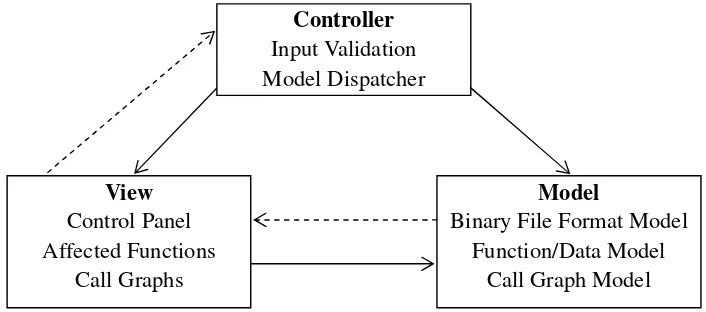
Model-view-controller (MVC): An model-view-controller architecture separates data (model) and user interface (view) concerns, so that changes to the user interface
do not affect the data handling, and that the data can be reorganized without changing the user interface.
Modification-traversing test cases: Modification-traversing test cases for P and P' are those test cases executing new or modified code in P', or formerly executed
code that has since been deleted from P [63].
different output [63].
The National Conference of Commissioners on Uniform State Laws (NCCUSL): The National Conference of Commissioners on Uniform State Laws is a non-profit, unincorporated association in the United States that consists of commissioners appointed by each state and territory. The purpose of the association is to discuss and debate in which areas of law there should be uniformity among the states and to draft acts accordingly. [2]
Notation for regression testing: Let P be a program and P' be a modified version of P. Let S and S' be the specifications for P and P', respectively. Let T be a test suite developed initially for P [63].
Obsolete test cases: Obsolete test cases for P' are those test cases if and only if the expected output of t has changed for S' [63].
Portable Executable (PE): The Portable Executable format is a file format for executables, object code, and DLLs, used in Windows operating systems. Typical PE
files have the extensions .exe, .dll, .ocx, .sys, .cpl and .scr. [52]
Regression testing: Regression testing involves selective re-testing of a system or component to verify that modifications have not caused unintended effects and that the system or component still complies with its specified requirements [38].
retest-all regression testing by selecting a subset of possible test cases. [63]
Relative Virtual Address (RVA): A relative virtual address is the virtual address of an object from the file once it is loaded into memory, minus the base address of the file image.
Relocation index: In the algorithm of analyzing PE components, the relocation table is read from the relocation section and then converted into a Hashtable called
relocation index.
Relocation table set: The algorithm of analyzing COFF components collects and saves the relocation tables of the functions into a text file called "relocation table set".
Reverse engineering by the Bowers v. Baystate Technologies case: Reverse engineer is to study or analyze (a device, as a microchip for computers) to learn
details of design, construction, and operation, perhaps to produce a copy or an improved version [3, p. 1326].
Software change impact analysis: Software change impact analysis, or impact analysis for short, estimates what will be affected in software and related
documentation if a proposed software change is made [7].
Start virtual address: Start virtual addressis one of the main attributes in the function/data model indicating the virtual address of the first byte of a functions or data.
actually running the program on specific inputs.
Reliable: Test cases are reliable if the correctness of modules exercised by those tests for the tested inputs implies correctness of those modules for all inputs [63].
Safe RTS technique: A safe RTS technique guarantees that the subset of tests selected contains all test cases in the original test suite that can reveal faults based upon the modified program [63].
Target virtual address: For each key-value pair in the relocation index, the start virtual address of the function or data being called (a.k.a. target virtual address) is stored as the value.
Virtual address: A virtual address is an address identifying a virtual (non-physical) entity.
What You See Is Not What You eXecute (WYSINWYX) phenomenon: There can be a mismatch between what a programmer intends and what is actually executed by the processor, e.g., presence or absence of procedure calls by the optimizing
CHAPTER 1
INTRODUCTION
Companies increasingly incorporate a variety of commercial-off-the-shelf (COTS) components in their products. Upon receiving a new release of a COTS component, users of the component often conduct regression testing to determine if the new version of the component will cause problems with their existing software and/or hardware system. Regression testing involves selective re-testing of a system or component to verify that modifications have not caused unintended effects and that the system or component still complies with its specified requirements [38]. A variety of regression test selection (RTS) processes have been developed [5, 10-12, 14-16, 21, 22, 26, 29, 32-37, 42, 44, 47-49, 51, 57, 63-69, 72-74, 80, 82, 84] to reduce the
number of tests that need to be executed without significant risk of excluding important failure-revealing test cases. However, most existing RTS techniques rely on
source code, and therefore are not suitable when source code is not available for analysis, such as when an application incorporates COTS components.
Due to the lack of information, the most straightforward RTS strategy for
Glue code is application code that interfaces with the COTS components, integrating
the component with the application. The retest-all strategy can be prohibitively expensive in both time and resources [26]. The goal of our research is to, with minimal reduction in regression fault detection ability, reduce the regression testing
required for COTS-based applications when components change and source code is
not available.
To advance the body of knowledge, theory should be an integral part of empirical studies in software engineering [30]. Empirically-based theories are generally perceived as foundational to science [30]. An explanation type theory will be built through this research. An explanation type theory, also labeled as “theory for understanding,” provides explanations but does not aim to predict with any precision, and there are no testable propositions. These theories often have an emphasis on showing others how the world may be viewed in a certain way, with the aim of bringing about an altered understanding of how things are or why they are as they are.
[27, 30]
The explanation type theory being built via this research is stated as follows:
When components change and source code is not available, regression tests can
be selected from the test cases that execute the glue code that is in the call chain of
functions of the component that changed, with minimal reduction in regression fault
detection ability.
COTS-based applications [85-90]. The process is called the Integrated - Black-box Approach for Component Change Identification (I-BACCI1) process. Black-box
testing, also called functional testing or behavioral testing, is testing that ignores the
internal mechanisms of a system or component and focuses solely on the outputs generated in response to selected inputs and execution conditions [38]. The I-BACCI process is an integration of (1) a static binary code analysis for change identification and impact analysis; and (2) the firewall analysis RTS technique. Our uniqueness is the combination of the two parts to identify and localize change with the goal of reducing the regression test suite.
The input artifacts to the process are (1) the binary code of the components (old and new versions); (2) the source code of the glue code of the user application not including the COTS components; and (3) all test cases which are mapped to the glue code functions they execute. These input artifacts are generally available to users of COTS components. The output of the I-BACCI process is a reduced suite of
regression test cases that execute the application glue code that is in the call chain of changed functions in the new COTS components.
The I-BACCI process has evolved to Version 4 through the application of the process on components in Common Object File Format (COFF) [55] and the Portable Executable (PE) format [58, 59] written in C/C++. COFF libraries usually have the extension .lib. Typical PE files have the
extensions .exe, .dll, .ocx, .sys, .cpl and .scr. Additionally, the
comprehensive open source supporting automation for the I-BACCI process, henceforth called Pallino2, has been developed to perform static binary change identification and impact analysis. Pallino outputs a list of affected exported component functions. Affected exported component functions are functions within the COTS component that interface with the application, and are either changed or are in the call chain of other changed functions. Based on the list of affected exported component functions and the original test suite, testers can identify glue code functions that call affected exported component functions. Then, the subset of the regression test cases that execute the glue code which is affected by the changed areas in the new COTS components can be identified. Currently Pallino works on components in COFF or PE format written in C/C++ and functionality that processes other binary file format can beeasily added into the tool without affecting many other modules. Pallino can be modified to support other RTS methods for COTS
components.
This paper reports the results of applying the I-BACCI Version 4 process to
identify a reduced test suite for four industrial case studies. Two of the case studies involve COFF component, and two involves PE component. These results are used to analyze the effectiveness and efficiency of the I-BACCI as an RTS process. Also,
another case study was conducted to evaluate the overall efficiency of the firewall analysis RTS technique that is used in the I-BACCI process.
CHAPTER 2
BACKGROUND AND RELATED
WORK
This chapter provides information about prior work in testing of software components, regression test selection, firewall analysis, binary code analysis, change identification, and impact analysis.
2.1 TESTING OF SOFTWARE COMPONENTS
Poor testability, due to the lack of access to the component's source code and other artifacts, is one of the challenges in user-oriented component testing [24, 25, 76]. The major objectives of user-oriented component testing are as follows [24]:
(1) to validate the functions and performance of a reusable component relative to
its specifications;
(2) to confirm the proper usage and deployment of a reusable component in a
specific platform and operation environment; and
(3) to check the quality of customized components developed using reused components.
component testing include [25]:
(1) difficulties understanding the functions and behaviors of reusable
components;
(2) inability to perform white-box program analysis to support debugging; and (3) difficulties conducting unit-level black-box testing without access to the
component creators and related artifacts.
Generally, black-box tests are run on COTS software because users do not have access to the source code to analyze the internal implementation. Black-box test cases of COTS component functionality can be based upon the specification documentation provided by the vendor. Alternately, the behavior could be determined by studying the inputs and the related outputs of the component. When only binary code is available, binary reverse engineering is a technically-feasible approach for automatically deriving information that can inform the RTS. The derived information can be a program structure of a component from its binary code, such as, call graphs [52].
Harrold et al. [31] presented techniques that use component metadata for regression test selection of COTS components. They illustrated their technique with a
controlled example and seven releases of a real component-based system, demonstrating an average savings of 26% of the testing effort [31]. Their techniques utilize three types of metadata to perform the regression test selection: (1) the branch
component for the branches affected by changes in the component between two given versions [31]. However, the component vendors may not provide the metadata information, especially the third type of metadata. Also, the cost of providing the metadata may be high in practice. [31] In this research, we focus on using information that is typically available to a COTS component user.
2.2 REGRESSION TEST SELECTION
The purpose of RTS techniques is to reduce the high cost of retest-all regression testing by selecting a subset of possible test cases [26]. A variety of RTS techniques [5, 10-12, 14-16, 21, 22, 26, 29, 32-37, 42, 44, 47-49, 51, 57, 63-69, 72-74, 80, 82, 84] have been proposed, such as methods based upon path analysis techniques or dataflow techniques. Rothermel and Harrold evaluated and compared the RTS techniques by establishing a framework composed of four categories: inclusiveness, precision, efficiency, and generality [63]:
• Inclusiveness measures the ability of a technique to choose tests that will cause the modified program to produce different output than the original program, and thereby expose faults caused by modifications.
• Precision measures the ability of a technique to eliminate or exclude tests that will not cause the modified program to produce different output than the original program. No techniques are 100% precise.
• Efficiency measures the computational cost of a technique.
language constructs, arbitrarily complex code modifications, and realistic testing applications. [63]
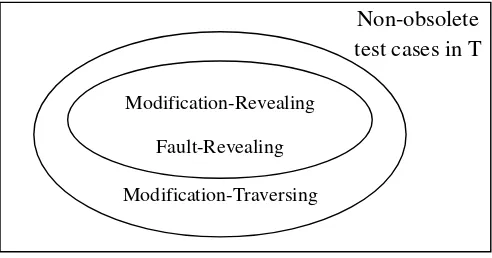
Rothermel and Harrold also formally defined the notation and terms for regression testing [63]. Let P be a program and P' be a modified version of P. Let S and S' be the specifications for P and P', respectively. Let T be a test suite developed initially for P. Fault-revealing test cases are those test cases detect one or more faults in P' if it causes P' to fail [63]. A safe RTS technique guarantees that the subset of tests selected contains all test cases in the original test suite that can reveal faults based upon the modified program [14, 45, 63, 64]. Generally, a superset of the set of test cases in T that are fault-revealing for P' can be selected under certain conditions, although there is no effective algorithm for finding the test cases in T that are fault-revealing for P' [62, 63]. Modification-revealing test cases are those test cases, when executed before and after the modification, the program will generate different output [63]. The modification-revealing test cases in T form a set
equivalent to the set of fault-revealing test cases in T, given two assumptions that (1) When P was tested with t, P halted and produced correct output, for each test case t
belonging to T; and (2) for each test case t belonging to T, t is not obsolete for P'. Obsolete test cases for P' are those test cases if and only if the expected output of t has
changed for S'. [63]
change. We may only consider the non-obsolete test cases in T for users’ application in user-oriented component testing. However, there is no effective algorithm for precisely identifying the non-obsolete test cases in T that are modification-revealing for P and P', even when the above two assumptions hold [62, 63]. Modification-traversing test cases for P and P' are those test cases executing new or
modified code in P', or formerly executed code that has since been deleted from P. A non-obsolete test case can only be modification-revealing for P and P' if it is modification-traversing for P and P' when a third assumption (Controlled Regression Testing) holds, with the above two assumptions. Controlled Regression Testing assumes that factors other than the program (such as the operating environment, the nondeterministic ordering of statements in concurrent programs, or databases and files that contribute data) do not affect test execution. [63] The relationship that holds among these terms for non-obsolete test cases in T when the assumptions hold is show in Figure 2.1. The set of modification-traversing test cases is a superset of the set of
modification-revealing test cases.
Figure 2.1: Relationship among classes of test cases for non-obsolete test cases, adapted from [63]
Non-obsolete test cases in T
Modification-Traversing Modification-Revealing
Rothermel and Harrold analyzed RTS techniques and determined that four RTS techniques are safe for controlled regression testing [63]:
• linear equation (nonminimization) [22], • cluster identification [42],
• modified entity [16], and • graph walk [62, 64-66].
Fischer presents the linear equation, a selective retest technique that uses systems of linear equations to select test suites that yield segment coverage of modified code. Linear equation techniques use systems of linear equations to express relationships between tests and program segments. The analysis time cost in the worst case is exponential in the program size, which may be very expensive in practice [22, 63]. The techniques may be data and computation intensive on large programs due to the calculations required to solve systems of linear equations [22, 63].
Laski and Szermer [42] present the cluster identification, a technique for
identifying single-entry, single-exit subgraphs of a control flow graph (CFG), called clusters, that have been modified from one version of a program to the next. The
cluster identification technique computes control dependence information for a procedure and its changed version, and then computes the control scope of each decision statement in the procedure by taking the transitive closure of the control
cluster identification technique selects non-modification-traversing tests and is less precise than the graph walk technique [63].
Chen, Rosenblum, and Vo [16] present the modified entity technique, a regression test selection technique that detects modified code entities. Code entities are defined as executable portions of code such as functions, or as nonexecutable components such as storage locations. First, a program is instrumented to generate traces of all functions called during its execution. Execution of a test case on the instrumented system generates a trace of the functions. Also, all of the (static) references between the entities in the source code of the program are stored in a database. When a new version is created, a source code database is created for the new version. The databases for both old and new version of a program are compared to identify the entities that were changed. Then the technique compares the list of changed entities with the coverage information preserved for each test case, and selects all test cases that cover changed entities for retesting the new version of the program. [16]
Because the modified entity technique may also select tests that do not execute modified clusters or modified execution traces, the modified entity technique is less
precise than the cluster identification or CFG-walk techniques [14, 63]. Although it is the most efficient safe RTS technique, the modified entity technique would still take more time executing the selected tests than that of cluster identification and graph
Rothermel and Harrold presented the graph walk technique. Graph walk involves the following five steps: (1) construct the CFGs for a procedure or program and its modified version; (2) collect traces for tests in the original test suite that associate tests with CFG edges; (3) perform synchronous depth-first traversals of the two graphs; (4) comparing the program statements associated with those nodes that are reached along prefixes of execution traces; and (5) use these graphs to select tests that execute changed code from the original test suite [63, 64]. The graph walk techniques select all modification-traversing tests, a superset of fault-revealing test cases and modification-revealing test cases, and are safe for controlled regression testing. Also, the graph walk technique is the most precise safe technique by selecting tests through modified programs at a finer grain [63].
Graph walk techniques gain their safeness and precision by increasing the costs of analysis [63]. For example, a mapping between each test case and CFG edges traversed by the test case must be maintained [64]. Especially for large scale industrial
software project, it is very complex to analyze the control flow graph and execution traces in such a fine granularity for the whole system. Rothermel and Harrold suggest
that it is helpful to conduct empirical studies to determine whether a safe RTS technique, such as the modified entity technique and graph walk technique, offers sufficient improvements in fault detection in comparison to a nonsafe but efficient
with those of modified entity technique, the most efficient safe RTS technique, will be discussed in Chapter 5.6.
Srivastava and Thiagarajan at Microsoft developed Echelon [71], a test prioritization system. Echelon is used to prioritize tests based upon changes between two versions identified by a binary code comparison. Echelon takes as input two versions of the program in binary form, and a mapping between the test suite and the lines of code it executes. Echelon outputs a prioritized list of test sequences (small groups of tests). The researchers analyzed the efficacy of Echelon based on two runs of a comparison between two binaries of a 1.8 million line of code office productivity application [71]. In the first run, Echelon detected 87% of the defects in the first two of 148 test sequences; the remaining 13% of the defects were not detected by any tests in the test suite. In the second run of different binaries, Echelon detected 98% of the defects in the first three of 221 test sequences; the remaining 2% of the defects were not detected by any tests.
However, Echelon is a large proprietary Microsoft internal product with a significant infrastructure and an underlying binary code manipulation engine, and
therefore cannot be used by the community at large. Also, Echelon prioritizes, but does not eliminate tests [71]. Our goal is to provide information about which test cases are not necessary to rerun.
replace a COTS component within a software system; and (2) a technique for prioritizing test cases to improve the efficiency of regression testing of COTS components, when integrated in new software systems to update obsolete components. Their techniques derive information from software characteristics by focusing on behavioral models that are automatically extracted from the execution of test cases on previous versions of the software, and by computing priorities according to the exercised behaviors instead of the specific changes. Their techniques rely on automatic inference of two types of behavioral models: input/output (I/O) and interaction models. I/O models are boolean expressions over the values exchanged during the computation, describing properties of data values exchanged between components, and are inferred from traces with the Daikon engine [20]. Interaction models describe sequences of invocations by finite state machines labeled with
method invocations, and are derived with the kBehavior engine [50]. Regression test cases are prioritized according to the complexity of the interactions between the
system and the target component that are triggered by the test, because "during integration testing, long interactions are more likely to expose faults than simple ones,
which should be already covered by the unit testing of the component." Their empirical investigations conducted so far showed that (1) the generated compatibility test suites were less than 7% of the original test suites, and could identify
96% of faults while executing less than 10% of test cases. [49] As a dynamic analysis technique that automatically synthesizes behavioral models from execution traces, their techniques require runtime setup and reliable sets of test suites. Also, their techniques prioritize instead of eliminating test cases. Our approach selects test cases needed to rerun based on static binary code analysis which will be discussed in Chapter 2.4.
2.3 FIREWALL ANALYSIS
Leung and White [4, 45, 46, 79] developed firewall analysis for regression testing with integration test cases (tests that evaluate interactions among components [38]) in the presence of small changes in functionally-designed software. Module dependencies, control-flow dependencies, and data dependencies are considered in firewall analysis [79]. Dependencies are modeled as call graphs. Firewall analysis restricts regression testing to potentially-affected system elements that directly call changed system elements, i.e., system elements that can be reached within one edge
from changed system elements in the call graph [79, 81]. Affected system elements include: modified functions and data structures, and their calling functions. A
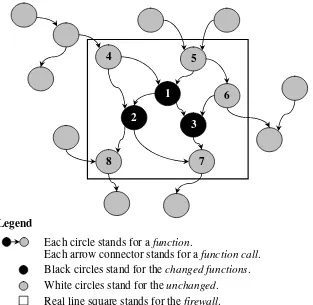
"firewall" is “drawn” around the changed functions on the call graph. All modules inside the firewall are unit and integration tested, and are integration tested with all modules not enclosed by the firewall [79]. Test cases that need to be re-run over
elements in Figure 2.2, system elements 1, 2, and 3 are modified, and the testing firewall requires that unit and integration tests be conducted for system elements 1-8. Kung et al. [40, 41] utilized the firewall concept on an object-oriented system, and White and Abdullah [77] expanded the firewall to address more features of an object-oriented system. Firewall has also been utilized in the regression testing of graphical user interfaces [78].
Figure 2.2: Illustration of firewall analysis
Firewall methods can only be guaranteed to select all modification-revealing [63]
tests and to be safe if all unit and integration tests initially used to test system components are reliable. Tests are reliable if the correctness of modules exercised by
2 1
3
4 5
6
7 8
Legend
Each circle stands for a function.
those tests for the tested inputs implies correctness of those modules for all inputs [63]. Unfortunately, test suites are typically not reliable in practice [81], so the firewall technique may omit modification-revealing tests and/or may admit some non-modification-traversing tests. When test suites are not reliable, there may exist some input i that belongs to the input domain of a modified function p, such that no test in the test suite selected by firewall analysis exercises p with input i, and such that input i may expose a fault in p. If some system test t is within the original test suites but not within the selected test suite, and such that t causes p to be invoked with the input i, then t is fault-revealing, but the firewall technique does not select t. [63] However, via empirical studies of industrial real-time systems, firewall analysis was shown to be effective [81]. The firewall analysis allowed an average savings of 36% of the testing time and 42% of the number of the tests run. No additional errors were detected by the customer on the studied software releases that were due to the changes in these releases to date. There were additional defects found, but none were
regression or unit test failures. These were pre-existing defects that were created in the original release. [81].
Compared to the graph walk techniques, firewall analysis takes the advantage of the simplicity and efficiency in change impact and test selection analysis, especially for large scale complex industrial software projects with integration test cases [63, 64,
spends less time on rerunning selected test cases, especially for regression testing components in very deep levels of the call chains in large scale complex industrial software projects [16, 63, 80]. Firewall is the RTS technique embodied in the I-BACCI Version 4. Based upon the results of these empirical studies of firewall, these theoretical limitations of firewall should not impair the effectiveness of the I-BACCI process in practice. As will be discussed in Chapter 3, our approach extends the traditional concept and scope of firewall analysis for use with binary code.
2.4 BINARY CODE ANALYSIS
Software developers generally write source code in high level programming languages. Compilers translate that source into binary code that computer processors can recognize and execute. During maintenance, the development team analyzes the source or binary code to determine the course of their corrective action. For example, developers can use their knowledge of what was changed at the function/method and line of code level to determine what to retest before releasing the evolved software to
customers. The developers have free reign to analyze their source manually or with tools, to test, integrate or revise the code.
Software purchasers, however, may not have access to the source code. Binary code analysis (BCA) approaches and tools have been developed and utilized in many software development-related activities, including program comprehension, software
detected via BCA to enhance software security [13].
Balakrishnan et al. presented the "What You See Is Not What You eXecute" (WYSINWYX) phenomenon: There can be a mismatch between what a programmer intends and what is actually executed by the processor, e.g., presence or absence of procedure calls by the optimizing compiler [9]. Therefore, analyses performed on source code can fail to detect certain bugs and vulnerabilities. Also, analyzing executables has other advantages, such as, revealing more accurate information about the behaviors that might occur during execution, because an executable contains the actual instructions that will be executed [9].
Additionally, BCA can be dynamic or static. Dynamic BCA monitors the execution of programs. In contrast, static BCA provides a way to obtain information about the possible states that a program reaches during execution without actually running the program on specific inputs. Static techniques explore the program's behavior for all possible inputs and all possible states that the program can reach. [9]
Srivastava and Thiagarajan discussed the advantages of comparing software at the binary level rather than the source code level [71]:
(1) easier to integrate into the build process because the recompilation step
needed to collect coverage data is eliminated; and
(2) all the changes in header files (such as constants and macro definitions) have
There are many examples of static BCA. To obtain the strings that contain significant high-level information about the program and its communication with the runtime environment, Christodorescu et al. [18] presented a static analysis technique for recovering possible string values in an executable program when no debug information or source code is available. Malicious code or patterns in executable programs can be statically detected [13]. CodeSurfer uses a static-analysis algorithm called value-set analysis (VSA) to recover intermediate representations similar to those a compiler creates for a program written in a high-level language [8]. Our tool utilizes static BCA to identify changes and change impact within the COTS components where source code is not available.
2.5 CHANGE IDENTIFICATION AND IMPACT ANALYSIS
A key step in choosing regression tests is applying impact analysis [56] to identify changes between the new release and the previously-tested version with the same source code base. Software change impact analysis, or impact analysis for short,
estimates what will be affected in software and related documentation if a proposed software change is made [7]. However, similar to RTS, most change identification
and impact analysis approaches utilize the source code of the old and modified programs [6, 42, 60, 61, 63, 73, 74]. These approaches are not suitable for component testing when source code is not available.
perform regression test selection. Apiwattanapong et al. [6] presented a technique for comparing object-oriented programs that identifies both differences and correspondences between two versions of a program. The algorithm is based on a method-level representation that models the object-oriented features of the language. Given two programs, their algorithm identifies matching classes and methods, builds a representation for each pair of matching methods, and compares the representation to identify similarities and differences. Empirical results show that the technique achieves improvements from 17% to over 65% in terms of matching unchanged parts of the code, compared to Laski and Szermer's algorithm [6]. Ren et al. [60] developed Chianti, a change impact analysis tool for Java. Chianti analyzes two versions of a Java program and decomposes their difference into a set of atomic changes. Change impact is then reported in terms of affected (regression or unit) tests whose execution behavior may have been modified by the applied changes. For each affected test, Chianti also determines a set of affecting changes that were responsible
for the test's modified behavior [60, 61]. Their empirical results show that after a program edit, on average the set of affected tests is 62.4% of all the possible tests and
for each affected test, the number of affecting changes is very small (5.9% of all atomic changes in that edit) [61].
Wang et al. [75] developed the Binary Matching Tool (BMAT) which compares
CHAPTER 3
THE I-BACCI PROCESS
This chapter presents the I-BACCI RTS process. Chapter 3.1 presents the high level information including the evolution of the process. Chapter 3.2 introduces the detailed steps of the process. An illustrative example is presented in Chapter 3.3. The limitations of the process is discussed Chapter 3.4.
3.1 INTRODUCTION AND PROCESS EVOLUTION
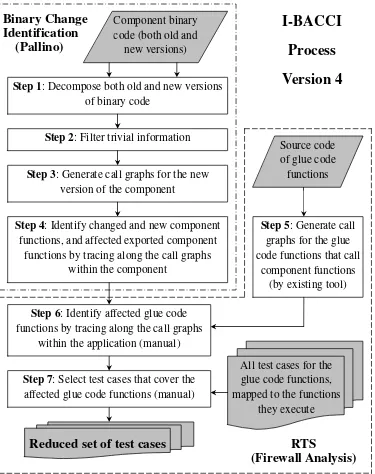
The I-BACCI process is an integration of (1) a static BCA for change identification and impact analysis; and (2) the firewall analysis RTS technique. Our uniqueness is the combination of these two parts to identify and localize changes with the goal of reducing the regression test suite. The I-BACCI Version 4 involves seven
steps, as shown in Figure 3.1. The first four steps are completed via a BCA process (in dash-dotted line frame)using the Pallino tool, which produces a report on affected
Figure 3.1: The I-BACCI version 4 regression test selection process
The inputs and output of the I-BACCI process are shown in gray blocks in Figure
3.1. The input artifacts to the process are the binary code of the COTS components (old and new versions); the source code and test suite of the development application; and all test cases which are mapped to the glue code functions they execute. These
Component binary code (both old and
new versions)
Source code of glue code functions Step 2: Filter trivial information
Step 5: Generate call graphs for the glue code functions that call
component functions (by existing tool) Step 6: Identify affected glue code
functions by tracing along the call graphs within the application (manual)
Step 7: Select test cases that cover the affected glue code functions (manual)
Reduced set of test cases
Step 3: Generate call graphs for the new version of the component
All test cases for the glue code functions, mapped to the functions
they execute
I-BACCI
Process
Version 4
Binary Change
Identification
(Pallino)
RTS
(Firewall Analysis)
Step 4: Identify changed and new component functions, and affected exported component
functions by tracing along the call graphs within the component
input artifacts are generally available to users of COTS components. The output of the I-BACCI process is a reduced suite of regression test cases necessary to exercise the changed areas in the new COTS components.
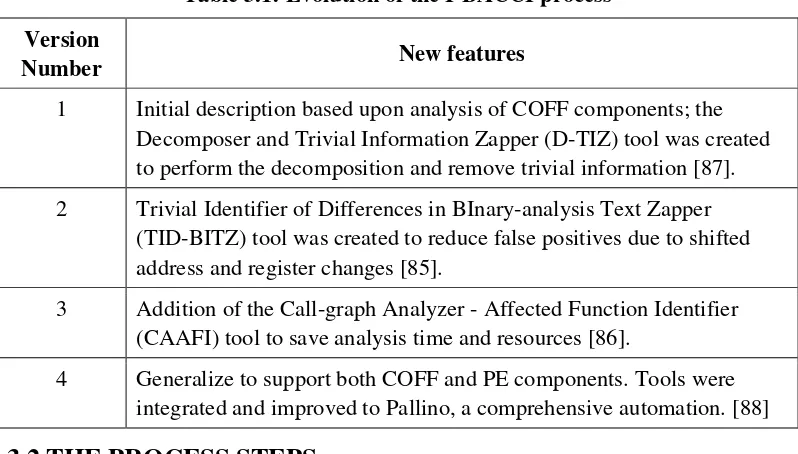
The I-BACCI process has been evolved to Version 4 through the application of the process on both COFF and PE components written in C/C++. A summary of the evolution for the I-BACCI Versions 1 - 4 is shown in Table 3.1.
Table 3.1: Evolution of the I-BACCI process Version
Number New features
1 Initial description based upon analysis of COFF components; the Decomposer and Trivial Information Zapper (D-TIZ) tool was created to perform the decomposition and remove trivial information [87]. 2 Trivial Identifier of Differences in BInary-analysis Text Zapper
(TID-BITZ) tool was created to reduce false positives due to shifted address and register changes [85].
3 Addition of the Call-graph Analyzer - Affected Function Identifier (CAAFI) tool to save analysis time and resources [86].
4 Generalize to support both COFF and PE components. Tools were integrated and improved to Pallino, a comprehensive automation. [88]
3.2 THE PROCESS STEPS
pre-defined formats, such as COFF and PE format, so that an external system is able to find and call the functions in the corresponding code sections. Often the first step can be accomplished by parsing tools available for the language/architecture. For example, COFF and PE binary files can be examined by the Microsoft COFF Binary File Dumper (DUMPBIN) [53]. Examples of DUMPBIN output will be shown in Chapter 6.
The second step, filtering trivial information, is frequently necessary because the output from the first step may contain trivial information such as timestamps and file pointers that are irrelevant to the change identification. Generally, the second step cannot be completed via existing tools. Therefore, the Pallino tool was created to perform the decomposition and remove trivial information. The output of the second step is the raw code section of each function/data, and function/data calling relationships for the new version of the component.
The main objective of the third step of the I-BACCI process is to identify true positive changes in the raw binary code of functions and data. The Pallino tool removes the false positives caused by differences due to trivial changes, such as
shifted addresses and register reallocations. The algorithm used in Pallino will be introduced in detail in Chapter 4. Also, this step generates call graphs for the new version of the component. The call graphs can be drawn using graph generation tools
such as GraphViz3. Pallino also represents and analyzes the call graphs of components of both COFF and PE types automatically in the I-BACCI Version 4. The call graph
example of Pallino output will be shown in Figure 4.5, 4.6 and 4.7 in Chapter 4.1. For different types of components, the execution order of the second step and the third step may be different. For example, for COFF components, the second step is executed before the third step. But the third step should be executed before the second step for PE components because only the names of exported component functions can be obtained in the binary code, such that functions have to be mapped between two releases after generating the call graphs for exported component functions. The main goal of the second and third steps is to facilitate comparisons and the identification of affected exported component functions.
In the fourth step, we identify changed and new added component functions according to the results of prior steps, and then identify affected exported component functions by tracing along the call graphs within the component using directed graph theory algorithms. Analysis starts from each component function identified as changed, and that change is propagated along the call graphs from the third step until
the exported functions are reached. The output of the fourth step is a list of all affected exported component functions.
With the source code of glue code functions, the fifth step is to generate function
call graphs for glue code functions that call exported component functions. The call graphs generated from the third step and the fifth step can be integrated together to
Figure 4.5, 4.6 and 4.7 in Chapter 4.1. The call graphs for the glue code can be drawn using existing open source tools such as Doxygen4.
Similar to the fourth step, the affected glue code functions are identified in the sixth step. Affected glue code functions are functions within the glue code that directly call affected exported component functions. These are the functions within the application that are potentially affected by the changed function(s) in the component, and therefore need to be re-tested.
In the seventh step, the set of test cases which are mapped to the glue code functions they execute are used to select only test cases that cover the affected glue code functions, as identified by the steps above.
3.3 ILLUSTRATION OF THE PROCESS
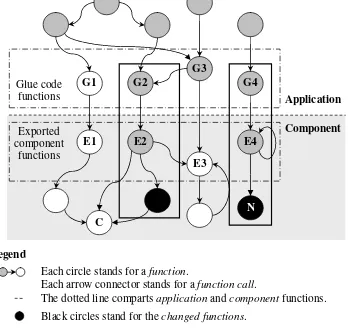
The I-BACCI process has the potential to reduce the set of regression test cases because it focuses on the affected glue code functions and ignores the unaffected areas in the application. The process is illustrated in Figure 3.2. Changed and new added
component functions are identified, as shown in the black circles. Then, the analysis starts from each component function identified as "changed" or "new," backtracks the
call graphs to identify all functions that directly or indirectly call the changed functions, until the glue code functions that can be reached within one edge from exported component functions in the call graph are reached.
Figure 3.2: Illustration of the use of firewall RTS in the I-BACCI process In this example, exported component functions E1 and E3 are not in the call chain
of either changed or new component functions, such that are not affected and are shown as white circles. However, exported component functions E2 and E4 are affected by changed and new component functions which are shown as black circles.
Component Application
Exported component
functions
G1 G2 G3 G4
N
N
G E Legend
Each circle stands for a function.
Each arrow connector stands for a function call.
The dotted line comparts application and component functions. Black circles stand for the changed functions.
Black circles with letter ‘N’ stand for the added functions.
Gray circles stand for the affected functions (unchanged functions that are in the call chain of the changed or added component functions). White circles stand for the unchanged and unaffected functions. Circles with letter ‘G’ and ‘E’ stand for the glue code functions and exported component functions, respectively.
Real line squares stand for the firewalls. Glue code functions in the firewall are the affected glue code functions.
Glue code functions
E1 E2 E4
E3
Therefore, exported component functions E2 and E4 are considered as “changed”, and glue code functions in the solid line box (G2 and G4) that call E2 and E4 are the affected glue code functions, which need to be re-tested. Although also affected by the component change, glue code function G3 is not chosen to be re-tested because G2 has been re-tested, according to the firewall analysis concept.
Compared to Figure 2.2 in Chapter 2.3, the I-BACCI process extends the traditional concept and scope of application for firewall analysis for use with COTS components. In my approach, firewall analysis is applied on the application instead of within the component. If the traditional firewall is used within the component, a significant number of exported component functions might be considered as "affected" by the change impact analysis. In this example, the traditional firewall would consist of functions E2, E4, and C, and the changed and new added component functions. The user of the component does not have any source code and test cases for these functions, and therefore can not conduct user-oriented component testing.
Analysis needs to backtrack the execution traces to find out which exported component functions are in the call chain of the component functions that are within
the firewall. In this example, all exported component functions (E1, E2, E3, and E4) would be considered as "affected". My approach extracts the execution traces from glue code to changed or new functions in binary code, i.e., only considers the
changed or new functions in binary code is that, only those tests that execute the changed part (instead of all affected part) of the component need to be selected. Traditional firewall analysis is then applied on source code of the application that incorporates the component, i.e., test cases that execute the glue code of the application are selected. In this example, two exported component functions (E2 and E4) would be considered as "affected" using my approach.
3.4 LIMITATIONS
The I-BACCI process shares an acknowledged technical limitation with all existing firewall methods: the potential for reporting false positives and false negatives in situations where binary differences are due to factors other than changes in source code (e.g. build tools, environment, or target platform). Although the I-BACCI process does work with the binary files for the component, the current method of analysis precludes identification of such differences.
The second limitation of the I-BACCI process is its potential for identifying false
positives by assuming, in tracing the call graphs, that any uses of called functions with changed binaries will be affected by the change. However, an actual use of a changed
function might never exercise the changed logic or data. With further development of the I-BACCI process, these unneeded tests may be eliminated from the regression suite.
CHAPTER 4
SUPPORTING
AUTOMATION:
PALLINO
This chapter presents the comprehensive supporting automation for the I-BACCI process, Pallino. Pallino performs static binary change identification and impact analysis and can be modified to support other RTS methods for COTS components. The input artifacts to Pallino are the binary code of the components (old and new versions), which is generally available to users of COTS components. Pallino outputs a list of affected exported component functions.
Based on the list of affected exported component functions and the original test suite, testers can identify glue code functions that call affected exported component
functions. Then the subset of the regression test cases that execute the glue code which is affected by the changed areas in the new COTS components can be
identified. Currently Pallino works on components in Common Object File Format (COFF) or Portable Executable (PE) formats written in C/C++.
The remainder of this chapter is structured as follows. Chapter 4.1 illustrates
The limitations of Pallino are discussed in Chapter 4.5.
4.1 ILLUSTRATION OF USE
This chapter presents two examples to illustrate how affected exported component functions are identified from binary code. The examples for COFF component and PE component will be discussed in Chapter 4.1.1 and Chapter 4.1.2, respectively.
4.1.1 ILLUSTRATION OF USE WITH COFF COMPONENT
Windows NT® uses a special format for the executable (image) files and object files. The format used in these files is referred to as COFF files5. Object files created from C or C++ programs using many compilers conform to COFF, including the Visual C++ and the GNU Compiler Collection (GCC).
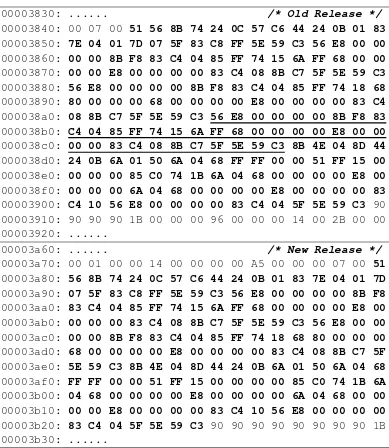
In the example to follow, Release 4 and Release 5 of an ABB component are compared. These two releases are referred to as the “old” and the “new” releases. The input to Pallino is .lib binary files of the two releases. Binary code fragments in
the two releases are shown in Figure 4.1.
At first glance, we can not see any relationship between the two binary code
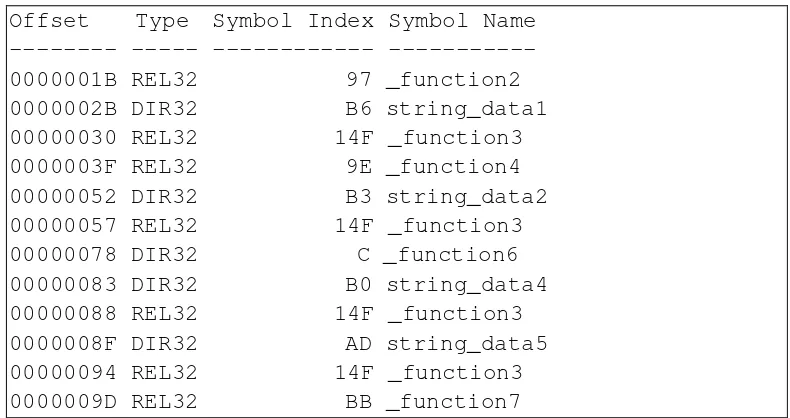
fragments because both the binary code and the address ranges are different. The DUMPBIN tool was used to translate the binary files into plain text. The counterparts in the output of DUMPBIN for the two binary code fragments are shown in Figure
4.2.
00003830: ... /* Old Release */
00003840: 00 07 00 51 56 8B 74 24 0C 57 C6 44 24 0B 01 83
00003850: 7E 04 01 7D 07 5F 83 C8 FF 5E 59 C3 56 E8 00 00
00003860: 00 00 8B F8 83 C4 04 85 FF 74 15 6A FF 68 00 00
00003870: 00 00 E8 00 00 00 00 83 C4 08 8B C7 5F 5E 59 C3
00003880: 56 E8 00 00 00 00 8B F8 83 C4 04 85 FF 74 18 68
00003890: 80 00 00 00 68 00 00 00 00 E8 00 00 00 00 83 C4
000038a0: 08 8B C7 5F 5E 59 C3 56 E8 00 00 00 00 8B F8 83
000038b0: C4 04 85 FF 74 15 6A FF 68 00 00 00 00 E8 00 00
000038c0: 00 00 83 C4 08 8B C7 5F 5E 59 C3 8B 4E 04 8D 44
000038d0: 24 0B 6A 01 50 6A 04 68 FF FF 00 00 51 FF 15 00
000038e0: 00 00 00 85 C0 74 1B 6A 04 68 00 00 00 00 E8 00
000038f0: 00 00 00 6A 04 68 00 00 00 00 E8 00 00 00 00 83
00003900: C4 10 56 E8 00 00 00 00 83 C4 04 5F 5E 59 C3 90 00003910: 90 90 90 1B 00 00 00 96 00 00 00 14 00 2B 00 00 00003920: ...
00003a60: ... /* New Release */
00003a70: 00 01 00 00 14 00 00 00 00 A5 00 00 00 07 00 51
00003a80: 56 8B 74 24 0C 57 C6 44 24 0B 01 83 7E 04 01 7D
00003a90: 07 5F 83 C8 FF 5E 59 C3 56 E8 00 00 00 00 8B F8
00003aa0: 83 C4 04 85 FF 74 15 6A FF 68 00 00 00 00 E8 00
00003ab0: 00 00 00 83 C4 08 8B C7 5F 5E 59 C3 56 E8 00 00
00003ac0: 00 00 8B F8 83 C4 04 85 FF 74 18 68 80 00 00 00
00003ad0: 68 00 00 00 00 E8 00 00 00 00 83 C4 08 8B C7 5F
00003ae0: 5E 59 C3 8B 4E 04 8D 44 24 0B 6A 01 50 6A 04 68
00003af0: FF FF 00 00 51 FF 15 00 00 00 00 85 C0 74 1B 6A
00003b00: 04 68 00 00 00 00 E8 00 00 00 00 6A 04 68 00 00
00003b10: 00 00 E8 00 00 00 00 83 C4 10 56 E8 00 00 00 00
00003b20: 83 C4 04 5F 5E 59 C3 90 90 90 90 90 90 90 90 1B 00003b30: ...
Figure 4.1: Binary code fragmentsin the two releases of a COFF component The sections can be located and identified by function signatures, e.g.,
function1 in this example. Directive information, such as size of raw data and function signature, is shown in the “SECTION HEADER” subsection. The “RAW