Scholarship at UWindsor
Scholarship at UWindsor
Electronic Theses and Dissertations Theses, Dissertations, and Major Papers
1-1-2006
XML Schema subtyping.
XML Schema subtyping.
Yun Li
University of Windsor
Follow this and additional works at: https://scholar.uwindsor.ca/etd
Recommended Citation Recommended Citation
Li, Yun, "XML Schema subtyping." (2006). Electronic Theses and Dissertations. 7136.
https://scholar.uwindsor.ca/etd/7136
This online database contains the full-text of PhD dissertations and Masters’ theses of University of Windsor students from 1954 forward. These documents are made available for personal study and research purposes only, in accordance with the Canadian Copyright Act and the Creative Commons license—CC BY-NC-ND (Attribution, Non-Commercial, No Derivative Works). Under this license, works must always be attributed to the copyright holder (original author), cannot be used for any commercial purposes, and may not be altered. Any other use would require the permission of the copyright holder. Students may inquire about withdrawing their dissertation and/or thesis from this database. For additional inquiries, please contact the repository administrator via email
XML Schema Subtyping
by
YunLi
A Thesis
Submitted to the Faculty of Graduate Studies and Research through Computer Science
in Partial Fulfillment of the Requirements for the Degree of Master of Science at the
University of Windsor
Windsor, Ontario, Canada
2006
© 2006 Y unLi
Published Heritage Branch
3 9 5 W ellington S tr e e t O ttaw a ON K 1 A 0 N 4 C a n a d a
Direction du
Patrimoine de I'edition
3 9 5 , rue W ellington O ttaw a ON K 1 A 0 N 4 C a n a d a
Your file Votre reference ISBN: 978-0-494-42327-1
Our file Notre reference
ISBN: 978-0-494-42327-1
NOTICE:
The author has granted a non exclusive license allowing Library and Archives Canada to reproduce, publish, archive, preserve, conserve, communicate to the public by
telecommunication or on the Internet, loan, distribute and sell theses
worldwide, for commercial or non commercial purposes, in microform, paper, electronic and/or any other formats.
AVIS:
L'auteur a accorde une licence non exclusive permettant a la Bibliotheque et Archives Canada de reproduire, publier, archiver,
sauvegarder, conserver, transmettre au public par telecommunication ou par Nntemet, preter, distribuer et vendre des theses partout dans le monde, a des fins commerciales ou autres, sur support microforme, papier, electronique et/ou autres formats.
The author retains copyright ownership and moral rights in this thesis. Neither the thesis nor substantial extracts from it may be printed or otherwise reproduced without the author's permission.
L'auteur conserve la propriete du droit d'auteur et des droits moraux qui protege cette these. Ni la these ni des extraits substantiels de celle-ci ne doivent etre imprimes ou autrement reproduits sans son autorisation.
In compliance with the Canadian Privacy Act some supporting forms may have been removed from this thesis.
While these forms may be included in the document page count,
their removal does not represent any loss of content from the thesis.
Conformement a la loi canadienne sur la protection de la vie privee, quelques formulaires secondaires ont ete enleves de cette these.
Bien que ces formulaires aient inclus dans la pagination, il n'y aura aucun contenu manquant.
i*i
Canada
ABSTRACT
An XML Schema is a grammar of an XML language. It defines a set of instance XML documents that are valid sentences in this language. An XML Schema S is a subtype of another XML Schema T if the set of instances of S is a subset of the instances of T. Since XML Schema has become a mainstream data type definition format for XML documents, its subtyping problem finds many applications in XML-centric programming and Web- service technology.
The proposed subtyping algorithm is based on Antimirov’s derivation calculus (Antimirov, 1994) for regular expressions and its extensions to regular hedge expressions (Kempa & Linnemann, 2003) (Hohenadel, 2003). This thesis formalizes and rebuilds the algorithm for regular tree grammars, which is very close to the subtyping algorithm for regular hedge grammars.
iii
First of all, I would like to express my gratitude to my supervisor, Dr. Jianguo Lu, who brought me to the research area of formal language theory and XML-related technologies. He taught me the way of doing research as a serious, independent, and creative researcher. His insightful comments and encouragements always inspired me to do my best in this thesis.
I also want to thank my thesis committee members, Dr. Sang-Chul Suh, Dr. Jessica Chen, and Dr. Richard Frost, for their great support.
Finally, I am very grateful for my family whose love and patience enabled me to complete this work.
iv
TABLE OF CONTENTS
ABSTRACT...iii
ACKNOWLEDGEMENTS... iv
LIST OF TABLES... vii
LIST OF FIGURES...viii
CHAPTER I. INTRODUCTION 1.1 Type Languages for XML Documents...1
1.2 XML Schema Subtyping...2
1.3 Thesis Overview...5
II. A FORMAL LANGUAGE FOR XML SCHEMAS 2.1 Regular Grammars and Context Free Grammars... 7
2.2 Trees...10
2.3 Regular Tree Grammars and Regular Tree Languages 12 2.4 Unranked & Ranked Trees...15
2.5 Intermediate Language... 17
2.6 XML Schema Mapping...22
2.7 Schema Determinism... 25
2.8 Subtyping... 29
III. A SUBTYPING ALGORITHM FOR XML SCHEMAS 3.1 What is a Subtyping Algorithm?... 31
3.2 Main Ideas of the Subtyping Algorithm... 31
3.3 Check for £-inclusion... 34
3.4 Simplification Process... 36
3.5 Algorithm Rules... 47
3.6 Time Complexity... 52
IV. IMPLEMENTATION 4.1 XML Schema Parsing... 56
4.2 Type Representations... 57
4.3 Subtype Checking... 59
4.4 Implicit Subtyping... 64
v
5.2 Subtyping for Regular Expression Types... 68
5.3 Subtyping Using BDD... 71
5.4 Subtyping Using Antimirov’s Containment Calculus... 72
5.5 Comparison... 75
VI. CONCLUSIONS AND FUTURE WORK 6.1 Main Contributions... 80
6.2 Limitations and Future W ork... 81
APPENDICES A A Set-theoretic Observation...83
B Logfile for Example 3 ... 86
REFERENCES...93
VITA AUCTORIS... 96
vi
LIST OF TABLES
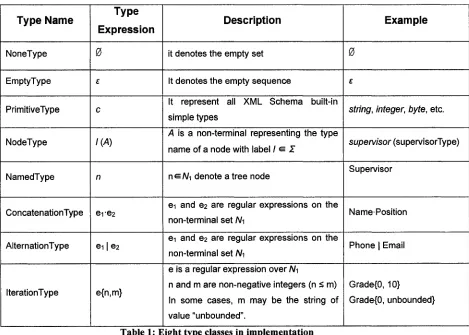
Table 1: Eight Type Classes in Implementation
vii
Figure 1: XML Schema Supervisorl...4
Figure 2: XML Schema Supervisor2... 4
Figure 3: An Instance XML Document of Supervisorl and Its Tree Representation^ Figure 4: The Relationship Between Unranked Trees and Binary Trees...16
Figure 5: XML Schema Test... 27
Figure 6: Main Ideas of the Subtyping Algorithm...32
Figure 7: Proof Tree of Example 3 ... 46
Figure 8: XML Schema Subtyping Rules... 47
Figure 9: XML Schema Subtyping Architecture...55
Figure 10: DOM XML Parser... 56
Figure 11: XML Schema Built-in Data Type Hierarchy... 65
viii
CHAPTER I
INTRODUCTION
Since the World Wide Web Consortium (W3C) recommended XML (the extensible Markup Language) as a standard in 1998, XML has received widespread attention and adoption in the computer industry. Its usage ranges from document publication to data exchange and integration on the Web. In addition, XML is the cornerstone of Web service technology, which is becoming the new standard for distributed computing. Modem Web applications and Web services generate XML documents dynamically, whose types need to be checked. In particular, applications consuming one type of XML documents may accept documents of its subtypes. Hence, the subtyping problem of various XML data types has attracted substantial research attention (Hosoya, Vouillon, & Pierce, 2000) (Tozawa & Hagiya, 2003) (Kempa & Linnemann, 2003) (Hohenadel, 2003).
1.1 Type Languages for XML Documents
An XML type describes a set of XML documents, typically expressed in terms of constraints on the structure and content of the documents of that type. To improve the safety of XML data processing, most XML-related technologies assume XML documents follow an XML type.
Since the inception of the XML specification, there have been many XML type languages defined. The original specification of XML (Bray et al., 2000) defined DTD (Document Type Definitions) as its type language, or the schema language. Since then, DTD had
1
DTD is relatively simple and has a compact syntax. However, DTD has a few shortcomings. For example, DTD has a non-XML syntax, which means one needs separate tools, such as a parser, to let a machine understand it. In addition, DTD doesn’t support namespaces easily, and provides very limited data typing. For example, it doesn’t have types like date and integer. Furthermore, data types defined in DTD are for attributes only.
To overcome the limitations of DTD, a large number of alternatives have been proposed. The representative ones include XML Schema (Fallside & Walmsley, 2004), DSD (Document Structure Description) (Klarlund et al., 2000), RELAX (Murata, 2001), RELAX NG (Clark & Murata, 2001), and so on. Among them, XML Schema is the most popular one and has become a mainstream data-type definition format for XML documents. We investigated 3448 WSDL (Web Service Definition Language) files randomly collected from the Web and found that 3070 WSDL files contain type definitions, 3054 out of which (99.48%) use XML Schema for their datatype definitions.
Because of the popularity of XML Schema, this thesis focuses on the subtyping problem of XML Schema only.
1.2 XML Schema Subtyping
There are various notions to capture the relationship between XML data types, such as the subsumption relation proposed by Kuper, et al. in (Kuper & Simeon, 2001) and the
2
containment relation between two languages (Tozawa & Hagiya, 2003). In this thesis, subtype refers to the set-inclusion relationship (Hosoya, Vouillon, & Pierce, 2000) (Kempa & Linnemann, 2003) (Hohenadel, 2003), i.e., XML Schema S is a subtype of another XML Schema T if the set of XML documents defined by S is a subset of the set of XML documents defined by T.
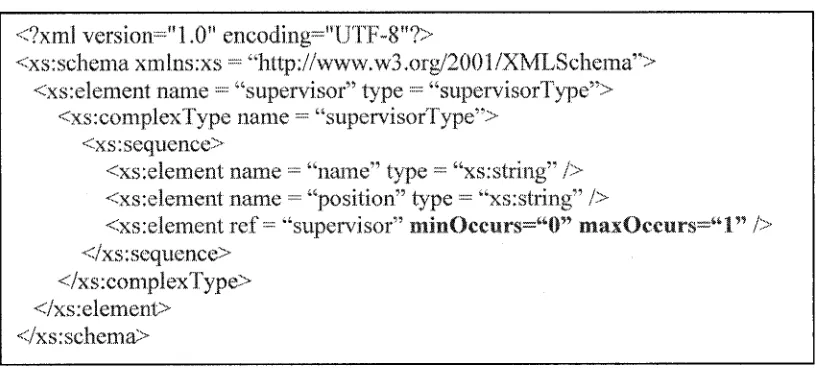
To illustrate the subtyping problem, let’s consider two XML Schemas: Supervisorl and Supervisor2, in Figure 1 and 2.
In Supervisorl, the minOccurs and maxOccurs attributes of the node labeled supervisor are set to 0 and 1 respectively, which means the node supervisor can occur 0 or 1 time within the node supervisor. However, Supervisor2 specifies that the node supervisor can occur 0, 1, or 2 times within the node supervisor. Obviously, Supervisor2 describes strictly more XML instances, which implies the set of instances of Supervisorl is a subset of the set of instances of Supervisor2. Hence, Supervisorl is a subtype of Supervisor2.
Subtyping yields a substantial degree of flexibility in XML-centric programming. An XML language supporting subtyping will allow procedures/methods applicable to one type to be safely applied to its subtypes. For example, applications that are designed to process the instance XML documents of Supervisor2 will also be able to process those of Supervisorl.
3
<?xml version-" 1.0" encoding="UTF-8"?>
<xs;schema xmlnsrxs = “http://www.w3 .org/2001 /XMLScheraa”> <xs:element name = “supervisor” type = “supervisorType”>
<xs:complexlype name = “supervisorType”> <xs:sequence>
<xs:element name == “name” type = “xs:string” /> <xs:element name = “position” type = “xs:string” />
<xs:element ref = “supervisor” m inOccurs=“0w m axOccurs=“ l ” /> </xs:sequence>
</xs:complexType> </xs:element>
</xs:sehema>
Figure 1: XML Schema Supervisorl
<?xml version^" 1.0" encoding="UTF-8"?>
<xs:schema xmlnsrxs = “http://www.w3.org/2001/XMLScheraa”> <xs:e.lement name = “supervisor” type = “supervisorType”>
<xs:complexType name = “supervisorType”> <x.s:sequence>
<xs:element name = “name” type = “xs:string” /> <xs:element name = “position” type = “xs:strmg” />
<xs:element ref == “supervisor” m inOccurs=“0” m axOccurs=<*2” /> </xs:sequence>
</xs: complexly pe> </xs:element>
</xs:schema>
Figure 2: XML Schema Supervisor2
Subtyping becomes more important with the widespread acceptance of W eb service technology. A Web service is defined in terms of its types, i.e. XML Schema. So, when searching for Web services or composing Web services, we need to compare Web services in terms o f XML Schemas, i.e., subtyping of XML Schemas. For example, the subtyping facility can help us locate relevant sub-services from the Web.
4
5
1.3 Thesis Overview
The contributions of this thesis are, in short, as follows: (1) based on formal language theory, we identify an appropriate language to model XML Schemas, and formally define the language based on regular tree grammars. (2) We propose a subtyping algorithm, which is based on Antimirov’s derivation calculus (Antimirov, 1994) for regular expressions and its extensions to regular hedge expressions (Kempa & Linnemann, 2003) (Hohenadel, 2003). This thesis formalizes and rebuilds the algorithm for regular tree grammars, which is very close to the subtyping algorithm for regular hedge grammars. (3) We implement the subtyping algorithm for XML Schemas.
The remainder of this thesis is organized as follows. In the next chapter, we will give the definitions of those basic notations that we use in our work, e.g., trees, regular tree grammars, and subtyping. Also, we will describe how to model XML Schemas by regular tree grammars. Chapter 3 will present the main ideas of our subtyping calculus, which was originally conceived by Antimirov (Antimirov, 1994). This chapter contains a detailed description of all extensions and modifications added to the original calculus. A detailed description of the implementation of the subtyping algorithm will be given in Chapter 4. In Chapter 5, we will discuss related work and indicate what current technical challenges are in this field. Importantly, we will compare our work with other related work at length. Chapter 6 will conclude the main contributions of our research work and then discuss the limitations of our subtyping system. Finally, we will address some
5
aspects, which at this time cannot be discussed within the context of this thesis, or which will become subject to optimization of the subtyping algorithm in the future works.
6
CHAPTER II
A FORMAL LANGUAGE FOR XML SCHEMAS
To study the relationships between XML Schemas, first of all, we need to model XML Schemas using a formal language. It is crucial to provide a formal model for XML Schemas in order to facilitate efficient implementations of subtyping algorithms. Towards this goal, in this thesis, we propose to use formal language theory, especially regular tree grammar theory, as such a framework for XML Schemas.
To understand why we need to use regular tree grammars to model XML Schemas, we first introduce two grammars that are closely related to regular tree grammars.
2.1 Regular Grammars and Context Free Grammars
Regular Grammars and context free grammars are the type 3 and type 2 grammars of Chomsky Hierarchy (Hopcroft & Ullman, 1979), respectively.
According to (Hopcroft & Ullman, 1979), all productions of a regular grammar are of the following forms:
n-> t
or n -*■ tn\ or n -* nit but not both or n -* e
where n , n \ e N (denoting a non-terminal set), and t is a string o f terminals e I (denoting
7
a terminal set).
It is impossible to use productions of the above forms to derive recursive trees when the recursion occurs in the content model (i.e. the order and structure of the children of a tree node). For example, XML Schema Supervisorl defines a set of trees derived from the following productions
Supervisor —>■ supervisor(Name, Position, Supervisor)
Supervisor -» supervisor^Name, Position)
If we consider parentheses as terminal symbols, there are terminal symbols (in lower-case) before and after the non-terminal symbol Supervisor on the right-hand side of the first production. Such a production can not be replaced by a production of form either n -> tn\
or n -* n\t as defined in regular grammars. Therefore, the expressiveness of XML Schemas is beyond that of regular grammars.
Regular expressions correspond to regular grammars. They are just different ways to express the same thing, except that regular expressions are more concise. Like regular grammars, regular expressions are not expressive enough to model XML Schemas, either.
A context-free grammar (Hopcroft & Ullman, 1979) is more expressive than regular grammars or regular expressions. It allows a sequence of terminals or non-terminals on the right-hand side of a production rule. Since XML became the standard data format for
8
the Web in 1998, context-free grammars have been increasingly important for XML and XML type languages such as DTD and XML Schema. Many early proposed type formalisms for XML data types (Hosoya, Vouillon, & Pierce, 2000) (Kempa & Linnemann, 2003) were based on context-free grammars.
Although context free grammars are expressive enough to model XML Schemas, the decision problem for the inclusion-checking between context-free languages is undecidable (Hopcroft & Ullman, 1979, Theorem 8.12). Syntactic restrictions have to be imposed to reduce the power of context free grammars so that the types represented by such grammars correspond to regular tree languages. These restrictions require, for any production of a context free grammar, a recursive non-terminal to occur only in the tail position and to be preceded by a non-nullable type expression on the right-hand side (Hosoya, Vouillon, & Pierce, 2000) (Kempa & Linnemann, 2003) (Hohenadel, 2003). A type expression is non-nullable if the language denoted by this type expression does not contain the empty string. Thus, these restrictions ensure the regularity.
To guarantee enough expressiveness and avoid the above syntactic restrictions, regular tree grammars are commonly used to model XML Schemas (Murata, Lee, Mani, & Kawaguchi, 2005). This thesis follows this approach and uses regular tree grammars in the subtyping algorithm.
9
2.2 Trees
As an XML Schema describes a set of XML documents and an XML document can be viewed as a tree, we first define what trees are in our work.
Following the definitions from (Comon et al., 2002), a ranked alphabet E is a finite nonempty set of symbols, each symbol of which has a unique nonnegative arity (or rank), denoting the number of its children. The ranked alphabet E is partitioned into disjoint sets,
i.e., E = Eq UZj U ... UEkwhere 0, 1,..., k are nonnegative integers and Emdenotes the
set of symbols of arity m. Elements of Ekare called k-ary symbols. In particular, elements in Eq are constants.
A leaf alphabet X is an ordinary finite alphabet. It is disjoint from the ranked alphabet E
considered in a given context.
Definition 1: Terms and Trees (Gecseg & Steinby, 1997)
Let Edenote a finite set of operation symbols and X as a set of variables. The set Tx(X) of Z’-terms with variables in X , is defined inductively as the smallest set Tof strings such that:
(1 )X c f and
(2) I (ti, ..., tm) e Twhenever m > 0 ,1 e Emand t i , , tm e T.
Term c( ) is simplified as c when c e Eq.
10
11
A EX-tree is an Z'-term with variables in A. Thus, the set TJX ) is the set of all ZX-trees.
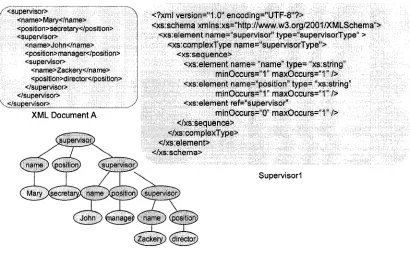
Many XML documents can be represented by ZX-trees. In this view, the root and inner nodes (labelled with a symbol from a ranked alphabet Z) of a ZX-tree correspond to elements which determine the structure of an XML document, while the leaf nodes (labelled with a symbol from a leaf alphabet X) provide data contents. For example, in Figure 3, XML document A is an instance of XML Schema Supervisorl and can be represented by the ZX-tree below it, where I = {supervisor, name, position} and X =
{Mary, secretary, John, manager, Zackery, director}.
In the domain of subtype-checking, we are only interested in the structure of a set of XML documents, rather than in actual data values. In such cases, we ignore the leaf alphabet X, and thus, an XML document can be adequately represented by a tree over a finite alphabet Z. Such finite labelled ordered trees are called Z-trees (Neven, 2002).
11
/ <supervisor> ( <name>Mary</name> <position>secretary</position> <supervisor>
<name>John</name> <position> manager</position> : <supervisor> <name>Zackery</name> <position>director</position> </supervisor> </supervisor> ■ ,</supervisor>
XML Document A
sjperviso
name ) (position) (supervisor
Mary Isecreta supervisor
osition anage name
Zackeryj (director
<?xml version="1.0" encoding="UTF-8"?>
<xs:schema xmlns:xs="http://www.w3.org/2001/XMLSchema"> <xs:element name="supervisor" type=“supervisorType'' >
<xs:complexType name="supervisorType"> <xs:sequence>
<xs:element name= “name" type= “xs:string” minOccurs="1” m a x O ccu rs-T /> <xs:element name=“position” type= “xsistring'1
minOccurs=“1” m a x O ccu rs-T /> <xs:element ref=“supervisor”
minOccurs=“0” maxOccurs=“1"/> </xs:sequence>
</xs:complexType> </xs:element> </xs:schema>
Supervisorl
Figure 3: An instance XML document of Supervisorl and its tree representation
2.3 Regular Tree Grammars and Regular Tree Languages
An XML Schema defines a set of Z-trees. The formal language for XML Schema should be defined over 2-trees. Tree grammars generate such trees and thus they are appropriate to model XML schemas. In our work, we capture XML Schemas by a class of tree grammars called regular tree grammars.
The formal definitions (shown below) of regular tree grammars and regular tree languages (below) are given in (Comon et al., 1999) and (Gecseg & Steinby, 1997). Please note that we do not consider the set of variables X in this thesis.
12
1 3
Definition 2 : Regular Tree Grammar
A regular tree grammar is defined by a system G = (E, N, P, S) where - E is a ranked alphabet or a set of terminal symbols;
- N is a finite nonempty set of non-terminal symbols and N fl E = 0 is assumed;
- P is a finite set of productions of form n t, where n e N and t e Tz(N);
- S is the start symbol and S e N.
Regular tree grammars have two main differences from other classes of tree grammars: - In a regular tree grammar, all non-terminal symbols have arity 0, while other tree
grammars allow non-terminals of arity greater than 0;
- A tree grammar has a set of production rules of form h where t\A2 are trees
defined over a terminal set E and a non-terminal set N. Additionally, h contains at
least one non-terminal. On the other hand, in any production of a regular tree grammar, only a single non-terminal is allowed on its left-hand-side. That is, the form
of productions is n - »t where n e N and t is a tree over EU N .
A regular tree grammar is used to derive trees from the start symbol S, using the corresponding derivation relations which can be defined simply by interpreting the productions of a regular tree grammar as the rewrite rules of a term rewriting system. That is, we replace a non-terminal A by the right-hand-side a of a rule A -* a. We use the
13
notation =>G to denote the one-step derivation relation of a regular tree grammar G and
the notation =>g to denote the general derivability relation of G.
A regular tree language, denoted by L(G), is the language generated by a regular tree grammar G. It is a set r ^ o f Jf-trees defined as:
L(G) = { t e T z \s=>G t}
Example 1: (regular tree grammar G l) A regular tree grammar that represents XML
Schema Supervisorl can be defined as G\ = (N, Z , P, S), where
N = {Supervisor}
£ = {supervisor, name, position, string} S -- Supervisor
P - { Supervisor -> supervisor(name(string), position{string), Supervisor) Supervisor —> supervisor(name(string), position(string)) }
The regular tree language generated by G\, denoted by L(G\), is a set of trees, i.e.,
L(G\) = { supervisor{name{string), position(string)), supervisor(name(string), position(string),
supervisor(name(string),position(string)))
}
The derivations of the two simplest trees in L(G\) are as follows:
14
1 5
Supervisor =>G supervisor(name(string),position(string))
Supervisor =>G supervisor(name(string), position(string), Supervisor) =>G supervisor (name(string), position(string),
supervisor(name(string), positionistring)))
A regular tree grammar G = (N, 27, P, S) is in normal form (Gecseg & Steinby, 1997) or called normalized (Comon et al., 1999) if each production of G is of form n -* c or n ->
l(n\,..., nm) where n ,n \,...,n me. N ,c e Zo, I e Z m, and m > 0. According to (Comon et al.,
1999, Proposition 3, p51), any regular tree grammar can be transformed into a normalized regular tree grammar. In the rest of the thesis, wherever we say regular tree grammars, we mean normalized regular tree grammars.
2.4 Unranked & Ranked Trees
An unranked tree is an 27-tree where nodes can have an arbitrary number of children. In other words, there is no fixed rank (or arity) associated with a label of an unranked tree. It is allowable for an XML Schema to define unranked trees. For example, in XML Schema Supervisorl, the supervisor node of the tree (as shown in Figure 3) has either two or three children. Hence, that tree is unranked.
In Definition 2, a regular tree grammar G = (N, 27, P, S) is defined over a ranked alphabet
27. That is, the right-hand side of a production has either a constant (i.e. a terminal
15
without children) or a terminal e Zm (m > 0) followed by m number of children. Hence, a
question comes up when we try to model XML Schemas that define sets of unranked trees, i.e., whether regular tree grammars are able to define unranked trees?
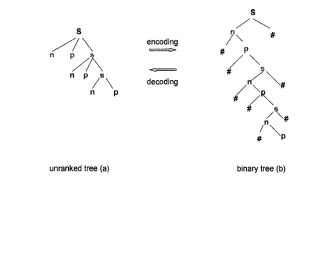
Neven’s work (Neven, 2002) on the relationship between unranked tree automata and ranked tree automata answers the question positively. In his paper, Neven claims that any unranked tree can be encoded into a binary tree where all non-leaf nodes have exactly two children in several ways. In Figure 4, we illustrate one such possibility.
n p
encoding / X
— ► #
n P
/ \ decoding
n p / Xn x#
• / \
'
A
#
unranked tree (a) binary tree (b)
Figure 4: The relationship between unranked trees and binary trees
The unranked tree (a) in Figure 4 is a short form of the tree in Figure 3 after deleting the data values. It can be converted into the binary tree (b) in Figure 4 by using some
16
1 7
encoding technique. Specifically, in the encoding, the leftmost child of a node remains the first child (i.e. left child) of this node and the other children o f this node are encoded into the right descendants of the left child. Whenever a node doesn’t have the left or right child, the symbol # is inserted as a placeholder.
After such encoding, the unranked tree (a) is converted into a ranked tree where all non leaf nodes have a fixed arity of 2. Then we can use a regular tree grammar to define such binary trees.
2.5 Intermediate Language
Using binary tree encoding, we see that unranked trees can be defined by regular tree grammars. However, the definition of regular tree grammar (i.e. Definition 2) should be slightly modified in order to deal with unrankedness.
Definition 3 : Intermediate Representation (Lee, Mani, & Murata, 2000)
- A regular tree grammar is defined by a system G = (27, Nj, N2, Pi, P2,S ) where 27,
N], and N2 are pairwise disjoint, and
- 27 is a set of terminal symbols;
- iVi is a finite nonempty set of non-terminal symbols used for deriving trees;
- N2 is a finite set of non-terminal symbols used for specifying content models (i.e.
the orders and structures of the children of tree nodes);
- P1 is a finite nonempty set of production rules of form n -* 1(A), where n e N \ , l e
17
E, and A e Nf,
Pi is a finite set of production rules of form A -> r, where A <e N i and r is a regular
expression over N\\
- Sis the start symbol and S e N[.
The right-hand side o f a production rule in a regular tree grammar conforming to Definition 3 is referred to as a type expression in this thesis.
Please note that regular expressions are introduced in the above definition of regular tree grammar to specify the orders and structures of the children of tree nodes. By using regular expression operators such as the Kleene star (*), concatenation (•), and alternation (|), unrankedness is introduced into the definition of regular tree grammars (see Definition 3). Thus, an XML Schema, which defines a set of trees (either ranked or unranked), can be represented by a regular tree grammar as defined in Definition 3. The definition of regular expressions is given in Definition 4.
Definition 4: Regular Expressions (Hopcroft & Ullman, 1979)
Let Nbe an alphabet. The regular expressions over N are defined recursively as follows:
• 0 is a regular expression and denotes the empty set;
• e (i.e. the empty string) is a regular expression and denotes the set {e};
• n (e AO is a regular expression and denotes the set {n};
18
• If r and s are regular expressions specifying the languages L(r) and L(s), then
r s is a regular expression and denotes the set {a-fJ \ a is in L(r) and /? is in L(s)};
• If r and s are regular expressions specifying the languages L(r) and L(s), then
r | s is a regular expression and denotes the set L(r) U L(s);
• If r is a regular expression specifying the language L(r), then the Kleene star —
r* is a regular expression and denotes the smallest superset of L(r) that contains e and is closed under string concatenation, i.e., the set of all strings that can be made by concatenating zero or more strings in L(r).
To illustrate the mapping between XML Schemas and regular tree grammars, we give another example below.
Example 2: (regular tree grammar (72) According to Definition 3, a regular tree
grammar representing XML Schema Supervisorl can be defined as G2 = (T, Nj, N2, Pi,
P2, S), where
A = {supervisor, name, position, strin g}
Ni = {Supervisor, Name, Position, String}
N2 = {SupervisorType, NameType, PositionType}
S = Supervisor
Pi = { Supervisor —» 5w/>ervwor(SupervisorType) Name —» «ame(NameType)
Position —> position^ PositionType) String —» string }
P2 = { SupervisorType -> Name • Position • (Supervisor | e)
NameType -» String
19
PositionType -» String}
Please note that grammar Gj can be rewritten into a regular tree grammar whose production rules have the form as in Definition 2. In other words, the forms n -* 1(A) and
A ^ r as defined in Definition 3 can be just viewed as the short forms o f n -> l(n i , . nm) as defined in Definition 2.
Theorem 1: A grammar G’ in Definition 3 can be transformed into an equivalent
grammar G in Definition 2.
Proof: The transformation is defined recursively on the structure of the definition of
grammars in Definition 3.
1) The terminal set E in G is mapped to the set E in G’ and the arity of any terminals in E in G that is greater than 1 is set to 1 in E in G’ (i.e., the arity of supervisor is changed to 1);
2) All non-terminals in the set N in G are included in the set N\ in G \ In addition, new non-terminals (i.e., Name, Position and String) are added in N\ to facilitate deriving trees from inner and leaf nodes;
3) New non-terminals ending with “Type” (i.e., SupervisorType, NameType, and PositionType) are added in the new set in G’. These non-terminals specify the content models of tree nodes labelled with supervisor, name, and position, respectively;
4) The start symbol S in G is mapped to the start symbol S in G’;
20
2 1
5) The productions of form n -* l(n \,..., nm) (where n, m,..., nm e N, I e Em, and m
> 0) of P in G are transformed into productions of form n -* 1(A) and A -* r
(where n e N i, I e E, and A e N i). The new set P i in G’ contains all productions
of form n -> 1(A) and the new set P2 in G’ contains all productions of form A -* r.
The form n -* 1(A) in G’ conforms to the form n -* l(n \,..., nm) in G. We prove (see
below) that A -* r in G’ can be transformed into the form n -* /(«lv .., nm) in G by using the definition of regular expressions (see Definition 4).
If r is the empty set 0, the empty string e, or any symbol n in N \, the form A
-* r obviously consistent with the form in G.
- Assume n\ -* a(Ai) and « 2 b(Ai), where A \, A2 e N2, «i, n% e N \, a , b e Z .
If r is the concatenation of » r«2, using binary tree encoding described in (Neven, 2 0 0 2), we get
If r is the alternation of n\\n2, using binary tree encoding described in (Neven, 2002), we get
A -> n\ •«2
n\ -> a(A\) m -*■ b(A2)
A - * a ( A1, b(A2, #)) (2-1)
A - * n \ \ n 2 n\ -* a(A1)
n2 -* b(A2)
A -> a(A\) (2-2)
21
A ■* b(A2) (2-3)
If r is n\*, using binary tree encoding described in (Neven, 2002), we get A -*• n\*
Y l \ Cl(A\)
A -> £ A -* a(Ai, #) A -> a(i4i, a(A\,A))
(2-4) (2-5)
(2-6)
Form (2-l)-(2-6) are consistent with the form n -> l ( n \ , . n m) in G.
Therefore, a grammar G' in Definition 3 can be transformed into a grammar G in
2.6 XML Schema Mapping
To facilitate XML Schema mapping, we partition the terminal set I into two disjoint sets lo and Em (m > 0), i.e. I = Z ()UZm. The set I m corresponds to the set of element names (or tag names) and the constants in Zq correspond to the built-in simple types defined in the XML Schema Recommendation (Fallside & Walmsley, 2004). The set N\ contains those non-terminals that we add in production rules. The non-terminal set N2 corresponds
to the set of type names. When anonymous types are encountered in an XML Schema, we introduce new non-terminals (in the set N2) and new production rules to facilitate XML
Schema mapping based on our modeling language. In this thesis, we assume that every XML Schema in our problem domain always has a root element S, whose production is of form n -* 1(A). An element declaration defines a production rule of form n -* 1(A)
Definition 2, and G ’ is equivalent to G. Q.E.D.
22
2 3
where n e N\, I <= E corresponds to the assigned element name, and A e jV2 corresponds to
the assigned type name for this element. A complex or simple type-definition defines a production rule without terminals, i.e., A -> r. The regular expression on the right-hand
side of such a production rule (e Pi) corresponds to the content model of a type.
In addition, we also extend the notion e* in the definition of regular expressions to e{n, m}, in order to denote an occurrence of at least n and at most m times of iteration of a regular expression e connected by concatenation, where n is a non-negative integer and m is either a non-negative integer (n < m) or the string of value undefined. The values of n and m directly correspond to the values of the attributes minOccurs and maxOccurs in an element declaration, respectively. The Kleene star (*) and other commonly-used operators for regular expressions are redefined (Hohenadel, 2003) as follows:
e* = e{0, undefined} e+ = e{ 1, undefined} e? = e{0, 1}
Like other research work on schema subtyping (Kempa & Linnemann, 2003) (Hohenadel, 2003), the intermediate language (see Definition 3) can not model all the features of XML Schemas. We explain that in the following.
1. Attributes. We do not consider attributes in this thesis. How to compare two types
with different attribute types? One possible method proposed by (Kempa &
23
Linnemann, 2003) to solve this problem may be to consider an attribute as a special “child” of the corresponding node.
2. Namespaces. Namespaces are an important issue in the context of XML Schema.
However, in order to simplify XML Schema mapping, this thesis ignores namespaces.
3. Content Types. There are four types of contents for complex types: simple, element,
mixed, and empty. An element that has simple content contains only character data
and attributes. An element that has element content contains child elements, but no character data content. If an element has both child elements and character data content, it has mixed content. If an element does not have any content (just attributes), it has empty content. In this thesis, we only consider elements with simple and
element contents.
4. Model groups. In XML Schema, content models are defined using a combination of
model groups, element declarations or references, and wildcards. There are three kinds of model groups: sequence, choice, and all. The sequence model group requires that the child elements appear in the order specified. The choice model group allows any one of child elements to appear. The all model group requires that all the child elements appear 0 or 1 times, in any order. These groups can be nested, and may occur multiple times, allowing you to create sophisticated content models. For now, we only consider two kinds of model groups: sequence and choice.
24
2 5
5. Include and import. An XML Schema can be composed of one or more other XML
Schemas. One way (but not the only way) to compose schemas is through the mechanisms include and import provided in the XML Schema Recommendation (Fallside & Walmsley, 2004). Include is used when the other schema(s) has the same target namespace as the main schema. Import is used when the other schema document has a different target namespace. In the future, we will work on how to deal with the import and include mechanisms in XML Schema mapping.
6. List and union types. Most simple types in XML Schemas are atomic types, which
mean they contain values that are indivisible. Besides atomic types, there are also two other varieties of simple types: list and union types. List types have values that are whitespace-separated list of atomic values, such as <availableSizes> 10 large
2</availableSizes> (Walmsley, 2002). Union types may have values that are either
atomic values or list values. In this thesis, we do not consider list and union types.
7. Other features. Some features provided by the XML Schema Recommendation are
not an integral part o f every XML Schema. These features include reusable groups, identity constraints, substitution groups, and redefinition.
2.7 Schema Determinism
The paper (Murata, Lee, Mani, & Kawaguchi, 2005) defines two restricted classes of regular tree grammars: local tree grammars and single-type tree grammars. A local tree grammar is a regular tree grammar without competing non-terminals (Murata, Lee, Mani,
25
& Kawaguchi, 2005). Two different non-terminals compete with each other if their productions share the same terminal on the right-hand side. This class of regular tree grammars roughly corresponds to DTD (Murata, Lee, Mani, & Kawaguchi, 2005).
A single-type tree grammar is such a regular tree grammar that for each production rule of form A -> r, the non-terminals appearing in regular expression r do not compete with each other. We see that a single-type tree grammar is less restricted than a local tree grammar because it allows the existence of competing non-terminals in different content model.
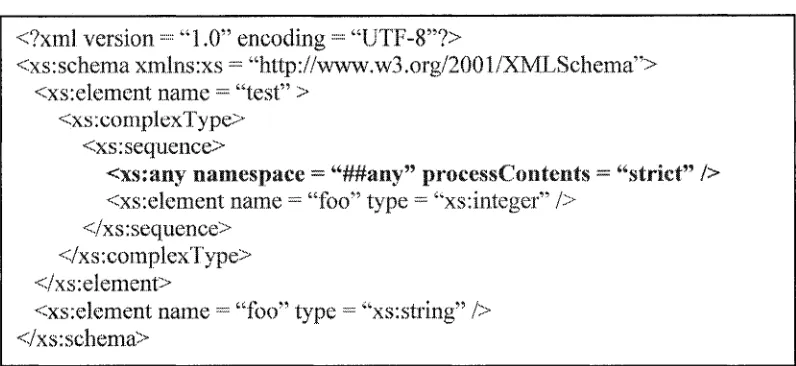
Like XML 1.0, XML Schema requires that content models be deterministic (Walmsley, 2002). That is, a schema processor, as it makes its way through the children of an instance element, must be able to find only one branch of the content model that is applicable, without having to look ahead to the rest of the children. According to this specification, the expressiveness of XML Schema should be within that of single-type grammars. However, in some cases, it is beyond the expressiveness of single-type tree grammars. For example, element wildcards supported by the XML Schema Recommendation, which are represented by the any elements, allow elements without specifying tag names. This feature doubtless increases flexibility as to what elements may appear in a content model. However, it may lead to non-single-type schemas. Let’s consider the following XML Schema borrowed from (Murata, Lee, Mani, & Kawaguchi, 2005).
26
2 7
<?xml. version = “ 1.0” encoding = “UTF-8”?>
<xs:schema xmlns:xs = “http://www.w3.org/200l/XMLSch^ma’b* <x.s:element name = “test” >
<xs xomplexTy pe> <xs:sequence>
<xs:any namespace = “##any” processContents = “strict” /> <xs:element name = “foo” type = “xs:integer” />
</xs:sequence> </xs: com plex! ype> </xs:element>
<xs:element name = “foo” type = “xs:string” /> </xs:schema>
Figure 5: XML Schema Test
The XML Schema Recommendation allows two element declarations with the same element names, as long as they are in different scopes. In XML Schema Test, the foo
element of type integer is scoped to the complex type within which it is declared, while the foo element of type string is global-scoped. Although these two element declarations share the same element name, they are in different scopes and thus they are allowable in XML Schemas.
In XML Schema Test, the value of the namespace attribute in the any element declaration (in bold) is Many, which means the replacement element can be in any namespace whatsoever, or be in no namespace. So, one of the possible replacement elements is the
foo element of type string. In such a case, the content model of XML Schema Test is non- deterministic because the processor, if it first encounters a child foo, will not know whether it should validate it against the fo o declaration of type string, or the foo
declaration of type integer.
27
We represent XML Schema Test by a regular tree grammar G3 = (Z, Nj, N2, Pi, P2, S)
where
Z = {test, foo, integer, string}
Nj = {Test, Any, Foo, String, Integer} N2 = {TestType, FooType}
S = Test
Pi = { Test -» test(TestType)
Any —> /oo(FooTypel)
Foo —»/oo(FooType2)
Integer —> integer
String —> string } P2 - { TestType Any • Foo
FooType 1—>■ String FooType2 -> Integer }
We see that ( 7 3 is not a single-type tree grammar because the non-terminals Any and Foo
compete with each other. That is, their production rules (in bold) have different non terminals on the left-hand side, but share the same terminal on the right-hand side. Moreover, these non-terminals appear in the right-hand-side regular expression of the following production
TestType —> Any • Foo
In terms of expressive power, any local tree language is a single-type tree language and any single-type tree language is a regular tree language ((Murata, Lee, Mani, &
28
2 9
Kawaguchi, 2005, Lemma 2.1). Most XML Schemas can be represented by single-type tree grammars. However, if the content model of an XML Schema is non-deterministic, only a regular tree grammar can model this XML Schema.
2.8 Subtyping
Based on the definitions of regular tree grammars and regular tree languages (see Definition 3), we formally define subtyping below.
Definition 5 (subtyping')
Given two XML Schemas R and S, R is a subtype of S (denoted by R <: S) if L(R) c= L(S), where L(R) and L(S) are regular tree languages generated by the regular tree grammars representing R and S, respectively.
As XML Schemas describe sets of XML documents, the subtyping problem between XML Schemas is reduced to the set-inclusion problem of sets of XML documents. This concept of inclusion-subtyping corresponds to one of the XML Schema derivation mechanisms: type restriction. As its name implies, type restriction means restricting the valid content of either a simple type or a complex type (i.e. base type) to define a new one. Specifically, the XML Schema Recommendation provides twelve facets (e.g. minlength, maxlength, pattern, enumeration, etc.) for users to specify a valid range of values, to constrain the length and precision of values, to enumerate a list of valid values, or to specify a regular expression that valid values must match. All instances of a new type derived by restriction are valid against its base type. In other words, the set of
29
instances consistent with the restricted type is a subset of the set of instances of its corresponding base type. In terms of the concept of set-inclusion subtyping (Definition 5), a restricted type is a subtype of its base type.
However, this concept of set-inclusion subtyping is not sufficient to support another important XML Schema mechanism, namely, type extension, which yields a “subclass” relationship by adding additional child elements and/or attributes to the tail of a “superclass” type, thus extending the content of the “superclass” type. This is quite similar to inheritance in object-oriented languages. Obviously, instances of an extended type are not valid against its base type any more, since new elements and/or attributes are
added, and vice versa. For example, given a type person we may define another type
employee where the instances of employee have the same elements as the instances of
person, except for the augmentation with a new child element named employeeNumber.
Like what is done in object-oriented processing, we are able to apply all the methods/procedures for type person to the instances of type employee. However, since neither of the instance sets of type employee and type person is a subset of the other, the relationship between these “subclass” and “superclass” types can not be described by set- inclusion subtyping. In the paper (Bry et al., 2004), a notion of extension-subtyping is proposed to deal with XML Schema’s type extension. However, we will not go further about this kind of subtyping here, because it is beyond the scope of this thesis.
30
CHAPTER III
A SUBTYPING ALGORITHM FOR XML SCHEMAS
3.1 What is a Subtyping Algorithm?
The subtyping problem for XML Schema is often reduced to the inclusion problem for regular expressions or regular tree languages (Hosoya, Vouillon, & Pierce, 2000) (Kempa & Linnemann, 2003) (Hohenadel, 2003). Since we model XML Schemas based on regular tree grammars, checking the subtype relationship between two regular tree languages is the main task in this thesis.
An algorithm that aims to check for L(r) c L(s) is called a subtyping algorithm, which
lies at the core of XML-centric programming language implementations. The input of such a subtyping algorithm is a subtype relationship statement r <: s, which is called regular inequality (Antimirov, 1994). The output of a subtyping algorithm is either true ox false, in accordance to the truth value of the input subtype relationship statement.
3.2 Main Ideas of the Subtyping Algorithm
Based on Antimirov’s derivation calculus (Antimirov, 1994) for regular expressions and its extensions to regular hedge expressions (Kempa & Linnemann, 2003) (Hohenadel, 2003), we formalize and rebuild the algorithm for regular tree grammars, which is very close to that for regular hedge grammars. Additionally, we add some heuristics in the
31
algorithm.
r.i <: si
no
yes
Tm <! Sm result
Trivial Check Simplification
Figure 6: Main ideas of the subtyping algorithm
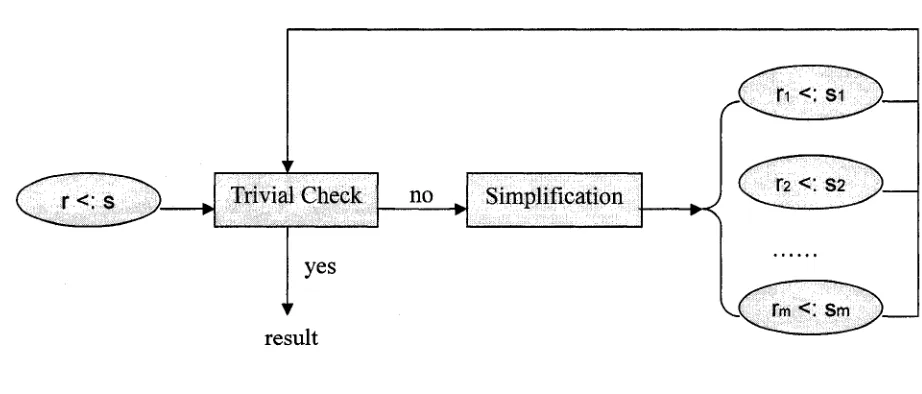
The basic idea of the subtyping algorithm (shown in Figure 6) is as follows: given two XML Schemas, if they can be trivially checked, the algorithm stops and returns the result immediately. Otherwise, it recursively simplifies the corresponding type expressions of the input XML Schemas, until they are simple enough to perform a trivial check.
For every invalid regular inequality, there exists at least one reduced regular inequality which is trivially inconsistent (Antimirov, 1994). A regular inequality r <: s is trivially inconsistent if the language generated by r contains the empty type e and the language generated by s doesn’t. If no such a trivially-inconsistent regular inequality is encountered, then after a finite number of derivation steps, the system ends up with a state that all reduced inequalities are already processed in previous derivation steps (i.e.,
32
3 3
no new inequality is reduced any more). In this case, the original regular inequality is assumed to be true. This is a standard procedure in subtyping algorithms of recursive types (Hosoya, Vouillon, & Pierce, 2005) and (Kempa & Linnemann, 2003). The correctness and termination proofs given by the paper (Hosoya, Vouillon, & Pierce, 2005) explain that if there is no trivial inconsistency encountered in recursions, the algorithm can eventually end up with the state that it cannot produce any new reduced regular inequality, and then the input regular inequality holds.
So, subtyping algorithms of recursive types, including ours, do not prove subtyping directly. Instead, these algorithms keep track of already-treated inequalities in an
environment variable a , which is a set of inequalities and is empty at the beginning of the algorithms. Each time before a regular inequality is subtype-checked, the system checks whether this inequality is already in the environment a . If yes, the inequality is proven to be true; otherwise, the inequality is put into the environment a before the system simplifies it. Next time when the system encounters the same inequality again, it stops and returns true. Thus, the termination of subtyping algorithms is ensured.
From Figure 6, we see, to (dis)prove r <: s where r and s are the type representations of two given XML Schema, there are two steps: (1) trivial check; (2) simplification. The process of simplification or derivation leads to a number of simpler regular inequalities. The algorithm recursively calls steps (1) and (2) on those regular inequalities. We will discuss these two steps at length in the following subsections.
33
3.3 Check for e-inclusion
Checking fo r e-inclusion of a type expression e means to check whether the regular tree
language Z(e) contains the empty string e, i.e. e e Z(e).
Given a regular inequality r <: s, if the language represented by r contains e, but the language represented by s doesn’t, i.e.
esZ (r) A e$Z (s)
one can easily infer L{r) <£ L(s). Then, according to the formal definition of subtyping (see Definition 5), the given inequality r <: s doesn’t hold. This situation, i.e., eeZ(r) A e $ L(s), is called a trivial inconsistency (Antimirov, 1994), which is a special case of e-
inclusion check.
If a trivial inconsistency occurs, the algorithm returns false immediately; otherwise, the input inequality r <: s is recursively simplified (or reduced), until all reduced inequalities are simple enough to perform a trivial check.
To check for e-inclusion in the implementation of the subtypng algorithm, we redefine the function Nullable below, which was originally defined in (Hohenadel, 2003), by replacing its original expressions with our type expressions as the argument. Since Hohenadel’s formal framework for XML Schema is different from ours, these two
34
3 5
expressions are different. The Nullable function returns true if a type expression e is
nullable, i.e., t e Z(e); otherwise, false.
Nullable(0) = false (N1)
Nullableii) = true (N2)
Nullable( c) = false, where c e N 0 (N3) Nullable{ 1(A) ) = false, where A e Nj, I e A (N4) Nullable(Q\ ei) = Nullable(e1) A Nullable(ti) (N5) Nullable(e\ \ e.2) = Nullable(e\) v Nullable(Qi) (N6) Nullable(e{ n,m}) =true, ifn = 0 (N7a) | Nullable(e), otherwise (N7b)
To illustrate the derivation process, we introduce a concrete example here.
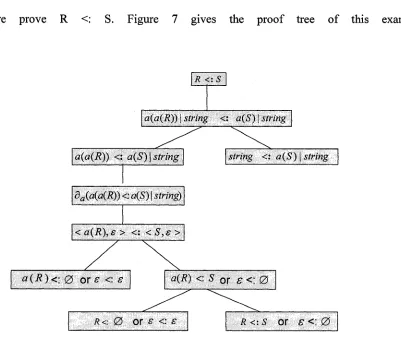
Example 3: To check if R <: S holds, where
R —» a(a(R)) | string S —> a(S) | string
After unfolding the non-terminal R and S by replacing them with their corresponding right-hand-side type expressions, the original inequality R <: S is rewritten as:
a(a(R)) | string <: a(S) | string
To check the above inequality is equal to check the following two inequalities:
(1) a(a(R)) <: a(S) | string (2) string <: a(S) | string
35
The second inequality is trivially true according to set theory and the definition of
subtyping (see D efinition 5). Thus, w e focus on checking the first inequality in the
following computations.
According to rule N4, we get
Nullable(a(a( R))) = false
So, the inequality a(a(R)) <: a(S)\string is not trivially inconsistent. We need to simplify it.
3.4 Simplification Process
XML Schemas define the tree structures of sets of XML documents. The tree structures, as defined in Definition 3 (i.e. S -> 1(A)), are derived from the root elements of XML Schemas. So, to compare two XML Schemas, we actually compare two trees derived from their root elements. From this point of view, we roughly explain how the simplification process works below.
Our subtyping algorithm adopts a top-down checking approach to fulfill this task. That is, the algorithm first checks the roots of two trees that represent two given XML Schemas. If the two roots have different labels (i.e. element names in our problem domain), then the algorithm stops and return false. In such a case, we think that there is no subtyping relationship between the two input XML Schemas. If the roots share the same element
36
3 7
name, the algorithm proceeds to check the content models of the roots. This check, augmented with the check for siblings, is repeated recursively on the inner nodes. For leaf nodes, the algorithm only needs to check their labels and siblings because leaf nodes do not have any children (or content model). Briefly speaking, our algorithm does the subtype-check for two trees dependently on the three dimensions of a node of a tree: the label, the content model and the siblings.
To make the algorithm recognize these three parts, we introduce the concept of linear forms (Antimirov, 1994). A linear form is a pair consisting of the label of a leaf node or the label of a non-leaf node followed by its content model as the first component and the siblings of the node as the second component. The set of linear forms of a tree node (denoted by a type expression) contains all possible permutations of the label, content model and siblings that the node can have.
If two tree nodes have the same label, the system only needs to check the content model and siblings of these nodes. These two parts are represented by the rest of the linear form after extracting the label. The label to be extracted is called a leading name (Kempa & Linnemann, 2003). The rest part, i.e., the pair only consisting of the content model and siblings, is called a partial derivative (Antimirov, 1996) of the original expression. Since a leading name is extracted from a linear form of the original expression, the resulted partial derivative is simpler than the original expression. The subtype-check is called recursively on partial derivatives of two type expressions.
37
To reduce (or simplify) a regular inequality r <: s, we have to compute: (1) the linear forms of type expressions r and s
(2) the leading names of r
(3) the partial derivatives of r and s (4) the partial derivatives of r <: s
3.4.1 Linear Forms
Following the definition of linear form s o f a regular term (Antimirov, 1994), Hohenadel (Hohenadel, 2003) defines the set of linear forms of an expression e, denoted by I ff), as a set of pairs consisting of the leftmost expression in e as the first component and the
remainder o f e as the second component. For example, let a, b c e Eo and I e E\,
W )
=
i<a>
£>)
lAKa)) = {<l(a),e>}
W ( a ) ‘ b) = {< (a ),b > )
lf(a\ b)-c) = {<a, c>, <b, c>}
Intuitively, the set of linear forms of an expression actually represents the permutation of all possible sequences in the language specified by the expression.
To compute the linear form s of a type expression, we modify the If function (Hohenadel, 2003) by taking our type expressions rather than regular expressions (Hohenadel, 2003) as the input. The function If is redefined recursively by the following equations.
38
3 9
//(0 ) = 0 (LF1)
//(£) = 0 (LF2)
If (c) = {< c, e>}, where c e 270 (LF3)
If (1(A)) = {< 1(A), e >}, where A e N2,1 e S (LF4)
If (61-62) = //(ei) © e2, if Nullable(ei) = false (LF5a)
| If (Q\) © e2 U If (ei), otherwise (LF5b)
/ / ( ei | e2) = //( ei) U If ( a ) (LF6)
lf ( e {n, m}) = lf(e) © e{n, m}, if m is “undefined” (LF7a)
| I f (e) © e{n,m-l}, otherwise (LF7b)
The computation of linear forms involves a binary concatenation operation © , which
takes a set o f linear forms and a type expression as its arguments, and returns another set of linear forms. It is an extension of concatenation to linear forms and its definition (see below) is borrowed from Antimirov (Antimirov, 1994).
For any set of linear forms I, I ’ and any type expression x, t, p, excluding 0 and £,
I© 0 = 0 (LF8)
0 © t = 0 (LF9)
/ © £ = / (LF10)
{<x,p>}® t = {<x,p t>} (LF11) ( i o n © < = ( / © t) u ( / ' © 0 (LF12)
Let’s go back to Example 3. According to the definition of linear forms, we get
39
lf(a(a(R))) = {<a(a(R)), £>}
//a (S ) | string) = //>(S)) u //string)
by rule LF4 by rule LF6
= (<tf(S), £>} u {<string, £>} by rule LF4 and LF3
= {<a(S), e>, <string, £>} by set theory
3.4.2 Function First
According to the definition of regular tree grammars (Definition 3), a leading name of a type expression can be an element name or a built-in simple type. This is the part to be extracted from the linear forms of this type expression.
Please note that a type expression may have more than one leading names. For example, the leading names of type expression ei|e2 should include the leftmost constants of ei and e2. Another case is the concatenation e r e2, where ei is nullable, the leading names of e r e2 should include the leading name of e2.
To compute the leading name(s) in a type expression, we use the First function, which takes a type expression as input and returns a set of leftmost terminals. The definition of
First is given below (Aho, Sethi & Ullman, 1988).
*
1. If n c where c e F 0, Firstin) - {c};
*
2. If n =>g c a where c e F 0and is a sequence of symbols from F and N,
First(n) = {c}. If n =>c s, add s to First(n);
3. If n =>G a \a 2...a mwhere ct\, a 2, ..., a m<= F 0, add F irst(a\) to First(n). If a\
40
4 1
* * *
=>g £\ add F irstia i) to First(ri). If a \ =>g £ and a-±=>G e, add F irst(a3) to First(ri), and so on.
Please note that this function is only applied on the left-hand-side type expression of a given regular inequality. In Example 3, First( a(a(K) ) ) = {a}.
3.4.3 Partial Derivatives of a Type Expression
After extracting a leading name w e First(e)/{s} from the linear forms of a type expression e, the remainder of the linear forms, i.e., the set of partial derivatives of e w.r.t.
w is denoted by d w ( e ) . The set of partial derivatives of a type expression represents the
reduced representation of the original type expression.
As the linear forms of a type expression is a set of pairs, the partial derivatives of the type expression is also a set of pairs after extracting a leading name. However, the first
component of a pair in d w(e) is the content of the leading name, instead of the leftmost
type expression. We modify the definition of partial derivatives (Hohenadel, 2003) as follows.
dw(e)={< cn(ei, w), ey> \ <ei, ei> e lf(e), and cn(ej, w) ^ 0}
In the above definition, we remove the original condition Q2 i1 0 and add cn(ei, w) ^ 0.
The reason why we don’t need e2 ^ 0 is the empty set can not be the second component of a type pair according to the definition of linear form (see Section 3.4.1).
41