ISSN(Online): 2320-9801
ISSN (Print) : 2320-9798
I
nternational
J
ournal of
I
nnovative
R
esearch in
C
omputer
and
C
ommunication
E
ngineering
(An ISO 3297: 2007 Certified Organization)
Vol. 3, Issue 8, August 2015
Genetic Algorithm Based Multicast Routing
Used In Mobile Ad Hoc Networks
T. Nalini, J.Sridhar
Professor, Department of Computer Science and Engineering, Bharath University, Chennai, Tamil Nadu, India
Assistant Professor, Department of Computer Science and Engineering, Bharath University, Chennai, Tamil Nadu,
India
ABSTRACT: Many intelligent optimization techniques like Artificial Neural Networks (ANN),Genetic Algorithms
(GAs), etc., were being proposed to find the static shortest path. Rapid advancements in the wireless communication particularly in the field of mobile networks has emerged as two major fields namely Mobile Ad hoc Networks (MANETs) and Wireless Sensor Networks (WSN). Topology dynamics is the top most challenge in the mobile wireless network field i.e., the network topology changes over time due to energy conservation or node mobility. In order to find the shortest path (SP) with in this network becomes a dynamic optimization problem due to nodes mobility. Nodes usually die due to low energy or it may move, this scenario makes the network to be more complex for finding shortest path. In this paper we propose a novel method of using Genetic Algorithms (GAs) to solve the dynamic shortest path discovery and routing in MANETs. MANETs is one of the faster growing new-generation wireless networks. The experimental results indicate that this GA based algorithm can quick adopt to environmental change (i.e. the network topology change) and produce high quality solutions after each change.
KEYWORDS: Wireless Sensor Networks, MANET, Multicast Routing
I. INTRODUCTION
Mobile ad hoc network (MANET) could be a self-organizing and self-configuring multihop wireless network, that consists of a group of Mobile Hosts (MHs) that may move around freely and join forces in relaying
packets on behalf of one another. Manet supports strong and efficient operations by incorporating the
routing functionality into MHs. In MANETs, the unicast routing establishes a multihop forwarding path for 2 nodes on the far side the direct wireless communication vary. Routing protocols conjointly maintain property once links on these methods break as a result of effects like node movement, battery emptying, radio propagation, and wireless interference. In multihop networks, routing is one in all the foremost necessary problems that includes a vital impact on the performance of networks. So far, there square measure in the main 2 kinds of routing protocols in MANETs, namely, topological routing and geographic routing. within the topological routing, mobile nodes utilize the topological data to construct routing tables or search routes directly. within the geographic routing, every node is aware of its own position and makes routing choices supported the position of the destination and therefore the positions of its local neighbors.
ISSN(Online): 2320-9801
ISSN (Print) : 2320-9798
I
nternational
J
ournal of
I
nnovative
R
esearch in
C
omputer
and
C
ommunication
E
ngineering
(An ISO 3297: 2007 Certified Organization)
Vol. 3, Issue 8, August 2015
II. RELATED WORK
A near-optimal routing algorithmic program using a changed Hopfield neural network (HNN) is conferred. Since it uses each piece of knowledge that's out there at the peripheral neurons, additionally to the extremely correlate data that's out there at the native vegetative cell, quicker convergence and higher route optimality is achieved than with existing algorithms that use the HNN. moreover, all the results are comparatively freelance of topology for
pretty much all source-destination pairs.[1]
This paper[2] presents a replacement neural network to resolve the shortest path drawback for inter-network routing. The planned resolution extends the normal single-layer repeated Hopfield design introducing a two-layer design that mechanically guarantees a complete set of constraints control by any valid resolution to the shortest path drawback. This new technique addresses a number of the restrictions of previous solutions, particularly the dearth of dependability in what issues successful and valid convergence. Experimental results show that Associate in Nursing improvement in successful convergence is achieved in sure categories of graphs. in addition, computation performance
is additionally improved at the expense of slightly worse results
the target of this study may be a comparison of 2 models of the genetic algorithmic program, the people and incremental/steady state genetic algorithms, to be used in non stationary/dynamic environments. it's by experimentation shown that the selection of an acceptable version of the genetic algorithmic program will improve its performance in such environments. this could extend the power of the genetic algorithmic program to trace environmental changes that are comparatively tiny and occur with low frequency while not the requirement to
implement a further technique for pursuit dynamical optima.[3]
The behavior of normal organic process algorithmic program within the case of multi-modal optimization serious issue. It typically converges towards one optimum purpose failing to take care of within the population the multiple optima of the matter into consideration. Varied strategies enrich the quality algorithmic program to get economical techniques for resolution multi-modal issues. These strategies chiefly encompass increasing the population diversity and of maintaining the promising areas within the search area so as to finally deliver the goods convergence of the population towards the multiple optima. the current paper introduces mmEA, Associate in Nursing organic process algorithmic program for multimodal optimization supported multidimensional exploration of the search area. this method does not need any user outlined parameter except those specific to plain organic process algorithmic program. Experiments and comparisons with similar techniques from literature, for static and dynamic atmosphere, prove that mmEA
technique is promising.[4]
several real-world optimization issues have to be compelled to be solved underneath the presence of uncertainties.
A big range of those uncertainty issues falls into the dynamic optimization class within which the
fitness operate varies through time. For this category of issues, Associate in nursing organic process algorithmic program is anticipated to perform satisfactorily in spite of various degrees and frequencies of modification within the fitness landscape. Additionally, the dynamic organic process algorithmic program ought to warrant an appropriate performance improvement to justify the extra procedure price. Effective apply of previous organic process data may be a should because it facilitates a quicker convergence when a modification has occurred. This paper proposes a replacement dynamic organic process algorithmic program that uses variable relocation to adapt already converged or presently evolving people to the new status. The planned algorithmic program relocates those people supported their modification in operate price as a result of the modification within the atmosphere and therefore the average sensitivities of their call variables to the corresponding modification within the objective area. The relocation happens throughout the transient stage of the organic {process biological process} process, and therefore the algorithmic program reuses the maximum amount data as attainable from the previous organic process history. As a result, the algorithmic program shows improved adaptation and convergence. The new custom-made population is shown to be fitter to the new atmosphere than the initial or most willy-nilly generated population. The algorithmic program has been tested by many dynamic benchmark issues and has shown competitive results compared to some
chosen progressive dynamic organic process approaches.[13]
ISSN(Online): 2320-9801
ISSN (Print) : 2320-9798
I
nternational
J
ournal of
I
nnovative
R
esearch in
C
omputer
and
C
ommunication
E
ngineering
(An ISO 3297: 2007 Certified Organization)
Vol. 3, Issue 8, August 2015
algorithmic program, etc. The DSPRP in MANETs may be a real-world dynamic optimisation drawback (DOP). In recent years, finding out organic process algorithms (EAs) for DOPs has attracted a growing interest as a result of its importance in EA’s real-world applications. The only approach of addressing DOPs is to restart EAs from scratch whenever Associate in Nursing atmosphere modification is detected. Although the restart theme extremely works for a few cases, for several DOPs, it's a lot of economical to develop alternative approaches that build use of data gathered from recent environments. Over the years, many approaches are developed for EAs to handle dynamic environments, like maintaining diversity throughout the run via random immigrants, increasing diversity when a modification, victimization memory schemes to apply keep helpful data applying multi population and evolution schemes to go looking in several regions of the search, and adapting (the parameters of) operators to quickly reply to a replacement atmosphere. Once the topology is modified, new immigrants or the helpful data keep within the memory will facilitate guide the search of fine solutions within the new atmosphere. [6]
III. MODULE DESCRIPTION
Network model implementation
Shortest path implementation
Unicast routing
Multicast routing
Dynamic Environment Change
31. NETWORK MODEL:
First sample network has to be designed. Here some of the mobile nodes can be added to the particular network region. After, the creation of nodes connections will be established. Then path cost will be set for each connectivity.[7]
3.2. SHORTEST PATH:
This module is used to find the shortest path from the source node to the destination node. Here shortest path is calculated for both
Unicast routing
Multicast routing
3.2.1. Unicast Routing:
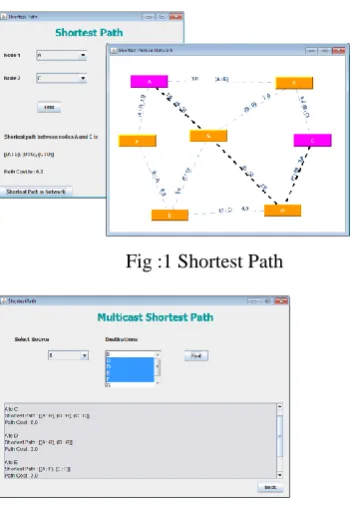
The message packets are sent from source to destination by multi hop forwarding path, so the shortest path is calculated between single source to the single destination.
3.2.2. Multicast Routing:
The single message in forwarded from the source to multiple destination,
So the shortest path is finding between single source to the multiple selected nodes in the network.
3.3. DYNAMIC ENVIRONMENT CHANGE:
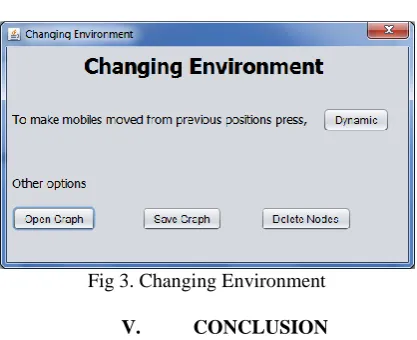
This module is designed to make change in the network model. Here two techniques are used to change network model.
Mobility
Power loss
In MANET, nodes are not in fixed position; they are changing their position time to time. It affects the path cost also. So, it has to run the shortest path once again.
Some times due to power loss, the mobile nodes on link can be failure. This also make change in network structure.
Due to the above reasons population in particular region is changed in every generation, so we have to maintain the diversity level. For that we are calling the immigrants method. Memory scheme method is used to enhance the performance of GA, by storing the old environment changes for the new generations.
3.3.1 DYNAMIC SP ROUTING PROBLEM:
ISSN(Online): 2320-9801
ISSN (Print) : 2320-9798
I
nternational
J
ournal of
I
nnovative
R
esearch in
C
omputer
and
C
ommunication
E
ngineering
(An ISO 3297: 2007 Certified Organization)
Vol. 3, Issue 8, August 2015
communication links connecting 2 neighboring routers falling into the radio transmission vary. A communication link (i, j) can not be used for packet transmission unless each node i and node j have a radio interface every with a typical channel. However, the channel assignment is on the far side the scope of this paper. additionally, message
transmission on a wireless communication link can incur exceptional delay and price. The
DSPRP is informally delineated as follows. Initially, given a network of wireless routers, a delay boundary, a supply node, and a destination node, we have a tendency to would liketo search out a delay finite least price loop-free path on the topology graph. Then, sporadically or stochastically, because of energy conservation or another problems, some nodes square measure regular to sleep or some sleeping nodes square measure regular to rouse. Therefore, the configuration changes from time to time. the target of the DSPRP is to quickly realize the new optimum delay-constrained least price acyclic path when every topology modification.
3.3.2 SPECIALIZED GA FOR THE SP PROBLEM:
This section describes the frame work of the GA for the SP problem. The frame work of the GA involves several key components: genetic representation, population initialization, fitness function, selection scheme, crossover, and mutation. A routing path consists of a sequence of adjacent nodes in the network. For the routing problem, the path-oriented encoding and the path-based crossover and mutation are also very popular
3.3.2.1. Genetic Representation:
A routing path is encoded by a string of positive integers that represent the IDs of nodes through which the path passes. Each locus of the string represents an order of a node (indicated by the gene of the locus). The gene of the first locus is for the source node and the gene of the last locus is for the destination node. The length of a routing path
should not exceed the maximum length. [8]
3.3.2.2. Population Initialization:
In the GA, each chromosome corresponds to a potential solution. The initial population Q is composed of a
certain number of, say q, chromosomes.[9] To promote the genetic diversity, in our algorithm, the corresponding
routing path is randomly generated for each chromosome in the initial population. We start to search a random path
from s to r by randomly selecting a node v1 from N(V1), the neighborhood of s. Then, we randomly select a node v2
from N(v1 ). This process is repeated until r is reached. Since the path should be loop-free, those nodes that are
already included in the current path are excluded from being selected as the next node to be added into the path, thereby avoiding reentry of the same node into a path.[10]
3.2.3. Fitness Function:
It is used to find the least cost path between the source and the destination. My primary criterion of solution quality is the path cost. Therefore, among a set of candidate solutions (i.e., unicast paths), we choose the one with the least path cost
3.2.4. Selection Scheme:
Selection plays an important role in improving the average quality of the population by passing the high-quality chromosomes to the next generation. The selection of chromosome is based on the fitness value.[11]
3.2.5. Crossover and Mutation:
A GA relies on two basic genetic operators, crossover and mutation. crossover processes the current solutions so as to find better ones. Mutation helps a GA keep away from local optima.[16] Here chromosomes are expressed by the path structure, the single-point crossover to exchange partial chromosomes (subpaths) at position ally independent crossing sites between two chromosomes. The population will undergo the mutation operation after the crossover operation is performed. Both crossover and mutation may produce new chromosomes that represent infeasible solutions. Therefore, we check if the path represented by a new chromosome is acyclic. If not, a repair function will be applied to eliminate the loops[17].
ISSN(Online): 2320-9801
ISSN (Print) : 2320-9798
I
nternational
J
ournal of
I
nnovative
R
esearch in
C
omputer
and
C
ommunication
E
ngineering
(An ISO 3297: 2007 Certified Organization)
Vol. 3, Issue 8, August 2015
3.3.1. GAs with Immigrants schemes:
In stationary environments, convergence at a proper pace is really what we expect for GAs to locate the optimum solutions for many optimization problems. However, for DOPs, convergence usually becomes a big problem for GAs because changing environments usually require GAs to keep a certain population diversity level to maintain their adaptability.[12] To address this problem, the random immigrants approach is a quite natural and simple way. The random immigrants maintains the diversity level of the population through replacing some individuals
of the current population with random individuals, called random immigrants, every generation. As to which
individuals in the population should be replaced, usually there are two strategies: replacing random individuals or replacing the worst ones.[13]
3.3.2. GAs with memory schemes:
While the immigrant’s schemes use random immigrants to maintain the population diversity to adapt to the changing environments, the memory scheme aims to enhance the performance of GAs for DOPs in a different way.[14] It works by storing useful information from the current environment ,either implicitly through redundant representations or explicitly by storing good (usually best) solutions of the current population in an extra memory. The stored information can be reused later in new environments. For example, for the explicit memory scheme, when the environment changes, old solutions in the memory that fit the new environment well will be reactivated, and hence, may adapt GAs to the new environment more directly than random immigrants would do. Especially, when the environment changes cyclically, memory can work very well. This is because in cyclic dynamic environments, as time passes, the environment will return to some old environment precisely, and the solution in the memory, which has been optimized with respect to the old environment, will instantaneously move the GA to the reappeared optimum of that environment.[15]
IV. RESULT
This project implemented in JavaProgram
Fig :1 Shortest Path
ISSN(Online): 2320-9801
ISSN (Print) : 2320-9798
I
nternational
J
ournal of
I
nnovative
R
esearch in
C
omputer
and
C
ommunication
E
ngineering
(An ISO 3297: 2007 Certified Organization)
Vol. 3, Issue 8, August 2015
Fig 3. Changing Environment
V. CONCLUSION
MANET is a self-organizing and self-configuring multi hop wireless network, which has a wide usage nowadays. The SP routing problem aims to establish a multihop forwarding path from a source node to a destination node and is one important issue that significantly affects the performance of MANETs. So far, most SP routing algorithms in the literature consider only the fixed network topology. It is much more challenging to deal with the SP routing problem in a continuously changing network like MANETs than to solve the static one in a fixed infrastructure. In recent years, there has been a growing interest in studying Gas for DOPs. Among approaches developed for GAs to deal with DOPs, immigrants schemes aim at maintaining the diversity of the population throughout the run via introducing random individuals into the current population, while memory schemes aim at storing useful information for possible reuse in a cyclic dynamic environment. This paper investigates the application of GAs for solving the DSPRP in MANETs. A DSPRP model is built up in this paper, specialized GA is designed for the SP problem in MANET, Immigrants and/or memory schemes that have been developed for GAs for general DOPs are adapted and integrated into - specialized GA (which gives several GA variants) to solve the DSPRP in MANETs. The experimental results indicate that both immigrants and memory schemes enhance the performance of GAs for the DSPRP in MANETs. Generally speaking, the immigrants schemes show their power in acyclic dynamic environments, and the memory related schemes beat other schemes in cyclic dynamic environments. Finally this work investigates both the effectiveness and efficiency of GAs with immigrants and memory schemes in solving the DSPRP in the real-world networks, i.e., MANETs. There are several relevant future works. One interesting work is to further investigate other approaches developed for GAs for general DOPs to solve the DSPRP in MANETs and other relevant networks.[18]
REFERENCES
[1] C. W. Ahn, R. S. Ramakrishna, C. G. Kang, and I. C. Choi, “Shortestpath routing algorithm using Hopfield neural network,” Electron. Lett.,vol. 37, no. 19, pp. 1176–1178, Sep. 2001.
[2] Udayakumar R., Khanaa V., Kaliyamurthie K.P., "High data rate for coherent optical wired communication using DSP", Indian Journal of Science and Technology, ISSN : 0974-6846, 6(S6) (2013) 4772-4776.
[3] C. W. Ahn and R. S. Ramakrishna, “A genetic algorithm for shortestpath routing problem and the sizing of populations,” IEEE Trans. Evol.Comput., vol. 6, no. 6, pp. 566–579, Dec. 2002.
[4] M. K. Ali and F. Kamoun, “Neural networks for shortest path computationand routing in computer networks,” IEEE Trans. Neural Netw., vol. 4,no. 6, pp. 941–954, Nov. 1993.
[5] Vijayaprakash S., Langeswaran K., Gowtham Kumar S., Revathy R., Balasubramanian M.P., "Nephro-protective significance of kaempferol on mercuric chloride induced toxicity in Wistar albino rats", Biomedicine and Aging Pathology, ISSN : 2210-5220, 3(3) (2013) pp.119-124.
[6] J. Branke, “Memory enhanced evolutionary algorithms for changing optimizationproblems,” in Proc. 1999 Congr. Evol. Comput., pp. 1875– 1882.
[7] Udayakumar R., Khanaa V., Kaliyamurthie K.P., "Optical ring architecture performance evaluation using ordinary receiver", Indian Journal of Science and Technology, ISSN : 0974-6846, 6(S6) (2013) pp. 4742-4747.
[8] H. Cheng, X. Wang, S. Yang, and M. Huang, “A multipopulation parallelgenetic simulated annealing based QoS routing and wavelength assignment integration algorithm for multicast in optical networks,” Appl. SoftComput., vol. 9, no. 2, pp. 677–684, Mar. 2009.
ISSN(Online): 2320-9801
ISSN (Print) : 2320-9798
I
nternational
J
ournal of
I
nnovative
R
esearch in
C
omputer
and
C
ommunication
E
ngineering
(An ISO 3297: 2007 Certified Organization)
Vol. 3, Issue 8, August 2015
[10] H. G. Cobb and J. J. Grefenstette, “Genetic algorithms for trackingchanging environments,” in Proc. 5th Int. Conf. Genet. Algorithms, 1993,pp. 523–530.
[11] D. Dasgupta and D. McGregor, “Nonstationary function optimizationusing the structured genetic algorithm,” in Proc. 2nd Int. Conf. ParallelProblem Solving Nature, 1992, pp. 145–154.
[12] A. Das and C. Martel, “Stochastic shortest path with unlimited hops,” Inf. Process. Lett., vol. 109, no. 5, pp. 290–295, 2009.
[13] D. Din, “Anycast routing and wavelength assignment problem on WDM network,” IEICE Trans. Commun., vol. E88-B, no. 10, pp. 3941–3951,Oct. 2005.
[14] Udayakumar R., Khanaa V., Kaliyamurthie K.P., "Performance analysis of resilient ftth architecture with protection mechanism", Indian Journal of Science and Technology, ISSN : 0974-6846, 6(S6) (2013) pp. 4737-4741
[15] J. J. Grefenstette, “Genetic algorithms for changing environments,” in Proc. 2nd Int. Conf. Parallel Problem Solving Nature, 1992, pp. 137–144. [16] S. Lee, S. Soak, K. Kim, H. Park, and M. Jeon, “Statistical properties
analysis of real world tournament selection in genetic algorithms,” Appl.Intell., vol. 28, no. 2, pp. 195–2205, Apr. 2008. [17] E. Lewis and G. Ritchie, “A comparison of dominance mechanisms and
simple mutation on non-stationary problems,” in Proc. 5th Int. Conf.Parallel Problem Solving Nature, 1998, pp. 139–148. [18] U. Herbery "Evaluation of using a Dynamic shortest path algorithm MANET"
IEICE Trans. Commun., vol. E88-B, no. 10, pp. 3941–3951,Jan 2010.
[19] P.JENNIFER, DR. A. MUTHU KUMARAVEL, Comparative Analysis of advanced Face Recognition Techniques, International Journal of Innovative Research in Computer and Communication Engineering, ISSN(Online): 2320-9801, pp 4917-4923 Vol. 2, Issue 7, July 2014
[20] Dr.R.Udayakumar, Computer Simulation of Polyamidoamine Dendrimers and Their Complexes with Cisplatin Molecules in Water Environment, International Journal of Innovative Research in Computer and Communication, ISSN(Online): 2320-9801,pp 3729,25-30, Vol. 2, Issue 4, April 2014
[21] DR.A.Muthu kumaravel, Mr. Kannan Subramanian, Collaborative Filtering Based On Search Engine Logs, International Journal of Innovative Research in Computer
and Communication Engineering, ISSN(Online): 2320-9801,pp 2432-2436, Vol. 2, Issue 1, January 2014
[22] Dr.A.Muthu Kumaravel, Mining User Profile Using Clustering FromSearch Engine Logs, International Journal of Innovative Research in Computerand Communication Engineering, ISSN(Online): 2320-9801,pp 4774-4778, Vol. 2, Issue 6, June 2014