A Comprehensive Study of Existing
Multicast Routing Protocols Used In Mobile
Ad Hoc Networks
PAVAN PICHKA
Student, M.Tech(CSE) VIT University Vellore-632 014. [email protected]
H.SANTHI* Assistant Professor
VIT University Vellore-632 014. [email protected]
DR.N.JAISANKAR
Professor VIT University Vellore-632 014. [email protected]
DEVI PRIYA.S
Assistant Professor VIT University Vellore-632 014. [email protected]
Abstract
Mobile Ad-hoc Networks are collection of mobile hosts linked wirelessly with no fixed communications or central supervision. The mobile hosts are self-organized and can be deployed everywhere and at any time. One of the major applications of MANETs is military and disaster recovery. These applications demand for proper communication and coordination among the mobile host. This is achieved with the help of multicasting. Multicasting plays an important role in mobile ad hoc networks. Multicasting is more beneficial than multiple unicast in a bandwidth-constrained ad hoc networks. In this paper we made a comprehensive study on existing multicast routing protocols.
Key words: MANET, Multicast Routing Protocols
1. Introduction
2. Classification of Multicast Routing Protocols
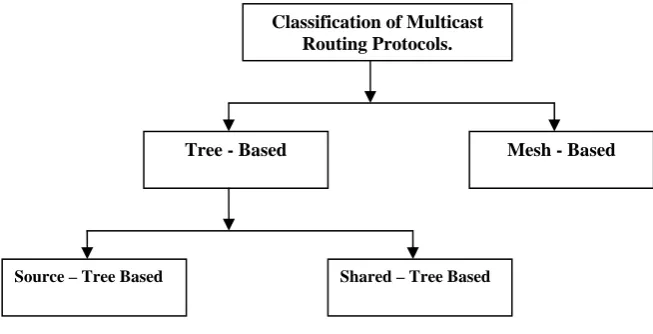
In general the multicast routing protocols used in mobile ad hoc networks are broadly classified into two broad categories: Application Independent (or) Generic Multicast Routing protocols and Application Dependent Multicast Routing Protocols [51]. The Application Independent multicast routing protocols can be used by all kinds of applications, whereas the Application-Dependent Multicast Routing Protocol is designed for certain specific applications such as nuclear reactor control, missile control and so on. The Application Independent multicast routing protocols are again classified with respect to three major factors: topology, multicast session initialization, and route maintenance mechanism.
Fig 1. Classification of Multicast Routing Protocols.
2.1. Source-Initiated Tree Based Multicast Routing Protocols 2.1.1. Location Guided Tree (LGT)
LGT is a tree construction algorithm [Kai Chen and Klara Nahrstedt, (2002)] that finds the best route by considering parameters such as bandwidth and control overhead. It uses source initiated shared tree hard state protocol approach. This mainly considers the geographical information of the node which does not contain any topology information and packet distribution for shortest range nodes. It uses two algorithms such as LGK and LGS [Kai Chen and Klara Nahrstedt, (2002)]. In this protocol, the network topology and network distance are calculated and network hops are more, when a node is far. Two parameters are used in this protocol v and e, v is the number of mobile nodes and e is the wireless links. Group nodes need not know about the group, but only knows about members in the group. So, network topology and network distance can’t be known to the nodes in a group. In LGK, nearest neighbor nodes are searched and group the nodes and send the packet. This reduces the cost of the packet transmission. In LGS, the nearest neighbour nodes are searched and join them with the least hop count by considering the geometric distance. Only group nodes are treated as tree nodes. This algorithm also finds latest paths by comparing with previously formed tree. These algorithms are useful in fixed networks as these are used to maintain global state information. In a dynamic environment these algorithms are used to compute path. Disadvantage is low bandwidth is utilized and this is used in low mobility environments.
2.1.2. Scalable Position Based Multicast (SPBM)
SPBM [Matthias Transier, et.al.] is a source initiated shared tree based hard state multicast routing protocol. This protocol uses the geographical position of the nodes, forwarding nodes and group member for scalability. The forwarding approach uses location strategy of the group, and group membership uses the location of members. Each group maintains only local topology for forwarding and not for maintaining global topology. If there is any problem in connection, then it splits packets and forwarded to the different intermediate nodes. Group membership uses the member hierarchical positions to recover path break. Advantage is this protocol is highly scalable in frequent changes in topology. Disadvantage is it is neither suited for large receiver groups and more the hierarchy, nor the frequency of processing.
Classification of Multicast Routing Protocols.
Tree - Based Mesh - Based
2.1.3. Multicast Zone Routing Protocol (MZRP)
MZRP [Zhang, X and Jacob, L, (2004)] is a source initiated tree based hard state multicast routing protocol. The source node forms tree within the zone and also forms tree outside the zone. If a node that is forwarder wants to join the group, it will send MRREQ packet or node will unicast this packet along the path that is already known or node will broadcast this packet along the tree that is formed by the source node. If this node finds route then it unicast. Otherwise, it will be added to the tree of neighbouring nodes. If the receiver receives the MRREQ packet it will send MRREP to the source and waits for the MRACK from the source. If MACK is received, then route will be enabled. If source wants to leave, then it sends a MPRUNE message to the group. Advantage is, this protocol works with different group size and it has less control overhead. Disadvantage is, it needs to maintain more states at nodes with multiple sources.
2.1.4. Associativity Based Adhoc Multicast (ABAM)
ABAM [C.-K. Toh, G. Guichal, and S. Bunchua, (2000)] is a source initiated source tree based hard state multicast routing protocol. A sender will initiate broadcast by broadcasting MBQ packets. Node that receives the packets will append information like route relaying load, associativity ticks and signal strength and then forward the packets. The receiver node will receive all packets and selects one packet based on the appended information and send MBQ-Reply messages back to the sender. Sender will confirm route that forms shared links in the group. The MC setup message will be transmitted to all the nodes by forwarding along the path to obtain forwarding nodes for forwarding the packets. When a link breakage occurs, upstream node is responsible to recover. Upstream node will send local query packet and if any node replies, source joins with that node group. Advantage is this protocol has low control overhead, high packet delivery ratio. Disadvantage is some latency in delivering the data and suffers from scalability issues.
2.1.5. Adhoc Multicast Routing Protocol Using Increasing ID Numbers (AMRIS)
AMRIS [C.W. Wu, Y. C. Tay, and C.-K. Toh,(2000)] is a source initiated shared tree based hard state multicast routing protocol. In this protocol, sender is assigned with MSM-ID and when the tree increases from source, MSM-ID will also increase and SID with smallest value will be taken for routing. A multicast operation is initiated by the NEW - SESSION message sent by SID. Nodes will replace SID that is larger than the specified SID. If a node wants to join in multicasting, it will send JREQ packets to its parent node. If requesting node is desired node then the parent node sends JACK to the requesting node, otherwise parent node has to forward to its downstream node. When a link break occurs the downstream node will be responsible to repair the link. This downstream node contains two subroutines BR1 and BR2. BR1 means if the node have parent nodes. BR2 means if the node doesn’t have parent nodes. Advantage is this protocol has less control overhead and link breakage repair will be performed by local nodes. Disadvantage is it will have delay during the link breakage. Bandwidth is wasted due to periodically transmission of packets.
2.1.6. Adaptive Core Based Multicast Routing Protocol (ACMP)
ACMP [Kaliaperumal B,et.al. (2005)] [Park.S and Park D (2004)] is source initiated shared tree based soft state multicast routing protocol. In this protocol, mesh is created by periodically broadcasting Join Request packet. If the node receives the request packet it will change the upstream address field to its own address and retransmits packet to the core of the group. By receiving JREQ packet core node will store (group address, source address) to its table which is used for forwarding purpose. The receiver sends JREP to the source with the core address of source group. Here adaptive core mechanism used that automatically recovers link failure. Advantage is it will improve the performance and robustness as it does not depend on the core. Disadvantage is the path between source and receiver will not be effective.
2.1.7. Independent Tree Adhoc Multicast Routing (ITAMAR)
is it takes less time for route discoveries. Disadvantage, it is less efficient and more processing overhead and control overhead.
2.1.8. Distributed QOS Multicast Routing Protocol (DQMRP)
DQMRP [Li Layuan and Li Chunlin (2002)] is source initiated shared tree based hard state multicast routing protocol. In this, source will send JOINreq packets to the receivers which are routers and each router will maintains entry for each packet which contains G, S.in, and S.out. G is nothing but the group address. S.in is the source of the incoming node request. And S.out is an outgoing node request. A node that sends JOINreq to the source will receive JOINack to the same node. If the source doesn't accept JOINreq, it sends JOINnack to the requesting node. JOINpend will be released if searching of path to requesting node does not satisfy given condition. If the receiver wants to connect with source it will send a JOINreq packet along with the QOS parameters delay, delay jitter, bandwidth and cost. If it is a node with satisfied condition, then source sends JOINack otherwise JOINnack is sent. Advantage is it reduces overhead in forming a tree and multicast node can leave without any confirmation and without disturbing tree which provides QOS support. It is well suited for mobile and dynamic environment along with providing QOS support. Disadvantage is more bandwidth is utilized and delay will be more and processing overhead will also be incurred.
2.1.9. Light Weight Adaptive Multicast (LAM)
LAM [Lusheng Ji and M. Scott Corson, (1998)] is source initiated shared tree based hard state protocol. It is based on the Core Based Tree (CBT) [Ballardie T; Francis P, and Crowcroft J,(1993)]. When a node wants to join the group, it finds path between itself and parent. The core node is responsible to join the node. When the node link breaks it will automatically rejoins by using the nodes in a broken link. In tree maintenance phase when a link breaks the event will be triggered by using TORA [Pirzada, A. and A.McDonald,(2004)] through the interface. Each node contains two lists parent-child list and child list. Child list stores one link for each child in its table. If a node wants to be a member, group variable and flag member has to be used. When a node wants to join, it will generate join message that contains group id and target core id. This protocol selects nearest neighbor as receiver of join message. When an invalid join is received it sends the LEAVE message back to the sender. If a join message reaches the core then core sends the acknowledgement for the join. ACK is received to the requesting node. If this node is not the child it will send leave, which represents it is not a child. Advantage is link break recovery time will be very less. Less storage overhead will be obtained. Disadvantage is it is not a robust as it completely depends on core node.
2.2. Source-Initiated Mesh Based Multicast Routing Protocols 2.2.1. On Demand Multicast Routing Protocol (ODMRP)
ODMRP [S.-J. Lee,W. Su, andM. Gerla, (2002)] is source initiated mesh based soft state multicast routing protocol. A source sends a JOIN DATA packet for constructing path to send the data along the route. When a forward node along the path receives this packet it stores its sender node as upstream node and rebroadcast the packet. When the packet reaches to the desired receiver it will create JOINTABLE and multicast to its neighbors. The neighbor nodes will check next node ID if it matches then it is a node that is along path of forwarding and finally these nodes become forwarding group. These packets will be broadcasted until nodes find the shortest path to the source. This process is used to build forwarding group and routes between sources to receivers. If a node wants to leave, no need of any leave message. Patch ODMRP [Lee, M and Kim,Y.K., (2001)] is used to save control overhead derived by ODMRP by using local route maintenance (3-hop). However Pool ODMRP [Cai. S, Yang, X, and Yao W, (2003)] is introduced to reduce control overhead in local route maintenance from 3 hops to 1 hop. Advantage is less control overhead and is used to find efficient routes. Disadvantage is this protocol is not suited for more mobility environment and more nodes, as delay will be increased in transmitting.
2.2.2. Dynamic Core Based Multicast Routing Protocol (DCMP)
less for higher delivery ratio of data. Here there are parameters such as: MaxHop and MaxPassSize. MaxHop represents no of links between passive and active core node. MaxPassSize represents the number of passive sources that are present. Advantage is it is more scalable, high packet delivery ratio. Disadvantage is if core active source fails then multicast operation will fail.
2.2.3. Neighbor Supporting Multicast Protocol (NSMP)
NSMP [Lee, S and Kim, C, (2000)] is source initiated mesh based soft state multicast routing protocol. In this, source will broadcast request to all the nodes. Forwarding nodes will stores upstream node status and forward the packet to the other nodes. When a receiver receives the packet, it will reply to the upstream node and nodes will store node status in the routing table for the reverse path. The receiver will select route request packet by considering the weight factor which is based on forwarding and not forwarding nodes along the path Source will locally broadcasts route discovery packets to update the routes and mesh. Any node want to join, node has to wait for this local route discovery process and has to join. Any links that have to be repaired is transmitted to the source. Here the condition is the only distance with 3 or 2 hops has to join. Otherwise, it has to broadcast the request. Advantage is it reduces control overhead by performing only local route discovery and high packet delivery ratio. Disadvantage is weight metric is fixed it will have a problem when there is high network variations.
2.2.4. Enhanced-On Demand Multicast Routing Protocol (E-ODMRP)
E-ODMRP [Oh , S. Y., Park J-S., and Gerla , M,(2008)] is source initiated mesh based hard state multicast routing protocol. It is same as ODMRP [S.-J. Lee,W. Su, andM. Gerla, (2002)] but it uses dynamic broadcasting to reduce the control overhead in ODMRP. This protocol also performs local route discovery by using ERS [Perkins, C. E, (1997)]. ERS requires more processing. It's not suitable for low end mobile devices. Packet delivery will be same as in ODMRP. Advantage is it reduces control overhead. Disadvantage is it suffers from scalability and nodes will perform ERS that leads to malicious activities. It requires more processing overhead.
2.2.5. Optimized Polymorphic Hybrid Multicast Routing Protocol (OPHMR)
OPHMR [Mnaouer,B, Chen,L., Foh, C. H and Tantra,J. W, (2007)] is source initiated mesh based hard state multicast routing protocol. This protocol uses proactive routing within the zone and reactive between zones or groups. Mobile nodes contain two modes: proactive and reactive modes. If a node wants to join groups of multicast nodes, node will perform broadcasting JREQ messages in reactive mode. If the node is in proactive mode it will check its routing table that whether there is a route to join to multicast group, then it will unicast the packet, else broadcast JREQ packet. Nodes will record the route status while JREQ message is passing along the route. Advantage is packet delivery will be increased and delay will be decreased. Disadvantage is delivery ratio decreases when mobile node increases.
2.2.6. Mesh Based Multicast Routing Protocol with Consolidated Query Packets (CQMP)
2.2.7. Bandwidth Optimized and Delay Sensitive (BODS)
BODS [InnInn ER2, 1 Winston K.G. Seah (2006)] is source initiated mesh based hard state multicast routing protocol. It is suitable for both bandwidth and delay sensitive applications ex: multimedia applications. The source node will broadcast query packet that contains nearest participant and distance to nearest participant. Receiver will check the nearest participant field by using priority i.e. highest and lowest. When the MREQ packet reaches by the path contain nodes that are members of a group, then it has higher priority. Otherwise it has lower priority. It will be known by the field nearest participant which contains any value. The highest priority will reduce the delay. Timer will be used in a packet that is transmitted. It will expire after some time. If there is more than one path, then it will set to the non empty nearest distance field. BODS is an algorithm that is used by any protocol. In this algorithm, nearest participant and the distance will be added to the header of the join query packet and a delay timer set. When it expires, it will rebroadcast the packet. Advantage is it has more effective bandwidth, control overhead will be very less and packet delivery ratio will be more. Disadvantage is it will be suited for low mobility situations.
2.3. Receiver-Initiated Tree Based Multicast Routing Protocols 2.3.1. Bandwidth-Efficient Multicast Routing (BEMRP)
BEMRP [ Ozaki, T, Kim, J.B. and Suda,T.,( 2001)] is a receiver-initiated source-tree based hard-state multicast routing protocol. This protocol finds the nearest forwarding node rather than finding a shortest path between the source and destination pair. It uses a hard state approach to maintain a multicast tree due to link breaks. Thus, it avoids periodic transmission of control packets to update the multicast tree hence the bandwidth is saved. BEMRP uses an optimization technique to remove unwanted forwarding nodes. This helps in a number of data packet transmissions. This protocol has three phases: Tree Initialization, Tree Maintenance and Route Optimization. The main advantage of this protocol is that it saves bandwidth due to the reduction in the number of data packet transmissions and uses a hard state approach for tree maintenance. The drawback is the probability of path breaks increases due to increase in distance between the source and destination because a node joins the multicast group through the forwarding node. Also, the delay increases due to reconstruction of the path using hard state approach.
2.3.2. Efficient Hybrid Multicast Routing Protocol (EHMRP)
EHMRP [Biswas,J.; Barai ,M; and Nandy, S.K. (2004)] is receiver initiated source tree based soft state multicast routing protocol. In this, when a node wants to join the multicast tree it will broadcast the advertise message to its neighbor nodes in a local group that has 2 hop distance from each other. So, each node will maintains 2 hop node information and if multiple packets are received then it selects one which is nearest and stable. If source receives packets with the nodes having same distance, then the node with larger ID will be selected. If a node wants to join with the cohort leader it sends CHILD message and cohort leader sends the leader message to it. If a source wants to leave the tree, it will stop transmitting child message. Advantage reduces the control overhead even there are many nodes in the group and provides packet delivery. Disadvantage is link failure will affects delivery and topology.
2.3.3. Hierarchical QOS Multicast Routing Protocol (HQMRP)
transmitting data to the links without any delay. Advantage is it provides QOS support i.e., Delay reduction, and will reduce control overhead as it will remove the unstable path and forwards through the stable path. Disadvantage is more processing overhead will be incurred on each local node.
2.3.4. Mobile Agents Aided Multicast Routing Protocol (MAMR)
MAMR [Wang, X, Li, F, Ishihara, S and Mizuno, T, (2001)] [Shekhar, H. M. P., Arun Kumar, M . A and Ramanatha, K. S. (2005)] is a receiver initiated shared tree based hard state multicast routing protocol. It uses AODV [Perkins, C. E, (1997)]. It has two phases such as tree discovery and tree maintenance. Two groups of nodes will act as spine nodes that act as the infrastructure for adhoc network. Spine nodes are known as MMAs in this protocol. Two groups are also known as clusters that form as a forwarder node or sender or receiver nodes. A receiver or forwarder node sends a RREQ to join to multicast group through MMAs, and MMAs will acts as replying nodes to the requesting node. Otherwise, sender node will start RREQ packets. There are two types of link networks: symmetric link adhoc network, asymmetric adhoc network. In symmetric link, MMA will forward RREP packets to the sender. In asymmetric link MMA will search for a route to sender and piggy back the same RREP to sender. Here, tree maintenance can be achieved by route error packet and ACKs. Advantage is the time required to obtain multicast tree and routing information will be reduced for the sender. Disadvantage is control overhead and processing overhead will be increased as everything is by the MMA.
2.3.5. Differential Destination Multicast Routing (DDM)
DDM [Ji, L., and Corson, M. S, (2001)] is a receiver initiated source tree based soft state and stateless multicast routing protocol. This protocol reduces maintaining states in each node by using two modes. Destination will periodically send join control packets to obtain path. This protocol uses a stateless mode approach for reducing storage overhead, by maintaining address of the following node and address of destination that is to be sent in DDM block of data packet and is unicast to next node. Second one, that is the soft state mode that contains forwarding set (next hop nodes) that has to be sent and nodes are sorted while traversing each packet along the path. Therefore, this reduces the storing of multiple destination addresses. This protocol helps in multicast routing with a short distance. This protocol has two phases: tree initialization, tree maintenance phases. The main advantage in this is, it saves storage space and less link breakage. Drawback is, it is less scalable as amount of receiver’s increase, the size of data packet increases as it uses small memory resources. More control overhead as it uses a soft state approach
2.3.6. Weight Based Multicast (WBM)
WBM [Das, S. K, Manoj , B. S , and Murthy, C. S. R, (2002a)] is receiver initiated source tree based soft state multicast routing protocol. This protocol uses hop distance of each node for selecting an efficient route to the destination. Receiver periodically broadcasts JoinReq packet with a time to live entry. Packet is selected by considering weight counter parameter and send reply packet. Advantage is Link break will be less as TTL entry is used and local prediction technique. Packet loss is less and high packet delivery ratio is there. Disadvantage is a prediction technique not work for high mobility and it depends on many factors such as load, weight, the size of the multicast group. When time expires, the destination node sends a JoinConf message along the path that is considered by reply packet.
2.3.7. Preferred Link Based Multicast Protocol (PLBM)
2.3.8. Mobile Adhoc on Demand Distance Vector (MAODV)
MAODV [Royer, E. M, and Perkins, C. E, (2000)] is receiver initiated shared tree based hard state multicast routing protocol. It is an extension of AODV [Perkins, C. E, (1997)] protocol. If the receiver wants to join the group, it will broadcasts Join RREQ to the desired multicast group. Group leaders or any multicast group member with the highest sequence number will respond to RREQ packet by sending RREP packet to requesting node that has highest sequence number and lowest hop count. The receiving node will select the RREP packet with the low distance, and sends MACT to confirm the route, and finally tree is constructed. If the link breakage occurs, then it is responsible for downstream node to broadcast RREQ packet, node with hop count less than or equal to indicated value in RREQ will respond. If upstream node does not respond to the RREQ packet, multicast tree will deteriorate and receiver itself forms a multicast group on its own. Advantage is packet contains sequence numbers that forms efficient route. Disadvantage is delay will be more and low packet delivery ratio in high mobility. So it is not flexible as leader fails then it is affected.
2.3.9. Shared Tree Adhoc Multicast Protocol (STAMP)
STAMP [Lucile Canourgues. et. al. ] is a receiver initiated shared tree based hard state multicast routing protocol. It contains three phases such as tree initialization, tree construction and tree maintenance. Receiver will initiate route by sending join messages to the upstream nodes. If a source in core group receives join message, then it replies with the join-ack message in reverse path. In tree construction when a node becomes a member of the group, then it stores downstream node as core and its upstream nodes as its neighbors of the group. Join message will be stored in the forwarder node and this makes downstream node that sends join-ack. This process will be repeated until the desired node of tree or core is found. In tree maintenance, if any link break occurs, there are two cases i.e., when the upstream node fails, then it is responsible to send join message and if downstream fails, then this node is removed from the list. Each group has one core that is assigned by algorithm, core election algorithm. That is, when a node joins, it will check there is a core for the group. Otherwise it will announce itself as a core and forwards core_announcement message. Advantage is it provides less control overhead by using a hard state approach and flooding only for core_announcement. Disadvantage is high control overhead during mobility situation.
2.3.10. Core Assisted Mesh Protocol (CAMP)
CAMP [Garcia-Luna-Aceves, J. J., and Madruga, E. L, (1999)] is a receiver initiated shared tree based hard state protocol. It is migrated from the internet broadcasting to mesh multicasting. It maintains group of mesh links that obtain shortest paths between sender and receiver. It maintains core per each group. If a node wants to join any group, it sends JREQ to the core. If core doesn’t exist then it broadcasts its JREQ using ERS that reaches to any group member. Advantage is overhead will be less as reactive approach is used and if the link breaks reverse path will be formed automatically.. Disadvantage is link break will affect the protocol and overhead will be formed in larger network.
2.3.11. Reliable Adaptive Multicast Protocol (RAMP)
RAMP [Sun, B and Li, L (2006)] is receiver initiated shared tree based soft state protocol. Receiver will broadcast its presence to the sender, and sender will filter receiver packet and retransmits based on certain threshold value. If number of packets are greater than the threshold value, then it multicasts to the group. Advantage is it won’t allow out of order packet and it contains a NACK message for not joining the group. Disadvantage is it will be time consuming and cost effective to set up group at a time.
2.3.12. Robust Multicast Adhoc Network Using Tree (ROMANT)
been previously built. If the packet reaches the tree node, it will broadcast the packet along the tree. It uses two types of control packets: core announcement and join announcement. Core announcement message contains the sequence number of the group, groupID, coreID, and distance to the core of a group, through which router packet has to be sent. Nodes will obtain the information of routes to the cores. Join announcement is sent by the sender that specifies groupID and parent of each forward node in sending the announcement on the tree. If the receiver wants to join using Core election, it sends core announcements, that it is the core of a group. If multiple cores are there then coreID with higher number will be elected. If more core announcements are received, then the best core announcement with core ID of the highest value, groupID with shorter distance, distance to the core and a latest sequence number is selected. It contains two phases such as tree construction and tree maintenance. Receivers will send the join announcements to the core with the parameter groupID. Sender and parent nodes in between the core and the receiver will join to the tree by sending the join announcements, if it is a non-member. If a node does not receive any packet then it is a non tree member. Each node will broadcast node announcement without any delay for tree maintenance. Advantage is control overhead remains stable when topology, mobile node changes. It provides a data delivery ratio because it does not allow broken links. Disadvantage is tree maintenance will be more overhead. It does not detect link break and does not repair them. Data packet loss will be more on this protocol.
2.3.13. Self Organizing Map (SOM)
SOM [Kumar, M, V. Senthil, V, Venkatesh, C and Natarajan, A. M, (2004)] is receiver initiated shared tree based hard state multicast routing protocol algorithm. It provides QOS support for the mobile users. SOM is used along with HQMRP to provide [Kumanan, T and Duraiswamy, K, (2011)] QOS. In this, a group of nodes is divided into clusters and each member of the group will maintain local routing and also information of other clusters and there is no need to maintain global state information. When a new node wants to join to the cluster it needs to send JOINreq message to its parent node. The JOINreq message contains GA which is a group address, NA is current node address and QM is QOS metric support. The JOINreq message will be added to the entry of each cluster. Number of entries is equal to the level of hierarchy in clusters. Here QOS support is provided by maintaining training list of connections that is used to find probable damages in link by using weight vector along with an index and type of connection. Attacks can be: Denial Of Service (DOS), Remote to local and user to root. SOM has two modes: training and mapping. Map is built by giving input. It categorizes input nodes, where each node containing weight vector and position. The node with the nearest weight vector will be taken and maps values to the desired weight node. These also set priority levels for transmitting data through the links without any delay. Advantage is it provides QOS support i.e., to reduce delay, reducing contention, maximizing throughput and data transmission. Disadvantage when mobility increases data delivery will be decreased. Breaking links will be occurring while moving to the other position.
2.3.14. Location Based Geocasting and Forwarding (LGF)
2.4. Receiver-Initiated Mesh Based Multicast Routing Protocols 2.4.1. Forward Group Management Protocol (FGMP)
FGMP [C.-C. Chiang, M. Gerla, and L. Zhang, (1998a)] is a receiver or sender initiated shared tree based soft state protocol. It is completely based on a group of nodes that has to be forwarded. Each node maintains a group of nodes that forwards the packets. If the receiver or sender wants to join there are two methods: FGMP-RA receiver advertising and FGMP-SA sender advertising. In FGMP-RA, the receiver will advertise its presence by JREQ packets and sender that receives the packet, will update its table with group of receivers. In FGMP-SA, the sender will advertise its presence and receiver will update its table with a group of senders and broadcasts this joining table to form forwarding group. The forwarding table consists of receiver Ids and joining table consists of sender Ids. Advantage is it will flood its packets to forwarding group only, as it reduces control overhead and storage overhead. Disadvantage, it does not work for high mobile environments. It works better for, when the number of receivers is more than senders.
2.4.2. Multicast Core Extraction Distributed Adhoc Routing (MCEDAR)
MCEDAR [Prasun Sinha, R. S and Bharghavan, V (1999)] is source tree based hybrid routing protocol. In this protocol, mesh is created by using CEDAR [Sivakumar, R Sinha, P and V. Bharghavan, V, (1999]. CEDAR will creates set that contains minimum number dominating core nodes by using core computation algorithm. Dominating core nodes are core node of senders or receivers or core node which is near to the requesting node. When a node wants to join the group the core node of that group will broadcast JoinReq (MA, JoinID). MA is the address of the group that wants to join and JoinID is the current id of the group. When a node that does not belongs to desired group receives the packet, it will broadcast to the nearby core nodes. Otherwise node will send JACK to the id that is smaller than id that is present in JoinREQ packet or it will send JACK to the node that has larger id as a replying node. Mgraph contains two tables they are parent and child. Parent contains all upstream nodes and child set contains downstream nodes. Advantage is it is robust when the receiver has links to the source. Disadvantage is it doesn’t work well for small groups. More control overhead will be obtained due to change of cores in a mobile environment.
2.5. Hybrid Multicast Routing Protocols
2.5.1. Adhoc Multicast Routing Protocol (AMROUTE)
AMROUTE [Xie, J, R. R. Talpade, R. R, McAuley, A and Liu, M, (2002)] is the source and receiver initiated shared tree on mesh based hard state multicast routing protocol. Here there will be a group that contains nodes that are connected in two directions among themselves. Each group contains one core that maintains nodes and tree. Each core broadcast JREQ to find the other groups or segment to form a group. When a sender node of other group sends a REQ to the receiver node of another group, then the receiver will send JACK to form a bidirectional link to that sender node. After this, two segments are combined and form mesh connection between them. Any node that sends request can be handled by any node in the segment of group by preventing many links directed towards the same node. The core node is formed and TREECREATE packets are transmitted across the nodes. Member node will store each link as mesh link and forms shared tree link with core node. Node receiving TREECREATENAK will treat link as mesh link. Nodes wishing to leave the group send JNAK to the neighbors. Advantage is it will have shared tree links stable even there is a change in network topology. Disadvantage is a core node creation will result in more overhead during mobility.
2.5.2. Adaptive Shared Tree Multicast Routing (ASTM)
Advantage is it is adaptive based on its fewer collisions. Disadvantage is when there is more node mobility, routing cannot be occurred. Changing of topology will sometimes lead to a long length path.
2.5.3. On Demand Global Hosts for Adhoc Multicast (OGHAM)
OGHAM [C.-C. Hu, E. H.-K. Wu, and G.-H. Chen, (2006)] is a source initiated hybrid topology based hard state multicast routing protocol. In this protocol it uses Backbone Host (BH). When there is a need for multicasting, every multicast member has to connect to the BH. When source wants to connect to the receiver, then it has to connect with the BH through its neighboring nodes. BH will establish the shortest path between source and receiver and find multicast routes, maintain forwarding groups and dynamic topology. If the receiver wants to join, it first connects to the BH and query to the source. Then source BH will respond to the query. If the receiver is not within the range, then BH establishes tree for connecting to it. Advantage is a latency time to deliver packet reduces as BH find shortest paths. BH will be available and no need of maintaining groups. Disadvantage is if BH will lose then, more effect will be there.
2.5.4. Progressively Adaptive Sub Tree in Dynamic Mesh (PAST-DM)
PAST-DM [Gui, C and Mohapatra, P, (2003)] is hybrid based source shared tree and mesh based soft state multicast routing protocol. In this, a virtual mesh routes was defined on already made physical links in a group. A node in the group will start neighbor discovery by Group_Req messages to all nodes within the group. When a node receives this message, it stores node distance and its neighbors by ERS technique from Group_Req messages. Otherwise, it will use a flooding technique. When a node wants to join by the above process, group leader reply with Group_Rep message and the group leader will maintain its own link status and will exchange these to know its presence. To leave the group, a node unicast GroupLV message to its neighbors. Advantage is scalability will be more as it is using virtual mesh topology. It overcomes from repeated data delivery of topology change. Disadvantage is overlay is formed even when there is no source to multicast. Sharing physical links affect efficiency.
2.5.5. Reliable On demand Routing Protocol (RORP)
RORP [Wang, N. –C and Chang, S.-W, (2005)] is a protocol that will find a different mobile node when they are in movement, connectivity information and time to connect by using GPS. Here the route discovery process and route maintenance are used, where routes with stable connectivity will be utilized for more time to transmit data. For the route maintenance we are creating multiple backup routes. When a source node wants to find a path for the destination node, then source sends RREQ packets to the nearby nodes. If the node is not within the region specified by RREQ packet and if source wants to send data, it will send packet to the node in the region of source node. For this, routing tables required are: neighboring node table (nodeID, the location information of nodeID), current path table (sequence number, path table life time), maintenance table (SourceID, DestinationID, the location information of next node and final node). Route discovery process contains a HELLO message that is used for discovering different routes. This message is sent to the nearby nodes to find links that are used to store in the path table. Destination information that contains two methods such as each destination broadcasts DestInfo. The second method is a mobile node periodically broadcasts to minimum set of nodes. These methods will increase a load at each node. If the node does not have routing information, node broadcasts the RREQ packet, and then the destination sends RREP in reverse path to the source node. Here there are two parameters LDT – Location Duration Time and RDT – Route Duration Time. These parameters in RREP packet node will checks DID. If it matches then destination forwards packet, otherwise it uses location information provided by RDT with the small set of LDT. When a node receives the RREQ packet, it stores information about nodes along the route. In route maintenance approach, full reconstruction and half reconstruction is present. Full reconstruction represents when a node doesn't receive RREP packet then it will send a RERR to which it again forms the path. In half reconstruction, the node is replaced and another node that is nearby will be connected. Half reconstruction incurs less overhead than full reconstruction. Advantage is RORP provide reliability in delivering the data. It gives less overhead by using GPS. Disadvantage is it takes more time for delivery of data during high mobility. Due to the more waiting time packet may be dropped.
2.5.6. Hypercube Based Virtual Dynamic Backbone (HVDB)
be present in the minimum distance from each node. It contains three tiers: mobile, hypercube and mesh tier. All cluster heads will be added to the hypercube tier. Cluster head is responsible for communication between clusters. Cluster members form a circle and divides geographical area. Center of the circle is the Virtual circle center. Hypercube tier consists of cluster heads. When cluster heads present in virtual circles, then it will be hypercube. Many hypercubes are connected by physical links. A mesh tier is nothing but number of hypercubes. Mesh is linked with physical and logical links. A mobile node finds information like position velocity and direction using GPS. Each mobile node periodically sends local membership to its cluster head CH. CH will process all the information and sends MNT-summary. At hypercube, every CH will send MNT-summary to other CH. Each CH in the hyper cube process all MNT-summary and sends HT-summary. Each CH maintains its MNT-summary as well as other MNT-summary and confirms whether it has to do or not to do the task. If a mobile node needs to send data to CH, it will searches for desired CH and confirms where it belongs to, then mobile node send data. CH of the hypercube and logical links are noted and forwarded. A multicast tree is constructed among mesh nodes in hypercube tier. Advantage is it provided QOS support to the large group network. This protocol provides high tolerance. As one link breaks it contain many links to the hypercube. As there is no leader for hyper cube, therefore no load overhead will be incurred. Disadvantage is it requires more time to construct and maintain trees.
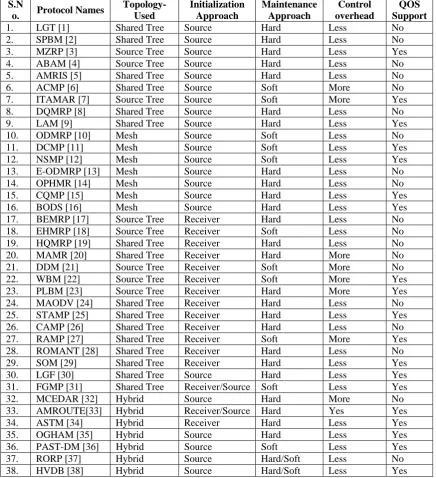
Table 1. Comparison on Multicast Routing Protocols based on different characteristics
S.N
o. Protocol Names
Topology-Used
Initialization Approach
Maintenance Approach
Control overhead
QOS Support
1. LGT [1] Shared Tree Source Hard Less No
2. SPBM [2] Shared Tree Source Hard Less No
3. MZRP [3] Source Tree Source Hard Less Yes
4. ABAM [4] Source Tree Source Hard Less No
5. AMRIS [5] Shared Tree Source Hard Less No
6. ACMP [6] Shared Tree Source Soft More No
7. ITAMAR [7] Source Tree Source Soft More Yes
8. DQMRP [8] Shared Tree Source Hard Less No
9. LAM [9] Shared Tree Source Hard Less Yes
10. ODMRP [10] Mesh Source Soft Less No
11. DCMP [11] Mesh Source Soft Less Yes
12. NSMP [12] Mesh Source Soft Less Yes
13. E-ODMRP [13] Mesh Source Hard Less No
14. OPHMR [14] Mesh Source Hard Less No
15. CQMP [15] Mesh Source Hard Less Yes
16. BODS [16] Mesh Source Hard Less Yes
17. BEMRP [17] Source Tree Receiver Hard Less No
18. EHMRP [18] Source Tree Receiver Soft Less No
19. HQMRP [19] Shared Tree Receiver Hard Less No
20. MAMR [20] Shared Tree Receiver Hard More No
21. DDM [21] Source Tree Receiver Soft More No
22. WBM [22] Source Tree Receiver Soft More Yes
23. PLBM [23] Source Tree Receiver Hard More Yes
24. MAODV [24] Shared Tree Receiver Hard Less No
25. STAMP [25] Shared Tree Receiver Hard Less Yes
26. CAMP [26] Shared Tree Receiver Hard Less No
27. RAMP [27] Shared Tree Receiver Soft More Yes
28. ROMANT [28] Shared Tree Receiver Hard Less No
29. SOM [29] Shared Tree Receiver Hard Less Yes
30. LGF [30] Shared Tree Source Hard Less Yes
31. FGMP [31] Shared Tree Receiver/Source Soft Less Yes
32. MCEDAR [32] Hybrid Source Hard More No
33. AMROUTE[33] Hybrid Receiver/Source Hard Yes Yes
34. ASTM [34] Hybrid Receiver Hard Less Yes
35. OGHAM [35] Hybrid Source Hard Less Yes
36. PAST-DM [36] Hybrid Source Soft Less Yes
37. RORP [37] Hybrid Source Hard/Soft Less No
3. Conclusion
Thus a MANET is a collection of low energy mobile hosts. The inherent characteristics of MANET makes multicasting is a challenging task. The constraints of the MANET can be solved by avoiding global flooding, advertising and so on. Multicasting supports a vide range of ad hoc applications that requires a collaboration and coordination among the low power mobile hosts. In general a multicast protocol uses two concepts to build a multicast tree. Some protocol uses a tree base approach and others uses a mesh concept to build a multicast tree. The advantages of tree based multicast protocols are they are scalable. And the advantages of mesh based multicast routing protocols are they are robust due to availability of multiple paths. The disadvantages tree based protocols are high control overhead, more latency and high memory requirement.
References
[1] Ballardie T; Francis P, and Crowcroft J,(1993): Core based trees (CBT). ACM SIGCOMM Computer Communication Review, vol.
23, pp. 85–95.
[2] Biswas,J.; Barai ,M; and Nandy, S.K. (2004): Efficient hybrid multicast routing protocol for ad-hoc wireless networks. IEEE LCN,
pp. 180–187, Nov. 2004.
[3] C.-C. Chiang, M. Gerla, and L. Zhang, (1998a): Forwarding Group Multicast Protocol (FGMP) for multihop, mobile wireless
networks. ACM-Baltzer Journal of Cluster Computing, vol. 1, no. 2, pp. 187–196.
[4] C.-C. Chiang, M. Gerla, and L. Zhang, (1998b): Adaptive shared tree multicast in mobile wireless networks. Proceedings of the IEEE
Global Telecommunications Conference (GLOBECOM ’98), vol. 3, pp. 1817–1822.
[5] C.-C. Hu, E. H.-K. Wu, and G.-H. Chen, (2006): OGHAM: on demand global hosts for mobile ad-hoc multicast services. Ad Hoc
Networks, vol. 4, no. 6, pp. 709–723.
[6] Cai. S, Yang, X, and Yao W, (2003): The comparison between PoolODMRP and PatchODMRP. Proceedings of the IEEE
International Conference on Networks (ICON ’03), pp. 729–735.
[7] C.-K. Toh, G. Guichal, and S. Bunchua, (2000): ABAM: on-demand associativity-based multicast routing for ad hoc mobile networks.
Proceedings of the IEEE Vehicular Technology Conference (VTC ’00), vol. 3, pp. 987–993.
[8] C.W. Wu, Y. C. Tay, and C.-K. Toh,(2000): Ad hoc Multicast Routing protocol utilizing Increasing id-numbers (AMRIS)
draftietf-manet-amris-spec-00.txt.
[9] Das, S. K, Manoj , B. S , and Murthy, C. S. R, (2002a): Weight based multicast routing protocol for ad hoc wireless networks.
Proceedings of the IEEE Global Telecommunications Conference (GLOBECOM ’02), vol. 1, pp. 117–121.
[10] Das, S. K, Manoj , B. S , and Murthy, C. S. R, (2002b): A dynamic core based multicast routing protocol for ad hoc wireless networks.
Proceedings of the International Symposium on Mobile Ad Hoc Networking and Computing (MobiHoc ’02), pp. 24–35.
[11] Garcia-Luna-Aceves, J. J., and Madruga, E. L, (1999): The core assisted mesh protocol. IEEE Journal on Selected Areas in
Communications, vol. 17, no. 8, pp. 1380–1394.
[12] Gui, C and Mohapatra, P, (2003): Efficient overlay multicast for mobile ad hoc networks. Proceedings of the IEEE Wireless
Communications and Networking Conference (WCNC ’03), vol. 2, pp. 1118–1123.
[13] Guojun Wang1; Jiannong Cao1, (2005): A Novel QoS Multicast Model in Mobile Ad Hoc Networks. Proc. IEEE IPDPS, p. 206.
[14] Harleen Dhillon and Hung Q. Ngo (2005): CQMP: A Mesh-based Multicast Routing Protocol with Consolidated Query Packets. IEEE
Communications Society / WCNC 2005 0-7803-8966-2.
[15] InnInn ER2, 1 Winston K.G. Seah (2006): Distributed Steiner-Like Multicast Path Setup for Mesh-based Multicast Routing in Ad Hoc
Networks. Proceedings of the IEEE International Conference on Sensor Networks, Ubiquitous, and Trustworthy Computing (SUTC’06) 0-7695-2553-9.
[16] Ji, L., and Corson, M. S,(2001): Differential destination multicast a MANET multicast routing protocol for small groups. Proceedings
of the 20th Annual Joint Conference of the IEEE Computer and Communications Societies (INFOCOM’01), vol. 2, pp. 1192–1201, 2001.
[17] Kai Chen and Klara Nahrstedt, (2002): Effective Location-Guided Tree Construction Algorithms for Small Group Multicast in
MANET, IEEE INFOCOM 0 -7803-7476-2/02
[18] Kaliaperumal B, Ebenezer A, and Jeyakumar, (2005): Adaptive core-based scalable multicasting networks. Proc. IEEE INDICON,
Dec. 2005, pp. 198–202.
[19] Kamal Kant. Lalit K. Awasthi, (2010): Unicast And Multicast Routing Protocols For Manets: A Comparative Survey. International
Journal of IT & Knowledge, 8 pages.
[20] Kumanan, T and Duraiswamy, K, (2011): QoS Control Mechanism in MANET using Self organizing Map - Hierarchical QoS
Multicast Routing Protocol (SOM-HQMRP). European Journal of Scientific Research ISSN 1450-216X Vol.59 No.3 (2011), pp. 329-337.
[21] Kumar, M, V. Senthil, V, Venkatesh, C and Natarajan, A. M, (2004): Performance comparison of multicast protocol for physically
hierarchical ad-hoc networks using neural concepts. ICSP, vol. 2, pp. 1581–1584.
[22] Latiff, L.A, Ali, A and C.-C. Ooi, (2005): Location-based geocasting and forwarding (LGF) routing protocol in mobile ad- hoc
network. AICT/SAPIR/ELETE, pp. 536–541.
[23] Lee, M and Kim,Y.K., (2001): PatchODMRP: an ad hoc multicast routing protocol. Proceedings of the International Conference on
Information Networking, pp. 537–543.
[24] Lee, S and Kim, C,(2000): Neighbor supporting ad hoc multicast routing protocol. Proceedings of the ACM International Symposium
on Mobile Ad Hoc Networking and Computing (MobiHoc ’00), pp. 37–44.
[25] Li, L and Li,C,(2006): A hierarchical QoS multicast routing protocol for mobile ad-hoc networks. Chinese J. Electronics, vol. 15, no.
4, pp. 573–577.
[26] Li Layuan and Li Chunlin (2002): A Distrtbuted Multicast Routing Protocol With Qos Constraints. National Natural Science
Foundation of China and NSF of Hubei Province 0-7803-7533-5/02.
[27] Lucile Canourgues, Jerome Lephay, Laurent Soyer and Andre-Luc Beylot STAMP: SHARED-TREE AD HOC MULTICAST
PROTOCOL. Rockwell Collins France, 6 avenue D. Daurat, BP 20008, F-31701 Blagnac Cedex, France.
[28] Luo Junhai, Ye Danxia, Xue Liu, and Fan Mingyu, (2009): A Survey of Multicast Routing Protocols for Mobile Ad-Hoc Networks.
IEEE COMMUNICATIONS SURVEYS & TUTORIALS, VOL. 11, NO. 1, FIRST QUARTER 2009.
[29] Lusheng Ji and M. Scott Corson, (1998): A Lightweight Adaptive Multicast Algorithm. Advanced TelecommunicationsJInformaLian
[30] Matthias Transier, Holger Fubler, Jorg Widmer, Martin Mauve, and Wolfgang ffelsberg ,: Scalable Position-Based Multicast for Mobile Ad-hoc Networks, EPFL, Laboratory for Computer Communications and Applications (LCA).
[31] Mnaouer,B, Chen,L., Foh, C. H and Tantra,J. W, (2007): OPHMR: an optimized polymorphic hybrid multicast routing protocol for
MANET. IEEE Transactions on Mobile Computing, vol. 6, no. 5, pp. 503–514, 2007.
[32] Oh , S. Y., Park J-S., and Gerla , M,(2008): E-ODMRP: enhanced ODMRP with motion adaptive refresh. Journal of Parallel and
Distributed Computing, vol. 68, no. 8, pp. 1044–1053.
[33] Osamah S. Badarneh and Michel Kadoch, (2009): Review Article Multicast Routing Protocols in Mobile Ad Hoc Networks: A
Comparative Survey and Taxonomy. EURASIP Journal on Wireless Communications and Networking Volume 2009, Article ID 764047, 42 pages doi: 10.1155/2009/764047.
[34] Ozaki, T, Kim, J.B. and Suda,T.,( 2001): Bandwidth-efficient multicast routing for multihop, ad-hoc wireless networks. Proceedings
of the 20th Annual Joint Conference of the IEEE Computer and Communications Societies (INFOCOM’01), vol.2, pp. 1182–1191.
[35] Park.S and Park D (2004): Adaptive core multicast routing protocol. Wireless Networks, vol. 10, no. 1, pp. 53–60.
[36] Perkins, C. E, (1997): Ad Hoc On Demand Distance Vector (AODV) Routing. Internet-Draft, draft-ietf-manet-aodv-00.txt.
[37] Pirzada, A.A.McDonald,(2004): Trusted Route Discovery with TORA Protocol. Communication Networks and Services Research,
2004. Proceedings. Second Annual Conference on Digital Object Identifier: 10.1109 /DNSR. 2004. 1344720 pp. 121 – 130.
[38] Prasun Sinha, R. S and Bharghavan, V (1999): MCEDAR: multicast core-extraction distributed ad hoc routing. Proceedings of the
Wireless Communications and Networking Conference, vol. 3, pp. 1313–1317.
[39] Royer, E. M, and Perkins, C. E, (2000): Multicast ad hoc on demand distance vector (MAODV) routing. Internet-Draft, draft- ietf
draft- maodv-00.txt.
[40] Sajama and Z. J. Haas, (2003): Independent-tree ad hoc multicast routing (ITAMAR). Mobile Networks and Applications, vol. 8, no.
5, pp. 551–566.
[41] Shekhar, H. M. P., Arun Kumar, M . A and Ramanatha, K. S. (2005): Mobile agents aided multicast routing in mobile ad-hoc
networks. Proc. IEEE ICACT, vol. 2, pp. 765–770.
[42] Sisodia, R.S., Karthigeyan, I, Manoj, B.S. and Murthy, C. S. R, (2003): A preferred link based multicast protocol for wireless mobile
ad hoc networks. Proceedings of the IEEE International Conference on Communications (ICC ’03), vol. 3, pp. 2213– 2217.
[43] Sisodia, R.S., Manoj, B.S. and Murthy, C. S. R, (2002): A preferred link based routing protocol for wireless ad hoc networks. Journal
of Communications and Networks, vol. 4, no. 1, pp. 14– 21.
[44] Sivakumar, R Sinha, P and V. Bharghavan, V, (1999): CEDAR: a core extraction distributed ad hoc routing algorithm. IEEE Journal
on Selected Areas in Communications, vol. 17, no. 8, pp. 1454–1465.
[45] Siva Ram Murthy, C and Manoj, B. S, (2011): Ad Hoc Wireless Networks Architectures and Protocols. ISBN 978-81-317-0688-6, pp.
387-466, Eighth Edition 2011.
[46] S.-J. Lee,W. Su, andM. Gerla, (2002): On-demand multicast routing protocol in multihop wireless mobile networks. Mobile Networks
and Applications, vol. 7, no. 6, pp. 441–453.
[47] Sun, B and Li, L (2006): Reliable adaptive multicast protocol in wireless adhoc networks. J. Systems Engineering Electronics, vol. 17,
no. 1, pp. 187–192.
[48] Vaishampayan. R and Garcia-Luna-Aceves, J.J, (2004): Robust tree-based multicasting in ad-hoc networks performance. Proc. IEEE
IPCCC, vol. 23, pp. 647–652.
[49] Vaishampayan. R and Garcia-Luna-Aceves, J.J, (2006): Efficient and Robust Multicast Routing in Mobile Ad Hoc Networks.
Department of Computer, Science.
[50] Wang, N. –C and Chang, S.-W, (2005): A reliable on-demand routing protocol for mobile ad-hoc networks with mobility prediction.
Computer Commun., vol. 29, no. 1, pp. 123–135.
[51] Wang, X, Li, F, Ishihara, S and Mizuno, T, (2001): A multicast routing algorithm based on mobile multicast agents in ad-hoc
networks. IEICE Transactions on Communications, vol. E84-B, no. 8, pp. 2087–2094.
[52] Xie, J, R. R. Talpade, R. R, McAuley, A and Liu, M, (2002): AMRoute: ad hoc multicast routing protocol. Mobile Networks and
Applications, vol. 7, no. 6, pp. 429–439.
[53] Zhang, X and Jacob, L, (2004): MZRP: an extension of the zone routing protocol for multicasting in MANETs. Journal of Information