University of Windsor
University of Windsor
Scholarship at UWindsor
Scholarship at UWindsor
Electronic Theses and Dissertations
Theses, Dissertations, and Major Papers
1-1-2007
A new class of facet-inducing inequalities for a polytope
A new class of facet-inducing inequalities for a polytope
associated with a constrained assignment problem.
associated with a constrained assignment problem.
Liping Wang
University of Windsor
Follow this and additional works at: https://scholar.uwindsor.ca/etd
Recommended Citation
Recommended Citation
Wang, Liping, "A new class of facet-inducing inequalities for a polytope associated with a constrained assignment problem." (2007). Electronic Theses and Dissertations. 7012.
https://scholar.uwindsor.ca/etd/7012
A N
e w
C
l a s s
o f
F
a c e t
- I
n d u c i n g
I
n e q u a l i t i e s
f o r
a
P
o l y t o p e
A
s s o c i a t e d
w i t h
a
C
o n s t r a i n e d
A
s s i g n m e n t
P
r o b l e m
by
Liping Wang
Thesis
Subm itted to the Faculty of G raduate Studies
through the D epartm ent of M athem atics and Statistics
in partial fulfillment of the Requirements of
the Degree of M aster of Science at the
University of Windsor
Windsor, Ontario, Canada
2007
Library and Archives Canada
Bibliotheque et Archives Canada
Published Heritage Branch
395 W ellington Street Ottawa ON K1A 0N4 Canada
Your file Votre reference ISBN: 978-0-494-35039-3 Our file Notre reference ISBN: 978-0-494-35039-3 Direction du
Patrimoine de I'edition
395, rue W ellington Ottawa ON K1A 0N4 Canada
NOTICE:
The author has granted a non
exclusive license allowing Library
and Archives Canada to reproduce,
publish, archive, preserve, conserve,
communicate to the public by
telecommunication or on the Internet,
loan, distribute and sell theses
worldwide, for commercial or non
commercial purposes, in microform,
paper, electronic and/or any other
formats.
AVIS:
L'auteur a accorde une licence non exclusive
permettant a la Bibliotheque et Archives
Canada de reproduire, publier, archiver,
sauvegarder, conserver, transmettre au public
par telecommunication ou par I'lnternet, preter,
distribuer et vendre des theses partout dans
le monde, a des fins commerciales ou autres,
sur support microforme, papier, electronique
et/ou autres formats.
The author retains copyright
ownership and moral rights in
this thesis. Neither the thesis
nor substantial extracts from it
may be printed or otherwise
reproduced without the author's
permission.
L'auteur conserve la propriete du droit d'auteur
et des droits moraux qui protege cette these.
Ni la these ni des extraits substantiels de
celle-ci ne doivent etre imprimes ou autrement
reproduits sans son autorisation.
In compliance with the Canadian
Privacy Act some supporting
forms may have been removed
from this thesis.
While these forms may be included
in the document page count,
their removal does not represent
Conformement a la loi canadienne
sur la protection de la vie privee,
quelques formulaires secondaires
ont ete enleves de cette these.
A b s tr a c t
Consider a constrained assignment problem where the side co n stra in t consists
o f a single e q u a lity w ith 0-1 coefficients. T h is problem has the fo llo w in g integer
p rogram m ing form u la tion :
m in i E " = i dijXij (1)
subject to £ L i x ij = 1 for all j —1, . . . , n (2)
£™ =i x ij = 1 for a lH = 1 , . . . , n (3)
Xy £ { 0 , 1 } for a lH , j = 1 , . . . , n (4)
E I L i £ J = i CijXij = r (5)
where a ll Cy are 0 o r 1 and r is an integer such th a t 0 < r < n.
L e t h = { 1, 2, . . . , m } , / 2 = { n i + 1, . . ., n } , J i = { 1, 2, . . . , n 2}, J2 = { n2 +
1 , . . . , n ) . I t was shown in [3] th a t w ith o u t loss o f generality we can assume th a t
Cij = 1 i f and o n ly i f ( i , j ) G ( i i ) x (,/[) IJ I2 x J 2. Furtherm ore, in th is case (5) is
equivalent to
x H = r u (6)
( i , j ) e / i x J i
where rq = {n\ + n2 + r — n ) /2.
D efin e
Pni,n2 ~ feasible solutions o f (2), (3), (6) and > 0, *, j = 1 , . . . , n.
T he p o lyh e d ra l stru c tu re o f was investigated in
[3],
where tw o large classeso f facet-inducing inequalities o f Qn’[h2 were presented. In th is thesis we present a new
A c k n o w le d g e m e n ts
I w ould like to express m y m ost sincere a ppreciation to m y supervisor, D r. A b d o
A fa k ih , fo r his guidance d u rin g m y tw o years study. I learned m uch fro m h im not
o n ly m athem atics, also the way to th in k about th ing s and to do research. He also
paid much a tte n tio n to the im provem ent o f m y E nglish and checked the mistakes I
made one b y one.
Special thanks go to m y thesis readers, D r. T im T ra yn or and D r. G uoqing Zhang, for
th e ir tim e and patience to read th ro u g h m y thesis and give me constructive comments.
I w ould also like to th a n k D r. M e h di M onfraed for being the chair o f m y defense.
I w ant to acknowledge L ih u a A n , Xuem ao Zhang and W en jia L iu fo r th e ir help in m y
thesis.
Last, b u t n o t least, I w ant to express m y g ra titu d e to m y fam ily, m y parents, m y
husband, and m y son, w ith o u t th e ir su pp o rt and understanding, everyth in g w ould be
impossible.
I w ish to express m y g ra titu d e to the people w ho developed P O R T A software and
C onten ts
A b s tra c t ii
Acknowledgements iv
C hapter 1. In tro d u c tio n 1
1.1. O the r C onstrained Assignment Problems 3
C hapter 2. P relim inaries 4
2.1. Polyhedral theory 4
2.2. G raph T heory 7
C hapter 3. The Assignm ent P olytope 9
C hapter 4. K now n Facets o f Qn[,h2
4.1. F irs t Class o f Facet-Inducing Inequalities for Q "j^ 2 18
4.2. Second Class o f Facet-Inducing Inequalities for Qn’ih i 19
C hapter 5. New Class o f Facet-Inducing Inequalities for Q% [ 'n 2 21
C hapter 6. Conclusion 31
B ib lio grap h y 32
C H A P T E R 1
In tro d u ctio n
T he assignment problem (A P ) (also know n as the m in im u m w eight b ip a rtite
m atching problem ) is a classical problem w ith m any applications in operations re
search, economics and com puter science. T he A P has been studied extensively, and
m any efficient a lgorithm s have been devised fo r solving it [15, 20, 17, 2], In p a rtic
ular, the assignment problem can be form u la te d as a lin e ar pro gram m in g problem ,
where the set o f feasible solutions is the w ell-know n B irk h o ff p olyto p e or the assign
m ent p o lyto p e [24]. T he p o lyh e d ra l stru cture , such as the dim ension, extrem e points,
and facets, o f th is p olyto p e are a ll w ell know n [4, 7].
In m any p ra c tic a l applications, one is often faced w ith problem s w hich can be
posed as constrained assignment problem s[8]. T h a t is, such problem s can be form u lated as assignment problem s together w ith one o r more side constraints. Whereas the
assignment problem is a p o ly n o m ia lly solvable problem , these constrained assignment
problem s are in general hard. T h is thesis is concerned w ith a constrained assignment
problem w ith one side co nstra in t. T h is side co nstra in t consists o f an e q u a lity w ith 0-1
coefficients. T h is problem was studied in [3] where tw o large classes o f facet-inducing
inequalities fo r the associated p o lyto p e were presented. N ote th a t th is p o ly
tope can be th o u g h t o f as a slice o f the B irk h o ff polytope. In th is thesis we present
a new class o f facet-inducing inequalities for
Qn’[,h2-T he success or fa ilu re to o b ta in a com plete description o f polytopes associated
w ith co m b in a to ria l o p tim iz a tio n problem s sheds some fig h t on the co m p u ta tio n a l
c o m p le x ity o f th e s e p ro b le m s [21, 12]. O n o n e h a n d , th e n o n - b ip a r t it e m a tc h in g problem (N B M P ) is one o f th e few genuine co m b ina to ria l o p tim iz a tio n problem s
where a com plete description o f its associated p olyto p e is know n [22, 23]. A t the
same tim e , the N B M P is also one o f the few genuine co m b in a to ria l o p tim iz a tio n
1. IN TRO DUCTIO N 2
problem s w hich are solvable by a p o lyn o m ia l tim e a lg o rith m
[11].
O n the o therhand, no com plete description o f the p olyto p e associated w ith any N P -h a rd problem
is known.
T he constrained assignment problem w ith 0-1 side constraint th a t we investigate
in th is thesis has the fo llo w in g integer pro gram m in g form u la tion :
min E L i E " = i d ijX ij (7)
subject to E I L i x ij = ^ for all j = 1 , . . . , n (8)
Y ! j= 1x ij - 1 for a lH = 1 , . . . , n (9)
Xy € {0,1} for a li i , j = 1 ,. . . , n (10)
- E I L i E ”= i CijXij = r (11)
where a ll are 0 o r 1 and r is an integer such th a t 0 < r < n. A n example o f such problem s arises in the core management o f pressurized w ater nuclear reactors
[6, 14].
N ote th a t the above problem where Cjj are general integers is N P -h a rd [10].
L e t G — (V i U V2, E ), |Vi| = |V2I = n, be a com plete b ip a rtite graph where each edge o f G is colored e ithe r red o r blue. T hen any feasible so lu tion o f (8) - ( l l ) can be in te rp re te d as a perfect m atching on G w hich uses exactly r red edges where an edge
( i , j ) o f G is colored red i f and o n ly i f ct] = 1. Define:
P n,r = Set o f feasible solutions o f (8), (9), (11) and > 0, i , j = 1 ,n . Q n’r — integer h u ll o f P n’r .
Therefore, the above problem is the problem :
n n
m in E E dijXij : € Q n,r. (12)
i= i j= 1
N ote th a t P n,r is th e intersection o f th e B irk h o ff p o lyto p e w ith a hyper-plane. In
general P n,r has fra c tio n a l extrem e points thus P " r # Q n,r. In C h a pte r 4, i t is shown
1.1. O TH ER CONSTRAINED ASSIGNMENT PROBLEMS 3
m in E E dijXij : E Q n\^l2, (13)
»=l j =i
where w hich is defined in C h apter 4, is a special case o f Q n r . In th is thesis
we present a new class o f facet-inducing inequalities for
1.1. O ther C on strained A ssign m en t P rob lem s
Leclerc
[16]
considered the fo llo w in g problem know n as the 2-edge restrictionmatching problem. G iven a b ip a rtite graph G — (V i U V2, E ), le t W C V\ U V2. F in d a perfect m atching M such th a t \M C \8(W )\ = 2, where <5 ( IT ) is the set o f edges in cid en t
w ith e xa ctly one node in W . He presented an 0 ( n4 5) a lg o rith m fo r th is problem where
n is the num ber o f nodes o f G. N e xt we show th a t th is 2-edge re s tric tio n m a tching
problem is a special case o f problem ( 7 ) - ( ll) .
L e t W n Hi = I u W n V2 = Ji and le t I2 = V1\ I U J2 = V2 \ Ji. Then, the 2-edge
re s tric tio n m atching problem reduces to the problem o f fin d in g a feasible so lu tion o f
the follo w in g system:
X T = i x ij = 1 for a ll j = 1, • • •, n
YTj= 1 x ij = 1 for a l i i = 1,
Cij —
€ { 0 , 1 } for a lH , j = 1 , . . . , n
s =iE;=iw = 2
where
' 1 i f ( i , j ) € ( h x J 2) U ( I2 x
0 i f { h j ) € { I \ x J\ ) U ( I2 x J2) ■
A b o u d i and Nemhauser [1] studied a constrained assignment problem w ith m side constraints o f the form :
T2fc-I,2fc—1 - x2k,2k = 0 for k = 1, . . . , m.
T h ey presented a class o f facet-inducing inequalities for the associated p olytope,
and the y showed th a t th is class provides a com plete description o f the associated
C H A P T E R 2
P relim in aries
In th is chapter, we present basic d e fin itio n s and relevant results fro m polyhe d ral
the o ry and graph th e o ry th a t w ill be needed in th is thesis.
2 .1 . P o ly h e d r a l t h e o r y
Vectors (or points) x 1, . . . , x k € R " are said to be lin e a rly ind e p e n d e n t i f Ai =
• • ■ = A*, = 0 is the unique so lu tion o f the system
k
Y k x 1 =
0.i = 1
T hen i t easily follow s th a t n is the m a xim u m num ber o f lin e a rly independent p oints
in R n . O n the o th e r hand, vectors (or points) x 1, . . . , x k € R " are said to be
a ffin e ly ind e p e n d e n t i f Ai = • ■ • = A* = 0 is the unique solution o f the system
k
£ > ‘ = 0,
i= 1
k
£ > = o.
*=1
Note th a t n + 1 is the m a xim u m num ber o f affinely independent points in R n . C learly,
the notions o f affine and linear independence arc related. L inear independence im plies
affine independence, b u t th e converse m ay n o t be true. T he next lem m a establishes
the exact re la tio n between these tw o notions.
L e m m a 2 .1 .1 . x1, . . . , x k €= R ” are a ffin e ly in d e p e n d e n t i f f x 1 — x 1, . . . , x k — x l are lin e a rly independent.
A set S C R " is said to be convex i f the line segment jo in in g any tw o points
2.1. POLYHEDRAL THEORY 5
A t1 + (1 - A )x2 € S fo r a ll 0 < A < 1. G iven a set S = { x 1, x2, . . . , xm} C R ", a p o in t
x G R n is said to be a convex combination o f x 1, x 2, . . . , x k, i f there exist nonnegative
scalars A i, A2, . . . , A*,, Ya= 1\ — such th a t x = Y li= i ■*-n p a rtic u la r, x is a convex com b ina tio n o f x 1. x2 i f x lies in the closed line segment jo in in g x1 and x 2.
The convex hull o f S, denoted b y conv(S'), is the set o f a ll p o ints th a t are convex
com binations o f points in S. G iven a set S C M X). the integer hull o f S is the convex
h u ll o f the in te g ra l points in S. T he follo w in g result, due to Caratheodory, is w ell
know n [20].
T h e o r e m 2.1.2. Let S C R n, then every point x G conv(S) can be represented as
a convex combination of n + 1 points from S. i.e. fo r every point x G conv(S), there
exist A i, A2, . . . , An+i > 0, X ^ i.1 A, = 1 such that x = ■
A set H C R " o f the fo rm {x € R n, pTx = a 0, p 0, a0 G R } is called a
hyperplane. E very hyperplane H divides the space in to tw o halfspaces:
H + — {x G R ” : pTx > cco}
H ~ = {x G R " : pTx < a 0}
I t is easy to see th a t b o th halfspaces H + , H ~ are convex sets. A set P C R n is
a polyhedron i f i t is the intersection o f a fin ite num ber o f halfspaces. E quivalently,
a polyhedron is the set o f points th a t satisfy a fin ite num ber o f lin e ar inequalities;
O bviously, a polyhedron is a convex set. A polyhedron P C R " is bounded i f there
exists a positive scalar 00 such th a t P C {x G R " : —a; < X j < o j fo r j = 1 , . . . , n } .
Bounded p olyhedra are called poly topes. We say a polyhedron P is o f dim ension k,
denoted by d im (P ) — k, i f the m a xim u m num ber o f affinely independent p o in ts in P
is k + 1. In a d d itio n , a polyhedron P G R n is said to be full-dimensional i f d im (P )= ra .
I f P is n o t full-dim ensional, the n a t least one o f the inequalities plx < ai describing
2.1. POLYHEDRAL THEORY 6
valid inequality for P i f it is satisfied by a ll points in P . E quivalently, pTx < Qo is a
va lid in e q u a lity o f P i f and o n ly i f P lies in the half-space {x € Mn : pTx < a o }[2 6 , 13].
I f pTx < Oq is a va lid in e q u a lity o f P , then F = {x G P : pTx = « o } is called a
face o f P , and we say th a t (pT , a 0) represents F . N ote th a t F is a polyhedron and P
and $ are faces o f P . A face F is said to be proper i f F ^ <& and F ^ P . T he face F
represented by (pT , ao) is nonem pty i f and o n ly i f m ax {pTx : x G P } = cxq. W hen F
is nonem pty, we say th a t th e hyperplane pTx = a0 supports P . I f F' is a p roper face o f P , the n d im (P ) < d im (P ). In p a rtic u la r, the dim ension o f F is k i f the m a xim u m
num ber o f affinely independent p oints th a t lie in F is k + 1.
A face F o f P is called a facet o f P i f d im (F ) = d im (P ) — 1, and a face F o f P
is called an edge o f P i f d im (F ) = 1. G iven a polyhedron P = { i 6 R " : A x < b},
one is interested in fin d in g out w hich o f the inequalities alx < bi are necessary in the
d escription o f P and w h ich are redundant.
Facets, w hich have the highest dim ension among a ll p roper faces, are cru cia l for
the descriptio n o f a polyhedron in th e sense th a t, for each facet F o f P , at least one
o f the inequalities representing F is necessary in the description o f P . I f P is fu ll
dim ensional, the n fo r each facet o f P , there exists a unique (up to a m u ltip lic a tio n by
a scalar) in e q u a lity representing it. However, i f P is not full-dim ensional, then there
are more th a n one in e q u a lity representing each facet.
P olyhedra can also be represented in term s o f th e ir extrem e points. G iven a convex
set S, x € S is said to be an extreme point o f S, i f i t is im possible to represent x as a
proper convex com b ina tio n o f tw o o ther points in S. i.e. x is an extrem e p o in t o f S
if f whenever x = \ x l + (1 — X) x2, x 1, x2 £ 5, 0 < A < 1, we m ust have x1 = x2 = x.
A p olyhedron P has a fin ite num ber o f extrem e points. Let x l , x2 be tw o d is tin c t
extrem e points o f P , the n re1, x2 are said to be adjacent i f the line segment [x 1, x 2] is
an edge o f P . N ote th a t a face F o f P is an extreme point i f and o n ly i f d i m( F ) = 0.
T he fo llo w in g w ell-know n result shows th a t a p olyto p e can be expressed as the convex
2.2. G RAPH THEORY 7
Th e o r e m 2.1.3 (W e y l-M in k o w s k i). Let P be a nonempty polytope, and l et x 1, . . . , x k be its extreme points, then
k k
P = { x € ffin : x = Ai X1, where \ = 1, Aj > 0 fo r i = 1 ,. . ., k}
i = l i = 1
Th e o r e m 2 .1 .4 . Let P be a polyhedron defined by P = { x € M n : A x = b, x > 0 } .
Then dimension P < n — ra n k (A ).
2.2. G raph T h eory
In th is section, we review basic d e fin itio n s and results fro m graph theory.
A graph G = (V ,E ) consists o f a fin ite set V o f vertices and a collection E o f un
ordered pairs o f vertices called edges. T w o or more edges th a t jo in the same p a ir o f
d is tin c t vertices are called parallel edges. A n edge represented by an unordered p a ir
in w hich the tw o vertices are th e same is know n as a loop. A simple graph is a graph
w ith no parallel edges and loops. T he complete graph K n is a graph w ith n vertices
in w hich there is an edge jo in in g every p a ir o f vertices. A bipartite graph, denoted by
G = (Vi U V2, E ), is a graph in w h ich the set o f vertices can be p a rtitio n e d in to tw o
subsets V\ and V2 such th a t every edge has one end node in V\ and the o ther in V2. The
complete bipartite graph is the graph (VJ. U V2, E ) in w hich there is an edge between
every ve rte x in Vi and every ve rtex in V2. A walk in G is a fin ite nonem pty sequence
W — v q, C], v-\, 6 2, v2, ■ ■ ■ Cfc, v^, whose term s are a lte rn a te ly vertices and edges, such
th a t, for 1 < * < k, the ends o f e,; are V i-\ and vt. I f the edges e i, e-2, ■ ■ ■ ■, ek o f a w a lk
are d is tin c t, W is called a trail, in a d d itio n , i f the vertices v0, v i , . . . ,Vk are d is tin c t,
W is called a path. A graph G = (V , E) is connected i f for each tw o vertices vt , Vj o f
G, there exists a p a th fro m vl to Vj. A p a th is closed i f its o rig in and term inus are
the same. A closed p a th containing a t least one edge is a cycle. The le n gth o f a p a th
o r a cycle is the num ber o f edges in it. T he fo llo w in g theorem characterizes b ip a rtite
graphs in term s o f cycles.
2.2. GRAPH THEORY 8
G iven a graph G = ( V , E ) , a matching M is a subset o f edges no tw o o f w hich are
in cid en t w ith a com m on vertex. V ( M ) denotes the set o f vertices in cid en t to an edge
in a m atching M . A m atching is said to be perfect i f V ( M ) = V , th a t is, every node
is matched.
T w o o f the m ost studied problem s concerning m atchings are th e maximum cardi
nality matching problem and the minimum weight matching problem [9]. T he m a x i
m um c a rd in a lity m atching problem is concerned w ith fin d in g a m a xim u m c a rd in a lity
m atching in a given graph. One o f its m any applications is the problem o f assigning
students to tw o-person d o rm ito ry rooms. In p a rtic u la r, given a lis t o f pairs o f s tu
dents w ho w ould be w illin g to share a room , th is problem asks fo r an assignment o f
students to room s so as to m axim ize the num ber o f room m ates w ho are acceptable
to each other.
T he m in im u m w eight m a tching problem is the problem o f fin d in g a perfect m a tch
ing w ith m in im u m w eight in an edge-weighted complete b ip a rtite graph. I t is also
know n as the assignment problem since i t models the fo llo w in g problem . G iven n
men, n jobs and a cost dkj o f m an i p e rfo rm ing jo b j , how should these men be
assigned to jobs in order to m inim ize the to ta l cost. The feasible region o f the lin
ear p ro gram m in g fo rm u la tio n o f the assignment problem , know n as the assignment
C H A P T E R 3
T h e A ssig n m en t P o ly to p e
In th is chapter, we review the properties o f th e assignment p olytope, w hich is also
know n as the B irk h o ff polytope. In p a rtic u la r, we present know n results concerning
its dim ension, facets, and extrem e points.
T he assignment problem is concerned w ith fin d in g a m in im u m w eight perfect
m atching in a b ip a rtite graph. G iven a b ip a rtite graph G = (V i U V2, E ) and |V i| =
|V2I — n, le t us associate w ith each edge ( i , j ) E E a weight dtl and a b in a ry variable such th a t x t:) = 1 i f ( i , j ) belongs to a m atching and x tJ = 0 otherwise. T hen the
assignment problem can be form u la te d as the fo llo w in g integer p ro gram m in g problem :
m in Y S ^ i d i j X ij (14)
s.t. J 2 j= i x ij = 1 f ° r a ll * = 1, • • •, n (15)
Y T i= i = 1 fo r all j = 1, . . . ,n (16)
E { 0 , 1 } for a lH , j = 1 , . . . , n (17)
As i t w ill be shown la ter, c o n d itio n (17) can be replaced by
x^ > 0 fo r a ll i , j = l , . . . , n , (18)
since the co n stra in t m a trix o f th e assignment problem is Totally Unim odular(TU). A
m a trix A is said to be T U i f the d ete rm ina n t o f every square s u b -m a trix o f A is 0,1
o r —1.
T he assignment polyto p e o f order n, denoted by Pn , is the set o f a ll feasible
solutions o f the assignment problem , i.e. the set o f a ll x = ( x^) sa tisfying (15), (16),
and (18). A non-negative n x n m a trix is called a doubly stochastic i f the sum o f
the entries in each row and in each colum n is equal to 1. T he sim plest exam ple o f
3. TH E ASSIGNMENT POLY TO PE 10
stochastic m atrices are p e rm u ta tio n m atrices. A permutation m atrix P is a square
m a trix w ith e xactly one ’1’ in each row and in each colum n (the rest o f the entries being zero). T hus by considering the variables as the entries o f an n x n m a trix ,
Pn can be equivalently defined as the set o f a ll d o u b ly stochastic m atrices o f order
n. F urtherm ore, there is one-to-one correspondence between feasible assignments and
p e rm u ta tio n m atrices o f the same order.
L e t I = { l , . . . , n } and J = { l , . . . , n } . In some cases we w ill fin d it conve
nient to represent variables x t] o f a feasible assignment b y (i , j ) t h cells in the tw o
dim ensional a rray I x J w ith the values o f the variables entered in th e ir associated
cells. In o ther cases a feasible assignment w ill be represented by a p e rm u ta tio n
( a ( i i ) , a ( i 2) , . . . , a ( i n)), such th a t x Ul = l , x2i2 = l , . . . , x nin = 1, and = 0 o th
erwise. For example, the diagonal assignment is represented by the p e rm u ta tio n
(1,2, . . . , n).
T he fo llo w in g result is well know n[7]. We present a p ro o f fo r completeness.
T h e o r e m 3.0.2. Let Pn be the assignment polytope of order n. Then the dimen
sion of Pn is (n — l ) 2.
P r o o f: Since the ra n k o f the co nstra in t m a trix in (15-16) is 2n — 1, the n by Theorem
2.1.4, we have th a t dim Pn < n2 — (2n — 1) — (n — l ) 2. N e xt, we w ill show th a t
dim Pn > (n — l) 2 by e x h ib itin g (n — l) 2 + 1 affinely independent assignments in Pn
thus p ro ving the theorem.
Represent each assignment e ithe r as a p e rm u ta tio n (c r(l), <r(2),. . . , ar(n)) or as a per
m u ta tio n m a trix .
Step 1: F irs t, le t x1 = (1, 2 , . . . ,n ) . See Table 3.1
T hen b y sw itch in g colum n 1 and colum n k in assignment x 1, for k — 2 , . . . , n. We
o b ta in assignments: x 1,2, x 1,3, . . . , x 1,n, where x l 'k — (k,2, 3 , . . . , k — 1,1, k + 1, . . . , n) for k = 2 , . . . , n. In th is step we have a to ta l o f n — 1 new assignment.
Step 2, N ow le t x2 = x 1'2. See table 3.2
B y sw itch in g colum n 1 and colum n k in x2, fo r a ll k 3, we o b ta in the assignments:
3. TH E ASSIGNMENT POLYTOPE 11
T hus generating (n — 2) new assignment.
1 0 0 0 0 0 0 0
0 1 0 0 0 0 0 0
0 0 1 0 0 0 0 0
0 0 0 1 0 0 0 0
0 0 0 0 1 0 0 0
0 0 0 0 0 1 0 0
0 0 0 0 0 0 1 0
0 0 0 0 0 0 0 1
Table 3.1 x1
0 1 0 0 o 0 0 0
1 0 0 0 0 0 0 0
0 0 1 0 0 0 0 0
0 0 0 1 0 0 0 0
0 0 0 0 1 0 0 0
0 0 0 0 0 1 0 0
0 0 0 0 0 0 1 0
o 0 0 0 0 0 0 1
Table 3.2 (x2 = x 1,2)
Step 3: N ow le t x3 = x 1,3. B y sw itch in g colum n 1 and colum n k in x3 for a ll k 3,
we o b ta in the assignment x 3,2. x 3,4, x 3,5, . . . , x 3,n. Thus generating (n — 2) new assign
ments.
3. TH E ASSIGNMENT POLYTOPE 12
X4-2 , X4’3 X4’5 , X4’6 , X4 ’"
x 5>2 , x 5’3 , x 5’4 , 2-5.6,
I " - 1’2 , X rfVrt—1,3 . , x n “ M , ■jXt — l , n —2 —l,ro
X™’2 rrTl,X 3, x " ’4 , . . . . ,£.71,71 — 2 ,£,71,71 — 1
Therefore, the to ta l num ber o f assignment generated is 1 + (n — 1) + (n — 2 )(n — 1) =
1 + (n — l ) 2.
N e xt we show th a t these assignments are affinely independent. Let x1,1 denote the diagonal assignment x 1. A rra n ge a ll these (n — l) 2 + 1 assignments in the order the y were generated.. Thus fo r a ll these assignments we have: the i j th com ponent o f as
signment x1'3 is equal to 1, w h ile the i j th com ponent o f a ll assignments generated
before x1'3 is equal to 0. Therefore, a ll these assignments are affinely independent,
and the results follow s.■
T h e follo w in g is an im m ediate co ro lla ry to the p ro o f o f the previous theorem .
Co r o l l a r y 3.0.3. Let Pn be the assignment polytope of order n, then Xij > 0 is
a facet-inducing inequality of Pn fo r all i, j = 1 , . . . , n.
From the d e fin itio n o f d ou b ly stochastic m atrices it im m e d ia te ly follow s th a t a
convex co m b ina tio n o f p e rm u ta tio n m atrices is a dou b ly stochastic m a trix . The
converse, nam ely th a t every d o u b ly stochastic m a trix can be expressed as a convex
com bination o f p e rm u ta tio n m atrices was independently proven by B irk h o ff and Von
Neum ann[25],
T h e o r e m 3.0.4. (Birkhoff-Von Neumann theorem) Let A be a doubly stochastic
matrix of order n, then A can be written as a convex combination of permutation
m ,atrice s o f o rd e r n .
Proof:
Since A = is a d o u b ly stochastic m a trix , a ll entries are non-negative.Let P l be a p e rm u ta tio n m a trix such th a t Ai = m in {a tJ : P\ 7 = 1 } is positive. T hen
3. THE ASSIGNM ENT POLYTOPE 13
the num ber o f zero entries o f R1 is a t least one m ore tha n those o f A. Repeating th is argum ent on R1 and n o tin g th a t A has a t m ost n2 non-zero entries, a fte r a fin ite , say
k, steps we have
A = A1P1+ , • • •, +AfcPfc
where each Pi is a p e rm u ta tio n m a trix , A, > 0 and Y li= 1 = 1- ®
F ollow ing is an example o f the decom position process used in the above p ro o f o f
B irk h o ff-V o n Neum ann theorem.
G iven the stochastic m a trix
( 1
2
A =
1
3
1 1
2 2
1 1 \
6
0
0 6
6
/
The m in im u m positive e n try in A is so le t Ai be and
Pi
T hen P x = A — A] Pi is nonnegative and has equal row and colum n sums.
R i
( I I q \ 2 3 u
I
I
0
0 0
I /Now the m in im u m positive e n try in P i is so le t A2 = | , and
P
2is so
' 0 1
1 0
0 0
3. THE ASSIGNMENT POLYTOPE 14
I t'2 = R \ — A2P2 is again nonnegative and has equal row and colum n sums.
The m in im u m positive e n try in R2 is so le t A3 = and
0 1 0
0 0 1
/
A fte r th is decom position, A = Ai P i + X2P2 + A3P3, where each Pi is a p e rm u ta tio n
m a trix , and each Ai; for i= l, 2 , 3 and Ai + A2 + A3 = | | | = 1.
Because o f the B irk h o ff-V o n Neum ann Theorem , the extrem e points o f the assign
ment p olyto p e Pn are e xa ctly the n x n p e rm u ta tio n m atrices [5]. A n o th e r way to
arrive at th is result is by using the n o tio n o f to ta l u n im o d u la rity [9]. I t is easy to prove
th a t the co nstra in t m a trix o f the assignment problem is T U . Therefore, a ll extrem e
p oints o f th e assignment p o lyto p e are integral. Because o f this, co nd itio n (17 ) can be
replaced by co n d itio n (18) in th e integer program m ing fo rm u la tio n o f the assignment
problem .
A djacency on the assignment polyto p e is characterized in th e fo llo w in g theorem .
[18]
T h e o r e m 3 .0 .5 . Let M i and M 2 be two distinct assignments. Then M i and M 2 a rc a d ja c e n t on th e a s s ig n m e n t polyt.opa i f f ( M i \ M 2) U ( M 2 \ M i ) fo r m s one. cycle.
R elated to th e n o tio n o f adjacency o f extrem e points is the n o tio n o f diam eter
o f a polytope. T he distance between a p a ir o f extrem e p o ints in a p o lyto p e is the
3. TH E ASSIGNMENT POLYTOPE 15
a p olyto p e is the greatest distance between any p a ir o f extrem e points in the polytope.
The fo llo w in g theorem establishes the diam eter o f the assignment p olytope. [4]
Th e o r e m 3 .0 .6 . The assignment polytope has diameter 2.
T h is theorem im plies th a t any tw o d is tin c t feasible assignments are either adja
cent on the B irk h o ff P olytope or are b o th adjacent to some feasible assignment.
T h e fo llo w in g is an exam ple o f the ch aracterization of adjacency on the assignment
polytope.
L e t M i, M2 be the sets o f edges corresponding to the assignment (2 ,1 ,3 ,4 ) and (1 ,2 ,3 ,4 ). ( M i \ M2) U ( M2 \ M i) form s one cycle, thus M i and M2 are adjacent. Now let M3 be the set o f edges o f assignment (1 ,2 ,4,3 ), th e n ( M i \ M 3) U ( M3 \ M i) form s tw o cycles. Hence, M i and M3 are n o t adjacent.
T he existence o f m any efficient alg orith m s fo r solving the assignment problem
is due, in p a rt, to the s im p lic ity o f its p olytope. In the fo llo w in g chapters, th is
m otivates our p o lyhe d ral in ve stiga tio n o f the p olyto p e Q%[n2 obtained b y intersecting
i-C H A P T E R 4
K n ow n F acets o f
Qn,Tl
ni,n2R ecall th a t our problem is
m in L I U £ " = i dijx ij ( 19)
subject to £ I L i = 1 fo r all j —1, . . . , n (2 0)
E j = i x ij = 1 fo r a lH = 1 , . . . , n (21)
e {0,1} for all i, j = 1, . . . , n (2 2)
= r
(23)
where a ll cy are 0 o r 1, and r is an integer such th a t 0 < r < n.
L e t G = (Vi U V2, E), | Vj | = | V2I = n be a colored complete b ip a rtite graph, where edges are colored e ithe r red o r blue. T hen any feasible so lu tion to (20)-(23) can be
in terprete d as a perfect m atching on G w hich uses e xactly r red edges, where an edge
( i , j ) is colored red i f and o nly i f c,? = 1. L e t us represent each edge ( i , j ) by a cell
(i, j ) in a tw o dim ensional a rray I x J where I = J = { 1 , 2 . , n}.
We say th a t problem (19)-(23) belongs to a special case called th e partitioned case
i f there exist p a rtitio n s / = I \ U I2 and J = J\ U such th a t cell ( i , j ) is red i f and
only i f ( i , j ) S (R x J j) U (I2 x J2). In th is p a rtitio n e d case, the cells o f the I x J
array are p a rtitio n e d in to 4 blocks: B \ = R x J{, B2 = h x J2, B :i = I2 x J 2, and
B4 = I2 x Ji. L e t |J i| = n \ and |J i| = n 2. T hen it was shown in [19] th a t in the
p a rtitio n e d case, c o n stra in t (23) is equivalent to
X I x ij = ri> (24)
(i , j ) e B i
4. KNOWN FACETS OF Q lpn2 17
I t is n o t d iffic u lt to show th a t (24) is also equivalent to either one o f the follo w in g
constraints:
= r 2, (25)
where r2 = n\ — rq ,
Xii = r3 > (26)
where r3 = n — n2 — r 2,
Xii = r4 > (27)
( i , j ) e s 4
where r± = n2 —'r\.
T h e follo w in g theorem was proved in [3].
T h e o r e m 4.0.7 (A lfa k ih et al [3]). The problem of solving (19)-(23) polynomially
reduces to a problem of the same type belonging to the partitioned case.
Therefore, w ith o u t loss o f generality we assume th a t o ur problem belongs to the
p a rtitio n e d case.
Define:
P n f f2 = Set o f feasible solutions o f (20), (21), (24) and Xtj > 0, i , j = 1 ,n.
Q r n k = integer h u ll o f P f [ f 2.
T h e o r e m 4.0.8 (A lfa k ih a t al [3]). Suppose r4 > 1 f o r i = 1 , . . . , 4 and Q ^ f k 7^ 0.
Then dimension = dimension P f f k ~ n2 ~ 2n.
T w o large classes o f facet-inducing inequalities for Q^’f k were Presented in [3].
Before we present these tw o classes we re m a rk th a t th e facet-inducing inequalities for
-4.1. FIR ST CLASS OF FACET-INDUCING INEQUALITIES FOR 18
4 .1 . F irst C lass o f F acet-Ind ucing Ineq ualities for Q”fn2
Facet-inducing inequalities fo r Qn’[h2 o f the firs t class are characterized by a p ri
m a ry defining cell a non-em pty subset o f row indices K r , and a non-em pty
subset o f colum n indices K c
-T he defining cell (p, q) for the firs t class can be any cell in the array. Suppose it is
in block B \. T hen the defining subset of row indices K r m ust be a n on-em pty proper
subset o f I2, and the defining subset of column indices K c m ust be a non-em pty
proper subset o f J2, and together th e y have to satisfy \ K r \ + \Kc\ = 1 + r.3.
P
Kr
Figure 4.1 Facets of the First class
+ + + *•• +
B i b2
+
+
+
b4
4.2. SECOND CLASS OF FACET-INDUCING INEQUALITIES FOR 19
T H E O R E M 4.1.1 (A lfa k ih et al [3]). Let (p ,q ) be the defining cell and K R and K c be the defining subsets of row and column indices selected as discussed above. Then
x pg
t
y
]
x pj
+
y
]
X iq —
y
'
x VJ
< 1
j e K c i ^ h \ K R , j e J 2\ K c
is a facet-inducing inequality fo r Qnfh2 ■
N ote th a t all coefficients in th is facet-inducing in e q u a lity are —1,1 or 0. T h is
in e q u a lity is shown in Figure4.1 where a + ( —) sign in cell ( i , j ) means th a t the
coefficient o f in the in e q u a lity is +1( —1).
4.2. Second C lass o f F acet-Ind u cing In eq u alities for
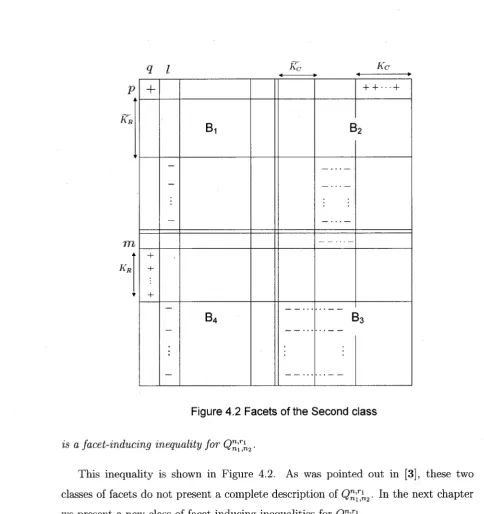
Qn,rTil ,712 1Facet-inducing inequalities o f th e second class are characterized by tw o defining
cells called the primary and the secondary defining cells, and by tw o defining subsets
o f row indices, and tw o defining subsets o f colum n indices.
T he p rim a ry defining cell, (p, q) can be any cell in the array. Suppose i t is con
tained in block B \, the n th e second class o f facet-inducing inequalities fo r Qnffn 2
exists o n ly i f the numbers r-2 and r4 are b o th > 2 . I f th is co n d itio n is satisfied, the
secondary defining cell (m, I) can be any cell in block B2 o r B4 such th a t I q.
Suppose th a t ( m , l ) G B 4. T he defining subsets o f colum n indices K c , K q can
be any nonem pty d is jo in t p roper subsets o f J2. T he defining subset K R can be any n onem pty subset o f J2\ { m } , and the defining subset K f{ can be any nonem pty subset o f I \ . These defining subsets also m ust satisfy \Kc\ + \ K r \ = 1 + r s , and
\ K C\ + \K r \ = r 4.
W ith those assum ptions m entioned above we have
Th e o r e m 4.2.1 (A lfa k ih et al [3 ]). Let (p ,q ), (m , l ), K R, K R, K c and K c be as discussed above. Then,
%pq
+
y ^ Xpj
+
X iq
y
^
■
j e K c i6K R i e I2\ ( K R U { m } ) j e J 2\ K c j £J 2\ ( Kc UKc )
y ]
x v
_
y
^
x u
— 1
4.2. SECOND CLASS OF FACET-INDUCING INEQUALITIES FOR Q " ^ 20
q l Kg Kc
p
Hr
m
k r
is a facet-inducing inequality fo r Qnfh2 ■
T h is in e q u a lity is shown in Figure 4.2. As was pointed o u t in
[3],
these tw oclasses o f facets do n o t present a com plete description o f Q rr\ f \ l 2. In the next chapter
we present a new class o f facet-inducing inequalities fo r Qnfh2 ■
+ + + ••• +
B i E 2
_
---+
+
+
-b4
:
E*3
C H A P T E R 5
N e w C lass o f F a cet-In d u cin g In eq u a lities for
Q
^ n2In th is chapter, we present a new, i.e. a th ird , class o f facet-inducing inequalities
for Qn'[h2 ■ Facet-inducing inequalities in th is new class are characterized by a primary
defining cell (p ,q), three secondary defining cells (l, q) , (m ,q) and (m ’ ,q); and by
fou r n onem pty d is jo in t defining subsets o f colum ns K c , K c, K c , K c , and b y one
nonem pty defining subset o f rows K r .
T h e p rim a ry defining cell, (p,q), can be any cell in the array. Suppose i t is in
block B i, th is new class o f facet-inducing inequalities for o n ly exists i f
r2 > 2 and r4 > 3, (28)
or
r2 > 3 and r& > 2. (29)
I f (28) holds, then the three secondary defining cells can be in B lo ck B4. O n the other hand, i f (29) holds, then the three secondary defining cells can be in B lo ck B 2.
Suppose th a t (28) holds and th a t the secondary defining cells are in B 4. T hen
K r C B \ { p } , K c , K q C J A M and K c , K c C J2 (see Figure 5 .1 ). We require th a t
these defining subsets o f rows and colum ns satisfy
\K c \ + \K c \ = r 2, (30)
\ K c \ + \ K c \ = r l + l , (31)
5. NEW CLASS OF FACET-INDUCING INEQUALITIES FOR Ql'^„ 22
(I Kc K c
< > < —> k c h'< p
Kn
I
m
'm!
+
+ + ••• +
--- E
*1
- b
2+
---
---R,
D4
D3
--- --- --- -
. .
,----Figure 5.1 Facets of the third class
L e m m a 5 .0 .2 . Let K c , K c , K c , K c , Kr be as discussed above and assumer 4 > 3
and?~2> 2. Then
x.PQ+ y~^ x Pj + x tq y~^ •x *.?
j£J2\(KcUKc )
E
=
iefQi, jeA c je A c
y ~ i x v ~ X,rry
»e/i\KnU{p}, j e K c ?:e/i\K'/iu{p}. j gKc j& Kc j e l < c
y ^
x m ' j_ y ^
x m ' j~
y .
j e ^ c j e A c i £ l2\ { l , m , m ' } , j e K c U K c U K c U K c
(3 3 )
5. NEW CLASS OF FACET-INDUCING INEQUALITIES FOR Q l ' ^ 23
P ro o f: For any assignment x G Q™'[R2, the sum
Xpq"I- %lqT 'y ^ X p j, (34)
j e J i M K c u K c )
is equal to 0,1 , or 2. I f (34) is equal to e ithe r 0 or 1 the lem m a tr iv ia lly holds.
Therefore, assume th a t i t is equal to 2. T h is holds when xiq = 1 and xn{] = 1 for
some j0 € ^ \ ( - ^ c U K c ).
For ease o f n o ta tio n le t B c = J2\ { K C U K c ), A c = J i \ ( { q } U R c U K c ) , A R =
I i \ ( { p } L ! K R), and B R = I2\ { l , m , m'}(see Figure 5.2). Thus i t follows fro m (30)-(32)
th a t
p
Kr
Ar
I
m
m1
Br
q
K c K c Ac Be K „Kc
< >< > < > < >
+
+
B i
Ba
Bs
B,
5. NEW CLASS OF FACET-INDUCING INEQUALITIES FOR 24
\Bc \ = r 3, (35)
\ A c \ = u - 2 , (36)
\Ar \ - \ R C\ = \Rc\ - I- (37)
We say a sub-block (X x Y ) has k allocations i f there exists an assignment x €
Q l ’unz such th a t E ( i j)e (x x y ) = k
-R ecall th a t in any assignment x <E Q%[h2, blocks B x, B 2, B3 and R4 m ust have
allocations r i , r 2, r3 and r4 respectively. Four cases w ill be considered (see Figure
5.2):
C ase 1:
x mj =0
and x m/j =0.
jeKc j£ Rc
R ecall th a t xiq = 1. Since xP ] 0 = 1 fo r some jo G R c , sub-block ( / 2 x Be)
can have a t m ost r3 — 1 allocations. B u t fo r any assignment x in Qn’[,h2:
B lo ck B3 should have r3 allocations. Therefore, a t least some cell in B lo ck
B3 w ith a negative sign m ust have an allo catio n and the result follows.
C ase 2:
x m>j1 =1
fo r some j x € K c and x mj =0.
I f some cell ( i , j ) w ith a negative sign in B lo ck B3 has an a llo ca tio n then
we are done. So assume th a t sub-block (J2 x Be) has r3 — 1 allocations, i.e.,
Xij = 1 fo r a ll j e Be- Thus sub-block ( ( K R iJ A R) x B e ) has no allocations.
N ow we have tw o subcases.
Su b case 2a:
x mn = 1 fo r some j2 GBe-T hen the sub-block ( {m , m'} x J i \ { q } ) can n o t have any allocations.
T herefore sub-block ( Br x J i \ { q } ) m ust have r4 — 1 allocations in any feasible assignment x. However, sub-block ( Br x Ac) can have a t most
r4 — 2. T hus one cell w ith a negative sign in sub-block ( B R x ( K cU K c j)
m ust have an a llo ca tio n and the result follows.
5. NEW CLASS OF FACET-INDUCING INEQUALITIES FO R 25
T he sub-block ( ( Kr U Ar) x ( ( K c \ { j i } ) U K c)) m ust have r 2 — 1 al
locations. Now i f any cell w ith a negative sign in sub-blocks ( Kr x
( K c \ { j i } ) ) or ( Ar x K c ) has an allocation, we are done. So assume
th a t sub-blocks ( Kr x K c) and ( Ar x Kc) have no allocations. Now
fro m (30) it follows th a t sub-blocks ( Kr x Kc) and ( Ar x K c) have
r2 — 1 allocations. Hence, a ll colum ns in K c and K c have allocations. Recall th a t j x€ K c has an a llo ca tio n in cell ( m ' , ji).
Now in B lo ck B xi f any cell in sub-block ( K Rx
Kc)
o r sub-block ( Ar xK c ) has an a llo ca tio n the n we are done. Therefore assume th a t sub
blocks ( Kr x K c ) and ( Ar x Kc) have no allocations. T h is im plies
th a t sub-blocks ( Kr x ( Kc U Ac)) and ( Ar x ( Kc U A c j ) m ust have 7T allocations since the colum n q already has an a llo catio n in the cell
(l,q) £ B 4. N o w we have to consider tw o subcases depending on w hether
or not a colum n in A c has an a llo ca tio n in B lo ck B x.
Su bcase i:
Xij3 = 1 fo r some i £ K r U A r and some j 3£Ac-In th is case, S ub-block ( ( { m } U B r ) x ( « / l \ { < 7 } ) ) m ust have r 4 — 1
allocations. However, i t follows fro m (36) th a t ( ( { m } U B r ) x A c )
can have at m ost r 4 — 3 allocations. Hence, Sub-block ( ( { m } U
B r ) x ( K c U
Kc))
m ust have at least 2 allocations. T h is im plies th a t sub-block ( B r x ( K c U K c ) ) m ust have at least 1 a llo ca tio n and the result follows.Su bcase ii:
S ub-block ( ( K r U A r ) x A c ) has no allocations.In th is case, Sub-blocks ( K r , K c ) and ( A r x ( K c ) ) m ust have
7T allocations. Now i t follow s fro m (32) and (37) th a t \ K r \ —
\ K C \= \ K C \ ~ 1 and \ A R \- \ K c \ { j i } \ = \ K C\- Hence, S ub-block
( K r x K c ) has \ K c \ —1 allocations and Sub-block ( A r x K c ) has \ K c \ allocations. Therefore, the Sub-block ( ( { m } U B r ) x ( K c U
5. NEW CLASS OF FACET-INDUCING INEQUALITIES FO R 26
\Ac\ — r 4 ~ 2. Thus th e Sub-block ( ( { m } U Br) x Kc) m ust have an a llo ca tio n and the result follows.
C ase 3:
x rnH =1
fo r somej 4
G and x m >j =0.
K K c
T h is case is s im ila r to Case 2.
C ase 4:
x mj, =1
for some j?,€
K c and x m>:j6 =1
fo r some jo€
T h iscase is s im ila r to Case 2a.
T h e o r e m 5.0.3. The valid inequalities of the form(33) are facet-inducing inequal
ities fo r Q ^ n2.
T he fo llo w in g lem m a is cru cia l fo r the p ro o f o f the above theorem . I t allows us
to lif t a facet-inducing in e q u a lity fo r Qnfh2 in to another facet-inducing in e q u a lity for
(Qn+l.n nn+l,n 1,71+1 j ✓yi+l.n ^Tti,ri2 ’ ^vni+l,ri2’ ^vni4-l,ri2+l’ cmu ^m,ra2+l*
LEM M A 5.0.4 (A lfa k ih et al [3]). Let X n = i X q = i au x u C «-o be a non trivial
facet-inducing inequality fo r Qn’[h2 and let A* = (a*j) be the (n + 1) x (n + 1) matrix derived
from A = (aij) such that:
A A, 0 \
Aio. 0
)
fo r any io G {n f + 1 , . . . , n } and any jo G { n2 + 1 , . . . , n } satisfying aioj0 = 0, where
A,j0 and Ai0. denote, respectively, the joth column and the ioth row of A. Then
X q = i a *jx ij — ao is a facet-inducing inequality for provided that it is a
valid inequality fo r it.
P r o o f o f T h eorem 5.0.3:
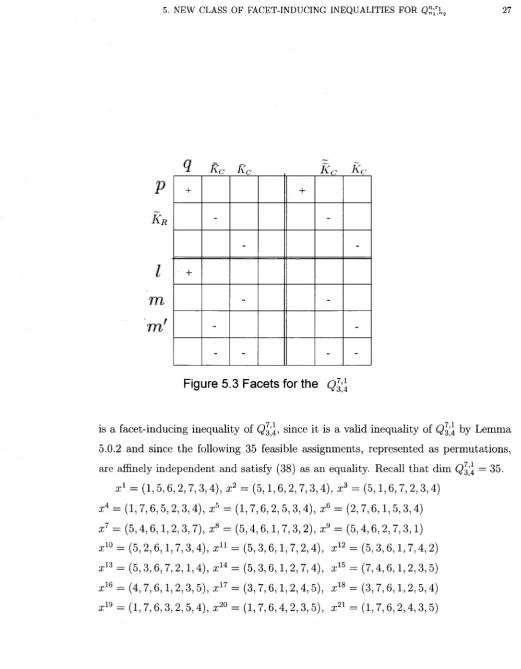
Consider the problem where n = 7, n4 = 3, n2 = 4, rq = 1. T hen r2 = 2, r3 = 1 a n d r 4 = 3 (see F ig u r e 5 .3 ) .
L e t (p,q) = (1 ,1 ), I = 4, m = 5 and m' = 6. F urther, le t B e = 5, K c = { 2 } ,
K c = { 3 } , K C = {6} , K C = { 7 } and K R = {2}. T hen
5. NEW CLASS OF FACET-INDUCING INEQUALITIES FOR 27
q
K c K c K c K cp
++
Kr -
--
-I
+
m
--m f
--- - -
-Figure 5.3 Facets for the
Q7
/ A
is a facet-inducing in e q u a lity o f Q l ’^, since i t is a va lid in e q u a lity o f Q I ’I by Lem m a
5.0.2 and since the follo w in g 35 feasible assignments, represented as p erm utations,
are affinely independent and satisfy (38) as an equality. Recall th a t d im Q34 = 35. x 1 = ( 1 , 5 , 6 , 2 , 7 , 3 , 4 ) , x 2 = ( 5 , 1 , 6 , 2 , 7 , 3 , 4 ) , x 3 = (5, 1, 6, 7, 2, 3,4)
x 4 = (1, 7 , 6 , 5 , 2 , 3 , 4 ) , x5 = (1, 7, 6,2, 5 ,3,4) , x 6 = (2, 7 , 6 , 1 , 5 , 3 , 4 )
x 7 = ( 5 , 4 , 6 , 1 , 2 , 3 , 7 ) , x 8 = ( 5 ,4 ,6, 1, 7,3, 2), x 9 = (5, 4, 6, 2, 7,3,1)
x 10 = ( 5 ,2 ,6 ,1 , 7, 3,4), x 11 = ( 5, 3 , 6, 1 , 7, 2,4), x 12 = (5, 3, 6, 1, 7, 4,2)
x 13 = ( 5,3,6, 7 , 2 , 1, 4 ), x 14 = ( 5, 3 , 6, 1 , 2, 7,4), x 15 = ( 7 , 4 , 6 , 1 , 2 , 3 , 5 )
x 16 = (4, 7 ,6 ,1 ,2 ,3 , 5), x 17 = (3, 7,6,1, 2 ,4 ,5 ), x 18 = (3, 7 ,6 ,1 ,2 , 5,4)