ISSN(Online): 2320-9801 ISSN (Print): 2320-9798
I
nternational
J
ournal of
I
nnovative
R
esearch in
C
omputer
and
C
ommunication
E
ngineering
(An ISO 3297: 2007 Certified Organization)
Vol. 4, Issue 2, February 2016
Multipath Dynamism Proficient (MDP)
Algorithm for Mobile Ad Hoc Network
Environment
Dr. Gunasekaran Shanmugam
Professor, Dept. of MCA, Tiruchengode, Namakkal –Dist, Tamil Nadu, India
ABSTRACT: In this paper, to recommend a power efficient algorithm in Multicast Ad hoc On-Demand Distance Vector (MAODV) routing protocol for Mobile Ad hoc Network (MANET) environment.It is a self-configuring network of mobile nodes which communicate with each other without any fixed infrastructure ie dynamic in nature. In the conventional version of MAODV implementations send multicast traffic to the multicast group only by group members and the multicast data packets are unicast, which increases the bandwidth usage in data delivery. The improvement of MAODV, allows each node in the network to send out multicast data packets, and the multicast data packets are broadcast again when propagating along with the multicast group tree. Each multicast group has a unique multicast group address. To propose multipath dynamism proficient algorithm along with analyse the performance of Packet delivery ratio and throughput and end to end delay metrics using the network simulator environment. It is proven that the obtained result good when compared with earlier approach.
KEYWORDS:Network, Multicast Group, Data Packets, Infrastructure, Power
I. INTRODUCTION
In the MANET environment most commonly used and suitable routing protocol is MAODV. In the MAODV, the group members and the routers are all tree members and belong to the group tree. Associated with each multicast tree, the group member that first constructs the tree and the tree is the group leader for that tree. It is responsible for maintaining the group tree by periodically broadcasting Group-Hello (GRPH) messages in the whole network. The group leader maintains the group sequence number, which is propagated in the network through the message GRPH.
MAODV is a shared-tree-based multicast routing protocol. Each multicast group maintains a shared tree, which consists only of receivers and relays (forwarding nodes). On demand, a multicast route is determined by using a broadcast route discovery mechanism. The first member who joins with the multicast group becomes the leader of that group. The multicast group leader maintains the multicast group sequence number and broadcast the number to the multicast group by a group HELLO message. The nodes update their request table using the group HELLO message information. MAODV maintains three table’s Unicast Routing table, Multicast Routing table and Group Leader Table[1][2]. Multicast Routing Table is maintained for each multicast group. Group leader table maintains the multicast group address along with its group leader address and the next hop towards the group leader [3].
ISSN(Online): 2320-9801 ISSN (Print): 2320-9798
I
nternational
J
ournal of
I
nnovative
R
esearch in
C
omputer
and
C
ommunication
E
ngineering
(An ISO 3297: 2007 Certified Organization)
Vol. 4, Issue 2, February 2016
Fig. 1.1 - Operation of MAODV
MAODV requires the use of periodic neighbour detection packets for detection of broken links, and periodic group leader control packet floods (e.g., every 5s) for disseminating a multicast group’s sequence number. MAODV routing protocol follows directly from unicast AODV, and discovers multicast routes on demand using a broadcast route discovery mechanism employing the same route request (RREQ) and route reply (RREP) messages that exist in the unicast AODV protocol. A mobile node originates an RREQ message when it wishes to join a multicast group, or has data to send to a multicast group but does not have a route to that group. Only a member of the desired multicast group may respond to a join RREQ. If the RREQ is not a join request, it receives a RREQ and does not have a route to that group; it rebroadcasts the RREQ to its neighbours.
As the RREQ is broadcast across the network, nodes set up pointers to establish the reverse route in their route tables. A node receiving an RREQ first updates its route table to record the sequence number and the next hop information for the source node. This reverse route entry may later be used to relay a response back to the source. For join RREQs, an additional entry is added to the multicast route table and is not activated unless the route is selected to be part of the multicast tree. If a node receives a join RREQ for a multicast group, it may reply if it is a member of the multicast group’s tree and its recorded sequence number for the multicast group is at least as great as that contained in the RREQ. The responding node updates its route and multicast route tables by placing the requesting node’s next hop information in the tables, and then unicast an RREP back to the source. As nodes along the path to the source receive the RREP, they add both a route table and a multicast route table entry for the node from which they received the RREP, by creating the forward path.
II. BACKGROUND
In [1] author considered his work, the utilization of bandwidth in an efficient way for multicast routing and addressed multi hop benefits as well for ad hoc wireless networks. The author discussed various related issues regarding multicast communication for wireless sensor network. The author [2] addressed about Ad hoc On demand Distance Vector Protocol in multiple dimension of multicast on demand distance vector protocol and discussed its direction of route reply and route request message. In Multicast multi path route discovery mechanism, MAODV (Multicast Ad-hoc On-Demand Distance Vector) routing protocol discovers multicast routes on demand using a broadcast route-discovery mechanism. A mobile node originates a Route Request (RREQ) message when it wishes to join a multicast group, or when it has data to send to a multicast group but it does not have a route to that group. Only a member of the desired multicast group may respond to a join RREQ. If the RREQ is not a join request, any node with a fresh enough route (based on group sequence number) to the multicast group may respond. If an intermediate node receives a join RREQ for a multicast group of which it is not a member, or if it receives a RREQ and it does not have a route to that group, it rebroadcasts the RREQ to its neighbours discussed by author [4] and author [5].
ISSN(Online): 2320-9801 ISSN (Print): 2320-9798
I
nternational
J
ournal of
I
nnovative
R
esearch in
C
omputer
and
C
ommunication
E
ngineering
(An ISO 3297: 2007 Certified Organization)
Vol. 4, Issue 2, February 2016
To discover the available routes and establish them before transmitting in wireless medium. The routes are created on demand, i.e. only when a route is needed for which there is no fresh record in the routing table. In order to facilitate determination of the freshness of routing information, AODV maintains the time since when an entry has been last utilized. A routing table entry is expired after a certain predetermined threshold of time. All the nodes to be in the position are considered. Now the shortest path is to be determined by implementing the Ad hoc on Demand Distance Vector routing protocol in the wireless simulation environment for periodically sending the messages to the neighbour’s and the shortest path. Hence, the source should be incessantly tracking their positions. By implementing the MAODV protocol in the simulation scenario, it transmits the first part of the data through the selected path. After few seconds, the nodes move to new positions addressed by the authors [6] and author [7].
The author [8] considered and addressed the MAODV (Multicast Ad-hoc On-Demand Distance Vector) routing protocol discovers multicast routes on demand using a broadcast route-discovery mechanism. A mobile node originates a Route Request (RREQ) message when it wishes to join a multicast group, or when it has data to send to a multicast group but it does not have a route to that group. Only a member of the desired multicast group may respond to a join RREQ. If the RREQ is not a join request, any node with a fresh enough route (based on group sequence number) to the multicast group may respond. If an intermediate node receives a join RREQ for a multicast group of which it is not a member, or if it receives a RREQ and it does not have a route to that group, it rebroadcasts the RREQ to its neighbours. As the RREQ is broadcast across the network, nodes set up pointers to establish the reverse route in their route tables.
The author [9] and [10] addressed energy efficiency and other related issues in detail. They discussed new direction of efficient algorithm to maintain reliable communication for wireless sensor networks. The author [11] discussed about Scalable Energy Efficient Location Aware Multicast Protocol for MANET. In MANET Environment, a node receiving a RREQ first updates its route table to record the sequence number and the next hop information for the source node. This reverse route entry may later be used to relay a response back to the source. For join RREQs, an additional entry is added to the multicast route table. This entry is not activated unless the route is selected to be part of the multicast tree. If a node receives a join RREQ for a multicast group, it may reply if it is a member for the multicast group’s tree and its recorded sequence number for the multicast group is at least as great as that contained in the RREQ. The responding node updates its route and multicast route tables by placing the requesting node’s next hop information in the tables, and then unicasts a Request Response (RREP) back to the source node. As nodes along the path to the source node receive the RREP, they add both a route table and a multicast route table entry for the node from which they received the RREP, thereby creating the forward path.
When a source node broadcasts a RREQ for a multicast group, it often receives more than one reply. The source node keeps the received route with the greatest sequence number and shortest hop count to the nearest member of the multicast tree for a specified period of time, and disregards other routes. At the end of this period, it enables the selected next hop in its multicast route table, and unicasts an activation message (MACT) to this selected next hop. The next hop, on receiving this message, enables the entry for the source node in its multicast route table. If this node is a member of the multicast tree, it does not propagate the message any further. However, if this node is not a member of the multicast tree, it will have received one or more RREPs from its neighbours.
The author [12] recommended the Efficient Clustering Architecture for Multicast Security in Mobile Ad Hoc Networks and discussed about
best
next hop for its route to the multicast group, unicasts MACT to that next hop, and enables the corresponding entry in its multicast route table. This process continues until the node that originated the RREP (member of tree) is reached. The activation message ensures that the multicast tree does not have multiple paths to any tree node. Nodes only forward data packets along activated routes in their multicast route tables. The first member of the multicast group becomes the leader for that group. The multicast group leader is responsible for maintaining the multicast group sequence number and broadcasting this number to the multicast group. This is done through a Group Hello message. The Group Hello contains extensions that indicate the multicast group IP address and sequence numbers (incremented every Group Hello) of all multicast groups for which the node is the group leader. Nodes use the Group Hello information to update their request table.ISSN(Online): 2320-9801 ISSN (Print): 2320-9798
I
nternational
J
ournal of
I
nnovative
R
esearch in
C
omputer
and
C
ommunication
E
ngineering
(An ISO 3297: 2007 Certified Organization)
Vol. 4, Issue 2, February 2016
activation), with J (join) flag set, to the next hop which is on the selected route. This message officially grafts the selected route onto the existing multicast tree.
Since AODV keeps hard state in its routing table, the protocol has to actively track and react to changes in this tree. If a member terminates its membership with the group, the multicast tree requires pruning. Links in the tree are monitored to detect link breakages. When a link breakage is detected, the node that is further from the multicast group leader (downstream of the break) is responsible for repairing the broken link. If the tree cannot be reconnected, a new leader for the disconnected downstream node is chosen as follows. If the node that initiated the route rebuilding is a multicast group member, it becomes the new multicast group leader. On the other hand, if it was not a group member and has only one next hop for the tree, it prunes itself from the tree by sending its next hop a prune message. This continues until a group member is reached. Once separate partitions reconnect, a node eventually receives a Group Hello for the multicast group that contains group leader information that differs from the information it already has. If this node is a member of the multicast group, and if it is a member of the partition whose group leader has the lower IP address, it can initiate reconnection of the multicast tree. The simulation parameters wireless network more than 71 nodes. Three source node and three destination nodes random way packet transmission. If packet losses change the alternate route and shortest path is constructed and neighbour information gather source node. The source to destination node sends each packet 512 bytes and using traffic application protocols CBR (Constant Bit Rate).dividing three multicast groups.
In multicast multi path route maintenance is the maintenance of the multicast multi-path routes to handle the route links properly by identifying and rectifying broken ones. In addition the node in the path also varies due to the mobility factor; in turn route path is deviated. To correct the deviated path, node movements are tracked to be within the admissible mobility rate or identify the route discovery from there on again. The source has to continuously monitor the position of the nodes to make sure the data is being carried through the path to the destination without loss. In any case, if the position of the nodes change and the source does not make a note of it then the packets will be lost and ultimately have to be resent.
In the conventional version of MAODV, the MAC layer detection is used for detecting broken links on the active routes, either the route to a specific node or the route to a multicast tree. In the improved version of MAODV one-hop Neighbour-Hello is used to perceive the link breakage in multicast group tree. In addition the AODV implementation in the latest version does implement the local revamp for link breakage, the improved version of MAODV implementation and simulation ignore local repair and still let the data source node initiate discovery for a new route instead.
III.PROPOSED ALGORITHM
A source packet that has to be sent is encoded and sub streams are allocated for the traffic to be flown by the traffic allocator mechanism [7][8]. Now the traffic allocator sees to that which route is best for the source to traverse and the resequencer decodes the packets and sends it to the recipient. Directed diffusion is an on-demand routing approach, designed for energy efficiency so it only sets up a path if there is data between a source and a sink. However, the major disadvantage of the scheme, in terms of energy efficiency, is the periodic flooding of data. In order to avoid the flooding overhead, the setup and maintenance of alternate paths is proposed in advance using a localized path setup technique based upon the notion of path reinforcement. The proposed path reinforcement power aware scheme parameters considered for conducting this experiment, extend the power efficient algorithm to implement timing constraints and through levels. The results of the power aware scheme show that it performs better when the network is dense. In a large network, a node will have a large number of neighbours. The computation time for calculating the minimum power among the nodes’ neighbours is quadratic or exponential (depending on the algorithm used, power + timing or power * timing). The following Multipath Dynamism Proficient Algorithm (MDP) is defined as
Step 1: Initial set as thresholdvalue = 50%; success = 0; cutoff = 20% XA := S
Step 2: Repeat
If g(XA) >= thresholdvalue then YB := XA;
(*Let XA be a neighbor of YB that minimizes*) Step 3: pt (YB,XA) = power-time(YB,XA) + v(s)f(XA);
ISSN(Online): 2320-9801 ISSN (Print): 2320-9798
I
nternational
J
ournal of
I
nnovative
R
esearch in
C
omputer
and
C
ommunication
E
ngineering
(An ISO 3297: 2007 Certified Organization)
Vol. 4, Issue 2, February 2016
Until XA = D
(* Delivery success and destination reached *)
Step 4: or if success <> 1 then
if thresholdvalue > cutoff then
thresholdvalue = thresholdvalue /2; Step 5: or XA = YB ( * Delivery failed *);
In the algorithm shown above, the first steps initialize a threshold value 50% which reduces the computational time for the remaining battery power of the nodes. In the second step while selecting a route, nodes with battery power greater than the threshold value will only be considered. The third step continues to compute the minimum power-cost route. In step four, if none of the nodes meet the threshold value, the threshold value is reduced by half. This will continue until a node meeting the threshold value is found or the threshold value reduces to a minimum specified value. The final step is the implication that the network is broken (Link broken) and the packet cannot be delivered.
IV.SIMULATION RESULTS
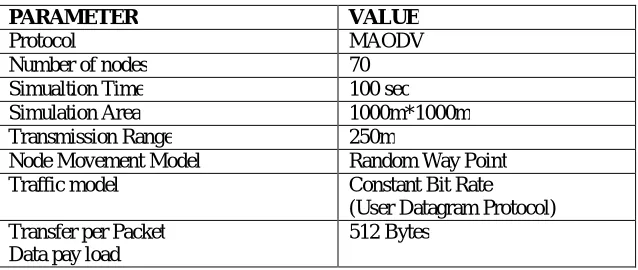
The simulation parameters wireless network more than 70 nodes are considered as first step process. Three source node and three destination nodes random way packet transmission. If packet loss changes the alternate route and shortest path neighbor information gather source node. Source to Destination node send each packets 512 bytes and using traffic Application protocols CBR (Constant Bit Rate) and dividing three multicast groups.
Table 1.1 Simulation parameters
PARAMETER VALUE
Protocol MAODV Number of nodes 70 Simualtion Time 100 sec Simulation Area 1000m*1000m Transmission Range 250m
Node Movement Model Random Way Point Traffic model Constant Bit Rate
(User Datagram Protocol) Transfer per Packet
Data pay load
512 Bytes
Energy: It is the average energy consumption involved in the entire data transmission.
Throughput: Throughput is a measure of how many units of information a system can process in a given amount of time.
Packet Delivery Ratio: It is the ratio of the number .of packets received successfully and the total number of packets transmitted. It is the ratio of the data packets delivered to the destinations to those generated by the sources.
Packet Delivery Ratio (PDR) = Total Packets Delivered to destination --- Total Packets Generated.
It can be expressed as in the form of mathematical e
P = 1/c ∑ (Rf / Nf ) (1) f-1
After finding the value of p which is calculated the average packet delivery ratio. Where, P is the fraction of successfully delivered packets, c is the total number of flow or connections, f is the unique flow id serving as index, Rf
ISSN(Online): 2320-9801 ISSN (Print): 2320-9798
I
nternational
J
ournal of
I
nnovative
R
esearch in
C
omputer
and
C
ommunication
E
ngineering
(An ISO 3297: 2007 Certified Organization)
Vol. 4, Issue 2, February 2016
End-to end delay ratio: it is of the number of packets successfully send and received and take processing delay calculation.
From the above Fig. 1.2 shows that the comparison performances chart of throughput, packet delivery ratio and end- to end delay outperforms with help of experiment result. In Fig. 1.3 exclusively is shown that the packet delivery ratio as well as number nodes increased in dynamic environment.
A) Average Energy Efficiency
Experiments are conducted with the intra domain network topology. It is a close approximation to analyse how the routing algorithm performs under these conditions since; recent findings suggest that many Internet Service Providers are in the process of increasing the node connectivity of their networks. Each link has a bandwidth of 20 Mbps. The topology has 3 sources that simultaneously send multicast traffic, where each source has 18 receivers and nodes 10 and 23 are selected as additional overlay nodes. Each source-destination pair has three paths including the min-hop path starting at the source node and each source generates Poisson traffic with an average rate of 10 Mbps.
The routing algorithm starts from the setting that all overlay rates other than the source nodes are set to model, the algorithm starts with basic unicast routing to reach each destination. It starts with a single shortest path multicast tree rooted at each source node and gradually shifts traffic to alternative trees rooted at overlay nodes. For the proposed algorithm simulated an Ad hoc network with varying densities and transmission ranges. Each node had a random location in a 1000 x 1000 area. They also had a random amount of initial power within a range of 70 joules to 150 joules. The thresholds were varied from 70 joules to 100 joules.
The X axis refers to the average energy consumed to multicast the data in multiple paths for the Dynamism proficient algorithm scheme proposed on the specified simulation environment described above. On considering the Y axis, overall network throughput is measured on the multi-path multicast scheme for data delivery. Throughput obtained is the number of useful bits per unit of time forwarded by the network from a certain source address to a certain destination, excluding protocol overhead, and excluding retransmitted data packets.
Fig. 1.4 depicts that initially slight change in the energy consumption level highly varies the throughput efficiency. However on due course of the continuous multicasting, the changes to the through put is almost similar to the variation of power consumption level which explains the better performance of the proposed power efficient reinforced path multicast. The values of the graph shown in Fig. 1.2 are depicted in the table below to reveal the exact variations measured on the simulation for the energy level being consumed to obtain the required level of through put. The life of the network depends on various factors’, which include the initial threshold, density of the network and range of the transmitters. These parameters need to be adjusted for each network. The work presented here studied the various power saving techniques employed by mobile devices. The initial results show that the various parameters affect the lifetime of the network. At this point, the nodes personal tasks are not taken into account. In the future, the power consumed can be taken into account by these activities, to see its impact on the lifetime of the network. In this proposed method the data can be split into five parts and transmitted in multi path based on the availability of the nodes.
B) Packet delivery ratio
The multi-path multicast packet delivery ratio is measure by the following calculation to identify the efficiency of the proposed path reinforcement scheme which is depicted in the Fig. 1.3
Multicast Packet Delivery Ratio = (Number of multicast data packets Received) / (Number of multicast data packets Sent)
The experimental simulation is carried out to evaluate the packet delivery ratio against the number of group nodes involved in multicast data delivery to its respective receivers. Pause-time is the time measured in seconds, for which a packet stops in, when it reached a destination after a travel from the place of departure. Node mobility(m/s) is the velocity with which a node moves on its due course of transmitting data from the source to destination. Dropped packets are number of packets dropped due to the effect of link breaks. The dropped packets may be a control packets or data packets. Fig. 1.5 shows the performance of delivery ratio against number of nodes to be multicast in Multi-path wireless ad hoc data transmission.
ISSN(Online): 2320-9801 ISSN (Print): 2320-9798
I
nternational
J
ournal of
I
nnovative
R
esearch in
C
omputer
and
C
ommunication
E
ngineering
(An ISO 3297: 2007 Certified Organization)
Vol. 4, Issue 2, February 2016
The multicast packet delivery ratio indicated in the Y axis shows the measure quantity of data being efficiently transferred to the receivers of the wireless ad hoc network. The resultant table extracted from the graph (Fig. 1.5) shows that for the proposed power efficient multi-path multicast scheme, the packet delivery ratio is higher than the existing multi-path multicast scheme which in turn shows better performance of the overall wireless ad hoc network. However the multicast packet delivery ratio gets decreased for increasing number of nodes in the multicast group for both the schemes with power and without power.
By the extensive use of AODV protocol for multicasting with improved MAODV the data quality parameters, i.e., delay and throughput have significantly improved. From the simulation results the delay has been reduced by 0.5s and the throughput has been increased by 5%.Wireless multicast is required for a range of emerging wireless applications employing group communication among mobile users. The optimal values obtained for energy, throughput and packet delivery ratio against the specified number of nodes as per the simulation conducted suggest the complexity of having multi-path routing to forward packets. It seems that it forward packets onto each branch at a different rate offering a marginal benefit to the power efficient scheme. Also, our proposed Dynamism proficient algorithm scheme does better than non power multi-path multicast scheme as a consequence of the availability of multiple trees to distribute the traffic load. Under network topology model the multicast proposal minimize the data delivery time line to an appreciable level.
ISSN(Online): 2320-9801 ISSN (Print): 2320-9798
I
nternational
J
ournal of
I
nnovative
R
esearch in
C
omputer
and
C
ommunication
E
ngineering
(An ISO 3297: 2007 Certified Organization)
Vol. 4, Issue 2, February 2016
Fig. 1.4 Energy Vs Throughput Fig. 1.5: Number of nodes Vs Delivery ratio
V. CONCLUSION AND FUTURE WORK
The proposed power efficient multi-path reinforcement multicast scheme evaluated in this paper shows better performance of multicast delivery in wireless ad hoc network compared to the existing non power multi-path scheme in terms of packet delivery ratio, throughput and delay. On considering the packet delivery ratio the Multipath Dynamism Proficient Algorithm shows nearly 20% to 30% improvement compared to existing one. The throughput for the Multipath Dynamism Proficient Algorithm scheme keeps on increasing varies energy levels and the optimal threshold point is arrived for the throughput in the specified simulation topological variations. The multicast data delivery timeline (measured as delay) seems to have minimal effect in applying the Multipath Dynamism Proficient Algorithm to multi-path multicast data delivery. As shown in the simulation results, it is observed that the performance of Energy, Throughput, the Packet delivery ratio, Packet end- to –end delay outperforms with the help of Multipath Dynamism Proficient Algorithmscheme. In the future work, need to propose a new suitable key encryption scheme for MANET environment. In addition to that require to analyse the performance of proactive and reactive routing protocols and identify the protocol suitability for Mobile ad hoc environment. Adding together to find out network link broken problems and try to implement new algorithm for preventing from link broken for MANET environment.
REFERENCES
1. T. Ozaki, J-B. Kim and T. Suda, “Bandwidth Efficient Multicast Routing for Multi hop, Ad hoc Wireless Networks,” Proceedings of the IEEE INFOCOM Conference, vol. 2, pp. 1182-1192, Anchorage, USA, April 2001.
2. C. E. Perkins and E. M. Royer, “The Ad hoc On demand Distance Vector Protocol,” Ad hoc Networking, edited by C. E. Perkins, pp. 173-219, Addison-Wesley, 2000.
3. E. Royer and C. E. Perkins, “Multicast Operation of the Ad-hoc On-demand Distance Vector Routing Protocol,”Proceedings of the 5th ACM/IEEE Annual Conference on Mobile Computing and Networking, pp. 207-218,Seattle, USA, August 1999.
4. S. Sajama and Z. J. Haas, “Independent-tree Ad hoc Multicast Routing (ITAMAR)”, Mobile Networks and Applications, vol. 8, no. 5, pp. 551-566, October 2003.
ISSN(Online): 2320-9801 ISSN (Print): 2320-9798
I
nternational
J
ournal of
I
nnovative
R
esearch in
C
omputer
and
C
ommunication
E
ngineering
(An ISO 3297: 2007 Certified Organization)
Vol. 4, Issue 2, February 2016
6. R.C. Seet, G. Liu, B.S. Lee, C.H Foh, K.J. Wong and K.K. Lee, “A‐STAR: A mobile ad hoc routing strategy formetropolis vehicular Communication”, Performance of Computer and Communication Networks, Lecture notes in Computer Science, Vol. 3042, Publisher: Springer Berlin Heidelberg, 2004, pp. 989‐999.
7. M Chatterjee, S. Das and D. Turgut, “WCA: A Weighted Clustering Algorithm for Mobile Ad hoc Networks”,Journal of Cluster Computing
(Special Issue on Mobile Ad Hoc Networks), Vol. 5, No. 2, Springer, pp. 193‐202, 2002.
8. W. Choi and M. Woo, “A Distributed Weighted Clustering Algorithm for Mobile Ad Hoc Networks”, In Proceedings of IEEE Advanced International Conference on Telecommunications and International Conference on Internet and Web Applications and Services, 2006, pp. 73. 9. Pariza Kamboj and Ashok.K.Sharma, “Energy Efficient Multicast Routing Protocol for MANET with Minimum Control Overhead
(EEMPMO)”, International Journal of Computer Applications ,Volume 8-No.7, 2010.
10. KU Adhvaryu and Pariza Kamboj, “Efficient Multicast Ad-hoc On-Demand Distance Vector Routing Protocol”,Journal of Network
Communications and Emerging Technologies ,EverScience Publications 26 Vol 5,Issue No 2, December(2015).
11. Pariza Kamboj, A.K.Sharma ,“Scalable Energy Efficient Location Aware Multicast Protocol for MANET(SEELAMP)” Journal of Computing
, Vol 2, Issue 5, May 2010.
12. Gunasekaran .S and Duraiswamy.K “Energy Efficient Clustering Architecture for Multicast Security in Mobile Ad Hoc Networks”,International Journal of Advanced Engineering Research and Studies, Vol. I, Issue II/January-March, page 244-251, 2012, 13. Anjaneyulu and Sita Kumari “Modified PUMA Multicast Routing Protocol for Mobile Ad hoc Network”, International Journal of Computer
Networks and Wireless Communications, ISSN: 2250-3501 Vol.5, No.2, April 2015.
BIOGRAPHY