CONTINUED INBREEDING I N MAIZE
DONALD F. JONES
Connecticut Agricultural Exfleriment Station, New Haven, Connecticut
Received January 2 0 , 1939
HE investigation
T
EAST in 1904 hasof the effects of inbreeding maize begun by E.
il
.
been continued to the present time. The results of
30 generations of self-fertilization are here summarized. All surviving lines have been reduced to a high degree of uniformity and constancy. Varia- tions of a degenerative nature have occurred from time to time and no doubt will continue to occur. Such variations have caused the extinction of a t least one line and may prevent the continuation of some or all of the surviving lines. For the past ten generations however, they have been able to exist at about the same level of vigor without appreciable change.
These inbred lines were started from a number of self-pollinated plants of the Leaming variety grown at the Illinois Agricultural Experiment Sta- tion in 1904~. This variety was known locally as Chester’s Leaming and was selected as one of the most productive types of corn grown in that lo- cality a t that time. At least 1 2 plants were hand pollinated at the start
but when the first detailed report on these inbreds was made in 1 9 1 2
(EAST and HAYES) only four lines had been continued in Connecticut. These were numbers 1-6, 1-7, 1-9, and 1-12.
Number 1-12 was the least productive of the four, yielding only two
bushels per acre in 1911 while the others gave 28, 25, and 26 respectively.
This 1-12 line was either discontinued or lost sometime between 1911 and
1914. The 1-7 line was separated into two lines in the second generation. One of these, the 1-7-1-1 line, has been continued to the present time.
The 1-7-1-2 line was lost in generation twenty for reasons that are not
clearly understood. I n about generation eighteen several plants showed a
peculiar streaking of the leaves. Although seed was saved from only nor- mal plants the condition increased until in generation twenty all of the plants were affected. No selfed seed was secured from a number of pollina- tions. Attempts to restore the line from old seed were unavailing.
The abnormality seemed to be in the production of chlorophyll. Affected plants were faintly striped or streaked with indistinct light green or yellow- ish green areas on the leaves. These plants produced pollen but rarely any seed. They were crossed on to normal plants in the same line and in unre- lated lines. In both cases abnormal plants appeared in the first and later generations in varying numbers and with different degrees of abnormality.
1 In 1912, EAST and HAYES stated that the first self-fertilized generations were grown in 1906
from hand-pollinated seed produced in 1905, but an earlier publication by EAST in 1909 presented results which show that the first self-pollinations must have been made in 1904.
INBREEDING I N MAIZE 463 I n the self-fertilized line the abnormality increased steadily in the propor- tion of plants affected and the degree to which they were reduced in size and vigor until finally no seed was obtained. This variation has not ap- peared in any other line.
TABLE I
The effect of thirty generations of self-fertilization upon the height of plant and yield of grain i n maize.
NUMBER OF 1-6 1-7 1-9
GENERATIONS HEIGHT YIELD BU. HEIGHT YIELD BU. HEIGHT YIELD BU.
SELFED INCHES PER ACRE INCHES PER ACRE INCHES PER ACRE
0 117 8 r f 7 117 8 1 f 7 117 8 1 5 7
1- 5 87 6 4 f 1 1 81 5 I i - 7 77 41+5
6-10 9 7 k 1 4 5 f I 2 8 4 f 1 36i-5 8 2 f 2 3 4 f 4 9 7 f 3 3 8 f 4 8 4 f 2 3 4 + 3 8 3 f z 2 6 f 2 11-15
21-25 81kz 2 0 f 6 7 5 f 3 2 I f 3 71+3 13+2 16-20 8 8 f 4 22+4 8 5 f 3 24+3 7 5 + 4 1 4 k 3
26-30 9 2 f 3 24i-9 80f 2 1 8 f 4 7 7 t 3 9 + 4
120
I
100
I- I
w r 2
80
60
40
0
d
* 20
5 IO 15 20 2 5 30
NUMBER OF GENERATIONS
FIGURE I.-A comparison of three maize lines, derived from the same variety, self-fertilized for 30 generations. Height of stalk is measured in inches and yield of grain in bushels per acre, both plotted on the same scale. The broken lines are the theoretical curves of inbreeding explained in the text.
for five-year periods to reduce the seasonal fluctuations. Wide variations, especially in yield, occur from season to season due to varying weather conditions. Since it is impossible to save seed of corn for more than a few years and have it produce normally there is no way to overcome these seasonal variations. A long continued experiment on inbreeding with plants is as much a record of weather conditions as it is of the effects of consan- guinity. For example, the 1-6 line in generation thirty was grown both in 1936 and 1938 from the same lot of seed. In the former year it yielded a t the rate of 38.3 bushels per acre and in the latter year 1.9 bushels. All yields were high in 1936 and extremely low in 1938 due to the rainy season and late maturity.
No measurements on height of stalk were made until the fifth genera- tion. The original, naturally pollinated variety was grown in 1905 in Illinois and again in 1916 in Connecticut from seed obtained anew from the original source. The yields were 75 bushels of dry shelled grain in Illinois and 88 bushels in Connecticut. These two results are averaged to give the yield a t the start before inbreeding. Height of stalk was measured only on the original variety grown in Connecticut in 1916. All yields have been calculated from air dried ears, 70 pounds of ear corn equalling one bushel of shelled grain.
By averaging the results for five-year periods some of the seasonal fluc- tuations are smoothed out and the general trend stands out clearly. The reduction in height of stalk has taken place almost entirely in the first five-year period. After the fifth generation no significant change has taken place, giving due consideration to the probable error as measured by the standard deviation calculated by Bessel’s fdrmula. Yield continued to de- cline in all three lines until generation twenty. During the last IO genera-
tions no significant change has taken place. The broken lines in figure I
are the theoretical reductions calculated in the following way: The average height and average yield of the three lines at the end of the 30 generations is subtracted from the figures at the start. This difference is halved in each generation and added to the end result.
In calculating the theoretical curves the results are averaged for five generation periods to correspond with the actual results treated in the same way. Since no height measuremehts were made until the fifth genera- tion the theoretical height is not averaged for the first five generations. Only the one figure for the fifth generation is used. (Example: I 17 -83 = 34. This number halved five times is 1.0625. Added to 83 it gives the theoreti- cal height for the fifth generation. The theoretical yields for the first five generations, obtained in the same way, are 49,35, 25, 21 and 19. The aver-
INBREEDING IN MAIZE 465
effect is correlated with the degree of heterozygosity as explained previ- ously (JONES 1918a). The number of heterozygous allelic pairs is reduced
50 percent, on the average, in each generation of self-fertilization. The more rapid attainment of constancy in height than in yield may be under- stood on the assumption that height of stalk is less complex in its transmis- sion than yield. Grain production sums up the plant’s entire ability to grow and to reproduce and no doubt is influenced in its expression by many more inherited determiners than length and number of internodes. I n a previous publication (JONES 1924) results were given from two of
these Leaming inbreds which were crossed, and successive selfed genera- tions from the F1 to F8 grown, all in the same years. New seed was pro- duced from a number of plants self-fertilized. Since the original plants were first generation hybrids of inbred strains the results are not directly com- parable to the figures given above. For testing the effect of inbreeding upon yield they are better because seasonal fluctuations are eliminated to a con- siderable extent and the mixing of seed from several plants reduces the chances of using progenitors more heterozygous than the average. The yields in bushels per acre obtained compared to the theoretical expecta- tions are as follows:
FI F2 Fs Fq
Fs
F, F7 FsActual IOI 69 43 44 23 2 7 25 2 7
Expected - 64 46 36 32 29 28
-
This is a remarkably close parallel considering the many external factors that can affect yield. The height measurements obtained from the same plants are not so closely in agreement with the theoretical expectation. They are as follows:
FI F2 F3 Fq Fs Fa F7 Fs
Actual 95 82 78 77 67 63 60 59
Expected - 77 68 64 61 60 60
-
The slower reduction in any measurable character, than the theoretical curves indicate, could result from the survival and selection of the more vigorous individuals as progenitors. In this way the attainment of homozy- gosity is delayed. It is expected that inbred lines will behave differently. By random assortment some individual progenitors will be more heterozy- gous and some less than the average. Experience with a large number of inbreds indicates that the majority of them are reduced to a high degree of stability in less than ten generations.
DONALD F. JONES
duced to complete homozygosity, due to degenerative changes. There is good evidence to indicate that loss variations have occurred in these lines. In figure 2 the behavior of two lines is given when separated at various
120
100
5
8
9
80 Y)60
60
I
5 IO 15 20 25 30
MJMBER OF GENERATIONS
FIGURE 2.-Two families separated into sib lines at various generations and continued until shown to be genetically similar or diverse. Both are plotted at the same scale in different positions.
stages of inbreeding. Height of stalk is used because it is less influenced by seasonal fluctuations than yield. The 1-6 line in the eighth generation was separated into two sib lines and grown in adjoining rows until the sixteenth generation. The two lines were clearly distinct as reported in a
previous publication (JONES 1924). At the same time the 1-7 line was also separated and the two sib lines continued to the 17th generation.
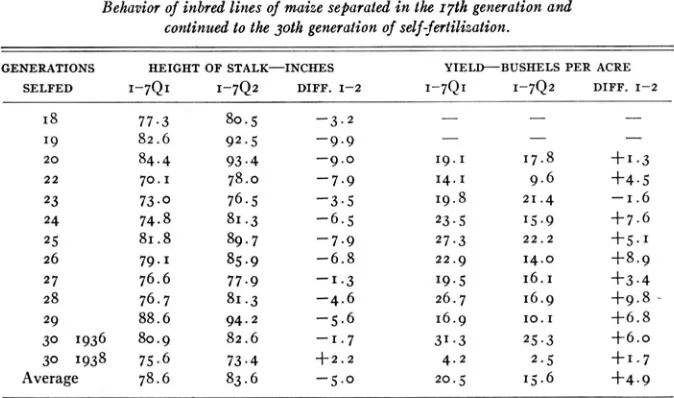
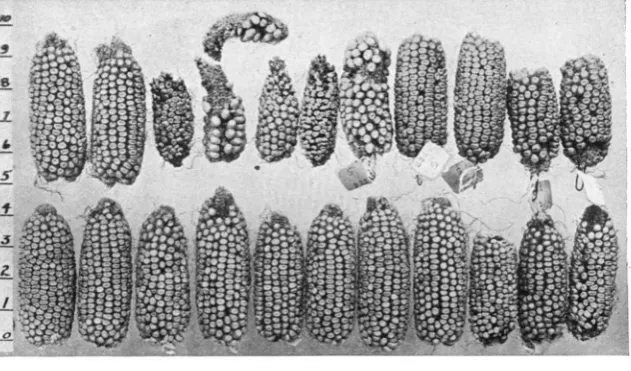
INBREEDING I N MAIZE 467 As no significant difference appeared in these paired lines one of them was discontinued and another separation made in the other in generation 17. These two lines I-7Q1 and I-7Q2 have been continued to date and have been significantly different for this entire period in appearance as well as in measurable characters. The difference in ear type is shown in figures 3 and 4. The I-7Q2 line has noticeably smaller and less well filled
FIGURE 4.-The I-7Q2 line separated from the I-7Q1 line in the 17th generation and further inbred for 1 2 generations.
ears. The production of grain is significantly less as shown by the results given in table 2. This poorer yielding line is taller in stalk growth. The
TABLE 2
Behavior of inbred lines of maize separated in the 17th generation and conhued to the 30th gewation of selffertilization.
GENERATIONS HEIGHT OF STALK-INCHES Y I E W B U S H E L S PER ACRE
SELFED I-7Q1 I-7Q2 DIFF. 1-2 I-7Qr 1-742 DIFF. 1-2
18 I9 2 0 22 23 24 25 26 27 28 29 30 I936 30 I938 Average
77.3 8 0 . 5
82.6 92.5 84.4 93.4 70.1 78.0 73 .O 76.5 74.8 81.3 81.8 89.7 79.1 85.9 76.6 77.9 76.7 81.3
80.9 82.6
78.6 83.6 88.6 94.2
75.6 73.4
-3.2 -9.9 -9.0 -7.9 -3.5 -6.5 -7.9 -6.8 -1.3 -4.6 -5.6 -1.7
+ 2 . 2
-5.0
-
19.1 14. I 19.8 23.5 27.3 22.9 19.5 26.7 16.9 31.3 4.2 2 0 . 5
- 17.8 21.4 15.9 14.0 16.1 16.9 25.3 2 . 5 1 j . 6 9.6
2 2 . 2
I O . I
- + I .3 +4.5
4-7.6 +S.I +8.9 +3.4 4-9.8 -
4-6.8 +6.0 +1.7 -1.6
F.
differences in height are all minus and in yield all plus, with one exception in each case, and the odds measured by Student’s method are considerably less than one in 100 that these differences are due to chance alone.
FIGURE s.-The I-6Vr line in the 29th generation of continuous self-fertilization.
FIGURE 6.-The I-6Vz lime separated from the 1-6V1 line in the zznd generation and further inbred for seven generations.
The 1-6 line was also again separated in the 17th generation but as
I
no differences were apparent in generation 2 0 one of these was discontinued.
INBREEDING IN MAIZE 469
A sensitive method for testing heterozygosity is to cross separated lines and compare the F1 progeny with the two parental lines. This was done for all three lines separated after seven generations and continued for six or more additional generations (JONES 1924). The crosses of the paired lines were significantly increased in yield over the parents in the 1-6 and 1-7 lines but not in the 1-9 line. Sib lines of 1-6 and 1-7 separated in the 22nd and 17th generations and further self-fertilized for six and eleven generations were crossed with each other and the results for height and yield are given in table 3 . The F1 progenies do not differ significantly from
TABLE 3
The result of crossing inbred lines of maize that had been separated i n generations 17 and zz and further inbred for 11 and 6 generations.
YIELD
PEDIGREE H E I G H T OF STALK I N INCHES N MEAN S.D. BU. P E R S.D. 61 64 67 70 73 76 79 Sz 85 88 ACRE
1-7Q1 K 8 5 1 0 2 2 5 65 3 . 0 2 7 3 . 8
FI I 13 19 IZ 3 48 67 2 . 8 2 5 1.2
I-7Qz K 3 9 4 6 1 23 69 3 . 1 17 2 . 5
I-6V1 F 2 7 8 7 3 1 28 8s 3 . 7 36 2 . 5
S I 3 1 1 1 6 7 3 41 79 3 . 3 . 33 1 . 4
I-6Vz F 1 5 4 9 8 1 2 8 78 3 . 7 35 1 . 9
either parent. There is every indication that these lines have now been reduced to complete, or very nearly complete, homozygosity, a t least for all loci that have any effect upon hybrid vigor.
The differences that have appeared in the last 1 5 generations are more probably due to germinal variations rather that to delayed segregation from an originally heterozygous complex. Two transmissable variations had previously appeared in these lines. Defective seeds were noted in the 1-6 line in the 13th generation and red cobs in the I-7line in about the tenth generation. This latter is a change from a recessive to a dominant condition.
the ears are now somewhat shorter than they were in the early stages of inbreeding. Ears of this line in about generation 13 are shown in
GENETICS 9 : 405-418, 1924, figure I. These are quite similar to the ones
shown here produced in generation 29. (Previous photographs show selected ears. The illustrations given here include the entire crop from small progenies of about 20 plants each. Some of the small specimens are
second ears.) In stalk growth and kernel type there has been no marked change since the tenth generation. This line now produces much aborted pollen apparently due to a failure of normal synapsis.
No.-+
6
7 - 1 7 - 29
/2INBRED
e
7 YEARS
r
HYBRIDS
FIGURE 7.-The four lines after seven generations of self-fertilization. (From photograph by H. K. HAYES taken in 1914)
The
1-7
line shown in figure 3 is considerably smaller in ear size than it was in generation IO. There is a noticeable tendency for the ears to be poorly filled at the tips with the production of many rudimentary stami-nate florets. While the cobs are still flattened they are not as broad as
the ears shown in Bulletin 207, Plate IIb. The change in height of plant
and ear type, shown by the sib lines separated in generation
17,
is agerminal change of some kind. The reduction in size of ear and seed forma- tion would be interpreted as a degenerative change if it were not that the plants are taller than the normal line which has not changed in ear type. Whether these changes involve more than a single locus has not been determined.
INBREEDING IN MAIZE 47= ears are available for photographing and only a few immature self-polli- nated seeds are on hand to continue this line. In 1937 it yielded a t the rate of 2 1 bushels per acre which is considerably above its average for the past 15 years. I n a good year the ears do not differ noticeably from the speci- mens shown in Bulletin 2 0 7 , Plate IIb. (See also Inbreeding and Out- breeding, p. 130.) Ears of this line in about the fifth generation are shown in United States Department of Agriculture Bulletin 243, Plates I11 and IV,
and in the seventh generation in figure 7. From the fifth to tenth genera- tion there had been a remarkable change.
TABLE 4
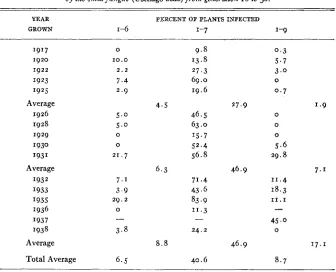
The behavior of three inbred lines of maize with respect to infection by the smut fungus (Ustilago zeae) jrom generation I O to 30.
YEAR PERCENT OF PLANTS INFECTED
G R O W N 1-6 1-7 1 - 9
I917 1920 1922 I923 I925 Average 1926 1928 1929 1930 1931 Average I932 I933 I935 I936 I937 I938 Average Total Average 0 10.0
2 . 2
7 . 4 2 . 9
4 . 5
5 . 0 5.0
0
0 2 1 . 7
6 . 3
7 . 1
3 . 9 29.2
0 -
3 . 8
8 . 8
6 . 5
9 . 8 13.8 27.3 69.0 1 9 . 6
46.5 63.0 ' 5 . 7 52.4 56.8
71.4 4 3 . 6 83.9 1 1 . 3
24.2
-
4 0 . 6
27.9
4 6 . 9
4 6 . 9
0 . 3 5 . 7 3 . 0
0 . 7
0
0
0
0
5 . 6
29.8
1 1 . 4 1 8 . 3 11.1
- 45.0
0
8.7
1 . 9
7 . 1
1 7 . 1
ing bodies of the fungus but these spore-bearing structures are larger and the plants show more injury. There are many barren stalks and some plants are killed before maturity. In this line the black spore masses usually appear a t the nodes near the base of the plant or at the ear nodes. I n the other two lines the fruiting bodies appear in the tassel or a t the upper nodes. I n these lines also the smut balls are usually small and the plants are seldom injured appreciably.
The increase in percent of plants infected seems to be one of the mani- festations of the effect of inbreeding. As the plants are reduced in vigor they are less resistant. Since the increase in susceptibility has come after generation 2 0 a t which time the reduction in yield is assumed to have come to an end this may not be a valid conclusion. The wide fluctuation in number of plants affected is largely seasonal. The years from 1931-1937 were a period of relatively high smut infestation.
No variations during the long continued inbreeding program have ap-
peared that can be considered as favorable to survival. Usually not more than IOO plants of any one progeny have been grown each year, not a
large number in which to look for variations. But many progenies have been grown and in the IO years after uniformity and constancy had been reached there has been a reasonable chance for growth variations to ap- pear. Because the plants are so uniform, slight variations would be notice- able and anything favoring growth would likely be selected. Since these inbred strains are so late in maturing any variation that helped the plants to ripen earlier would tend to be perpetuated. Possibly unconscious selec- tion of favorable growth variations has counteracted to some extent the reduction due to inbreeding. But if there is any tendency of this kind it did not save two lines from extinction and there is no certain indication that any of the lines are now improving in any character.
SUMMARY
From four original lines of maize three have been continuously self- fertilized for 30 generations.
One original line and one sub-line, separated in the second generation, failed to survive. At least in one case this failure is due to a degenerative change which apparently could not be prevented by selection of normal plants as progenitors.
Reduction in height has ceased after five generations and in yield after 2 0 generations.
Sib lines separated a t various stages clearly differed in some cases and remained the same in others.
INBREEDING 1N MAIZE 473
After 2 0 generations of seIf-fertilization these inbred lines appear to be uniform and constant for all visible characters and homozygous for all loci that have any effect upon hybrid vigor.
Throughout the entire period of inbreeding no variations have appeared which could be interpreted as being favorable to survival.
LITERATURE CITED
EAST, E. M., and HAYES, H. K., 1912 Heterozygosis in evolution and in plant breeding. U. S. Dept. of Agric. Bull. 243: 1-58, 1912.
EAST, E. M., and JONES, D. F., 1919 Inbreeding and outbreeding. Philadelphia, J. B. Lippincott Co.
JONES, D. F., 1918a The effects of inbreeding and crossbreeding upon development. Connecticut Agric. Exper. Sta. Bull. 207: 1-100.