Running head: AN ATTEMPT TO
An Attempt to Predict Behavior: How Does organizer of Mindamic Generate
‘ Causalities ’ in Interaction Raimo J Laasonen
Abstract
The rearch is a sequel to former attempts to inquire dynamic of the mind or mindamic with
probability theory. Other types of information was dealt with, formerly. So the turn was that of social information. It was assumed: How does organizer of mindamic generate ‘causalities’ in interaction? The subjects were 259 persons; 166 were men and 93 women. The age of persons varied from 18 to 72 years. The data were obtained from the videotapes of 37 sessions with a set of the observation categories. The
statistical analysis comprised of the Bayesian
probabilities, and the application of the chain rule of the matrix calculus. The results indicated an alternation between the dynamic causes in the
organizer of the persons and the overt behavior. The tightness of the most probable causes generate
inhibition of the overt behavior. The looseness of the causes in the organizer generate more frequent overt behavior such as the evasive behavior, the
An Attempt to Predict Behavior: How Does organizer of Mindamic Generate ‘Causalities’ in Interaction
The research is a sequel to former attempts to inquire dynamic of the mind or mindamic with
probability theory. However, during last 10 years the focus of the research has changed from the mind processes and their causes to the organizer of the mindamic. It might be difficult to cope with
environment without some kind of organization in the mind. Different kinds of information persons deal with have been under scrutiny but social information, more exactly, person perception is open. In the
research the deficiency is mended, at least, partly. A problem lyis in a fact that an explained organized body of knowledge is not available. Therefore, it is profitable to do a hypothesis in a form of a
question. How does organizer of the mindamic
generate ‘causalities’ in interaction? Environmental information processes in the mind and behavior is to match with environment as overt behavior, an
organization(s) is neeedful. The organization
that the organizer produces overt behaviors. Interaction does not take place in void but with an immediate social environment or with other persons in sight. So it is consistent to assume that the most probable causes are born in interplay between the organizer and the immediate social environment. A suitable frame work is: Input from the immediate social environment—Processing in the organizer—Overt behavior as an output.
Behavioral categories functioned as device for observation from videotapes. Statistical analysis comprised of an application of Bayes formula and elementary matrix calculation. A similar kind of technique as higher order transitions in Markov
chains was applied to finding changes of causalities during mindvals.
Shortly, the background variables were gender, age, job, and hobbies. The categories for the
organizer were scan, order, association,
modification, and specification. The categories of the overt behavior included reinforcement, extiction, punishment, avoidance, and approach.
Subjects and Data gathering
The subjects were 259 persons participating in a contest where social information was the only one needed. The data were obtained from 37 half an hour sessions which included in six interactive occasion with situations. No time interval of observation existed. Observation took place freely and the
adequate responses fitting the set of categories were tallied in the observation forms.
Categories of Observation
The categories for the organizer were. A person 1) scans, observes in detail 2) orders, enumerates action 3) associates, refers to former/previous action 4) modifies, changes action of the same
matter 5) specifies, focuses action to a particular point. The overt behavior categories were. A person 6) reinforces, action that rewards previous/former behavior 7) extincts, action that induces changes in decisions 8) punishes, annuls previous/former
behavior 9) avoids, behaves evasively 10) approaches, behaves straightforwardly.
observations. Therefore, it was rational to double random sample the data for the reliability and validity of observation. First, the number of the sessions(1-37) were randomized and then the
randomized order was fifty-fifty randomized. After that the queues were multiplied that resulted in 13 sessions for assessing the reliability and validity from the matrix of all the category frequencies. The discrete time was in the columns.
Corelations were calculated between the columns. The correlations in the matrix were squared. A procedure that resulted in common variances in the off-diagonal cells when nulls
replaced the ones in the diagonal cells. Application of the formula (Nunnally, 1967, p. 195,6-23)to the common variance matrix minus the diagonal sum of the ones gave a value of 0.94 for the coefficient of reliability of observation.
is then when the correlation are nulls and the coefficients of alienation are ones.
At first, the correlations were calculated between the categories. Thereafter, the sums of the negative and positive coefficients were calculated. From the positive sum was subtracted the sum of negative values. The difference was divided by the number of 110 which is the maximum sum of the off diagonal alienation coefficients. The resulted quotient indicates the overlap between the
frequencies in the categories. The obtained value was 0.086. Thus the categories are separate enough.
Results Statistical Analysis
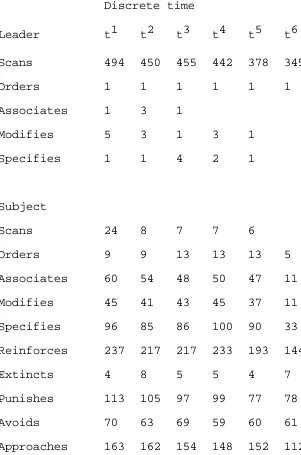
The scan of the leader was the prevailing mode of behavior and in the columns of the frequency
Table 1
Start Frequencies for Statistical Analysis Discrete time
Leader t1 t2 t3 t4 t5 t6 Scans 494 450 455 442 378 345
Orders 1 1 1 1 1 1
Associates 1 3 1
Modifies 5 3 1 3 1
Specifies 1 1 4 2 1
Subject
Scans 24 8 7 7 6
Orders 9 9 13 13 13 5
Associates 60 54 48 50 47 11
Modifies 45 41 43 45 37 11
Specifies 96 85 86 100 90 33 Reinforces 237 217 217 233 193 144
Extincts 4 8 5 5 4 7
Punishes 113 105 97 99 77 78
Avoids 70 63 69 59 60 61
Table 2
Distribution of Background Frequencies (N=259) Variable
Gender f
Men 166
Women 93
Age 18-28y 111
29-39y 92
40-50y 40
51-61y 13
62-72y 2
Job
Mental 199
Mental-physical 48
Physical 10
Hobbies
Mental 72
Mental-physical 123
There are 3 missing information in Table 2; 1 is in the age classification and 2 in the job
classification. In a statistical sense they do not have a greater meaning.
Construction of Causal Matrix
In every occasion a drop out of a person took place. Furthermore, the persons have expectations about future events. The means of the utilized frequency matrix were calculated in the rows. The means were as the expectations at time zero. The drop out of a person demanded on weighting of the frequency matrix from the expectations to the last interaction occasion. The number of the persons in each occasion was divided by the start number of 7 persons, the expectation included. It resulted in a probability vector by which the frequency matrix was multiplied at time.
the events. The relative frequencies in the weighted frequency matrix converted into
probabilities. The event probabilities converted from the cumulative probabilities at time. However the start set does not empty so the last columns of the submatrices are not filled with ones.
In the place of the input it was unnecessary to calculate the event probabilities. The event
probabilities were calculated for the process and for the output. The following connections formed from the procedure: Input->Process; Process->Process; Process->Output or Overt behavior->Organizer;
Organizer->Organizer; Organizer->Overt behavior. The Bayes formula in a matrix form was the device for the connection. The obtained connection matrices were one-to-one multiplied and put into a stochastic form. The chain rule with the transposes of the matrices was applied to the former time order of the
framework.
The next task was to arrange a stochastic matrix where the overt behavior, the organizer, and the
in the cells between the overt behavior and the behavioral output of the same categories. The nulls were for the sake of no direct influences because of the organismic processes.
The background vector of the frequencies and their relative frequencies converted into
probabilities of the system vector. The system
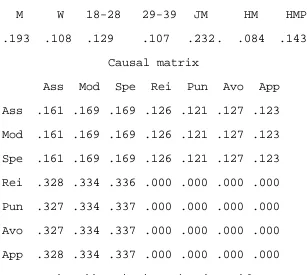
probabilities and the start matrix are in Table 3. The procedure of the Markovian higher step transition was adopted to define mindvals or the intervals in the mind time. A closer conceptual examination is going to take place in the conlusion section. So the causal matrix was powered til the 6th power because of the 6 occasions of interaction. The chaining of the system vector and the matrix powering took place with the Markov chain,
Table 3
Probabilities of System Vector and Causal Matrix System variable
M W 18-28 29-39 JM HM HMP .193 .108 .129 .107 .232 . .084 .143
Causal matrix
Ass Mod Spe Rei Pun Avo App Ass .161 .169 .169 .126 .121 .127 .123 Mod .161 .169 .169 .126 .121 .127 .123 Spe .161 .169 .169 .126 .121 .127 .123 Rei .328 .334 .336 .000 .000 .000 .000 Pun .327 .334 .337 .000 .000 .000 .000 Avo .327 .334 .337 .000 .000 .000 .000 App .328 .334 .337 .000 .000 .000 .000 Note. The abbreviations in the table are: M=men, W=women, 18-28 and 29-39 are the age groups, JM= mental job, HM=mental hobbies, and HMP=metal-physical hobbies.
Table 4
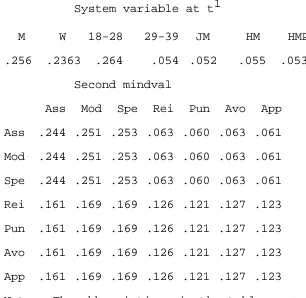
Causalities in Second Mindval System variable at t1
M W 18-28 29-39 JM HM HMP .256 .2363 .264 .054 .052 .055 .053
Second mindval
Ass Mod Spe Rei Pun Avo App Ass .244 .251 .253 .063 .060 .063 .061 Mod .244 .251 .253 .063 .060 .063 .061 Spe .244 .251 .253 .063 .060 .063 .061 Rei .161 .169 .169 .126 .121 .127 .123 Pun .161 .169 .169 .126 .121 .127 .123 Avo .161 .169 .169 .126 .121 .127 .123 App .161 .169 .169 .126 .121 .127 .123 Note. The abbreviations in the table are: M=men, W=women, 18-28 and 29-39 are the age groups, JM= mental job, HM=mental hobbies, and HMP=metal-physical hobbies.
Table 5
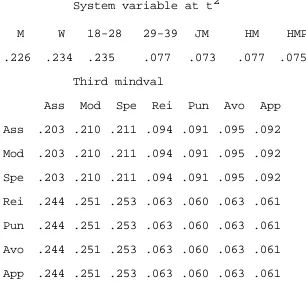
Causalities in Third Mindval System variable at t2
M W 18-28 29-39 JM HM HMP .226 .234 .235 .077 .073 .077 .075
Third mindval
Ass Mod Spe Rei Pun Avo App Ass .203 .210 .211 .094 .091 .095 .092 Mod .203 .210 .211 .094 .091 .095 .092 Spe .203 .210 .211 .094 .091 .095 .092 Rei .244 .251 .253 .063 .060 .063 .061 Pun .244 .251 .253 .063 .060 .063 .061 Avo .244 .251 .253 .063 .060 .063 .061 App .244 .251 .253 .063 .060 .063 .061 Note. The abbreviations in the table are: M=men, W=women, 18-28 and 29-39 are the age groups, JM= mental job, HM=mental hobbies, and HMP=metal-physical hobbies.
Table 6
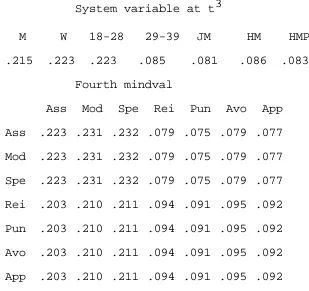
Causalities in Fourth Mindval System variable at t3
M W 18-28 29-39 JM HM HMP .215 .223 .223 .085 .081 .086 .083
Fourth mindval
Ass Mod Spe Rei Pun Avo App Ass .223 .231 .232 .079 .075 .079 .077 Mod .223 .231 .232 .079 .075 .079 .077 Spe .223 .231 .232 .079 .075 .079 .077 Rei .203 .210 .211 .094 .091 .095 .092 Pun .203 .210 .211 .094 .091 .095 .092 Avo .203 .210 .211 .094 .091 .095 .092 App .203 .210 .211 .094 .091 .095 .092 Note. The abbreviations in the table are: M=men, W=women, 18-28 and 29-39 are the age groups, JM= mental job, HM=mental hobbies, and HMP=metal-physical hobbies.
Table 7
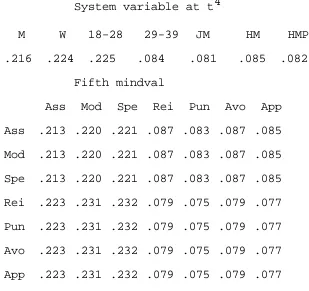
Causalities in Fifth Mindval System variable at t4
M W 18-28 29-39 JM HM HMP .216 .224 .225 .084 .081 .085 .082
Fifth mindval
Ass Mod Spe Rei Pun Avo App Ass .213 .220 .221 .087 .083 .087 .085 Mod .213 .220 .221 .087 .083 .087 .085 Spe .213 .220 .221 .087 .083 .087 .085 Rei .223 .231 .232 .079 .075 .079 .077 Pun .223 .231 .232 .079 .075 .079 .077 Avo .223 .231 .232 .079 .075 .079 .077 App .223 .231 .232 .079 .075 .079 .077 Note. The abbreviations in the table are: M=men, W=women, 18-28 and 29-39 are the age groups, JM= mental job, HM=mental hobbies, and HMP=metal-physical hobbies.
Table 8
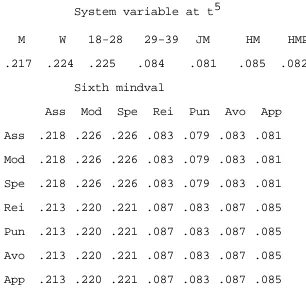
Causalities in Sixth Mindval System variable at t5
M W 18-28 29-39 JM HM HMP .217 .224 .225 .084 .081 .085 .082
Sixth mindval
Ass Mod Spe Rei Pun Avo App Ass .218 .226 .226 .083 .079 .083 .081 Mod .218 .226 .226 .083 .079 .083 .081 Spe .218 .226 .226 .083 .079 .083 .081 Rei .213 .220 .221 .087 .083 .087 .085 Pun .213 .220 .221 .087 .083 .087 .085 Avo .213 .220 .221 .087 .083 .087 .085 App .213 .220 .221 .087 .083 .087 .085 Note. The abbreviations in the table are: M=men, W=women, 18-28 and 29-39 are the age groups, JM= mental job, HM=mental hobbies, and HMP=metal-physical hobbies. Ass=associates, Mod=modifies, Spe=specifies, Rei=reinforces, Pun=punishes, Avo=avoids, and App=approaches
System variable at t6
occur in the subprocess of the process system. A prominent thing is emergence of order in the
causalities but the magnitudes of the most probable causes fluctuate. Another thing is the sameness of the causalities of the organizer in the 1st mindval and in the last mindval.
Discussion
The hypothesis was answerable with the dynamic most probable causes. However, auxiliary concepts are necessary before the proper inferrences from the derived data. Earlier, the term mindval was
applicable to move in mind time. The mindval is definiable as an experiental interval of time which bases on behavior of persons, occasions, experiences, things, matters or on their combinations. In a simple way, the mind is a process system where processes process processes. So time is inherent in the process system.
do not fulfill the persons expect others in sight to refer the former behavior.
In their organizers expectations of the persons are somewhat perplexed because the causal
probabilities are the same from the association, the modification, and the specification to the effects of the modification, and the specification. In the same manner the auto-causalities of the modification, and of the specification are similar. The weakest
causalities are from the modification, and from the specification to the association. So the persons expect others to modify or to specify their behavior.
On the contrary, the persons organize their overt behavior into a certain order of presentation. The persons generate evasive behavior, they reward the former behavior. After that they behave
straightforwardly, and they annul the former behavior, as the last option.
organizer as an input into the next mindval. The overt behavior is reminiscent.
This time (Table 4) the persons order their causalities in the organizer in a social occasion. The persons specify, modify, and associate, in the very order. The persons cease to expect behavior of others in the 2nd mindval (Table 4) and they transfer to person perception. The persons use their
organizers more than previously because the probabilities rise in the organizer.
On the contrary the persons keep their overt behavior in check, considerably and compared with the previous expected output. So the most probable
causes in the organizer are firmer but the overt behavior is scarce. Principally, the persons reward or avoid contacts; then they approach. The last alternative is the persons punish others. The
orders of the causalities stay valid. In spite of the slack the overt behaviors of the persons
become more frequent. Now there emrges an order in the overt behavior. The avoidance behavior becomes first, thereafter the reinforcement, third comes the approaching behavior, and lastly, the punisment. The order means behavior where the implementations
differentiate according to the realized options. The previous causalities in the organizer and the reminiscence of the overt behavior repeat
themselves in motion to the 4th mindval (Table 6). The person again tighten the organized causalities in the same order than previously. The persons specify foremostly, and then they modify. If neither of the behaviors realizes then the persons refer to the former action. What is significant is the persons reduce their overt behaviors. Actually, they repeat the behaviors in the 2nd mindval but more frequently. Thereafter on, the persons maintain their orders of the overt behaviors.
There occurs small increases in the overt behavior in the 5th mindval (Table 7) and the
(Table 8). Correspondingly, the persons lessen the causal connections of the organizers in the 5th mindval. In the 6th mindval the persons return to the causal relations which occurred during the 1st mindval. The persons loosen the causal orders and they transfer back to a vexed organization of
behavior. From the 4th mindval on the persons adhere to their equal avoidance, and rewarding behavior; after that they behave straightforwardly, and annul the former behavior of others in sight.
As with the system vector there occurs a wear off effect. So the changes in the system
probabilities indicate the profitable properties, or jobs, or hobbies during the subprocess of the process system. In the 1st mindval it is benficial to belong to the age group of 18-28, to be a woman, and to be a man. In the 2nd mindval the same properties are
mindval on.
In summary, there occurs alternation between the dynamic causes in the organizer and the overt
behavior. The tightness of the most probable causes generate inhibition of the overt behavior. The
looseness of the causes in the organizer generate more frequent overt behavior such as the evasive
behavior, the rewarding behavior, the straightforward behavior, and the annulment of the former behavior.
In a theoretic sense, social information from the immediate environment(persons in sight) is to be dealt with before responding. Organizing, and
hand, the persons get into novel social
situations where former experience does not count but the previous experience. So there is the
differentiation between the former and previous experiences.
As an entity the results refer to the direction; the order of the dynamic causes evolves rather early in the mind time. No greater changes take place after the emergence of the order. The wear off effect favors the background properties of the
persons at the expense of the activies. The previous experience in the subprocess dictates behavior in the next new social occasion.
So its presumable that persons utilize
References
Goldman-Rakic P. S. (1993). Working memory and the mind. In Readings From Scientific American
Magazine. Mind and Brain (pp. 66-77). NY: W. H. Freeman and Company.
Author’s word
Well, there are teachers and Teachers. Somehow, I feel fortunate having had some Teachers. The work tries to be a thank for my Teachers who made it
possible to work individually and on one’s own account. Here they come. Professor Emeritus in Social Psychology Kullervo Rainio who made it clear that behavioral reseach is much a matter of ‘reading’ behavior. Professor Emeritus in Education Science Erkki A. Niskanen who taught logical patching of theoretic gaps. Professor Singa Sandelin who lit me up about modern systems approach. My good late
friend Associate professor in Education Pentti Holopainen who held me tough education in direct observation during many years and made action research familiar. Professor in Etology Vilmos Csanyi who instructed me theorizing so much, in a couple of days, I felt my studies to have been vain. The teachers, they have been more harmers than