Corporate Governance Practices in India
Babita, Research Scholar
Haryana School of Business, GJUS&T, Hisar
Sucheta, Research Scholar
Haryana School of Business, GJUS&T, Hisar
ABSTRACT
This paper seeks to explore the present state of corporate governance practices in India and with this purpose latest available annual report (of 2012-13 or 2013-14) of 100 companies from ten different industry sectors are examined. The results depict that firms in India are presently following governance practices by following mandatory and non mandatory guidelines issued by SEBI in clause 49 of listing agreement regarding corporate governance. But still there is a scope for improvement towards an ideal state of governance in India for excellence. Moreover, there are no significant differences in corporate governance practices followed by firms across different sectors.
Keywords:Annual Reports, Clause 49, Corporate Governance, Disclosure Practices, SEBI.
1. Introduction
The corporate governance of a company builds trust, belief and long term relation with its investors, customers and all other stakeholders apart from building a healthy and positive corporate image. Security Exchange Board of India (SEBI) has been explained some mandatory and non-mandatory requirements for the companies to adopt regarding corporate governance under clause 49 of the listing agreement.
The term ‘Clause 49’ refers to clause number 49 of the Listing Agreement between a corporation and the Stock Exchanges on which it is listed. This clause is an important and robust addition to the Listing Agreement, was inserted as late as 2000 with an objective to make improvement of corporate governance in all listed companies, consequent to the recommendations of the Kumar Mangalam Birla Committee on CG constituted by SEBI in 1999 (Bhasin, 2010). It is an influential event in Indian corporate governance, which stipulates some mandatory and non mandatory requirements with which companies shall/may comply. These requirements are related to the Board, its committees, Board/committee meetings, disclosure and transparency, etc. Moreover, Clause 49 mandates for all listed companies to disclose a detail report on corporate governance disclosure practices they have followed.
2. Literature Review
As far as corporate governance is concerned, several studies are available relating to the compliance status of firms with regard to specified corporate governance guidelines. The corporate governance codes and their iterative development are similar in developing and developed countries, however, the degree of compliance is found different between the countries [Arsoy and Crowther, 2008]. There exist inter-company differences in adherence to corporate governance norms, as different parameters are given importance by companies as per the level of Market capitalization and working laws pertaining to the industry [Patel and Patel, 2012]. Patel and Sondhi (2014) considered the significant changes proposed by the Companies Bill, 2012 as compared to the 1956 Act and observed during their study that the not all Indian listed companies comply with the provisions mentioned under the Company Bill, 2012 and many of them are yet to comply with these changed provisions.
Vithalani (2014) studied corporate governance practices of seven Maharatna Companies in India and summarized that all the seven companies complied with the corporate governance disclosure practices with reference to guidelines issued by SEBI under Clause 49 to a huge extent. Moreover, Patel and Patel (2012) evidenced that inconsistency is present in the relationship between regulatory compliance of corporate governance parameters and respective growth of companies. It was observed that corporate governance and disclosure practices followed by companies are very good in India with the exception of one or two parameters [Dessai and Bhanumurthy, 2010;Patel and Patel, 2012; Patel and Sondhi, 2014]. More than 70% of private sector Indian companies listed in BSE comply with 80% or more of the codes [Gupta and Parua, 2006]. All the companies listed on recognized stock exchanges of India have complete compliance with mandatory CG practices as per the clause 49 of the listing agreement of Securities and Exchange Board of India (SEBI), however, with regard to non-mandatory requirements and the extent of corporate responsibility disclosure, the results were quite unsatisfactory [Sharma et al., 2009]. As far as non-mandatory requirements are concerned companies are unwilling to abide by them [Sharma, 2013]. A few number of companies’ disclosure levels are ahead of the requirements of the revised Clause 49 by following the voluntary corporate governance guidelines 2009 and taking sustainability initiatives and steps forward for corporate social responsibility [Bhardwaj and Rao, 2014].
There is still a gap present between implementing governance norms and required governance norms for the efficient system and ambiguity in correlation between compliance of corporate governance parameters and net profit also exists, however, need for extension of the scope of existing mandatory requirements of Clause 49 is suggested [Bhasin, 2010; Brahmbhatt et al., 2012; Bhardwaj and Rao, 2014].
3. Objective of the Study
4. Data and Methodology
With the purpose of the study, latest available annual reports (of 2012-13 or 2013-14) of 100 companies from ten sectors, namely, automobiles, banks, FMCG, IT, oil & gas, pharmaceuticals, power, steel, telecommunication services and transport and logistics, are examined. Mandatory and non mandatory requirements specified under clause 49 of listing agreement are used as parameters to score companies for their corporate governance disclosure practices. For the purpose of analysis, weight-age method is used by assigning an appropriate standard score to all the parameters of checklist according to their importance, out of which sampled firms get scores for their adoption to those parameters. Companies are scored out of 100 for their corporate governance practices and disclosures.
5. Results and Discussion
The results for all the checklist parameters of corporate governance are discussed separately below:
i. Company’s philosophy on code of governance: The first parameter for the assessment of corporate governance score is the statement of the company’s philosophy on code of governance with a weightage of 1 on a scale of 100. All the 100 companies make adequate disclosure of the statement of their philosophy on code of governance. So, all companies get a score of 1.
ii. Composition of the Board and BOD meetings held: Composition of the board and BOD meetings held is the second parameter with a weightage of 5 points as score 1 for each point given in Table 1.
Table 1 Compliance/Non-compliance of firms to board composition and meeting requirements
Number of Firms
Particulars Compliance Non compliance Total
Not less than 50% of the Board of directors
comprising of non-executive directors 98
02 100
In case of non-executive Chairman, at least one-third of Board comprise of independent directors and in case of an executive Chairman, at least half
of Board comprise of independent directors 85
15 100
At least one woman director 58 42 100
At least four BOD meetings a year 99 01 100
Attendance record of BOD meetings 100 00 100
executive directors, so get the expected score of 1 & remaining 2 firms scored 0 for non compliance of this requirement. However, 85 of the 100 firms gets a score of 1 by complying with the requirement of the minimum strength of independent directors and remaining 15 firms did not get any point. Further, 58 firms get 1 point as having atleast one woman director on their board, whereas other 42 get 0 for non compliance of this requirement. Moreover, 99 firms score 1 as they held atleast four BOD meetings during the year under consideration and only one firm did not comply with this requirement. As well as, all the 100 firms disclose the attendance record of directors at BOD meetings and get 1 point for that.
iii. Chairman & CEO Duality: The third parameter is Chairman & CEO duality with a maximum score assigned is 5. Firms with non executive independent directors are considered as with ideal chairmanship and scored 5 for this parameter. Firms having non promoter non executive Chairman of their Board get score 4 and firms with promoter non executive Chairman are scored 3. Further, firms with non promoter executive Chairman and promoter executive Chairman have scored 2 and 1 respectively. Distribution of firms on the basis of this criterion is discussed below with the help of Figure 1.
Fig 1 Distribution of firms on the basis of Board Chairmanship
Figure 1, exhibiting different chairmanship wise distribution of sampled firms, reveals that the firms having a promoter executive Chairman of Board and having a promoter non executive chairman are almost equally distributed as their percentages are 29 and 28 respectively. Of the total, 23 percent firms have non promoter executive Chairman and 11 percent firms have a non executive independent Chairman of Board. However, only 9 percent firms have non promoter non executive Chairman.
v. Disclosures regarding definition, separate meetings and selection criteria for independent directors:
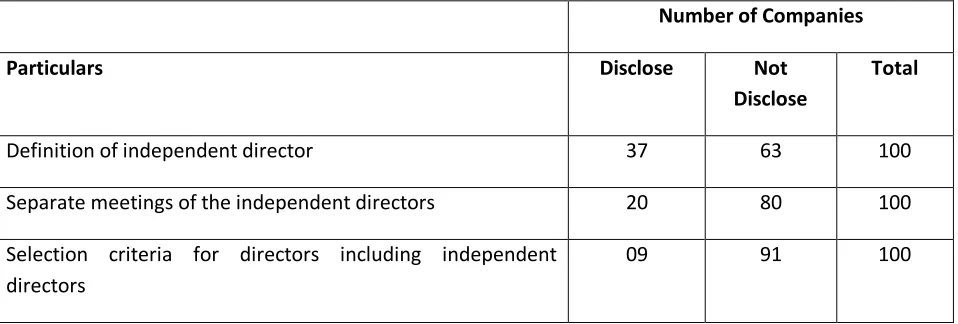
The fifth parameter is concerning disclosures regarding definition, separate meeting of independent directors and selection criteria for directors including independent directors, having a weightage of 3 points, one point for each.
Table 2 Distribution of firms for disclosure/non-disclosure of items under 5th parameter
Number of Companies
Particulars Disclose Not
Disclose
Total
Definition of independent director 37 63 100
Separate meetings of the independent directors 20 80 100
Selection criteria for directors including independent directors
09 91 100
In this regard Table 2 depicts that 37 firms out of 100 sampled firms get a score of 1 as they disclose the definition of independent directors in their annual reports and remaining 63 firms don’t resort to this practice. In addition, 20 of 100 firms gets a score of 1 by disclosing the information regarding separate meetings of independent directors, while a majority of firms (80) did not get any point on this parameter. Further, only 09 firms get 1 point for making disclosure regarding selection criteria of independent directors whereas remaining 91 firms get 0 for non disclosure for this item.
vi. Board meeting follow-up system and compliance with the Board procedure: Disclosure about post Board meeting follow-up system and compliance with the Board procedure is the sixth parameter having weightage of 2 on a scale of 100. Out of all 100 sampled firms, 35 get a score of 2 by making appropriate disclosure regarding past Board meeting follow-up system and compliance with the Board procedure while remaining 65 firms did not get any point as they do not disclose the same.
vii. Appointment of lead independent director: Seventh parameter with a weightage of 2 points is about the appointment of lead independent director. Results reveal that only 11 firms out of 100 have formally appointed a lead independent director and get a score of 2 for it. Whereas other 89 firms get 0 for not having the post of lead independent director.
ix. Code of conduct: The ninth parameter to evaluate the companies CG score is about the code of conduct having weightage of 2 points and for that all the 100 companies scored 2 points as for making sufficient disclosure regarding code of conduct.
x. Disclosure about Board Committees: The tenth parameter taken for the evaluation of CG score is disclosures regarding various board committees with the weightage of 23 points inclusive of 8 points for audit committee, 6 points for remuneration committee, 3 points for the shareholders’ grievance redressal committee, 2 points for nomination committee and 4 points for additional committees. Tables 3-4 show the number of companies having disclosures and non-disclosure of the information regarding specific points, listed in CG checklist.
a. Audit Committee: Seven points concerning audit committee are included in CG checklist to score companies on the maximum score of 8 on the scale of 100. All the seven points listed in Table 3 have an equal weightage of 1 except the point ‘information about the participation of head of finance, statutory auditor and chief internal auditor in the committee meeting’ which have the weightage of 2.
Table 3 Distribution of firms for disclosure/non-disclosure about audit committee
Number of Companies
Particulars Disclose Not
Disclose
Total
Composition of audit committee 100 00 100
Compliance of minimum requirement of the number of independent directors on the committee
94 06 100
Compliance of minimum requirement of the number of meetings of the committee
98 02 100
Information about literacy and expertise of committee members
73 27 100
Information about participation of head of finance, statutory auditor and chief internal auditor in the committee meeting
58 42 100
Audit committee charter/terms of reference 94 06 100
Publication of audit committee report 04 96 100
disclosure of audit committee charter/terms of reference.Moreover, 98 firms get score 1 for complying with the minimum requirement of the number of meetings of the committee and 73 firms get a score of 1 for the disclosure of information about literacy and expertise of committee members.In addition, 58 firms get a score of 2 for disclosing the information regarding the participation of head of finance, statutory auditor and chief internal auditor in the committee meeting. Further, only 4 firms get 1 point for publishing of the audit committee report.
b. Remuneration Committee: Six points related to remuneration committee are included in CG checklist to score companies on the ideal score of 6 on the scale of 100. All the six points as given in Table 4 have equal weightage of 1.
Table 4 Distribution of firms for disclosure/non-disclosure about remuneration committee
Number of Companies
Particulars Disclose Not
Disclose
Total
Formation of the committee 95 05 100
Information about number of committee meetings 83 17 100
Compliance with minimum requirements of the number of non-executive directors on the committee
87 13 100
Compliance of the provision of independent director as Chairman of the committee
87 13 100
Information about participation of all members in the committee meetings
77 23 100
Disclosure of sitting fees in Board & committee meeting 95 05 100
c. Shareholders’/ Investors’ Grievance Committee: There are three parameters associated with shareholders’/ investors grievance committee incorporated in CG checklist and shown in Table 5, to score companies on the total score of 3 on the scale of 100, 1 point for each parameter.
Table 5 Distribution of firms for disclosure/non-disclosure about investors’ grievance committee
Number of Companies
Particulars Disclose Not
Disclose
Total
Transparency in composition of the committee 100 00 100
Information about the nature of complaints and queries received and disposed
97 03 100
Information about number of committee meetings 88 12 100
Table 5 depicts that all the 100 firms maintain transparency in the composition of shareholders’/ investors grievance committee and get a score of 1 each. Out of 100, 97 firms get 1 point for disclosing information about the nature of complaints and queries received and disposed. Moreover, 88 of 100 firms scored 1 for disclosing information about number of committee meetings.
d. Nomination Committee: Disclosures related to nomination committee have the weightage of 2 points that are equally divided into two points, formation of committee and publishing of committee charter/term of references.
Table 6 Distribution of firms for disclosure/non-disclosure about nomination committee
Number of Companies
Particulars Disclose Not Disclose Total
Formation of committee 52 48 100
Publishing of committee charter/ references 42 58 100
Table 6 reveals that for the first point, i.e. formation of the committee, 52 firms get a score of 1 as they well disclose the information regarding formation of the nomination committee and for the second point, i.e. publishing of committee charter/term of references, 42 firms scored 1.
Table 7 Distribution of firms for disclosure/non-disclosure about other additional committees
Number of Companies
Particulars Disclose Not
Disclose
Total
Health, Safety and Environment Committee 11 89 100
CSR and Sustainable Development Committee 49 51 100
Investment Committee 19 81 100
Other Committee 58 42 100
The table exhibits that out of sampled firms 11 firms have health, safety and environment committee (get score 1), 49 firms have CSR and sustainable development committee (get score 1), 19 firms have an investment committee (get score 1) and 58 firms have other committees of the Board (get score 1).
xi. Disclosure and Transparency: Eleventh parameter for calculating company CG score is about disclosure practices and transparency having a weightage of 25 on a scale of 100. This parameter consists of disclosure of eleven points in company’s annual report as indicated in Table 8. All these points have an equal weightage of 2 points except shareholders’ information as it has a weightage of 5 points.
Table 8 Distribution of firms for disclosure and non-disclosure of items under eleventh parameter
Number of Companies
Particulars Disclose Not
Disclose
Total
Significant related party transactions having potential conflicts with the interest of the company
100 00 100
Non-compliance related to capital market matters during last three years
100 00 100
Accounting treatment 100 00 100
Director’s remuneration amount & policy 100 00 100
Risk Management 97 03 100
Management discussion and analysis 100 00 100
Shareholders’ information 100 00 100
Audit qualification 74 26 100
Training of Board members 39 61 100
Evaluation of non-executive directors 35 65 100
The table depicts that almost all sampled firms by making proper disclosures regarding significant related party transactions, non-compliance related to capital market matters, accounting treatment, director’s remuneration, risk management, management discussion & analysis and shareholders’ information get full score for these points. The results also reveal that only 17 firms of 100, in relation to shareholder rights get a score of 2 by specifying that they send the financial results to each shareholder electronically, however, remaining 83 firms get 1 point for giving a partial reference of shareholder rights. In addition, 74 firms are assigned a score of 2 by moving towards a regime of unqualified financial statements. Furthermore, 39 firms get 2 points for providing training to their Board and 35 firms get 2 points for having a mechanism of evaluation of non executive directors.
xii. General Body Meetings: The twelfth parameter under consideration of this study is information about general body meetings carrying a weightage of 3 points on a scale of 100. All the points for this parameter as listed in Table 9 carry equal weightage of 1 point.
Table 9 Distribution of firms for disclosure of information regarding General Body Meetings
Number of Companies
Particulars Disclose Not Disclose
Location and time of general meetings held in last three years 100 00
Details of special resolution passed in the last three AGMs/EGMs 100 00
Details of resolution passed last year through postal ballot, including the name of conducting official and voting procedure
93 07
The table presents that all the 100 companies get the ideal score for disclosure regarding location & time of general meetings held in last three years and details of special resolution passed in the last three AGMs/EGMs. But out of all, 7 firms did not give any detail regarding resolution passed last year through postal ballot, so assigned 0 score for this point and remaining 93 firms get full score for the same.
xiii. Means of Communication and General Shareholder Information: For this parameter all the 100 companies by making sufficient disclosure of this information assigned with the ideal score of 2.
xv. CEO/CFO Certification: For the fifteenth parameter all the 100 companies have the CEO/CFO certification for corporate governance and get the ideal score of 2 points on a scale of 100.
xvi. Compliance of Corporate Governance and Auditors’ Certificate: This parameter carries a weightage of 5 points on the scale of 100 and the results reveal that all the 100 companies have a clean certification from the auditor and get full score of 5.
xvii. Code for prevention of insider trading practices: Disclosure of code for prevention of insider trading practices with critical importance carries the weightage of 5 on the scale of 100 as seventeenth parameter. The results depict that 70 firms out of sampled firms make proper disclosure for having a code for prevention of insider trading practices. Consequently, these 70 firms assigned with the score of 5 and remaining firms get 0 score.
xviii. Disclosure of Stakeholders’ Interests: The last parameter is about disclosure of the stake holders’ interest with a weightage of 10 points on the scale of 10. Carring 2 points for each, environment/health/safety measures (EHS), human resource development (HRD) initiatives, corporate social responsibility (CSR), industrial relations (IR) and disclosure of policies on EHS, HRD, CSR and IR.It is observed that 92 firms disclose EHS (get 2 points), 97 firms make disclosure regarding HRD initiatives (get 2 points), and 88 firms make disclosures regarding CSR and IR (get 2 points for each). Moreover, none of the firms make disclosure of policies on all these issues, however, 26 firms make disclosure of policies on either of these issues. Therefore, these 26 firms are assigned 1 point for giving partial reference of this point.
On the basis of above mentioned eighteen parameters CG score for each company is calculated separately.
Evaluation of Corporate Governance Status
The quality and state of governance that the sampled companies have achieved is identified by observing their CG score on the corporate governance score card. Table 10 shows the distribution of sampled firms based on their obtained scores under different categories of the score range with their respective grade assigned.
Table 10 Distribution of firms on the basis of their achieved grade on CG score card
Score Range Grade No. of Companies
100-85 A- Excellent 19
84-75 B- Very Good 44
74-65 C- Good 29
64-50 D- Average 08
It is clear from the table that maximum number of firms (44), fall in the category of 84- 75 score range with B grade, which means 44 firms have a very good governance system. 29 firms with C grade have enough good governance in their entities. Moreover, only 19 firms follow excellent governance mechanism with grade A. Further, remaining 8 firms fall in the score range of 64-50 and thus attain an average status of governance with D grade. However, sample firms are having a grade range from A to D i.e. from excellent to average, with maximum 91 points and minimum 56 points obtaining an average score of 76 points.
It concludes from the above majority of firms follow very good/good governance and disclosure practices in India, but still there is a room for improvement towards excellence.
Industry/Sector- wise Analysis of Corporate Governance Practices in India
This section displays sector-wise differences of corporate governance practices in India with the help of Table 11.
Table 11 Sector-wise statistical analysis
Industry/Sectors No. of Companies
Min. CG Score
Max. CG Score
Mean CG Score
Std. Dev.
No. of Companies
CG Score > Mean
CG Score < Mean
Automobiles 10 62 90 75.70 9.19 05 05
Banks 10 56 83 76.30 8.04 06 04
FMCG 10 68 90 80.70 7.90 05 05
IT 10 70 91 81.00 6.60 04 04
Oil & Gas 10 65 88 78.00 7.15 05 03
Pharmaceuticals 10 56 91 72.90 9.64 05 05
Power 10 72 85 79.40 5.27 06 04
Steel 10 64 90 73.30 9.09 04 06
Telecommunications 10 65 88 75.60 8.00 05 05
Transport & Logistics 10 57 86 71.40 8.45 06 04
sector (73.30), pharmaceuticals (72.90) and transport & logistics (71.40). However, it is observed that the mean score of all the sectors comes from the categories good or very good on evaluation score card.
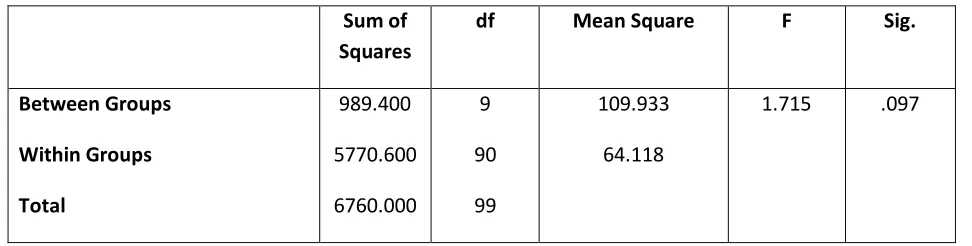
In order to test the significant differences in corporate governance practices across various sectors, one-way ANOVA is used. It tests whether groups formed by the categories of independent variables are similar. Results of one-way ANOVA are shown in Table 12.
Table 12 One way ANOVA to test sector- wise differences
Sum of Squares
df Mean Square F Sig.
Between Groups
Within Groups
Total
989.400
5770.600
6760.000
9
90
99
109.933
64.118
1.715 .097
The table reveals that there is no significant difference between governance practices of firms across various sectors at 5 % level of significance.
6. Conclusion
References
Arsoy, A.P. and Crowther, D. (2008), “Corporate Governance in Turkey: Reform and Convergence” Social Responsibility Journal, Volume 4 No. 3, pp. 407-421.
Bhardwaj, N. and Rao, B.R. (2014), “Corporate Governance Practices in India: A Case Study” Asia Pacific Journal of Research, Volume 1 Issue XIII, pp. 43-54.
Bhasin, M.L. (2010), “Corporate Governance Disclosure Practices: The Portrait of a Developing Country”
International Journal of Business and Management, Volume 4 No.4, pp. 150-167.
Black, B.S. and Khanna, V.S. (2006), “Can Corporate Governance Reforms Increase Firms’ Market values: Evidence from India” http://ssrn.com/abstract=914440, retrieved on 16 August 2010.
Brahmbhatt, M., Patel, R. and Patel, S. (2012), “An Empirical Investigation of Corporate Governance Scenario in public vs Private Banks in India” International Journal of Marketing, Financial Services & Management Research, Volume 1 Issue 10, pp. 10-28.
Dessai, S.P.S. and Bhanumurthy (2010), Corporate Governance and Disclosure Practices: A Study of Sensex companies” http://mba.americaeconomia.com/system/files/sanjay_p._s._dessai.pdf, retrieved on 3 August 2014.
Gupta, A. and Parua, A. (2006), “An Enquiry into Compliance of Corporate Governance Codes by the
Private Sector Indian Companies”
http://papers.ssrn.com/sol3/Delivery.cfm/SSRN_ID962001_code551806.pdf?abstractid=962001&mirid= 1, retrieved on 3 August 2014.
Patel, F.J. and Sondhi, S.J. (2014), “An Analysis of Footsteps of Corporate Governance in Companies Bill, 2012” http://gtueliabrary.edu.in/documents/E-Book/CORPORATEGOVERNANCE/9.pdf, retrieved on 3 August 2014.
Patel, R. and Patel, S. (2012), “Corporate Governance in Oil & Gas Sector: An Empirical Investigation”
International Journal of Research in Commerce, IT & Management, Volume 2 Issue 8, pp. 92-100.
Sharma, M.K., Agarwal, P. and Ketola, T. (2009), “Hindu Philosophy: Bridging Corporate Governance and CSR” Management of Environmental Quality: An International Journal, Volume 20 No. 3, pp. 299-310.
Sharma, P.K. (2013), “Corporate Governance in Automobile Industry in India” International Journal of Marketing, Financial Services & Management Research, Volume 2 No. 5, pp. 123-140.
Vithalani, D. V. (2014), “An Analytical Study of Corporate Governance Disclosure Practices of Maharatna Companies in India”, http://gtueliabrary.edu.in/documents/E-Book/CORPORATEGOVERNANCE/3.pdf, retrieved on 3 August 2014.
Document