Attacks based on Conditional Correlations
against the Nonlinear Filter Generator
Bernhard L¨ohlein
ITC Security T-Systems Nova GmbH
Am Kavalleriesand 3, D-64295 Darmstadt, Germany [email protected]
Abstract. In this paper we extend the conditional correlation attack ([LCPP96]) against the nonlinear filter generator (NLFG) by introduc-ing new conditions and generalisations and present two known-plaintext attacks, called hybrid correlation attack and concentration attack. The NLFG is a well known LFSR-based keystream generator which could be used as a basic building block in a synchronous stream cipher system. Both new attacks use methods from the conditional correlation attack and additional from fast correlation attacks to derive the unknown initial state of the LFSR of the NLFG. The basic principle of iteratively cumu-lating and updating conditional correlations for the NLFG was proposed in [L¨oh01] and for general combiners with memory in [GBM02]. With the hybrid correlation attack it is possible to successfully attack the NLFG by applying a fast correlation attack, even if the filter functionf of the NLFG is highly nonlinear, e.g. the normalised nonlinearitype,fis≥0.45. The concentration attack maps all computed conditional correlations to
D−Bunknown LFSR bits, whereD≥kand 1≤B≤kare parameters which can be chosen by the attacker, andkis the length of the LFSR of the NLFG. Even with low values of conditional correlations, it is possible to mount the hybrid correlation attack and the concentration attack suc-cessfully. This is not the case for the originally version of the conditional correlation attack ([LCPP96]) in a time lower than a full search over all possible initial states.
Key words:stream ciphers, keystream generator, nonlinear filter generator, NLFG, conditional correlation attack, fast correlation attacks
1
Introduction
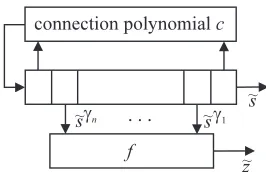
The nonlinear filter generator (NLFG, Fig. 1 and left part of Fig. 3) consists of a linear feedback shift register (LFSR) of length k and a boolean function f : GF(2)n→GF(2), called filter function, whoseninputs are taken from some shift register stages Γ, called taps, to produce the GF(2) keystream sequence ˜
Fig. 1.The nonlinear filter generator with LFSR, consisting of the connection poly-nomial cand state vector st, the taps Γ = (γ1, . . . , γn) and the filter function f to produce the GF(2) keystream sequence ˜z.
The NLFG can be used as a keystream generator itself or as a building block in a more complex shift register based system in cryptographic stream cipher applications. An example is the use of the nonlinear filter generator as a synchronous secret key encryption and decryption system in a communication system (see Fig. 2). In this scenario we suppose that the secret keyK between two parties is used to initialise the stagess0 of the LFSR of the NLFG at time t = 0. The encryption is done by a bitwise XOR operation of the keystream ˜
z and the message ˜m (plaintext) to the ciphertext sequence ˜c. The encrypted sequence ˜c is sent to the receiver over an unsecure channel and is decrypted by a bitwise XOR operation of ˜c and ˜z.
The LFSR of the NLFG has the connection polynomial
c(x) =xk− k−1 X
j=0 cjxj,
c∈GF(2)[x]. This LFSR produces the GF(2) sequence ˜s=s0, s1, . . ., namely
st+k = kX−1
j=0 cjst+j
for t ≥ 0, when it is initialised withs0 = (s0, s1, . . . , sk−1)T ∈ GF(2)k, where T stands for transposition. Let the state of the LFSR at time t ≥ 0 be s
t = (st, st+1, . . . , st+k−1)T ∈GF(2)k. Any state st and sequence element st, t≥0, can be written as a linear combination
st=¡Ct¢T s0, and
st= ³
c(t−k) ´T
s0
where C is the k×k companion matrix over GF(2) w.r.t. to the connection polynomial candc(t−k)∈GF(2)k is a vector which can be derived from one of the matricesCt−k+1, Ct−k+2, . . . , Ct. The regular matrixC is given by
C=
0 0 . . .0 c0 1 0 ... c1 0 1 . .. ... ..
. . .. ... 0ck−2 0. . . 0 1ck−1
= ³
c(1−k), c(2−k), . . . , c(0) ´
and thekrow vectors ofCt are then defined as
Ct= ³
c(t−k), c(t−k+1), . . . , c(t−1) ´
.
The GF(2) keystream sequence ˜z =z0, z1, . . . of the NLFG is generated by applying n stages (taps) Γ = (γ1, γ2, . . . , γn), 0 ≤γ1 < γ2 < . . . γn < k, from the LFSR as inputs to the filter functionf : GF(2)n→GF(2),
zt=f(st+γ1, st+γ2, . . . , st+γn)
fort≥0. The span of the tapsΓ is denoted byM =γn−γ1. Usuallycis chosen as a primitive polynomial so the period of the sequences ˜sand ˜zis 2k−1 iff is balanced ([Sch99]).
In the process of designing a secure NLFG, all known attacks should be con-sidered. The objective of a known-plaintext attack against the nonlinear filter generator is to determine the unknown initial state vector s0 by observing N keystream symbolsz0, . . . , zN−1and assuming knowledge of the complete struc-ture of the system, namelyc,Γ, andf.
2
Properties and known attacks against the NLFG
In the past years, several properties and attacks on the nonlinear filter generator were published. With the Berlekamp-Massey algorithm it is possible to rapidly construct an equivalent LFSR which produces the sequence ˜zwith the knowledge ofN = 2L(˜z) keystream symbols inO(N2), whereL(˜z) is the linear complexity of the sequence ˜z. General lower and upper bounds for L(˜z) were derived in [Key76] and [FSCG95], i.e. ¡k2¢ ≤ L(˜z) ≤ Pgj=1¡kj¢, where the lower bound is valid for c primitive and k prime and g is the algebraic degree of the filter function f. Better lower bounds for L(˜z) can be found in [Rue86] and [Sch99] for special cases.
The basic correlation attack against the nonlinear filter generator was pub-lished in 1985 by Siegenthaler ([Sie85]), where correlations between ˜z and linear transformations of ˜s are used to build an equivalent generator. This generator consists ofm≤nLFSRs with connection polynomialcand a combining function g : GF(2)m →GF(2). The drawback of this attack is the huge amount of time of O(N2), N ≈ 2k, needed for computing the necessary correlations and that the filter functionf must have high correlation to an affine function. One conse-quence of the basic correlation attack is that the designer has to choose a highly nonlinear filter function for his NLFG. The nonlinearityNfof a boolean function f : GF(2)n →GF(2) is defined asN
f = minld(f, l), wherel : GF(2)n→GF(2) is an affine function, i.e. l(x) =wT x+a withw, x ∈GF(2)n, a∈GF(2), and d(f, l) is the Hamming-distance betweenf andl. The Hamming-distanced(f, l) between two boolean functionsf andl withninputs is the number of different outputs over all 2n inputs:
d(f, l) := X x∈GF(2)n
(f(x) +l(x)),
where the sum is taken over GF(2).
For balanced boolean functionsf with ninputs the following bound forNf holds ([SZZ93]):
Nf ≤Nmax,bal(n) = ½
2n−1−2n/2−1−2,ifneven, ¥¥
2n−1−2n/2−1¦¦,ifnodd,
where y = bbxcc denotes the biggest even integer y with y ≤ x. We consider the normalised nonlinearity pe,f = 2−nNf of a boolean functionf : GF(2)n → GF(2). We call a boolean functionf highly nonlinear ifpe,f ≥0.45. In literature there are many methods to construct highly nonlinear and balanced boolean functions with appropriate cryptographic properties.
to realise the attack. These fast correlation attacks can also be applied with minor modifications to the NLFG ([For90], [GSSD97], [JJ02]). Fast correlation attacks dedicated to the NLFG perform better on the NLFG than on combiner generators because they can exploit all nonzero correlation between the filter function and all linear functions simultaneously. A common disadvantage of these fast correlation attacks is the large number N of observed keystream symbols needed to perform a successful attack and the assumption that the filter function f is not highly nonlinear, i.e. they are only successful, if pe,f ≤0.45, and the computation complexity is lower than a full search.
In [Gol96], [GCD99], [GCD00] the special and the general inversion attacks were published and analysed. The first one only works for filter functions f which are linear-separable in the first or last variable, i.e.f(x1, . . . , xn) =x1+ g(x2, . . . , xn) or f(x1, . . . , xn) = g(x1, . . . , xn−1) +xn, where g : GF(2)n−1 → GF(2) is an arbitrary boolean function. The general inversion attack is appli-cable to any filter function. Both attacks have time complexity ofO(2M−1) on average and are successful for highly nonlinear filter functions and smallN. The inversion attack was improved for certain NLFG configurations in [GG02] to O(2k−r−1), wherer is the largest gap between LFSR cells, which have taps to the filter function or the connection polynomial c. The filter generator can be made resistant against the inversion attack if one chooses γ1 = 0, γn = k−1 and gcd(γ1, . . . , γn) = 1. In [LBGZ01] ideas from the inversion attack and the conditional correlation attack are used to form a trellis based decoding proce-dure. Like the inversion attack, it has a time complexity of O(2M−1) and is conceptually the same as the basic generalized inversion attack from [GCD99] and [GCD00].
In [GR94] and [Fil00] the decimation attack is proposed for LFSR based keystream generators. The idea is to consider a decimated sequence ˜z[d], with ˜
z[d] =z0, zd, z2d, . . . of the observed keystream sequence ˜z =z0, z1, z2, . . .. For the NLFG the decimation attack is applicable to ad with 1 ≤d≤g,d|g and g = gcd(γ1, . . . , γn) ([Gol96]). For such a d, the decimated keystream sequence ˜
z[d] can now be written as
zdt=f(sdt+γ1, . . . , sdt+γn) =f(s 0
t+γ1/d, . . . , s0t+γn/d)
for all t ≥ 0. Thus, the decimated sequence ˜z[d] can be generated from the decimated LFSR sequence ˜s[d]. If the decimated sequence ˜s[d] can be generated by a smaller LFSR with lengthk0< k, then all known attacks against the NLFG can be applied to this smaller NLFG. Properties of decimated sequences have been developed in [Rue86]. Ifkis chosen as prime or 1≤k≤89, then it always holds thatk0=kand the decimation attack provides no further advantages.
In [BP00]N = 2kkeystream symbols are used to build an equation system with 2k nonlinear equations of the form zt = f(st+γ1, . . . , st+γn) for 0 ≤ t ≤
2k−1 andk+γ
nlinear equations for the variablessk, sk+1, . . . , s2k+γn−1from the
merged and common values are removed from the merged set and substituted into the other equations. This process is called local reduction technique and is iterated untilkindependent variables from{s0, s1, . . . , s2k+γn−1}have a solution
or no further merging and substituting is possible. In the latter case, a tree-based search is done over the unsolved variables. The attack is only feasible for small values of n and there must be enough overlapping in the solution sets of the nonlinear equations.
While in the last years fast correlation attacks where the main subject of research on attacks against LFSR-based keystream generators, algebraic at-tacks on stream cipher systems get more attention. If an attacker observes the keystream bitszt1, zt2, . . . , ztN at time positionst1, . . . , tN he receives N
equa-tionszti =f(sti+γ1, . . . , sti+γn). By substituting the sequence elementsst,t≥k,
with the help of the linear relation tos0, . . . , sk−1a nonlinear system ofN poly-nomial equations zti = fi(s0, . . . , sk−1) in k variables can be obtained, where
the algebraic degree of each boolean functionfi is≤g ([Bab01]). The problem of solving a nonlinear system of multivariate equations is NP-hard even if all the equations are quadratic and the underlying field is GF(2) ([GJ79]). There will be at mostV =Pgj=1¡kj¢distinct monomials of the variabless0, . . . , sk−1in the nonlinear system of equations. By substituting any distinct monomial by a new variable a linear system withV variables can be received. IfV ≤N, then this new system of linear equations can be solved inO(Vw) operations, wherew= 2.3788 if the matrix inversion algorithm from [CW90] is used,w= log2(7)≈2.807 with Strassen’s algorithm ([Str69]), and w = 3 with the Gaussian reduction algo-rithm. Alternativly, if k ≈ N, then the algebraic method XL ([CKPS00]) or its improved versions XL’ or XL2 ([CP03]) can be used to solve the nonlinear system of quadratic equations. The authors of [CKPS00] have evidence that the XL algorithm can solve randomly generated systems of polynomial equations in subexponential time (w.r.t. k) when N exceeds k by a number that increases slowly withk. In [Cou02] the XL method was extended to polynomial equations of arbitrary algebraic degree and applied to stream ciphers1. The attack against the NLFG with the extended version of XL can be mounted in two directions:
1. The algebraic degreeg off is low (²= 0).
2. The algebraic degreeg off is high and the functionf (fi) is approximated by a functionh(hi), which has a low algebraic degree, with high probability 1−². In this case the system of equations consists ofzti =hi(s0, . . . , sk−1)
for 0≤i≤N.
The overall complexity for solving the nonlinear system is then approximately µ
k k/N1/g
¶w
(1−²)−N.
In the view of the XL attack, the filter function f should be not only highly nonlinear, but also have a large distance to approximations of low algebraic degree.
1 N. Courtois et al. have announced further articles on algebraic attacks on stream
In [BS00] tradeoff attacks (Time/Memory/Data tradeoffs) are developed and analysed for synchronous stream cipher systems. Two main variants of a tradeoff attack are discovered, which differ in the generation of special states: Rivest and BSW sampling. Special states generate output prefixes of a keystream generator with a predefined bit pattern ofl bit length. In the case of BSW sampling the special states of the keystream generator can be enumerated in an efficient way, i.e. in polynomial time. Both variants have a tradeoff relationship given by
T S2N2=Z2,
where T is time complexity in the realtime phase of the attack (i.e. one time unit equals the generation ofO(log2(Z)) bit keystream),Srepresents the storage requirement (typically access on a hard disk), N is the amount of keystream, and Z is the size of the state space of the stream cipher, i.e. Z = 2k in the case of the NLFG. The time for preprocessing is P =Z/N and the number of disk operations in the realtime phase is then given by Tdisk =
√
T in the case of Rivest sampling andTdisk=
√
T2−lfor BSW sampling. In the case of Rivest sampling D2 ≤T ≤ N is allowed and (2−lD)2 ≤T ≤ N for BSW sampling. Such if a keystream generator allows efficient BSW sampling for an appropriate l >0 the number of disk operations and the lower bound onT can be further reduced. Typical values could beP=Z2/3,T =Z2/3,S =Z1/3,N =Z1/3.
In [L¨oh01] the linear transformation attack against the NLFG was presented. It transforms the given NLFG with a linear and regular transformationA(u)in an equivalent NLFG with the same connection polynomialc, a filter functiong: GF(2)m→GF(2) withm≥ninputs and tapsΓ0= (γ10, . . . , γm0 ). The objective was to find a transformationA(u)so that the parameters ofgor the spanγm0 −γ10 are better suited for one of the above described attacks. In a theoretical analysis and a case study it was shown that the probability of existence of an equivalent NLFG, which is better suited for an attack, is negligible for reasonable values of kandn([L¨oh01]).
Also the BDD attack (binary decision diagrams, [Kra01], [Kra02]), which can be applied to several classes of LFSR based keystream generators, has to be considered in the design and analysis of the NLFG.
In the next section the conditional correlation attack, including our improve-ments, is described. In appendix A examples for the notations and definitions can be found.
3
The conditional correlation attack
Fm. It turns out that some of these correlations can be much larger than what one could expect from the unconditional correlations.
3.1 Notations
For arbitrary taps Γ = (γ1, . . . , γn), 0 ≤ γ1 < . . . < γn < k, and t ≥ 0 let Γ(t) = (t+γ1, . . . , t+γn) and for an output pattern T(m) = (t1, . . . , tm), ti integers, Γ(T(m)) = (i1, . . . , iM0), 0 ≤ i1 < . . . < iM0, is defined as the tupel of {γr+ts : 1 ≤r ≤n,1 ≤ s≤ m} with cardinality M0 = |Γ(T(m))|. For an arbitrary tupelD= (d1, . . . , dl), sequence ˜s, andt≥0 the vectorst(D) is given by st(D) = (st+d1, . . . , st+dl). The dependence between the M0 input symbols
st(Γ(T(m))) = (s
t+i1, . . . , st+iM0)T and the correspondingmoutputs at timet1, . . . ,tm by applyingf is described by the augmented functionFm: GF(2)M
0
→
GF(2)moff, where
Fm(st(Γ(T(m)))) := (f(st(Γ(t1))), . . . , f(st(Γ(tm))))T. If the indextis omitted in the above definitions it will be set to zero.
In the original paper ([LCPP96]) only the special caseΓ = (0, . . . , n−1) andT(m)= (0, . . . , m−1) is considered. With an optimal time patternT(m)the effort for computing the conditional correlations is minimised and the values of them are maximised.
3.2 Conditional correlation coefficients
The main purpose of the conditional correlation attack is to find linear conditions Bl on the vectors(Γ(T(m))) such that the conditional correlation coefficients
λl(f, Γ, T(m), y(T(m)), .) :=¯¯¯P ³
Cond.Blons(Γ(T(m)))|B ´
−0.5¯¯¯
are near 0.5. The vectors(Γ(T(m))) in the computation of the above probability is regarded as a vector of independent bits. The abbreviation B stands for the condition Fm(s(Γ(T(m)))) = y(T(m)) ∈ GF(2)m. The symbol ”.” on the left hand side of the above equation is a wildcard for arguments which depend on the conditionBl.
In our extensions of the conditional attack we define the following four linear conditions Bl , 1 ≤ l ≤ 4, on the vector s(Γ(T(m))), where i 6= i0 and i, i0 ∈ Γ(T(m)).
1. B1:si= 0, 2. B2:si=si0,
3. B3:s(Γ(T(m)))T d= 0, with d= (d
i1, di2, . . . , diM0)T 6= 0 and 4. B4:s(Γ(T(m))) =e, withe= (ei1, . . . , eiM0)T.
the corresponding value of the component of s(Γ(T(m))) does not count. Note that condition B1 is a special case ofB3 and B4, andB3 is a generalisation of B2. Currently there is no mathematical method to find high correlations. The only way for finding them is to perform a full search. This is the main reason for the introduction of B1 and B2 is that the full search may be feasible for this coefficients and that they are needed in the hybrid correlation attack and the concentration attack. The time complexitiesCl(m) for computing a full set of coefficients for condition Bl, 1 ≤ l ≤ 4, are: C1(m) = M02M0, C
2(m) = (M0−1)/2M02M0,C3(m) =M022M0 andC4(m) =M02M03M0.
In the original description of the conditional correlation attack in [LCPP96] only the conditionB3has been considered and analysed. In [L¨oh00] it is shown that for some classes of filter functions the conditional correlation coefficients for B1 andB2 can also be used to perform a conditional correlation attack, which have a significant lower time and space complexity asB3andB4. From the con-ditionsBl, the appropriate conditional probabilities and correlation coefficients can be specified as follows.
1. B1 andi∈Γ(T(m)):
p1(f, Γ, T(m), y(T(m)), i) :=P(si= 0|B)
λ1(f, Γ, T(m), y(T(m)), i) :=|P(si= 0|B)−0.5| 2. B2,i, i0∈Γ(T(m)) andi6=i0:
p2(f, Γ, T(m), y(T(m)), i, i0) :=P(si=si0|B)
λ2(f, Γ, T(m), y(T(m)), i, i0) :=|P(si=si0|B)−0.5| 3. B3 andd6= 0:
p3(f, Γ, T(m), y(T(m)), d) :=P(s(Γ(T(m)))Td= 0|B)
λ3(f, Γ, T(m), y(T(m)), d) :=|P(s(Γ(T(m)))T d= 0|B)−0.5| 4. B4:
p4(f, Γ, T(m), y(T(m)), e) :=P(s(Γ(T(m))) =e|B)
λ4(f, Γ, T(m), y(T(m)), e) :=
0,ifw∗(e) = 0,
0,ifw∗(e)≥1 ∧p4(f, Γ, T(m), y(T(m)), e)≤0.5, p4(f, Γ, T(m), y(T(m)), e)−0.5,else,
wherew∗(e) is the number of zeros and ones in vectore.
The main task of an attacker is to find conditional correlation coefficients which are close to 0.5.
As an illustration, we show for conditionB1 how an attacker, who has ob-served N keystream symbols z0, . . . , zN−1 and has computed the correlation coefficients λ1(f, Γ, T(m), y(T(m)), i) > 0, can obtain a linear equation for the initial state vectors0. An occurrence of a vectory(T(m)) = (y
t1, yt2, . . . , ytm)
T is
searched inz0, . . . , zN−1, i.e. finding an indextwithzt+t1 =yt1, . . . , zt+tm=ytm,
with a high conditional correlation coefficientλ1(f, Γ, T(m), y(T(m)), i). A linear equation can be obtained as follows: If p=p1(f, Γ, T(m), y(T(m)), i)>0.5, the linear equation
st+i= 0 = ³
c(t+i−k) ´T
holds with probabilityp, and forp <0.5
st+i= 1 = ³
c(t+i−k) ´T
s0
holds with probability 1−p. For the other conditions the procedure is similar. With k independent linear equations of the above form a regular system of linear equations can be obtained, which can be solved for the unknown initial state vectors0. We note here that for the conditionsB1,B2andB3exactly one equation and for conditionB4w∗(e) equations can be established simultaneously. Theorem 1. Let Γ and T(m) be arbitrary, g : GF(2)n−2 → GF(2) be an arbitrary boolean function, f : GF(2)n → GF(2) defined as f(x
1, . . . , xn) = x1+g(x2, . . . , xn−1) +xn, then it holds
λl(f, Γ, T(m), y(T(m)), .) = 0
for ally(T(m))∈GF(2)m andl= 1,4.
Proof. [L¨oh00] or [L¨oh01] ut
This is currently the only known class of boolean functions with this prop-erty. If Γ is considered as a set, and if it is a (n, e) positive difference set, and f is a correlation immune boolean function of order d, then it holds that λ1(f, Γ, T(m), y(T(m)), .) = 0 for 1≤m≤ bd/ec+ 1 and allT(m)([Gol96]).
3.3 The algorithm for the conditional correlation attack
Assuming that an attacker knows the components of the NLFG, i.e.c,f, andΓ, and has observedN keystream symbolsz0, . . . , zN−1. For choosing appropriate m, 0< λmin≤0.5 andL⊂ {1,2,3,4}, the following steps have to be performed: Step 1 Determine the setT(m)= (t
1, t2, . . . , tm), so that
|Γ(T(m))|= min T0(m)|Γ(T
0(m))|, (1)
whereT0(m)= (t01, . . . , t0m). Step 2 Compute
D={(l, y(T(m)), .) :λl(f, Γ, T(m), y(T(m)), .)≥λmin},
forl∈L.
Step 3 Search inz0, . . . , zN−1for an occurrence ofy(T(m)) with (l, y(T(m)), .)∈ D.
Step 4 Obtaink0 ≥k linear equations for the initial state vector s0 from the tuples (l, y(T(m)), .) found in step 3.
Step 6 Test possible solutions found in step 5 to see whether they produce the correct observed keystream sequence z0, . . . , zN−1. If yes, then terminate, else go to step 5.
The steps 1 and 2 can be performed in a pre-computation stage, independent of the observed keystream. In step 4 the required matricesCtor vectorsc(t)for forming the linear equations can be efficiently computed by a caching procedure ([L¨oh01]).
3.4 Discussion and drawbacks
The computational effort of the pre-computations (step 2) in the conditional correlation attack is at least exponential inM0. IfΓ is a (full positive) difference set ([Gol96]) or is optimised w.r.t. to equ. (1) ([L¨oh01]), thenM0is lower bounded by
M0≥nm−m(m−1) 2
for anyT(m)such that small values ofmare feasible in an attack. In the attacking phase of the conditional correlation attack the expected number of rounds (step 5) is asymptotically given by (λmin+ 0.5)−k/g ([LCPP96], [L¨oh01]), where g is the number of equations which can be obtained for one conditional correlation coefficient in the set D. The value of g is 1 for the conditions B1, B2 and B3 andw∗(e) forB4. In each round a linear equation system has to be solved with a cost of k3 operations in GF(2), such that the computational runing time is O(k3(λmin+ 0.5)−k/g) in the attacking phase.
Ifm is small, then the values of the conditional correlation coefficients will be very small and near 0 for n ≥10 and the expected number of rounds will be higher than the computational efforts for a full search or a fast correlation attack for large k. This drawback can be avoided with the hybrid correlation attack and the concentration attack presented in the next sections.
4
The hybrid correlation attack
basic principle of iteratively updating conditional correlations for the NLFG was proposed in [L¨oh01] and for general combiners with memory in [GBM02].
In the next subsections we will give an overview and a detailed description of the hybrid correlation attack.
4.1 Overview
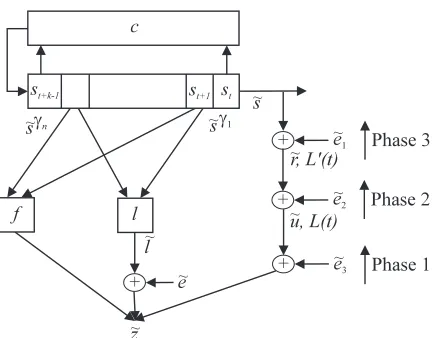
The hybrid correlation attack is divided into three computational phases, where the second phase is optional. First we will give an overview of all involved phases.
Phase 1 In the first phase conditional correlation coefficients are computed for the conditionsB1and/orB4. They are used to make a first error correction, e.g. soft-decision decoding ([HOP96]), on the keystream sequence ˜z, to derive the intermediate sequence ˜uand log-likelihood values L(t)∈IR for every sequence element st, 0≤t ≤N −1. We give a short introduction in the log-likelihood algebra in appendix C. Therefore, L(t) is a abbreviation forL(St), whereSt∈ GF(2) is the binary random variable for the event of the LFSR sequence element st. If L(t) >0 then the event st = 0 is more likely thanst = 1. The absolute value ofL(t) is a measure of prediction. Phase 1 is mandatory.
Phase 2 In the second phase the attacker has the additional possibility to use conditional correlations (conditionsB2and/orB3) to further improve the correc-tion. In this phase only conditional correlation coefficients with a value greater than 0.45 should be applied. The valuesL(t) of the first phase are transformed to L0(t)∈IR and the resulting sequence will be ˜r. If phase 2 is omitted, we set L0(t) :=L(t) and ˜r:= ˜u. The sequences ˜uand ˜rare an estimate for the unknown ˜
s. Note that phase 2 is optional.
Phase 3 In the third phase the attacker has the choice between applying a fast correlation attack or a majority information set procedure:
1. The attacker can apply a fast correlation attack on the sequence ˜r. In contrast to the application of fast correlation attacks on the sequence ˜z, it doesn’t converge to a linear transformation of ˜s, but directly to ˜s. We recommend [CT00] as fast correlation attack because the log-likelihood valuesL0(t) from phase 2 can be utilised as input to the decoding procedure which is based on low-weight parity checks of c. Any other fast correlation attack for LFSR-based keystream generators is also suitable.
2. With a majority decoding rule the most reliable log-likelihood values are selected to form an information set to recover the initial state of the LFSR.
Fig. 3. Comparison of the error models of the fast correlation attacks (middle, l : GF(2)n→GF(2) is a linear transformation) and the hybrid correlation attack (right). The normal operation of the NLFG is displayed on the left side.
4.2 Details
Phase 1 In the first phase conditional correlations onB1 and/or B4 have to be applied on the observed keystream sequence ˜z to obtain log-likelihood values L(t) and an intermediate sequence ˜u. Because of lack of space we only describe the case that coefficients have been computed for conditionB1and givenmand T(m)= (t
1, . . . , tm). The case for condition B4 is straight forward. First we set L(t) := 0 for 0≤t≤N−1.
For min(Γ(T(m)))−t
m≤t≤N+ max(Γ(T(m)))−tm−1 let us define the vectorsy
t,i(T
(m)),i∈Γ(T(m)), as
y t,i(T
(m)) = (y
t,i,t1, yt,i,t2, . . . , yt,i,tm)
T := (z
t+t1−i, zt+t2−i, . . . , zt+tm−i)
T.
For everyi ∈Γ(T(m)) we have a probability p
1(f, Γ, T(m), yt,i(T(m)), i) re-lated to a conditional correlation for which we can associate a log-likelihood value
ln Ã
p1(f, Γ, T(m), y t,i(T(
m)), i) 1−p1(f, Γ, T(m), y
t,i(T( m)), i)
! ,
which contributes toL(t):
L(t) := X i∈Γ(T(m))
ln Ã
p1(f, Γ, T(m), y t,i(T
(m)), i) 1−p1(f, Γ, T(m), y
t,i(T( m)), i)
! .
If a p1(f, Γ, T(m), y t,i(T
With the valuesL(t) we can compute the intermediate sequence ˜uas follows:
ut:=
0,if L(t)>0, 1,if L(t)<0, 0 or 1,if L(t) = 0.
The computational effort of phase 1, without the pre-computations for the coefficients, is onlyO(N M0).
Phase 2 In the second phase the attacker has the option to use conditional correlations w.r.t. B2 or B3, whose correlation should be higher thanλmin,2≥ 0.45 orλmin,3≥0.45, to further correct the sequence ˜u. Suppose that after the first phase the valuesL(t), 0≤t≤N, are computed. First, the valuesL0(t) have to be initialised:L0(t) :=L(t) for 0≤t≤N−1.
For 0≤t≤N−tm−1 we set yt(T(m)) = (yt,t1, yt,t2, . . . , yt,tm)
T := (z
t+t1, zt+t2, . . . , zt+tm)
T.
We first describe the case for conditionB2 and then the general case forB3. For everyi, i0 ∈Γ(T(m)) andi6=i0 with
λ2(f, Γ, T(m), yt(T(m)), i, i0)≥λmin,2 we receive the equation
st+i =st+i0, which holds with probabilityp2(f, Γ, T(m), y
t(T
(m)), i, i0). Then we define
g:= ½
0,if p2(f, Γ, T(m), yt(T(m)), i, i0)≥0.5, 1,else.
and update the log-likelihood values fort+i andt+i0: L0(t+i) :=L0(t+i) + (−1)g·L(t+i0) and L0(t+i0) :=L0(t+i0) + (−1)g·L(t+i). If we have correlations for conditionB3, with
λ3(f, Γ, T(m), yt(T(m)), d)≥λmin,3, d= (di1, di2, . . . , diM0)T, andw(d)≥2, we set
g:= ½
0,if p3(f, Γ, T(m), y t(T(
m)), d)≥0.5, 1,else.
From the conditional correlation coefficient we receive the equation
M0 X
j=1
which holds with probabilityp3(f, Γ, T(m), y t(T
(m)), d).
For any 1≤j≤M0 unddij 6= 0 the valueL0(t+ij) is updated as:
L0(t+ij) :=L0(t+ij)+(−1)g· Y
1≤j0≤M0,j6=j0 dij0 6=0
sgn(L(t+ij0))· min
1≤j0≤M0,j6=j0 dij0 6=0
(|L(t+ij0)|).
With the valuesL0(t) we can compute the intermediate sequence ˜ras follows:
rt:=
0,if L0(t)>0, 1,if L0(t)<0, 0 or 1,if L0(t) = 0.
The computational effort of phase 2, without the pre-computations for the coefficients, is at most O(N M02) if we only consider conditionB2, and at most O(N2M0) if we also consider condition B
3. Note that in general only a few coefficients have values ≥λmin,2 resp. ≥λmin,3 so that the real effort is much less.
Phase 3 In the third phase the attacker has the choice between applying a fast correlation attack on the sequence ˜r or forming an information set of the sequence ˜r. We describe two possibilities to perform the latter approach and refer the reader to the literature on fast correlation attacks for the former.
1. Choose the largest k0 > kvalues of |L(t)|, 0 ≤t≤N−1, randomly select k of them, and solve the corresponding linear system to obtain the initial state of the LFSR. If this state generates the observed sequence ˜z, then the right solution is found. If not, try the nextkrandomly chosen values. 2. Alternatively, we can search for a time value t, for which
L0min(t) := min 0≤j≤k−1|L
0(t+j)|
is maximal. Solve the independent setrt, rt+1, . . . , rt+k−1to an initial state r0= (r0, r1, . . . , rk−1)T, and check, if it generates the sequence ˜z.
4.3 Summary and discussion
We have implemented the conditional correlation attack and the hybrid correla-tion attack. An illustrative example for condicorrela-tional correlacorrela-tion coefficients and the error correction of phase 1 of the hybrid correlation attack can be found in the appendix B. Even if the error correction of phase 1 and 2 is small, it may be good enough to let a fast correlation attack succeed in phase 3. Phase 1 and 2 of the hybrid correlation attack can be further improved by choosing not only one T(m), but different T1(m1), T2(m2), . . . with minimal intersection, small mi≥1,i≥1 and
P
i≥1mi> m, and computing and applying the corresponding conditional correlation coefficientsλl(f, Γ, T(mi)
i , y(T( mi)
5
The concentration attack
The concentration attack combines methods from the hybrid correlation attack and the fast correlation attack described in [MFI01a]. The idea is to concentrate the log-likelihood valuesL0(t) after phase 2 of the hybrid correlation attack to the elements at time B, B+ 1, . . . , D−1, whereD ≥k and the first B bits (positions 0,1, . . . , B−1) of the LFSR sequence ˜sare guessed. The concentration is done via check equations which are derived from the recurrence relation of the LFSR sequence. From the first D bits the most reliable are chosen to form an information set of sizek. The concentration attack can be subdivided into the following steps.
Step 1 Perform phase 1 and 2 of the hybrid correlation attack and receive the log-likelihood valuesL0(t).
Step 2 Choose the parameters 1≤B≤k,D≥kandW ≥1 and compute the following consistency and check equations for 1≤w≤W:
2a Set of consistency equations:
E(w) :=
(
({j1, j2, . . . , jw}, w
X
i=1
c(ji−k)) :k≤j1< . . . < jw≤N−1, w
X
i=1
c(ji−k)=ak
)
2b Set of check equations forB≤t≤k−1:
E(t, w) :=
(
({j1, j2, . . . , jw},
w
X
i=1
c(ji−k)) :k≤j1< . . . < jw≤N−1,
w
X
i=1
c(ji−k)=at
)
2c Set of check equations fork≤t≤D−1:
E(t, w) :=
(
({j1, j2, . . . , jw}, c(t−k)+ w
X
i=1
c(ji−k)) :D≤j1 < . . . < jw≤N−1,
c(t−k)+ w
X
i=1
c(ji−k)=ak
)
,
whereat= (at,0, at,1, . . . , at,k−1)T ∈(GF(2)∪ {∗})k, with
at,i :=
∗,if 0≤i≤B−1, 1,ifi=tandt6=k, 0,else.
ForB≤t≤k−1 we have at= (∗, . . . ,∗
| {z } B
,0, . . . ,0 | {z } t−B
,1,0, . . . ,0 | {z } k−t−1
)T
and
ak = (∗| {z }, . . . ,∗ B
,0| {z }, . . . ,0 k−B
Step 3 Choose appropriate large log-likelihood boundsL00min andL000min. Step 4 Guess the firstB bitss0, s1, . . . , sB−1, setL00(t) :=L0(t) for 0≤t≤N,
and evaluate the consistency and check equationsE(w) andE(t, w) to receive the log-likelihood valuesL000(t) forB≤t≤D−1 (details below).
Step 5 Select the most reliable bits to form an information set of sizek. Step 6 Check if the current solution generates the observed keystream ˜z. If not,
go to step 4 and make the next guess, else the correct solution is found.
Note that the computation of the conditional correlation coefficients in step 1 and of the check equations in step 2 can be done in the pre-computations. Efficient algorithms can be derived from methods presented in [CJM02] and [Wag02].
We will now describe the tests and evaluations in step 4. Suppose we have guessed the bits s0, s1, . . . , sB−1. First it is tested if the guess is correct and is consistent:
1. Check if for 0≤t≤B−1 and|L00(t)| ≥L00min, (−1)st = sgn(L00(t)) is valid.
2. For a test equation ({j1, j2, . . . , jw},(b0, . . . , bk−1)T) inE(w) we can estab-lish the equation Pwi=1sji =
PB−1
i=0 bisi =: b. If minwi=1(|L00(ji)|) ≥ L00min, then we test, ifQwi=1sgn(L00(ji)) = (−1)b holds.
If one of these conditions is not fulfilled, then the guess is not correct with high probability and we try the next guess.
If all conditions are valid, then we setL00(j) = (−1)b, withb =PB−1 i=0 bisi, for any ({j},(b0, . . . , bk−1)T) in E(1) and afterwards setL000(t) =L00(t) for 0≤ t≤D−1.
We now briefly describe how to evaluate a check equationE(t, w),B ≤t≤ k−1, in step 4 under a guess fors0, s1, . . . , sB−1. Suppose we have an equation ({j1, j2, . . . , jw},(b0, . . . , bk−1)T) in E(t, w). Note, that we have
bi=
0 or 1,if 0≤i≤B−1, 1,ifi=t,
0,else.
Then the following equations can be established
w X
i=1
c(ji−k)= (b
1, . . . , bB−1,0, . . . ,0,1,0, . . . ,0)T
sT0 w X
i=1
c(ji−k)=sT
0 (b1, . . . , bB−1,0, . . . ,0,1,0, . . . ,0)T w
X
i=1 sji =
BX−1
i=0
bisi+st
The last equation can be rewritten as
st= w X
i=1 sji+
BX−1
i=0 bisi=
w X
and the transformation of this equation in an update of the corresponding log-likelihood value is as follows
L000(t) :=L000(t) + (−1)b· w Y
i=1
sgn(L00(ji))· w min
i=1(|L
00(j
i)|).
The evaluation of check equations in E(t, w) for k ≤ t ≤ D −1 is straight forward.
The expected number of check equationsµ(t, w) inE(t, w) is given by 2B−k¡N−k w
¢
forB≤t≤k−1 and 2B−k¡N−wD¢fork≤t≤D−1 ([MFI01b]). Note that the valuesµ(t, w) does not depend on a particular connection polynomialc.
The number of check equationsµ(t, w) can be increased significantly by a factor of 2t−Bif we evaluate the equations in step 4 in the orderB, B+1, . . . , D− 1. The estimated valuesL000(t0) can then included in the evaluation ofL00(t) for t0∈ {B, B+ 1, . . . , t−1}, if|L000(t0)|exceeds a thresholdL000min. The components of the vectoratare then given by
at,i:=
∗,if 0≤i≤t−1, 1,ifi=tandt6=k, 0,else.
6
Conclusions
With the hybrid correlation attack against the NLFG we have proposed a gen-eral framework for embedding any fast correlation attack against LFSR-based keystream generators. The hybrid correlation attack reduces the real error prob-ability introduced by the nonlinearity of the filter functionf so that fast corre-lation attacks will be more successful and efficient.
Note that the application of the hybrid correlation and concentration attack is only possible if there are conditional correlations for conditionsB1orB4, which are greater than zero. With Theorem 1, a class of filter functions, is classified for which these conditional correlation coefficients are zero for anym ≥1 and arbitraryT(m) andΓ. With the linear transformation attack (end of section 2) the attacker is able to find an equivalent NLFG for which the filter function doesn’t have the structure as required in Theorem 1 and conditional correlation coefficients for B1 and B4 greater than zero may exist. But in this case, M0 which determines the computational effort for computing the coefficients will in most cases be much larger than the original value.
The concentration attack uses the first and second phase of the hybrid corre-lation attack and then concentrates the computed log-likelihood values toD−B unknowns with the help of a partial search over 2B possible states.
7
Acknowledgements
I am grateful to my former colleagues at the University of Hagen and at T-Systems for support and helpful comments. Also thanks to anonymous referees for hints to improve the quality of the paper.
References
[And95] Ross J. Anderson. Searching for the optimum correlation attack. In Bart Preneel, editor,Fast Software Encryption (FSE 1994), LNCS 1008, pages 137–143. Springer-Verlag, 1995.
[Bab01] Steve Babbage. Cryptanalysis of LILI-128. Technical report, January 2001. https://www.cosic.esat.kuleuven.ac.be/nessie/reports/.
[BP00] S.S. Bedi and N.R. Pillai. Cryptanalysis of the nonlinear feedforward gen-erator. In Bimal Roy and Eiji Okamoto, editors, Progress in Cryptology, INDOCRYPT 2000, LNCS 1977, pages 188–194. Springer-Verlag, 2000. [BS00] Alex Biryukov and Adi Shamir. Cryptanalytic time/memory/data tradeoffs
for stream ciphers. In Tsutomu Matsumoto, editor, Advances in Cryptol-ogy, ASIACRYPT’00, Lecture Notes in Computer Science 1976, pages 1–13. Springer-Verlag, 2000.
[CJM02] Phillippe Chose, Antoine Joux, and Michel Mitton. Fast correlation attacks: An algorithmic point of view. In Lars Knudsen, editor,Advances in Cryptol-ogy, EUROCRYPT’02, LNCS 2332, pages 209–221. Springer-Verlag, 2002. [CJS01] Vladimor Chepyzhov, Thomas Johansson, and Bernard Smeets. A simple
algorithm for fast correlation attacks on stream ciphers. In Bruce Schneier, editor,Fast Software Encryption (FSE 2000), Proceedings, Lecture Notes in Computer Science 1978, pages 181–195. Springer-Verlag, 2001.
[CKPS00] Nicolas Courtois, Alexander Klimov, Jacques Patarin, and Adi Shamir. Efficient algorithms for solving overdefined systems of multivariate poly-nomial equations. In Bart Preneel, editor, Advances in Cryptology, EU-ROCRYPT’00, Lecture Notes in Computer Science 1807, pages 392–407. Springer-Verlag, 2000.
[Cou02] Nicolas T. Courtois. Higher order correlation attacks, XL algorithm and cryptanalysis of Toyocrypt. Technical report, Cryptology ePrint Archive of the IACR, 2002. TR-2002-087,http://eprint.iacr.org.
[CP03] Nicolas T. Courtois and J. Patarin. About the XL algorithm over GF(2). In M. Joye, editor,Progress in Cryptology - CT-RSA 2003, Lecture Notes in Computer Science 2612, pages 140–156. Springer-Verlag, 2003.
[CT00] Anne Canteaut and Michael Trabbia. Improved fast correlation attacks using parity-check equations of weight 4 and 5. In Bart Preneel, editor,Advances in Cryptology, EUROCRYPT’00, LNCS 1807, pages 573–588. Springer-Verlag, 2000.
[CW90] D. Coppersmith and S. Winograd. Matrix multiplication via arithmetic programming. Journal of Symbolic Computation, 9:251–280, 1990.
[For90] R´ejane Forr´e. A fast correlation attack on nonlinearity feedforward filtered shift-register sequences. In Jean-Jacques Quisquater and Joos Vandewalle, editors,Advances in Cryptology, EUROCRYPT’89, LNCS 434, pages 586– 595. Springer-Verlag, 1990.
[FSCG95] Amparo F´uster-Sabater and Pino Caballero-Gil. On the linear complexity of nonlinearly filtered pn-sequences. In Josef Pieprzyk and Reihaneh Safavi-Naini, editors,Advances in Cryptology, ASIACRYPT’94, LNCS 917, pages 80–90. Springer-Verlag, 1995.
[GBM02] Jovan Dj. Goli´c, Vittorio Bagini, and Guglielmo Morgari. Linear crypt-analysis of bluetooth stream cipher. In Lars Knudsen, editor,Advances in Cryptology, EUROCRYPT’2002, Lecture Notes in Computer Science 2332, pages 238–257. Springer-Verlag, 2002.
[GCD99] Jovan Dj. Goli´c, Andrew Clark, and Ed Dawson. Inversion attack and branching. In Josef Pieprzyk, Reihaneh Safavi-Naini, and Jennifer Seberry, editors,Information Security and Privacy, Fourth Australasian Conference, ACISP’99, LNCS 1587, pages 88–102. Springer-Verlag, 1999.
[GCD00] Jovan Dj. Goli´c, Andrew Clark, and Ed Dawson. Generalized inversion attack on nonlinear filter generators. IEEE Transactions on Computers, 49(10):1100–1109, October 2000.
[GG02] A. G´orska and K. G´orski. Improved inversion attacks on nonlinear filter generators. Information Processing Letters, 38(16):870–871, August 2002. [GJ79] Michael R. Garey and David S. Johnson. Computers and Interactability.
W.H. Freeman and Company, 1979.
[Gol96] Jovan Dj. Goli´c. On the security of nonlinear filter generators. In Dieter Gollmann, editor,Fast Software Encryption (FSE 1996), LNCS 1039, pages 173–187. Springer-Verlag, 1996.
[GR94] Richard A. Games and Joseph J. Rushanan. Blind synchronization of m-sequences with even span. In Tor Helleseth, editor,Advances in Cryptology, EUROCRYPT’93, Lecture Notes in Computer Science 765, pages 168–180. Springer-Verlag, 1994.
[GSSD97] Jovan Dj. Goli´c, Mahmoud Salmasizadeh, Leonie Ruth Simpson, and Ed Dawson. Fast correlation attacks on nonlinear filter generators. In-formation Processing Letters, 64(1):37–42, October 1997.
[HOP96] Joachim Hagenauer, Elke Offer, and Lutz Papke. Iterative decoding of binary block and convolutional codes. IEEE Transactions on Information Theory, 42(2):429–445, March 1996.
[JJ00] Fredrik J¨onsson and Thomas Johansson. Theoretical analysis of a correlation attack based on convolutional codes. In Ezio Biglieri and Sergio Verd´u, editors,IEEE International Symposium on Information Theory 2000, page 212, 2000.
[JJ02] Fredrik J¨onsson and Thomas Johansson. A fast correlation attack on LILI-128. Information Processing Letters, 81(3):127–132, February 2002. [Key76] Edwin L. Key. An analysis of the structure and complexity of nonlinear
binary sequence generators. IEEE Transactions on Information Theory, 22(6):732–736, November 1976.
[Kra01] Matthias Krause. BDD-based cryptanalysis of keystream generators. Tech-nical report, Cryptology ePrint Archive of the IACR, 2001. TR-2001-092, http://eprint.iacr.org.
[LBGZ01] Sabine Leveiller, Joseph Boutros, Philippe Guillot, and Gilles Z´emor. Crypt-analysis of nonlinear filter generators with{0,1}-metric Viterbi decoding. In
Bahram Honary, editor,Cryptography and Coding VIII, LNCS 2260, pages 402–414. Springer-Verlag, 2001.
[LCPP96] Sangjin Lee, Seongtaek Chee, Sangjoon Park, and Sungmo Park. Condi-tional correlation attack on nonlinear filter generators. In Kwangjo Kim and Tsutomu Matsumoto, editors, Advances in Cryptology, ASIACRYPT’96, LNCS 1163, pages 360–367. Springer-Verlag, 1996.
[L¨oh00] Bernhard L¨ohlein. Analysis and modifications of the conditional correlation attack. In Joachim Hagenauer, Johannes Huber, and Peter Vary, editors,
Third ITG Conference Source and Channel Coding, ITG-Fachbericht 159, pages 37–43. VDE Verlag, January 2000.
[L¨oh01] Bernhard L¨ohlein. Design and analysis of cryptographic secure keystream generators for stream cipher encryption (in German). PhD thesis, Faculty of Electrical and Information Engineering, University of Hagen, Germany, December 2001. Berichte aus der Kommunikationstechnik, Band 10, Shaker Verlag.
[MFI01a] Miodrag J. Mihaljevi`c, Marc P. C. Fossorier, and Hideki Imai. Fast correla-tion attack algorithm with list decoding and an applicacorrela-tion. In Hideki Imai, editor, Fast Software Encryption (FSE 2001), LNCS 2355, pages 196–210. Springer-Verlag, 2001.
[MFI01b] Miodrag J. Mihaljevi`c, Marc P. C. Fossorier, and Hideki Imai. On decod-ing techniques for cryptanalysis of certain encryption algorithms. IEICE Transactions on Fundamentals, E84-A(4):919–930, April 2001.
[MS89] Willi Meier and Othmar J. Staffelbach. Fast correlation attacks on stream ciphers. Journal of Cryptology, 1(3):159–176, 1989.
[Rue86] Rainer A. Rueppel.Analysis and Design of Stream Ciphers. Springer-Verlag, 1986.
[Sch99] Markus Schneider. Methods of generating binary pseudo-random sequences for stream cipher encryption (in German). PhD thesis, Faculty of Electrical Engineering, University of Hagen, Germany, September 1999. Berichte aus der Kommunikationstechnik, Band 4, Shaker Verlag.
[Sie85] Thomas Siegenthaler. Decrypthing a class of stream chiphers using chiper-text only. IEEE Transactions on Computers, 34(1):81–85, January 1985. [Str69] V. Strassen. Gaussian elimination is not optimal. Numerische Mathematik,
13:354–356, 1969.
[SZZ93] Jennifer Seberry, Xian-Mo Zhang, and Yuliang Zheng. Nonlinearly balanced boolean functions and their propagation characteristics. In Douglas R. Stin-son, editor,Advances in Cryptology, CRYPTO’93, LNCS 773, pages 49–60. Springer-Verlag, 1993.
[Wag02] David Wagner. A generalized birthday problem (extended abstract). In Moti Yung, editor, Advances in Cryptology, CRYPTO’2002, LNCS 2442, pages 288–303. Springer-Verlag, 2002. Full version under http://www.cs. berkeley.edu/~daw/papers/genbday.html.
A
Examples for notations and definitions
Consider a NLFG with the filter functionf : GF(2)3→GF(2),f(x1, x2, x3) = x1x2+x2x3+x3,Γ = (0,3,10) and an arbitrary LFSR of lengthk= 40.f has n = 3 inputs, is balanced, has an algebraic degree of 2, and a nonlinearity of Nf = 2 (pe,f = 0.25).
Let m = 2 and the output time pattern T(2) = (t1, t2) = (0,3), and so T(1) = (0). This yieldsΓ(t1) = (0,3,10),Γ(t2) = (3,6,13),Γ(T(1)) = (0,3,10) andΓ(T(2)) = (0,3,10,6,13). Note that new numbers in the step fromΓ(T(1)) toΓ(T(2)) are appended at the tail ofΓ(T(1)). The cardinalityM0 ofΓ(T(2)) is 5.
Γ(T(2)) includes the indices of the inputs from the sequence ˜sto the filter functionf to produce the keystream output at timet1= 0 andt2= 3.
For the above configuration we compute the probabilityp1(f, Γ, T(2),10,(0,1)T) and the corresponding conditional correlation coefficientλ1(f, Γ, T(2),10,(0,1)T) for conditionB1. For the computation of these values the sequence ˜sis treated as a random sequence withP(st= 0) =P(st= 1) = 0.5 for anyt≥0.
The set S of inputs to the filter function f, which procduce the output y(T(2)) = (0,1)T at timet
1= 0 andt2= 3, is
S={(0,0,0,0,1)T,(0,1,0,0,1)T,(0,1,0,1,0)T,(0,1,0,1,1)T,
(0,1,1,0,1)T,(0,1,1,1,0)T,(0,1,1,1,1)T,(1,0,0,0,1)T}.
The subsetS0 ofS, for which the conditions10= 0 holds, is given by
S0={(0,0,0,0,1)T,(0,1,0,0,1)T,(0,1,0,1,0)T,(0,1,0,1,1)T,(1,0,0,0,1)T}.
Thus, we havep1(f, Γ, T(2),10,(0,1)T) = 5/8 = 0.625 andλ1(f, Γ, T(2),10,(0,1)T) =
|0.625−0.5|= 0.125.
B
A toy example for the application of the hybrid
correlation attack
In this example we show how the first phase of the hybrid correlation attack (see section 4) is applied.
We consider the filter functionf : GF(2)9→GF(2),
f(x1, . . . , x9) =x1x2+x3x4+x5x6+x7x8+x9
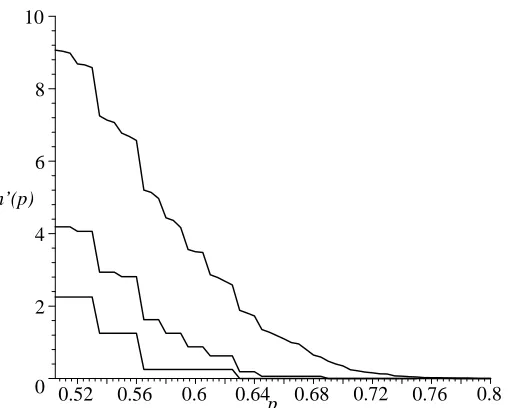
withNf = 240 andpe,f ≈0.469. Also letΓ = (0,1, . . . ,8), the connection poly-nomialc∈GF(2)[x] be primitive and of degreek= 40. In Fig. 4 the normalised cumulated frequency valuesh01(p) = 2−mh0
1(f, Γ, T(m), p) of the conditional cor-relation coefficients for condition B1 are displayed for different values of m, namely form= 3,5 and 10 andT(m)= (0,1, . . . , m−1).
applied phase 1 of the hybrid correlation attack with condition B1 for m = 3,5 and 10. The average improvements∆pe,f,real and the rest error probability pe,1+pe,2=P(e1,t= 1) +P(e2,t= 1) are displayed in Table 1. Even form= 3 the rest error probability achievespe,1+pe,2= 0.438416 so that a fast correlation attack in the third phase of the hybrid correlation attack on the sequence ˜rwould be successful.
In this example, the application of phase 2 of the hybrid correlation is also possible and brings further error correction.
0 2 4 6 8 10
h’(p)
0.52 0.56 0.6 0.64p 0.68 0.72 0.76 0.8
Fig. 4. The normalised cumulated frequency values h0(p) = 2−mh01(f, Γ, T(m), p) of
the conditional correlation coefficients for m= 3 (left), 5 (middle) and 10 (right) for conditionB1.
m ∆pe,f,realpe,1+pe,2
3 0.017207 0.438416 5 0.036875 0.417820 10 0.058812 0.395700
C
Introduction to log-likelihood algebra
In this section we give an introduction to the log-likelihood algebra, which was introduced in [HOP96] and is used in the hybrid correlation and the concentra-tion attack in this paper.
Consider a binary random variableX∈GF(2) with probability 0≤P(X)≤ 1, i.e.P(X = 0) +P(X= 1) = 1.
The log-likelihoodL(X) for the random variableX is then defined as
L(X) := ln µ
P(X = 0) P(X= 1)
¶ = ln
µ
P(X = 0) 1−P(X = 0)
¶ .
L(X) is strong monotone and takes values from−∞to +∞for 0≤P(X = 0)≤1.L(X) = 0 ifP(X= 0) = 0.5. IfL(X)>0 then the eventX = 0 is more likely thanX= 1. SuchL(X) is a measure for the reliability of the eventX= 0. If we consider two statistic independent, binary random variablesX1∈GF(2) andX2∈GF(2) with probabilityP(X1) andP(X2).
Then we have for the probability of the summation of the two random vari-ables X1 andX2
P(X1+X2= 0) =P(X1= 0)·P(X2= 0) +P(X1= 1)·P(X2= 1)
=P(X1= 0)·P(X2= 0) + (1−P(X1= 0))·(1−P(X2= 0)) = 1 + 2P(X1= 0)·P(X2= 0)−P(X1= 0)−P(X2= 0). With
P(X = 0) = e L(X) 1 +eL(X) we receive the log-likelihood relation of the summation as
L(X1+X2= 0) = ln µ
1 + 2P(X1= 0)P(X2= 0)−P(X1= 0)−P(X2= 0) P(X1= 0) +P(X2= 0)−2P(X1= 0)P(X2= 0)

= ln µ
1 +eL(X1)eL(X2)
eL(X1)+eL(X2)

≈sgn(L(X1))·sgn(L(X2))·min(|L(X1)|,|L(X2)|).
This relation can be generalised to the summation ofnstatistic independent, binary random variablesX1, . . . , Xn∈GF(2) with
tanh ³x
2 ´
= e x−1
ex+ 1 to
L Ã n
X
i=1 Xi= 0
! = ln
1 +
Qn i=1tanh
³ L(Xi)
2 ´
1−Qni=1tanh ³
L(Xi)
2 ´ ≈ n Y i=1
sgn(L(Xi))· min