Abstract
CHERUVU, PRAVEENKUMAR
Tuple Space Computing on the Grid (Under the direction of Dr. Gregory T Byrd)
A computational grid is a framework for resource sharing across multiple organizations, operating in different administrative domains. Grids are built over wide-area networks. They provide infrastructure for wide-wide-area distributed computing platform. Grids provide secure and fine-grained access to computational resources in multiple (virtual) organizational domains. Tuple space is a network-global storage space providing a coherent-addressable shared memory abstraction. Tuple space provides a logically shared address space and enables data sharing.
Grids can be used for building computing platforms that can span across wide-area networks, grid-computing platform. Tuple spaces enable distributed programming and are decoupled in space and time. Communication in tuple space is asynchronous. Tuple spaces provide data sharing ability and coordinate access to data. The purpose of this research is to explore distributed programming in context with grid-computing platform. The idea is to introduce tuple space based programming for grids. This thesis looks at the design of a grid-enabled tuple space.
Tuple Space Computing on the Grid
by
Praveenkumar Cheruvu
A thesis submitted to the graduate faculty of
North Carolina State University
In partial fulfillment of the requirements of the degree of
Master of Science
COMPUTER ENGINEERING
Raleigh
2003
Approved by
________________________________
Dr. Gregory Byrd, Chair of the Advisory Committee
__________________________ _____________________________
To
BIOGRAPHY
Acknowledgements
First and foremost, I would like to thank my parents for every thing they have given me in life. I thank god for all his grace and support to achieve my goals. My mother Nirmala Devi and father Pandu Ranga Rao have been a constant source of inspiration. I thank my sisters Sita, Padma and Manju for all their support.
I sincerely thank my advisor Dr. Gregory T. Byrd for giving me an opportunity to work under his guidance. His vision and ideas are primarily responsible for the architecture we have designed and implemented. I have learnt some incredible things from him. I am greatly impressed with his attitude to work and perfection of doing things. I thank him for his trust, continuous support and for all his time. Working under him has been a rewarding experience.
TABLE OF CONTENTS
LIST OF FIGURES ... vii
LIST OF TABLES ... viii
INTRODUCTION
... 1INTRODUCTION TO GRIDS AND GLOBUS
... 52.1 Grids
... 52.1.1 Grid Architecture ... 5
2.2 Grid Computing Toolkit and Components
... 62.2.1 Resource Management... 6
2.2.2 Security Architecture ... 7
2.2.3 Information Infrastructure... 8
2.2.4 Data Management ... 8
2.3 Globus Toolkit
... 92.3.1Resource Management Architecture in Globus ... 9
2.3.2 Security Architecture in Globus... 11
2.3.2 Grid programming tools... 13
TUPLE SPACE
... 153.1 Basics
... 153.2 Tuple space Operations
... 163.3 Space-based Programming
... 173.3.1 Distributed data structures ... 18
3.3.2 Synchronization ... 18
3.3.3 Communication... 19
3.4 Application Patterns
... 193.4.1 Replicated Worker Pattern ... 20
3.4.2 Command Pattern... 21
3.4.3 Marketplace Pattern ... 21
3.4.3 Specialist Pattern... 21
3.5 JavaSpace
... 223.6 Tspaces
... 23ARCHITECTURE
... 244.1 Tuple space and Computational Infrastructure
... 244. 2 Grid Computing Platform
... 254.3 Grid enabled TS
... 264.3.1 Resource Management in grid-enabled Tuple space ... 26
4.3.2 Security in Grid-enabled Tuple space... 27
4.4 Architecture for Tuple Space Computing on Grid
... 28IMPLEMENTATION
... 315. 1 Implementation Infrastructure
... 315.2 Grid Sockets
... 325.3 Grid-enabled JS
... 335.4 Tuple space Computing on Grid
... 345.5 Applications using Grid-enabled JS
... 365.6 Performance
... 365.6.1 Experimental Setup... 37
5.6.2 Analysis... 37
CONCLUSION AND FUTURE WORK
... 436.1 Conclusion
... 436.2 Future Work
... 44LIST OF FIGURES
2.1 Layered Grid Architecture 15
2.2 Resource Management Architecture 19
2.3 Job submission in Globus 20
2.4 Security Architecture in Globus 22
3.1 Tuple space Paradigm 26
4.1 Tuple space in general computing environment 34
4.2 Tuple space in grid computing 35
4.3 Architecture of tuple space computing on grid 38
5.1 Server-Centric service model 41
5.2 Grid-enabled JavaSpace 42
5.3 Interaction diagram of application and grid-enabled JS 45
5.4 write operation 47
5.5 write operation 47
5.6 read operation 48
5.7 read operation 48
5.8 take operation 48
5.9 take operation 48
5.10 Lookup time 49
5.11 Lookup time 49
5.12 Space operation comparison 49
5.13 Lookup time comparison 49
5.14 Space operations with 1 KB Entry 50
5.15 Space operations with 2KB Entry 50
LIST OF TABLES
Chapter 1
Introduction
Distributed computing aims at building applications that are distributed over network of machines. Conventionally distributed computing systems are static and focus on large-scale resource sharing. Distributed applications are difficult to design and build because of different machine architectures and software platforms. In addition, distributed applications communicate over unreliable network.
Distributed architectures lack the capability of dynamic resource aggregation, allocation and scheduling. The Client server paradigm is the simplest flavor of distributed computing architecture. Distributed computing technologies that are in use such as CORBA [1] (Common Object Broker Architecture) and RMI [2] (Remote Method Invocation) are based on the client-server paradigm.
Compared to distributed architectures, there are not many languages that support distributed programming. MPI [3] (Message Passing Interface) and Linda [4] are extensions of sequential languages distributed programming. MPI provides built-in routines for developing distributed programs. Linda provides a global shared memory and language constructs. Linda enables indirect communication among processes.
resource management, scheduling, state management and process monitoring from the user.
Grid technology is different from distributed, enterprise, and peer-to-peer computing. Grids focus on dynamic and cross-organizational sharing. Grids complement existing distributed computing technologies.
Grid applications must be flexible to adapt to the dynamic environment. Processes in grid applications should be self-contained and granular enough so that they can be distributed. Ideally, processes in grid applications must be decoupled in time. To perform some useful computation processes need to exchange data. For exchanging data, there must be rendezvous of processes. If the computations are performed across the grid domain, all the processes involved in the computation might not be able complete at the same time. But, if one process is just waiting to deliver data to another, we are under-utilizing that computational resource. Figure 1.1 shows grid computing infrastructure.
decoupling requires a global memory store, where all the processes can store data. In time decoupling the processes need not have overlapping life times. Time decoupling requires coordinated data exchange between processes.
The prototype implementation has integrated tuple space with grid. The design is based on grid architecture and utilizes the resource management and secure components of grid. The architecture allows grid applications using space-based programming, transparently accessing grid-enabled tuple space. The prototype implementation uses the Globus Toolkit [16], a grid-computing toolkit from Argonne National Lab, and JavaSpace [24, 25], Sun’s implementation of tuple space.
Outline
The outline of the thesis is as follows.
Chapter 2 gives introduction about grids. The chapter explains about the resource management and security in grids. Globus Resource Management and Grid Security Infrastructure have been explained in detail.
Chapter 3 introduces tuple spaces. It provides an overview of tuple spaces primitives and operations. We introduce Space-based programming paradigm and its features. We state/discuss various application patterns for developing distributed application based on space-based programming.
discussed. We provide the ground for exploiting tuple space paradigm in grid computing environment.
Chapter 2
Introduction to Grids and Globus
This chapter gives an introduction to grids. We describe the architecture and components of a grid. We explain about grid computing toolkits, resource management, and security architecture.
2.1 Grids
A “Computational Grid” is a hardware and software infrastructure that provides dependable, consistent, pervasive and inexpensive access to high-end computational capabilities [5].
Grids are built using standard, general-purpose protocols and interfaces. Grids coordinate resources that are not in one centralized control. Resource sharing in grids is dynamic and across virtual organizations [6]. Virtual Organizations encompass highly flexible relationships and can provide precise control over shared resources.
2.1.1 Grid Architecture
resources. The application layer has various applications that across virtual organization.
2.2 Grid Computing Toolkit and Components
A Grid computing toolkit is an implementation of grid architecture. Grid computing toolkits consist of components that provide the core functionality of the grid. Grid components provide functionality to (i) manage heterogeneous resources across virtual organization (ii) provide secure access to resources (iii) lookup information (iv) transfer high volumes of data (v) manage component failures.
2.2.1 Resource Management
Figure 2.1 Layered Grid Architecture Fabric
Connectivity Resource
The characteristic feature of grids is to assemble a collection of computational resources based on need, without regard to physical location. Resource management [7] is the component of grid that locates the resources based on the requirements. Resource management authenticates the user and creates the processes. Resource management adapts to scheduling policies and security mechanism at different administrative domains. The resource management interfaces with different heterogeneous resources and should be easily extensible. Since grid enables co-allocation [8], the resource management should be able to allocate resource for a job at multiple sites. Resource management provides mechanisms to monitor computations, negotiate resources and manage faults. All the functions are provided by the resource manager.
Resource Manager is an important component in grid infrastructure. It processes the requests by creating one or more processes, enabling remote monitoring of the jobs, and updating the information service. Resource Manager acts on behalf of one or more computational resources. Resource specification is passed to the resource manager. Resource Manager identifies local resources that meet the resource requirements. The resource manager schedules resources. It can also map the request to some local resource allocation mechanism. Condor [9], Load-Leveler [10], LSF [11], NQE [12] are examples. Local mechanism can co-exist with resource manager. Job scheduling and submission are performed by resource manager.
2.2.2 Security Architecture
interoperability with local policies and dynamically varying resource requirements. Resources may have different authentication and authorization mechanisms. The security policy provides an authentication mechanism for the user and the resource and verifies each other’s identity. Security policy enables transparent use of local access control mechanism without any changes. Grid security architecture employs a common way to express the identity of security principals, such as a user and a resource. Security policy defines rules for security objects and relationships among them. A trusted domain in grid is a collection of objects governed by a single administrative domain and single security policy. Grid security policy provides a mapping for security objects in different administrative domains. There can be two names one global security object and one local object specific to administrative domain. The global security object can be mapped to different local object in different administrative domain.
2.2.3 Information Infrastructure
Information infrastructure [14] in grid provides a coherent view of system information that spans across virtual organizations. Information infrastructure consists of tools to query resource information. These tools are used by grid applications to query about resource capabilities, availability and status.
2.2.4 Data Management
transfer protocol. With data management, all grid applications have ubiquitous, high-performance and secure access to data.
2.3 Globus Toolkit
Globus Toolkit [16] is a reference implementation of grid. Globus is a bag of modular software components. Globus toolkit provides the core functionality required for building grids. It consists of components for Resource Management, Security, Data Management, Information Services and Packaging Technology.
2.3.1Resource Management Architecture in Globus
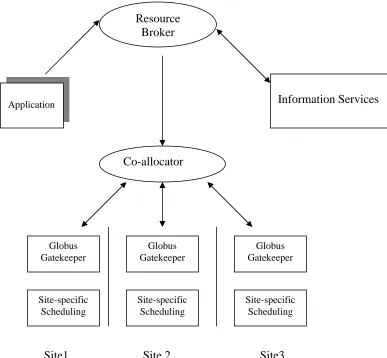
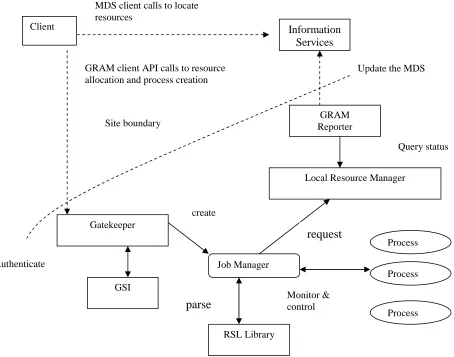
Globus resource manager is called GRAM (Globus Resource Allocation Manager). The components of GRAM are the client library, RSL parser library, job manager, and GRAM reporter. The client library is used by an application or by a co-allocator on behalf of an application. GRAM has a component called the gatekeeper, which performs mutual authentication (to perform mutual authentication between the user and the resource). The gatekeeper responds to a request by doing three things;(i) it performs mutual authentication;(ii) it determines a local username that maps to
Application
Resource Broker
Information Services
Co-allocator
Globus Gatekeeper
Globus Gatekeeper
Globus Gatekeeper
Site-specific Scheduling
Site-specific Scheduling
Site-specific Scheduling
Site1 Site 2 Site3
remote user. (iii) it starts job manager that actually executes the job. One and two are performed by grid security infrastructure. Figure 2.3 shows Job submission scenario in Globus.
2.3.2 Security Architecture in Globus
Globus defines a security policy that specifies security subjects, security objects relationship between them. In Globus, users are security subjects and resources are security objects. A subject participates in security operations. An object is protected by security policy. Globus defines a trusted domain as an administrative domain with
Information Services
Gatekeeper
GRAM Reporter
Local Resource Manager
Job Manager GSI RSL Library Process Process Process MDS client calls to locate
resources
GRAM client API calls to resource allocation and process creation
Update the MDS
Site boundary create request parse Authenticate Monitor & control Query status Client
one single security policy. A Trusted domain is a collection of security subjects and objects. There can be multiple trusted domains in the Globus environment. In Globus a user has a global subject, which is used to identify the user in the grid domain. Users also have local subject for identifying himself or herself in each local site or domain. In each trusted domain, there exists a mapping between from global to local subjects. The mapping of global name (identity) to local name (identity) is site-specific. The global subject enables single sign-on policy. All the operations between entities in a trusted domain are authenticated. In Globus, all the access control decisions are made locally on the basis of local subject.
Globus defines the user proxy, a session manager process that is given permission to act on behalf of the user. The proxy has a fixed lifetime. Globus provides a resource proxy that controls the access to a particular resource. The resource proxy creates the mapping between the computation and the resource. Resource proxies are used to translate inter-domain security mechanism to local security mechanism.
The user proxy along with single sign-on allows the processes on grid to run for extended period of time without any additional user interaction for mutual authentication. The user proxy interacts with resource proxy to perform delegation. User proxy issues a request to the resource proxy of the resource. If the request is successful, then process is created.
Globus uses the authentication protocols defined by secure socket layer protocol [17] (SSL). SSL is most widely adopted for authentication and secure communication for a broad range of distributed services.
2.3.2 Grid programming tools
Grid programming tools are developed from the roots of parallel and distributed computing. Grid programming model must manage computations in heterogeneous and dynamic environment with varying latencies. The programming model must enable large-scale, high-performance computing. The Message Passing Interface [3]
Fig 2.4 Security Architecture in Grids
User User
proxy
process process
Global-to-local mapping
Global-to-local mapping
Rp Rp
Grid gateway Grid gateway
(MPI) is a standard library and provides routines to send and receive message. Information is exchanged by passing messages and gives full control to the programmer. MPICH-G2 [18] is a grid-enabled implementation of MPI that uses Globus. Remote Procedure Call [19] (RPC) is powerful technique for constructing distributed applications. RPC enables to call procedures on remote machines. The caller specifies remotes procedure with arguments and waits for a response from the remote procedure. RPC is a language construct rather than a library function. GridRPC [20] is a RPC model and API for grids. Shared memory programming [21] model provides a global memory that is accessible to all the processes. In shared memory, data location is transparent and access global memory in same manner as local memory. Shared memory model is advantageous if the processes are decoupled.
Summary
Chapter 3
Tuple space
This chapter explains the tuple space paradigm. The basic operations of tuple space are introduced and their semantics are explained in detail. We illustrate the asynchronous communication paradigm of tuple spaces. A new programming alternative for grid applications called space-based programming is introduced. We describe the features and advantages of space-based programming paradigm.
3.1 Basics
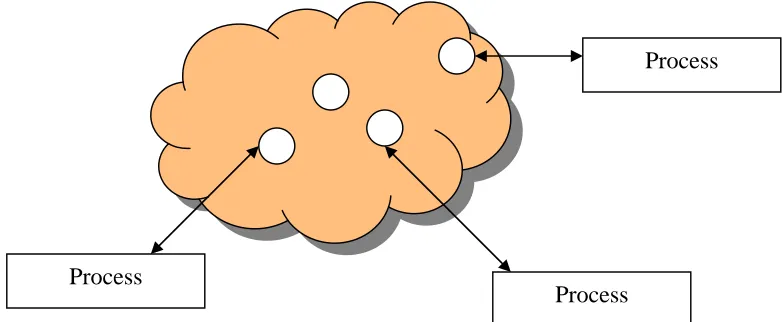
Tuple space [4] is a logically shared memory, which stores data in basic units called “tuples”. A tuple is a data structure consisting of one or more typed fields. Each typed field in tuple may contain a value or it may be empty.Tuples are not accessed by their address but rather by their content.
The processes that use tuple space are decoupled in space and time. In space decoupling, processes exchanging data need not know any information before hand (priori). In time decoupling, rendezvous of processes is not required. Tuple spaces are persistent, and lifetime of a tuple is not bounded to any particular process involved.
Linda [4, 22] is a programming language facilitating parallel programming. Linda exemplifies tuple space. A programming model with an approach of adaptive parallelism called “Piranha” [23] was developed based on Linda.
3.2 Tuple space Operations
Tuple space defines a few simple operations. The basic operations are to read and write tuples into tuple space. All the tuple space operations are atomic. Table 3.1 describes the three basic operations in tuple space.
Tuple space Operation Description of Operation
out Inserts a tuple into the tuple space
in Removes a tuple from the tuple space
rd Copies a tuple from the tuple space without withdrawing it
Table 3.1 Basic tuple space operations
(“Q”, int i, bool b) is a tuple with containing three fields, a string, an integer, and a boolean. The operation in(“Q”, int i, bool b) would remove a single tuple from tuple space, whose first component is “Q” and second and third components are integer and boolean respectively. The fields in the tuple can either be formal like (“Q”, int i, bool b) or actuals like (“Q”, 5, true). Tuples are matched by their content.
3.3 Space-based Programming
Tuple space provides a programming model that views an application as a collection of processes cooperating via a flow of tuples into and out of one or more spaces. Tuple space enables processes to share data and coordinate events in a distributed environment. Data sharing is achieved by accessing the tuple space as global shared memory. Event coordination is achieved by using blocking operations.
Tuples are immutable once placed in tuple space. To update one or more fields in a tuple following steps must be performed:
(i) Withdraw the tuple from the tuple space. (ii) Update the relevant fields
(iii) Insert the new updated tuple to tuple space.
A tuple space and its tuples may persist after the termination of processes that inserted tuples. Thus processes communicating via tuple space need not have overlapping life times (time decoupling). Processes communicating need not know the identity of each other (space decoupling). The notion of time decoupling and
Process
Process
Process
space decoupling is called communication orthogonality. Space-based programming languages provide both time and space decoupling. The consequence of time and space decoupling results in distributed sharing. Distributed Sharing allows disjoint process to write tuples into tuple space. Tuple space stores tuples and there is no special module or process required to maintain the shared tuples.
3.3.1 Distributed data structures
Space-based applications involve many coordinating processes. Data structures in space-based applications must be accessible to all the processes. Any process must be able to manipulate the data. We require a distributed data structure. A distributed data structures provides entirely a different approach and uncouples data from a particular process. Distributed data structures allow processes to independently access and alter data in a concurrent manner. There is no idle time for processes. Processes can work on independent pieces of the data structure. An array, which is formed by collection of entries, is an example of a distributed data structure. Processes can concurrently access different entries (elements of the array).
3.3.2 Synchronization
of process to synchronize then barriers can be used. Barriers can also be implemented using a shared variable.
3.3.3 Communication
Processes in space-based applications communicate through space (tuple space). Space-based communication promotes a loosely-coupled communication style. Loosely-coupled communication tends to be more flexible. It is more scalable and easier to build compared to message passing. Message passing is the standard way of communication is. In message passing processes exchange data directly. A process directly exchanging data is considered tightly-coupled. But space-based communication is indirect as processes use space to exchange messages.
In message passing, processes must know each other’s identities, precise locations and must exist at the same time. Message passing is bound to the properties “who”, “when” and “where”. Space-based communication relaxes these three properties. For space-based communication, “who” can be “anyone”. Processes need not know each other and can communicate anonymously. Anonymous communication is powerful and allows you to send a message to anyone that knows what to do with the message. Processes can be located anywhere as long as they have access to an agreed-upon space for exchanging messages. The machine on which processes run may change but communication code used by space-based applications does not change. Processes exchanging data need not exist at the same time.
In previous section, we have explained the space-based programming paradigm and its features. We use loosely coupled communication, distributed data structure and to coordinate the activities between the remote processes. Using the basic features of space-based programming we can develop a framework for space-based applications, which can be expressed in few patterns.
3.4.1 Replicated Worker Pattern
3.4.2 Command Pattern
Command pattern is simple and powerful. In this pattern processes can pick up a tuple from space that has not been seen before. This is more useful in object oriented tuple spaces because we can package the behavior and data in an object and place them in space. Command pattern enables to create generic worker applications. The worker application can accept different types of tasks. With object tuples the code to perform the task is bundled with object data. Compute server that consists of worker processes doing computational task is a good application of command pattern.
3.4.3 Marketplace Pattern
The Marketplace pattern represents a framework in which processes interact with one another through space. The processes can be either producers or consumers of any resource. The resource any be any thing computing cycles, automobiles etc. This pattern is well-suited for all the types of bidding applications.
3.4.3 Specialist Pattern
3.4.4 Collaborative Pattern
Collaborative pattern is best useful when it involves multiple users/processors. A multi-user chat application is a good example. Workflow is another type of collaborative pattern. When one processes completes a task, it copies the information to all other processes. Collaborative patterns tend to be specific to the type of applications, so there is no general framework.
3.5 JavaSpace
JavaSpace [24, 25] is a java-based implementation of tuple space. JS provides many features that enable to develop complex distributed system using a handful set of operations. The key features of JS are network accessible, persistence, associative look-up, transactional secure and can exchange executable content.
The basic data unit in JS is an “Entry. The entries in JS are like tuples in tuple space. JS provides a simple and compact API. The following are the methods provided in the JavaSpace API:
read: The read method allows to read the tuples from space
readIfExists: This method is similar to the read except that the it return , if there is no matching entry found in space
take: This method matches the template and removes them from the space. takeIfExists: The takeIfExists is similar to the take except that it is non-blocking write: The write method is used to put the entries in the space.
snapshot: The snapshot method is useful, when you have to make repeated calls upon space using the same template entry.
Sun’s reference implementation of JS is implemented as a service on Jini [26, 27, 28]. Jini is framework for building scalable, distributed, and robust systems in Java. The key components of Jini are lookup [29], discovery and join protocols [30]. Jini is designed for local area networks (LAN) with features for network plug and play.
3.6 Tspaces
Tspaces [31] from IBM is another implementation of tuple space. Tspaces is hybrid system that ranks between a pure tuple space and relational database. Tspaces is accessible to non java-based clients. Tspaces allows to dynamic definition of new operators. Tspaces provides functions for indexing, query and data access controls.
Summary
Chapter 4
Architecture
In this chapter we will describe the architecture for tuple space computing on the grid. We explain integration of the tuple space paradigm and the distributed program execution environment.
4.1 Tuple space and Computational Infrastructure
Computing environments generally consist of multiple machines interconnected via a local area network. The interconnected machines can be viewed as a cohesive multiprocessor that is powerful enough to solve large and complex applications. The large problem is divided into parts. Each of the interconnected machines is used for solving a part of the problem. After solving, all the parts are grouped together to get final solution. Tuple space can be used as shared memory for problem solving environments. Tuple space can provide an effective framework to organize the component pieces of a large complex application. Tuple space can act as a framework and can be the “glue” which is needed to produce a useful system.
4. 2 Grid Computing Platform
A Grid computing platform can span across a wide area network. In grid computing, various heterogeneous systems operating under different administrative domains are viewed as single resource. Grid applications can be running anywhere across the grid domain. Tuple space can be used for organizing the components of a grid/distributed application.
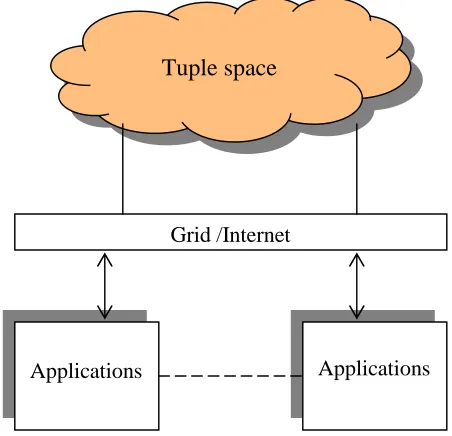
In previous chapters we have explained that grids provide a framework for developing computing platforms. Tuple space running on the grid can be used to organize the components of a grid application running on the grid. In order to use tuple space in grids, we need a tuple space that is “grid-enabled” and is accessible to the applications running on the grid. Grid-enabled tuple space should be based on grid
Applications Applications Local Area Network
Tuple space
architecture. In later section we explain our approach for developing a grid-enabled tuple space. Figure 4.2 shows tuple space on grid computing platform.
4.3 Grid enabled TS
In this section we look into requirements for a making tuple space, grid-enabled. In chapter 2 we explained various components of grids. The most important components that characterize grids are resource management and security architecture. We want tuple space to be accessible to the applications as a resource and to be expressed in terms of native resource specification of grids. We also want to secure operations on tuple space using the grid security infrastructure. Grid-enabled tuple space should adhere to resource management and security architecture of the grid.
4.3.1 Resource Management in grid-enabled Tuple space
Resource Management in grids has a resource specification language for specifying the resources that are required to perform the job. Resource brokers look
Applications Applications Grid /Internet
Tuple space
for resources based on request and schedule jobs based on resource availability. We have two options with resource management: (i) specifying tuple space as a resource, and (ii) specifying tuple space as a part of the application.
Taking the first approach, if tuple space is specified as a resource, the information should be stored in Information Infrastructure of the grid. The gateway of the grid has to expose the tuple space as a resource. Resource brokers look up information infrastructure for resource availability and status. To perform the job, the tuple space must be started and processes must have access to it.
In the second approach, an application specifies the location of the tuple space. The requirement is that the tuple space must be running in the grid domain, available as a part of grid the infrastructure. Applications can specify the mechanism to access tuple space. This approach is easier and straightforward. Resource brokers have to just schedule the jobs. Resource brokers need not control the tuple space.
In our architecture we have specified tuple space as a part of the application. This has simplified the architecture. In addition it will be easier for the local sites to control the tuple space.
4.3.2 Security in Grid-enabled Tuple space
grid must be able to access secure tuple space without any special requirements/changes.
The approach we have taken is to secure the communication socket used to access tuple space. Our secure socket framework is based on the grid security infrastructure. Grid security infrastructure is based on PKI [32] (Public Key Infrastructure). Grid security infrastructure defines a CA (Certificate Authority), which signs certificates for grid users. Grid certificates are used to authorize grid users to access resources. The grid certificates are based X.509 certificates. X.509 certificates are used to authenticate and authorize users in PKI systems.
Grids provide single sign-on, which is essential because grid computations grow and shrink dynamically. Resources availability is dynamic and some applications might run for extended period of time. It is not practical for users to interact directly with resources each time to authenticate. Grids make use of proxy, a session manager that is given permission to act on behalf of the user. Grid users can customize the lifetime of proxies as required.
Secure socket communication uses certificates from proxies to authenticate users. A basic socket is wrapped with software layer of grid to make grid-aware sockets. A secure layer is built over grid-ware sockets using grid certificates. We use these grid sockets to access tuple space.
4.4 Architecture for Tuple Space Computing on Grid
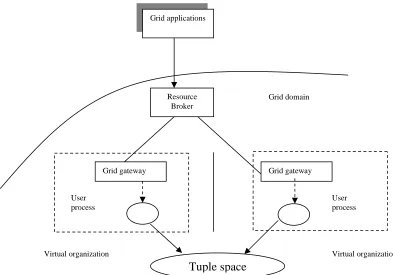
the resources are available, the job is started, and the application starts running. The processes in the application can be running anywhere on the grid domain. A grid-enabled tuple space either can be running at a well-known location on the grid or can be started by the job manager. The tuple space running on grid domain is accessible to application processes running on the grid. Processes access the tuple space using secure sockets. Grid-enabled tuple space coordinates the data exchange between the processes running in different administrative domains.
Fig 4.3 Architecture of Tuple space computing on grid
Resource Broker
Tuple space
Grid applications
Grid gateway Grid gateway
User process
User process Grid domain
Summary
Chapter 5
Implementation
In the previous chapter, we have described our approach and architecture to enable tuple space computing on grid. We have implemented a prototype of tuple space computing on the grid. In this chapter we describe the implementation details.
5. 1 Implementation Infrastructure
Grid-enabled tuple space is the integration of grid and tuple space. The essential components in building grid-enabled tuple space are a grid computing toolkit and tuple space. Grid computing toolkits provide middleware and core components for building grids. Globus, described in Chapter 2, is one of the most widely used grid computing toolkit. Gridbus, GridSim, SimGrid are some other examples [33].
In Chapter 3, we have stated tuple space basics. We have explained briefly about data types and operations on tuple space. JavaSpace and Tspaces are implementations of tuple space.
Globus is our grid computing toolkit. We have chosen the Globus Toolkit, because it is open source software, with wide acceptance in the research community, one of the first toolkits providing all the components for building grids.
For tuple space, we have used JavaSpace. JavaSpace is a specification developed specified by Sun for a Java-based object-oriented tuple space. JavaSpace has all the features of tuple space. We have chosen JavaSpace because it is open source software and is built on Java standards.
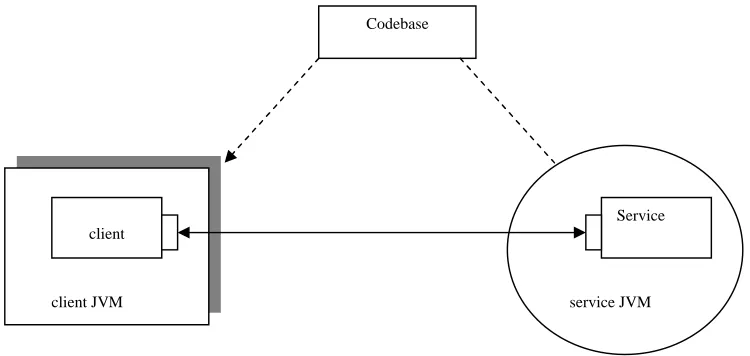
Sun’s implementation of JavaSpace is called outrigger. Its implementation is based on foundations of Java Remote Method Invocation [2] (RMI). Distributed systems that are based on RMI framework can be either client-centric or sever-centric. In client-centric approach, services are downloaded and completely run in client’s virtual machine. In server-centric approach, a proxy to the service is downloaded to the client upon request. However, proxy is not a full implementation of service. It simply provides the interface to the remote service. Server-centric can easily shared among multiple clients. Outrigger is server-centric. Figure 5.1 shows the server-centric model.
5.2 Grid Sockets
A gird-enabled tuple space uses grid sockets for all the operations on tuple space. A socket is an abstraction for network communication. Grid sockets enable communication over grid. Grid sockets are a part of grid computing toolkits.
We have secured grid sockets using the Globus security infrastructure. Secure grid
Codebase
Service client
client JVM service JVM
Grid-proxy is a session manager based on grid-certificates. Grid-proxy acts on behalf of the user. Grid-proxy is used to identify the user and has fixed lifetime. Secure sockets use grid-proxy for identifying the user. Using grid-proxy for secure sockets provides two-fold advantage: (i) grid-users can transparently and securely accesses tuple space, and (ii) it is based on grid-security infrastructure.
5.3 Grid-enabled JS
Grid-enabled JS must use grid sockets for all the operation on JS. We have stated that JS is a service, built on Jini infrastructure. Jini infrastructure provides core functionality for network communication, transaction management, persistence, and event management. There is no built-in security in Jini infrastructure. JS uses the core functions from Jini to provide key features like network accessibility, persistence, associative look-up, and transactional secure operations.
In our approach to develop grid-enabled JS, we change one core functional package, network communication of JS. We have used secure grid sockets, which enable grid/network communication. We have designed enabled JS using grid-sockets. Instead of using the network communication package from Jini infrastructure, grid-enabled JS uses grid sockets. Grid-enabled JS uses the Jini infrastructure for transaction management, persistence, and event management. Grid-enabled JS is secured, as grid-sockets are secure sockets.
JavaSpace
Jini
Java
OS
JavaSpace
Globus
Java
5.4 Tuple space Computing on Grid
Tuple space computing on grid enables us to use tuple space as the computational infrastructure for applications running on grid. We have explained in chapter 3 that JS is a Jini service. There are some pre-required processes that must be running to use JS. An http server is needed to download proxies for JS. The “rmid” daemon is required to maintain the state of JS. A lookup process is required so that clients requesting JS service can locate it. Finally a transaction manager is required to keep the track of transactions.
Grid-enabled JS running on the grid requires http server, rmid daemon, lookup service, transaction manager. All the required processes must be running on the grid domain. We have stated two approaches in chapter 4 for making tuple space accessible to grid applications. One way is to make the grid gateway start all the required processes to be able to run and use tuple space. The first approach involves starting JS multiple times. Second approach is to keep the required process running as part of grid infrastructure at a well-known/fixed location with in the grid-domain. The second approach eases the grid gateway’s responsibility for initiating JS processes. Grid applications can access JS from the well-known/fixed location within the grid domain.
We have stated earlier that JS is built on foundations of RMI. RMI framework provides registry, which acts as a centralized location for finding services. Jini lookup service provides similar functionality to the registry, but it is more robust. For tuple space computing on the grid, we can use either rmi-registry or lookup from Jini.
printers, scanner, etc) and make them accessible to grid applications/clients. Applications can also search for the lookup service. Applications can poll for the required types of services. Jini lookup would be the best choice, if the local site has more dynamic services. Jini is designed for local area networks. Jini enables dynamic network plug and play for local area networks. Jini considers all local area access are trusted and there is no built-in security mechanism in Jini.
We can use the grid gateway to expose the local site services. Grid gateway enables secure access to all the applications and clients in the grid domain. Using the grid gateway, we can transparently enable all local site services to applications in the grid domain. Grids are built over wide area networks, and by enabling Jini services to grid applications we are eliminating the restriction of Jini to local area networks.
Rmi-reigistry can be used instead of Jini lookup service for JS service. With rmi-registry, a daemon process will be running in the grid domain. Grid applications can locate the JS service by accessing a particular port on a host where rmi-registry is listening. Using rmi-registry relaxes some flexibility. Rmi-registry is more useful if services are static. Since rmi-registry does not allow dynamic registration of services, it must be restarted each time new service is added. Rmi-registry has low overhead compared to Jini lookup service. Jini lookup uses multicast and broadcast for service discovery. With rmi-registry there are no multicast and broadcast overhead.
5.5 Applications using Grid-enabled JS
In this section we explain sequence of interactions between grid applications, grid components and grid-enabled JS. Applications submit request to the resource broker. Resource broker submits the job. Globus gatekeeper authenticates and starts the job manager. Grid-enabled JS is available as a part of grid infrastructure. Job manager creates the processes and makes grid-enabled JS accessible to the applications.
5.6 Performance
We have measured the performance of our prototype implementation of grid-enabled JS. The performance results of grid-grid-enabled JS are compared with results obtained with JS.
Figure 5.3 Interaction diagram of application and grid-enabled JS
Application Resource broker
Gatekeeper Grid-enabled JS
Submit a request
Authenticate
Find service
5.6.1 Experimental Setup
The experiments were performed on single Red Hat Linux machine. The HTTP server, lookup server reggie, and the transaction manager were running on this. Globus Gatekeeper was running on the same machine. The experiments are performed logged-in as an authorized user of the grid.
We have measured performance by running programs with operations for read, write and take. The Entry we have used has a String and an Integer and the size of the entry is about 210 bytes. We have collected performance measurements with continuous write, read and take operations. We have also measured time to taken for operations on space with Entry sizes 1KB, 2KB and 4KB.
5.6.2 Analysis
Figure 5.4 shows the time taken for ten consecutive write operations for a normal JS. The average time for a write operation is 5.2 ms excluding the first operation, which is always longer. Figure 5.5 shows the time for ten write operations in the grid-enabled JS. The average time is 7.2 ms.
Figure 5.6 shows the time required for ten consecutive take operations in JS. Figure 5.7 shows the time for ten read operations in grid-enabled JS. The average time for read is 7.1 ms and 8.7 ms for JS and grid-enabled JS respectively.
The average time for write, read and take operations is more in grid-enabled JS compared to JS. The overhead is due to use grid sockets in grid-enabled JS. All the operations on grid-enabled JS are authenticated (but not encrypted, by default).
Figure 5.10 and Figure 5.11 show the time required to lookup the JS service for Jini only (e.g., a local area network) and for our combination of Globus+Jini (for a grid). Lookup is a registry that has proxies for services running in Jini. Lookup time is the time taken to locate the registry and find the JS service. The average lookup time is 703 ms for Jini. With Globus+Jini, the average time to lookup for JS service is 2322 ms. The lookup time for Globus+Jini is more than three times that for Jini. This increase is due to steps involved for submitting and starting a job on the grid. With Jini alone, the application can get the JS service from the lookup service. With Globus+Jini, the applications must submit the job; then the gatekeeper has to authenticate and start the job manager. Job manager starts the application and then find the JS service.
Figures 5.12 show the comparison of space operations with JS and grid-enabled JS. Figure 5.13 shows the comparison of lookup time between Jini and Globus+Jini. Comparisons of space operations for different Entry sizes (1KB, 2KB and 4KB) are shown in Figures 5.14, 5.15, and 5.16, respectively.
w rite - JavaSpace
0 10 20 30 40 50 T im e ( m il li s e c s ) w rite
w rite - Grid-enabled JavaSpace
read - JavaSpace 0 20 40 60 80 100
1 2 3 4 5 6 7 8 9 10
T im e ( m ill i s e c s ) read
Figure 5.6 read operation
read - Grid-enabled JavaSpace
0 20 40 60 80 100
1 2 3 4 5 6 7 8 9 10
T Im e ( m il li s e c s ) read
Figure 5.7 read operation
take - JavaSpace
0 20 40 60 80 100
1 2 3 4 5 6 7 8 9 10
T im e ( m il li s e c s ) take
Figures 5.8 take operation
take - Grid-enabled JavaSpace
0 20 40 60 80 100 120
1 2 3 4 5 6 7 8 9 10
t ake
Lookup tim e for Grid-enabled JavaSpace 0 1000 2000 3000 4000
1 2 3 4 5 6 7 8 9 10
Lookup t ime
Figures 5.11 Lookup time
Lookup tim e for JavaSpace
550 600 650 700 750 800
1 2 3 4 5 6 7 8 9 10
Lookup t ime
Figure 5.10 Lookup time
Com parison of Space Operations
0 2 4 6 8 10
1 2 3
wr i t e r e a d t a k e 4 1 % 2 2 % 2 3 %
JavaSpace
Gr id-enabled JavaSpace
Figure 5.12 Space operations comparison
Com parison of Average Lookup tim e
0 500 1000 1500 2000 2500 1 JavaSpace Grid-enbaled JavaSpace
Com parison of Space Operations (1 KB Entry) 0 2 4 6 8
1 2 3
wr i t e r e a d t a k e
T im e ( m ill i s e c s ) JavaSpace Gr id-enabled JavaSpace
Figure 5.14 Space operations on 1 KB Entry
Com parison of Space Operation (2KB Entry) 0 2 4 6 8
1 2 3
wr i t e r e a d t a k e
T im e ( m ill i s e c s ) JavaSpace Gr id-enabled JavaSpace
Figure 5.15 Space operations on 2KB Entry
Com parison of SPace Operations (4KB Entry) 0 2 4 6 8
1 2 3
wr i t e r e a d t a k e
T im e ( m ill i s e c s ) JavaSpace Gr id-enabled JavaSpace
Summary
Chapter 6
Conclusion and Future Work
6.1 Conclusion
Grid computing is distinguished from conventional distributed computing by its focus on dynamic resource sharing. We have studied about grids and their computing environment.
This thesis proposed tuple space computing on the grid. We have described how tuple spaces can be leveraged in the context of grids. The most important contribution is the integration of tuple space and the grid. We believe that ideas of tuple space are interesting in distributed computing environment. Tuple space enables decoupling of processes and is best suited for dynamic environments like the grid. Tuple space provides a shared address space across global network. We have developed a prototype grid-enabled tuple space that is accessible to grid applications, and space-based application patterns can be used for developing grid applications.
The next-generation grids are evolving to a service-oriented architecture, based on Java and xml. This enables grids to move to the next step in their evolution, acceptance in enterprises. The prototype design and implementation of tuple space, based on Java/Jini technology supports the service-oriented architecture.
6.2 Future Work
The prototype implemented a single tuple space operating in a grid domain. There can be multiple replicated tuple spaces so that the model is more fault-tolerant and reliable. There can be federation of tuple spaces working in multiple administrative domains. Tuple space can be a good choice for Information Infrastructure of grid and event notification can be used for resource brokers waiting for specific resources. Resource brokers can use tuple space as information distribution framework and co-operate in job submission. Load-balancing resource brokers can be built with tuple spaces.
References
[1] CORBA: Common Object Request Broker Architecture, http://www.corba.org.
[2] RMI: Remote Method Invocation Specification, http://www.java.sun.com/products/jdk/rmi.
[3] MPI: Message Passing Interface, http://www.mcs.anl.gov/mpi.
[4] S. Ahuja, N. Carriero, and D. Gelernter. Linda and Friends. IEEE Computer, pp-26-34, August 1986. [5] I. Foster, C. Kesselman, ed. The Grid : Blueprint for a New Computing Infrastructure. Morgan Kaufman 1999.
[6] I. Foster, C. Kesselman, G. Tsudik, S. Tuecke. The Anatomy of the Grid: Enabling Scalable Virtual Organizations. International J.Supercomputer Applications, Vol 15, no 3, 2001.
[7] K. Czajkowski, I. Foster, N. Karonis, C. Kesselman, S. Martin, W. Smith, S. Tuecke. A Resource Management Architecture for Metacomputing Systems. Proc. IPPS/SPDP '98 Workshop on Job Scheduling Strategies for Parallel Processing, pp. 62-82,1998.
[8] K. Czajkowski, I. Foster, and C. Kesselman. Resource Co-Allocation in Computational Grids.
Proceedings of the Eighth IEEE International Symposium on High Performance Distributed Computing (HPDC-8), pp. 219-228, 1999.
[9] M. Litzkow, M. Livny and M. Mutka. Condor-A Hunter of Idle Workstations. Proc. 8th International Conference on Distributed Computing Systems, pp 104-111, 1988.
[10] International Business Machines Corporation, Kingston, NY. IBM Load Leveler: User's Guide, September 1993.
[11] S. Zhou. LSF: Load sharing in large-scale heterogeneous distributed systems. Proc. Workshop on Cluster Computing, 1992.
[12] Cray Research, Document Number IN-2153 2/97, 1997.
[13] I. Foster, C. Kesselman, G. Tsudik, S. Tuecke. A Security Architecture for Computational Grids.
Proc. 5th ACM Conference on Computer and Communications Security, pp.83-92, 1998.
[14]K. Czajkowski, S. Fitzgerald, I.Foster, C.kesselman. Grid Information Services for Distributed Resource Sharing. Proceedings of the Tenth IEEE Symposium on High-Performance Distributed Coputing (HPDC-10), August 2001.
[15] B. Allock, J. Bester, J. Bresnahan, A.L. Chervenak, I. Foster, C. Kesselman, S.Meder, V.Nefedova, D. Quesnal, S. Tuecke. Data Management and Transfer in High Performance Computational Grid Environment. Parallel Computing, Vol 28 , no 5, pp 749-771, May 2002.
[16] I. Foster, C. Kesselman, ed. The Globus Project: A Status Report. Proc IPPS/SPDP ’98 Heterogenous Computing Workshop, pp. 4-18, 1998.
[17] K. Hickman and T. Elgamal. The SSL protocol. Internet draft, Netscape Communications Corp, June 1995
[18] I. Foster, N. Karonis. A Grid-Enabled MPI: Message Passing in Heterogeneous Distributed Computing Systems. Proc. 1998 SC Conference, November 1998.
[19] RPC: Remote Procedure Call, http://www.cs.cf.ac.uk/Dave/C/node33.html.
[20] H. Nakada, S. Matsuoka, K. Seymour, J. Dongarra, C. Lee and H. Casanova. Overview of GridRPC: A Remote Procedure Call API for Grid Computing. 3rd International Workshop on Grid Computing,
LCNS, Vol 2536, pp. 274-278, November 2002.
[21] P. Keleher, et al. TreadMarks: Distributed Shared Memory on Standard Workstations and operating Systems. USENIX Winter 1994 Conference, pp. 115-132, 1994.
[23] D. Gelernter and N. Carriero. Coordination languages and their significance. Communications of the ACM, vol 35, no.2 pp 97-107, February 1992.
[24] Sun Microsystems. JavaSpaces Specification Revision 1.0, 1999.
[25] E. Freeman, S. Hupfer, and K. Arnold. Java Spaces: Principles, Patterns, and Practice, Addison-Wesley, Massachusetts, 1999.
[26] K.Arnold, B.O’Sullivan, R.Scheifler, J.Waldo and A. Wollrath. The Jini Specification. Addison-Wesley, 1999.
[27] W. Edwards. Core Jini. Prentice Hall, 2001.
[28] Sun Microsystems. Jini Architecture Specification, 1999.
[29] Sun Microsystems. Jini Lookup Service Specification, 1999.
[30] Sun Microsystems. Jini Discovery and Join Specification, 1999.
[31] T. Lehman et al. Hitting the distributed computing sweet spot with Tspaces. Computer Networks,
Vol 32, pp 457-472, 2001.
[32] PKI: Public Key Infrastructure, http://www.ietf.org/html.charters/pkix-charter.html.
[33]http://ww.buyya.com.
[34] I. Foster, C. Kesselman, J. Nick, S. Tuecke. The Physiology of the Grid: An Open Grid Service Architecture for Distributed Systems Integration. Open Grid Service Infrastructure WG, Global Grid Forum, June 22, 2002.
[35] S. Tuecke, K. Czakkowski, I. Foster, J. Frey, S. Graham, C. Kesselman. Grid Service Specifcation.
Open Grid Service Infrastructure WG, Global Grid Forum, Draft 2, July 17, 2002.