CLARK, MATTHEW RANDALL. Using Numerical Comparison Problems to Promote Middle-School Students’ Understanding of Ratio as an Intensive Quantity. (Under the direction of Sarah B. Berenson and Eric N. Wiebe.)
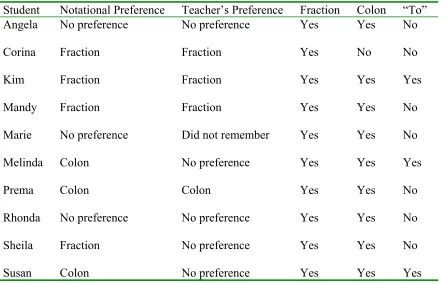
The purpose of this qualitative study is to investigate middle-school students’ understanding of their notation for ratios and to determine, through semi-structured task-based interviews, possibilities for using numerical comparison problems to promote their growth in understanding. The issue of concern is that students use fractional
representations of ratios as a convenient notation for solving missing-value problems, but when they use this notation to solve numerical comparison problems, they are unable to interpret and compare the ratios as intensive quantities.
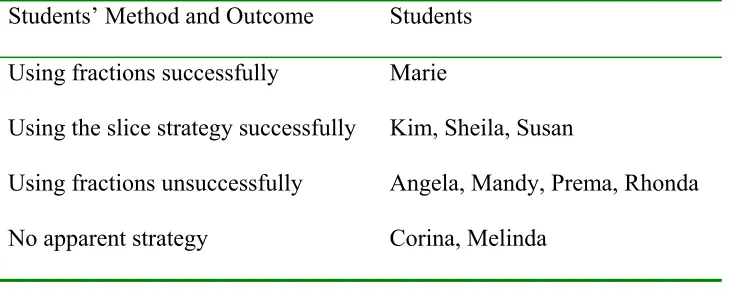
Patterns are reported for students’ notation, their problem-solving strategies, their expressions of extensive and intensive quantities, and their use of contextual elements from the problem. A model of ratios and fractions based on Venn diagrams and a general model of ratios and other number-type domains provide the framework for charting students’ activities and explanations.
INTENSIVE QUANTITY
by
MATTHEW RANDALL CLARK
A dissertation submitted to the Graduate Faculty of North Carolina State University
in partial fulfillment of the requirements for the Degree of
Doctor of Philosophy
MATHEMATICS EDUCATION
Raleigh 2003
APPROVED BY:
___________________________ ___________________________
BIOGRAPHY
Matthew Randall Clark, son of C. Randall and Margaret Clark, was born on January 4, 1968, in Atlanta, Georgia, and spent most of his early childhood growing up in Oxford, Mississippi, where his father attended graduate school at the University of
Mississippi. In 1973, Matthew’s father accepted a faculty position at Auburn University and the family moved to Auburn, Alabama. Matthew attended mostly private schools in Auburn until transferring to Auburn Junior High School before the eighth grade.
After graduating from Auburn High School in 1985, Matthew attended Clemson University and earned his B.A. degree in Mathematical Sciences with a social-science minor composed of courses in psychology and economics. In September 1988, he moved to New York City to attend graduate school at Columbia University and later earned his M.S. degree from Columbia in Biostatistics.
In February 1990, Matthew moved to Raleigh and began working as a statistical documentation writer at SAS Institute, where he worked until May 1997. In the summer of 1991, he bought a house in Cary, where he still lives. After doing some freelance work and taking some time off to pursue other interests, Matthew applied in the fall of 1999 to the Ph.D. program in Mathematics Education at North Carolina State University. In January 2000, Matthew began his coursework at N.C. State and his research assistantship at the Center for Research in Mathematics and Science Education.
ACKNOWLEDGMENTS
First, I would like to thank my parents for always emphasizing education and for their encouragement during the years since I returned to graduate school.
I would like to thank the members of my Ph.D. committee—Sarah Berenson, Eric Wiebe, Ernie Stitzinger, and Hollylynne Stohl—for their advice and helpful comments throughout the dissertation process. Dr. Stitzinger was very generous in volunteering to join the committee, Dr. Stohl has consistently provided a boost to my confidence and motivation over the years with her positive comments, and Dr. Wiebe, who served as co-chair, provided helpful review comments on drafts of my first three chapters. In addition to her guidance throughout my years at N.C. State, I would like to thank my advisor, Dr. Berenson, for giving me the opportunity to pursue my Ph.D. in Mathematics Education and for getting me involved with the math-education research community, which has been critical in preparing me to enter my new career.
I also want to thank the students who participated in this study and their parents, many of whom invited me into their homes to conduct an interview. The Girls on Track program in 2002, from which the students were selected for this study, was supported by a grant from the Dwight D. Eisenhower Professional Development Program. Earlier work that led up to this study was based on previous years of Girls on Track data and
TABLE OF CONTENTS
Page
LIST OF TABLES . . . . vii
LIST OF FIGURES . . . viii
INTRODUCTION . . . 1
The Research Domain . . . 2
Multiplicative Conceptual Field . . . 2
Proportional Reasoning . . . 3
Ratios . . . 5
Classifications . . . . 7
Conceptual Versus Procedural Understanding . . . 7
Additive Versus Multiplicative Reasoning . . . 8
Internal Versus External Representations . . . 9
Extensive Versus Intensive Quantities . . . 9
The Research Focus . . . 11
The Mathematical Problems . . . 11
The Research Questions . . . 12
LITERATURE REVIEW . . . 14
Conceptual Framework . . . 14
The Emergent Perspective . . . 15
Categories of Reasoning about Ratio and Proportion Problems . . 17
The Overlapping Model of Ratios and Fractions . . . 19
Multiplicative Conceptual Field . . . 29
Learning with Understanding and Meaningful Learning . . . 30
Recent Research on Teaching MCF Topics . . . 32
Proportional Reasoning . . . 34
Ratios and Fractions . . . 38
METHODOLOGY . . . 40
Participants . . . 42
Phase 1: Written Assessment (June 20, 2002) . . . 44
The Gum Problem . . . 44
The Coffee Problem . . . 45
The Pizza Problem . . . 45
The Orange-Juice Problems . . . 46
Phase 2: Teaching Session (June 24-28, 2002) . . . 46
The Coin Problem . . . . 48
Phase 3: Follow-Up Interview (July 31-August 16, 2002) . . . . 48
The Cookie Problem . . . . 49
The Sidewalk Problem . . . . 49
The Fertilizer Problem . . . . 50
Data Analysis . . . . 50
Summary . . . . 51
RESULTS . . . . 52
Ratios . . . . 53
Written Representations of Ratios . . . . 55
Examples of Ratios . . . . 56
The Relationship Between Ratios and Fractions . . . . 56
The Pizza Problem . . . . 58
Emerging Theme: Mixed Fractions and Decimal Expressions as Ratios . . . . 61
Emerging Theme: Role of Manipulatives . . . . 61
Confirming Evidence: Decontextualization of Ratios . . . . 65
Interfering Factor: Slices as Unit . . . . 67
Interfering Factor: Indivisibility of Discrete Variables . . . . 68
Interfering Factor: Attempts to Solve for a Missing Value . . . . . 69
The Coin Problem . . . . 71
Emerging Theme: Mimicking the Language of Intensive Quantities . . . . 72
Interfering Factor: Variable of Conversion . . . 76
The Orange-Juice Problems . . . 77
Notation for Ratios . . . 78
Emerging Theme: Mixed Fractions as Ratios . . . 79
Emerging Theme: Decimal Expressions as Ratios . . . 84
Interfering Factor: Part-Part Versus Part-Whole Representations . . . 85
The Cookie Problem . . . 87
The Sidewalk Problem . . . 92
Emerging Theme: Common Reference Value for Comparing . . . . 93
Confirming Evidence: Decontextualization . . . 95
Interfering Factor: Fence Versus Fenceposts . . . . 100
The Fertilizer Problem . . . . 101
Emerging Theme: Common Reference Value for Comparison . . . 102
Emerging Theme: Mixed Fractions as Ratios . . . 103
Emerging Theme: Decimal Expressions as Ratios . . . 106
Confirming Evidence: Well-Chunked Measures . . . 111
Interfering Factor: Attempts to Solve for a Missing Value . . . 115
Interfering Factor: Improper Fractions . . . 116
Overall Patterns . . . 117
Levels of Proportional Reasoning . . . 120
Interpretations and Expressions for Forms of Ratios . . . 121
The Role of Manipulatives . . . 121
Multiplicative Conceptual Field . . . 122
Knowledge Transfer Across Problems . . . 123
CONCLUSIONS AND RECOMMENDATIONS . . . 124
Responses to Research Questions . . . 125
Understanding of Ratios . . . 126
Characteristics of the Problems . . . 127
Strategies for Solving Problems . . . 129
Growth in Making Connections . . . 129
Conjectures . . . 131
Levels of Quantitative Reasoning . . . 131
Decontextualization . . . . 133
Hierarchy of Representations . . . . 134
Extended Paths in the Overlapping Model . . . . 137
General Comments . . . . . . . 139
Limitations of the Study . . . . 139
Comments About the Problems in the Study . . . . 140
Comments About the Students . . . . 143
Recommendations . . . . 145
Recommendations for Further Research . . . . 145
Recommendations for Instruction . . . . 147
REFERENCES . . . . 152
LIST OF TABLES
Page
Table 1 Strategies for Solving Ratio and Proportion Problems . . . . 18
Table 2 Participants by Groups Based on Test Scores . . . 43
Table 3 Students’ Use of Notation for Ratios . . . 55
Table 4 Summary of Participants’ Work on the Pizza Problem . . . 59
Table 5 Summary of Participants’ Performance on the Orange-Juice Problems . . . 79
Table 6 Comparison of Strategies on Missing-Value Problems . . . 88
Table 7 Summary of Participants’ Strategies on the Sidewalk Problem . . . 93
Table 8 Summary of Participants’ Work on the Fertilizer Problem . . . 102
Table 9 Overall Characteristics of Student Behavior . . . 118
LIST OF FIGURES
Page
Figure 1 Ratios as a Subset of Fractions . . . . 19
Figure 2 Fractions as a Subset of Ratios . . . . 20
Figure 3 Ratios and Fractions as Distinct Sets . . . . . 21
Figure 4 Ratios and Fractions as Overlapping Sets . . . . 22
Figure 5 Ratios and Fractions as Identical Sets . . . . 22
Figure 6 Subconstructs Within the Overlapping Model . . . . 25
Figure 7 The Overlapping Model with Alternative Number-Type Domains . . . 27
Figure 8 Path of Decontextualization Across Model 4 . . . 28
Figure 9 Marie’s Path to Solving the Pizza Problem . . . . 60
Figure 10 Kelly’s Crossmultiplication Method . . . . 65
Figure 11 The Coin Arrangement and Pencil Placement . . . . 72
Figure 12 Corina’s Matching Strategy to Compute the Ratio . . . . 82
Figure 13 Kim’s Extended Sidewalk and Crossmultiplication . . . . 94
Figure 14 A Comparison of Sheila’s and Susan’s Paths for the Sidewalk Problem . . . . 98
Figure 15 Corina’s Mixed Fractions Within a Unit Rate . . . 104
Figure 16 Generalized Overlapping Model for Ratio Representations Used in This Study . . . 135
Figure 17 Paths Within the Overlapping Model . . . 137
Figure 18 Solution to the Sidewalk Problem with Colon Notation and a Common Reference Value . . . 150
INTRODUCTION
Evidence from international studies suggests that although students in the United
States perform well in mathematics through the fourth grade, their performance by the
eighth grade slips to below the international average (Sowder et al., 1998). In the
intervening middle grades, rational-number concepts and operations are the dominant
topics in mathematics courses (Conference Board of the Mathematical Sciences [CBMS],
2001, chap. 8). As Confrey (1998) stated, by “not mastering the concepts of fractions,
ratio and proportion, decimals, and percents, many students are at risk in an ‘algebra for
all’ middle school movement of becoming part of the failure statistics” (p. 39).
A major concern of researchers who focus on middle-school mathematics
education is that students’ understanding is often too syntactical in nature and limited in
terms of the underlying concepts (Case, 1988). A suspected cause is that students are
taught formal notations and strategies before they have sufficient opportunity to construct
a conceptual foundation for using them (Cramer et al., 1993; Kaput & West, 1994; Lo &
Watanabe, 1997). One notation that students learn in middle school is writing ratios as
fractions, and fractional notation for ratios is most often presented in textbooks as the
preferred notation (Clark, Berenson, & Cavey, in press). However, Clark and Berenson
(2002) found that at least on a particular problem, of a type that Lamon (1993) refers to
as an associated-sets problem, middle-school students who used non-fractional notation
performed significantly better than those who used fractional notation.
The research topic for this study is the nature of middle-school students’
of ratios, and how they use this notation in their problem-solving activities. The
instructional goal is helping students develop an understanding of fractional
representations of ratios and a flexibility with these representations that enables them to
solve a variety of unfamiliar problems.
The Research Domain
In this section, I identify the overall context of the mathematical subject matter by
beginning with multiplication-related topics and narrowing the focus to proportional
reasoning and then to ratios.
Multiplicative Conceptual Field
Vergnaud (1994) rejected the notion that reasoning related to ratios, fractions,
multiplication, division, and proportions could be condensed into a framework based on
information processing or linguistics. Instead, he offered the theory of conceptual fields,
emphasizing knowledge acquisition as dependent on situations and problems and
stressing the “local features” (p. 42) of that acquired knowledge. The multiplicative
conceptual field (MCF), according to Vergnaud (pp. 57-58), comprises a set, or “bulk,”
of situations for which a student uses multiplication, division, or a combination of the
two; a set of schemes, which he defines as “invariant organizations of behavior for
well-defined classes of problems,” that students use in these situations; a set of concepts and
theorems that students use to plan and analyze their activity; and a set of formulations
and symbolizations.
The practical implication of this theory is that researchers and teachers have to
new competencies and conceptions related to MCF topics and the long-term development
of a foundation for future learning (Vergnaud, 1988). Researchers who use an
MCF-based framework recommend that instruction be oriented to giving students the
opportunity to develop concepts for MCF topics “not in isolation but in concert with each
other over long periods of time through experience with a large number of situations” (Lo
& Watanabe, 1997, p. 217). Vergnaud’s ideas apply to my proposed study because, even
though my focus is on students’ understanding of ratios and fractional representations of
ratios, their understanding of multiplication, division, and decimals can facilitate or
inhibit their progress at interpreting fractional representations of ratios.
Multiplicative reasoning, according to Singh (2000), is the “entry point to the
world of ratio and proportion” (p. 273). It is this world of ratio and proportion where I
focus my attention for the proposed study.
Proportional Reasoning
Proportional reasoning, “at the heart of middle grades mathematics” (Ben-Chaim,
Fey, Fitzgerald, Benedetto, & Miller, 1998, p. 249), is a type of reasoning that students
should develop in the fifth through eighth grades (CBMS, 2001; National Council of
Teachers of Mathematics [NCTM], 2000). Proportional reasoning, as defined by Karplus,
Pulos, and Stage (1983), is “reasoning in a system of two variables between which there
exists a linear functional relationship” (p. 219). Its pivotal role in middle school was
highlighted by Lesh, Post, and Behr (1988) in an often-quoted passage in which they
called proportional reasoning the “capstone” of elementary-school arithmetic and the
As Tourniaire and Pulos reported in 1985, proportional reasoning became the
subject of intense research efforts after Inhelder and Piaget (1958) theorized that
proportional reasoning is a distinguishing feature of the formal operational stage of
development. Since the Tourniaire and Pulos summary of research to date, proportional
reasoning has remained a research emphasis due to the continuing problems that
middle-school and even high-middle-school students have with ratio and proportion (Carraher, 1996;
CBMS, 2001; Sowder et al., 1998). According to Post, Cramer, Behr, Lesh, and Harel
(1993), one major problem with instruction on proportions is that the crossmultiplication
algorithm is taught too soon and as a result drives a wedge between operations and
mathematical meaning. However, researchers (Ben-Chaim et al., 1998; Lamon, 1993,
2001; Singh, 2000) have demonstrated that middle-school students can develop
mathematical meaning for ratio and proportion given appropriate instruction and time.
Clark et al. (in press) found that middle-school textbooks are remarkably similar
in presenting fractions as the preferred notation for ratios, a convenient notation for
applying the crossmultiplication algorithm to missing-value problems. But what is the
nature of students’ understanding of this notation? Von Glasersfeld’s (1996) remarks
seem appropriate for this topic: “In school…mathematical symbols are often treated as
though they were self-sufficient and no concepts and mental operations had to
accompany them” (p. 312). He concludes, “When students are only trained to manipulate
marks on paper, it is small wonder that few of them ever come to understand the meaning
of what they are doing and why they should do it.” Investigating middle-school students’
(2002) found that those who represented the ratios as fractions were not as successful as
those who did not.
Ratios
Thompson (1994) defines ratio as “the result of comparing two quantities
multiplicatively” (p. 190). It is this definition that best matches my broad use of the term
for this study. A ratio, according to Thompson, can be a multiplicative comparison of two
complete collections of objects or can be a comparison of one of the quantities in terms of
one item of the other collection, what is often called a unit rate. He points out that
although many attempts to distinguish rate and ratio as terms seem to be valid, there is
no conventional distinction between these terms, and he argues that the inconsistencies in
terminology, both in the classroom and in the mathematics-education research literature,
have created a great deal of confusion. Often the distinction between the terms is based
on the nature of or the relationship between the units of the quantities in the ratio, but
Thompson emphasizes the mental operations, which are the same regardless of the
measure spaces, and concludes that a precise classification scheme is not important. In
this study, I use “ratio” to refer to a wide variety of multiplicative relationships and avoid
using “rate” as a stand-alone term; however, I do use “unit rate” because it refers to a
specific form of a ratio that is associated with a problem-solving strategy.
Rejecting the common curricular sequence of the four basic operations followed
by fractions followed by ratio and proportion, many researchers (Confrey, 1994; Kaput &
West, 1994; Lo & Watanabe, 1995) recommend that initial instruction in ratio and
proportion, with a basis in students’ informal strategies, begin as early as the third grade.
their understanding of ratios, given an appropriate activity. According to Lo and
Watanabe (1997), “If the goal for teaching ratio and proportion is more than introducing
the cross-multiplication algorithm, we do not see any reason to wait to introduce ratios
and proportions until after instruction on fractions, as is typically done” (p. 234).
A glaring omission in middle-school mathematics is the lack of opportunity for
students to build connections between ratios and fractions (Carraher, 1996; Sowder et al.,
1998). A conjecture by Clark et al. (in press) is that an in-depth understanding of
fractional representations of ratios depends on a conceptual convergence of ratio and
fraction to form this connection, which seems unlikely if fractions are treated as a
prerequisite topic and instruction in ratio is based entirely on fractional notation. Kaput
and West’s (1994) conclusion expresses the need for further research on students’
understanding of ratios:
The rush to put formal computational tools in students’ hands before they
understand their quantitative foundations is one major factor in the widespread
incompetence and alienation from mathematics among students across the nation.
Although the tradition of teaching ratio reasoning in the formal style is very
long-lived, we should not assume that it should be venerated, or continued. The
preponderance of data indicates that it does not work and may in fact do actual
harm. (pp. 284-285)
The purpose of the proposed study is to examine students’ understanding of ratio
as they are about to begin Algebra I, after they have experienced classroom instruction in
ratio and proportion and at a time when they need a sufficient understanding of linear
(NCTM, 2000). Students’ understanding of ratio will serve as the foundation for learning
about rate of change and linear equations in Algebra I (NCTM). Many researchers (Kaput
& West, 1994; Lamon, 1993; Singh, 2000) examined sixth graders’ understanding of
ratio and proportion at the time in school when students are traditionally introduced to
these topics, but as research suggests, the present curriculum is failing at teaching
ratio-related concepts to middle-school students (Sowder et al., 1998). Gathering more
information from seventh and eighth graders could help researchers and teachers learn
more about what students need in earlier grades to develop a deeper understanding of
ratios.
Classifications
In this section I define and contrast pairs of terms that I use throughout the
dissertation.
Conceptual Versus Procedural Understanding
Using Stieg Mellin-Olson’s terms, Skemp (1976) distinguished instrumental
understanding, knowing “rules without reason” (p. 20), and relational understanding, which includes understanding why something is done. A similar classification is that of
Hiebert and Lefevre (1986), who defined conceptual knowledge as a web of knowledge
“rich in relationships” (p. 3), or what Eisenhart et al. (1993) call knowledge about
underlying mathematical structures, and procedural knowledge as the knowledge about
the language, symbols, and algorithms. Hiebert and Lefevre created two distinct
subcategories of procedural knowledge—knowledge of the formal language and symbols
tasks. A major problem with middle-school students’ mathematical knowledge, according
to Wearne and Hiebert (1988), is that it “appears to be more procedural than conceptual,
procedural in the sense that the syntax of the system, rather than the underlying concepts,
guides students’ responses” (p. 220).
However, as Silver (1986) argued, the primary focus in mathematics education
should be on the complex interactions between elements of conceptual and procedural
knowledge, not simply on the classifications of such knowledge. The relationship
between the development of conceptual and procedural knowledge continues to be a
major research focus in mathematics education (Rittle-Johnson, Kalchman, Czarnocha, &
Baker, 2002). One aspect of the proposed study is to research the use of a particular
problem type in promoting the conceptual understanding of ratios in fractional form and
promoting students’ connecting of the concepts to procedures they have previously
learned.
Additive Versus Multiplicative Reasoning
Progression from a reliance solely on additive strategies to the ability to
discriminate between situations for which an additive strategy is appropriate and those for
which a multiplicative strategy is appropriate is a “hallmark” (CBMS, 2001) of students’
development in fifth through eighth grades. Because a common problem is that students
use additive reasoning in situations that require multiplicative reasoning, experts (Lamon,
1993; Sowder et al., 1998) suggest that teachers design activities that create conflict
between students’ additive and multiplicative strategies in an attempt to promote the
transition from using only additive reasoning to using both appropriately. An example of
problem that the students in this study answered on their test (see Problem 9 in the
Appendix).
Many researchers (Clark & Kamii, 1996; Confrey, 1994; Schwartz, 1988; Steffe,
1994) warn against the heavy emphasis of teaching multiplication based on the idea of
repeated addition. According to Confrey, models of repeated addition do not adequately
represent certain actions of children and therefore may be inconsistent with their informal
knowledge related to MCF concepts.
Internal Versus External Representations
When I discuss fractions as representations of ratios I am referring to external
representations, specifically the way that students represent ratios in written form.
However, internal representations—how students represent ratios mentally—although not
directly observable, is an even more important issue in the proposed study because of its
impact on students’ problem-solving abilities and strategies. As Hiebert and Carpenter
(1992) assume, there is a relationship between students’ internal and external
representations and those internal relationships can be connected in useful ways that help
students reason about problems. In addition, they assume that “the nature of external
mathematical relationships influences the nature of internal mathematical relationships”
and conversely that “the way in which a student deals with or generates an external
representation reveals something of how the student has represented that information
internally” (p. 66).
Extensive Versus Intensive Quantities
An intensive quantity, according to Schwartz (1988), is a “generalization of the
expressed with “per,” that does not depend directly on a simple measurement or count—
what Schwartz calls an extensive quantity. As Singh (2000) described them, intensive
quantities are not usually measures or counts but are “generated through the act of
division” (p. 275). Schwartz gives the example of 5 fish as an extensive quantity and “5
fish for every 2 bicycles” (p. 44) as an intensive quantity. He stated that intensive
quantities can be difficult for students to represent because the intensive quantity is
invariant while the related extensive quantities are unspecified.
Schwartz (1988) explained the pedagogical challenge inherent in situations that
involve an intensive quantity: As students multiply or divide they generate new quantities
whose referent is different than those of the two original quantities. Using the intensive
quantity of five pieces of candy per bag and the extensive quantity of six bags, for
example, a student can multiply to obtain a product of 30 but must realize that the 30 now
refers to pieces of candy, a different unit than those associated with the two numbers that
the student multiplied. As Schwartz stated, “Multiplication and division are referent
transforming compositions of quantity, and addition and subtraction are referent
preserving” (pp. 47-48). He argued that teaching multiplication and division as repeated
addition and subtraction, respectively, is a flawed strategy because it ignores this feature
of multiplication and division—that they are referent transforming, not referent
preserving.
One topic of interest in this study is whether students are able to construct the
appropriate composite unit when computing, interpreting, and comparing intensive
quantities. For example, when given a number of hours that it took a worker to fertilize a
to distinguish between hours per acre and acres per hour? I use the term composite unit to
refer to the unit of an intensive quantity formed by the ratio relationship of two extensive
quantities and the term label to refer to students’ written expression of units, both for
intensive and extensive quantities. My use of “composite unit” should not be confused
with Steffe’s (1994) use of this term by which he refers to a number composed of other
numbers that a child can use as a unit without reconstructing it.
The Research Focus
In this section, I introduce the problem type that I have used in my research and
list my research questions for the dissertation.
The Mathematical Problems
Within semi-structured one-on-one interviews with middle-school students, the
teaching technique is primarily a problem-solving approach (Polya, 1948), which was
recommended by Behr, Harel, Post, and Lesh (1992) to give students an “experiential
base for internalizing the unit-conversion principles they will apply to the concepts of
fraction, rational number, rate ratio, and proportion” (p. 306). Advances in problem
solving are characterized by an “increase in flexibility” (Carpenter, 1986, p. 115), made
possible by a stronger conceptual base, more efficient procedures, and the connections
between conceptual and procedural knowledge. By presenting a series of problems to the
students, I hope to encourage such an increase in flexibility as they interpret their
notation, make connections between ratios and fractions, and revise their procedures.
Numerical comparison problems (Ben-Chaim et al., 1998) are problems for which
question, the student must compare those ratios, working with numerical values to make
the comparison but without having to give a numerical answer. For example, the problem
could specify the times and distances for two sprinters and ask which ran faster.
Providing various contexts for such problems is important because seventh and eighth
graders tend to use different reasoning processes to compare ratios in a word problem
than they do when comparing fractions in no particular context (Heller, Post, Behr, &
Lesh, 1990).
According to Cobb, Yackel, and Wood (1995), “A situation in which a student’s
current computational procedures prove inadequate can give rise to a problem, the
resolution of which involves the construction of conceptual knowledge” (p. 18). On this
basis, I chose numerical comparison problems as the focus of activity for the students in
the study for two reasons: because in previous articles (Clark & Berenson, 2002; Clark et
al., in press) I have explored and documented the inadequacy of students’ procedural
knowledge and operations for solving this type of problem, and because the instructional
goal embedded in the proposed study is to promote the conceptual understanding of ratio
as an intensive quantity.
The Research Questions
In the proposed study, my goal is, through the interview and data-analysis
process, to better understand the students’ understanding (Hunting, 1997) of ratios and to
describe their learning experiences. Hiebert and Lefevre (1986) define a special type of
conceptual knowledge that students develop through the “linking process…between two
pieces of information that already have been stored in memory” (p. 4). I refer to this as a
understanding and supports a broader understanding of concepts previously learned. In
this case, the new understanding is of fractional representations of ratios, which requires
a connection between the concepts of ratio and fraction.
Specifically, my research questions are as follows:
1. What is the nature of students’ understanding of ratios, especially fractional
representations of ratios, and what meaning, if any, do they associate with ratios
in this form?
2. What characteristics of the numerical comparison problems—for example,
whether variables are discrete or continuous and whether the smaller or larger
number in a ratio is given first—influence students’ notation, their strategy, and
their likelihood of success?
3. Are students able to compute intensive quantities and construct the appropriate
composite unit, and if they are not able to compare ratios based on intensive
quantities, what strategies do students use to solve numerical comparison
problems?
4. How do students grow in their understanding of ratios and intensive quantities
during the problem-solving sessions, and are students successful at
retroconnective learning, making connections between ratios and fractions to
develop an understanding of ratio as an intensive quantity?
LITERATURE REVIEW
In this chapter, I provide a review of the literature, first in the context of stating
my conceptual framework for this study and then for various MCF-related topics that are
related to it.
Conceptual Framework
A “skeletal structure of justification,” according to Eisenhart (1991), a conceptual
framework enables a researcher to blend ideas from many sources in stating the
underlying assumptions for a study. She argues that conceptual frameworks are better
suited than other types of frameworks, such as theoretical and practical frameworks, for
educational research because researchers can focus on relevant aspects of a theory for a
particular study and because a conceptual framework is less likely to bind them to a path
that produces a theory-driven conclusion.
I have developed a conceptual framework for my proposed study, and in this
section, I explain the following components and how they fit together to support my
research:
the emergent perspective (Cobb & Yackel, 1996)
Lamon’s (1993) classification scheme for proportional reasoning
The Emergent Perspective
According to Wood, Cobb, and Yackel (1995), “It is useful to see mathematics as
both cognitive activity constrained by social and cultural processes and a sociocultural
phenomenon that is constituted by a community of actively cognizing individuals” (p.
402). This point of view, which blends elements of psychological constructivism with
elements of sociocultural theories, is often referred to as social constructivism, or the
emergent perspective (Cobb & Yackel, 1996). From this perspective, mathematical meaning emerges from individual interpretation and taken-as-shared meaning.
In the framework of the emergent perspective, three pairs of categories are
reflexively linked across the social and psychological dimensions. Classroom social
norms enable and constrain how individuals change their beliefs about their role, others’
roles, and the nature of mathematical activity in the classroom, which, in turn, contributes
to the evolving social norms of the classroom (Cobb, 2000). Sociomathematical norms,
or a “criteria of values with regard to mathematical activities” (Voight, 1995), contribute
to the classroom culture in which individual learning takes place and enable and constrain
students’ changing mathematical beliefs and values, which, in turn, contribute to the
evolving sociomathematical norms. Cobb gives what counts as an insightful solution,
what characteristics are required for a solution to be considered different from another,
and what counts as an acceptable mathematical explanation as examples of
sociomathematical norms.
The third pair of categories—classroom mathematical practices, in the social
dimension, and the individual’s mathematical conceptions, in the psychological
practices are the communal aspect of the classroom that corresponds to individual’s
mathematical conceptions and activity (Cobb & Yackel, 1996). Explaining the reflexive
relationship between the individual and communal, Cobb and Yackel stated, “Students
actively contribute to the evolution of classroom mathematical practices as they
reorganize their individual mathematical activities and, conversely, that these
reorganizations are enabled and constrained by the students’ participation in the
mathematical practices” (p. 180).
The use of the emergent perspective as a research framework is usually associated
with research in a classroom, where the observer is looking for evidence of individuals’
learning within the context of the classroom culture and the progress of a class as a
whole, composed of those individuals. For my research, with data collected through
individual interviews, the psychological dimension is in the foreground and the social
dimension, which is not directly observable, is in the background and only accessible
through the participants’ comments. As Cobb and Bauersfeld (1995) explained, “When
the focus is on the individual, the social fades into the background, and vice versa” (p. 8).
In this study, I can only make inferences and conjectures about the classroom
communities in which the students have participated. However, I believe that it is
important to attempt to account for classroom influences, especially when analyzing
students’ mathematical beliefs and conceptions about notation, which are strongly
influenced by classroom mathematical practices. Because each individual in my study
comes from a different set of classroom experiences, I do not have sufficient data to
two ways, by her individual characteristics and by the characteristics of the mathematical
communities that have influenced them.
Categories of Reasoning about Ratio and Proportion Problems
For my analysis, I use Lamon’s (1993) standard for whether a student reasons
proportionally: Proportional reasoning occurs when a student can “demonstrate
understanding of the equivalence of appropriate scalar ratios and the invariance of the
function ratio between two measure spaces” (p. 45). In this same paper, Lamon
categorized students’ strategies by semantic types of ratio and proportion problems. Table
Table 1
Strategies for Solving Ratio and Proportion Problems (adapted from Lamon, 1993, p. 46)
Strategy Characteristic
Nonconstructive strategies
Avoidance No serious attempt
Nonproportional visual or additive Purely visual judgment (“It looks like…”)
Responses without reasons
Trial and error
Incorrect strategy based on sums or
differences
Nonproportional pattern building Reliance on a pattern without any
accompanying numerical relationship
Constructive strategies
Preproportional reasoning An intuitive sense-making activity, based on a picture, chart, or model, with some relative thinking
Qualitative proportional reasoning The use of ratio and relative thinking with some understanding of numerical relationships in a qualitative sense
Quantitative proportional reasoning The use of symbols to represent the relationships in the problem and full understanding of those relationships in a quantitative sense
One of the problems I used with the students in my study was one that Lamon
(1993) used in her study with the sixth graders. She found that qualitative proportional
is the following: After seventh grade, have students progressed to using quantitative
proportional reasoning in their solutions of this problem?
The Overlapping Model of Ratios and Fractions
One potential connection that is the focus of the proposed study is the connection
between the fractional representation of a ratio and the fraction as a rational number. A
serious deficiency in middle-school mathematics is the lack of opportunity for students to
make connections between ratios and fractions (Carraher, 1996; Sowder et al., 1998).
From our work with teachers and with middle-school students, Clark et al. (in press)
proposed a series of models based on Venn diagrams for representing possible
interpretations of the relationship between ratios and fractions.
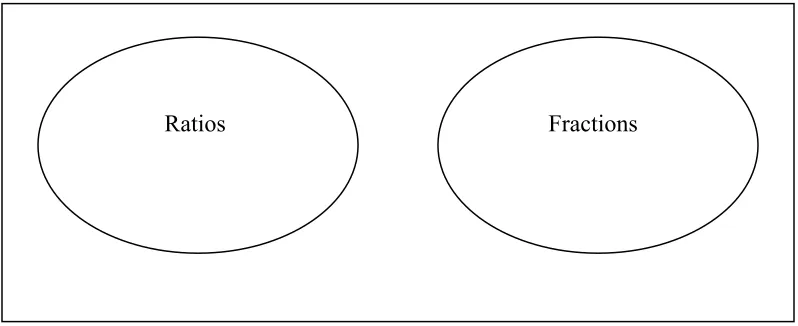
In Model 1, all ratios are fractions. Clark et al. (in press) represent Model 1 with
the set notation R ⊂ F, which means that the set of ratios is contained in the set of
fractions, but to be precise they note that F ⊄ R because in Model 1 the sets are not
identical. Figure 1 shows the Venn diagram for Model 1.
Figure 1. Ratios as a Subset of Fractions
According to Begle (1975), “A ratio is nothing but a special case of a fraction” (p.
255). Many mathematics-education textbooks published in the 1960s and 1970s use
fraction as the shortened form of fractional number, synonymous with rational number Ratios
(Grossnickle & Reckzeh, 1973, p. 259). Some authors (for example, Brumfiel, Eicholz,
Shanks, & O’Daffer, 1963, p. 145) make the distinction of fraction as the numeral
(written notation) and rational number as the concept; others (for example, Willerding,
1966, p. 180) use fraction to refer to both the concept and the symbol.
The most common interpretation of Model 1 is that the set of all fractions is the set
of all rational-number expressions, of which ratios compose a subset. But such a
perspective would exclude from that subset commonly accepted ratios that are irrational,
such as the “golden ratio,” the ratio of the hypotenuse to leg length of an isosceles right
triangle, the ratio of the circumference of a circle to its diameter, and odds ratios in
famous probability problems that involve e (Grinstead & Snell, 1997, pp. 85-86).
In Model 2, all fractions are ratios. With set notation, Clark et al. (in press)
represent Model 2 by F ⊂ R and for clarification add that R ⊄ F. Figure 2 shows the
Venn diagram for Model 2.
Figure 2. Fractions as a Subset of Ratios
“All fractions are ratios,” according to Van de Walle (1994, p. 275), but “it is not
correct to say that all ratios are fractions.” In their activities with pre-service and
in-service teachers, Clark et al. reported that Model 2 was the most popular choice. In
individual written responses about the models, two thirds of pre-service teachers enrolled Fractions
in their first methods course selected Model 2 as best representing their understanding of
ratios and fractions; however, their understanding of fractions, in most cases, was limited
to part-whole comparisons, a common but incomplete interpretation (CBMS, 2001).
Model 2 was either the most popular choice or tied for first among experienced teachers,
most of whom had a broader understanding of fractions and interpreted Model 2 as a ratio
as a relative comparison, in a multiplicative sense, and a fraction as one notation for
expressing that comparison.
In Model 3, ratios and fractions are separate, without any elements in common. In set notation, Model 3 is represented as R ∩ F = ∅ (Clark et al., in press). Figure 3 shows
the Venn diagram for Model 3.
Figure 3. Ratios and Fractions as Distinct Sets
A common distinction is that a fraction represents a part of a whole, such as in
Johnson’s (1988) example of “one of two pieces” (p. 79), and a ratio represents “an
amount compared to another amount” such as in his example of “one piece compared to
two pieces.” Two of the nine pre-service teachers mentioned by Clark et al. (in press)
defined fraction as expressing a whole relationship and ratio as expressing a
part-part relationship and chose Model 3.
In Model 4, some, but not all, ratios are fractions, and some, but not all, fractions
are ratios. Clark et al. (in press) refer to this model as the “overlapping model.” Figure 4
shows the Venn diagram for Model 4.
Figure 4. Ratios and Fractions as Overlapping Sets
Clark et al. reported an example of a group of teachers who defended their choice of
Model 4 with the following examples: “1 cup sugar : 2 cups flour” in the ratio-only
realm, “1 cup sugar / 3 cups ingredients” in the intersection, and “½ cup sugar” in the
fraction-only realm. Because of the three realms, Model 4 seems to be open to the widest
variety of interpretation.
In Model 5, the terms have identical meanings. Using set notation, Clark et al. (in press) represent Model 5 as R = F. Figure 5 shows the Venn diagram for Model 5.
Figure 5. Ratios and Fractions as Identical Sets
Ratios Fractions
Fractions
Although Clark et al. reported finding no textbooks that introduce the terms as synonyms,
we did find instances of the terms defined essentially the same way (for example,
Washington & Triola, 1988).
Clark et al. (in press) chose the overlapping model as the one that best represents
our interpretation of the relationship between ratios and fractions. One reason that the
overlapping model is particularly useful for this study is that an interpretation of a
fractional representation of a ratio as an intensive quantity qualifies as an understanding
of the representation both as a ratio and as a fractional number. In the overlapping model,
there are two possible connections for students to make across the boundaries—the
connection between a non-fractional representation of a ratio (in sentence form or with
the colon notation, for example) and a fractional representation of that ratio, and the
connection between the fractional representation of the ratio and the fraction as a
stand-alone rational number.
Kieren’s (1993) theory of subconstructs of rational numbers provides a foundation
for discussing how students might consider ratios and fractions relative to the overlapping
model. According to Behr, Harel, Post, and Lesh (1993), when rational numbers are
thought of in the context of problems, they take on “personalities” (p. 13) that are not
captured by the strict mathematical definition of a rational number as an element of an
infinite quotient field. Kieren identified four subconstructs of rational numbers: quotients,
operators, measures, and ratios. Behr et. al (1992, 1993) also include part-whole as a
separate rational-number subconstruct, and as noted by Ball (1993), Nesher has suggested
The following examples of rational-number subconstructs are taken from Lamon
(2001). For the measure subconstruct, ¾ means the distance of 3 steps of the unit ¼ on a
number line. For the operator subconstruct, ¾ means to multiply by 3 and divide the
result by 4. For the part-whole subconstruct, ¾ means three parts out of a whole divided
into 4 equal parts. For the quotient subconstruct, ¾ is associated with partitioning when
four people share three of something evenly. For the ratio subconstruct, 3:4 describes a
multiplicative relationship of three of something compared to four of something else.
Figure 6 shows the overlapping model of ratios and fractions, as proposed by
Clark et al. (in press), with these various personalities or flavors of rational numbers
Conceptual
Ratio
Fraction
Measures
Operators Quotients Ratios in non-
fractional form (as in 5:3, 60 miles per hour, 3 cups of chocolate for every 2 cups of peanuts)
abstraction
Conceptual convergence Algebraic applications (rate of change, graphing, functions)
Part-part and associated-sets fractional representations
Part-whole fractional representations
(includes odds ratios) (includes probabilities)
In the overlapping model of ratios and fractions, the quotient subconstruct appears
in the fraction-only realm, and the measure and operator subconstructs appear in the
fraction-only realm as well but closer to the intersection because, depending on the
context and phrasing of the problem, these two subconstructs are more likely to be
interpreted as ratios. Probability is seen as a type of part-whole comparison and odds
ratios as a type of part-part comparison. This view of the subconstructs within the
overlapping model is at the granular level.
Pulling back several steps from that granular level provides a view of the
generalized overlapping model of ratios and other number-type domains suggested by
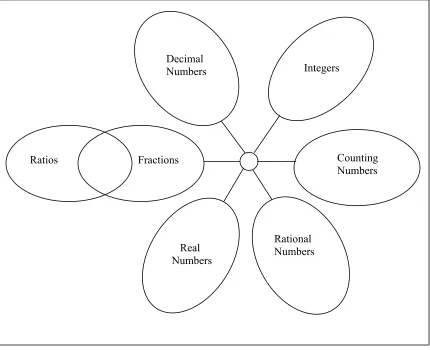
Clark et al. (in press). In our article, Clark et al. argue for a broader perspective of ratios,
not one limited by their representations as fractions. Figure 7 shows how alternate
number-type domains can be matched with ratio to form the same relationship of Model
4. Imagine the right side of Figure 7 as a set of lenses that can be rotated, as needed,
when analyzing how a student expresses and interprets a type of number as a ratio and
Figure 7. The Overlapping Model with Alternative Number-Type Domains Clark and Berenson (2002) reported on the phenomenon of decontextualization of
ratios, when students identify a ratio in a word problem, write the ratio in fractional form,
and then perform operations on the fraction or on the numerator and denominator without
considering the context of the problem from which those numbers came. For example,
consider a numerical comparison that asks students to compare two runners—one who
took 7 minutes to run 3 laps and one who took 8 minutes to run 5 laps. A potential error
would be to write the ratios as 7/3 and 8/5, in fractional form; perform a procedure, such
as crossmultiplication, long division, or conversion to fractions with a common
denominator, to determine that 7/3 is the larger; and conclude that the first runner ran
Ratios Fractions
Integers
Counting Numbers Decimal
Numbers
Real Numbers
faster, without returning to the context of the problem to construct the composite unit for
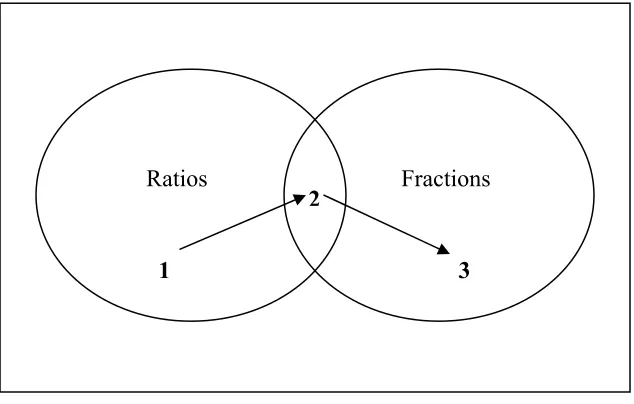
the intensive quantities. Figure 8 shows the overlapping model of ratios and fractions,
and the path of decontextualization, as described in the example in this paragraph, is from
left to right across the diagram.
Figure 8. Path of Decontextualization across Model 4
At first, the student recognizes the multiplicative relationship between the pairs of
numbers (1). Next the student writes the ratios as fractions (2). Finally, the students
performs a procedure with the fractions as numbers (3), disconnected from the context of
the ratio relationship.
Clark and Berenson (2002) found significant associations to provide support for a
conjecture that seventh- and eighth-grade students who use non-fractional representations
are more successful on numerical comparison problems than those who use fractional
representations. Those who used non-fractional representations were also more likely to
maintain contextual elements of the problem in their solution, such as labels or diagrams
that refer to the information given in the problem. One promising sign is that the students
who use fractional representations and maintain a written expression of the context in Ratios Fractions
1
2
their solution are more successful than those who use fractional representations and
provide no context. Although only a result of association, this link prompted us to
hypothesize that while teaching students to interpret and apply fractional representations
of ratios, teachers might help students by encouraging them to write out contextual
elements in their solutions.
Multiplicative Conceptual Field
In the first chapter, I defined the multiplicative conceptual field (MCF), as stated
by Vergnaud (1994). The first step in using his MCF theory, according to Vergnaud, is to
“account for the knowledge contained in most ordinary actions, those performed at home,
at work, at school, or at play” (p. 44). Rejecting the separation between “real-life”
mathematics and “school” math, Vergnaud explained that any problematic situation
found in real life could potentially be used in a classroom context to add to the variety of
situations that students must encounter to develop MCF concepts.
According to MCF theory, students master some classes of situations long before
they master others (Vergnaud, 1994, p. 46). This is consistent with research results on
proportional reasoning that have demonstrated that students are able to solve problems
with integer ratios before non-integer ratios (Tourniaire & Pulos, 1985), for example.
For my study, MCF theory is relevant because of the wide range of knowledge of
various topics that impact students’ progress on the activities. The problems require
students to compare ratios, which they often represent as fractions, but their knowledge
of decimal numbers, division, common denominators, and other MCF topics can either
Vergnaud (1988) recommended, it is “not wise to study the learning and teaching of
fractions, ratios, and rates independently of multiplicative structures” (p. 158).
Learning with Understanding and Meaningful Learning
An early proponent of meaningful learning in the 1930s and 1940s, William
Brownell suggested that teachers teach with the aim of students truly understanding the
mathematical content. Concerned that teachers had misinterpreted his message, he later
stressed students developing both an understanding of the material and proficiency in
computation (Brownell, 1956). Brownell’s goal is often expressed today in terms of
Hiebert and Lefevre’s (1986) definitions of conceptual and procedural knowledge, which
I discussed in the previous chapter.
According to Ausubel (1963), meaningful learning occurs when the learner is able
to “relate substantive (as opposed to verbatim) aspects of new concepts, information, or
situations to relevant components of existing cognitive structure in various ways that
make possible the incorporation of derivative, elaborative, correlative, supportive,
qualifying, or representational relationships” (p. 22). Ausubel distinguished between
factors related to the material and factors related to the learner in specifying whether
learning is potentially meaningful. For learning to be potentially meaningful, the new
material must be related in a nonarbitrary way to concepts previously learned, which is a
characteristic primarily of the material itself, and the new material must be compatible
with the existing cognitive structure of an individual learner, which Ausubel defined as
“an individual’s organization, stability, and clarity of knowledge in a particular
is more likely to be achieved more quickly, to be transferred to new situations, and to be
retained over time.
The word “understanding” is most frequently used to describe the learner’s state
when new information is appropriately connected to existing knowledge (Hiebert &
Lefevre, 1986). A goal that is widely accepted by mathematics-education researchers is
that students should learn mathematics with understanding (Hiebert & Carpenter, 1992).
This goal is the basis for the NCTM standards (NCTM, 2000). Hiebert and Lefevre point
out how closely related the terms “understanding,” “meaningful learning,” and
“conceptual knowledge” are: “The heart of the process involves assimilating (Piaget,
1960) the new material into appropriate knowledge networks or structures” (p. 4).
“Conceptual knowledge” refers to the substance, “meaningful learning” to the process,
and “understanding” to the resulting state.
A critical feature of a network of knowledge is the connections between ideas,
facts, or procedures (Hiebert & Carpenter, 1992). “Thinking mathematically involves
looking for connections, and making connections builds mathematical understanding”
(NCTM, 2000, p. 274). The teacher’s role, according to NCTM, should be to emphasize
mathematical connections to “help students build a disposition to use connections in
solving mathematical problems, rather than see mathematics as a set of disconnected,
isolated concepts and skills” (p. 277). NCTM’s standards stress the alliance of factual
knowledge, procedural proficiency, and conceptual understanding needed for students to
become successful in their math classes—a goal that has been expressesd by researchers
and teachers since Brownell warned in 1956 that one type of knowledge is not sufficient.
Recent Research on Teaching MCF Topics
According to von Glasersfeld (1996), “The need for an experiential basis for the
abstraction of concepts is often overlooked” (p. 312). Discussing the importance of
students’ experiences with various subconstructs in their development of a complete
understanding of rational numbers, Behr et. al (1993) claimed that researchers must
“explore children’s ability to acquire knowledge of these personalities and determine
what their informal knowledge of these personalities is” (p. 13). Informal knowledge, as
described by Mack (1990), is knowledge that is applied, circumstantial, and “can be
drawn upon by the student in response to problems posed in the context of real-life
situations familiar to him or her” (p. 16).
In Mack’s (1990) study, she used students’ informal knowledge of fractions as a
basis for teaching them how to add and subtract fractions and how to compare fractions.
Another example of research of an instructional program to teach an MCF-related topic is
a study by Moss and Case (1999), in which they reported success in using students’
informal knowledge of percents as a basis for teaching decimal notation. Confrey (1994)
suggested that students be introduced to multiplication, division, and ratio as a trio early
in elementary school and that this instruction be based on their informal knowledge of
splitting activities, such as folding and sharing. Lamon (2001) found that basing
rational-number instruction on children’s informal knowledge of measurement was more
successful than the traditional focus on part-whole interpretation.
After basing initial instruction on students’ informal knowledge, these researchers
have attempted to help students construct knowledge of more advanced concepts by
informal knowledge. For example, Lachance and Confrey (1995, 2002) based their
instruction of decimal notation on what the students previously learned about the trio of
multiplication, division, and ratio in addition to their informal knowledge of splitting
activities. In Lamon’s (2001) study, after students developed an in-depth understanding
of one subconstruct of rational number, such as measure or operator, she based
instruction on other subconstructs on students’ understanding of the initial subconstruct
that they had experienced in depth.
Ben-Chaim et. al (1998) tested the effectiveness of the Connected Mathematics
Project (CMP), a middle-school curriculum based on problem solving, versus a control
group. In the CMP group, students were to develop their own procedures for solving
proportion-related problems; in the control group, students observed the teacher solving
example problems and then practiced solving similar problems using the methods they
had learned from the teacher and the textbook. The researchers classified
proportional-reasoning problems according to three general categories: missing-value value problems,
where three pieces of information about the proportional relationship are given and the
student has to compute the fourth; numerical comparison problems, which is the problem
type for my study; and qualitative prediction and comparison problems, which require the
students to make general comparisons and predictions not based on specific numerical
values. This third category of problem is sometimes referred to as directional questions
(Heller, Post, Behr, & Lesh, 1990) because the student is often asked if a result would be
greater than, less than, or the same as a prior result. For example, if a runner runs more
runner ran faster the second day, without knowing anything about the specific distance,
time, or speed.
Ben-Chaim et. al (1998) found that in both the experimental and control groups
students performed better on missing-value problems than on numerical-comparison
problems. Overall, the students in the CMP group performed better on a written exam
than those in the control group. Based on follow-up interviews, the researchers concluded
that the students in the CMP were also more successful at providing explanations for their
solutions. They hypothesized that the problem-solving approach of the CMP curriculum,
with the emphasis on classroom discourse, might be the factor that best explains the
superior performance of the CMP group.
Proportional Reasoning
In addition to Lamon’s categories for reasoning strategies, I use common
categories for numeric approaches that students use to solve ratio and proportion
problems. These categories are important for the proposed study because the numerical
comparison problems that I use are, in general, too hard for students to solve intuitively
and therefore require some numerical strategy.
According to Karplus, Pulos, and Stage’s (1983) classification system for numeric
approaches to missing-value proportion problems, a between strategy involves comparing
the given components of two ratios, establishing that multiplicative relationship, and
applying the relationship to the other given number in one of the ratios to find a value for
the other ratio; and a within strategy involves comparing the numbers of one ratio,
ratio. Karplus, Pulos, and Stage concluded that neither of these strategies seems more
natural for students and that factors such as the problem context, the numerical content of
the problem, and the preceding task influence which strategy a student uses.
A problem that I wrote (Clark, 2001) and have used many times with teachers to
illustrate strategies for solving missing-value problems is the following:
If you ride a bike 5 miles in 20 minutes and continue at a constant speed, how far
will you travel in a total of 60 minutes?
A student applying a between strategy would see that 60 minutes is 3 times as long as 20
minutes and conclude that the missing distance, 15 miles, would also be 3 times as long
as the given distance for 20 minutes. A student applying a within strategy would realize
that going 5 miles in 20 minutes is a mile every 4 minutes and divide 60 minutes by 4
minutes per mile to get 15 miles. A student crossmultiplying would set up the proportion,
multiply 60 by 5 and 20 by the unknown, and divide 300 by 20 to get 15.
Another common proportional-reasoning strategy, particularly among children
who are just beginning to reason proportionally, is one often called building up
(Tourniaire & Pulos, 1985), in which a student establishes a relationship between two
extensive quantities and alternately iterates, or builds up, until reaching an established
target. For example, if a child is asked, “If you can buy 3 cans of soda for 75 cents total,
how much would 12 cans cost?” the child might build up to 12 cans, counting 3 cans for
75 cents, 6 cans for a $1.50, 9 for $2.25, and 12 for $3. The building-up strategy is most
commonly used by children when all the numbers are integers (Tourniaire & Pulos).
As reported by Ben-Chaim et al. (1998), a common error on numerical
student tries to work with miles per hour but actually computes hours per mile. As I
began my study, I wondered if students could learn the reversibility of a rate, that it can
be expressed as either amount of one unit per the other, and how this reversibility relates
to fractions and their multiplicative inverses. The main reason I chose numerical
comparison problems is that students must interpret and compare ratios in the context of
the problem, sometimes choosing the smaller number and sometimes the larger one for
their answer, depending on what the question asks; therefore, these problems cannot be
solved by any procedure that students have learned to determine which fraction is the
larger or smaller number.
Because of the lack of students’ conceptual understanding associated with the
crossmultiplication procedure for missing-value proportion problems, many researchers
(for example, Post, Cramer, Behr, Lesh, & Harel, 1993) have suggested that the unit-rate
method, a type of within strategy by which the student computes how many units of one
variable are associated with one unit of the other variable within the given ratio and then
multiplies, shows the most promise. However, Singh (2000) warned that in our rush to
overturn the teaching of the crossmultipliation procedure we run the risk of replacing one
procedure, crossmultiplication, that students do not understand with another procedure,
the unit-rate procedure, that students do not understand either. As an example of a
potential pitfall, Singh mentioned the case of a sixth-grade girl who relied so heavily on
the unit-rate method that when her procedure gave a result that conflicted with her
number sense she reverted to additive reasoning. Singh stressed the goal of students
achieving flexibility—an ability to choose a method that is best suited to the problem—
14 donuts, how many donuts can you make with 12 cups of flour? A more efficient
solution than using the unit rate of one cup for 14/8 donuts, Singh argues, is to see 4 cups
of flour, which are needed to make 7 donuts, as the unit and to iterate this unit three
times. Singh concluded that the unit-rate method should not be taught until students have
a good grasp of unit-coordination schemes, such as iterating the composite unit in the
donut problem.
Another argument against relying too heavily on the unit-rate method was made
by Christou and Philippou (2002), who found that fourth- and fifth-grade students’
exclusive focus on finding an emphasized unit rate distracted them from finding the unit
rate when it made more sense to reverse the roles of the variables. When given
missing-value problems involving dollars and pencils, the students in their study who relied on the
unit-rate method tried to compute the cost per pencil instead of figuring out how many
pencils could be bought for one dollar and applying that within relationship to find the
missing value. An instructional goal for this study is for students to develop this
flexibility to define a ratio of one variable in terms of another and to define its
multiplicative inverse as the ratio of the second variable in terms of the first and to use
either ratio, depending on the situation.
Using manipulatives when solving proportion-related problems can enhance the
performance of some students (Harrison, Brindley, & Bye, 1989; Tourniaire & Pulos,
1985). Tourniaire and Pulos cited a 1979 study by Kieren and Southwell in which they
found that children could solve a problem using manipulatives two years before they