PERPUSTAKAAN U T H M
PENGESAHAN STATUS LAPORAN PROJEK SARJANA
FORECASTING SUNSPOT NUMBERS USING NEURAL NETWORK: EFFECT TO THE ELECTRICAL SYSTEM
SESIPENGAJIAN: 2006/2007
Saya REZA E Z U A N BIN S A M I N mengaku membenarkan Laporan Projek Sarjana ini disimpan di Perpustakaan dengan syarat-syarat kegunaan seperti berikut:
1. 2. 3.
Laporan Projek Sarjana adalah hakmilik Kolej Universiti Teknologi Tun Hussein Onn. Perpustakaan dibenarkan membuat salinan untuk tujuan pengajian sahaja.
Perpustakaan dibenarkan membuat salinan tesis ini sebagai bahan pertukaran antara institusi pengajian tinggi.
** Sila tandakan (V)
• •
HI
SULIT
TERHAD
TIDAK TERHAD
(Mengandungi maklumat yang berdarjah keselamatan atau kepentingan Malaysia seperti yang termaktub di dalam AKTA RAHSIA RASMI 1972)
(Mengandungi maklumat TERHAD yang telah ditentukan oleh organisasi/badan di mana penyelidikan dijalankan
Disahkan oleh
(TANDATANGAN PENULIS)
Alamat Tetap:
7
(TANDATAF JG iN PENYELIA)
63 J ALAN BESAR, TONGKANG PECAH, 83010 BATU PAHAT, JOHOR.
Tarikh:
PROF. M A D Y A SITI HAWA BT RUSLAN Nama Penyelia
Tarikh:
CATATAN:
FORECASTING SUNSPOT NUMBERS USING NEURAL NETWORK: EFFECT TO THE ELECTRICAL SYSTEM
REZA EZUAN BIN SAMIN
A project report submitted in partial fulfillment of the requirements for the award of the degree of
Master of Electrical Engineering
Faculty of Electrical and Electronics Engineering Kolej Universiti Teknologi Tun Hussein Onn
summaries which have been duly acknowledged"
Student
REZA EZUAN BIN SAMIN
_ ; ^ g / ( ] / ^ o f c
Supervised by
Supervisor I
Supervisor II
iii
ACKNOWLEDGEMENT
Assalamualaikum. First of all I would like to thank Allah The Almighty for giving me the strength to complete my research as one of the requirement for my Master degree.
I would also like to thank Associate Professor Siti Hawa Bt. Ruslan, my project supervisor for her support and encouragement all the time especially during the difficulties that I faced during the completion of my research. Not to forget, Dr Azme Bin Khamis, my project co-supervisor for his guidance and opinion especially in the area of Neural Network.
I would also like to thank my parents for their support, love and understanding during the completion of my Master study. I also like to thank my beloved fiance for the understanding and support all the time.
ABSTRACT
The purpose of this research is to develop the forecasting system of Sunspot Numbers that highly related to Geomagnetic Induced Current (GIC). This geomagnetic induced current (GIC) have the effect to the electrical system especially to the
transformers. Sunspot data obtained from the National Geophysical Data Center (NGDC) ranging from 1700 until 2005 is analyzed using Neural Network (NN) using the MATLAB 7.0 Graphic User Interface (GUI) method computer program called "Sunspot Neural Forecaster" so that the analysis and simulation of the sunspot data can be done easily and more user friendly. First, a comparison analysis between
Feedforward Neural Network (FNN) and Recurrent Neural Network (RNN) is done to choose the best NN type for the next analysis. The second stage of the analysis involved the selection of NN training algorithm between Levenberg Marquardt, Resilient
Backpropagation and Gradient Descent. As in the selection of NN type analysis, the best NN training algorithm is selected for the next analysis. The next analysis involved the selection of NN models between NN1, NN2, NN3 and NN4 and the best models is selected for the last analysis which is the transfer function analysis. The NN transfer function analysis involved Tansig/Purelin and Logsig/Purelin transfer function for the hidden layer and output layer respectively. Based from the analysis that have been done, FNN using Levenberg Marquardt training algorithm with NN2 model and
V
ABSTRAK
Tujuan penyelidikan ini adalah untuk membangunkan suaru sistem ramalan "Sunspot Neural Forecaster" bagi meramal nombor bintik suria (Sunspot Numbers) yang mempunyai kesan terhadap arus teraruh geomagnetik, {Geomagnetic Induced Current, GIC). Fenomena GIC ini memberi impak kepada sistem elektrik terutamanya sistem transformer. Data bagi penyelidikan ini diperolehi daripada National Geophysical Data Center (NGDC) dari tahun 1700 hingga 2005. Analisis kemudian dijalankan
menggunakan data tersebut dengan menggunakan rangkaian neural menggunakan perisian MATLAB 7.0 diberi nama "Sunspot Neural Forecaster" menggunakan kaedah
GUI agar analisis bagi nombor bintik suria dapat dibuat dengan lebih mudah serta mesra pengguna. Pada peringkat awal, analisis perbandingan dibuat antara FNN dan RNN dan rangkaian neural terbaik dipilih bagi analisis seterusnya. Analisis seterusnya merupakan analisis bagi algoritma pembelajaran yang berbeza. Tiga jenis analisis algoritma pembelajaran telah dibuat iaitu Levenberg Marquardt, Resilient
TABLE OF CONTENTS
CHAPTER TITLE PAGE
ACKNOWLEDGEMENT iii
ABSTRACT iv
ABSTRAK v
TABLE OF CONTENTS vi
LIST OF TABLES ix
LIST OF FIGURES x
LIST OF SYMBOLS xiii
LIST OF ABBREVIATION xiv
LIST OF APPENDICES xvi
I INTRODUCTION 1
vii
II LITERATURE STUDY 7
2.1 Introduction 7 2.2 What Is Sunspot Numbers 8
2.3 Sunspot Numbers & Geomagnetic Induced Current 11
2.4 GIC and Its Effect to Electrical System 12
2.5 Sunspot Forecasting 20 2.6 The Role of Forecast 24
ffl RESEARCH METHODOLOGY 27
3.1 Introduction 27 3.2 Introduction to Neural Network 27
3.2.1 Feedforward Neural Network 31 3.2.2 Recurrent Neural Network 33 3.2.3 Training Algorithm 34 3.2.4 Transfer Function 35 3.2.5 Improving Generalization 38 3.2.6 Neural Network Application in Forecasting 39
3.3 Development of NN System 40 3.3.1 Data Collection 41 3.3.2 Preparing of Input and Output Data 41
3.3.3 Design of Neural Network Model 42
3.3.4 Network Training 44
3.4 Summary 44
IV PROGRAMMING & GRAPHIC USER INTERFACE (GUI) 45
4.1 Introduction 45 4.2 GUI for Sunspot Neural Forecaster 46
V RESULT AND DISCUSSION 53
5.1 Introduction 53 5.2 Selection of NN Type 54
5.3 Feedforward Neural Network Analysis 5 6
5.3.1 Selection of Training Algorithm 56
5.3.2 Selection of Model 60 5.3.3 Selection of Transfer Function 73
5.3.4 Optimized NN parameters analysis 77
5.4 Sunspot numbers forecasting 79
VI CONCLUSION 82
6.1 Conclusion 82 6.2 Recommendation for Future Works 83
REFERENCES 86
ix
LIST OF TABLES
3.1 Combination of transfer function 43 5.1 MSE performance analysis for different NN type 54
5.2 MSE Performance analysis for different training
algorithm. 57 5.3 NN1 MSE and correlation analysis 61
5.4 NN2 MSE and correlation analysis 63 5.5 NN3 MSE and correlation analysis 65 5.6 NN4 MSE and correlation analysis 67 5.7 Average MSE performance analysis for different
models 71 5.8 MSE performance analysis for different transfer
LIST OF FIGURES
NO OF FIGURE TITLE PAGE
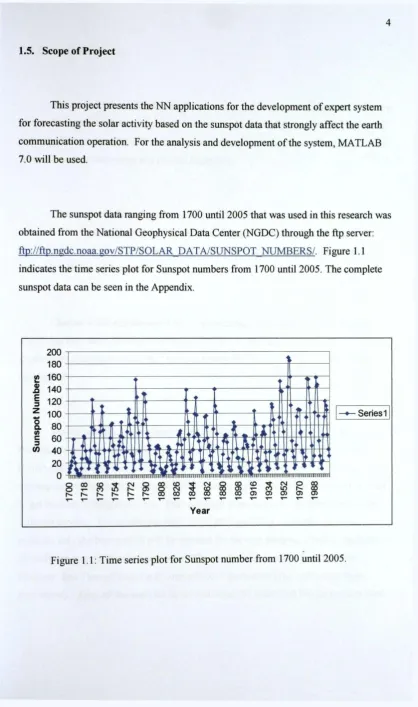
1.1 Time series plot for Sunspot number from 1700 until 2005 4
2.1 Sunspots observed from the sun 9 2.2 Sunspot and geomagnetic activity 12 2.3 Six steps of sunspot chain from the Sun to the ground 13
2.4 Ejection from the sun travels to earth and distorts earth
magnetic field 13 2.5 Half cycle saturation of power transformers due to GIC 15
2.6 Relationship between sunspot numbers and major
transformer breakdown due to GIC 16 2.7 Observed Regional GIC Index (RGI) as measured at
the Ottawa observatory on 12-14 March 1989 18 2.8 Disturbance environments observed by region on
13 March 1989 19 2.9 The Salem nuclear plant transformer damage due to GIC
half cycle saturation of transformer on 13-14 March 1989 20
3.1 Main components of neurons 28 3.2 Neural network main components 29 3.3 Feedforward Neural Network (FNN) 32 3.4 Recurrent Neural Network (RNN) 33
xi
3.7 Tangent Sigmoid transfer function 37 3.8 NN system development flow 40 4.1 GUI for "Sunspot Neural Forecaster" 46
4.2 Actual vs NN prediction 47 4.3 Multiple hidden nodes analysis at MATLAB command
window 49 4.4 GUI simulation for MSE and correlation analysis 50
4.5 Flow chart manual for "Sunspot Neural Forecaster" 52
5.1 FNN MSE performance analysis 55 5.2 RNN MSE performance analysis 55 5.3 MSE performance for Resilient Backpropagation algorithm 58
5.4 MSE performance for Gradient Descent 58 5.5 MSE performance for Levenberg Marquardt 59
5.6 NN1 MSE performance analysis 62 5.7 NN1 correlation analysis 62 5.8 NN2 MSE performance analysis 64 5.9 NN2 correlation analysis 64 5.10 NN3 MSE performance analysis 66 5.11 NN3 correlation analysis 66 5.12 NN4 MSE performance analysis 68 5.13 NN4 correlation analysis 68 5.14 MSE training performance for different models 69
5.15 MSE validation performance for different models 70 5.16 MSE testing performance for different models 70 5.17 Average MSE performance for different models 72 5.18 NN2 Tansig/Purelin MSE performance analysis 75 5.19 NN2 Logsig/Purelin MSE performance analysis 75 5.20 NN2 average MSE performance analysis for different
transfer function 76 5.21 Actual vs. NN prediction for optimized NN parameters 78
LIST OF SYMBOLS
Transfer function
Connection matrix from input layer to hidden layer Bias vector
Connection matrix from hidden layer to output layer Function
Nonlinear mapping Function argument Input
Time lag
Number of observation Actual input
Actual inputs at their maximum Actual inputs at their minimum Scaled input
Actual observation Output of model
Output vector
ARV Average Relative Variance
CME Coronal Mass Ejection
CT Current Transformer
DSF Disappearing Filaments
EHV Extra High Voltage
EPvNN Elman Recurrent Neural Network
FFN Feedforward Neural Network
GA Genetic Algorithm
GEA Genetic and Evolutionary Algorithm
GIC Geomagnetic Induced Current
GMDH Group Method of Data Handling
GRNN General Regression Neural Network
GUI Graphic User Interface
MAE Mean Absolute Error
MAPE Mean Absolute Percentage Error
MLP Multi Layer Perceptron
MSE Mean Square Error
NGDC National Geophysical Data Center.
NN Neural Network
RGI Regional GIC Index
RNN . Recurrent Neural Network
SETAR Self Exciting Threshold Autoregressive
Self Organizing Map
APPENDIX TITLE
CHAPTER I
INTRODUCTION
1.1. Research Background
Solar activity forecasting is an important topic for various scientific and technological areas like space activities related to operation of low earth orbiting satellites, electric power transmission line, high frequency radio communications and geophysical applications. The particles and electromagnetic radiations flowing from solar activity outbursts are also important for long term climate variations and thus it is very important to know in advance the phase and amplitude of the next solar and geomagnetic cycles.
documented in the literature. Numerous techniques for forecasting are developed to accurately predict phase and amplitude of future solar cycles, but with limited success. Depending on the nature of the prediction methods, five classes can be distinguish: 1) Curve fitting; 2) Precursor; 3) Spectral; 4) Neural Networks; 5) Climatology.
Several method of forecasting the sunspot numbers have been developed by M. Salvatore and C. Francesco (2006), Dmitriev A.V et.al (1999), Fessant, F, Bengio, S and Collobert, D. (2000) and L. Ming (1990). All of the researchers have used Neural Network (NN) in the forecasting system. In term of the NN method, there are many NN type such as Feedforward Neural Network (FNN) and Recurrent Neural Network (RNN) that have been used by the researchers and each one have their own reason in selecting the NN type that they have chosen.
1.2. Problem Statement
3
1.3. Importance of Study
It is hope that by forecasting the Sunspot Number, it will help as a preventive action in protecting our electrical system due to the effect of Geomagnetic Induced Current (GIC). This is due to that sunspot numbers is highly related with the GIC phenomena.
1.4. Research Objective
The objectives of this research are as follows:
1. To develop a prototype forecast system for predicting the solar activity using MATLAB software. Instead of using the ordinary and less user friendly command window in MATLAB, more user friendly graphic user interface (GUI) is used. By forecasting the related data, it is hope that it will help in preventing the Geomagnetic Induced Current (GIC) from affecting the electrical system.
2. To determine the effect of NN parameters such as number of hidden nodes, transfer function and learning algorithm to the performance of the system.
1.5. Scope of Project
This project presents the NN applications for the development of expert system for forecasting the solar activity based on the sunspot data that strongly affect the earth communication operation. For the analysis and development of the system, MATLAB 7.0 will be used.
The sunspot data ranging from 1700 until 2005 that was used in this research was obtained from the National Geophysical Data Center (NGDC) through the ftp server:
ftp://ftp.ngdc.noaa.gov/STP/SOLAR DATA/SUNSPOT NUMBERS/. Figure 1.1 indicates the time series plot for Sunspot numbers from 1700 until 2005. The complete sunspot data can be seen in the Appendix.
200 180
[image:23.599.93.512.70.778.2]Year
5
1.6 Thesis Outline
The next chapter will focus on the literature study and brief explanation about the effect of sunspot numbers to the electrical system. In term of the literature study, it will not only discuss about the NN method in forecasting the sunspot numbers but also other methods such as time series and genetic algorithm.
Chapter 3 will discuss on the research methodology which were used in this research. Brief explanation about NN and the NN parameters that will be used in the analysis will be made. Furthermore, the procedure of the NN development in this research will also be discussed.
Chapter 4 will discuss about the programming and the graphic user interface (GUI) that have been developed using MATLAB 7.0 software. In this chapter also, brief explanation about how to use the "Sunspot Neural Forecaster" interface will also be highlighted.
Results and discussion about all the NN analysis are in chapter 5. In this chapter, the analysis begins with comparison analysis between Feedforward Neural Network (FNN) and Recurrent Neural Network (RNN). Then the analysis proceeds to the training algorithm analysis where different training algorithm will be compared in order to get the best training algorithm. The next stage of the analysis involved analysis for different models. The models are NN1, NN2, NN3 and NN4. As in the previous