THE EFFECT OF SUPERNUMERARY CHROMOSOMES ON
THE
DEVELOPMENT OF MEALY BUGS1
UZI NUR
Department of Biology, University of Rochester, Rochester, New York
Received June 28, 1966
UPERNUMERARIES, or B chromosomes, were described from several popu- lations of the mealy bug, Pseudococcus obscurus Essig (Homoptera: Coccoi- dea)
,
in California ( NIJR 1 9 6 2 ~ ) . Cytological analysis and breeding experiments revealed that the supernumeraries undergo preferential segregation in both spermatogenesis and oogenesis (NUR 1962b). In male mealy bugs with the lecanoid chromosome system only two of the four products of meiosis form sperm ( HUGHES-SCHRADER 1948), and the supernumeraries are included without reduc- tion in the functional products. I n oogenesis, when an even number of super- numeraries is present, they pair in twos and segregate regularly. However, when one or an odd number of supernumeraries is present, the unpaired supernumer- ary segregates more often into polar body I1 than into the egg pronucleus. The accumulation of the supernumeraries in spermatogenesis is much greater than their loss in oogenesis, and their frequency in wild populations is expected to increase unless some of the supernumeraries are eliminated by selection against at least some of the individuals with supernumeraries.I n order to understand better the factors involved in the maintenance of the supernumeraries, 114 adult females which mated in the wild were collected, allowed to lay eggs, and then analyzed cytologically together with their 2513 offspring (NUR 1966). The offspring were raised under conditions of no differ- ential viability. The frequency of the supernumeraries in the females and their offspring was the same, suggesting no selection for or against females with super- numeraries. From the frequency of the supernumeraries in each female and her offspring, it was also possible to arrive at the number of supernumeraries pos- sessed by the male which had fertilized the female in the wild. The frequency of the supernumeraries in the males in the wild was significantly lower than that of the females and the offspring, and males without supernumeraries were about twice as frequent as either females or offspring without supernumeraries. These results suggested that the elimination of the extra supernumeraries occurred only in the males and apparently through selection against males with supernumer- aries, irrespective of the number of supernumeraries that they carried.
The present study was undertaken in order to test whether, indeed, males with- out supernumeraries are superior to those with supernumeraries. Developmental time and the number of sperm cysts per male in males without supernumeraries
' 'l'liis sludj- was s u p p r t e d by a grant (GB 1585) from the National Scienre Foundation
1240 U . N U R
(OB males) were compared to those in males with one supernumerary (1B
males). The comparison involved full sibs raised under the same conditions. The experiments were run at four different temperature regimes and involved both a supernumerary from Berkeley, California, and a supernumerary from Rochester, New York. A comparison between OB and 1B females is also reported.
MATERIALS A N D M E T HO D S
The mealy bugs in this study were the offspring of two fertilized females which were col- lected from Population 1 in Berkeley (NUR 1962c) on September 21, 1963. Female #735 had one supernumerary (1B) and must have mated in the wild with a male without supernumeraries (OB) because all her offspring were either OB or 1B. The offspring of this female all carried the same supernumerary and were used to start a line with a Berkeley supernumerary. Female #752-1 was OB and all her offspring were also OB. Her offspring were used to start a OB line. The Berkeley supernumerary was used in experiments 1 to 12. In these experiments. 1B females from the Berkeley supernumerary line were mated to OB males.
Experiments 13 to 15 used a supernumerary from Rochester on the Berkeley genetic back- ground. For these experiments, a 1B female was collected in the greenhouse of the University of Rochester on September 27, 1964. A 1B son of this female was mated to a OB female from the OB Berkeley line. From their offspring, a 1B son was then crossed to another OB female from the OB Berkeley line. In mealy bugs with the lecanoid chromosome system, the male transmits to its offspring only those chromosomes which it received from its mother (BROWN and NELSON- REES 1961). The supernumeraries, on the other hand, are transmitted by the male, irrespective of their parental origin (NUR 1962b). It was possible, therefore, by the crossing procedure just described to establish a line which carried a Rochester supernumerary on the Berkeley genetic background.
The eggs for experiments 4 and 5 were laid by the same female. In the other experiments, a different female was used for each experiment. In experiments 4,5, and 9, the eggs were laid over a 3 day period. The procedure for obtaining eggs in all the experiments except 4, 5, and 9 was modified to increase the number of eggs per experiment and at the same time to obtain eggs at about the same stage in their development, Each female was allowed to lay for 6 days (experi- ments 1-3, 6-8, IO-12), or 9 days (experim-nts 13-15) and the eggs of each female were isolated daily and placed at 4°C to stop development. One day after the last day of laying, all the eggs of a given female were placed together on a sprouting potato in a jar. This day is the one given in Tables 1 and 2 under Date.
In the experiments conducted at 24°C and 30°C the eggs were laid at room temperature and placed in either a 24" or a 30" constant temperature room. In experiment 9, the female laid the eggs at room temperature over a 3 day period. The eggs remained at room temperature for 5 more days and were then transferred to 30" until the end of the experiment. This temperature regime is referred to as 24"-30". The temperature regime for experiments 1 to 3 was as follows: 18"-7 days. 21"-8 days, 24"-5 days, 21"-2 days, 18"-2 days, and 15" t o the end of the experiment. This temperature regime is designated in Tables 1 and 2 as 15"-24". The temperature was in- creased to 24" in order to insure complete hatching.
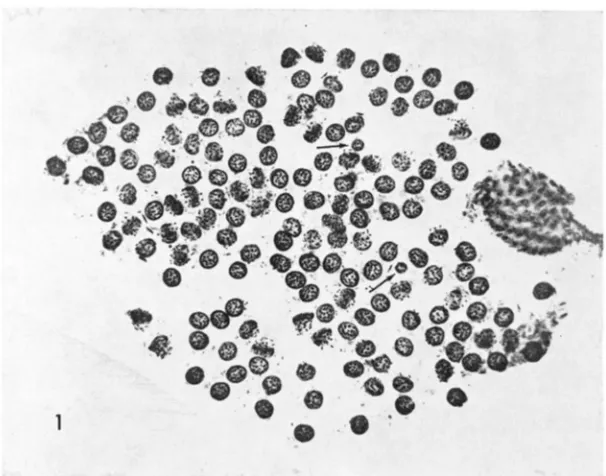
It was previously shown (NUR 1962d) that in the male's testes all the cysts develop more or less synchronously. Immediately after the second molt, each cyst contains 32 sperms and 32 darkly stained bodies. The latter are the division products of the heterochromatic set. At this stage the number of sperm cysts in the testes can be counted (Figure 1) and, for this reason, this stage was selscted for the analysis of the number of sperms and for the determination of develop- mental time.
EFFECT OF SUPERNUMERARIES 1241
FIGURE 1.-A squash preparation of a testis with 163 large cyst. antl two small cysts (arrows). Each large cyst contains 32 spernis and 32 darkly stained heterochromatic residues. The two small cysts contain 16 sperms antl 16 heterochromatic resitlues. Not all the heterochromatic resi- c l u ~ s are in focus. IH1 X.
to the presence or the absence of a heterochromatic hody in the polyploid gut cells (Figures 2, 3). In the male. each nucleus usually contains a darkly stained body representing the heterochromatic
spt ( F i w r e 2 ) . The preqence of this body makes it impossible to determine whether a super-
' C
..
$9
II2
'"3
L
1242 U. NUR
numerary is present. In a few male tissues, including the midgut, the darkly stained body is absent, and for this reason the cells of the midgut were used to determine the presence of the supernumerary.
The procedure used for making the slides resulted in permanent preparations. At a later time, all the cysts i n each testis were drawn with the aid of a camera lucida at a magnification of 80X and then counted. The genotype of the male was not known at the time of counting. In a few of the males, it was not possible to count the cysts because the males happened to be either too young or too old or because part of the testes was lost during the dissection. For this reason, the number of observations on developmental time in a given experiment is slightly larger than that on the number of cysts (Tables 1, 2). As stated i n the Introduction, when a single supernumerary is present in a female, it tends to segregate more often into polar body I1 then into the egg pro- nucleus. This preferential segregation resulted in a greater number of OB than of 1B males and females in each experiment (Table 1,2,3).
TABLE 1
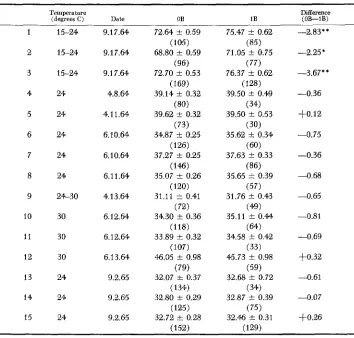
The mean number of days from laying to the beginning of third instar for males without supernumeraries (OB) and for those with one supernumerary ( I B )
1 2 3 4 5 6 7 8 9 10 11 12 13 14 15 Temperature
(decrees C) Date OB 1B
15-24 15-24 15-24 24 24 24 24 24 24-30 30 30 30 24 24 241 9.17.64 9.17.64 9.1 7.64 4.8.64 4.1 1.64 6.10.64 6.10.64 6.11.64 4.13.64 6.12.64 6.12.64 6.13.64 9.2.65 9.2.65 9.2.65
72.64 f 0.59
68.80 f 0.59 (96) 72.70 f 0.53
( 169) 39.14 k 0.32
(80) 39.62 +- 0.32
(73) 34.87 f 0.25
(126) 37.27 & 0.25
(146) 35.07 f 0.26
(1.20) 31.11 f 0.41
( 72) 34.30 f 0.36
(118) 33.89 f 0.32
46.05 +- 0.98 (79) 32.07 +- 0.37
(134) 32.80 k 0.29
(125) 32.72 +- 0.28
(152) (105)
(107)
75.47 +- 0.62
71.05 f 0.75
76.37 k 0.62
39.50 2 0.49
39.50 k 0.53
35.62 0.34
37.63 f 0.33
35.65 ir 0.39
31.76 k 0.43
35.11 +- 0.44
34.58 ?c 0.42
45.73 f 0.98
32.68 k 0.72
32.87 ir 0.39
32.46 -C 0.31 I1 29)
(85) (77) (128) (34) (30) (60) (86) (57) (49) (64) (33) (59) (34) (75) Difference (OB-IB) -2.83'*
-2.25 '
-3.67** -0.36 +0.12 -0.75 -0.36 -0.68 -0.65 -0.81 -0.69 $0.32 -0.61 -0.07 f0.26
, ~~~I \ I
* Difference between OB and 1B significant at the 0.05 level.
* * Difference between OB and 1B significant at the 0.01 level.
E F F E C T O F S U P E R N U M E R A R I E S 1243 OBSERVATIONS
The Berkeley supernumerary: This work was designed to study the effect of a single supernumerary on the rate of development and on the number of sperms produced by males. The effect of a supernumerary on the time of development from laying to the beginning of the third instar is given in Table 1. Experiments 1 to 12 involved a Berkeley supernumerary on a Berkeley genetic background (see MATERIALS A N D METHODS). From Table 1 it may be seen that in 10 out of
the 12 experiments, the males with the Berkeley supernumerary developed more slowly than those without the supernumerary. The probability that by chance, in 10 or more of the 12 experiments the differences between the means will have
TABLE 2
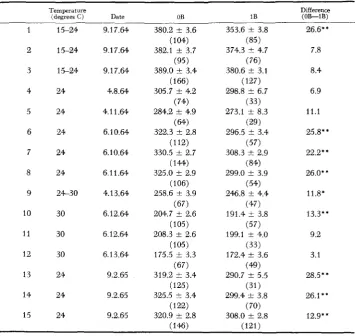
The mean number of sperm cysts per male in males without supernumeraries (OB) and those with one supernumerary ( I B )
Temperature Difference
(dewees C ) Date OB 1B (OB-1B)
- 1 2 3 4 5 6 7 8 9 10 11 12 13 14 15 15-24 15-24 15-24 24 24 24 24 24 24-30 30 30 30 24 24 24 9.17.64 9.17.64. 9.17.64 4.8.64 4.11.64 6.10.64 6.10.64 6.11.64 4.13.64 6.12.64 6.12.64 6.1 3.64 9.2.65 9.2.65 9.2.65
380.2 f 3.6
382.1 f 3.7
389.0 t 3.4
305.7 f 4.2
284.2 f 4.9
322.3 t 2.8
330.5 t 2.7
325.0 t 2.9
258.6 f 3.9
204.7 +- 2.6
208.3 f 2.6
175.5 t 3.3
319.2 t 3.4
325.5 t 3.4
320.9 t 2.8 (104) (95) (166) (74) (64.1 (112) (144.)
( 106)
(67) (105) (105) (67) (125) (122) (146)
353.6 t 3.8
374.3
*
4.7380.6 t 3.1
298.8 f 6.7
273.1 t 8.3
296.5 t 3.4
308.3 t 2.9
299.0 t 3.9
246.8 t 4.4
191.4 t 3.8
199.1 t 4.0
172.4 f 3.6
290.7 f 5.5
299.4 t 3.8
308.0 f 2.8 (85) (76) (127) (33) (29) (57) (84) (54) (47) (57) (33) (4.9) (31)
( 70)
(121) 26.6** 7.8 8.4 6.9 11.1 25.8**
22.2* *
26.0** 11.8* 13.3** 9.2 3.1 28.5** 26.l** 12.9** . , . ,
Difference between OB and 1B significant at the 0.05 level. * ' Difference between OB and 1B significant at the 0.01 level.
12M U. NUR
the same sign is 0.019. At the 24", 24"-30", and 30" temperature regimes the average increase in developmental time due to the supernumerary was 0.43 days. At the 15"-24" temperature regime the increase was 2.9 days, and in the three experiments at that temperature regime the difference between the means of the
OB and 1B males was significant at either the 0.05 or the 0.01 level.
The effect of the supernumerary on the number of sperm cysts per male is given in Table 2. As was previously mentioned, each cyst usually contained 32 sperms and 32 heterochromatic residues (Figure
1 ) .
A few of the cysts, however, were smaller, and contained either 16 sperms and 16 heterochromatic residues or 8 sperms and 8 heterochromatic residues. It was of interest to know whether the presence of the supernumerary affected the relative frequency of the three types of cysts. To this end, all the cysts in experiment 9 were classified according to the number of heterochromatic residues that they contained, and the means of the three types of cysts were then calculated. The mean numbers of the cysts with 32, 16, and 8 heterochromatic residues in OB males were 256.2,4.8 and 0.2 respectively, while in the 1B males, the means were 244.3, 4.9 and 0.2 respec- tively. The means of the cysts with 16 and with 8 heterochromatic residues were almost identical in both the OB and the 1B males. It was decided, therefore, to count the cysts without classifying them, and only the total number of cysts is given in Table 2. In experiment 9, the average number of sperms per cysts was 31.7, and this value may also be a close approximation for the other experiments. The total number of cysts in a male ranged from 121 to 517. The presence of the supernumerary reduced the number of cysts per male in all the experi- ments (Table 2). I n experiments 1 to 12 with the Berkeley supernumerary the reduction in the number of cysts ranged from 3.1 to 26.6 cysts per male. It is not clear whether the magnitude of the effect depended on the temperature. Both the number of cysts and the number of days to third instar decreased markedly with the increase in temperature. The potatoes in experiments 5 and 12 started to rot toward the end of these experiments, and this led to an increase in develop- mental time and to a decrease in the number of cysts, compared to other experi- ments which were started at the same time.The coefficients of variation were calculated for the number of days required to reach the third instar and for the number of cysts in the OB and 1B males of each of the 15 experiments. The correlation between the number of cysts in the left and the right testis of each male and the correlation between the number of cysts per male and the number of days to third instar were also calculated. It was found that there were no significant differences between the OB and 1B males with respect to any of these parameters.
EFFECT O F SUPERNUMERARIES 1245
numeraries are most likely homologous. Since supernumeraries are very rare in mealy bugs, in a species in which they are present they are probably of common origin. Because P. obscurus is a pest on many hosts, including many ornamental plants, and is very common in greenhouses, its present distribution may be of very recent origin. Thus, the Rochester and Berkeley populations may not have had sufficient time for extensive genetic differentiation. However, a certain amount of local differentiation is suggested by the fact that while mealy bugs from the Berkeley population grew very well on potatoes, those from Rochester could not be reared on potatoes for more than one generation. The failure of the Rochester mealy bugs to grow in the laboratory prevented the analysis of the effect of the Rochester supernumerary on Rochester males.
The frequencies of the supernumeraries and the rates of transmission are similar in the two populations. A sample of 23 females collected on October 9, 1962, in the greenhouse of the University of Rochester had a mean of 1.82 i: 0.20 supernumeraries per female. This mean is identical to that of the 1965 sample from Population 1 in Berkeley. The rate of transmission of the supernumerary in the 1B female which contributed the Rochester supernumerary was 0.35 (based on 200 offspring). That of her 1B son was 0.96 (based on 53 offspring). These values are very similar to those of 1B males and females from Population 1 in Berkeley (NUR 1962b).
The effect of the supernumerary on females: In a previous paper (NUR 1962c), it was reported that a preliminary comparison between females with one super- numerary and those with none under laboratory conditions failed to show any significant differences. The data on which that statement is based are given in Table 3. The experiments were quite similar to those performed with the males. Females with a single Berkeley supernumerary were crossed to OB males, and their OB and 1B daughters were compared with regard to their developmental time from egg to laying, the number of eggs laid during the first week of laying, and the mean length of their tibia. The daughters were raised at 23.5"C, and at that temperature, they laid over 90% of their eggs during the first week of laying. After laying for one week, each daughter was analyzed cytologically. In experi- ment A, the mother laid eggs for 4 days. Eggs from the first 2 days of laying and the last 2 days of laying were reared separately but the data were pooled because there were no significant differences between the two batches. In experiment B,
a different mother laid eggs for 2 days.
Examination of Table 3 reveals that there were no significant differences between the OB and 1B females in the two experiments. Moreover, the differences between the OB and 1B females with regard to the time to laying and to the number of eggs laid in experiments A and B were about equal but in opposite directions. Only in tibia size did the two experiments agree since, in both, the
OB females had a larger tibia. However, this apparent effect of the supernumerary does not agree with the results of the analysis of tibia size in females collected
1246 U. NUR
TABLE 3
Developmental time until laying (Days), the number of eggs laid on the first 7 days of laying (Eggs), and the mean tibia length in females with one supernumerary
( I B ) and without a supernumerary (OB)
A OB 79 69.5 t 0.3 398.7 t 11.7 360 t 2
1B 42 69.8 f 0.5 412.4 f 17.0 355 t 4
B OB 23 59.7 k 0.6 435.9 t 18.4 371 f 4
1B 19 59.5 f 0.7 417.7
*
26.0 364 t 4Data condensed from NUR 1962a
The inability to detect any differences between the OB and the 1B females may be attributed to the small number of females in each experiment and to the small number of experiments. However, the apparent lack of effect of the super- numerary agrees well with the available information of the effect of the super- numeraries on females in the wild. As was already described in the introduction,
a comparison was made between the frequency of supernumeraries in 114 females from Population 1 which mated in the wild and 2513 of their offspring, raised in the laboratory under conditions which resulted in no differential mortality
(NUR 1966). Both mothers and off spring had the same mean number of super- numeraries and the same frequencies of the various cytological classes. The population is known to show very little change in the frequency of the super- numeraries from generation to generation. The similarity in means between the mothers and the unselected offspring strongly suggests that the supernumeraries have little or no effect on female viability and probably also none on female fecundity.
DISCUSSION
Supernumeraries and fitness: From the examination of Tables 1 and 2, it appears that, in males, the supernumeraries increased developmental time and caused a reduction in the number of sperm cysts produced. In 12 out of the 15 experiments reported in Table 1, the mean developmental time of the 1B males was greater than that of the OB males; in three of the experiments, the difference was significant at the 0.05 level. In the three experiments in which the mean developmental time of the OB males was greater than that of the 1B males, the differences between the means were very small, and, in only one other experi- ment, was the difference smaller than these.
The effect of the supernumeraries on the reduction in the number of cysts was even more consistent. In all the 15 experiments, the mean number of cysts
of the OB males was larger than that of the 1B males; in nine of the experiments, the difference was significant at the 0.05 level. Significant differences were found in all the four temperature regimes, including experiments with both the Berkeley and Rochester supernumeraries.
EFFECT OF SUPERNUMERARIES 1247
in temperature from 15"-24" to 24". There was a further reduction in the number of cysts at 30", but there was no further decrease in developmental time. A com- parison between developmental time and the number of cysts in the various temperature regimes shows that developmental time and the number of cysts are correlated. An increase in developmental time was usually associated with an increase in the number of cysts. The supernumerary could not have affected the number of cysts by affecting developmental time, because while it increased developmental time, it, at the same time, decreased the number of cysts.
The effect of cold temperature: The number of sperms produced and develop- mental time are both components of fitness, and, in both, the OB males were superior to the 1 B males. The effect of the supernumeraries in increasing develop- mental time was most pronounced at the lowest temperature regime and this may have a special biological significance. In Population 1, the percent of adult fe- males found to be fertilized underwent seasonal fluctuations. It was high (85 to 100%) during midsummer and fall but low (30 to 37%) during the winter, spring, and early summer (NUR 1 9 6 2 ~ ) . The low frequency of fertilized females is probably the result of a shortage of adult males. In cultures raised under laboratory conditions, the sex ratio may fluctuate widely, but the lack of males during the winter is not due to a low frequency of males among the eggs laid. A cytological examination of 2474 embryos from 48 ovisacs which were laid in the wild and collected from Population 1 during September, 1965, revealed a sex ratio of 49.6
*
2.3% males. It appears, therefore, that the shortage of males in the winter, and probably also in early spring, is due to the inability of many of the males to complete development at low temperatures. In the experiments at the 15"-24" temperature regime, developmental time to the end of the second instar was 70 to 75 days. The time to the end of the second instar comprises about three quarters of the total developmental time, so that, at these low tempera- lures, the time from the egg to the adult male would be over 3 months. The male feeds only during the first and part of the second instars. It then spins a cocoon and remains inside its cocoon until it emerges as a n adult. At low temperatures, the period during which the male does not feed may last a month or longer, making the male very susceptible to desiccation. The ability of the OB males to complete development several days earlier than the 1B males may increase their chances of survival considerably. The increase in the percent of fertilized females during the early summer probably marks the appearance of the first generationof males to develop in the spring. During this period, a shorter developmental lime may also be of great importance because the first males to mature would have a large number of unfertilized adult females available to them.
The maintenance of the supernumeraries: It was pointed out earlier that, be- cause of the preferential segregation of the supernumeraries, their frequency would tend to increase, unless some of the individuals with supernumeraries were eliminated by natural selection. The maintenance of the supernumeraries at approximately constant frequency can be explained in either of two ways:
1248 U . N U R
selection against individuals carrying them is equal to that added by the prefer- ential segregation in the males. (2) The supernumeraries may be beneficial, at least in a low dose, and are maintained because of this beneficial effect. The extra supernumeraries which are added by the superiority of the individuals with the low dose and through preferential segregation are then eliminated through a strong selection against individuals with supernumeraries in higher doses. The second explanation can apply only to populations with a relatively high mean because only in such population would there be enough individuals with two or more supernumeraries for natural selection to operate against.
Information about the fitness of individuals with a single supernumerary is thus very important when one tries to distinguish between the two possible ex- planations. Individuals without supernumeraries are expected to have a higher fitness than 1B individuals according to the first explanation but are expected to have a lower fitness than the 1B individuals according to the second explanation. As mentioned earlier, in Population I , the supernumeraries apparently have little or no effect on the females. In the males, on the other hand, individuals without supernumeraries seem to have a higher fitness than those with super- numeraries, irrespective of dose
(NUR
1966). The present study gives further evidence that the OB males have a higher fitness than 1B males and tends to favor the explanation that, in P. obscurus, the supernumeraries are harmful and are maintained only because of their preferential segregation (NUR 1966).This explanation for the maintenance of supernumeraries with accumulation mechanisms was first suggested by
OSTERGREN
(1945,1947).I wish to express m y appreciation to DRS. CONRAD A. ISTOCK and RICHARD C. LEWONTIN for critically reading the manuscript. The assistance of MRS. IRENE NUR and MISS GLORIA C. LOR-
RICK in counting the cysts, and that of MRS. SYBIL B. BREGMAN in the preparation of the manu-
script is gratefully acknowledged.
SUMMARY
EF FE C T OF S U P E R N U M E R A R I E S 1249
LITERATURE CITED
BROWN, S. W., and W. A. NELSON-REES, 1961 Genetics 46: 983-1007.
HUGHES-SCHRADER, S., 1948
NUR, U,, 1962a
Radiation analysis of a lecanoid genetic system.
Cytology of coccids (Coccoidea-Homoptera) . Advan. Genet. 2 : 127-
Cytogenetics and population studies of supernumerary chromosomes in a mealy bug. Ph.D. dissertation, University of California, Berkeley. - 1962b A supernumerary chromosome with an accumulation mechanism in the lecanoid genetic system. Chromosoma
13: 249-271. __ 196% Population studies of supernumerary chromosomes in a mealy bug. Genetics 47: 1679-1690.
-
1962d Sperms, sperm bundles and fertilization in a mealy bug, Pseudococcus obscurus Essig. (Homoptera: Coccoidea). J. Morphol. 111 : 173- 199. __ 1966 Harmful supernumerary chromosomes in a mealy bug. Genetics 54:1225-1238.
OSTERGREN, G., 1945 Parasitic nature of extra chromosome fragments. Bot. Notiser 2: 157-163.
-
1947 Heterochromatic B-chromosomes i n Anthoxanthum. Hereditas 33 : 261-296.SNOW, R., 1963 Hydrochloric acid-carmine as a stain for chromosomes in squash preparations 203.