R E S E A R C H
Open Access
Alternate control systems
Yuming Feng
1,2, Chuandong Li
1*, Tingwen Huang
3and Weijing Zhao
4*Correspondence: [email protected] 1School of Electronic Information
Engineering, Southwest University, Chongqing, 400715, P.R. China Full list of author information is available at the end of the article
Abstract
The exponential stability of a class of nonlinear systems by means of alternate control is studied. An exponential stability criterion is given in terms of a set of linear matrix inequalities. Numerical simulations are presented to verify the correction of the obtained results.
Keywords: alternate control system; exponential stabilization; Chua’s oscillator
1 Introduction
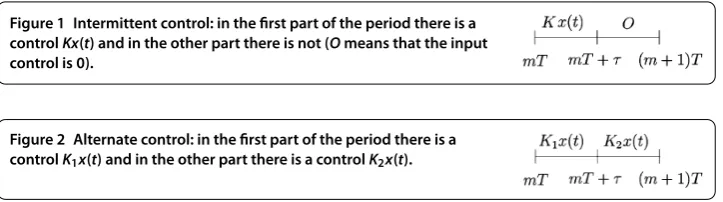
There are many methods to stabilize a nonlinear system. For example, impulsive control methods [–], switching control methods [–],etc.Intermittent control methods are special cases of switching control methods and have been studied by many researchers, e.g., [–]. Within the intermittent control, one adds a continuous control during the first part of the period while in the other part of the period there is no control. This method is available for some cases, but it costs time. For other cases in which the time is very important, this method is not of use. So we advise to add two different controls alternately to the system. We call this system alternate control system. Figure and Figure show the working principles of intermittent control system and alternate control system, from which we conclude that alternate control system is a generalization of intermittent one.
In this paper, we first investigate the stability of the alternate control system, then by using the stability criterion obtained we study the stability of Chua’s oscillator. Also, nu-merical simulations are illustrated to show the effectiveness of the results.
The rest of the paper is organized as follows. In Section , we formulate the problem of alternate control system and introduce some notations and lemmas. We then establish, in Section , an exponential stability criterion. In Section , we discuss the alternate control of Chua’s oscillator. Lastly, we conclude the paper.
2 Problem formulation and preliminaries Consider a class of nonlinear systems described by
˙
x(t) =Ax(t) +f(x(t)) +u(t), x(t) =x,
()
wherex∈Rnpresents state vector,f :Rn→Rnis a continuous nonlinear function
sat-isfyingf() = and there exists a diagonal matrix L=diag(l,l, . . . ,ln)≥ such that f(x)≤xTLxfor anyx∈Rn,A∈Rn×nis constant matrix,u(t) denotes the external input
of system ().
Figure 1 Intermittent control: in the first part of the period there is a controlKx(t) and in the other part there is not (Omeans that the input control is 0).
Figure 2 Alternate control: in the first part of the period there is a controlK1x(t) and in the other part there is a controlK2x(t).
For stabilizing the origin of the system () by means of a periodically alternate control, we assume that the control imposed on the system is of the following form:
u(t) =
Kx(t), mT≤t<mT+τ, Kx(t), mT+τ≤t< (m+ )T,
()
whereK,K∈Rn×nare constant matrices,T> denotes the control period,τ∈(,T) is a constant.
Our target is to design suitableT,τ,K, andKsuch that the system () can be stabilized at the origin.
By the control law (), the system () can be rewritten as follows:
˙
x(t) =Ax(t) +f(x(t)) +Kx(t), mT≤t<mT+τ,
˙
x(t) =Ax(t) +f(x(t)) +Kx(t), mT+τ≤t< (m+ )T.
()
It is obvious that the system () is a classical switched system where the switching rule only depends on the time.
Remark WhenK(t) = , the alternate control system () becomes the classical inter-mittent control system [].
In the sequel, we will use the following two lemmas.
Lemma (Sanchez and Perez []) Given any real matrices,, of appropriate dimensions and a scalar≥such that <=T,the following inequality holds:
T+T≤T+–T–. ()
Lemma (Boydet al.[]) The LMI
Q(x) S(x) ST(x) R(x)
> ,
where Q(x) =QT(x),R(x) =RT(x),and S(x)depend affinely on x,is equivalent to
R(x) > , Q(x) –S(x)R–(x)ST(x) > .
Throughout this paper, we usePT,λM(P), andλm(P) to denote the transpose, the
used to denote the Euclidean norm of the vectorx. The matrix norm · is also re-ferred to the Euclidean norm. We use P> (< , ≤, ≥) to denote a symmetrical positive (negative, semi-negative, semi-positive) definite matrixP.f(x(t–
)) is defined by f(x(t–)) =limt→t–
f(x(t)).
3 Main results
Theorem If there exist a symmetric and positive definite matrix P∈Rn×n,positive scalar constants g> ,> ,> ,and scalar constant g∈R such that the following hold:
() PA+ATP+PK
+KTP+P+–L+gP≤,
() PA+ATP+PK+KTP+P+–L–gP≤,
() gτ–g(T–τ) > ,
then the origin of the system()is exponentially stable,and
x(t)<
λM(P) λm(P)
xexp
–γ(t–T),
whereγ =gτ–g(T–τ)
T ,for any t> .
Proof Let us construct the following Lyapunov function:
V x(t)=xT(x)Px(t), ()
from which we obtain
λm(P)x(t)
≤V x(t)≤λM(P)x(t). ()
IfmT≤t<mT+τ, then by (), (), and () we have
˙
V(x) = xTPx˙
= xTPAx+f(x) +Kx
= xTPAx+ xTPf(x) + xTPKx
=xTPA+ATP+PK+KTP
x+ xTPf(x)
≤xTPA+ATP+PK+KTP
x
+xTPx+–xTLx
= –gV(x) +xT
PA+ATP+PK+KTP
+P+–L+gP
x
≤–gV(x),
which implies that
V x(t)≤V x (mT)–exp–g(t–mT)
Similarly, ifmT+τ≤t< (m+ )T, then we have
˙
V(x) = xTPx˙
≤gV(x) +xT
PA+ATP+PK+KTP+P+–L–gP
x
≤gV(x),
which implies that
V x(t)≤V x (mT+τ)–exp g(t–mT–τ)
. ()
It follows from () and () that: () If ≤t<τ, then we have
V x(t)≤V(x)exp(–gt).
So
V x τ–≤V(x)exp(–gτ).
() Ifτ≤t<T, then we have
V x(t)≤V x τ–exp g(t–τ)
≤V(x)exp–gτ+g(t–τ)
.
So
V x T–≤V(x)exp –gτ+g(T–τ)
.
() IfT≤t<T+τ, then we have
V x(t)≤V x T–exp –g(t–T)
≤V(x)exp–gτ–g(t–T) +g(T–τ)
.
So
V x (T+τ)–≤V(x)exp –gτ+g(T–τ)
.
() IfT+τ≤t< T, then we have
V x(t)≤V x (T+τ)–exp g(t–T–τ)
≤V(x)exp–gτ+g(T–τ) +g(t–T–τ)
.
So
V x (T)–≤V(x)exp –gτ+ g(T–τ)
() If T≤t< T+τ, then we have
V x(t)≤V x (T)–exp –g(t– T)
≤V(x)exp–gτ–g(t– T) + g(T–τ)
.
So
V x (T+τ)–≤V(x
)exp–gτ+ g(T–τ)
.
() If T+τ≤t< T, then we have
V x(t)≤V x (T+τ)–exp g(t– T–τ)
≤V(x)exp–gτ+ g(T–τ) +g(t– T–τ)
.
So
V x (T)–≤V(x)exp –gτ+ g(T–τ)
.
By induction, we have: () IfmT≤t<mT+τ,i.e.,t–τ
T <m≤ t
T, then we have
V x(t)≤V(x)exp–mgτ–g(t–mT) +mg(T–τ)
. ()
So
V x (mT+τ)–≤V(x)exp –(m+ )gτ+mg(T–τ)
.
() IfmT+τ≤t< (m+ )T,i.e.,Tt <m+ ≤t+T–τ
T , then we have that
V x(t)≤V x (mT+τ)–exp g(t–mT–τ)
≤V(x)exp–(m+ )gτ+mg(T–τ)
+g(t–mT–τ)
. ()
From () we know that
V x(t)≤V(x)exp–mgτ+mg(T–τ)
=V(x)exp– gτ–g(T–τ)
m
<V(x)exp
– gτ–g(T–τ) t–τ
T
<V(x)exp
– gτ–g(T–τ) t–T
T
, ()
From () we know that
4 Numerical example
The original and dimensionless form of a Chua’s oscillator [] is given by ⎧
⎪ ⎨ ⎪ ⎩
˙
x=α(x–x–g(x)),
˙
x=x–x+x,
˙
x= –βx,
()
whereα andβ are parameters andg(x) is the piecewise linear characteristics of Chua’s diode, which is defined by
g(x) =bx+ .(a–b) |x+ |–|x– |
, ()
wherea<b< are two constants.
In this section, we set the system parameters asα= .,β= .,a= –., andb= –., which make Chua’s circuit () chaotic []. Figure shows the chaotic phenomenon of Chua’s oscillator with the initial conditionx() = (, , –).
We rewrite the system () as follows:
˙
x=Ax+f(x), ()
where
A= ⎡ ⎢ ⎣
–α–αb α – –β ⎤ ⎥ ⎦,
f(x) = ⎡ ⎢ ⎣
–.α(a–b)(|x+ |–|x– |)
⎤ ⎥ ⎦.
So
f(x)= .α(a–b)(x+ )+ (x– )– (x+ )(x– )
= .α(a–b) x+ –x–
=
α(a–b), x > ,
α(a–b)x
, x≤
≤α(a–b)x.
Figure 4 Time response curves of Chua’s oscillator with alternate control.
Thus we can chooseL=diag(α(a–b), , ). Choosing
K=diag(–, –, –),
K=diag(–, –, –).
WithT= andτ= , solving LMIs (), () and inequalitygτ–g(T–τ) > , we obtain a feasible solution:
== ., g= , g= ,
and
P= ⎡ ⎢ ⎣
. . . . . –. . –. .
⎤ ⎥ ⎦.
Thus by the previous theorem we see that the origin of the system () is exponentially stable. The time response corves of Chua’s oscillator with alternate control is shown in Figure .
5 Conclusions
This paper gives a new model of control system, namely alternate control system. A stabil-ity criterion is given in terms of linear matrix inequalities. By the new method, the chaotic Chua circuit is controlled.
Obviously, there is norest timein an alternate control system. By comparing our model with the traditional intermittent control system, we know that our model is a generaliza-tion of intermittent control system. The proposed method can be applied to linear and nonlinear systems.
This paper considers systems without delay. For delayed systems [–], we know that the methods used to deal with them are different from ones of the systems without delay. We are ready to focus on this aspect in future papers.
Competing interests
Authors’ contributions
CL has proposed the ideal ofalternate control. YF has proved the main theory and prepared the paper with latex. TH has provided all the figures of the paper. WZ has given some advice to improve the paper. All authors have read and approved the final manuscript.
Author details
1School of Electronic Information Engineering, Southwest University, Chongqing, 400715, P.R. China.2School of Mathematics and Statistics, Chongqing Three Gorges University, Wanzhou, Chongqing, 404100, P.R. China.3Department of Mathematics, Texas A&M University at Qatar, P.O. Box 23874, Doha, Qatar.4College of Air Traffic Management, Civil Aviation University of China, Tianjin, 300300, P.R. China.
Authors’ information
The second author is a Senior Member, IEEE.
Acknowledgements
This research is supported by the Natural Science Foundation of China (grant No. 61374078), NPRP grant # NPRP 4-1162-1-181 from the Qatar National Research Fund (a member of Qatar Foundation), Scientific & Technological Research Foundation of Chongqing Municipal Education Commission (grant Nos. KJ1401006, KJ1401019), the Fundamental Research Funds for the Central Universities (grant No. XDJK2015D004) and Key Program of Chongqing Three Gorges University (grant No. 14ZD18).
Received: 9 August 2014 Accepted: 19 November 2014 Published:03 Dec 2014
References
1. Yang, T: Impulsive Control Theory. Springer, Berlin (2001)
2. Yang, T: Impulsive control. IEEE Trans. Autom. Control44(5), 1081-1083 (1999)
3. Yang, T, Chua, LO: Impulsive stabilization for control and synchronization of chaotic systems: theory and application to secure communication. IEEE Trans. Circuits Syst. I, Fundam. Theory Appl.44(10), 976-988 (1997)
4. Yang, Z, Xu, D: Stability analysis and design of impulsive control systems with time delay. IEEE Trans. Autom. Control
52(8), 1448-1454 (2007)
5. Allerhand, LI, Shaked, U: Robust state-dependent switching of linear systems with dwell time. IEEE Trans. Autom. Control58(4), 994-1001 (2013)
6. Geromel, JC, Deaecto, GS, Daafouz, J: Suboptimal switching control consistency analysis for switched linear systems. IEEE Trans. Autom. Control58(7), 1857-1861 (2013)
7. Heertjes, MF, Sahin, IH, van de Wouw, N, Heemels, WPMH: Switching control in vibration isolation systems. IEEE Trans. Control Syst. Technol.21(3), 626-635 (2013)
8. Tanwani, A, Shim, H, Liberzon, D: Observability for switched linear systems: characterization and observer design. IEEE Trans. Autom. Control58(4), 891-904 (2013)
9. Li, C, Huang, T, Chen, G: Exponential stability of time-controlled switching systems with time delay. J. Franklin Inst.
349(1), 216-233 (2012)
10. Li, C, Feng, G, Liao, X: Stabilization of nonlinear systems via periodically intermittent control. IEEE Trans. Circuits Syst. II, Express Briefs54(11), 1019-1023 (2007)
11. Zochowski, M: Intermittent dynamical control. Physica D145, 181-190 (2000)
12. Li, N, Cao, J: Periodically intermittent control on robust exponential synchronization for switched interval coupled networks. Neurocomputing131, 52-58 (2014)
13. Huang, J, Li, C, He, X: Stabilization of a memristor-based chaotic system by intermittent control and fuzzy processing. Int. J. Control. Autom. Syst.11(3), 643-647 (2013)
14. Huang, J, Li, C, Han, Q: Quasi-synchronization of chaotic neural networks with parameter mismatch by periodically intermittent control. In: Proceeding of CSIE 2009, March 31 - April 2, Los Angeles, California, USA, 7 volumes (2009) 15. Huang, T, Li, C, Liu, X: Synchronization of chaotic systems with delay using intermittent linear state feedback. Chaos
18, 033122 (2008)
16. Sanchez, EN, Perez, JP: Input-to-state stability (ISS) analysis for dynamic NN. IEEE Trans. Circuits Syst. I, Regul. Pap.
46(11), 1395-1398 (1999)
17. Boyd, S, Ghaoui, L, Feron, EEI, Balakrishnan, V: Linear Matrix Inequalities in System and Control Theory. SIAM, Philadephia (1994)
18. Shilnikov, L: Chau’s circuit: rigorous results and future problems. Int. J. Bifurc. Chaos4(3), 489-519 (1994) 19. Xia, W, Cao, J: Pinning synchronization of delayed dynamical networks via periodically intermittent control. Chaos
19(1), 013120 (2009). doi:10.1063/1.3071933
20. Yang, X, Cao, J: Stochastic synchronization of coupled neural networks with intermittent control. Phys. Lett. A373(36), 3259-3272 (2009)
21. Zheng, G, Cao, J: Robust synchronization of coupled neural networks with mixed delays and uncertain parameters by intermittent pinning control. Neurocomputing141, 153-159 (2014)
10.1186/1687-1847-2014-305