Citation:
Yeomans, L and FitzPatrick, L (2017) Internal Communication. In: Exploring Public Relations. Pearson Education. ISBN 9781292112183, 1292112182
Link to Leeds Beckett Repository record:
http://eprints.leedsbeckett.ac.uk/3499/
Document Version: Book Section
Permission granted by Pearson to deposit chapter on 04/05/2017
The aim of the Leeds Beckett Repository is to provide open access to our research, as required by funder policies and permitted by publishers and copyright law.
The Leeds Beckett repository holds a wide range of publications, each of which has been checked for copyright and the relevant embargo period has been applied by the Research Services team.
We operate on a standard take-down policy. If you are the author or publisher of an output and you would like it removed from the repository, please contact us and we will investigate on a case-by-case basis.
CHAPTER 15
_______________________________________________________________
Internal communication
Liz Yeomans and Liam FitzPatrick
Learning outcomes
By the end of this chapter you should be able to:
• define internal communication and recognise its development as a discipline • identify the roles of the professional practitioner
• identify the communication options available to the IC practitioner in helping an organisation achieve its objectives
• evaluate and segment internal publics within an organisation • assess the channels that are available to internal communicators
• explain how data gathering and research insights help practitioners to develop and evaluate internal communication strategies.
Structure
• What is internal communication? Perspectives and definitions • What does an internal communication function do?
• What matters to employees: motivation in the workplace • Planning internal communication
Outcomes rather than outputs: choosing effective channels • The importance of evidence in IC planning and evaluation
• Professionalisation: attributes, competencies and skills in internal communication
Introduction
the process of communication that helps us find a common purpose, agree on objectives and work together. The tone or culture of an organisation is expressed through communication.
And that communication happens inside organisations, whether it is managed or not. While daily interactions between colleagues are a necessary part of getting the job done, organisations also need to ensure that staff understand the overall goals and priorities. Also, as organisations grow larger and more complex, so does the challenge of engaging staff in the ‘bigger picture’ – the many challenges, threats and opportunities faced by the organisation as a whole.
Internal communication (IC) has developed as a growing specialism inside the broader fields of strategic public relations, strategic communication and corporate communication. Just as the concerns of public relations have developed beyond one-way broadcast of messaging, so has internal communication developed an interest in maintaining ‘internal conversations’; encourag-ing employees to discuss and debate issues among themselves and with upper management. In the same way that PR is not just about media relations, IC is about much more than company newsletters or parties.
IC is not just a concern for multinational or large organisations that need to communicate with thousands of employees. While it is essential for an international company such as Sony or BT to have a sophisticated communication system in order to engage with their employees worldwide, a small, family-owned printing firm also benefits from information sharing and feedback to help the business perform better.
Further, IC is also vital when an organisation of any size or sector is undergoing some form of change or transformation. Internal publics will have to have a clear understanding of what is needed of them. Businesses need to explain customer needs, public sector organisations need to promote understanding of service priorities and every organisation needs staff who are committed and enthused about the task in hand.
practice and the tools and approaches that are used. We also examine the role that communi-cation professionals play in supporting an organisation’s leadership as well local managers to hold conversations with their teams.
What is internal communication? Perspectives and definitions
Internal communication is the term used to describe an organisation’s managed com-munication system, where employees are regarded as an internal public or stakeholder group (Vercic et al 2012). Other terms used are ‘employee communication', ‘organisa-tional communication' and 'internal marketing'. An organisation’s managed communica-tion system may include a variety of channels and activities, including newsletters, no-ticeboards, staff briefings and intranets, to name just a few. But how can internal com-munication be defined and why is it important?
Until relatively recently, internal communication received little attention from public relations theorists since their focus of attention was on external communication. How-ever, internal communication is now of great importance for many organisations, and theorists are re-examining internal communication in the light of developments such as employee engagement (Welch 2011; Karanges et al 2015; Zerfass et al 2015;).
The development of a 'strategic communication' perspective in public relations over the past decade (Hallahan et al, 2007)has led some theorists to consider internal com-munication differently, thus placing emphasis on helping employees to make sense of organisational change and complexity. Furthermore, all employees, not just managers and communication specialists, are understood to have a communication role within organi-sations and contribute to sense-making (Yeomans, 2008; Heide and Simonsson, 2012; Mazzei, 2014).
Definitions of internal communication vary. For example, a Europe-wide study of practitioners found that internal communication is commonly defined as a tactical, one-way function that is responsible for producing and disseminating internal media (Vercic et al 2012). This contradicts definitions of internal communication as a function that enables two-way communication, including the definition that has been presented in earlier editions of this chapter. Nevertheless, the management concept of employee en-gagement, which we discuss later, suggests that 'building two-way, trusting relationships with internal publics, with the goal of improving organisational effectiveness', is a stra-tegic concern for leaders (Yeomans and Carthew 2014) and practitioners (FitzPatrick and Valskov 2014). Furthermore, while listening to employees and other stakeholders (e.g. through research and other techniques) is often neglected in communication strategies, ‘excellent’ communication departments claim to use a variety of techniques in organisa-tional listening, which suggests a two-way orientation (Zerfass et al 2015).
Internal communication is inextricably linked to supporting an organisation's need to effectively communicate information about important changes - for example, a merger with another company, a re-branding or the introduction of a new product. In theory, at least, internal publics should be among the first to know about these changes so that they are able to see their own role in the 'bigger picture'.
A brief history of internal communication
Very little has been documented on the history of internal communication although it seems to be closely intertwined with changing attitudes to management practice and the need to motivate employees (FitzPatrick 2008). A recent account of the history of internal communication from a UK perspective by Yaxley and Ruck (2015) draws on a mix of archival, academic, practitioner and anecdotal sources to trace its development. The authors note that the roots of formal internal communication lie in the production of the ‘employee publication’. The employee publication emerged from nineteenth and twentieth century industrialisation in Europe and the United States. As companies grew larger, so grew the need for a means of communication between employers and employees.
From these early days, a tension existed between giving the employees control of their own publication and producing a ‘house organ’ under the company’s editorial control. For example, Lever Brothers, the British soap manufacturer, established an employee-run publication Port Sunlight Monthly Journal in 1895, but this was superseded by a company run journal, Progress, in 1899, which “was a ‘means of intercommunication’ between the company’s head office and its Port Sunlight works, branch offices in the UK, offices and other concerns overseas, as well as ‘customers and friends’” (Yaxley and Ruck 2015: 5). This tension between giving employees a voice, and an internal communication system controlled by managers, continues to the present day in terms of debates on who has ownership of internal social media. Yaxley and Ruck (2015) present four historic strategies in internal communication, reflecting a ‘telling and selling’ ap-proach through to an ‘engage and consult’ apap-proach as follows.
Paternalism: 19th century – the establishment of the employee publication.
Companies at the forefront of this practice were concerned with the welfare of their employees. Such welfarism can also be seen as a strategy to combat organised labour and industrial unrest.
of the industrial editor.
Persuasion: 1980s – emphasis on internal communication presenting ‘a case for change’ to employees during a period of economic upheaval. A ‘what’s in it for you’ message reflected a period of persuading employees. Internal communication as a system of planned communication became more closely aligned with management.
Participation: 21st century – a period which reflects an interest in the concepts
of ‘engagement’ and ‘consultation’ with employees against the backdrop of factors including a lack of trust in management and an ‘engagement deficit’, changing labour practices and trans-formational communication technologies.
Yaxley and Ruck (2015) argue that while these four strategies are linked to four historic periods, they do not belong exclusively to these periods. They shift back and forth and overlap, thus, “Rather than seeing the history of internal communications simply as one of progression, a model is proposed that sees trends or themes continuing or replicating over time” (Yaxley and Ruck, 2015:11). (See Fig 15.1) The three recurring trends or themes are:
Propaganda: within the context of internal communication, ‘management propaganda’ refers to
one-way, information-giving which prioritises management-controlled messages over other content and presents the organisation in a favourable light at the expense of more credible content and two-way exchange of ideas. This is a continuing theme for internal communication.
Employee voice: refers to the opportunity for employees to have their voice heard. While “voice” was evident in the very early days of internal communication practice when employees were found to run their own publications, the voice of the employee has been subject to ebbs and flows in perceived importance in organisations. While staff surveys are one way of capturing the em-ployee voice, social media potentially empowers emem-ployees to write their own blogs and tweet ideas – within the framework of company policy on using these tools.
Professionalism: refers to the increasing professionalism of internal communication – from
as a strategic practice underpinned by a qualification. The ‘downside’ of seeking strategic man-agement status, however, is a potential move away from considering the ‘employee voice’.
[INSERT FIGURE 15.1 from Yaxley and Ruck, 2015: 11]
[INSERT PICTURE 15.1 of the cover of Port Sunlight monthly journal]
Think about 15.1 Learning about the organisation
Think about an organisation you have worked for – perhaps as a part-time employee. How were you made aware of the business, its products or services and other activities? Was it through your line manager, colleagues or other methods? List the methods of communication that helped you to understand your employer’s business.
Now list the methods of communication that you have used to communicate with a line manager and colleagues. Why did you choose these methods? Consider which methods were likely to be the most effective.
Feedback
It is likely that you will have learned about the organisation from your line manager, more formally, and from your colleagues on an informal basis. Other methods, such as
e-newsletters, provide the ‘bigger picture’ on what the business is about. However, you may prefer to communicate with people, including your line manager, face to face.
What does an internal communication function do?
relate to organisations and their employee-related objectives (FitzPatrick 2016): Ensuring the organisation meets its legal obligations to talk to employees
Supporting major change
Promoting collaboration and a sense of community in the workplace Promoting external advocacy – getting employees to tell the outside world
about their organisation
Encouraging good employees to stay
Ensuring employees know what is expected of them and know how to achieve
it
A communications team will tend to focus on the activities that most closely relate to organisational objectives. For example in some industries, such as oil and gas, short-ages of highly skilled technicians make it a business imperative to retain staff. A hospital might need to explain hygiene and hand washing policies to staff or an airport might need workers to explain to friends and neighbours the argument for developing new runways and terminals. In all of these cases, good internal communication will make a real contribution to the success of the organisation at retaining valued staff, getting employees to follow essential rules or promoting external understanding of a major issue.
The objectives of encouraging employees to act as advocates, getting them to stay and to work harder are often grouped together under the heading of employee en-gagement; a subject that is of increasing interest in academic and practitioner discus-sions over the past two decades (e.g. Fawkes 2007; MacLeod and Clarke 2009; Welch 2011; Schaufeli 2014; Johansson 2015).
Employee engagement can be defined in a variety of ways but there are consistent themes which focus on ‘an attitude, a psychological or motivational state, or a personal-ity trait’ (Welch 2011: 335). Writers talk about outcomes such as engaged employees saying positive things about their organisation internally and externally, staying or committing to being a member of the team, even though there are other opportunities elsewhere, and working harder; putting in extra time energy and effort (Schaufeli 2014). Organisations are interested in achieving high levels of employee engagement be-cause there seem to be clear links with business profitability, customer service levels, productivity and innovation in the workplace. Engagement is also specifically linked with low levels of people leaving their jobs voluntarily (often called ‘employee turno-ver’), lower absence or sickness levels and lower accident rates (Bridger 2015).
Communicators are interested in this area because engagement is a mix of attitudes (feeling positive or proud), behaviours (recommending the company as a place to work or working harder) and outcomes (better organisational performance); all of which can be strongly influenced by communications (Bridger 2015).
It is communication that enables employees to make judgements, for example about fairness, and communication is the route by which people are recognised in the workplace. People will decide if there are opportunities for personal growth based on the stories they hear about their peers or information about the availability for training. And, as we discuss later, material benefits are often not as powerful motivators as some of the psychological and social elements of a job.
Think About 15.2
What motivates you in your job?
people somehow?
Feedback
What makes people feel engaged will vary from person to person, and organisation to organisa-tion. People working in a bank might base their engagement on the size of their bonus while a doctor’s commitment might be mainly shaped by the interesting nature of the work. An engineer might want to work with a strong community of colleagues who share a fascination with the chance to solve technical problems. Smythe (2007) contends that organisations should identify the drivers of engagement that are peculiar to them and trust their instincts by shaping the ex-perience of work around them.
What matters to employees: motivation in the workplace
In most workplaces employees are there voluntarily. Most of the time we choose where we work and we feel entitled to be treated well and with respect. Even if we feel trapped in a job because of high unemployment or limited opportunities elsewhere, we make a choice about how much effort we make at work. For some time writers have talked about discretionary effort, arguing that money only makes us show up to work; doing a good job depends on our motivation (Yankelovich and Immerwahr 1983; Schaufeli 2014).
How-ever, the concept might be of less use at explaining positive motivations; what makes people choose to work harder or more effectively?
Later work by Herzberg et al (1959) suggested that we have two types of motiva-tion factors at work (see Mullins 2013). These he described as Hygiene (or Mainte-nance) factors and Motivator (or Growth) factors. Hygiene factors such as being paid properly, being treated fairly or being safe only matter when they are absent – they are a source of discontent rather than a basis for positive satisfaction. ‘Extrinsic’ (or external) motivating factors such as the opportunity for advancement or recognition, by contrast, add to the desire to work harder and better. The main contribution of Herzberg’s two-factor theory is that it enables jobs to be designed with ‘quality of work life’ in mind (Mullins 2013: 258). A communicator will understand that talking endlessly about pay and fairness will not automatically excite people. Rather, celebrating achieve-ments or highlighting personal opportunities may make be more compelling messages when trying to create positive expectations and engagement.
Recent popular writing draws on the theory of ‘intrinsic motivation theory’ to high-light the three essential components that are needed to get workers enthused (Pink 2009). These motivations come from an individual’s desires for self-determination:
Autonomy: the urge to be in charge of our own lives
Mastery: the desire to keep improving the way we do something we care about
Purpose: the drive to have a greater reason for doing what we do
con-tent that people are going to want to read or view, but perhaps more significantly, the role involves advising leaders on how to interest and enthuse their people.
Employer brands and employee value propositions
When we begin to talk about motivation it quickly becomes clear that large parts of the ‘deal’ between an employer and a worker will rarely be formally defined. An em-ployment contract may cover issues such as pay, bonuses and expected behaviour but may leave unsaid fundamental things like what it takes to be promoted, the culture of the organisation and the things that really matter inside the organisation. This unwritten or ‘psychological’ contract is increasingly addressed using the conventions of marketing or brand management and communicators are often called upon to help define or sup-port an Employer Brand (Ambler and Barrow 1996) or Employee Value Proposition; tasks that would not be possible without a firm grasp of workplace motivation. Im-portantly, they hinge on the idea of trust: employees have to trust employers to keep their unwritten end of the bargain (Middlemiss 2011). When trust breaks down in a workplace, people are less willing to be flexible or change ways of working when nec-essary.
Communicators have an important role in maintaining trust in the workplace. Trust includes cognitive elements – actual delivery of the practical components such as pay or promotions – and affective components – the emotional attachments (Atkinson 2007). It seems that until the practical or cognitive elements are satisfied, the emotional trust cannot develop. But, it is exactly this emotional trust that is linked to employees en-hancing their contribution to an organisation (Atkinson 2006).
Proposition, thinking through its tangible (e.g pay rates) and intangible (e.g. workplace culture, corporate values or impact on the future employability of staff) elements. And they call on communicators to help articulate all of these components in a way that makes workers and potential employees feel able to speak positively, work harder and remain loyal.
.
Box 15.3
Defining employee engagement: the UK context
A report to the UK government by MacLeod and Clarke (2009) is widely cited in discus-sions of employee engagement. The report defined employee engagement and the char-acteristics of an ‘engaged organisation’ as follows:
‘We believe it is most helpful to see employee engagement as a workplace approach de-signed to ensure that employees are committed to their organisation’s goals and values, motivated to contribute to organisational success and are able at the same time to en-hance their own sense of well-being.
‘Engaged organisations have strong authentic values, with clear evidence of trust and fairness based on mutual respect, where two-way promises and commitments – between employers and staff – are understood, and are fulfilled.’
Source: MacLeod and Clarke 2009: 9
Think about 15.4 Your next job
Think about your next job and what you would hope to gain from it. If you could choose from a selection of employment offers which of the following features would matter and in what order?
Good pay
A friendly team
A supportive manager
A chance to learn
A good name to have on your CV
A chance to make a difference to the world
A nice place to work
Being allowed to get on with the job
Investment in your training
The prospect of promotion
Long term job security
Something else
Once you had landed your dream job, what role would communication play in helping you feel that you were getting what you signed up for? Would you need to hear stories confirming that loyal employees had been promoted or given additional training? Would you want to see evidence that your work was changing lives for the better? Would it be useful to meet co-workers socially or informally to confirm that you have joined a supportive and collabora-tive organisation? How could internal communications influence your satisfaction?
Planning internal communication
9 on Strategic Public Relations Planning and Chapter 10 on Public Relations Pro-gramme Evaluation.)
Setting objectives
An opening question therefore in any communication planning is “what steps do we want people to take as a result of our communication?” As we said before,
employ-ee-related objectives might be to remain loyal to an organisation, to follow specific work instructions, to be external advocates or ambassadors, to collaborate more or to embrace some form of fundamental change (FitzPatrick 2016).
As a shorthand, many practitioners approach objective setting by laying out three essential outcomes that they would like to achieve. This is illustrated in Table 15.1 – three planning questions reflecting the communication practitioner’s interest in
messag-es that elicit conative (doing), affective (emotional) and cognitive (thinking/knowing) responses (Gregory 2014). The approach suggests that we do things because we feel that they are a good idea because of what we know. Although human actions can have more subtle drivers, many communicators find this approach a useful general starting point for planning (FitzPatrick and Valskov 2015:46).
WHAT SHOULD PEOPLE DO AS A RESULT OF OUR
COMMUNI-CATION? CONATIVE
WHAT SHOULD PEOPLE FEEL OR BELIEVE AS A RESULT OF OUR COMMUNICATION?
AFFECTIVE
WHAT SHOULD PEOPLE KNOW AS A RESULT OF OUR
COM-MUNICATION? COGNITIVE Are there specific behaviours
that our organisation needs to promote, such as good
cus-What do people need to be-lieve in order to prompt the desired behaviours e.g that
tomer service, safe working or selling new products?
good customer service matters, that safety is a personal re-sponsibility or that selling a new product will generate better commission?
about customer satisfaction, case studies about safety inci-dents or details of a new sales commission structure.
Table 15.1: Three planning questions
Two-way communication and impact
There is a widely held belief that people, in Western economies with strong notions of democracy, individualism, and having a voice, are less likely to adopt desired behav-Think about 15.5
Getting employees to follow procedures
How might the IT department of an organisation persuade employees to follow security procedures? While most people, including students, normally have to sign a User Agree-ment before they can use a workplace or college network, bad practices such as password sharing or downloading suspect programmes are rife.
Clearly, people are given information about what is acceptable use and by signing a user agreement they could be said to know the risks and rules. But bad practice in many work-places suggests that knowledge of the rules alone is not enough to get people to do the right thing. What communication steps could an IT department take to increase concern for ob-serving rules and encouraging the right behaviours?
Feedback
iours if they are communicated in the form of an order or through one-way broadcast messages. Popular writers and researchers on leadership communication stress the value of meaningful ‘conversations’, and dialogue rather than the delivery of speeches or monologues with no scope for feedback (Men 2014; Murray 2014; llles and Mathews 2015). There are two main reasons why this is likely to be true.
First, even if communication were simply a process with a transmitter and a re-ceiver , few pieces of information are understood on the first time of telling since many complex factors are likely to affect message comprehension, including a good deal of filtering according to effort, motivation and interest (Früh 1980 cited in Windahl and Signitzer 2008: 181). Commonly, as participants in a social network, we need to check we have understood something and we may want to see if other people have re-ceived the same message as well what they think about it in order to develop a shared understanding of the message (Rogers and Kincaid 1981). Impactful internal commu-nication processes therefore allow people to ask questions and perhaps discuss a piece of news. When a message is sent just by email, there may be no opportunity to ask questions. A team meeting would, by contrast, be a great place to test if a message is understood.
However, a second reason to promote ‘conversations’ is that people are more likely to do something if they are part of a genuine dialogue from the outset and have had a hand in deciding what actions are necessary (Quirke 1995; Smythe 2007). Essen-tially, if employees have been consulted and their views taken into account, there is a powerful emotional motivation to execute the plan (Kotter 2014).
Much effort is commonly invested in employee communications in supporting manag-ers to hold such convmanag-ersations as illustrated by Case Study 15.1.
Social media inside organisations
There is much interest in exploring the role that social media inside organisations can play in collecting ideas and promoting ‘conversations’ and involvement. Recent years have seen the growth of many tools designed to mimic inside organisations the widely available social networking tools that exist outside (Lombardi 2015: 156). Lombardi highlights that internal (or enterprise) social networks are typically being considered as vehicles for:
Co-creation - bringing together people to solve a particular problem or challenge
Collaboration – enabling people with a similar problem or as members of a work
or project group to support each other with advice and information
Community – helping people with work or recreational interests to connect with
each other for predominantly social purposes.
In her writing Lombardi also points out that managing these social networks inside or-ganisations requires specific skills and clarity of roles. Without care, oror-ganisations can invest considerable sums in technologies only to find limited usage or involvement.
Box 15.4
Social media inside organisations
and several tools have been developed specifically to promote conversations among col-leagues at work. Many of these mirror externally available tools – for example Yammer has strong similarities to Twitter. And Facebook has developed a secure version that can used inside the closed IT networks of organisations.
Most of the literature on the subject is very recent so it may be too early to evaluate the lasting impact of such tools on issues like performance, collaboration, retaining valued team members or generating external advocacy. A critically minded observer may therefore want to ask questions about impact and participation rates; is a particular tool helping the performance of a organisation and what proportion of employees are using it?
Research from external communication may also be instructive as well. For example, there is a suggestion that that people remember information better if they get it from a magazine or a newspaper rather than reading it online (Santana, Livingstone and Yoon 2013). Many or-ganisations are also nervous about the risks of providing a general platform for employees to talk to each other. Although staff are quite free to express themselves in personal conver-sations, the thought of having candid opinions on screen for everyone to see may be signif-icant obstacle for some leaders. There is also a limit to the impact that social media can have in generating some of the benefits that exist in the external work because of the size of most workforces. The sheer number of people using Facebook, Twitter or Instagram brings a dynamic that is hard to replicate in a workplace of a few hundred colleagues.
Nonetheless, advocates of internal social media point to the potential and significant benefits which new communications tools can bring. If the exact impacts are as yet unknown, the proliferation of tools and the widespread use of social media outside the workplace would suggest that it is likely to have some influence.
Mini case study 15.1
Pearson is a large and complicated company supplying services to education. Over 40,000 staff, working for different brands within the group are involved in publishing textbooks (like this one), providing tests and examinations and the technologies used by teachers and students around the world.The group realised in 2011 that it needed its people, regardless of business area or location, to be able to collaborate and have access to common information about where Pearson was going and its plans.
Staff now use a social network called Neo which uses a commercially available platform called
Jive (www.jivesoftware.com). Neo offers a chance to track down colleagues with useful experi-ence and know how, spaces for sharing files and videos as well as areas for announcements and discussions. Staff use it to hear the latest news from the organisation, to make their own
comments on developments and to hold conversations on line about work and non-work matters.
Kim England, Pearson’s Global Community Director, aims to keep discussion and debate flowing but stresses the importance of getting regular staff enthused about the possibilities of the Plat-form. “When we launched, we worked with enthusiasts and champions. We wanted them to discover how to make Neo work for them, rather than being told what it was for and not for”. She
explains that the value of a social tool inside an organisation lies in getting people to actively seek each other out and have discussions about business challenges and possible solutions. Importantly, it enables people to make connections outside their day to day network; people form communities that connect with each other across countries, brands and businesses.
Initially, England reports, that there was some concern among managers about a social platform in the workplace. There were fears about staff wasting time, saying inappropriate things or, more simply, there being no real value to the organisation from a multi-million dollar investment in technology. “We spent a lot of energy”, she explains, “briefing managers about how the plat-form works and we came up with some clear guidelines about what Neo should and shouldn’t be
Showing results is important for any investment and social media is no different, “We were able to share usage rate and progressively we have been able to replace around 150 different intra-nets which were costly to maintain”, says Kim, “but we also had an impact by running regular campaigns to find successes; for example we run annual awards for things like the best Cost Savings and Best Innovation – results that matter to our leaders.”
Importantly, Neo’s openness means that leaders are engaging with staff as never before; talking
and sharing are seen to make the difference in a complex, multi national business. “When people are not ready to engage in debate it really sticks out now”, England explains. “In the past people may have thought that knowledge was power; now we say ‘collaboration is influence’”.
Source: by kind permission of Pearson UK. With thanks to Kim England, Pearson.
Understanding the diversity of internal publics
As with any branch of communication, practitioners need to have a good understanding of the stakeholders or publics (Vercic et al 2012) with whom they are working. Internal communication is no different and in fact has to cope with a number of special dimen-sions. It may be argued that employees are naturally a more knowledgeable stakeholder group than most others (see Box 15.4). They know what works and what does not work in the organisation and they know its history. They will know that management have been trying to close a particular site for years and they will remember promises made decades ago. As a result, they are often more demanding consumers of internal infor-mation and potentially more critical or sceptical of corporate “spin” (Theofilou and Watson 2014).
ru-mours from colleagues very often travel faster than the ‘official’ version of events.
So-ciological studies of organisational culture and resistance to it provide interesting in-sights into the dark side of employee behaviours. For example, negative word-of-mouth communication among frontline workers could be damaging to company performance (Harris and Ogbonna 2012). Staff also draw inferences from their experiences and what they see: an organisation might claim to value diversity, for example, but staff will reach their own conclusions when the bullying of gay colleagues is ignored or if the board is dominated by white middle-aged men.
Although they may work for the same organisation, a workforce may not perceive things in a uniform way. Marketeers may view the world differently from finance peo-ple; factory workers may not share similar interests to maintenance engineers visiting customers. This is because different occupational groups will share their own norms and values, possibly due to the specific professional training that they have received, or simply because they are located in a part of the organisation that is remote from central services (Hofstede and Hofstede, 2010).
A communicator needs to understand the diversity that exists in their organisation and be ready to help leaders tailor messages and reflect the needs of individual internal publics (Edmondson et al 2009). As discussed earlier in this chapter, internal communi-cators need to be aware of what motivates their colleagues. When communicommuni-cators know why their colleagues come to work and what enthuses them, they can begin to shape communications that appeal to them and encourage the relevant actions that support the organisational culture (see Box 15.6).
Leadership communication
disastrous comments by senior executives and their impact on their workforce. Equal-ly, leaders who model a personal commitment to good communication are often men-tioned and celebrated.
Communicators are often involved in helping senior leaders to lead. Usually, this will mean ensuring that senior managers’ visions and plans are understood. However, as we have argued earlier in this chapter, effective communication involves more than top down communication, ensuring that messages are received and understood by employ-ees. Therefore it is worth examining two key concepts of leadership which are relevant to internal communication.
The first, and perhaps most popular form of leadership, is ‘transformational lead-ership’ whereby leaders provide compelling visions and plans to their followers and
ensure that listening and dialogue on these plans takes place in order to achieve their objectives. However, transformational leadership has been criticised for its
over-emphasis on leaders and less on listening to and involving employees in making decisions (Tourish 2013).
A second approach to leadership is ‘communicative leadership’. Here, a leader consciously places emphasis on communication and empowerment. This type of leader engages “employees in dialogue, actively shares and seeks feedback, practices partici-pative decision making, and is perceived as open and involved” (Johansson et al 2014:
155).
The key difference between the two approaches to leadership is the distribution of power. Empowerment is when there is greater opportunity for workers to influence de-cision-making. Examples of empowerment and ‘communicative leadership’ are com-monly found in Scandinavian countries, as demonstrated in Case Study 15.1.
communications and others, such as when the subject is trivial or needs much detailed local, or team-level explanation. Any communication programme will need to include careful analysis of the rolefor the CEO and the channels through which they communi-cate. For example, a major organisational change will demand that leaders are visible to the workforce and are able to discuss the changes with honesty in terms of how they af-fect employees. In this case, a communicator is likely to advise on the importance of face to face communication, and a good leader will recognise the value of this advice if communication is their priority.
The importance of local managers
As mentioned earlier in this chapter, the role of line managers or supervisors in effective employee communication processes has been a preoccupation of practitioners and re-searchers for some time. Writers on management processes have, for a long time advo-cated making communication a clear responsibility for people with leadership roles (Buckingham and Coffman 1999) Processes, often based on military models of hierar-chical information and order giving were widely recommended (McGeough 1995). This has been referred to as treating managers like animated noticeboards (FitzPatrick and Valskov 2014:122).
Over time, thinking has evolved. Managers are more commonly expected to be flexible in how they manage conversations with their teams with an increasing emphasis on problem solving and discussion, rather than the delivery of instructions (D’Aprix
manager is able to explain how the announcement changes the work that people do and can be available to provide clarification in terms that their team will understand. However, managers are not always the best channel of internal communication; there are limits to their usefulness. A manager might be the ideal person to talk about changes to shift patterns or efficiency, but perhaps will be ill-equipped to explain the technicalities of a pension scheme. Sinickas (2004) suggests that no one expects a manager to be an expert in every single topic that might come up and that employees generally prefer to hear from the person who is the most knowledgeable on a particular subject. In many, but – crucially - in not all cases, that could be the local manager or supervisor.
An internal communications team will therefore be involved in making sure man-agers and supervisors are ready to communicate. FitzPatrick (2008) argues that line manager communication works best when effort has been invested in:
Explaining to managers that communication is one of their responsibilities
Briefing or educating managers about the issues which need discussion Providing training in communication skills
Providing materials that managers can use in team meetings
Gathering feedback and making sure senior leaders
Think about 15.6
Why are line managers trusted more than organisations?
In a workplace, who would you expect to be trusted more by regular employees? The chief executive officer (CEO) or a local supervisor/team leader?
Feedback
performing overall and what plans exist for the future. Yet a local manager will have a per-sonal relationship with the team. They will know about their likes and their concerns. There will be a shared history; team members will know when a manager can be depended upon to keep their promises and they will know how to ‘read’ them. The CEO can seem remote; perhaps being based far away. A local manager is local and present.
Outcomes rather than outputs: choosing effective channels
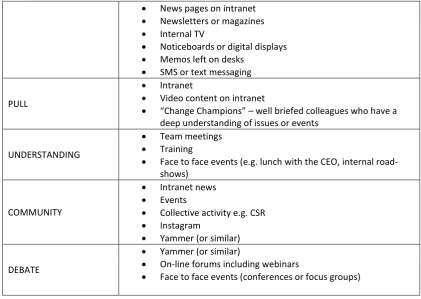
Every organisation needs to have ways to deliver messages. A communications manager will commonly want several different channels at their disposal so that they can ensure that information and feedback touches every corner of the workforce in ways that are appropriate and accessible. For example, an online forum may be popular with office workers but have little uptake in the factory where no one has access to computers. A poster series may be an exciting or powerful way to remind people about workplace safety, but ineffective at explaining detailed changes to company rules and procedures. Additionally, channels themselves may have several different purposes. The company magazine may not be much use for sharing urgent news but could be fantastic for building a sense of community or providing deep background on current issues.. Broadly speaking an organisation will want to have channels to:
Push out information such as news, company results or changes to policies and
procedure
Allow staff to Pull out information as they need it
Aid Understanding because we often want to check what we think we heard or
get help to see the personal implications of an announcement from head office Promote Community; helping people feel that they are part of something and
Generate Debate about issues and give employees a pace to ask questions
Think about 15.7
Communicating bad and good news: Is the medium the message?
In internal communication, as with other branches of communication and PR, how you say something is often as important as what you say.
Imagine you work for an organisation that announces job losses to the media before staff or that you hear news of your sacking via a text message. How would you feel and how might that in-fluence how you feel about your employer?
Or perhaps, you work for a very big company but the chief executive comes and finds you in person to thank you for a recent project. What impact might that have on your commitment to your job?
Feedback
From an IC communicator’s perspective, there are practical constraints which have to be ob-served. You might want to ensure everyone hears a piece of news at the same time or you might have to observe financial regulations about telling the local stock exchange before anyone else. However, putting yourself in the shoes of the employee will help you to think through possible emotional reactions to how a message is perceived using different channels.
A communication manager might also be responsible for promoting collaboration across the
organisation. Not every IC team has this role but, if they do, it is likely that specific channels
will be dedicated to helping people share ideas of work problems.
PURPOSE COMMON CHANNELS OR MEDIA
News pages on intranet Newsletters or magazines Internal TV
Noticeboards or digital displays Memos left on desks
SMS or text messaging
PULL
Intranet
Video content on intranet
“Change Champions” – well briefed colleagues who have a deep understanding of issues or events
UNDERSTANDING
Team meetings Training
Face to face events (e.g. lunch with the CEO, internal road-shows)
COMMUNITY
Intranet news Events
Collective activity e.g. CSR Instagram
Yammer (or similar)
DEBATE
Yammer (or similar)
On-line forums including webinars
Face to face events (conferences or focus groups)
Table 15.2 Common internal communication channels and their uses
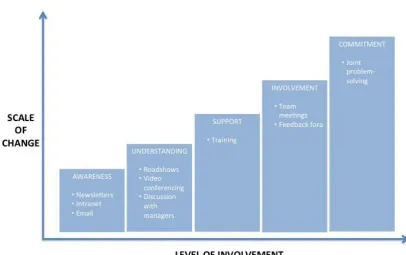
[image:29.595.95.517.56.355.2]Figure 15.2 The greater the level of personal change, the greater the need to involve people in the decision (source: Quirke 1995: 128)
Mini case study 15.3
Face to face still matters at UK financial regulator
Three and half thousand people work for the Financial Conduct Authority, the UK’s regulator for financial matters. With the remit to protect consumers, ensure the UK financial system is run with integrity and promote competition there is a diverse workforce based in London and Edinburgh which include highly skilled financial experts as well as people in operational roles.
A well established intranet is the principal medium for sending out general messages as well as providing a reference point for colleagues to catch up on news and other information. Tools such as posters, leaflets and desk drops are used but sparingly because of a com-mitment to sustainability and value for money.
Explaining the FCA’s strategy and how well the organisation is performing has increasingly involved giving the CEO and the most senior leaders platforms to talk directly to people. The CEO has an internal blog which is more effective at reaching staff than general email which can get lost alongside all the other messages competing for attention. In addition, short videos are valued by the IC team for putting a human face on potentially complex an-nouncements. Overall, this preference for face to face communication is a central plank in the IC strategy.
Senior leaders meet weekly to discuss current priorities with the CEO. The meeting agenda is managed by the IC team who also draft a briefing note for leaders to use for con-sistent communication after the meeting. When major announcements are needed, much effort goes into preparing the FCA’s 350 managers so that they can answer questions from staff and ensure that the wider context is fully understood.
These briefings either happen as specific events or at the Manager Conference which pro-vides an opportunity to network. Managers also receive Manager Essentials – a monthly email digest of people-related issues that help them to be effective. The IC team know that over 80% of managers normally open the email.
For the wider workforce, a series of events called Exco Unplugged has been developed to help people at all levels to raise and discuss current concerns in an informal and candid environment. And every year, all staff are invited to attend the Annual Strategy Meeting
communica-tions is still heavily on providing opportunities for people to talk in person to each other.
IC manager Ben Firth emphasises that his role involves ensuring that communications goes up to the leadership and is not simply one way. “We’ve developed channels to promote a conversation and our measurement activity enables us to report on what is getting through and how people are reacting; it provides us with the intelligence we need to tell leaders things which they might not know through other channels”.
The importance of evidence in IC planning and evaluation
As with every branch of communication, evidence matters when planning and eval-uating internal communication (see Chapter 10 Public relations programme research and evaluation). While personal judgement and experience helps the communication manager to develop the right instincts about messages and tone of voice, facts and figures are needed for securing budgets, defining the best approaches and under-standing what is working (and what is not). Later on we talk about the importance of deep understanding and empathy as one of the core competencies for successful practitioners.
Many organisations conduct an annual survey of their employees (Bridger 2015). These surveys will commonly address issues such as overall morale and commitment. Routinely they will ask a few questions about communication and will give a limited insight into whether staff are receiving the information that they need to do their jobs. However, many staff surveys are limited in their usefulness for internal communicators; mainly because employees don’t take them seriously; be-cause the survey only touches on a few aspects of the internal communication mix or because the study only happens once a year (Walker 2012). Further, many of these studies are disconnected from the actual effectiveness of the organisation (Coco et al 2011). Just because the survey results are positive, it does not mean that everything is running smoothly. Additionally, measuring an issue through a survey does not mean that action has been taken to improve it (Bridger 2015). Communicators therefore tend to look for a mix of evidence that tells them what people are thinking, what channels are working and what people are hearing from their communication. Since communication is just one of the factors that in-fluence attitudes and behaviours in the workplace, it is helpful to understand what else matters to employees.
PURPOSE COMMON APPROACHES
Understanding internal demographics Reviewing HR data about employee numbers, grades and locations
Tracking HR information such as sickness rates or resignations
Understanding employee attitudes and knowledge
Getting out and about Work shadowing
‘Temperature checks’ (mini-surveys run at spe-cific points in the year)
Focus groups
Monitoring internal forums for comments Annual staff surveys and attitude surveys Reviewing feedback from line managers Deep statistical analysis of other surveys Communications processes Communications audits
opening rates, attendance at staff meetings) Surveying users of individual channels User focus groups
[image:34.595.98.526.56.110.2] Qualitative content analysis of upward feedback
Table 15. 3 General approaches to information gathering
Approaches to information gathering
Building informal knowledge of the workforce
Communicators are routinely advised to spend time away from their desks talking to colleagues (FitzPatrick and Valskov 2015). If the value of a specialist advisor lies in knowing stakeholders better than anyone else, meeting and listening to colleagues has to be a priority for any internal communication practitioner. From this experience, the practitioner will become well aware of the size and shape of the workforce. Desk re-search into information about location, numbers, ages, gender, languages spoken is es-sential. Additionally, it is possible to draw conclusions about morale and commitment from data about things such as staff sickness rates, customer complaints or labour dis-putes (Walker 2012).
Monitoring channel usage
can learn a lot from the reactions that staff have to communication (i.e. qualitative in-formation). What comments are they leaving in on-line forums or what are the questions that they ask at open staff meetings? Leaders will often ask for immediate feedback on specific communication activity and the internal communication team is best placed to explain what is working and where more effort is needed.
Managing formal internal communication research
Using informal research methods such as getting out and spending time work shadow-ing are essential approaches that help build an awareness of the perspectives of col-leagues. Additionally, a communicator will want to formalise continuing information gathering. Broadly speaking, communicators have the choice of qualitative research, such as focus groups and interviews; or quantitative tools, such as surveys (Walker 2009). The practices are not so very different from those used in external communica-tion research. (See also Chapter 10 Public Relacommunica-tions Research and Evaluacommunica-tion.)
Explore 15.1
Outsourcing research
Go on to the internet and look for firms that conduct internal communication research. What do these firms offer to the IC specialist? What information do they require from their clients in order to undertake a research project?
Preparing a research brief
As well as clearly defining the aim and purpose of the research study – for example, is to gain insight into employees’ opinions of a new website to evaluate its usefulness? Or is the research more comprehensive, covering all the channels of communication? In addition, it is important to consider ethical and cultural issues which will help limit bias in the results.
Confidentialityand anonymity
Often employees are asked to express opinions which they might fear could damage their workplace relationships and or even long-term job prospects. Even when such a fear is unfounded, the researcher should be aware that responses could be unreliable. Therefore significant steps to assure anonymity should be taken. This might include employing an external contractor, limiting the detail with which groups are reported on or simply asking fewer questions about the participant which could allow them to be identified.
Employees expect something to happen as a result of their contribution. Declining re-sponse rates in employee surveys are often due to staff knowing that the whole exercise is a waste of time so it is important to report back to them on what happened as a result of their comments.
Culture
While organisations tend to develop their own corporate cultures, they may also be shaped by the social and cultural norms of organisational subcultures, occupational cul-tures and national culcul-tures (Hofstede and Hofstede 2010). For example, workers in China may approach a questionnaire very differently to their Dutch colleagues; engi-neers might behave very differently in a focus group to HR professionals and older staff may have a different approach to digital media to younger team members. (See Box 15.6 Organisations and Cultures). A researcher has to recognise the potential for cultural bias inside a workplace.
Box 15.6
Organisations and cultures
speak for itself”. The engineers’ assumptions may have run parallel to very different assumptions held by Amoco’s senior executives.
Researchers note that while organisations espouse a common corporate culture through val-ues statements, it is groups of people, known as subcultures, who hold a ‘shared interpretation of their organisation’ which ‘differentiates them from other groups of employees’ (Conrad and Poole 1998: 117). Organisational subcultures might include professional, administrative and customer interface groups (Hofstede and Hofstede 2010).
The challenge for communicators arises when there are ‘cultural rifts’: large gaps that open up when a group of workers (e.g. doctors) has significantly different perspectives and concerns about an issue from another group (e.g. senior executives). Organisational cultures and subcul-tures are also likely to be influenced by a range of intercultural norms or assumptions arising from national cultures, gender, religion, class, and generational differences (Hofstede and Hof-stede 2010). In an increasingly globalised business environment, it is therefore vital for commu-nicators to be sensitive to cultural diversity and dissimilarity (Banks 2002; Kent and Taylor 2011).
Telling the story: reporting on data-gathering
po-tential risks (reflecting a deep knowledge of the audiences). When decisions have been taken and actions implemented, it is wise to tell study participants what happened and how their feedback helped shape policy. This might be no more complicated than a ref-erence here or there in intranet articles or a thank you note from a senior manager.
Professionalisation: attributes, competencies and skills in
in-ternal communication
In recent years internal communication has developed a body of specialist professional practitioners who enjoy a growing status among their peers in other branches of PR. The UK Chartered Institute of Public Relations’ IC section is one of its largest and most
popular groups: 931 CIPR members out of a total institute membership of 11,000 pro-fessionals subscribed to the CIPR Inside Group (CIPR 2015).This reflects in part the importance placed on the specialism by directors of communication. Furthermore, re-search across Europe routinely identifies internal communication as a priority for lead-ing communication managers (Zerfass et al 2010).
the personal attribute of empathy, or being able to step into another’s shoes, for internal communication managers (Jin 2010; Tench and Moreno 2015).An aspiring internal communicator can therefore expect that professional development will involve recog-nising the importance of personal attributes alongside gaining wider competencies and management skills, such as data-gathering, that might be applicable in other disciplines outside the world of PR.
Case Study 15.1
Pharma giant Novo Nordisk focuses on making leaders better
communicators
Together with a willingness to use a variety of modern and sophisticated tools, the communica-tion team at Novo Nordisk still places a heavy emphasis on supporting leaders to tell the com-pany story. Copenhagen-based Novo Nordisk is one of the leading pharmaceutical companies in the world, focusing on the treatment of diabetes and haemophilia. Its products play a major role in the long-term health of millions of people around the world. The firm is known for its leadership style which driven by very clear corporate values . High expectations are placed on the 40,000 or so people it employs in 79 countries; it's a footprint that has expanded rapidly in recent decades. Its staff include people working in factories, highly qualified scientists and a strong sales force.
How internal communication is organised
well-developed intranet which has a central news role and the facility for local business units and functions to add their own updates and information. There is also a high quality print magazine, a mobile platform for news sharing and the capability to produce events and video. Additionally, around the company there is an extensive and organisednetwork of communication specialists partnering with local business and central functions like IT, manufacturing, HR, Quality and R&D. Much effort is put into keeping these specialists connected to developments at head office so that they can create local programmes that reflect core messages and the company values. Although the central head office team does not control these locally employed specialists, they offer support and guidelines to ensure a consistent quality for communication.
Further, within the central team, there is a particular focus on developing the communication effectiveness of managers across the company. Mats Bark, Senior Advisor Organisational Communication says, “Our most senior leaders are very much engaged in explaining the strat-egy; and it is part of our core company philosophy that people feel involved and engaged. Real engagement is not something that you can run from Head Office - our challenge is to make sure that middle managers are equipped to take the high level messages and turn them into some-thing that is relevant locally”.
“So at the centre we use our channels to spread information widely”, he explains, “but it is when the local leaders stop and take time to discuss the strategy that we see real understanding and enthusiasm; we provide the awareness, but it’s your leader who ensures you understand and that you know what you are meant to do”.
Tools for managers
Additionally, the company has a series of training courses to offer leaders who want to develop their communication skills. Four times a year there is a centrally organised training programme but many business units prefer to have it delivered locally. Simpler training is also available through the communications network; there has been an investment in ensuring that local communications managers are able to run training when it is needed.
The communication effectiveness review
A key tool in the team’s armoury is the Communications Effectiveness Review (CER), a stand-ardised internal listening and consulting process to help local leaders understand how commu-nication can support local business priorities. A CER is focused on an individual business area or subsidiary and follows a set of common steps in close collaboration with the local general man-ager, HR Director and communication colleagues.
“We’re a science-based company, so data matters around here”, explains Bark, which is why the CER begins with an on-line survey of everyone working in the business under consideration. The study does not look at the impact of general channels but rather explores communication outcomes such as awareness of the business strategy and how well people see the link between their own jobs and company goals.
Finally, the review team run an extended workshop meeting with the whole management team to discuss findings and to make plans. “We’re not there to impose things”, explains Bark, “our aim is to help the local leaders develop communications solutions to business problems; solutions that they can own and which work for them”. He also stresses the importance of reporting back findings to employees “At the next available opportunity, there is an all-employee meeting in the business when the leaders reflect back what they have heard and what they plan to do next. It's a question of credibility and trust”. About a year later there is the opportunity to run a follow-up survey when the business gets to see if there have been real improvements. Says Mats, “we normally see real change in the quality of communication; which is why leaders are normally pleased to have us visit them for a CER”.
Conclusion
Novo Nordisk has always looked at managers as a key part of the communication operation and over 20 years or so has been able to see the benefits of effective local leaders. Says Bark, “It’s part of our company philosophy to have high expectations of managers at every level; they are expected to deliver results but in line with our very strong values. Having engaged employees is part of the formula that has made us so successful.”
Used with permission from Novo Nordisk
Summary
This chapter has examined the growing specialism of internal communication in
organisations. It has discussed the key considerations and skills for internal
communicators in helping organisations achieve better relationships with their
employees. We argue that a sound understanding of the diversity of internal publics, as well as their motivations and concerns – based on evidence – is the
starting point for carefully planned communication. We also argue that good
discussed the role of the communicator in helping managers and leaders to
Bibliography
Ambler, T. and Barrow, S. (1996). ‘The employer brand’. Journal of Brand Management 4(3):
185-206
Atkinson, C. (2007). ‘Trust and the psychological contract’. Employee Relations 29(3):
227-246.
Banks, S.P. (2000). Multicultural Public Relations: A social-interpretive approach, 2nd edition.
Ames, IA: Iowa State University Press.
Bridger, E. (2015). Employee Engagement. London: Kogan Page.
Buckingham, M. and Coffman, C., (1999). First, break all the rules: What the world’s greatest
managers do differently. NY:Simon and Schuster.
Coco, C. T., Jamison, F., and Black, H. (2011). ‘Connecting people investments and business
outcomes at Lowe's: Using value linkage analytics to link employee engagement to
business performance’. People & Strategy, 34(2), 28-33.
Conrad, C. and M.S. Poole (1998). Strategic Organizational Communication: Into the
twen-ty-first century, 4th edition. Fort Worth, TX: Harcourt Brace.
D’Aprix, R. (2011).‘The challenges of employee engagement: Throwing rocks at the corporate
rhinoceros’in The IABC Handbook of Organizational Communication: A Guide to
In-ternal Communication, Public Relations, Marketing, and Leadership, 2nd edition. T.
Gillis (ed.). NY: Jossey Bass.
Dewhurst, S. and FitzPatrick, L. (2007). How to Develop Internal Communicators. London:
Melcrum Publishing.
Dirks, K.T. and Ferrin, D.L. (2002). ‘Trust in leadership: meta-analytic findings and
implica-tions for research and practice’. Journal of Applied Psychology87(4): 611-628.
Edmondson, V. C., Gupte, G., Draman, R.H. and Oliver, N. (2009). ‘Focusing on
communica-tion strategy to enhance diversity climates’. Journal of Communication Management13
Fawkes, J. (2007). ‘Employee engagement: a review of the literature’ in The CEO Chief
En-gagement Officer: Turning hierarchy upside down to drive performance. J. Smythe (ed.).
Aldershot: Gower.
FitzPatrick, L. (2008). ‘Internal communication’ in The Public Relations Handbook. A.
Theaker (ed). London: Routledge.
FitzPatrick, L. and Valskov, K. (2014). Internal Communication; A manual for practitioners.
London: Kogan Page.
Gregory, A. (2014). ‘Strategic public relations planning and management’ in Exploring Public
Relations, 3rd edition. R. Tench and L. Yeomans (eds). Harlow: Pearson Education.
Grunig, J.E. (1992). ‘Symmetrical systems of internal communication’ in Excellence in Public
Relations and Communication Management. J.E. Grunig (ed.). Hillsdale, NJ: Lawrence
Erlbaum Associates.
Hallahan, K., Holtzhausen, D., van Ruler, B., Verčič, D., and Sriramesh, K. (2007). ‘Defining
strategic communication’. International Journal of Strategic Communication1(1), 3-35.
Harris, L. and Ogbonna, S. (2012). ‘Forms of employee negative word-of-mouth: a study of
frontline workers’. Employee Relations35(1): 39–60.
Heide, M. and Simonsson, C. (2011). ‘Putting coworkers in the limelight: New challenges for
communication professionals’. International Journal of Strategic Communication5 (4):
201-220.
Herzberg, F. Mausner, B. and Snyderman, B. B. (1959). Motivation to Work. New York, NY:
John Wiley and Sons, Inc.
Hofstede, G.H. and Hofstede, G. J. (2010). Cultures and Organizations: Software of the Mind,
3rd edition. New York, NY: McGraw-Hill.
Illes, K. and Mathews, M. (2015). Leadership, Trust and Communication: Building trust in
companies through effective leadership communication. London:University of
Westmin-ster/Top Banana Ltd.
Jin, Y. (2010). ‘Emotional leadership as a key dimension of public relations leadership: a
na-tional survey of public relations leaders’. Journal of Public Relations Research 22(2):