NEW PUBLIC ADMINISTRATION BASED ON KNOWLEDGE BASES
Brana Komljenovićand Mladen Radivojević
ITEP, Banja Luka, Bosnia and Herzegovina
Nada Mirjanić-Gluvić and Bojan Žunić
CEPS, Bosnia and Herzegovina
ABSTRACT
In this paper we present a new view of public administration as a service provider and users
of their services. Part of the necessary activities that could lead to a satisfying public service
user will be presented in knowledge bases updated with the use of Protégé editors. We will
monitor the knowledge necessary for the development of the new e-m-Management and its
impact on the satisfaction of users and service providers. The emphasis in the work is given
to the necessary horizontal and vertical linking of all segments of the public administration
and all public administrations with the users of its services. Knowledge bases and Semantic
Web can not once again affect the way to a satisfied user of public services because it is
neither easy nor easy, nor cheap, but can provide the appropriate knowledge to make it more
visible and achievable. The application of a good governance model, which implies customer
orientation, increasing the effectiveness, efficiency, transparency and citizen participation,
can not even be imagined without the use of new technologies today. New technologies and
new tools can help us make this path more visible and achievable by using knowledge and
tools tools that can quickly provide this knowledge.
KEYWORDS - public administration, effectiveness and efficiency, e-m-administration,
knowledge base
GE-International Journal of Engineering Research
ISSN(O): 2321-1717, ISSN(P): 2394-420X Impact Factor- 5.613, Volume 7, Issue 02, February 2019 Website- www.aarf.asia, Email : [email protected] , [email protected]
1. INTRODUCTION
New tools, new rules, a new economy, new social relations, more sophisticated users -
all this requires a whole new approach in the work of public administration. For a better
service, for its transformation and offering on-line, the public administration must be
transformed from the basis. These changes from the public administration require a new
business strategy reduced to Management (electronic and mobile administration) or
e-m-Service (service via a computer or mobile device). The new public administration and its
services must be based on new technologies, new work and service processes, and new offers
to a more demanding user.
Public administration provides legal services to legal and natural persons (citizens and
business systems).
It must develop a quality infrastructure for e-m-Management, focused on continuous
improvement and the search for new ways in operation and servicing. The new trends, setting
the users of the service into focus, ask the public administration employees to ask themselves
the following questions:
- How will e-m-Business change the behavior of service users?
- How to develop a service design that will meet the needs of the users?
- What investments in people and technology should be achieved in order to make
progress in the new environment?
Public administrations in the developed world, nowadays leading the
e-m-Management Revolution, are rapidly moving and effectively improving their work and
services. Traditional, slow-moving public administrations will hardly reach them, and it is
even more difficult to overcome them.
Management in public administration often fails to anticipate changes that arise due to
the use of new technological solutions, and become aware of the resulting changes and
successful wearing of them. Constant changes mean that public administration must build a
healthy sense of disadvantage to the status quo. The ability to detect changes needs to be
developed, and make quicker decisions and be energetic enough to create new service
models. From now on, public administration will have to live in a state of permanent
transformation. It will constantly implement changes, improve business, improve service and
If the business form is wrong or built on obsolete assumptions, even a larger number
of patches will not bring anything good. Tapping in the same place and fantasizing about
magic solutions that will emerge by itself, leads to great disappointment when it does not
appear. Likewise, heavy work based on obsolete business models will lead to frustration and
fear. None of these approaches is suitable for tackling problems and will not lead to
development and progress.
Public administrations that want to efficiently and effectively serve their users, who
want to be the best, must create complex models of services based on new technologies - the
e-m-Services form. The e-m administration form (e-m-Services) is very complex and you
should not even try to copy it from someone.
In order to be able to observe a different approach to monitoring and implementation
of new ideas that need to be introduced in the work of public administration, we will
introduce some more concepts that are necessary for us. These are primarily semantic web
and knowledge base.
The term semantic web was introduced by Tim Berners Lee (2001) as a clear structure
of the content of the website. It was created as a need for more efficient finding of certain
information and knowledge. It is based on the idea that information on the web becomes
machine-readable. Instead of documents related to hyperlinks, they should use interconnected
data (information) that has the specified structure and meaning.
In order for the Semantic Web idea to work, computers should have access to
information collections. He must provide rules for reasoning about data, and enable
presentation of data and information (Radivojević, M., Ševo, I., 2016).
Here we use the Protégé editor, an open source code for updating knowledge that
enables: reading and saving knowledge. Editor Protégé provides a rich set of modeling
structures and activities that support the creation, visualization, and manipulation of data and
information that are represented in different formats.
In this paper, we are reviewing the work of public administration in transition
countries, because authors receive services in the public administration of one such country.
Public administration consists of all administrations, administrative organizations and local
2. APPROPRIATE VISION OF E-BUSINESS
The first step in switching from classical service to classroom services to
e-m-Business (e-m-Management) is to create an appropriate e-m-Vision.
In order to bring the vision of the em-administration into practice, it is necessary to
define key characteristics and commitments in four dimensions - What (define the nature of
connections to be established), Who (which entities will be interconnected), Where (defines a
place on (which determines which em-business initiatives will be given priority in terms of
the expected results, which will have an impact on the proper dimensioning of the other three
dimensions) (Radivojevic, M., 2005). Within each dimension it can be thought narrow, wide
and very wide.
E-m-Management allows you to easily overcome the borders that are traditionally
defined in the work of public administration, and even to the extent that the notion of the
border becomes meaningless. The first steps in this direction relate to firmer linking and
demolition of barriers to service users.
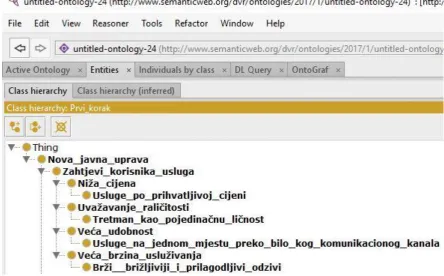
We use the Protégé editor, an open source platform to update the first necessary
knowledge (Figure 1): The first step is to create an appropriate e-m-Vision.
Key Characteristics and Commitments - What (the nature of the connections to be
established), Who (which entities will be interconnected), Where (where the e-m
Administration's apps will be located), and Why (which service initiatives will get priority).
2. 1. DEVELOPMENT AND CONSTRUCTION OF A CHAIN OF VALUE
The value of each job in the public administration gives the needs they meet, not the
services they offer. A new value chain degradation philosophy enables the public
administration to recognize the necessary service and, at the right time, offer it to the user.
The decommissioning requires the establishment, evaluation and fostering of a genuine core
of service. This approach enables the decommissioning of old structures, a detailed overview
of the basic possibilities of public administration and the identification of new forms and
sources of service quality. Interpretation allows the rejection of old paradigms, systems,
strategies, and classic services. The decision to reject a functional pattern of past service
requires great courage because it is risky, but the reward for this will be great.
Public administration must learn to accept the benefits of new emerging technologies.
They give, create and provide a new form of value, which service users will increasingly
demand from them.
Service users will require the public administration to:
• Increased service speed. Service can never be too fast. In real terms, current,
reassuring and flexible responses to the needs of service users are rewarded. Public
administrations that have visions accept the need for constant change and accordingly
demolish and re-shape their business processes and services, with the aim of faster service
delivery.
• More comfort. Users value the convenience of obtaining a service in one place via
any communication channel, at any time, and from any place. (Can the user imagine that the
service is offered at the very moment when he needs it. Can he imagine that the public
administration "thinks" about him, knows what he needs (maybe need) and what he should
offer at the right moment (immediately)).
• Respect for reliability. Users want the public administration to treat them as a
singularity. In the future, no services will be offered to give users little or no choice. New
technology gives public administration the ability to give users exactly what they want and
• Lower cost. There is no more talk about services at an "affordable price", only
integrated services go at an affordable price.
The ability to view the world from the perspective of the users of the visionary public
administration often saves the public administration from taking wrong steps and arriving at
the wrong destination.
Being "best" means restructuring the process of providing services in order to increase
their quality. Do not use new technology just to provide a service. They should be used to
enhance and enrich all the activities that surround the service.
The activity of the classical service user has time and geographical constraints for it.
The user must go to a particular administration body, at a given location and at a certain time
interval. However, the activity of On-line service provision is fundamentally different -
almost entirely virtual and independent of the site, and as such it must become known,
informative and usable.
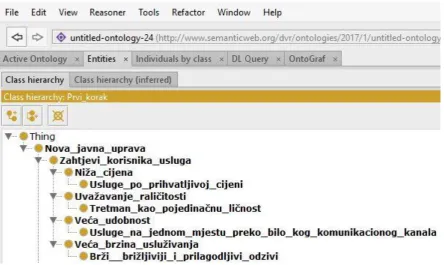
With the use of Protégé editors in the database, we introduce: What the users of
services require (Figure 2) - Higher service speed (faster, more careful and flexible
responses), Greater convenience (one-stop service via any communication channel), Respect
[image:6.595.106.551.420.696.2]for reliability individual peculiarity), Lower the price (services at an affordable price).
The basis of e-m-Service is integration. If a public service provides a service through
Web access points (portals, nodes), then Web applications must run all other applications in
the service chain. Full integration of service processes is not easy as it does at first glance.
Successful integration requires the redesign of existing applications and processes in order to
develop an integrated infrastructure that connects service applications with applications in the
internal processes. A good part of public administrations still do not have a fully integrated
infrastructure and therefore everywhere encounters inefficient processes and inflexible
applications. The lack of an integrated application architecture is not new, but the emergence
of e-m Services becomes crucial. In the traditional model of service, the service user had no
choice, so the public administration did not have the incentive to do its work differently. In
the new era, new forms of services leave users a much larger choice.
Problems of integrated infrastructure must be a priority for serving in public
administration. The growth and development of new technology solutions require the need to
redefine the service architecture. Public administrations that think ahead are beginning to
understand the problems ahead of them, and have to solve a number of problems before they
are ready to use all the opportunities offered by new technological solutions.
A good part of public administrations has reached the upper limit in automating
isolated functional processes, which in turn is becoming an e-m-service brake.
The new service climate requires that public administrations in their dealings with
their customers exude flexibility, zeal and show their internal connections.
3. VISION OF e-m ADMINISTRATION
A good part of public administration in the world has already implemented some
segments of electronic and mobile services. How should research be continued in this area?
It is necessary to look for ways to anticipate user and technology trends and imagine
new organizational forms that would optimally meet the needs of service users. Much of what
we find surprising and unpredictable is actually a series of events that are almost the same in
some public administrations. Once this pattern is met, we will be able to understand and
anticipate changes. Based on this understanding, we will be able to build a different
e-m-Strategy. Appropriate knowledge of social, economic and technical trends is also needed
Service users quickly change their search habits, especially using new technologies.
Recognizing the trend is not only a new possibility of the e-m-Rada public administration,
but also the recognition of new services and service ideas.
Here we suggest some trends (Radivojević M., 2012) that could lead public
administration to e-m-Management. The ability to look at these trends gives a better chance
of a better understanding of the opportunities ahead of the public administration. The most
important thing for public officials to look at is: what is the common thread that runs through
[image:8.595.73.518.443.708.2]all these trends. We follow the "Trends and Trends Categories" within certain categories
(Figure 3).
Service user: Faster services, Self-service, Larger selection of services, Integrated
solutions
Self-service: Integrated Services, Flexible compliance, Greater transparency of the
process.
Employees: Looking for the best and the smartest, Retaining talented staff.
Technology: Integrated applications, Integration of multiple channels, Mediation
applications between old and new software and equipment.
3.1 TURN TO USER TRENDS - fast service
Users value the prices of services that are cheap and obtained on time (fast). Such
services can be achieved by reducing the number of steps required to serve users. Users do
not like postponing services or waiting in line. As the available time of the user decreases, he
begins to crave more quickly on the On-line service. The message is clear: Public
administration must reduce the processing time of the service. Delay in any step of this
process is unacceptable, and it is most often due to poorly designed processes that contain a
lot of unnecessary ones.
The trend of e-m-Service is a change in the complete business model and this is the
only acceptable strategy.
In order to create innovative business solutions for e-m-Management, the first one
must be able to answer the following questions:
• What business solutions can contribute to making the service unusable and
unforgettable? While this is not easy, users have to offer new satisfaction and better service.
By evaluating each service process it is necessary to ask whether they meet the priority needs
of the users, not only today, but also in the near future and in the future.
• How to structure management to make service processes more efficient? To what
extent does public service itself provide services, and to what extent does the service shift to
reduce the service cycle? How do you deliver your service?
The preconditions that are placed before the efficient development of electronic and
mobile administration in order to operate it efficiently, ie providing complete electronic and
mobile services to citizens, business systems and other entities, are the following: Internet
access, adequate communication and information infrastructure of administration; databases
in electronic form; applications for processing, accessing and exchanging data; access points
for service execution; the security system that is viewed in accessing the service through the
appropriate security mechanisms (smart card sl.).
Fulfillment of the above prerequisites is, in fact, a list of activities that need to be
performed to enable the establishment and functioning of e-m-Management.
In order to fully implement the concept of e-m-Management, it is necessary to start
activities in two directions: increase of information literacy of citizens and construction of
4. MODERNIZATION OF LABOR
New technologies form the basis on which the development of modern administration
and society as a whole is based. They open up new opportunities for solving problems in the
provision of services, thus directly influencing the organization, the development of service
processes and their reengineering, and operational and strategic planning in public
administration. Among other things, new technologies enable:
• automation of service processes, which facilitates work, and increases the efficiency
and quality of services;
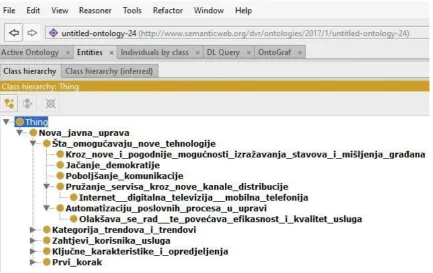
• providing services through new distribution channels (Internet, digital television,
mobile telephony), thus destroying spatial barriers;
• Improving communication within administration and administration with service
users;
• Strengthening democracy through new and more suitable possibilities for expressing
citizens' attitudes and opinions, etc.
One way to encourage active participation in exercising citizens' rights is to improve
access to information and services, this is one of the goals of the new e-m administration.
The model of the e-m administration should be developed in order to improve the
quality of the work of the administrative bodies and local self-government units, and to
enable greater participation of citizens in local issues and the economic development of the
local community.
The application of the good governance model, which implies customer orientation,
increasing the effectiveness, efficiency, transparency and citizen participation, can not even
be imagined today without the use of new technological solutions. Increased use of these
technologies and the advancement of the Internet have put powerful powerful tools at your
disposal to citizens, businesses, and local governments. Using new technologies, public
administration can improve services, making them faster, more accessible and more efficient,
and bringing business closer to citizens, business systems and other stakeholders.
Some of the opportunities provided by new technologies are presented in the
Figure 4. What new technologies allow
4. 1 IDENTIFYING PRIORITIES
The development of e-m-Management is a long-term, complex and costly process. It
requires large investments in hardware infrastructure on the one hand, and in applications on
the other. The development should take place according to the previously established
priorities. First, it is necessary to determine the most important services and implement them,
in order to develop lower priority services later.
Defining priorities involves evaluating broad opportunities and selecting the most
promising goals (Specht P., 2003). Clearly defined priorities allow them to allocate resources
and optimize service capabilities. They also enable the speed and development of services to
be achieved, that citizens are satisfied, and that the relationship between development time
and price is acceptable.
In order to properly evaluate the success of the project in the right way, it is necessary
to find and adopt the criteria for measuring the results at the very beginning. Some of them
are user satisfaction, quality of services, time and money savings, and citizens and public
The process of creating an e-m administration strategy is similar to the agreement of a
huge puzzle. Each element you agree most often initiates a large number of new problems
and solutions, which again need to be combined into a harmonious whole. Unlike a
hypothetical puzzle, creating an e-m-Solution requires simultaneous combination of multiple
disciplines:
- labor and service strategies,
- application to support work and service and
- introduction of technological solutions.
None of these disciplines is sufficient for itself. For the construction of high quality
digital solutions for fragmented service problems, synergy of all these disciplines is needed.
4. 2 SEL-SERVICE
An increasing number of service users now no longer take car keys to go for a
service, but increasingly take the computer keyboard or mobile device to do so. Users are
looking for solutions that can offer them self-service, which will not only save them time, but
also give them certain powers. If they seek information or service without the help of
administrative staff, then they are self-service solutions that are available 24 hours, 7 days a
week, and all 365 days. Under self-service, we mean the possibility for a user of the service
to provide for himself (for example, for example), for example for sending his birth
certificate to the authority or organization (where necessary).
This trend is expanding. Users want to get a service at any time and in any place, and
they can get this if the public administration has developed such services and if the user has
any way of accessing the Internet.
The lesson learned by the reform public administrations of the developed world,
which has enabled self-service to its users, is: e-m-Management has to focus on the user
rather than on technology. Public administrations that focus on e-m-administration strategy
on technology rather than on the user have Web access points so confused that users can not
guess how to get online services. In order to focus its attention on the needs of users,
management in public administration must pay attention to "overall activities". This can be
achieved if:
- the emphasis on simplicity, in joining each request with only one goal with
- remove web pages that are slow to load,
- remove error messages during the service process.
To realize a self-service trend is to achieve the e-m administration strategy. The
effects of the countries that adopted it (Canada, Singapore, USA, Estonia, ...) are good (West
D. 2013.). In order for this to happen, public administration must build a new infrastructure
and design new protocols that will modernize the self-service process. Integration of service
processes at the level of the administration, administrative organization or local
self-government unit is crucial for the quality service of users. The emergence of a smiling as a
key user requirement means that public authorities need to work quickly to integrate existing
applications, processes and equipment to enable this. However, it must be emphasized that
this is a very complex and difficult task.
CONCLUSION:
The way to a satisfied public service user is neither easy, nor simple, nor inexpensive.
The application of the good governance model, which implies user orientation, increase of
efficiency, efficiency, transparency and citizen participation, can not even be imagined today
without the use of new technologies (computer and mobile devices).
In this paper, we proposed a new concept of using a knowledge base that could
provide the necessary knowledge and public administration and users of its services. It was
not our goal to encompass all the knowledge, but only to suggest a different way to their
arrival. The next step would be to update the knowledge base and promote its greater use.
REFERENCES
1. Radivojević M., Nove tehnologije u reformi javne uprave, „Grafokomerc“ Trebinje,
2005.
2. Radivojević, M., Kremenović, O., 2012., Od elektronskog poslovanja do poslovne
inteligencije u javnoj upravi. JU Službeni glasnik Republike Srpske, Banja Luka,
ISBN 978-99938-22-28-8, COBISS.BH–ID 2411288.
3. Walton, D., 2007., Agency and the Semantic Web. New York, Oxford University
4. Gandhi S., Conrad C. E-Government Initiative At City Of Orlando: Current Trends
And FutureDirections. URISA 2001 Conference, October 2001.
5. Lee, T. B., Hendler, J. Lassila, O., The Semantic Web, Scientific American, May
2001
6. Specht P. H., The Impact of IT on Organizational Performance in the Public Sector. In
Handbook of Public Information. Marcel Dekker Inc, NY, 2003.
7. West D. M., Assessing e-Government: the Internet, Democracy, and Service Delivery
by State and Federal Government. Brown University Paper, 2013.
8. Haznadarević, L., Radivojević, M., 2016., The new Concept of the Theory of
Organitation Based on the Knowledge Bases and the Semantic Web, IJISET -
International Journal of Innovative Science, Engineering & Technology, Vol. 3 Issue