International Journal of Emerging Technology and Advanced Engineering
Website: www.ijetae.com (ISSN 2250-2459, ISO 9001:2008 Certified Journal, Volume 4, Issue 6, June 2014)
791
Modified Coin Identification Using Neural Network
Harveen Kaur
1, Neetu Sharma
21Student, M.Tech, ECE Dept., BGIET, Sangrur 2Assistant Professor, ECE Dept., BGIET, Sangrur
Abstract— In recent years there has been a growing trend of using neural networks for the development of intelligent systems that are able to simulate pattern recognition and object identification. Physical parameters of a coin are the sole criterion that is currently being used for Coin identification by machines. As physical features can easily be easily imitated another criterion which is not based on physical features but recognises the pattern of the coin helps preventing confusion between different coins of similar physical dimensions and against forgery.
The paper purposes a rotation-invariant coin identification system (RICIS) that adds the features of the physical properties like colour, radius and centre to recognize rotated coins by 5 degrees and at the same time advantages of pattern matching using a neural network and pattern averaging along with the physical features. This Rotation Invariant Coin Identification System, abbreviated as RICIS, firstly pre-processes the image, where meaningful representations of coin patterns are provided removing the background and the unnecessary data within the result images. In the second phase the coin pattern is learned when the optimized data is fed to a resilient back propagation neural network representing the coin images. RICIS has been successfully implemented as shown in this work to identify the 1, 2,5,10 rupee coins. This solves a real life problem where physical similarities between these coins led to slot machine abuse. An overall 99.4% correct identification of coins has been achieved.
Keywords— Digital Signal Processing, Feature Vector Table, Image Processing, Neural Network
I. INTRODUCTION
There are many coin operated equipment in the world such as an automatic machine for payment especially vending machine. Coins used in many countries have various patterns such as shape, size, surface design, weight etc. Some coins used in different countries have similar in size, weight and surface design but different value. Today in many parts of India, one rupee coin telephone booth is widely practiced. Any metal like that of the original coin’s measurement can be inserted in the coin box and the purpose can be solved.
That means if we give two coins one original and other replica having same diameter, thickness, weight and magnetism but with different materials to the mechanical method based system then it will treat both the coins as the original coin so these systems can be fooled easily. In the recent year’s image based coin recognition systems have also come into continued existence. The coin identification systems based on images can also be divided into two categories: method based on image registration and method based on feature vectors with rotation variation. In these systems first of all the image of a coin is taken with a digital camera or scanner etc.
In this paper, Coin identification using neural networks technique is proposed which is capable of collecting data and extracting features of Coin. In section 2, Coin identification techniques for coin images are reviewed. In section 3, The proposed Coin identification technique, including data and extracting the features is presented. In section 4, experimental results are provided to demonstrate the percentage of the technique. Finally, in section 5 the conclusion problem.
II. LITERATURE REVIEW
In 2010 Huahua Chen presented an approach for Chinese coin recognition based on unwrapped image and rotation invariant template matching. In this approach first of all coin segmentation is done using Hough transform then the segmented image is unwrapped. Unwrapping is done by transforming reference and specimen coin image from Cartesian coordinates to polar coordinates. After unwrapping, the template matching is done and on the basis of this recognition is done. Experiments were performed on 144 variably rotated coins images. Out of which 116 were correctly recognized. So, overall 80.6% correct recognition was achieved.
International Journal of Emerging Technology and Advanced Engineering
Website: www.ijetae.com (ISSN 2250-2459, ISO 9001:2008 Certified Journal, Volume 4, Issue 6, June 2014)
792 Then based on the radius a test image (rotated at certain fixed angle) from database is selected. Then coarse image subtraction between object and test image is done. Then, minima of the resultant image is checked if it is less than a specified threshold then fine image subtraction between object and test image is done otherwise new test image is selected. Then based on fine image subtraction, recognition takes place.
In 2011 Shatrughan Modi proposed Coins are integral part of our day to day life. We use coins everywhere like grocery store, banks, buses, trains etc. So it becomes a basic need that coins can be sorted and counted automatically. For this it is necessary that coins can be recognized automatically. In this paper we have developed an ANN (Artificial Neural Network) based Automated Coin Recognition System for the recognition of Indian Coins of denomination `1, `2, `5 and `10 with rotation invariance. We have taken images from both sides of coin. So this system is capable of recognizing coins from both sides. Features are extracted from images using techniques of Hough Transformation, Pattern Averaging etc. Then, the extracted features are passed as input to a trained Neural Network. 97.74% recognition rate has been achieved during the experiments i.e. only 2.26% miss recognition, which is quite encouraging.
In 2011 Velu C M et. al. proposed that to classify recently released Indian coins of different denomination. The objective is to recognize the coins and count the total value of the coin in terms of Indian National Rupees (INR). The system designs coin recognition which uses by combining Robert’s edge detection method, Laplacian of Gaussion edge detection method, Canny edge detection method and Multi-Level Counter Propagation Neural Network (ML-CPNN) based on the coin Table 1. In this paper, it is proposed to introduce ML-CPNN approach. The features of old coins and new coins of different denominations are considered for classification. Indian Coins are released with different values and are classified based on different parameters of coin such as shape, size, surface, weight and so on. Some countries’ coins are having same parameters, but with different value. This paper concentrates on affine transformations such as simple gray level scaling, shearing, rotation etc. The coins are well recognized by zooming processes by which a coin size of the image is increased. To implement the coin classification, code is written in Matlab and tested with simulated results. A method is proposed for realizing a simple automatic coin recognition system more effectively.
The Robert’s edge detection method gives 93% of accuracy and Laplacian of Gaussion method 95% of the result, the Canny edge detection method yields 97.25% result and the ML-CPNN approach yields 99.47% of recognition rate.
In 2013 Yamini Yadav proposed that Coins are a fundamental need of human life. They are used in everyone’s daily routine, like banks, transport, market and these spare change also has some other uses than getting traded in for cash like for measurement purpose, in games (toss), in organizations for research purpose, etc. So, it holds a great importance that coins can be detected with high accuracy. The Aim of a coin recognition system is to classify high volumes of coins with high accuracy within a short time span. In this paper we present a comparison between various coin recognition systems in terms of their accuracy. Different coin recognition approaches have been proposed by various researchers based on image recognition method. One can easily detect and recognizes coins with the help of these systems. Classification is based on images from both sides and a radius of the coin. On the basis of this literature survey we can say that image processing is the most effective method for coin recognition.
In 2013 Parminder Kaur proposed that the objective of this paper is to classify recently released Indian coins of different denomination. The objective is to recognize the coins and count the total value of the coin in terms of Indian National Rupees (INR).
In 2013 Suchika Malik proposed a reliable coin recognition system that is based on a registration approach. Coins are frequently used in everyday life at various places like in banks, grocery stores, supermarkets, automated weighing machines, vending machines etc. So, there is a basic need to automate the counting and sorting of coins. For this machines need to recognize the coins very fast and accurately, as further transaction processing depends on this recognition.
International Journal of Emerging Technology and Advanced Engineering
Website: www.ijetae.com (ISSN 2250-2459, ISO 9001:2008 Certified Journal, Volume 4, Issue 6, June 2014)
793 To date, no optical recognition system for coins has been researched successfully. In this project, the recognition of coins will be based on new algorithms of Polar Fast Fourier Transform and image processing, in a field – classification and identification of coins.
III. METHODOLOGY
A. Architecture for NN based Coin Identification System
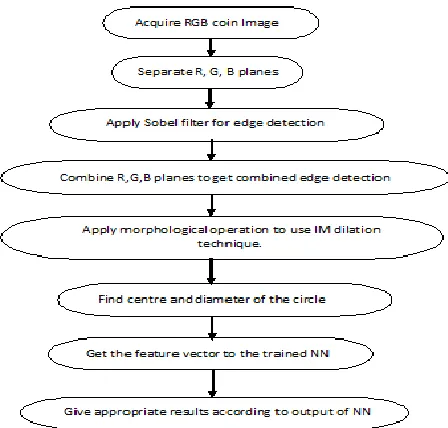
[image:3.612.341.558.135.327.2]The Coin identification process is divided into eight steps. The architecture of NN based coin identification system is shown in Figure 1.
Figure 1: Architecture Of NN Based Coin Identification System
B. Acquire RGB Coin Image
This is the first step of coin recognition process. In this step the RGB coin image is acquired. India. Different kinds of Indian coins for each denominations 1,2,5,10 will be taken and then preprocessed as shown in figure 2.
Figure 2: Indian Coins of different Denominations
C . Separate RGB plane to Red, Green and Blue planes
[image:3.612.55.279.284.498.2]From the first step the image we got is a 24-bit RGB image. Image processing of colored images takes more time than the gray scale images. So, to reduce the time required for processing of images in further steps it is good to convert the 24-bit RGB image to 8-bit Gray scale images. Hence we converted the coloured image to R, G, and B planes and took histograms for each.
[image:3.612.327.561.443.619.2]International Journal of Emerging Technology and Advanced Engineering
Website: www.ijetae.com (ISSN 2250-2459, ISO 9001:2008 Certified Journal, Volume 4, Issue 6, June 2014)
794
[image:4.612.76.274.128.704.2]Figure 4: Histogram for Red color
Figure 5: Histogram for Green colour
Figure 6: Histogram for Blue colour
D. Apply Sobel filter for Edge detection from Image and find colour ,centre, and radius.
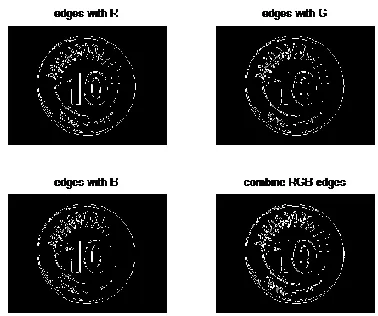
[image:4.612.352.541.227.385.2]In this step, shadow of the coin from the Gray scale image is removed. As all the coins have circular boundary. So, for removing shadow first of all edges of the coin are detected using Sobel Edge Detection for each of the three planes and then to get combine RGB edges.
Figure 7: Edges detected with Sobel Filter
The Combined image is then dilated using
morphological operations to link the images and then filled to segment the coin from the background. Again sobel filter is applied to find the edge of the circle. Along with that centre of the circle is also calculated.
Figure 8: Dilated Image of coin
[image:4.612.375.534.493.609.2]International Journal of Emerging Technology and Advanced Engineering
Website: www.ijetae.com (ISSN 2250-2459, ISO 9001:2008 Certified Journal, Volume 4, Issue 6, June 2014)
795
Figure 9: Object Detection
Figure 10: Boundaries of Object
Figure11:Centre of the circle
Now based on the center coordinates and radius, the coin is extracted from the back ground from original image
E. Generate Feature Vector
In this step, a feature vector is generated from the coin image. The coin images become the input for the trained neural network, along with the other features like diameter, colour , radius and the centre of the circle.
F.GIVE FEATURE VECTOR AS INPUT TO TRAINED NN
The feature vector from the above step is then passed as input to a trained neural network. This trained neural network classifies the coin into appropriate class based on which the output will be generated. MATLAB provides a Neural Network Toolbox with the help of which Neural Network for pattern recognition can be easily created.
IV. RESULTS
Neural networks have been created to recognize the coins based on the number of features used for recognition. For training and testing of both the networks following data has been used.
A. Training and Testing Data
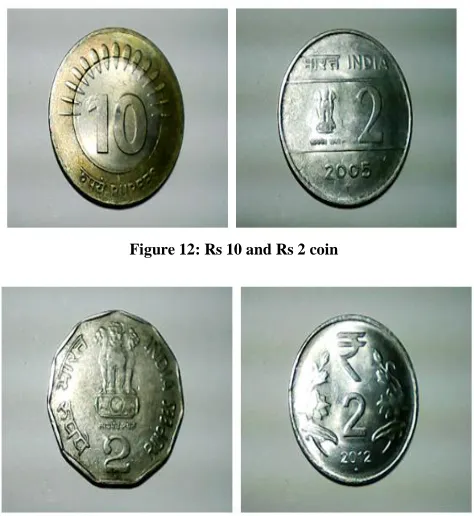
Five samples of each denomination of Indian coins are taken from digital camera. So, it results to 5 images for each coin. But for 2 and 5 three types of coins and 1 four types of coins are used. After pre-processing when we get images of 100×100 then these images were rotated to 50, 100, 150,….,3550 i.e. total 72 rotated images get generated for each image. So there are 20*72=1440 images for Rs.1, 15*72=1080 images for Rs.2 and Rs.5 but 5*72=360
images for Rs. 10. So there are total
[image:5.612.327.564.433.691.2]1080*2+1440+360=3960 images for the network.
Figure 12: Rs 10 and Rs 2 coin
International Journal of Emerging Technology and Advanced Engineering
Website: www.ijetae.com (ISSN 2250-2459, ISO 9001:2008 Certified Journal, Volume 4, Issue 6, June 2014)
[image:6.612.53.294.129.712.2]796
[image:6.612.52.290.140.290.2]Figure 10: Rs 1 different coins
Figure 14: Rs 1 different coins
Figure 15: Rs 5 different coins
Figure 16: Confusion Matrix
Fig.16 shows the confusion matrix of neural network. In confusion matrix Target classes are the classes to which the coin actually belongs and Output classes are the classes in which the coins get classified by trained NN. It is clear from the figure that 99.4% correct recognition has been achieved which is quite encouraging.
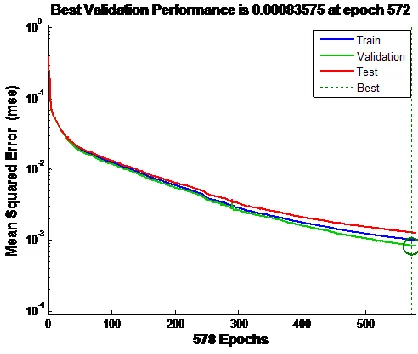
Graph1 : b/w mean squared error & 578 Epochs
Graph 1. Shows the performance of network for each training, testing and validation. The best validation performance is achieved at epoch 572.
V. CONCLUSION AND FUTURE WORK
This work presented a modified coin identification system that uses coin plane patterns and a neural network for identification of rotated coins .This Rotation Invariant Coin Identification System, abbreviated as RICIS, uses image preprocessing as its first stage. A resilient back propagation neural network receives the optimized data representing the coin images and learns the coin patterns in the second stage. RICIS has been successfully implemented as shown in this work to identify the 1, 2,5,10 rupee coins. This solves a true existence problem where physical similarities between these coins lead to opening machine misuse. However, RICIS can also be trained to recognize other coins providing it is trained using the additional coins previous to use. RICIS can be used as a support tool to standard physical measurements in opening machines. An overall 99.4% correct identification of coins has been achieved.
[image:6.612.332.541.212.389.2]International Journal of Emerging Technology and Advanced Engineering
Website: www.ijetae.com (ISSN 2250-2459, ISO 9001:2008 Certified Journal, Volume 4, Issue 6, June 2014)
797 So there are always chances for improvement so as to get better output from a desired system. Future work will centre of attention on training RICIS to identify all varieties of Indian coins in addition to of medieval and primeval India.
REFERENCES
[1] Chen. H., 2010.An approach for Chinese coin recognition based on unwrapped image and rotation invariant template matching. [2] Gupta. V. et al. , 2011.An approach based on image subtraction
technique for recognition of Indian coins.
[3] Modi. S., 2011.An ANN(Artifical Neural Network)based Automated Coin Recognition System.
[4] Velu C M et. Al, 2011. To classify recently released Indian coins of different denomination.
[5] Jain. N., Jain. N., 2012.Coin Recognition Using Circular Hough Transform.
[6] Yadav. Y., 2013.Coins are fundamental need of human life. , [7] Kaur. P., 2013.To classify recently released Indian coins of different
denomination.
[8] Malik. S., 2013.A reliable coin recognition system based on registrartion approach..