International Journal of Emerging Technology and Advanced Engineering
Website: www.ijetae.com (ISSN 2250-2459, ISO 9001:2008 Certified Journal, Volume 6, Issue 3, March 2016)
245
Performance Tests on CI Engine Using Chicken Feather as A
Bio-Diesel.
A. M. Arjun
1,
V. Deepan Chakaravarthy
2,
N. Sethuraman
3, S. Vinod Raj
4, R. Malayalattar
5 1,2Student-IFET College of Engineering,3,4,5Assistant Professor IFET College of Engineering Abstract-The main objective of our project is to reduce
the fuel consumption by using the bio-diesel and to compare the performance with the neat diesel. Nowadays with increase of population, they put demand on non-renewable resources. The disposal of Fatty chicken by the Human beings is high due to increasing health conscious. The chicken feathers are solid wastes that are not used. Therefore, waste chicken feathers should be changed into usable resources. This project is about extraction of bio-diesel from chicken feather. However, different animal waste can also use to prepare bio-diesel. This cost-effective process of bio-diesel from the chicken feather is by trans-esterification process. The Fatty Acid Methyl Esters (FAME) and glycerine were obtained. The obtained FAME to be tested for various parameters namely flash point, fire point and density, calorific value. My work is detailed investigation on Performance of the diesel engine with different blends of bio-diesel and diesel namely B10%, B20%, B30% and the obtained results compared to the neat diesel performance.
Keywords- Blend, Bio-diesel, Chicken feather, Diesel, Trans-esterification.
I. INTRODUCTION
Biodiesel is simply a liquid fuel derived from vegetable oils and fats, which has similar combustion properties to regular petroleum diesel fuel. Biodiesel can be produced from straight vegetable oil, animal oil/fats, tallow and waste cooking oil. Biodiesel is biodegradable, nontoxic, and has significantly fewer emissions than petroleum-based diesel when burned.
Biodiesel is an alternative fuel similar to conventional or “fossil/petroleum” diesel. The process used to convert these oils to biodiesel is called trans-esterification. This process is described in more detail below. The largest possible source of suitable oil comes from oil crops such as soybean, rapeseed, corn, and sunflower.
At present, oil straight from the agricultural industry represents the greatest potential source, but it is not being used for commercial production of biodiesel simply because the raw oil is too expensive. After the cost of converting it to biodiesel has been added, the price is too high to compete with petroleum diesel. Waste vegetable oil can often be obtained for free or already treated for a small price. One disadvantage of using waste oil is it must be treated to remove impurities like free fatty acids (FFA) before conversion to biodiesel is possible.
In conclusion, biodiesel produced from waste vegetable/animals oil and fats can compete with the prices of petroleum diesel without national subsidies.
II. BIODIESEL PREPARATION
A.Material Collection
The first process is to collect the feathers from poultry; the collected feather should be cleaned with water. Now the feather is ready for the boiling process.
B.Extraction Of Fat
The obtained feather should keep in pressure cooker with some amount of water (1 kg- 0.5 lt). At the constant temperature (1000C) the feather get boil for half an hour. After that fat will floated on the top layer of the water, shown in the Fig (I). The fat to separate from the water, and the feather to be disposed.
Figure I
C.Free Fatty Acid Test (FFA)
International Journal of Emerging Technology and Advanced Engineering
Website: www.ijetae.com (ISSN 2250-2459, ISO 9001:2008 Certified Journal, Volume 6, Issue 3, March 2016)
246
Free fatty acids appear as lipids breakdown products and are therefore good indicators of degradation. There are many types of free fatty acids. They can be differentiated by the length of the carbon chain, the presence and number of double bonds and the alignment of the carbons at the double bonds. The procedure for FFA test is given below. The 5gm of fat to be taken in a conical flask and add 50 ml of ethanol to it.
Heat the solution till the bubbles come. 50 ml of NaOH (0.1N) poured in the burette. Next Phenolphthalein indicator of 2 drops to be
added in the conical flask. Now the titration is to be started.
When the colour change occurs in the solution the titration to be stopped. It shown in Fig (II)
[image:2.595.332.530.366.562.2] Note the burette readings.
Figure II
The formula to determine the fatty acid is given below
FFA =
= = 1.76.
The obtained answer is less than 2. So, the trans-esterification process is to be conducted.
D.Trans-Esterifiaction
Trans-esterification is a process in which viscosity & density of oil can be reduced.
In the trans-esterification of animal fat, a triglyceride reacts with alcohol in the presence of either acid or base catalyst to produce a mixture of fatty acid alkyl ester and glycerol. In this process chicken fat is made to react with methanol in the presence of base catalyst (NaOH). The steps for trans-esterifiction process are given below.
E.Pre-Heating
1 lit of fat is to taken in a beaker.
Heat the fat up to 600C to remove the water content present in it.
The cool down the temperature of the fat.
F.Preperation Of Methoxide Solution
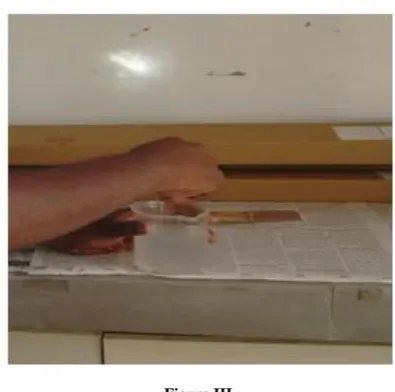
300 ml of Methanol is to be filled in a beaker. 4.5 gm of NaOH pallets is to be dissolved in the
methanol solution; it will act as catalyst for trans-esterification process.
The Meth oxide solution preparation is shown in Fig (III)
Figure III
G.Preparation Of Bio Fuel
The Pre-Heated fat is to be placed on hot plate. Maintain the temperature of 600-700C
Insert the stirrer into the solution as shown in the Fig(IV)
International Journal of Emerging Technology and Advanced Engineering
Website: www.ijetae.com (ISSN 2250-2459, ISO 9001:2008 Certified Journal, Volume 6, Issue 3, March 2016)
247
Figure IV
After the process completed glycerol and bio-fuel will be obtained.
After 24 hrs glycerol will be settled at the bottom of the beaker and the bio-fuel float at the top layer. Shown in Fig (V)
Then separate the glycerol and bio-fuel.
Figure V
H.Properties Of Bio-Fuel
Kinematic Viscosity. Flash Point.
Fire Point. Density. Calorific Value.
TABLE I
PROPERTIES BIO-DIESEL ASTM
STANDARD
Kinematic
Viscosity at 40
0C (mm2/s)
3 1.9-6
Flash Point0C 110 >93
Fire Point0C 125 >110
Density Kg/m3 883 (750-900)
Calorific Value 37000(KJ/Kg)
25000-43000(KJ/Kg)
III. METHODOLOGY
Phase separation study: Biodiesel and diesel was mixed with various ratios on volume basis. The various blends and their composition are given in Table (II)
TABLE II
S.NO DIESEL BIO-DIESEL
1. 90% 10%
2. 80% 20%
3. 75% 25%
International Journal of Emerging Technology and Advanced Engineering
Website: www.ijetae.com (ISSN 2250-2459, ISO 9001:2008 Certified Journal, Volume 6, Issue 3, March 2016)
248
TABLE III
Make Kirloskar
Bore 87.5 mm
Stroke 110 mm
Orifice Diameter 0.02 m
Rate Speed 1500 rpm
Compression Ratio 16:1
Coefficient of discharge
of orifice
0.64
BHP 10 HP
IV. RESULT AND DISCUSSION
In this section we investigate the performance characteristics of a high speed diesel engine at various loads from one fourth loads to full load fuelled with Chicken oil biodiesel and compared with standard diesel.
The performance test conducted in the single cylinder diesel engine the following procedure should followed.
The initial arrangements are done in the diesel engine.
The diesel is taken out from the fuel tank.
The blended mixer of diesel and biodiesels can be filled in the fuel tank.
The engine is started at the no load condition. We can note it down no load reading of monometer, fuel consumption, current and voltage and speed.
The following tabulation used to note the values by using the formula we can find the power outputs and varies efficiency. The ratios used for performance testing are,
100%diesel.
90% diesel and 10% bio-diesel. 80% diesel and 20%bio-diesel. 75%diesel and 25% bio-diesel.
V. PERFORMANCE CURVE
Figure VII
The comparison between Brake power and Thermal Efficiency shown in Fig (VII) it says that at the blending of B25 thermal efficiency increases when Brake Power increases. Where in other blends the thermal efficiency is low when compare to B25.
Figure VIII
International Journal of Emerging Technology and Advanced Engineering
Website: www.ijetae.com (ISSN 2250-2459, ISO 9001:2008 Certified Journal, Volume 6, Issue 3, March 2016)
249
Figure IX
The comparison between Brake power and Specific Fuel Consumption shown in Fig (IX) it says that at the blending of B25 Specific Fuel Consumption decreases when Brake Power decreases.
Figure X
The comparison between Brake power and indicated thermal efficiency shown in Fig (X) it says that at the blending of B25 indicated thermal efficiency increases when Brake Power increases. Where in other blends the indicated thermal efficiency is low when compare to B25.
VI. CONCLUSION
In our present work biodiesel production from chicken feather meal, which is a waste ingredient of poultry processing unit, provides us a new cheap raw material to produce biodiesel. It would be possible to optimize the conditions in terms of yield and purity. However, Bio-diesel can blend with commercial Bio-diesel at 25 per cent with 75 per cent of diesel to meet the current needs. It will become a major fuel resource in near future.
Following are the conclusions based on the experimental results obtained while operating twin cylinder diesel engine fuel with Chicken feather fat as biodiesel blends in different ratios with diesel fuel. The lower blends of biodiesel can be used in diesel engine without any engine modifications.
Brake thermal efficiency of B25 is superior to diesel at all load conditions, B25 gave best results so it could be considered as an optimum fuel blend in terms of performance. Biodiesel showed high brake specific fuel consumption than that of diesel for same power developed due to its lower calorific value.
Maximum 88% biodiesel production was found at 20% methanol, 0.5% NaOH and 550C reaction temperature. The maximum biodiesel production measured after 15 hrs. Thermal efficiency of biodiesel is almost similar to conventional diesel fuel. Efficiency of biodiesel (B10, B20) is 1% and 2% lower than diesel fuel due to low volatility, higher viscosity and density.
The properties like density, viscosity, flash and fire points of bio-fuel volumetric blends under test are higher, and calorific values are lower and are in the range of 94-96%that of diesel.
REFERENCES
[1] Swarup Kumar Nayak, Bhabani Prasanna Pattanaik “Experimental
Investigation on Performance and Emission Characteristics of a Diesel Engine Fuelled with Mahua Biodiesel Using Additive”
[2] Prema Kumarab, Abhishek Jain, Akash “Experimental
Investigation on Combustion, Performance and Emission characteristics of blends of Plastic oil and Biodiesel as a substitute fuels in Diesel Engine”
[3] Harish, Shashi Kumar, Dr. Rajanna, Prakash “Experimental
Investigation on the Performance and Emission Characteristics of Edible and Non-Edible Oil”
[4] Mahesh, Puttaiah “Studieson Performanceand Emission
CharacteristicsofNon-Edible oil (Honge oil) as Alternate fuel in CI engine”
[5] Aleem Amber, Aslam Fakhra, Shahid Ammara “Quantification of
fat in Chicken’s feather Meal for its conversion into Biodiesel”
[6] Banapurmath N.R, Tewari P.G, Yaliwal V.S, Satishkambalimath
and Bsavarajappa Y.S , “Combustion characterstics of a 4-stroke CI engine operated on Honge oil, Neem and rice bran oils when directly injected and dual fuelled with producer gss induction”
[7] Cherung-Yuan Lin, Rong-ji Li, “Engine performance and
emission characteristics of marine fish-oil bio-diesel produced from the discarded parts of marine fish” fuel processing technology90 (2009) 883-888
[8] Fernando. S, Development of a Novel Biofuel Blend Using
Ethanol-Biodiesel-Diesel Micro-emulsions: EB-Diesel Energy & Fuels 2004, 18, 1695-1703.
[9] Mahesh C.V, Puttaiah E.T, “Studies on Performance and
Emission Characteristics of Non-Edible oil (Honge Oil) as Alternate Fuel in CI Engine” International Journal of Engineering Research & applications (IJERA), vol. 2, issue 3, 2288-229, May-June 2012.
[10] MetinGumus, CenkSayin, Mustafa Canakci, “The impact of fuel
International Journal of Emerging Technology and Advanced Engineering
Website: www.ijetae.com (ISSN 2250-2459, ISO 9001:2008 Certified Journal, Volume 6, Issue 3, March 2016)
250
[11] PrommesKwanchareon, Apanee Luengnarue mitchai and Samai
Jai-In, “Solubility of a diesel biodiesel in ethanol blend, its fuel properties and its emission characteristics from diesel engine”
[12] Rasim Behçet, “Performance and emission study of waste
anchovy fish bio-diesel in a diesel engine” fuel processing technology92 (2011) 1187-1194
[13] Internal combustion Engine‖ by M.L.Mathur and R.P.Sharma.