International Journal of Emerging Technology and Advanced Engineering
Website: www.ijetae.com (ISSN 2250-2459,ISO 9001:2008 Certified Journal, Volume 4, Issue 9, September 2014)
840
An Efficient Retrieval of Cloud Data using ECIES Scheme
Tarun Soni
1, Piyush Singh
21Department of Software Engineering, RKDF Institute of Science Technology, Bhopal, India 2Asst. Prof., Department of Computer Science, RKDF Institute of Science Technology, Bhopal, India
Abstract— Cloud Computing is an important field area
for the access of information over internet. On one hand cloud computing provides efficient use of storage but the chances of accessing un-authorized data also increase. Although there are various techniques implemented for the retrieval of data from the cloud, but the technique implemented provides less security and computational time and storage. Hence an efficient technique is implemented using combinatorial method of ECIES which provides prevention from various attacks and also provides efficient retrieval of data.
Index Terms— Cloud, security, multi-keyword, cloud
computing, PAAS, SAAS.
I.INTRODUCTION
Clouds can be explained as pools of virtualized resources that can be easily used and accessed. For optimum resource utilization the resources in cloud can be reconfigured dynamically. With the help of strong cloud architectures its mass computing and storage centers organizations and individuals are benefited while utilizing them. Cloud computing basically contains virtualization, on-demand deployment, Internet delivery of services, open source software etc. [1]. With the help of internet and central remote servers cloud computing maintains data and applications. Cloud computing helps the consumers and businesses to use clouds applications and resources without installing and accessing the personal files on any computer through internet. Cloud Computing provides efficient computing by centralizing storage, memory, processing and bandwidth promising lower costs, rapid scaling, easier maintenance, service availability. The main focus needs upon the data security and privacy. Services provided by cloud computing are [2].
Services to large number of distinct end users in opposition to bulk data processing or workflow management for a single user.
Using the data model which consists of sharable units in which all data objects have access control lists (ACLs) with one or more users.
Developers are capable of running applications on a separate computing platform with physical infrastructure, job scheduling, user authentication, base software environment etc. and do not need to implement platform by themselves.
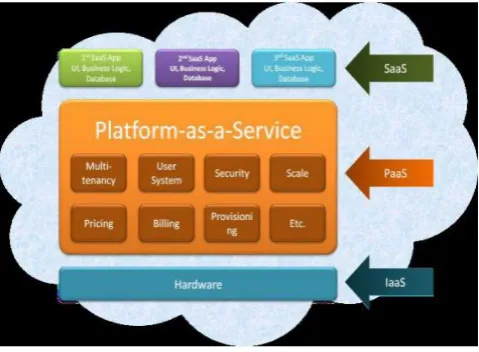
[image:1.595.320.560.362.538.2]In the present scenario IT sector is moving towards fast processing, fast computing and wider storage space. Cloud Computing provides IT solutions as a utility for various users. IT services organizations are moving towards providing of cloud computing services. Clouds consist of large datacenters spread over multiple infrastructure of the organization thereby having millions of servers. The concept behind cloud computing refers to usage of processing, memory and storage capability from computers that are shared and servers connected via Internet which follows principle of grid computing being executed at infrastructure level, platform level, development level and service level.
Figure 1. Cloud Computing Services
International Journal of Emerging Technology and Advanced Engineering
Website: www.ijetae.com (ISSN 2250-2459,ISO 9001:2008 Certified Journal, Volume 4, Issue 9, September 2014)
[image:2.595.49.283.207.416.2]841 Cloud computing environment enables the individuals and businesses to work with applications. The data stored of entity is stored maintained on shared machines in a web-based environment and is not physically located in organizations/individuals home or in corporate environment.
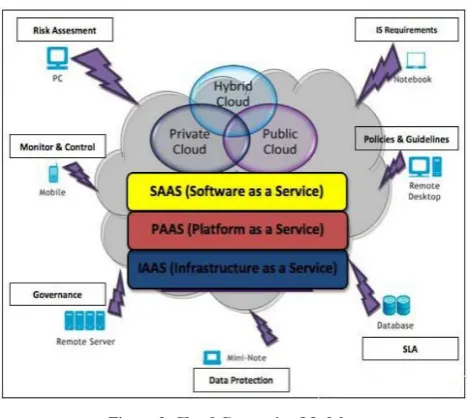
Figure 2. Cloud Computing Models
Cloud Computing is a model that enables convenient and on-demand network access with a pool of configurable computing resources in the form of networks, servers, storage, applications, and services etc. that are shared and can be provisioned and released without any management effort. Service provider has no relation and interaction while resources are being released and services being withdrawn. Cloud Computing is based on architecture which is responsible for providing various services and can be categorized into:
Infrastructure as a Service (IaaS) is foundation of cloud services providing clients to access server hardware, use storage services, bandwidth usage and information and other computing resources. Platform as a Service (PaaS) is build upon IaaS. It
provides clients to access basic operating software. It gives optional services for developing and use the software applications that are database access and payment service. These services are then not needed to be purchased and the computing infrastructure does not need to be managed.
Software as a Service (SaaS) is builds upon IaaS and PaaS providing clients to access the software applications [4].
II. LITERATURE SURVEY
Issa M. Khalil [5] et.al. remarked the benefits associated with clouds in the form of configurable computing resources, economic savings and service flexibility. They explained cloud concepts as multi-tenancy, resource sharing and outsourcing generating security challenges requiring tuning of security measures which proposes security policies, protocols etc. for cloud security challenges. They identified cloud vulnerabilities classifying security threats and attacks and presenting state-of-the-art practices for controlling vulnerabilities, neutralizing threats, calibrating attacks etc. They provided cloud security framework presenting lines of defense identifying the dependency levels. They identified multiple cloud security threats classifying them into categories. They surveyed cloud security issues like mis-configurations, malicious insiders, multi tenancy, side channels, weak browser security, mobility etc. classifying them into categories as security standards, network, access, cloud infrastructure and data. They also identified various attacks suggesting the countermeasures for them with analysis, study and short comings of the solutions giving the measures for cloud security attacks, intrusion detection systems, autonomous systems and federated identity management systems etc.[5]
Jiadi Yu [6] et.al. gave the services associated with cloud computing in the form of data outsourcing and data services. The data can be protected through data encryption but is not efficient. They explained that through Searchable symmetric encryption (SSE) encrypted data over cloud can be retrieved. They focused on data privacy issues related with SSE formulating the privacy issue from similarity relevance and scheme robustness observing leak in privacy of data on use of server-side ranking based on order preserving encryption (OPE). They proposed two-round searchable encryption (TRSE) scheme supporting top-k multi-keyword retrieval. They employed vector space model and homo-morphic encryption for providing search accuracy and enabling users to involve in ranking fulfilling security requirements of multi-keyword top-k retrieval and the work being done on server side through operations on cipher text thus eliminating information leakage and ensured data security [6].
International Journal of Emerging Technology and Advanced Engineering
Website: www.ijetae.com (ISSN 2250-2459,ISO 9001:2008 Certified Journal, Volume 4, Issue 9, September 2014)
842 They explained that with traditional techniques of searchable encryption users can securely search the encrypted data with the help of keywords but is not sufficient for data utilization in huge number of data files in cloud as it provide support only to Boolean search. With the help of ranked search they enhanced system usability through search result relevance ranking ensuring file retrieval accuracy. They measured relevance score for building secure searchable index and one to many order preserving mapping technique for protecting sensitive secure information. Their scheme facilitates server side ranking efficiency without the loss of keyword privacy. They solved efficient ranked keyword search problem and achieved effective utilization of remotely stored encrypted data in Cloud Computing. They investigated the efficient support of relevance score dynamics, the authentication of ranked search results and reversibility of our proposed one-to-many order preserving mapping technique [7].
W. Jansen [8] et.al. Presented that cloud computing serves people in different ways capable of doing multiple operations like on-demand scalability and reliability of available pooled computing resources, secure access to metered services, relocation or dislocating the data from inside to outside of the organization. They remarked the challenges of privacy and security associated with cloud computing and suggesting the measures for organizations to take while outsourcing data applications to public cloud. They explained that apart from the services provided by cloud computing it is also associated with privacy and security issues which are important for multiple organizations suggesting that public cloud computing is still important information technology solution set that organizations should adopt. It should be ensured that cloud computing solution is configured, deployed and managed for security and privacy concerns of organization preventing the data with policies in organization‟s cloud. They also suggested risk management tasks for assessing and identifying the risks i.e. managing the risks in cloud computing [8].
Ning Cao [9] et.al. remarked that for flexibility and economic savings data owners outsource complex data management systems to more commercial public cloud recognizing that this data needs to be encrypted for privacy protection removing the use of traditional approach for data utilization which was based on plaintext keyword search. They explained that cloud contains large number of files and documents thus should allow multiple keyword search and return documents in the order of their relevance to these keywords. They solved the problem of privacy preserving multi-keyword ranked search (MRSE). Their scheme consisted of efficient similarity measure of coordinate matching explaining that to capture relevance of data documents to search query all possible matches are considered.
They proposed MRSE schemes and presented the idea of MRSE on secure inner product computation. They evaluated similarity measure by inner product similarity. With the help of MRSE schemes they achieved stringent privacy requirements guarantying privacy and efficiency and low overhead on computation and computation [9].
Qi Zhang [10] et.al. explained that cloud computing provide holding and delivering services and eliminates the requirement for users to plan ahead for provisioning allowing organizations to start small and increase their resources when there is high demand for service. They recognized that technology of cloud computing is at its start consisting of some issues that are still being addressed therefore explained its architectural principles, state of the art implementation, research challenges, concepts, design challenges, research directions etc. They gave that cloud computing has turned utility computing into reality. They focused their research on automatic resource provisioning, power management and security management. They explained that cloud computing provides several features making it attractive to business owners in the form of lowering operating cost, no up-front investment, high scalability, easy access, reducing business risks and maintenance expenses [10].
M. A. Vouk [11] et.al. explained that cloud computing is the result of research in fields of virtualization, distributed computing, utility computing, networking, web, software services etc. giving service oriented architecture, has reduced information technology overhead providing flexibility, on demand services, owner cost etc. They remarked the issues associated with cloud computing and presented cloud implementation based on VCL technology. They explained the components and concepts of cloud computing like computing through service oriented architectures (SOA), component-based system engineering, orchestration of multiple services through workflows, virtualization etc. They gave that cloud computing with the help of Cyber infrastructure has increased efficiency, quality, reliability among applications by determining the common features in application need providing efficient sharing of services and equipments among the applications [11].
III.PROPOSED METHODOLOGY
The proposed methodology works on the following four phases:
1. Setup
International Journal of Emerging Technology and Advanced Engineering
Website: www.ijetae.com (ISSN 2250-2459,ISO 9001:2008 Certified Journal, Volume 4, Issue 9, September 2014)
843
Setup phase & Key Generation
During the setup of the proposed methodology the parameters of the cloud needs to be initialize such as users, brokers and data centres as well as the physical characteristics of the cloud also needs to be setup.
Since Elliptic Curve Cryptography is used here for the generation of public and private keys, hence the basis elliptic curve equation of the form:
Here sender and receiver need to select a private random point on the elliptic curve and a common base point G. From the generated private and Base point public key is generated using,
Where, „x‟ is the private key and G is the common base point and „y‟ is the public key.
Encryption
For the encryption of the message with a keyword „K‟ using public key that can be derived from string „str‟. For every string that contains a keyword and data and time known as „str‟. First of all generate a public key for the known bit string and applying identity based encryption to obtain ciphertext „C‟.
Decryption
The receiver for the decryption of the ciphertext „C‟ uses his private key to generate original message m‟.
Algorithm
1.Setup the cloud environment with a number of users and data centres and brokers having their individual physical characteristics.
2.User „Ui‟ when sends the data to the data centre will generate a keyword and create a string ‟str‟. 3.User „Ui‟ using his public key encrypt the data and
send to the storage repository in the form of tupple (keyword, cipher text).
4.User „Ui‟ also allots a unique id and password for the receiver for the access of the data.
5.Te receiver needs to authenticate first for the data to access.
6.After authentication receiver „R‟ sends query in form of keyword to the central authority where on the basis of keyword the queries are fetched with the match keyword.
7.Receiver accesses the data in encrypted form and performs decryption using private key.
8.Receiver also verifies the message is valid or not using Message Authentication Code.
Flow Chart
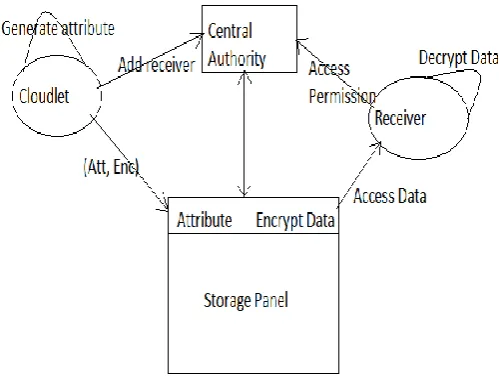
The figure shown below is the flow chart of the proposed methodology, it contains a number of users central authority known as broker and receiver or data centre. First of all users can generate data and also generates attribute for the generated data from user and send to the storage panel. The user also adds receiver for authentication. The receiver then access data using attribute and decrypt the data using ECIES.
Figure 3. Flow Chart of the methodology
IV. RESULT ANALYSIS
[image:4.595.316.566.265.457.2]The table shown below is the analysis and comparison of existing and proposed work. The analysis is done on the basis of number of keywords and computational time to access these keywords.
Table 1
Comparison of Time on No. of Keywords
Time (ms)
No. of
Keywords
Existing
Work
Proposed
Work
500
21
9
1000
38
14
1500
43
23
2000
64
37
2500
75
48
3000
85
59
3500
93
66
International Journal of Emerging Technology and Advanced Engineering
Website: www.ijetae.com (ISSN 2250-2459,ISO 9001:2008 Certified Journal, Volume 4, Issue 9, September 2014)
[image:5.595.49.293.189.446.2]844 The figure shown below is the analysis and comparison of existing and proposed work. The analysis is done on the basis of number of keywords and computational time to access these keywords.
Figure 4 Time Vs No. of Keywords comparisons
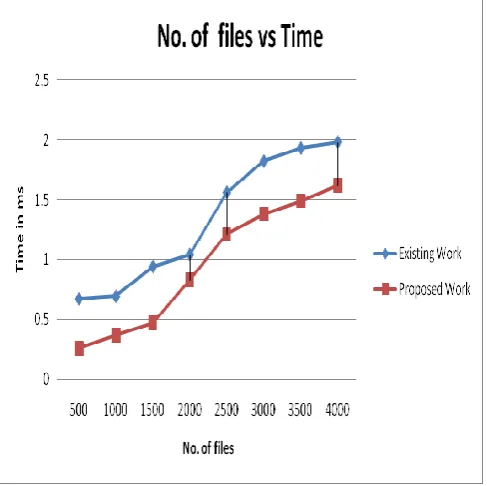
The figure shown below is the analysis and comparison of existing and proposed work. The analysis is done on the basis of number of files and computational time to access these keywords.
Table 5 Comparison of Time on No. of files
V.CONCLUSION
The proposed methodology implemented here for the retrieval of encrypted data using ECIES is efficient in terms of retrieval rate and security and storage cost and computational time. The existing technique implemented for the retrieval of encrypted data suffers from various attacks and the proposed scheme guarantees data privacy. According to the efficiency evaluation of the proposed scheme over a real data set, extensive experimental results demonstrate that our scheme ensures practical efficiency, but the technique implemented here prevents from the above issues hence performance is better as compared to the existing technique.
REFERENCES
[1] Pankaj Arora, Rubal Chaudhry Wadhawan and Er. Satinder Pal Ahuja “Cloud Computing Security Issues in Infrastructure as a Service”, International Journal of Advanced Research in Computer Science and Software Engineering, 2012.
[2] Dawn Song, Elaine Shi, Ian Fischer and Umesh Shankar “Cloud Data Protection for the Masses”, IEEE 2012.
[3] P. Shanmuga Priya and R. Sugumar “Multi Keyword Searching Techniques over Encrypted Cloud Data”, IJSR, 2014.
[4] Kim-Kwang Raymond Choo “Cloud computing: Challenges and future directions”, 2010.
[5] Issa M. Khalil, Abdallah Khreishah and Muhammad Azeem “Cloud Computing Security: A Survey”, Computers, 2014. [6] Jiadi Yu, Peng Lu, Yanmin Zhu, Guangtao Xue and Minglu Li
“Toward Secure Multikeyword Top-k Retrieval over Encrypted Cloud Data”, IEEE Transactions on Dependable and Secure Computing, 2013.
[7] Cong Wang, Ning Cao, Kui Ren and Wenjing Lou “Enabling Secure and Efficient Ranked Keyword Search over Outsourced Cloud Data”, IEEE Transactions on Parallel and Distributed Systems, 2012.
[8] Wayne Jansen and Timothy Grance “Guidelines on Security and Privacy in Public Cloud Computing”, Draft NIST Special Publication, 2011.
[9] Ning Cao, Cong Wang, Ming Li, Kui Ren and Wenjing Lou “Privacy-Preserving Multi-keyword Ranked Search over Encrypted Cloud Data”, 2010.
[10] Qi Zhang, Lu Cheng and Raouf Boutaba “Cloud computing: state-of-the-art and research challenges” Springer, 2010.
[image:5.595.50.294.516.759.2]