International Journal of Emerging Technology and Advanced Engineering
Website: www.ijetae.com (ISSN 2250-2459,ISO 9001:2008Certified Journal, Volume 4, Issue 1, January 2014)
204
Pollution Under Control Using Optical Character Recognition
Vidya V.Palve
1, Sanjay.V.Patil
21
M.E Student, 2Asso.Prof., (Electronics &Telecommunication), J.T.Mahajan College of engg.Faizpur. Abstract—Theon road vehicle population in India is
growing at an exponential rate. Hence the condition and roadworthiness of many on-road vehicles are highly unsatisfactory leading to higher exhaust emissions and road accidents.
Pollution Under Control (PUC) is the existing system of periodic I&M in India which is a mandatory requirement for all categories of on-road vehicles including two wheelers. Under this system the PUC certificate is issued for a vehicle upon conformity to emissions based on idle test for Gasoline vehicles and free acceleration smoke test for diesel vehicle. This manual process may result in some hindrances. So we are thinking about automating the above mentioned process.
In our system a web cam would be placed which would capture the image of the vehicle’s number plate. The captured image by the camera would be converted into text using optical character recognition. Further in our system we would be using a sensor to detect the amount of CO emitted by the vehicle. This value would be sent to the software whichwould save it along with the vehicle number. The entire software system would be developed in Mat lab (using OCR)
Keywords— Air pollution, Exhaustemission, License plate recognition, Matlab, OCR, PUC test.
I. INTRODUCTION
The vehicle population in India is growing at an exponential rate and is fast approaching the 50 million mark.
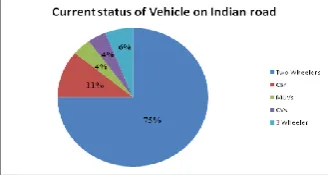
[image:1.595.350.510.420.519.2]The Majority of the in-use vehicles aretwo wheelers (75%).There are around 5 million cars, 4.5 million three- wheelers, 2 million goods vehicles and over 0.65 million buses playing onIndian roads. Thesituation and roadworthiness of many on-road vehicles are highlyunsatisfactoryleading to higher exhaust emissions and road accidents.
Figure I-Current status of Vehicles on Road.
It is time that effective measures are initiated to reduce emissions from in-use fleet of vehicles. Properly designedInspection and Maintenance system has proved to be the most effective tool for reducing emissions and improving roadworthiness of the vehicles.
[image:1.595.82.249.615.704.2]The aim of the project is to present the more efficient way of PUC testing for vehicles by using OCR (OpticalCharacter Recognition) based system. Here we used a system at PUC centers to retrieve CO gas concentration and simultaneouslyidentify vehicles by their license plates by using OCR software tool thepresent PUC system falls short of achieving the goal of emission reduction from on-road vehicles besides having technical limitations, with some associated disadvantage of false passes and compliance. Considering all these limitations into account and realizing the need for improvement in the present system we designed a system which willimprove the current PUC system above ninety percent.
Figure II -Current Pollution Status of Vehicles on Road.
II.PRESENT PUCSYSTEM –LIMITATION
Thepresent PUC system has following limitations
1.Fewer testing facility.
2.Limited number of trainedvehicle inspectors. 3.Equipment’s neither maintained nor regularly
calibrated.
4.Proper test procedure not followed.
5.No well-definedcriteria for authorizing /registering PUC Center.
6.No auditing of existingPUC Center.
7.Lack of centralized authority for Co-ordination. 8.Less number of vehicles undergoing PUC test due
to absence of control Mechanism to identify vehicles escaping PUC.
International Journal of Emerging Technology and Advanced Engineering
Website: www.ijetae.com (ISSN 2250-2459,ISO 9001:2008Certified Journal, Volume 4, Issue 1, January 2014)
205
III. LITERATURE REVIEWSo many researches of PUC testing (Emission Inspection system) & vehicle identification have been approached by license plate extracting and recognition. Some of the researched work is as follows. [1]Described the review of Indian PUC testing forvehicles and survey of different methods of license plate recognition. This paper presentedCurrent PUC system and its limitation,this paper concluded that, at any R.T.O. authorized P.U.C. center, and the concerned officer has to manually enter the vehicle number and the CO value emitted by the vehicle. This manual process may result in some hindrances. The paper suggested automated PUC system using most efficient optical character recognition tool. It makes character recognition quick and easy. [2] Described Inspection /Maintenance and Certification System for in use vehicles. The Society of IndianAutomobile Manufacturers (SIAM) has proposed a computerized emission inspection system to replace the existing PUC system in India. The main aim of the system is to bring liability and reduce false passes in the process. The proposed system in fact intends to reduce the human touch involved in the current PUC system and thus reduce malpractices which otherwise exist in the current system.
The testing procedure still remains based on idle tests only. In this system the gas analyzer is connected to a computer, which has a printer and a web camera connected to it. The emission values from the gas analyzer are directly sent to the computer and simultaneously photograph of the number plate as identification of the vehicle is captured by the web camera. This emission data are to be stored in the computer and sent to the required departments on-line.
SIAM has set up model-computerized emission checking centers in five major cities as demonstration projects and is in the process of setting up few more centers. The state transport departments are closely monitoring these centers and cities like Delhi and Bangalore have shown interest in preparing a road map for converting all the existing PUC centers to computerized one.
[3] Presented the way of PUC testing for vehicles by designing a microcontroller based system. They designed a system which is connected to PUC analyzer present at PUC centers to retrieve gas concentration, andtransfer the data to the server to maintain database .This system consists of the Smart Card Reader. The smart Card consists of the information related to the vehiclelike Engine number, Chassis number, ‘barcode’ etc.[4] ProposedEmission Model Development Using In- Vehicle On- Road Emission Measurements. On-road Emission Measurement (OEM) is emerging as a feasible alternative for collecting emission data in the field.
This paper describes how OEM data can be utilized to develop emission models that are suitable for estimating instantaneous mobile source emissions. To identify vehicles by their license plates some well-known schemes were used. [5]This paper presents an efficient method for LPR. This method utilizes a template matching concept. This LPR system can only be practical on the front view and rear view orientation of the license plates. The methodology is suitable for both Indian license plates and foreign license plates. The algorithm was tested with 10 images such as images taken from parking lots and roadside. The license plates that was successfully located and segmented as 80% and 87.5% respectively. The recognition rate of character using template matching method is 97%. Overall performance of the system is 88.16%. The total processing time of the system is 298ms.
International Journal of Emerging Technology and Advanced Engineering
Website: www.ijetae.com (ISSN 2250-2459,ISO 9001:2008Certified Journal, Volume 4, Issue 1, January 2014)
206
[12] Algorithm for vehicle license plate identification is proposed, on the basis of a novel adaptive image segmentation technique and connected component analysis incombination with character recognition Neural Network. [13] In order to reach the necessary processing speed, a simplified Stauer-Grimson background estimation algorithm has been used; a basic pixel-by-pixel comparison OCR algorithm has also been used. [14]Presented a recognition technique based on Support Vector Machines. Multi-class SVMs are developed to classify the given number plate candidate. [15]Proposed boundary line method combining the Hough transforms and Contour algorithm. This method optimizes speed and accuracy in processing vehicle images taken from various positions. They used horizontal and vertical projection to separate plate numbers in vehicle license plate segmentation module. Finally, license plate number recognized byOCR module implemented by Hidden Markov Model.IV. PROPOSED PUCSYSTEM
AT any R.T.O. authorized P.U.C. center, the concerned officer has to manually enter the vehicle number and the CO value emitted by the vehicle. This manual process may result in some hindrances. So we are thinking about automating the above mentioned process.
In our system a web cam would be placed which would capture the image of the vehicles number plate. The captured image by the camera would be converted into text using optical character recognition. Further in our system we would be using a sensor to detect the amount of CO emitted by the vehicle. This value would be sent to the software which would save it along with the vehicle number.
A. Advantages of proposed system using OCR.
1. Reductions in exhaust emissions from in-use vehicles.
2. Reduction in fuel consumption.
3. Source of database on emissions performance of on-road vehicles.
4. Identification and accountability of on-road vehicles. 5. Securing smooth road traffic of motor vehicles.
6.
Enhancement of user’s awareness for vehicle safety and pollution control.7. Enhance vehicle life.
B. Elements of proposed PUC using OCR.
PUC using OCR systems normally consist of the followingelements:
1. Camera:-Takes image of a vehicle from either front or rear end. (16 mega pixel camera)
2. Computer: -Normally a PC running Windows is used. It runs the License Plate Recognition application that controls the system, capturesthe images, analyzes and identifies the License plate, and interfaces with other applications and systems. 3. Hardware:-PC, Gas Sensor mq7 (CO sensor), at
mega16 processor.
4. Software tool: -Optical Character Recognition using template matching(Mat lab )
5. Database: -The events are recorded on a local database or transmitted over thenetwork. The data consist of the recognition results of the vehicle.
V.HARDWARE
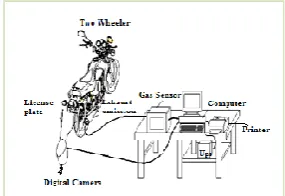
The testing procedure of proposed PUC system is based on idle tests only. The general layout of the computerized PUC testing system is given in Figure-III.In this system the CO sensor is connected to a computer, it has a web camera andprinter attached to it. The emission values from the CO sensor are directly sent to the computer and simultaneously photograph of the number plate as identification of the vehicle is captured by the 16 mega pixel camera. Thisexhaustemission data areto be stored in the computer for database.
[image:3.595.360.503.520.618.2]Then interfacing that picture with the data is to be stored in the computer and the printout of the PUC certificate is given by the printer.
International Journal of Emerging Technology and Advanced Engineering
Website: www.ijetae.com (ISSN 2250-2459,ISO 9001:2008Certified Journal, Volume 4, Issue 1, January 2014)
[image:4.595.89.239.136.372.2]207
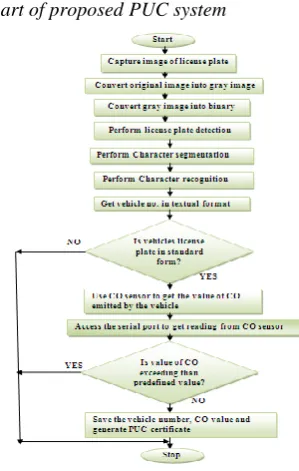
A. Flowchart of proposed PUC systemFigure IV-Flowchart of proposed system
B. Emission Limits for PUC:
[image:4.595.373.506.182.297.2]The present & proposed exhaust emission limits for compliance to PUC certification is outlined in Table-1. At present in India the PUC testing is based on idle tests for gasoline vehicles and free acceleration smoke tests for diesel vehicles.
Table 1
Present and proposed PUC limit
C. Important Specification of license plate
All letters of the License plateregistration number shall be in English and the figures shall be in Arabic numerals and the letters & figures shall be painted in reflecting colours.
1.In case of transport vehicles other than those under the rent a cab scheme 1989 registered in black on white ground.
2.In the case of motor vehicles temporarily registered in red on yellow ground.
3.In the case of motor vehicles in the possession of dealer in white on a red ground.
4.In other cases, in white on a black ground.
5.In the case of transport vehicle under rent a cab scheme, 1989, in yellow on a lack ground.
Table II Dimension of License plate
All thosemotor vehicles with registration number plates not accordance to the standard specifications will be penalized. So vehicle's registration number plate is in accordance with the given specifications.
VI. SOFTWARE
License plate recognition concept is an image processing technology used to recognize vehicles by only their license plates.
The proposed algorithm consists of four major parts: License plate preprocessing, License plate detection, Character segmentation and recognition of plate characters. The main purpose of this algorithm is to develop a system that can extract the license plate number from input images has been captured relative to the high resolution camera. After the vehicle image is captured by camera it will be passed to a pre-processing unit which prepare image for further processing by the system. Its main function is to eliminate the noise caused by the image-acquisition subsystem. The image will be scanned by plate detection module to locate the desired vehicle’s license plate. The next stage is responsible for segmenting the individual character of the plate. Finally each character will be passed to the Optical Character Recognition (OCR) tool to be identified and the final result is ASCII characters and numbers of the plate.
FigureV - Flowchart of License plate recognition system
A. Capture vehicle image
The original image of the vehicle license plate is captured using a16 mega pixel high resolution photographic camera.
Vehicles Types
Present PUC Limits
Proposed PUC Limits
Co HC CO HC
Gasoline (4-wheeler)
3% - 0.5%* 750*
2/3-wheeler 4.5% - 3.5% 9000
[image:4.595.69.240.485.594.2]International Journal of Emerging Technology and Advanced Engineering
Website: www.ijetae.com (ISSN 2250-2459,ISO 9001:2008Certified Journal, Volume 4, Issue 1, January 2014)
208
Figure VI-Captured image (original image)B. License plate preprocessing
Preprocessing is the set ofalgorithm applied on the original image to enhance the image quality. It is an important and generalprocedure in any computer vision system. For the present system preprocessing involves three processes:
Resize – The vehicle’s captured image size from the camera might be large and can drive the system slow. It is necessary to be resized to a practicable aspect ratio.
Convert Color Space – The vehicle images captured using photographic cameras will be either in raw format or converted into some multimedia standards. Normally, these images will be in RGB form, with three channels (viz. red, green and blue) Number of channels defines the amount color information available on the vehicle image. The image has to be converted to grayscale.
Figure VII- Gray image.
Localize - The vehicle captured image certainly contains other parts of the vehicle and the environment, which are of no requirement to the system. The interested area in the imageis the license plate and needs to be localized from the noise. Localization is basically a process of finalize the image. As shown in FigureVIII .The image is converted to black and white. There are two motivations or this operation –
1. Highlighting characters. 2. Suppressing background.
This phase is used to eliminate the shadows or dirt in the license plate region and convert the gray scale image to a binary form. In this paper a binary technique called Otsu algorithm is used for binarization.
The Otsu’s method is used to convert each block to binary form. Otsu’s method searches for the threshold that minimizes the intra-class variance.Image thresholding classifies pixel in two categories, those to which some property measured from the image falls below a threshold, and those at which the property equals or exceeds a threshold.
Figure VIII-Binary image.
C. License plate detection
After the license plate is processed with the binary method the system steps into detection part. The result of the detection is the key to the following work and directly affects the performance of the entire system. This phase marks the license plate in the image and helps to extract the license plate for the later part of the recognition system. Connected component analysis (CCA) is a well-known technique in image processing that scans an image and labels its pixels into components based on pixel connectivity (i.e., all pixels in a connected component share similar pixel intensity values) and are, in some way, connected with each other (either four-connected or eightconnected). Once all groups have been determined, each pixel is labeled with a value according to the component to which it was assigned. CCA works on binary or gray-level images, and different measures of connectivity are possible. For thepresent application, CCA with eight connectivity has been applied to binary images.
Figure IX-DetectedLicense plate.
D. Segmentation
In segmentation process the license plate is segmented into its constituent parts obtaining the characters individually. This is an important phase in LPR system to perform the character recognition. The same method used for license plate detection is used in this phase.
Figure X-Segmented Character
E. Character Recognition
International Journal of Emerging Technology and Advanced Engineering
Website: www.ijetae.com (ISSN 2250-2459,ISO 9001:2008Certified Journal, Volume 4, Issue 1, January 2014)
[image:6.595.365.526.128.267.2]209
Figure XI-Templates used for template matching.Template matching technique is mainly used for classifying objects. Templates are mainly often used to recognize printed characters, numbers and small other objects. In template matching method templates are correlated with the source image. Correlation is a measure of degree to which two variables agree. The variables are the corresponding pixel values in two images, template and source. The correlation value is between -1 and +1. Higher the correlation value means strong relationship between the template and source image.
VII. PERFORMANCE OF THE PUCSYSTEM AND
PROBLEM ANALYSIS
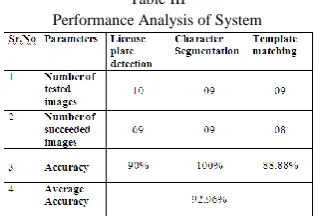
[image:6.595.71.254.132.249.2]In this project, The two important parameters are taken in to account for issue the PUC certificate are percentage of emission and license plate recognition of the vehicle. The hardware is implemented by PC, Gas Sensor mq7 (CO sensor), at mega16 processor. The LPR system was tested on a Microsoft Windows 7 operating system, Dual core processing unit and 4 GB RAM. The software implementation was realized using MATLAB R2009. Table III shows the performance result. The system was tested with 10 images. Image database consists of all Indian license plates. It is difficult to locate the Indian license plate because the aspect ratio and area of Indian license plates are different.
Table III
Performance Analysis of System
The graphical representation of Accuracy of License plate recognition process is given below.
Figure. XII- LPR Accuracy chart of proposed system.
Proposed PUC certificate is shown in figure XIII .
Figure XIII. PUC Validity certificate
VIII.FUTURE IMPROVEMENT
The intelligent software system can be developed which analyzes the data at RTO server and produces results in graphical form at any time which gives better understanding of the situation
The system can be implemented to Establish a strong database of vehicles tested, which can be made use of by the government authorities for taking policy decisions.
IX. CONCLUSION
The existing system of PUC in India in fact falls short of its objectives-be its emission reduction or enhancing roadworthiness of vehicles thereby bringing down road accidents.
It is time now that the whole system is revamped and a more realistic and scientific system is put in place.
Here we are attempted to develop a authenticated system for emission testing. Inspection& Authentication system for vehicles is no doubt an important tool for eliminating corruption in the present system and reducing exhaust emissions from on-road vehicles.
[image:6.595.85.246.595.704.2]International Journal of Emerging Technology and Advanced Engineering
Website: www.ijetae.com (ISSN 2250-2459,ISO 9001:2008Certified Journal, Volume 4, Issue 1, January 2014)
210
matching method is 88.88% and Average accuracy of the system is 92.96%.REFERENCES
[1] VidyaV. Palve , Sanjay V.Patil”Review of Pollution Under Control using OCR”International Journal of Emerging Technology and Advanced Engineering, pp.234-238, volume 3, issue 12 Dec 2013.
[2] Inspection/Maintenance and Certification System for In-use Vehicle adopted from the proceedings of theUNDESA/UNESCAP “GITE Regional Workshop on I&M in Asia” held in Bangkok, and a training programme on “Automobile & Environment” held in Japan organized by JICA/JARI. December 2001.
[3] Prachi Rajarapollu1, Sanjay Khonde,” Design & Analysis of Microcontroller Based Emission Inspection System for Vehicles” International J. of Recent Trends in Engineering and Technology, Vol. 3, No. 4, May 2010,pp.62-65.
[4] Rakha, Ahn, El-Shawarby, and Jang,” Emission Model DevelopmentUsing In-vehicle On-Road Emission Measurements, pp.1-25
[5] Divyagilly, Dr. Kumudharaimond,” License Plate Recognition- a Template Matching Method” International Journal of Engineering Research and Applications (IJERA) ISSN: 2248-9622 Vol. 3, Issue 2, March -April 2013, pp.1240-1245
[6] I-Chen Tsai, Jui-Chen Wu, Jun-Wei Hsieh, and Yung-Sheng Chen.”Recognition of Vehicle License Plates from a Video Sequence”IAENG International JournalofComputerScience, 36:1, JCS_36_1_04.2009.
[7] KripaIyer,”An Automatic & Robust Vehicle License Plate Recognition System” 978-1-4244-1674-5/08 /$25.00 ©2008 IEEE CIS 2008.
[8] Othman khalifa, Sherozkhan, Rafiqul Islam and AhemadSuleimanKulliyyah,”AMalaysian VehicleLicense Plate Localization and Recognition System” The International Arab Journal of information technology vol.4, no.4October 2007.pp-359-364.
[9] VelappaGanapathy, Wenlik Dennis,” A Malaysian Vehicle License Plate Localization and Recognition System”.
[10] K.M.Sajjad,”Automatic License Plate Recognition using Python and Open CV”.
[11] SerkanOzbay, and Ergun Ercelebi,” Automatic Vehicle identification by Plate Recognition” World Academy of Science, Engineering and Technology 2005.
[12] C.N.Anagnostopoulos, I. Anagnostopoulos, V. Loumos, andE. Kayafas,”A license plate recognition algorithm for Intelligent Transportation System applications”,pp.1-16, T-ITS-05-08-0094 [13] FredrikTrobro,” Real Time Automatic License Plate Recognition
in Video Streams”, pp.1-28 September 23, 2007.
[14] LihongZheng, Xingjian He, Qiang Wu and Tom Hintz,” Number Plate Recognition without Segmentation” Proceedings of Image and Vision Computing New Zealand 2007, pp. 164–168. [15] Tran DucDuan, Tran Le Hong Du, Tran VinhPhuoc, Nguyen Viet