International Journal of Emerging Technology and Advanced Engineering
Website: www.ijetae.com (ISSN 2250-2459,ISO 9001:2008 Certified Journal, Volume 5, Issue 6, June 2015)
371
Lossless Medical Image Compression Based On Hybrid
Technique
Bhaskar Mishra
1, Pradeep Tripathi
2 1,2Department of CSE & VITS, Satna, India Abstract— Today, the medical images increase due to
various major disease predictions such as brain stroke and lung disease, etc. The size of medical image required large amounts of memory and consume more bandwidth for storage and transmission. Compression is the process of coding which use to reduce the number of bits to represent the certain information. Accurate diagnostic decisions and legal restrictions often require that the compression must be lossless. Hence, it is essential to analyze and suggest a technique for lossless image compression. In this paper, we proposed a context selection process which is for collecting redundant frame for compression from medical image. The collection of redundant frame is performed by particle swarm optimization algorithm. In this paper a combined algorithm is proposed for lossless medical image compression. The combined algorithm is a combination of integer wavelet transform function, particle swarm optimization and HCC. The proposed algorithm is implemented through MATLAB software and is compared with Combination algorithm, and JPEG compression technique.
Keywords—JPEG, Lossless, Medical Image, PSO, Wavelet Packets, Wavelet Transform.
I. INTRODUCTION
Medical image compression is very important in the present world for efficient archiving and transmission of images. The process of medical diagnosis produces a huge amount of medical image such as CT, MRI and ECG [2] image. These images are taken more space and bandwidth so compression [14] of medical image is important for transmission. Image compression is a process of efficiently coding digital [13] image, to reduce the number of bits required in representing an image. Image Processing is a technique [6, 20] to enhance raw images received from cameras/sensors placed on satellites, space probes and aircrafts. Image Processing is used in various applications such as: Remote Sensing, Medical Imagingp [3], Forensic Studies, Textiles, Material Science, Military, and Film industry, Document processing, Graphic arts, Printing Industry. Image compression [6] is a combination of both lossless as well as lossy compression technique.
Lossless compression compresses the image by encoding all the information from the original file, so when the image is decompressed, it will be exactly identical to the original image. Examples of lossless image compression are PNG and GIF. Lossy compression [7] as the name implies, leads to loss of some information. The compressed image is similar to the original uncompressed image, but not just like the previous as in the process of compression [1] some information concerning the image has been lost. They are typically suited to images.
Recently, evolutionary algorithms are used for optimization [19] & Recognition:
1. Particle swarm optimization (PSO) 2. Ant colony optimization (ACO) 3. Genetic algorithm (GA).
4. Simulated annealing algorithm (SA)
PSO algorithm is responsive for optimum solution for parameters selection. Particle Swarm Optimization (PSO) algorithm is a global optimization method. It is swarm intelligence algorithm that emulates swarm behaviors such as fish schooling and birds flocking [5]. It is a population-based iterative learning algorithm that shares some common characteristics compare with other evolutionary computation (EC) algorithms. Compared with some heuristic methods such as genetic algorithms, the most important general advantages of PSO are the easiest of its implementation, and high speed of convergence.
II.PROPOSED ALGORITHM
International Journal of Emerging Technology and Advanced Engineering
Website: www.ijetae.com (ISSN 2250-2459,ISO 9001:2008 Certified Journal, Volume 5, Issue 6, June 2015)
372
The difference between both these packets performs by particle swarm optimization. The separated packet forms different code block and finally passes through the HCC code matrix and image is compressed. The continuity of this chapter discusses integer wavelet transform function, Context Selection, Particle Swarm Optimization, HCC [9] code matrix and finally discusses proposed algorithm. Now the process of proposed algorithm is given below.
A. Integer Wavelet Transform (IWT)
Integer wavelet transform function is widely use transform function for lossless [8] data encoding in image processing. H(Z) (transform function) is always contains the whole number value which is the part of lossless image. For lossless encoding, it is essential to make an invertible mapping from an integer [9] image input to an integer wavelet characterization. Here we use a lifting scheme which is used to construct symmetrical bi-orthogonal wavelet transform starting from applying Deslauriers– Dubuc scaling function. A family of (N, N) symmetrical bi-orthogonal wavelets transform [11] is derived, where N is the number of vanishing moments of the analysis high-pass filter (HPF) and N is the number of vanishing moments of the synthesis low-pass filter [17](LPF). The integer version of it, given in is implemented in the first stage of our encoding algorithm. In this case, the integer wavelet representation of a one dimensional signal A0(n) having N nonzero samples is given by
Where x represents the integer part of x, j is the number of scales. Here Ai+1(n) and Di+1(n) denote, the approximation and the detail part respectively. The integer part of a transforming function gives the better encoding technique. The encoded transform value creates the number of packets after that, these packets are randomly provided in giving dimension to the search space.
B. Particle Swarm Optimization (PSO)
PSO was first described by James Kennedy and Russell Eberhart in 1995.
This algorithm is swarm intelligence and population based search algorithm based on the simulation of the social behavior of birds, bees or a school of fishes. PSO initially intends to graphically simulate the graceful and unpredictable choreography of a bird folk. The basic concept of the algorithm is to create a swarm of particles [5] which move in the space around them (the problem space) searching for their goal, the place which best suits their needs given by a fitness function. Each individual within the swarm is represented by a vector in multidimensional search space. This vector has also one assigned vector which determines the next movement of the particle and is called the velocity vector. The PSO [4] also determines how to update the velocity of a particle. Each particle updates its velocity based on current velocity and the best position it has explored so far; and also based on the global best position explored by the swarm. The PSO [16] process then is iterated a fixed number of times or until a minimum error based on the desired performance index is achieved.
The PSO algorithm consists of following three steps:
1. Evaluate the fitness of each particle. 2. Update individual and global best.
3. Update velocity and position of each particle.
These steps are repeated until some condition is met. Performance of particle is fitness of each particle. Each particle’s velocity is updated using the following equation:
vi(t+1)=wvi(i)+c1r1[ i(t)−xi(t)]+c2r2[g(t)−xi(t)]
where,
i is the particle index.
w is the inertial coefficient.
c1and c2 are acceleration coefficients.
r1 and r2 are random values .
Regenerated every velocity update particle.
vi(t) is the particle’s velocity at time t. xi(t) is the particle’s position at time t.
ˆxi (t) is the particle’s individual best solution as of time t.
g(t) is the swarm’s best solution as of time t.
Each particle’s positions are update using the following equation:
International Journal of Emerging Technology and Advanced Engineering
Website: www.ijetae.com (ISSN 2250-2459,ISO 9001:2008 Certified Journal, Volume 5, Issue 6, June 2015)
373
C. Context Selection Method
Structure context selection is a method which is used for seeking the similar block of packet in IWT applied in medical image as an input. Initially the medical image input in 2D IWT transforms function [9], these transforms function decomposed the given input image into a number of layers and these layers produce the transform value in terms of whole number using IWT. The distribution and collection of these entire packets consider as the context structure of wavelet packet is searched in group m(r1, r2). In the case of non context, the packet value takes 0 [15]. In the 2D IWT, the packet context in terms of m(X, Z) = 0 since points P and R are same context packet, and m(X, Y) =1 and m(Z, Y) = 1 since Y is the redundant structure of packet from dissimilar to P and R. In general, for any pair of packets r1 and r2, m(r1, r2) is 0 if and only if the packet belongs to same packet.
m
Under the assumption that the packet context f(r) and the redundant structure m(r) are linearly proportional to the wavelet packet transform at the corresponding total number of packets, the total packet in non-redundant as;
n
Where m(ri) is the redundant packet in ri packet.
III. WORKING PROCESS
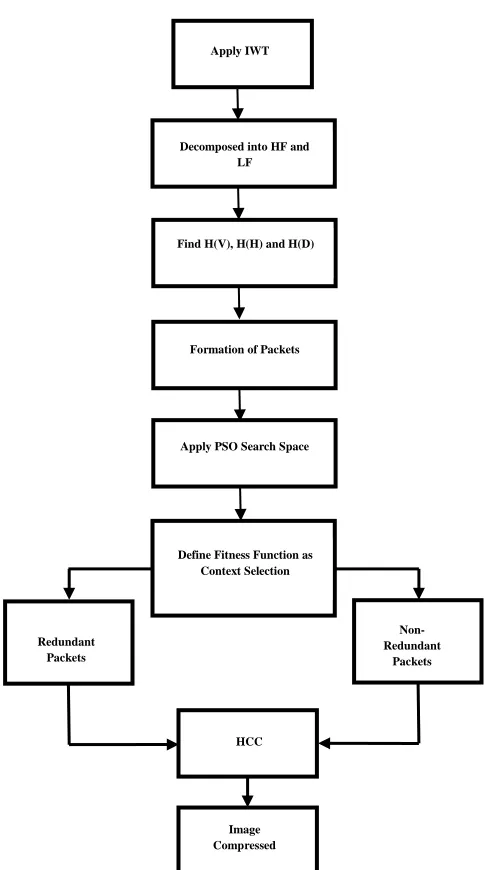
In this we describe the proposed algorithm for image compression using wavelet [12] transform and Optimization technique i.e. particle swarm optimization. Basically, in this our algorithm PSO is used for removal of redundant structures of packets in similar block and the non redundant structure of packets in dissimilar blocks. These both blocks are supplied in HCC matrix and final images are compressed. In this algorithm for searching of redundant structure block and non-redundant structure block we use the fitness constrains function, those structures [10] satisfied the given constraints are called non redundant structure and else redundant structure.
Our proposed algorithm is a combination of integer wavelet packet transform function, particle swarm optimization and HCC matrix. Now the steps of the algorithm are following:
Steps of Proposed Work:
1. Apply input medical image on IWT transform function, it decomposed image into details and approximation layers.
2. Approximation layer part further decomposed in high level. Now repute the value of horizontal, vertical as well as diagonal transform.
3. The block coefficient value of transforming form a series of packets P1…………Pn, passes from PSO algorithm and find optimal sets of structure.
4. Now initialized population sets n=100 and Define a fitness constraints for selection of similar structure and dissimilar structure.
Fitness
5. Load the packet (value) in terms of particle of PSO in search space.
6. Define the velocity parameter by difference of structure r1-r2=x.
7. For every packet ri in m;
x=0;
8. For every packet in ri in m.
xij =x (ri, rj)
9. if (x=1) then the packet is non redundant; 10. else
11. Packets are redundant.
12. Two block codes are generating one is redundant and another is non redundant.
13. The sorted packet of redundant and non-redundant input the HCC matrix [13].
International Journal of Emerging Technology and Advanced Engineering
Website: www.ijetae.com (ISSN 2250-2459,ISO 9001:2008 Certified Journal, Volume 5, Issue 6, June 2015)
[image:4.612.48.290.130.565.2]374
Figure 1: Shows Flow Chart of Working Process.
IV. RESULT ANALYSIS
For the implementation of proposed algorithm MATLAB is used. For the performance of the proposed algorithm used medical BHCT image as well as BHMRI images and for measuring the performance of our proposed algorithm and other methods we use some standard parameters like PSNR, Compression Rate and Compression Ratio (CR) for the empirical assessment used following parameters.
The images in these dimensions of 512*512 with 8-bit grayscale [18] image several quality measurement variables like, PSNR (peak signal-to-noise ratio), CR (compression ratio). PSNR can be measured to find out how well an image is reproduced with respect to the context image. These variables are signal fidelity metrics and do not measure how viewers perceive impairments. Numerical values of these variables for any image tell us about the quality of that image. The measure of peak signal-to-noise ratio (PSNR) is defined as the following formula:
MSE=
PSNR=10
Here, MAXI is the maximum possible pixel value of the
image.
The compression that is achieved can be quantified by the compression ratio given by the following formula:
Compression Ratio
A compression ratio like 10 (or 10:1) indicates that the original image has 10 information carrying units (e.g. Bits) for every 1 unit in the compressed data set.
For the validation, proposed algorithm compared to JPEG algorithm and Combination Methods used two different set of image in terms of BHCT image and BHMRI image [18].
Figure 2: Decomposed Image After Applying Transforms Function.
Decomposed into HF and LF
Find H(V), H(H) and H(D)
Formation of Packets
Apply PSO Search Space Apply IWT
Define Fitness Function as Context Selection
Redundant Packets
Non-Redundant
Packets
HCC
[image:4.612.336.552.474.621.2]International Journal of Emerging Technology and Advanced Engineering
Website: www.ijetae.com (ISSN 2250-2459,ISO 9001:2008 Certified Journal, Volume 5, Issue 6, June 2015)
[image:5.612.327.556.110.709.2]375
Table 1:
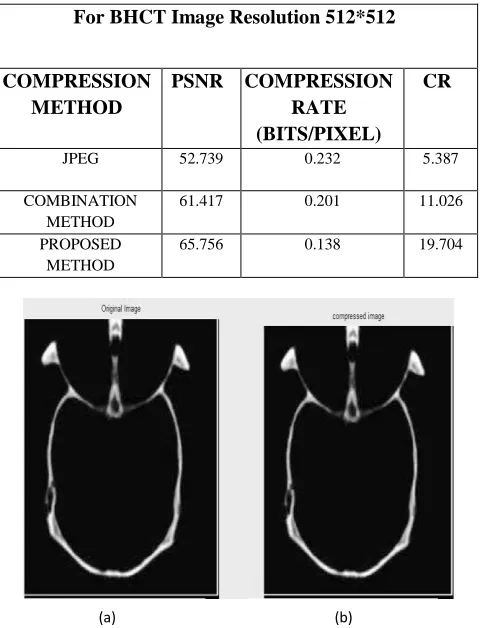
Show The PSNR, Compression Rate and CR Value of Image After Processing.
For BHCT Image Resolution 512*512
COMPRESSION METHOD
PSNR COMPRESSION RATE (BITS/PIXEL)
CR
JPEG 52.739 0.232 5.387
COMBINATION METHOD
61.417 0.201 11.026
PROPOSED METHOD
65.756 0.138 19.704
Figure 3: (a) is the Original BHCT Image After Processing Generate Compressed BHCT Image (b).
Figure 4: The Comparative Analysis of PSNR Value of BHCT Image.
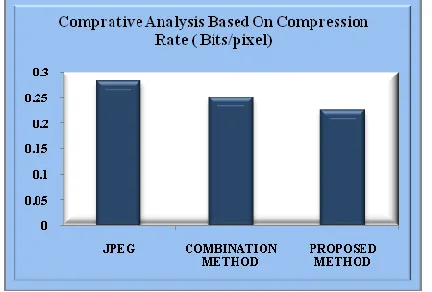
[image:5.612.333.557.135.286.2]Figure 5: The Comparative Analysis of Compression Rate Value Of BHCT Image.
[image:5.612.49.289.167.481.2]Figure 6: The Comparative Analysis of CR Value of BHCT Image.
Table 2:
Show The PSNR, Compression Rate and CR Value of Image After Processing.
For BHMRI Image Resolution 512*512
COMPRESSION METHOD
PSNR COMPRESSION RATE (BITS/PIXEL)
CR
JPEG 43.188 0.283 5.475
COMBINATION METHOD
50.295 0.251 9.029
PROPOSED METHOD
53.849 0.226 16.136
[image:5.612.331.555.312.467.2] [image:5.612.59.280.514.665.2]International Journal of Emerging Technology and Advanced Engineering
Website: www.ijetae.com (ISSN 2250-2459,ISO 9001:2008 Certified Journal, Volume 5, Issue 6, June 2015)
376
[image:6.612.62.278.124.303.2]Figure 7: (a) is the Original BHMRI Image After Processing Generate Compressed BHMRI Image (b).
Figure 8: The Comparative Analysis Of PSNR Value of BHCT Image.
[image:6.612.333.557.133.283.2]Figure 9: The Comparative Analysis of Compression Rate Value of BHMRI Image.
Figure 10: The Comparative Analysis of CR Value of BHMRI Image.
V.CONCLUSION AND FUTURE WORK
In this above our work we proposed a lossless compression algorithm for medical images. In this we use mainly two things IWT and the other is an optimization algorithm (PSO). The all transform packet divided into two groups such as redundant and non redundant packets, these perform by a structure context method. PSO is used for the collection of similar and dissimilar packet. In PSO define a fitness function constraint for differentiating the similar and dissimilar types of packets. After performing these packets are provided to HCC for Compression. For Performance evaluation, we use some parameter like PSNR, compression ratio, and CR. Based on these parameters compare some other method with proposed method. It takes more time for searching for similar and dissimilar packets. So in future we try to reduce computational time and use some other optimization algorithm.
REFERENCES
[1] Yao-Tien Chen, Din-Chang Tseng, ―Wavelet-based medical image compression with adaptive prediction‖ Elsevier, 2007, 1-8. [2] Andreas Weinlich, Johannes Rehm, Peter Amon, Andreas Hutter,
Andre Kau‖ Massively Parallel Lossless Compression of Medical Images Using Least-Squares Prediction and Arithmetic Coding‖ IEEE 2013, 1680-1685.
[3] Ganesh Dasika, Ankit Sethia, Vincentius Robby, Trevor Mudge, and Scott Mahlke ―MEDICS: Ultra-Portable Processing for Medical Image Reconstruction‖ ACM 2010 1-12.
[4] Daniel Bratton and James Kennedy, ―Defining a Standard for Particle Swarm Optimization‖, Proceedings of the 2007 IEEE Swarm Intelligence Symposium, 2007, 1-8.
[5] J. Kennedy and R. C. Eberhart, Particle swarm optimization, 1995 IEEE International Conference on Neural Networks, vol. 4, 1995, 1942–1948.
[image:6.612.60.278.338.484.2] [image:6.612.62.278.515.661.2]International Journal of Emerging Technology and Advanced Engineering
Website: www.ijetae.com (ISSN 2250-2459,ISO 9001:2008 Certified Journal, Volume 5, Issue 6, June 2015)
377
[6] Bhaskar Mishra Pradeep Tripath and Bhanu Pratap Singh, ―Various Image Compression Methods: A Survey‖ The International Journal Of Science & Technoledge, 2014, 164-168.
[7] Gwenole Quellec, Mathieu Lamard, Guy Cazuguel, Christian Roux, Beatrice Cochener ―Case Retrieval in Medical Databases by Fusing Heterogeneous Information‖ IEEE Transactions On Medical Imaging, 2011, 1-18.
[8] M.Ferni Ukrit, A.Umamageswar, G.R.Suresh ―A Survey on Lossless Compression for Medical Images‖ International Journal of Computer Applications, Vol-31, 2011, 47-50.
[9] A.Benjamin Joseph, Dr. R. Baskaran ―Edge Preserved Image Compression Technique Using Wavelet and Edge Based Segmentation‖ International Journal of Computer Science & Informatics, 2011, 80-85.
[10] C.S.Rawat, Seema G Bhateja, Dr. Sukadev Meher, ―A Novel Algorithm of Super-Spatial Structure Pre-diction for RGB Colourspace‖, 2012, 1-5.
[11] R.Bavithra, L.Ayeesha begame, K.S.L.Deepika, ―A Survey on Medical Image Compression Based on Transforms‖ SSRG-IJEC, vol.1, 2014, 9-11.
[12] Gwenole Quellec, Mathieu Lamard, Guy Cazuguel, Christian Roux, Beatrice Cochener ―Case Retrieval in Medical Databases by Fusing Heterogeneous Information‖ IEEE Transactions on Medical Imaging, IEEE 2011, 1-18.
[13] A. Alarabeyyat, S. Al-Hashemi, T. Khdour, M. Hjouj Btoush, S. Bani-Ahmad, R. Al Hashemi ―Lossless Image Compression Technique Using Combination Methods‖ Journal of Software Engineering and Applications, 2012, 752-763.
[14] Huang-ChihKuo, Youn-Long Lin, "A Hybrid A1gorithm for Effective Lossless Compression of Video Display Frames," IEEE Trans. On Multimedia, vol.l4, no.3, June 2012.
[15] M.Ferni ukrit and G.R.Suresh, ― Lossless Compression for Medical Image Sequences Using Combination Methods‖ NCIEEE, 2013, 14-18.
[16] K.Uma, P.Geetha, A.Kannan, K.Umanath, ―Image Compression Using Optimization Techniques‖ International Journal of Engineering Research and Development, vol.5, 2012, 1-7.
[17] Kamrul Hasan Talukder, Koichi Harada ―Haar Wavelet Based Approach for Image Compression and Quality Assessment of Compressed Image‖ IAENG International Journal of Applied Mathematics, 2007, 1-8.
[18] David A. Clunie, ―Lossless Compression of Grayscale Medical Images - Effectiveness of Traditional and State of the Art Approaches‖ 1-11.
[19] Bahriye Akay, Ibrahim Kirmizi, ―Structural Optimization of Wavelet Packets using Swarm Algorithms‖ IEEE World Congress on Computational Intelligence, 2012, 1-5.