comm
en
t
re
v
ie
w
s
re
ports
de
p
o
si
te
d r
e
se
a
rch
refer
e
e
d
re
sear
ch
interacti
o
ns
inf
o
rmation
Cell-specific microarray profiling experiments reveal a
comprehensive picture of gene expression in the
C. elegans
nervous
system
Stephen E Von Stetina
¤*
, Joseph D Watson
¤†
, Rebecca M Fox
*‡
,
Kellen L Olszewski
*§
, W Clay Spencer
*
, Peter J Roy
¶
and
David M Miller III
*†
Addresses: *Department of Cell and Developmental Biology, Vanderbilt University, Nashville, TN 37232-8240, USA. †Graduate Program in
Neuroscience, Center for Molecular Neuroscience, Vanderbilt University, Nashville, TN 37232-8548, USA. ‡Department of Cell Biology, Johns
Hopkins School of Medicine, Baltimore, MD 21205, USA. §Department of Molecular Biology, Lewis-Sigler Institute for Integrative Genomics,
Princeton University 246 Carl Icahn Laboratory, Princeton NJ 08544, USA. ¶Department of Medical Genetics and Microbiology, Donnelly
Centre for Cellular and Biomolecular Research, University of Toronto, Toronto, ON, M5S 1A, Canada.
¤ These authors contributed equally to this work.
Correspondence: David M Miller. Email: [email protected]
© 2007 Von Stetina et al.; licensee BioMed Central Ltd.
This is an open access article distributed under the terms of the Creative Commons Attribution License (http://creativecommons.org/licenses/by/2.0), which permits unrestricted use, distribution, and reproduction in any medium, provided the original work is properly cited.
Expression in worm neurons
<p>A novel strategy for profiling <it>Caenorhabditis elegans </it>cells identifies transcripts highly enriched in either the embryonic or larval <it>C. elegans </it>nervous system, including 19 conserved transcripts of unknown function that are also expressed in the mamma-lian brain.</p>
Abstract
Background: With its fully sequenced genome and simple, well-defined nervous system, the nematode Caenorhabditis elegans offers a unique opportunity to correlate gene expression with neuronal differentiation. The lineal origin, cellular morphology and synaptic connectivity of each of the 302 neurons are known. In many instances, specific behaviors can be attributed to particular neurons or circuits. Here we describe microarray-based methods that monitor gene expression in C. elegans neurons and, thereby, link comprehensive profiles of neuronal transcription to key developmental and functional properties of the nervous system.
Results: We employed complementary microarray-based strategies to profile gene expression in the embryonic and larval nervous systems. In the MAPCeL (Microarray Profiling C. elegans cells) method, we used fluorescence activated cell sorting (FACS) to isolate GFP-tagged embryonic neurons for microarray analysis. To profile the larval nervous system, we used the mRNA-tagging technique in which an epitope-labeled mRNA binding protein (FLAG-PAB-1) was transgenically expressed in neurons for immunoprecipitation of cell-specific transcripts. These combined approaches identified approximately 2,500 mRNAs that are highly enriched in either the embryonic or larval C. elegans nervous system. These data are validated in part by the detection of gene classes (for example, transcription factors, ion channels, synaptic vesicle components) with established roles in neuronal development or function. Of particular interest are 19 conserved transcripts of unknown function that are also expressed in the mammalian brain. In addition to utilizing these profiling approaches to define stage-specific gene expression, we also applied the mRNA-tagging method to fingerprint a specific neuron type, the A-class group of cholinergic motor neurons, during early larval development. A comparison of these data to a MAPCeL profile of embryonic A-class motor neurons identified genes with common functions in both types of A-class motor neurons as well as transcripts with roles specific to each motor neuron type.
Conclusion: We describe microarray-based strategies for generating expression profiles of embryonic and larval C. elegans neurons. These methods can be applied to particular neurons at specific developmental stages and, therefore, provide an unprecedented opportunity to obtain spatially and temporally defined snapshots of gene expression in a simple model nervous system.
Published: 5 July 2007
Genome Biology 2007, 8:R135 (doi:10.1186/gb-2007-8-7-r135)
Received: 16 April 2007 Revised: 13 June 2007 Accepted: 5 July 2007 The electronic version of this article is the complete one and can be
Background
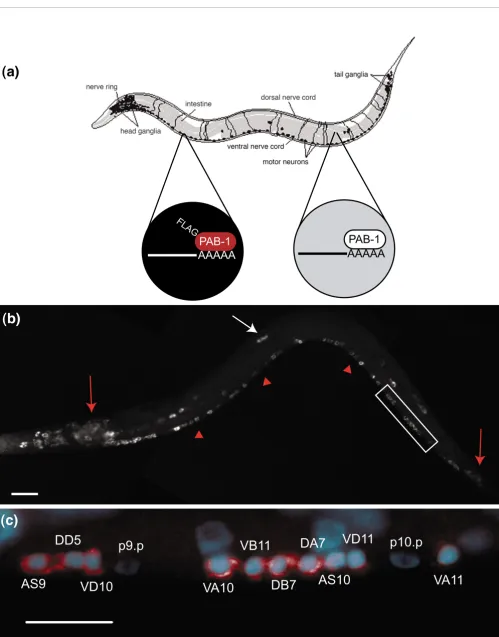
The nematode Caenorhabditis elegans is a widely used model system for developmental studies. The major tissues of com-plex metazoans, (muscle, intestine, nervous system, skin, and so on) are represented in the worm, but the entire animal is composed of fewer than 1,000 somatic cells. Owing to this simplicity and to the rapid development of the C. elegans body plan, the anatomy of every adult cell has been described and the patterns of division giving rise to each one are known [1,2]. The C. elegans genome is fully sequenced [3,4] and encodes over 20,000 predicted genes. Thus, C. elegans offers a unique opportunity to identify specific combinations of genes that define the differentiation and structure of specific cell types. In principle, microarray profiles can provide this information. In order to implement this strategy, however, the small size of C. elegans (length = 1 mm) has required the development of specialized methods for extracting mRNA from specific cell types. In one approach, MAPCeL (micro-array profiling of C. elegans cells), green-fluorescent protein (GFP)labeled cells are isolated by fluorescence activated cell sorting (FACS) from preparations of dissociated embryonic cells [5]. This method has now been used to profile global gene expression in specific subsets of neurons and muscle cells [5-10] (RMF, DMM, unpublished data). An alternative technique, mRNA-tagging [11], can be utilized to profile larval cells, which are not readily accessible for FACS [12]. In this approach, an epitopetagged mRNA binding protein (FLAG-PAB) is expressed transgenically with a specific promoter (Figure 1). FLAG-PAB-bound transcripts are then immuno-precipitated for microarray analysis. mRNA-tagging profiles have been reported for two major tissues, body wall muscles and the intestine [11,13].
Here we apply the MAPCeL and mRNA-tagging strategies to provide a comprehensive picture of gene expression in the embryonic and larval nervous systems. This analysis reveals approximately 2,500 transcripts that are significantly ele-vated in neurons versus other C. elegans cell types during these developmental periods. The enrichment in these data-sets of transcripts known to be expressed in neurons, as well as newly created GFP reporters from previously uncharacter-ized genes in these lists, confirmed the tissue specificity of our results. The 'pan-neural' transcripts detected in these data-sets encode proteins with a wide array of molecular functions, including ion channels, neurotransmitter receptors and
tran-scription factors. Overall, 56% of these C. elegans genes are conserved in humans. The discovery of 27 uncharacterized human homologs enriched in both embryonic and larval neu-rons suggests that these profiles have uncovered novel genes with potentially conserved function in the nervous system.
In order to identify transcripts that are selectively expressed in a specific neural cell type, we used the mRNA-tagging strat-egy to fingerprint a subset of motor neurons (A-class) in the ventral nerve cord of L2 stage larvae. This A-class dataset contains around 400 significantly enriched genes. Approxi-mately 25% of these transcripts are not detected in the profile of the entire nervous system. This finding suggests that indi-vidual neurons may express rare transcripts that are likely to be restricted to specific neuron types. The application of the mRNA-tagging strategy to profile a specific class of larval neurons complements earlier work in which this method was used to profile larval ciliated neurons [14] and also experi-ments in which MAPCeL and other FACS-based approaches have been applied to selected embryonic neurons [5-10]. Thus, this work demonstrates the utility of complementary profiling strategies that can now be applied to catalog gene expression in specific C. elegans neurons throughout development.
Results
Neuronal mRNA-tagging yields reproducible microarray expression profiles
To profile gene expression throughout the nervous system, we generated a stable, chromosomally integrated transgenic line expressing an epitope-tagged poly-A binding protein (FLAG::PAB-1) throughout the nervous system. Pan-neuro-nal expression was confirmed by immunostaining with a FLAG-specific antibody (Figure 1). We selected the second larval stage (L2) to test the application of the mRNA-tagging method. At this stage, the nervous system is largely in place and should, therefore, express a broad array of transcripts that define the development and function of most neurons. Sub-microgram quantities of mRNA isolated by the mRNA-tagging method were amplified and labeled for application to an Affymetrix chip representing approximately 90% of pre-dicted C. elegans genes. Neuron-enriched transcripts in these samples were detected by comparison to a reference profile of all larval cells (see Materials and methods). We reasoned that
mRNA-tagging isolates neural specific transcripts
Figure 1 (see following page)
comm
en
t
re
v
ie
w
s
re
ports
refer
e
e
d
re
sear
ch
de
p
o
si
te
d r
e
se
a
rch
interacti
o
ns
inf
o
[image:3.612.55.554.80.717.2]rmation
Figure 1 (see legend on previous page)
AAAAA
PAB-1
FLA G
AAAAA
PAB-1
VA10
DB7
VB11
DA7
AS10
VD11
VA11
DD5
AS9
VD10
p9.p
p10.p
(a)
(b)
this approach should detect a significant fraction of known neuronal transcripts and thus provide an initial test of the specificity of this strategy.
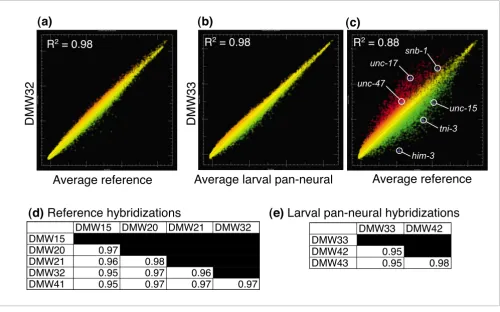
Comparisons of independently derived datasets for both the experimental (larval pan-neural) and reference samples showed that individual replicates for each condition are highly reproducible (Figure 2a,b). For example, an average coefficient of determination (R2) of approximately 0.96 was calculated from pairwise combinations of each individual ref-erence dataset (Figure 2d). The pan-neural datasets were similarly reproducible (R2 of approximately 0.96; Figure 2e). The overall concurrence of these data is graphically illus-trated in the scatter plots shown in Figure 2a,b.
Transcripts detected by neuronal mRNA-tagging are expressed in neurons
Scatter plots comparing larval pan-neural versus reference data revealed a substantial number of transcripts with
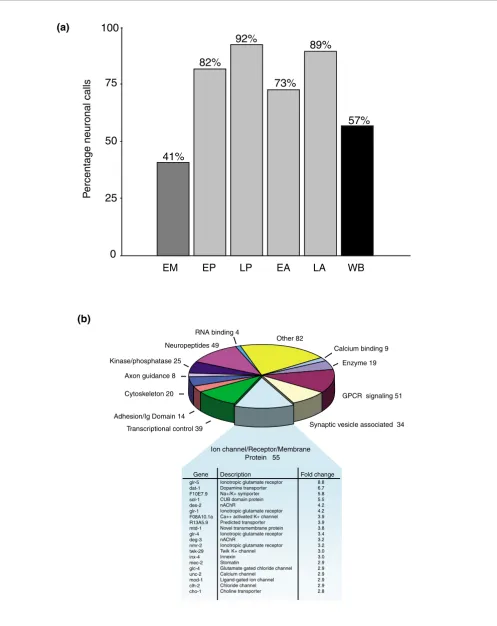
signif-icant differences in hybridization intensities (Figure 2c). Sta-tistical analysis detected 1,562 transcripts with elevated expression (≥ 1.5-fold, ≤ 1% false discovery rate (FDR)) in the larval pan-neural sample (Additional data file 1). Strikingly, we found that 92% of the 443 genes with known expression patterns included in the larval pan-neural enriched dataset (409/443) are listed in WormBase [15] as neuronally expressed (Figure 3a; Additional data file 1). By contrast, only 57% of all genes (1,612/2,837) with defined expression pat-terns in WormBase are annotated as expressed in neurons (see Materials and methods; Figure 3a; Additional data files 2 and 3). Moreover, genes with key roles in neuronal function are highly represented in this list. For example, 55 transcripts encoding ion channels, receptors or membrane proteins with known expression in the C. elegans nervous system are enriched (Figure 3b; Additional data file 7). The enrichment of transcripts known to be expressed in neurons demon-strates that the larval pan-neural profile is largely derived from neural tissue. This conclusion is also substantiated by
[image:4.612.58.558.87.399.2]Microarray profiles reveal transcripts enriched in C. elegans neurons
Figure 2
Microarray profiles reveal transcripts enriched in C. elegans neurons. (a) Scatter plot of intensity values (log base 2) for representative hybridization (DMW32; red) of RNA isolated from all larval cells (reference) by mRNA-tagging compared to the average intensity of the reference dataset (green). (b) Scatter plot of a representative larval pan-neural hybridization (DMW33; red) compared to the average intensities for all three larval pan-neural hybridizations (green). (c) Results of a single larval pan-neural hybridization (DMW33; red) compared to average reference intensities (green) to identify differentially expressed transcripts. Known neural genes snb-1 (synaptobrevin, all neurons), unc-17 (VAChT, cholinergic neurons), and unc-47 (VGAT, GABAergic neurons) are enriched (red). Depleted genes include two muscle-specific transcripts (unc-15, paramyosin, and tni-3, troponin) and a germline-specific gene (him-3) (green). (d,e) Pairwise comparisons of individual hybridizations. Coefficient of determination (R2) values for all pairwise combinations
of reference hybridizations (d) and for all pairwise combinations of larval pan-neural hybridizations (e) indicate reproducible results for both reference and experimental samples.
DMW32
DMW33
Average reference
Average larval pan-neural
R
2= 0.98
R
2= 0.98
Average reference
+ +
+ +
+
+ snb-1 unc-17 unc-47
him-3 tni-3
unc-15
R
2= 0.88
DMW15
DMW20
DMW21
DMW32
DMW15
DMW20
0.97
DMW21
0.96
0.98
DMW32
0.95
0.97
0.96
DMW41
0.95
0.97
0.97
0.97
DMW33
DMW42
DMW33
DMW42
0.95
DMW43
0.95
0.98
(a)
(b)
(c)
comm
en
t
re
v
ie
w
s
re
ports
refer
e
e
d
re
sear
ch
de
p
o
si
te
d r
e
se
a
rch
interacti
o
ns
inf
o
rmation
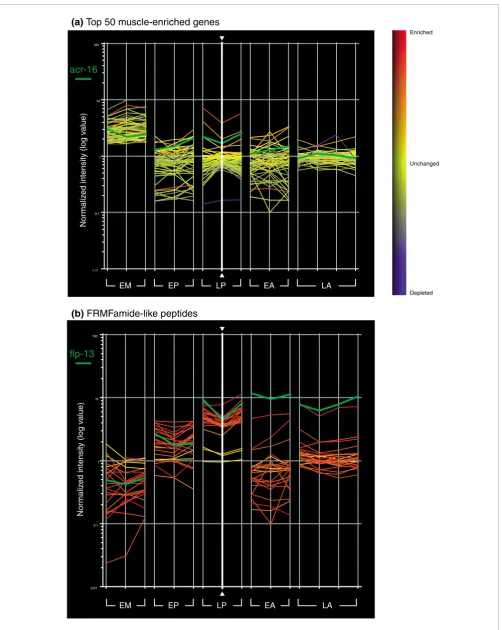
the finding that mRNAs highly expressed in other cell types are preferentially excluded from this dataset (Figure 2c). For example, microarray profiling experiments identified a total of 1,926 transcripts enriched in either larval germline, muscle or intestinal cells (GMI; Additional data file 5) [13]. This set of genes is significantly under-represented (97/1,562) in the larval pan-neural dataset (representation factor 0.6, p < 2.033e-9; a representation factor <1 indicates under-repre-sentation; see Materials and methods). Of the 97 genes that intersect our larval pan-neural profile and the GMI set, 35 have a previously characterized spatial expression pattern. Of these, 89% (31/35) are also expressed in neurons. A compar-ison of the top 50 most significantly enriched transcripts in a MAPCeL profile of embryonic body wall muscle cells (RMF, DMM, unpublished data) detected only four transcripts that also show elevated expression in the larval pan-neural profile (Figure 4a; Additional data file 6). Independent results have confirmed that at least one of these, the acetylcholine recep-tor subunit acr-16, is expressed in both muscle and neurons [16,17]. The apparent low frequency of false positives empiri-cally defined by these comparisons is consistent with the esti-mated FDR of ≤ 1% for this dataset. The stringent exclusion of non-neuronal transcripts has been achieved, however, while retaining sensitivity to transcripts that may be expressed in limited numbers of neurons (Figure 5). For example, our methodology identifies genes that are expressed in only two neurons; daf-7 (transforming growth factor (TGF)-beta-like peptide expressed in ASIL and ASIR) [18] and gcy-8 (guan-ylate cyclase expressed in AFDL and AFDR) [19] (Figure 5).
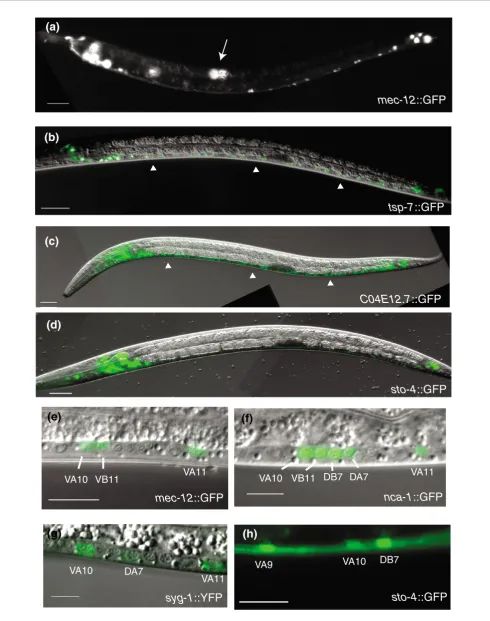
The strong enrichment of known neuronal genes in the larval pan-neural dataset indicates that other previously uncharac-terized transcripts in this list are also likely to be expressed in the nervous system. To test this prediction, we evaluated GFP reporter genes for representative transcripts in this profile. As shown in Table 1 and Additional data file 17, all but one of the transgenic lines (24 of 25) derived from these promoter GFP fusions show expression in neurons (Figure 6). Of the GFP reporters tested, 56% (14/25) are exclusively detected in neu-rons (Additional data file 17). For example, the stomatin gene sto-4 is highly expressed in ventral cord motor neurons, touch neurons and in head and tail ganglia (Table 1; Figure 6d,h). Our GFPreporter analysis demonstrates that the remaining 11 genes tested are expressed in other tissues in addition to neu-rons. For instance, the GFP reporter for C04E12.7 (phosphol-ipid scramblase), which is expressed widely throughout the nervous system, is also expressed in muscle cells (Table 1; Figure 6c). Thus, these results indicate that the genes identi-fied in the larval pan-neural profile largely fall into two classes; those that are exclusively expressed in neurons, and those that are expressed in multiple tissues, including neu-rons. Our finding of neuronal GFP expression for transcripts exhibiting a wide range of enrichment (1.5- to 8.3-fold) pre-dicts that most of the genes in this list that have not been directly tested are also likely to be expressed in neurons. Together, these results demonstrate that our pan-neural
mRNA-tagging approach enriches for bona fide neuronally expressed transcripts and effectively excludes transcripts expressed exclusively in other tissues.
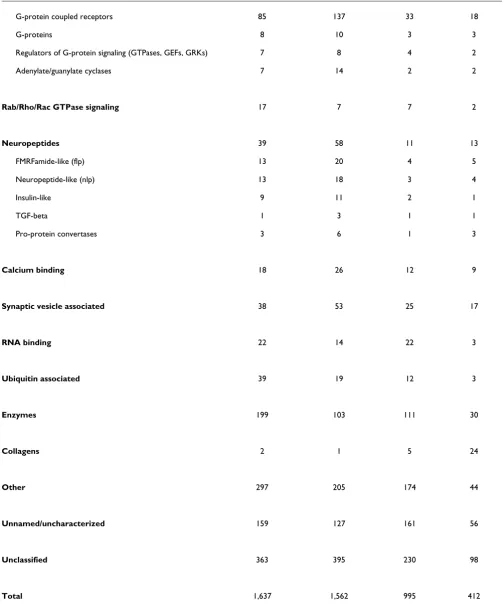
Gene families enriched in neurons of C. elegans larvae Protein-encoding genes in the enriched larval pan-neural profile were organized into groups on the basis of KOGs and other descriptions that identify functional or structural cate-gories (Table 2; Additional data file 4) [20]. Over half (880/ 1,562) are homologous to proteins in at least one other widely diverged eukaryotic species (that is, KOGs and TWOGs), 49 of which are classified as uncharacterized conserved proteins. Homologs for an additional 225 pan-neural enriched proteins are limited to other nematode species (that is, LSEs).
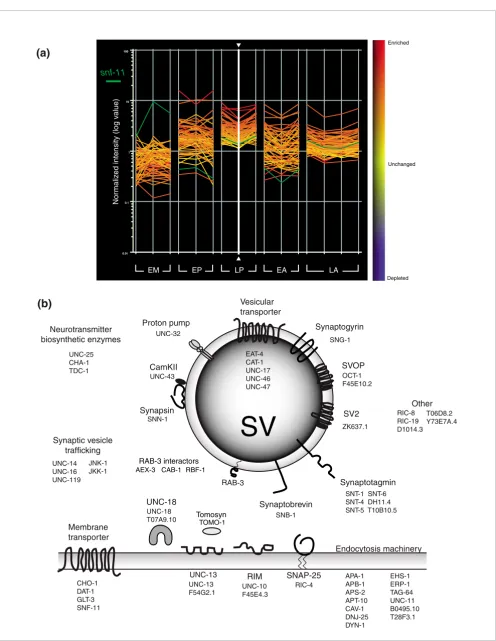
Transcripts encoding proteins with fundamental roles in neu-ronal activity or signaling are highly represented in this data-set (for a comprehensive list see Additional data file 4). For example, in addition to the 34 synaptic vesicle (SV) associated transcripts from Figure 3b (Additional data file 7), transcripts for 19 proteins with potential roles in synaptic vesicle func-tion are identified (Figure 7). These include six members of the synaptotagmin family of calcium-dependent phospholi-pid binding proteins (snt-1, snt-4, snt-5, snt-6, DH11.4, T10B10.5), only one of which, snt-1, has been previously shown to function in neurons [21]. Expression of the addi-tional synaptotagmin genes in the nervous system may account for the residual synaptic vesicle function of snt-1 mutants [21]. Three members of the copine family (B0495.10, tag-64, T28F3.1), a related group of calciumbinding proteins with potential roles in synaptic vesicle fusion (listed as part of endocytosis machinery in Figure 7), are also enriched [22].
In addition to genes with general functions in synaptic vesicle signaling, the larval pan-neural profile includes transcripts encoding proteins with roles specific to particular neuro-transmitters. For example, the plasma membrane and vesic-ular transporters for choline and acetylcholine (cho-1 and unc-17), GABA (snf-11 and unc-46, unc-47), dopamine (dat-1 and cat-1), and glutamate (glt-3 and eat-4) are included (Fig-ure 7) [23-27]. The corresponding families of neurotransmit-ter-specific ligand-gated ion channels are highly represented, including 22 members of the ionotropic nicotinic acetylcho-line (ACh) receptor family (Additional data file 4). Other classes of ion channels with key neural functions are also abundant, such as potassium channels (24), voltage-gated calcium channels (10) and DEG/ENaC sodium channels (10) (Table 2).
Figure 3 (see legend on next page)
0
25
50
75
100
P
e
rcentage neuronal calls
EM
EP
LP
EA
LA
WB
41%
82%
92%
73%
89%
57%
(a)
(b)
Axon guidance 8
Neuropeptides 49
Other 82
GPCR signaling 51
Ion channel/Receptor/Membrane Protein 55
Cytoskeleton 20
Enzyme 19 Kinase/phosphatase 25
Adhesion/Ig Domain 14
Transcriptional control 39
glr-5 dat-1 F10E7.9 sol-1 des-2 glr-1 F08A10.1a R13A5.9 mtd-1 glr-4 deg-3 nmr-2 twk-29 inx-4 mec-2 glc-4 unc-2 mod-1 clh-2 cho-1
Ionotropic glutamate receptor Dopamine transporter Na+/K+ symporter CUB domain protein nAChR
Ionotropic glutamate receptor Ca++ activated K+ channel Predicted transporter Novel transmembrane protein Ionotropic glutamate receptor nAChR
Ionotropic glutamate receptor Twik K+ channel Innexin Stomatin
Glutamate gated chloride channel Calcium channel
Ligand-gated ion channel Chloride channel Choline transporter
8.8 6.7 5.8 5.5 4.2 4.2 3.9 3.9 3.8 3.4 3.2 3.2 3.0 3.0 2.9 2.9 2.9 2.9 2.9 2.8
Gene Description Fold change
RNA binding 4
Calcium binding 9
comm
en
t
re
v
ie
w
s
re
ports
refer
e
e
d
re
sear
ch
de
p
o
si
te
d r
e
se
a
rch
interacti
o
ns
inf
o
rmation
classes [28-30], as well as transcription factors that define specific neuronal subtypes, such as the canonical LIM homeodomain MEC-3 (mechanosensory neurons) [31-33] and the UNC-4 homeodomain (A-class ventral cord motor neurons, see below) [34-37]. Transcription factors with unde-fined roles in the nervous system are also identified. Of par-ticular note are 15 members of the nuclear hormone receptor (NHR) family, only one of which, fax-1, has been previously shown to regulate neuronal differentiation [38].
A striking example of the power of this profiling approach is revealed by strong enrichment for genes involved in peptider-gic signaling. Neuropeptides are potent modulators of synap-tic transmission. A combination of genesynap-tic and pharmacological experiments have assigned specific neuro-modulatory roles to FMRFamide and related peptides (FaRPs) encoded by members of the 'flp' (FMRFamide like peptides) gene family [39]. Examples include flp-13 (cell excitability)[40], flp-1 (locomotion) [41] and flp-21 (feeding behavior) [42]. The enriched status of the majority of flp genes (20/23) in the larval pan-neural profile (Figure 4b) par-allels immunostaining and GFP reporter results showing expression of this gene family in the C. elegans nervous sys-tem [43]. Transcripts encoding insulin-like peptides (ins) and neuropeptide-like genes (nlp) are among the most highly enriched mRNAs in the pan-neural dataset (Additional data file 4). Neuropeptide activating proteases such as the propro-tein convertase egl-3 and the carboxypeptidase egl-21 are also elevated [44]. Finally, we detect 136 members of the G-pro-tein coupled receptor (GPCR) family, including four GPCRs (npr-1, npr-2, npr-3 and T19F4.1) that have been either directly identified as neuropeptide receptors or implicated in neuropeptide-dependent behaviors [42,45,46] (E Siney, A Cook, N Kriek, L Holden Dye, personal communication). The strong representation of diverse neuropeptidergic components in the larval pan-neural profile is suggestive of a nervous system that is richly endowed with complex signaling pathways for modulating function and behavior.
Embryonic and larval nervous systems express many common sets of genes
To complement the profile of the larval nervous system obtained by the mRNAtagging method, a pan-neural GFP reporter gene [47] (J Culotti, personal communication) was used to mark embryonic neurons for MAPCeL analysis. GFP labeled neurons were isolated by FACS to ≥ 90% purity from
primary cultures of embryonic cells (see Materials and meth-ods). Comparisons of independent replicates showed that these data are highly reproducible (Additional data file 8). We identified 1,637 enriched genes (≥ 1.5-fold, FDR ≤ 1%) versus a reference dataset obtained from all embryonic cells (Addi-tional data file 1). The majority (82%) of transcripts in this list with known expression patterns are expressed in neurons (Figure 3a). All of the promoter-GFP fusions (10/10) created from previously uncharacterized genes in the enriched embryonic pan-neural dataset showed expression in neurons, further validating this MAPCeL profile (Table 1; Additional data file 17). A comparison of the embryonic (MAPCeL) and larval (mRNA-tagging) profiles reveals considerable overlap, with approximately 45% of transcripts (710/1,637; represen-tation factor 5.2, p < 1e-325) enriched in the embryonic neu-rons also elevated in larval neuneu-rons (Figure 8a). The intersection of these two datasets is significantly enriched (96%) for known neuron-expressed genes. The high likeli-hood of neural expression for these transcripts is underscored by our finding that a set of approximately 240 candidate neu-ral genes originally identified as including a presumptive pan-neural regulatory motif ('N1 box') are overrepresented (35%, representation factor 2.6, p < 4.1e-17) in this subset of pan-neural transcripts [48].
As an additional test of the similarities between these inde-pendent datasets, we examined the embryonic and larval pan-neural profiles for elevated expression of gene families with roles in synaptic vesicle function (Figure 7a). Both the embryonic and larval pan-neural datasets were enriched for many of these components. In contrast, the majority of these transcripts are not upregulated in a MAPCeL profile of embryonic muscles (RMF, DMM, unpublished data). Inter-estingly, the one exception to this correlation, the GABA transporter snf-11, is known to be expressed in body wall muscle in addition to neurons [26].
Examination of the embryonic and larval pan-neural datasets confirmed expression of genes that regulate the dauer path-way in C. elegans neurons. The dauer larva adopts an alterna-tive developmental program to withstand stressful conditions (for instance, starvation, overcrowding, high temperature). The decision to adopt the dauer state is regulated by the nerv-ous system and is triggered during the L1/L2 transition in response to environmental cues [49-54]. Figure 9 graphically represents the dauer pathway genes identified in the
com-Microarray profiles detect known C. elegans neural genes
Figure 3 (see previous page)
Figure 4 (see legend on next page)
Nor
maliz
ed intensity (log v
alue)
EM EP LP EA LA
(a) Top 50 muscle-enriched genes
Nor
maliz
ed intensity (log v
alue)
EM EP LP EA LA
(b) FRMFamide-like peptides
Depleted Enriched
Unchanged
0.01 0.1 1 10 100
0.1 1 10 100
acr-16
0.01 0.1 1 10 100
0.01 0.1 1 10 100
comm
en
t
re
v
ie
w
s
re
ports
refer
e
e
d
re
sear
ch
de
p
o
si
te
d r
e
se
a
rch
interacti
o
ns
inf
o
rmation
bined pan-neural datasets. Of particular note is a conserved insulin-dependent signaling pathway (for example, age-1/ PI3Kinase) that also regulates lifespan in C. elegans and in other species [28].
Transcription factors constitute the largest gene family that is differentially enriched between the embryonic and larval pan-neural profiles (Table 3). For example, the combined pan-neural datasets detect a total of 30 NHRs. However, 16 NHRs are exclusively detected in embryonic neurons, whereas only six are enriched solely in larval neurons. Home-odomain transcription factors are also unequally distributed across the two datasets. Of 32 enriched homeoproteins, 24 are exclusive to the larval pan-neural profile, whereas only 4 are selectively elevated in the embryonic pan-neural dataset (Table 3). The relative lack of enrichment of homeodomain mRNAs in the embryonic pan-neural profile was initially surprising given strong genetic evidence for the widespread role of the members of this transcription factor class in embryonic neural development [31,47,55-57]. A likely expla-nation for this finding is that many homeobox transcripts are dynamically expressed in multiple cell types in the embryo but are increasingly restricted to neurons during larval devel-opment [56,58]. This view is consistent with our observation that a majority (22/28) of homeodomain genes that are enriched in the larval pan-neural dataset are in fact also detected as expressed genes in the embryonic pan-neural pro-file (see below).
Homologs of C. elegans neural genes are expressed in the mammalian brain
Over half of the enriched transcripts identified in the embry-onic and larval pan-neural profiles have likely homologs in mammals (Additional data file 1). A substantial fraction of these transcripts encodes members of protein families with conserved roles in neural function or development (for instance, synaptic vesicle proteins; Figure 7b). We also iden-tified neuron-enriched transcripts from C. elegans that are conserved but have largely undefined in vivo biochemical functions. For example, of the 711 transcripts that are enriched in both the embryonic and larval pan-neural data-sets (Figure 8a), 27 encode uncharacterized conserved proteins (Additional data file 9). To determine if these tran-scripts are also detected in the mammalian brain, we queried
the Allen Brain Atlas [59], which catalogs in situ hybridiza-tion results for 20,000 mouse transcripts (see Materials and methods). Of the 27 uncharacterized conserved genes from C. elegans, 26 have mouse homologs and 25 are included in the Allen Brain Atlas. We find that 76% (19/25) of these genes are detected in the mouse brain and, therefore, suggest that neu-ral functions for these genes are likely conserved from nema-todes to mammals. For instance, one member of this group of genes, osm-12, is the C. elegans homolog of a human disease gene, BBS7. Bardet-Biedle syndrome (BBS; OMIM 209900) is a rare, pleiotropic disorder with multiple pathologies (obes-ity, rod-cone dystrophy, cognitive impairment) [60]. At least 12 genes (BBS1-12) have been linked to this disease [61]. osm-12 and other BBS genes are highly expressed in ciliated neu-rons in C. elegans and genetic studies suggest key roles in intraflagellar transport [62]. These findings and additional work in other systems have led to the hypothesis that basal body dysfunction could be the root cause of BBS [63-66]. Thus, we propose that genetic studies in C. elegans of other uncharacterized conserved genes detected in the pan-neural enriched profile may be instructive.
The C. elegans interactome identifies neuronal genes potentially involved in synaptic function
The C. elegans interactome documents approximately 5,500 protein-protein interactions derived from yeast two-hybrid results, from interologs (that is, interactions between protein homologs in other species) and from functional interactions described in the literature [67]. To gain insight into the func-tional significance of prospective neural genes identified by these microarray datasets, we looked for evidence of interac-tions among proteins encoded by these genes in the Interac-tome database (see Materials and methods). The 711 transcripts enriched in both the embryonic and larval pan-neural datasets were uploaded for this analysis (Figure 8a). This search generated an interaction map with a single prom-inent cluster. Most of the transcripts in this group (30/34) are detected in at least one of the pan-neural datasets (Figure 10). Our finding that the majority of genes in this interactome group are expressed in the nervous system favors the idea that these networks reflect authentic interactions in neurons. We note that 13 of the proteins in this list (yellow circles in Figure 10) have not been previously assigned to the nervous system. Annotation of this interactome map with functional
Neuropeptides are highly represented in profiles of neural cells while transcripts highly enriched in body wall muscle are excluded
Figure 4 (see previous page)
data for each corresponding protein revealed two distinct subclusters featuring roles in either synaptic transmission or nucleic acid binding. For example, the JIP3/JSAP1 JNK scaffolding protein, UNC-16, interacts with KLC-2 (kinesin light chain) to regulate vesicular transport in neurons [68]. Other members of this interacting complex, MKK-4 (MAP kinase kinase) and JNK-1 (Jun kinase) are also required for maintaining normal synaptic structure [69,70]. These findings suggest that additional proteins in this subcluster may function at the synapse. F43G6.8 (E3 ubiquitin ligase) and B0547.1 (COP-9 signalosome subunit) are attractive possibilities as synaptic development and function are regu-lated by ubiquitin-dependent protein degradation [71]. As more phenotypic data are compiled, this analysis can be extended to encompass data derived from RNA interference (RNAi) experiments, which may yield models for molecular machines that function in neurons [72].
An mRNA-tagging transcriptional profile of a small subset of neurons
Although our gene expression profiles of the embryonic and larval nervous systems provide a comprehensive list of transcripts that function in neurons, these data lack the spa-tial resolution to identify the specific neurons in which these
transcripts are expressed. For instance, the dopamine transporter, dat-1, is highly enriched (15.9-fold) in the larval pan-neural dataset, but dat-1 expression is limited to eight dopaminergic neurons [73]. Other transcripts that are also restricted to a small number of neurons, however, might not be detected in a global profile of the entire nervous system. For example, the genes gcy-5 and gcy-6 (guanylate cyclase) are each expressed in single neurons, ASER and ASEL [74], respectively, and neither is enriched in the larval pan-neural dataset. The application of the mRNA-tagging strategy to individual classes of neurons should, therefore, correlate gene expression with specific neurons as well as detect low abundance transcripts with potential key functions in these cells. To test this idea, we used the unc-4 promoter to express FLAG-PAB-1 in only the subset of neurons in the ventral nerve cord that express the UNC-4 homeodomain protein. In the L2 larva, unc-4::GFP and unc-4::LacZ reporters show strong expression in a total of 18 neurons: VA motor neurons (12), SAB motor neurons (3), the I5 pharyngeal motor neuron (1) and AVF interneurons (2) [35,75]. Weaker, sporadic expression is observed in nine embryonically derived DA motor neurons at this stage. (unc-4 is strongly expressed in the DAs in the embryo and in L1 larvae.) To increase the sensitivity of the mRNA-tagging method for profiling these
[image:10.612.54.558.86.375.2]Pan-neural datasets detect neuron-specific transcripts
Figure 5
Pan-neural datasets detect neuron-specific transcripts. A representation of transcripts enriched in the larval pan-neural dataset and a subset of the neurons in which these genes are expressed. (a) Lateral view of an adult worm depicting selected neurons. Ventral is down, anterior is to the left. (b) Close-up of the adult head, showing the serotonergic neuron NSM and two sensory neurons, AFD and ASI. For simplicity, only one of the two pairs of neurons is diagrammed. The pharynx is colored green and the anterior end of the intestine is gray. (c) Table displaying representative genes enriched in the larval pan-neural dataset and expressed in each indicated neuron. Asterisks denote exclusive expression in the listed cell type. (Artwork courtesy of Zeynep Altun, Chris Crocker and David Hall at WormAtlas [120].)
AVA
ALM
PDE
DA9
DVB
Intestine Gonad
Embryos Pharynx
NSM
AFD
ASI
Neuron Gene name Function AFD gcy-8* Thermosensory
ASI daf-7* Chemosensory
NSM eat-4 Serotonergic
AVA glr-1 Glutamatergic
PDE cat-1 Dopaminergic
DVB unc-25 GABAergic
DA9 unc-17 Cholinergic
ALM mec-2 Mechanosensory
(a)
comm
en
t
re
v
ie
w
s
re
ports
refer
e
e
d
re
sear
ch
de
p
o
si
te
d r
e
se
a
rch
interacti
o
ns
inf
o
rmation
neurons, PAB-1 was labeled with three tandem repeats of the FLAG epitope (3XFLAG). Figure 11a,b show a mid-L2 larval animal (NC694) expressing the unc4::3XFLAG::PAB-1 trans-gene in VA, SAB, and I5 motor neurons and in AVF interneu-rons; less intense expression is seen in the DA motor neurons. Because most (24/27) of the neurons in this group are members of the 'A-class' of ventral cord excitatory motor neurons (VA, SAB, DA), we will refer to the mRNA-tagging data obtained from this transgene as the 'larval A-class motor neuron' profile (Figure 9).
[image:11.612.56.555.127.562.2]As previously observed for the larval pan-neural data (Figure 2), independent hybridizations resulted in highly reproduci-ble data for the larval A-class motor neuron profile (Addi-tional data file 8). A comparison of the A-class hybridization data to the reference sample of mRNA from the average larval cell detected 412 enriched genes (see Materials and methods). Of the 114 genes in this list with known expression patterns, 102 (approximately 90%) are found in neurons (Figure 3a). Of these genes, 96 have detailed spatial information, and 76 (approximately 80%) of these show annotated expression in Table 1
Expression of promoter-GFP reporters for transcripts enriched in the embryonic pan-neural, larval pan-neural or A-class motor neuron datasets
Pan-neural A-class
Cosmid Gene Protein EP fold change LP fold change In neurons* Fold change UNC-4 neuron(s)*
C01G6.4 Predicted E3 ubiquitin ligase 1.8 - √ - VA, DA
VF11C1L.1 ppk-3 PIP kinase 1.8 - √ - VA, DA
C25D7.8 Novel 1.9 - √ - VA, DA
F08G12.1 3.0 - √ - VA, DA
M79.1 abl-1 Abelson kinase 2.3 - √ - VA, DA
F25G6.4 acr-15 Acetylcholine receptor - 4.9 √ - VA, DA
T27A1.6 mab-9 Transcription factor - 1.7 √ - DA
F39G3.8 tig-2 TGF-β - 1.8 √ - VA, DA
T19C4.5 Novel - 2.0
-CC4.2 nlp-15 Neuropeptide - 6.5 √
-C18H9.7 rpy-1 Rapsyn - 2.7 √ - DA
Y71D11A.5 Ligand-gated ion channel 2.1 1.8 √
-C04E12.7 Phospholipid scramblase - 3.2 √ 1.8 VA, DA
F36A2.4 twk-30 K+ channel - 2.1 √ 5.1 VA, DA
Y71H9A.3 sto-4 Stomatin - 3.0 √ 1.6 VA
F29G6.2 Novel - 3.2 √ 1.6 VA, DA,SAB, I5, AVF
C44B11.3 mec-12 Alpha-tubulin - 5.9 √ 1.9 VA, DA
T23D8.2 tsp-7 Tetraspanin - 3.5 √ 4.8 VA, DA
T05C12.2 acr-14 Acetylcholine receptor - 1.5 √ 3.1 DA
F33D4.3 flp-13 Neuropeptide - 7.1 √ 7.9 I5
C11D2.6 nca-1 Ca++ channel - 2.3 √ 2.2 VA, DA
E03D2.2 nlp-9 Neuropeptide - 3.1 √ 2.5 VA
F55C12.4 Novel - 3.5 √ 2.1 DA
F43C9.4 mig-13 CUB domain - 1.8 √ 2.8 VA, DA
F39B2.8 Predicted membrane protein 1.7 3.5 √ 2.1 VA, DA
K02E10.8 syg-1 Ig domain 1.8 1.8 √ 1.8 VA, DA
ZC21.2 trp-1 Ca++ channel 1.9 2.2 √ 1.9 VA, DA
Y47D3B.2a nlp-21 Neuropeptide 3.9 8.3 √ 3.7 VA, DA
F09C3.2 Phosphatase 1.9 2.7 √ 1.7 VA, DA
T27E9.9 Ligand-gated ion channel 2.3 4.0 √ 3.1
Y34D9B.1 mig-1 Frizzled-like - - √ 1.6 VA, DA
regions that also contain UNC4expressing neurons (Addi-tional data file 1). Of particular note, the native unc-4 tran-script, which is selectively expressed in these neurons in vivo, is the most highly enriched (eight-fold) mRNA in this dataset. Other known A-class motor neuron genes in this list include the vesicular ACh transporter (VAChT) unc-17 and the Olf/ EBF transcription factor unc-3 (Figure 11c) [75,76]. In con-trast, transcripts known to be restricted to other cell types, such as muscle (myo-2, unc-22) or GABAergic neurons ( unc-25), are depleted from the A-class neuronal profile (Figures 4a and 11c). For instance, <2% of transcripts selectively expressed in larval germ line, intestine, or muscle (30/1926) are enriched in the larval A-class motor neuron profile (Addi-tional data file 5) [13].
All of the GFP reporter lines (19/19) constructed for A-class enriched transcripts (Table 1; Additional data file 17) are expressed in UNC-4 neurons. For example, in the mid-L2 stage ventral nerve cord, mec-12::GFP is expressed in DA, VA, VB and VD motor neurons (Figure 6a,e) and syg1::GFP (Ig domain) is detected in DA and VA motor neurons among oth-ers (Figure 6g). These results strongly suggest that most of the genes in the UNC-4 neuron enriched dataset are expressed in these cells in vivo. Thus, these data indicate that the mRNA-tagging method can produce a reliable profile of subsets of neurons in C. elegans.
A subset of pan-neural genes are expressed in larval A-class motor neurons
Nearly 70% of the larval A-class enriched transcripts (282/ 412) are also elevated in the larval pan-neural dataset (repre-sentation factor 8.2, p < 2.9e-209; Additional data file 10). As expected, genes with known functions in all neurons are highly represented in this group (Table 2). Synaptic vesicle associated transcripts that are widely expressed in the nerv-ous system, such as rab-3 (G-protein), snt-1 (synaptotagmin) and snb-1 (synaptobrevin), are enriched in both datasets. Absences from the larval A-class profile are correlated with class-specific functions in neurons. For example, the 60 tran-scripts encoding proteins involved in synaptic transmission enriched in the larval pan-neural dataset include vesicular transporters for GABA (unc-47), glutamate (glt-3), dopamine/serotonin (cat-1) and acetylcholine (unc-17) (Fig-ure 7b) [24]. The selective enrichment of the vesicular ACh transporter unc-17 in the larval A-class profile is consistent with the known cholinergic signaling capacity of A-class motor neurons [75]. In another striking example of neuron-specific gene expression, the 'mec' genes, which are required
for normal differentiation or function of mechanosensory neurons, are highly represented in the larval pan-neural dataset but are not detected in the larval A-class profile (Table 4) [77]. The one exception is the alpha-tubulin encoding gene, mec-12, for which enriched expression in A-class neurons was confirmed with a GFP reporter gene (Figure 6a,e). As described above, most of the known flp genes are enriched in the pan-neural dataset [39]. A subset of five flp genes is found in the A-class dataset (flp-2, 4, 5, 12, 13), providing enhanced spatial resolution for the expression repertoire of this large family of neuropeptide transmitters (Figure 4b).
The A-class profile includes approximately 130 transcripts that are not detected in the larval pan-neural dataset (Addi-tional data file 10). Interestingly, approximately 20% of these genes (23/127) encode collagen-like proteins for which neural functions are largely undefined. cle-1, which encodes a type XVIII collagen, the one member of this protein family that does have a documented role in the nervous system [78], is enriched in both the larval pan-neural and A-class datasets. We speculate that post-embryonic motor neurons may secrete collagens and other extracellular matrix components for assembly into the basement membrane that envelopes the ventral nerve cord [79]. Indeed, our data confirm that UNC-6 (netrin), a critical extracellular matrix signal that steers migrating cells and neuronal growth cones, is highly expressed in larval A-class motor neurons (Figure 12) [80].
Comparison of transcripts enriched in embryonic versus larval A-class motor neurons
We have previously used the MAPCeL strategy to profile embryonic motor neurons marked with unc-4::GFP [5]. These include 12 embryonic A-class motor neurons (9 DA and 3 SAB) and a single pharyngeal neuron, I5 [5]. The embryonic A-class motor neurons are similar to the post-embryonic VAs in that they express unc-4, are cholinergic, extend anteriorly directed axons, and receive inputs from the command interneurons AVA, AVD, and AVE [79]. The strong overlap of these distinct morphological and functional traits as well as some residual larval expression of unc-4 in embryonic A-class motor neurons (Figure 11b) are consistent with the observa-tion that approximately 40% of transcripts enriched in the larval A-class motor neuron dataset (162/412) are also elevated in the embryonic A-class motor neuron MAPCeL profile (representation factor 7.4, p < 3.1e-99; Figure 8b; Addi-tional data file 10). Transcripts from the cholinergic locus, cha-1 (choline acetyl transferase) and unc-17 (vesicular ACh transporter), which are essential for the biosynthesis and
GFP reporters validate neuronal microarray datasets
Figure 6 (see following page)
comm
en
t
re
v
ie
w
s
re
ports
refer
e
e
d
re
sear
ch
de
p
o
si
te
d r
e
se
a
rch
interacti
o
ns
inf
o
[image:13.612.58.548.87.708.2]rmation
Figure 6 (see legend on previous page)
mec-12
::GFP
sto-4
::GFP
syg-1
::YFP
nca-1
::GFP
mec-12
::GFP
tsp-7
::GFP
C04E12.7
::GFP
sto-4
::GFP
(a)
(b)
(c)
(d)
(e)
(f)
(g)
(h)
VA10 VB11 VA11 VA10 VB11 DB7 DA7 VA11
VA10 DA7
VA11
Table 2
Transcripts enriched in C. elegans neurons
Category Embryonic pan-neural Larval pan-neural Embryonic A-class Larval A-class
Ion channels/receptors/membrane proteins 122 156 60 41
Acetylcholine receptors 13 24 9 9
GABA receptors 1 4 3
Glutamate receptors 8 8 1 2
Potassium channels 11 24 8 10
Calcium channels 8 10 7 4
DEG/ENaC channels 3 10 1 1
Stomatins 3 7 2 1
Other ligand-gated ion channels 6 13 2 2
Gap junction proteins (innexins) 4 4 1 1
Symporters/exchangers/transporters 24 27 12 3
Other membrane proteins 41 25 17 5
Axon guidance 4 8 8 3
Adhesion/Ig domain 6 17 10 11
Cytoskeleton-related 33 34 16 5
Transcriptional control 90 91 38 10
Homeobox 8 28 3 3
Hormone receptors 24 15 5 1
Aryl-hydrocarbon receptors 1 3 1
SMADs 3 1 1
HMG box 5 5
HLH factors 2 4 1 1
Other transcription factors 32 25 13 4
General factors 18 8 14
Kinase/phosphatase 82 79 51 18
comm
en
t
re
v
ie
w
s
re
ports
refer
e
e
d
re
sear
ch
de
p
o
si
te
d r
e
se
a
rch
interacti
o
ns
inf
o
rmation
G-protein coupled receptors 85 137 33 18
G-proteins 8 10 3 3
Regulators of G-protein signaling (GTPases, GEFs, GRKs) 7 8 4 2
Adenylate/guanylate cyclases 7 14 2 2
Rab/Rho/Rac GTPase signaling 17 7 7 2
Neuropeptides 39 58 11 13
FMRFamide-like (flp) 13 20 4 5
Neuropeptide-like (nlp) 13 18 3 4
Insulin-like 9 11 2 1
TGF-beta 1 3 1 1
Pro-protein convertases 3 6 1 3
Calcium binding 18 26 12 9
Synaptic vesicle associated 38 53 25 17
RNA binding 22 14 22 3
Ubiquitin associated 39 19 12 3
Enzymes 199 103 111 30
Collagens 2 1 5 24
Other 297 205 174 44
Unnamed/uncharacterized 159 127 161 56
Unclassified 363 395 230 98
[image:15.612.53.557.115.728.2]Total 1,637 1,562 995 412
Table 2 (Continued)
packaging of ACh into synaptic vesicles, are enriched in both A-class motor neuron profiles [24]. In addition to these gene families, several others are enriched in both embryonic and larval A-class motor neurons (Additional data file 19). ACh signaling depends on the synaptic vesicle cycle and genes with key roles in this mechanism are elevated in both datasets: these include unc-18, snt-1 (syntaxin), snn-1 (synapsin), ric-4 (SNAP-25), sng-1 (synaptogyrin), unc-2 (calcium channel), rab-3, and unc-11 (clathrin component). In addition, genes with either established or likely roles in the G-protein coupled signaling pathways that modulate ACh release from these motor neurons (dop-1, pkc-1, kin-2, gar2, rgs-1, rgs-6, gpc-2) are common to both enriched datasets [5,81]. The general role of A-class motor neurons in both releasing and respond-ing to a broad range of neuroactive signals is underscored by the embryonic and larval enrichment of multiple neuropeptides (that is, flp-2, flp-4, flp-5, and flp-13) (Figure 4B). Shared ionotropic receptors include the nAChR subu-nits, acr-12, acr-14 and unc-38, which lead to excitatory responses, as well as the recently described ACh gated chlo-ride subunit, acc-4 (T27E9.9), which should mediate acetyl-choline-induced inhibition of motor neuron activity [82]. Together, these data support the proposal that C. elegans A-class motor neurons utilize complex mechanisms for integrat-ing signals originatintegrat-ing as either paracrine or autocrine stimuli [5].
Other transcripts that are highly enriched in both embryonic and larval A-class datasets with potential roles in specifying shared characteristics of this motor neuron class include: syg-1, which encodes an Ig-domain membrane protein that localizes the presynaptic apparatus of the HSN motor neuron in the egg laying circuit (Figure 6g) [83]; rig-6, which encodes the nematode homolog of contactin, a membrane protein with extracellular fibronectin and Ig domains that organizes ion channel assemblages [84,85]; and cdh-11, which encodes the homolog of calsyntenin, a novel cadherin-like molecule that is highly localized to postsynaptic sites [86]. Finally, we note that of the 25 genes that encode innexin gap junction components [87], only one, unc-9, is enriched in both of the A-class motor neuron datasets. This finding points to the UNC-9 protein as a likely component of gap junctions that couple A-class motor neurons with command interneurons that drive motor circuit activity in the ventral nerve cord [37].
In addition to genes that are enriched in both embryonic and larval A-class motor neurons, we also detected transcripts that are selectively elevated in one or the other dataset (Addi-tional data file 10). Transcription factors comprise the largest group of differentially expressed genes. Of 24 transcription factor genes enriched in embryonic A-class motor neurons, only two, unc-3 and unc-4, are also included in the separate list of 10 transcription factors enriched in larval A-class motor neurons (Table 3). UNC-3 (O/E HLH protein) and UNC-4 (homeodomain protein) have been previously shown to specify shared characteristics of embryonic and larval A-class
motor neurons [36,75,76]. Roles for the remaining transcrip-tion factors in the differentiatranscrip-tion of these motor neuron sub-types are unknown. For example, members of the POU ( ceh-6) and CUT (ceh-44) classes of homeodomain protein fami-lies, which are well-established determinants of neuronal fate [88,89], are selectively enriched in the larval A-class list. Con-versely, five members of the nuclear hormone receptor family (nhr-3, nhr-95, nhr-104, nhr-116 and F41B5.9) are preferen-tially expressed in embryonic A-type motor neurons. The extent to which these different combinations of transcription factors account for characteristics that distinguish embryonic and larval A-class motor neurons can now be explored by genetic analysis.
A key morphological feature that distinguishes DA from VA motor neurons is clearly linked to differential levels of specific transcripts in embryonic versus larval A-class datasets. During embryonic development, DA motor neurons extend commissures that circumnavigate the body wall to innervate dorsal muscles. The dorsal trajectory of DA motor neuron outgrowth depends on the UNC-6/netrin receptor genes, unc-5 and unc-40, and the receptor protein tyrosine phos-phatase (RPTP) clr-1 gene [90,91], all three of which are enriched in the embryonic A-class dataset (Figure 12). In con-trast, unc-5, unc-40 and clr-1 are not elevated in larval VA motor neurons, which consequently innervate muscles on the ventral side. Guidance cues that govern the anteriorly directed outgrowth of motor axons, the dorsal and ventral nerve cords, respectively, are not known. However, a likely candidate to direct axonal outgrowth along the C. elegans anterior-posterior axis is Wingless (Wnt) signaling [92-94]. In this regard, it is interesting that a comparison of the embryonic and larval A-class motor neuron transcripts iden-tifies two different Wnt receptors that are selectively enriched in either the DA (lin-17) or VA (mig-1) motor neurons. In addition, the transcript for the Wnt ligand cwn-1 shows ele-vated expression in the embryonic A-class dataset.
Comparisons to microarray profiles of C. elegans
sensory neurons identify differentially expressed transcripts
lar-comm
en
t
re
v
ie
w
s
re
ports
refer
e
e
d
re
sear
ch
de
p
o
si
te
d r
e
se
a
rch
interacti
o
ns
inf
o
rmation
val profile of chemosensory neurons [14] (data not shown). These findings confirm the reliability of these neuron-specific profiling methods for identifying differentially expressed transcripts and confirm that the panneural profiling approach is sufficiently sensitive to detect genes expressed in diverse cell types throughout the C. elegans nervous system.
Microarray profiles are consistent with gene expression topographic maps
We compared our data to a topographic map derived from 553 microarray experiments in which genes are assigned to specific 'mountains' based on similarities in gene expression [95]. In some instances, co-regulated genes were grouped into specific functional subsets, thereby defining the 'name' of the mountain. For example, mountain 6 contains many genes that are known to function in neurons. Neuronal transcripts identified in all four of our neuronal microarray experiments (embryonic and larval pan-neural, embryonic and larval A-class) are significantly over-represented in the neuromuscu-lar mountain (mountain 1) and one of the neuronal moun-tains (mountain 6). In contrast, transcripts in the embryonic muscle dataset are significantly under-represented in moun-tains 1 and 6 but are over-represented in the muscle mountain (mountain 16) (RMF, DMM unpublished data). These data provide additional validation for our neuronal expression profiles.
Detection of expressed genes
We limited the analysis above to transcripts that show a sta-tistically significant level of enrichment in neurons relative to other cell types in order to focus on genes that may function predominantly in the nervous system. Our microarray data, however, also include intensity values for a larger group of transcripts that may be broadly expressed in neurons as well as in other tissues. We define these transcripts as 'expressed genes' (EGs). We identified 7,953 EGs in the MAPCeL profile of embryonic neurons using criteria that exclude transcripts that are likely to originate from the small fraction (approxi-mately 10%) of non-GFP cells in the FACS preparation [5] (Additional data file 12). For the larval pan-neural and larval A-class motor neuron datasets obtained with the mRNA-tag-ging method, EGs were defined using similar considerations, in this case, to exclude transcripts that are likely due to back-ground levels of RNA adhering nonspecifically to the sepha-rose beads used in the immunoprecipitation step (see Materials and methods). EGs in these experimental samples represent transcripts that may be enriched in neurons as well as genes that are expressed at comparable levels in neurons and in other tissues. This approach identified a total of 4,033 EGs in the larval pan-neural dataset and 3,320 EGs in the larval A-class profile (Additional data file 13). As expected, 'housekeeping' genes are prevalent in these datasets but excluded from the neuron enriched profiles. For example, 20 ribosomal subunit genes (13 large, 7 small) are included in the dataset of larval pan-neural EGs but are not listed in the
profile of transcripts enriched in larval neurons (Additional data files 1 and 13).
A comparison of all EGs in the larval and embryonic datasets described in this paper (that is, reference, pan-neural, A-class motor neurons), in addition to the previously described embryonic A-class dataset [5], reveals a total of approxi-mately 12,000 unique transcripts or 63% of the predicted genes represented on the C. elegans Affymetrix Gene Chip (Additional data file 14). We note that approximately 1,600 of these EGs correspond to transcripts that have not been previ-ously confirmed by expressed sequence tags (Additional data file 16); a subset of 336 transcripts from this group is enriched in at least one of the neuronal datasets, suggesting that they may have specific functions in C. elegans neurons.
Discussion
panneural transcripts are linked to identified components of the synaptic vesicle cycle and, therefore, predicts that genetic or RNAi perturbation of these genes should result in neuro-transmitter signaling defects (Figure 10). In addition to find-ing transcripts that may have shared roles in both the embryonic and larval nervous system, these pan-neural pro-files have also identified a significant number of genes (71%, 1,777/2,488) that are differentially enriched in either embry-onic or larval neurons. In the future, it will be interesting to determine if these genes define stage-specific features of the developing nervous system.
The mRNA-tagging method can be used to generate gene expression profiles of specific neurons
In addition to detecting transcripts that are broadly expressed throughout the nervous system (that is, synaptic vesicle com-ponents), the pan-neural profiles also include genes that are selectively expressed in specific neurons. In most instances, these known assignments are based on promoter-GFP reporter constructs for a limited number of genes in a given neuron and are, therefore, incomplete. To test the applicabil-ity of the mRNA-tagging strategy for obtaining a comprehen-sive gene expression profile of a specific subset of neurons, we utilized this approach to fingerprint a group of 18 larval cells largely composed of A-type motor neurons [35,75]. This experiment revealed >400 transcripts with enriched expres-sion in these cells (Additional data file 1). Although the major-ity (70%) of these transcripts also show elevated expression in the larval pan-neural profile (Figure 8), a significant fraction of these mRNAs are exclusively enriched in the A-class data-set in this comparison and are, therefore, likely to represent genes with limited expression in the nervous system. These results indicate that the mRNA-tagging strategy can now be applied to monitor gene expression in specific C. elegans neu-rons and that this approach should detect neuron-specific genes with potential key roles in the specification or function of individual neuron types. Our findings confirm an earlier study in which a neuron specific promoter was used in con-junction with the mRNA-tagging strategy to identify tran-scripts that are highly expressed in a group of approximately 50 sensory neurons from C. elegans [14]. Our work provides the important technical advance, however, of substantially enhancing the sensitivity of this method; we show that relia-ble profiles can be obtained by amplifying nanogram quanti-ties of mRNA whereas the method of Kunitomo et al. [14] required micrograms of starting mRNA.
Limitations of the mRNA tagging method
Despite the successful use of mRNA-tagging for these cell-specific profiling experiments, additional improvements in this method would be helpful. For example, with any given promoter, we sometimes observe FLAG-1::PAB-1 staining in the expected cell types as well as in additional ectopic loca-tions (data not shown). This problem is unlikely to result from gene expression domains in the transgenic PAB-1 construct because the substitution of pab-1 cDNA to remove all possible genomic PAB-1 regulatory sites did not rectify this problem (Von Stetina et al., unpublished data). Our solution has been to generate multiple transgenic lines for each construct until we obtain at least one line in which FLAG-PAB-1 expression is limited to the cells of choice. A second problem with this method is pull-down of non-specific mRNA bound to the anti-FLAG sepharose beads. We have reduced this back-ground by including a stringent wash step with a low salt buffer, but additional treatments to remove this extraneous mRNA would enhance the sensitivity of this method (see Materials and methods). Lastly, some promoters result in subviable transgenic lines or unpredictable genetic interactions that limit profiling experiments [37] (data not shown). The biological mechanisms of these effects are unknown but have also been observed for PAB-1 mRNA-tag-ging lines in Drosophila [97].
Applications of cell-specific microarray profiling methods
The mRNA-tagging strategy has been used to generate robust gene expression profiles of major C. elegans tissues (that is, muscles, intestine, nervous system) [11,13] (this paper). By exploiting promoter elements with more limited expression, it has also been possible to extend this approach to specific subsets of neurons. These results suggest that mRNAtagging can now be exploited to obtain gene expression profiles in a broad array of cell types at precisely defined developmental intervals. For example, mRNA-tagging profiles obtained dur-ing a critical larval period in which GABAergic motor neurons switch axonal versus dendritic polarity could potentially reveal genes that direct the remodeling process [98]. The combined profiling results reported in this paper identify a set of 177 transcription factors showing enriched expression in neurons. Genetic analysis has established that many of these transcription factors regulate key aspects of neuronal differentiation and function [31,47,55-57,76,99,100]. Both the MAPCeL and mRNA-tagging approaches can now be
uti-Transcripts encoding proteins that function in synaptic transmission are enriched in the neural datasets but largely excluded from muscle
Figure 7 (see following page)
comm
en
t
re
v
ie
w
s
re
ports
refer
e
e
d
re
sear
ch
de
p
o
si
te
d r
e
se
a
rch
interacti
o
ns
inf
o
[image:19.612.59.555.77.718.2]rmation
Figure 7 (see legend on previous page)
UNC-32
Vesicular transporter
SV2
SNT-1 SNT-6 SNT-4 DH11.4 SNT-5 T10B10.5 SNB-1
UNC-43
RAB-3
UNC-13
UNC-10 F45E4.3 SNN-1
RIC-4
Neurotransmitter biosynthetic enzymes
UNC-25 CHA-1 TDC-1
Proton pump
CamKII
Synapsin
Synaptobrevin
Synaptotagmin
SNAP-25 RIM
ZK637.1 SNG-1
Synaptogyrin
SVOP
OCT-1 F45E10.2 EAT-4
CAT-1 UNC-17 UNC-46 UNC-47
Endocytosis machinery
APA-1 APB-1 APS-2 APT-10 CAV-1 DNJ-25 DYN-1
EHS-1 ERP-1 TAG-64 UNC-11 B0495.10 T28F3.1
Membrane transporter
CHO-1 DAT-1 GLT-3 SNF-11
UNC-18
UNC-18 T07A9.10
(a)
(b)
Nor
maliz
ed intensity (log v
alue)
EM EP LP EA LA
RAB-3 interactors
AEX-3
Tomosyn
TOMO-1
Synaptic vesicle trafficking
UNC-14 UNC-16 UNC-119
JNK-1 JKK-1
UNC-13 F54G2.1
RBF-1
RIC-8 RIC-19 D1014.3
T06D8.2 Y73E7A.4
Other
CAB-1
0.01 0.1 1 10 100
0.01 0.1 1 10 100
Depleted Enriched
Unchanged
SV
Major transcription factor families enriched in C. elegans neurons
Transcription factor families Fold change
Cosmid name Common name Embryonic pan-neural Larval pan-neural Embryonic A-class Larval A-class
Homeobox
C40H5.5 ttx-3 1.6 1.5
C33D12.1 ceh-31 1.6
D1007.1 ceh-17 1.6
K02B12.1 ceh-6 1.6 1.6
T13C5.4 3.3 1.6
T26C11.7 ceh-39 1.6
ZC64.3 ceh-18 1.6
C18B12.3 1.7
C28A5.4 ceh-43 1.7
F56A12.1 unc-39 1.8
W03A3.1 ceh-10 1.8
C10G8.6 ceh-34 1.9
C17H12.9 2
F55B12.1 ceh-24 2
ZC123.3 1.6 2
C30A5.7 unc-86 2.1
T26C11.5 ceh-41 1.6 2.1
C39E6.4 mls-2 2.3
F01D4.6 mec-3 2.6
R08B4.2 2.6
B0564.10 unc-30 2.2 2.7
W05E10.3 ceh-32 2.7
F26C11.2 unc-4 2.8 13.2 9.0
C37E2.4 ceh-36 2.9
R07B1.1 vab-15 2.9
Y54F10AM.4 ceh-44 3.3 2.1
F58E6.10 unc-42 2.4 3.8
ZC247.3 lin-11 5.2
C07E3.5 1.7
F46C8.5 ceh-14 1.7
W06A7.3 ret-1 1.8
Y113G7A.6 ttx-1 2.8
Hormone receptors
Y94H6A.1 1.5
F47C10.3 1.6
F47C10.7 1.6
F56E3.4 fax-1 1.7
H01A20.1 nhr-3 1.8 1.7 1.9
R09G11.2 nhr-1 1.7
T03G6.2 nhr-40 1.7
Y39B6A.17 nhr-95 1.6 1.7 1.8
C24G6.4 nhr-47 2 1.8
K06B4.8 2
K06B4.1 nhr-51 2.5 2.1
K06B4.2 nhr-52 2.1
F21D12.1 nhr-21 2.2
[image:20.612.55.550.98.744.2]comm
en
t
re
v
ie
w
s
re
ports
refer
e
e
d
re
sear
ch
de
p
o
si
te
d r
e
se
a
rch
interacti
o
ns
inf
o
rmation
F07C3.10 nhr-63 4
C06C6.4 nhr-67 1.8
C08F8.8 nhr-124 1.5
C17E7.8 nhr-116 2.3
F09C6.9 3.3 1.9
F16B4.9 1.9
F31F4.12 1.6
F41B5.9 nhr-96 2.5 1.7
F44C8.11 1.8
F44C8.9 1.7
F48G7.11 2
F59E11.8 1.8
K06B4.10 nhr-88 1.8
K08A2.5 nhr-71 1.5
K11E4.5 1.8
R07B7.15 nhr-104 1.7
R11E3.5 1.8
T07C5.4 nhr-44 3.2
T19A5.4 nhr-59 1.9
T27B7.1 nhr-115 1.7
T27B7.4 nhr-65 2.9
Y17D7A.3 1.5
Y67D8B.2 1.8
Aryl-hydrocarbon receptors
C25A1.11 aha-1 1.7
C41G7.5 ahr-1 1.7
C56C10.10 2.2 2 2.3
SMADs
F01G10.8 daf-14 1.7
F25E2.5 daf-3 1.9
F37D6.6 tag-68 2.2 2.3 2.0
HMG box
F40E10.2 sox-3 1.6 1.5
T22B7.1 egl-13 1.6
T05A7.4 hmg-11 2.3 2.1
F47G4.6 2.3
K08A8.2 sox-2 2.5 2.9
C12D12.5 4.7
Y17G7A.1 hmg-12 1.8
HLH factors
C43H6.8 hlh-15 4.4 1.6
F58A4.7 hlh-11 1.6
Y16B4A.1 unc-3 2.9 3 4.9
F48D6.3 hlh-13 3
W02C12.3 1.8
[image:21.612.54.568.85.723.2]