the loss of eccentric hamstring torque
observed after soccer specific fatigue
Matthews, MJ, Heron, K, Todd, S, Tomlinson, A, Jones, PA, Delextrat, A and Cohen,
D.D
http://dx.doi.org/10.1016/j.ptsp.2017.01.006
Title Strength and endurance training reduces the loss of eccentric hamstring torque observed after soccer specific fatigue
Authors Matthews, MJ, Heron, K, Todd, S, Tomlinson, A, Jones, PA, Delextrat, A and Cohen, D.D
Type Article
URL This version is available at: http://usir.salford.ac.uk/41401/ Published Date 2017
USIR is a digital collection of the research output of the University of Salford. Where copyright permits, full text material held in the repository is made freely available online and can be read, downloaded and copied for noncommercial private study or research purposes. Please check the manuscript for any further copyright restrictions.
Strength and endurance training reduces the loss of eccentric hamstring torque observed after soccer specific fatigue
Martyn J. Matthews, Kate Heron, Stefanie Todd, Andrew Tomlinson, Paul Jones, Anne Delextrat, Daniel D. Cohen
PII: S1466-853X(17)30046-9 DOI: 10.1016/j.ptsp.2017.01.006
Reference: YPTSP 802
To appear in: Physical Therapy in Sport
Received Date: 8 February 2016 Revised Date: 26 January 2017 Accepted Date: 30 January 2017
M
AN
US
CR
IP
T
AC
CE
PT
ED
observed after soccer specific fatigue
Authors
Martyn J Matthews1 Kate Heron1
Stefanie Todd1 Andrew Tomlinson1 Paul Jones 1
Anne Delextrat2 Daniel D Cohen3
1
School of Health Sciences, Centre for Health Sciences Research,University of Salford, Salford, United Kingdom, M66PU
2Faculty of Sport and Health Sciences, Oxford Brookes University, Oxford, UK
3
Instituto de Investigaciones, Escuela de Medicina, Universidad de Santander,, Bucaramanga, Santander, Colombia
Corresponding Author
Martyn Matthews
University of Salford
School of Health Sciences
Frederick Road
Salford
M6 6PU
UK
M
AN
US
CR
IP
T
AC
CE
PT
ED
Strength and endurance training reduces the loss of eccentric hamstring torque observed after soccer specific fatigue
Abstract
Objectives: To investigate the effect of two hamstring training protocols on eccentric peak
torque before and after soccer specific fatigue.
Participants: Twenty-two university male soccer players.
Design: Isokinetic strength tests were performed at 60°/s pre and post fatigue, before and
after 2 different training interventions. A 45-minute soccer specific fatigue modified BEAST
protocol (M-BEAST) was used to induce fatigue. Players were randomly assigned to a 4 week
hamstrings conditioning intervention with either a maximum strength (STR) or a muscle
endurance (END) emphasis.
Main outcome measures: The following parameters were evaluated:– Eccentric peak torque
(EccPT), angle of peak torque (APT), and angle specific torques at knee joint angles of 10˚,
20˚, 30˚, 40˚, 50˚, 60˚, 70˚, 80˚ and 90˚.
Results: There was a significant effect of the M-BEAST on the Eccentric torque angle profile
before training as well as significant improvements in post-fatigue torque angle profile
following the effects of both strength and muscle endurance interventions.
Conclusions: Forty-five minutes of simulated soccer activity leads to reduced eccentric
M
AN
US
CR
IP
T
AC
CE
PT
ED
either a maximum strength or a muscular endurance emphasis can equally reduce fatigue
induced loss of strength over this time period.
M
AN
US
CR
IP
T
AC
CE
PT
ED
Introduction
Hamstring strain injuries (HSI) are one of the most common sporting injuries, accounting for
12% to 26% of all injuries that occur in sprint dominated sports (Lysholm et al., 1987; Woods
et al., 2004; Small et al., 2009) and are a major cause of time lost to both training and
competition (Bennell et al., 1998; Woods et al., 2004; Ekstrand et al., 2011). In soccer, the
majority of HSI occur under conditions of fatigue (Woods et al., 2004; Small et al., 2009;
Small et al., 2010), primarily in the latter periods of a game or half (Rahnama et al., 2003;
Small et al., 2009), such that 47% of HSI are sustained during the final 15 minutes of match
play (Woods et al., 2004). In intermittent sprint sports such as soccer, declines in hamstring
peak torque are observed, not only after 90 minutes of real or simulated soccer (Cohen et al.,
2015; Marshall et al., 2014; Small 2010), but also as early as half-time (45 minutes into play)
or after 45 minutes of simulated soccer (Hoff et al., 2004; Marshall et al. 2014).
Moreover, soccer-specific fatigue appears to promote preferential strength loss at longer
muscle lengths (Cohen et al., 2015), angles at which deficits are associated with injury.
Cohen’s study observed these changes to the torque angle profile after a 90 minute fatiguing
protocol, however, it is unknown whether these changes might also occur sooner. Although
there is an observed increase in injury risk at the end of a soccer half (Woods et al., 2004;
M
AN
US
CR
IP
T
AC
CE
PT
ED
mins (Small et al 2010), it is unknown whether 45 minutes of soccer specific fatigue is also
associated with a change in the torque angle profile.
With the changes to the eccentric torque and torque angle profile observed in the hamstrings
under conditions of fatigue (Delextrat et al., 2010; Delextrat et al., 2013; Cohen et al., 2015),
and the higher incidence of HSI observed under conditions of fatigue (Woods et al., 2004;
Orchard et al., 2013), the training of muscular endurance, as well as maximum strength, of
hamstrings may be helpful within an injury prevention program. Even with the previous
success of strength training protocols for decreasing the incidence of HSI (Arnason et al.,
2008; Mjolsnes et al., 2004; Van der Horst et al., 2014), it is not known whether these
strength protocols have any influence on preserving eccentric muscle strength under
conditions of fatigue. Moreover, it is also not known whether endurance based protocols will
have any influence on eccentric muscle strength under conditions of fatigue. It therefore
seems prudent to investigate the effects of both endurance training (low load/high repetition)
as well as strength training (high load/low repetition) protocols on hamstring fatiguability.
The principle aims of this study were firstly to investigate the effect of a 45 minute soccer
specific fatiguing protocol (M-BEAST) on the torque angle profile of competitive soccer
players. Secondly, we aimed to compare the effects of a high load/low repetition (maximum
strength emphasis) and a low load/high repetition (muscular endurance emphasis) hamstring
conditioning training intervention on eccentric hamstring torque and torque decline following
M
AN
US
CR
IP
T
AC
CE
PT
ED
We hypothesised that 45 minutes of soccer specific activity will result in a significant
reduction in eccentric hamstring strength. In addition, we hypothesised that a 4 week
hamstrings conditioning intervention with either a high load/low repetition, maximum
strength, emphasis or a low load/high repetition, muscle endurance, emphasis will positively
influence eccentric hamstring strength under conditions of soccer specific fatigue.
Methodology
Participants
Twenty-two volunteers from the University soccer teams participated in this study. Of these,
twenty completed the study. Participants were pre-screened with a physical activity readiness
questionnaire (University of Salford, Human Performance Laboratory, PARQ) for any
previous or current injuries and medical conditions that would impede their participation and
those with present injuries, major operations and muscle or tendon injuries within the past
year were excluded. Ethical approval was gained prior to the study from the institution’s RGEC.
Procedures
All testing took place in the human performance laboratory of the University. Subjects
participated in two testing days separated by a four week training block. On each occasion,
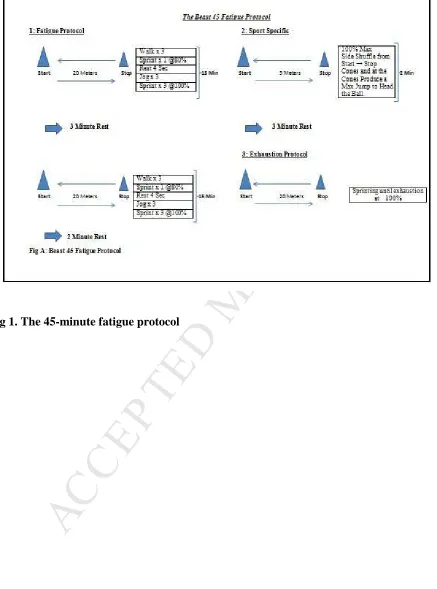
players were assessed before and after a modified 45-minute soccer-specific fatiguing
protocol (M-BEAST) that is based on the Ball-sport Endurance And Sprint Test (BEAST90)
(Williams et al., 2010) (Figure 1). In order to optimise the range during which true isokinetic
measures are collected and allow for more repeatable measures across a range of joint angles
(Baltzopoulos, 2008), the KinCom isokinetic dynamometer was set to 60˚/s (type, 125 AP,
M
AN
US
CR
IP
T
AC
CE
PT
ED
(EccPT), angle of peak torque (APT), and angle specific torques at knee joint angles of 10˚,
20˚, 30˚, 40˚, 50˚, 60˚, 70˚, 80˚ and 90˚. After the first testing session, participants were
randomly allocated (using a systematic random sample based on alphabetical order of names)
to either a strength training group (STR) (n=11) or a muscle endurance training group (END)
(n=11). Two participants from the END group did not complete the experiment.
Anthropometric data for both groups of are as follows. END (n=9; 21.8 ± 2.8 years, 179.4 ±
6.5 cm and 79.3 ±11.8 kg). STR (n=11; 23.2 ± 3.8 years, 184.8 ± 8.4cm and 82.5 ± 8.8 kg).
Participants were asked to avoid eating two hours prior to testing and to avoid any strenuous
activity in the 48 hours prior to assessment. Prior to the isokinetic test, a seven-minute
continuous dynamic warm up was performed on the track in the human performance lab of
the University. Testing was conducted on the dominant leg, defined as the leg most
commonly used for kicking. Each participant was seated on the isokinetic dynamometer in
90˚ hip flexion and 90˚ knee flexion, with the range of 90˚ to 0˚ of knee extension set
(Askling et al., 2003; Brockett et al., 2004). The lever arm was aligned with the knee joint
line (parallel to lateral epicondyle) and the shin pad attached above the malleoli. The
dynamometer was adjusted according to the participant’s limb length, to ensure that their
knee was overhanging the seat by two inches. Shorts were worn to aid visibility. Each
participant’s thigh, waist and torso were strapped to eliminate extraneous movement. To
ensure consistency between tests the lever arm length (cm) and dynamometer settings were
recorded for each participant and gravity correction was applied. Angular velocity was set at
60˚/s. The participant was instructed to give maximal effort for three repetitions. All
isokinetic testing was conducted by the same researcher who was trained and familiar with
M
AN
US
CR
IP
T
AC
CE
PT
ED
Reliability
Prior to the initial test session, all participants attended a familiarisation session with the
isokinetic dynamometer, after which the repeatability of EccPT and APT was determined
using intra-class correlation coefficient (model 2,1). The comparison of first and second
measurements indicated a strong correlation between the two measures of .92 (p<0.01)
(EccPT) and .94 (p<0.01) (APT). For the angle specific ICCs there was a strong correlation
shown at 10˚ (.92; p<0.01), 20˚ (.91; p<0.01), 30˚ (.88; p<0.01), 40˚ (.90; p<0.01), 50˚ (.89;
p<0.01), 60˚ (.91; p<0.01), 70˚ (.92; p<0.01), and 80˚ (.91; p<0.01).
Selection of exercise
Rehabilitation programs and training sessions that work on eccentric loading via Nordic
Hamstring Curls (NHC) appear to have a positive effect in reducing both the risk and
recurrence of HSI (Arnason et al., 2008; Petersen et al., 2011; Thorborg et al., 2012;
Mjølsnes et al., 2004; Häkkinen et al., 1985 Brito et al., 2010), with typical training
protocols structured to bring about an improvement in eccentric strength, particularly at
longer muscle lengths (Brockett et al., 2004; Arnason et al., 2008; Askling et al., 2003;
Gabbe et al., 2006; Petersen et al., 2011).
However, although NHC appear to have a positive effect on muscle strength (Brito et al.,
2010), and can decrease hamstring strains (Arnason et al., 2008; Mjølsnes et al., 2004), many
M
AN
US
CR
IP
T
AC
CE
PT
ED
control, reaching a “break point” well before the angles at which hamstring injuries occur. In
order to reach beyond these ranges, many trainers prescribe a form of “assisted” NHC
involving the use of an elastic band to support the athlete and provide assistence during the
most demanding phase of the exercise, enabling them to complete full NHC and allow them
to condition the hamstrings at longer lengths (Matthews et al., 2015).
Using the assisted NHC method described above, it is also possible to decrease muscle load,
and target muscular endurance training by allowing the athlete to complete a higher number
of repetitions.
Strength Protocol
The STR group performed a typical strength training protocol involving 5 sets of 4 NHC with
a two minute rest between each set. The load selected corresponded to each participant’s 4
repetition maximum (4RM), a load that allowed just 4 repetitions to be performed to an angle
of 45° or beyond. If participants could already perform 5 repetitions of the NHC, a weighted
vest was worn. This allowed additonal load to be added in .5kg increments and ensured the
load and repetitions remained in the 4RM range. As participants progressed, the load was
adjusted to the new 4RM. This protocol was performed twice a week for four weeks. (Pic 1).
Endurance Protocol
The END group performed a typical muscle endurance training protocol, starting at 5 sets of
12 assisted NHC, using a large rubber band secured around the participant’s chest, with the
load adjusted by the trainer to allow the performance of just 12 full-range repetitions. This
M
AN
US
CR
IP
T
AC
CE
PT
ED
Both training protocols were administered and supervised individually by the authors who are
either qualified strength and conditioning coaches or registered independent clinical
healthcare providers.
Statistical Analysis
Data were analysed using statistical software, SPSS v 16.0 for Windows (Chicago, Ill). A
multi-factorial analysis of variance (ANOVA) was carried out to determine the effects of
fatigue, time, or group. To determine where potential differences occurred, in the event of a
significant F ratio, post hoc comparisons were made using paired T-tests. To account for
multiple tests and the increased probability of a type I error, a Bonferroni correction was
applied. The alpha level was set a priori at p = 0.05.
The calculation of effect sizes give a good indication of the adaption to the temporal
dynamics of training (Rhea 2004; Frohlich et al 2009). As such effect sizes were calculated
using the means and standard deviations method.
Results
Twenty participants completed the exercise intervention (STR, n=11; END, n=9). Two
participants dropped out due to time commitments, giving a 91% completion rate.
Effect of fatigue - pre intervention
M
AN
US
CR
IP
T
AC
CE
PT
ED
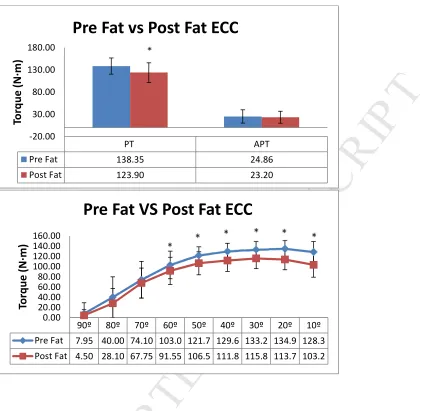
(p<0.001; d=.71, r=.33), while hamstring eccentric APT showed no significant difference;
angle specific hamstring eccentric torque decreased significantly pre- vs post-fatigue at 60
(p<0.001; d=.43, r=.21), 50 (p<0.001; d=.76, r=.35), 40 (p<0.001; d=.95, r=.43), 30 (p<0.001;
d=.96, r=.43), 20 (p<0.001; d=1.16, r=.50) and 10 (p<0.001; d=1.12, r=.49) degrees. (Figure
2).
Effect of fatigue - post intervention
Post intervention END Pre vs Post Fatigue
For the END group, post-intervention: hamstring EccPT and APT showed no significant
difference pre- vs post-fatigue; angle specific hamstring eccentric torque showed no
significant differences pre- vs post-fatigue at all angles. (Figure 3)
Post intervention STR Pre vs Post Fatigue
For the STR group, post-intervention: hamstring EccPT and APT showed no significant
differences pre- to post-fatigue; angle specific hamstring eccentric torque showed no
significant differences post-fatigue at all angles. (Figure 4)
M
AN
US
CR
IP
T
AC
CE
PT
ED
Pre-Fatigue Eccentric END
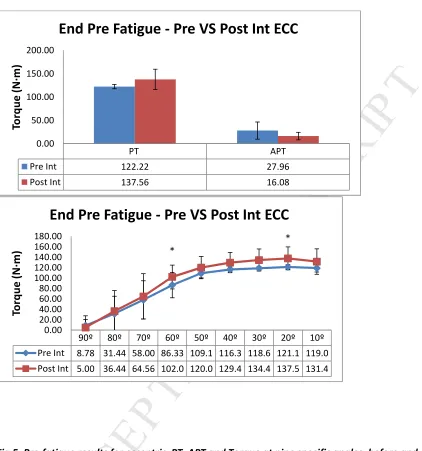
For the END group, Pre-Fatigue: hamstring EccPT and APT showed no significant
differences pre vs post intervention; angle-specific hamstring eccentric torque increased
significantly pre vs post-intervention at joint angles of 60˚ degrees (p<0.01; d= .66, r=.31)
and 20˚ (p<0.05; d=1.04, r=.46), but showed no significant difference at all other angles.
(Figure 5).
Post-Fatigue Eccentric END
For the END group, Post-Fatigue: hamstring EccPT increased significantly pre vs
post-intervention (p<0.001; d=1.29, r=.54). APT showed no significant difference; angle specific
hamstring eccentric torque increased significantly pre vs post-intervention for the Endurance
trained group at 70˚ (p<0.05; d= 0.60 , r= .29), 60˚ (p<0.05; d=.54, r=.26), 50˚ (p< 0.001; d=
0.94, r= 0.42 ), 40˚ (p<0.001; d=1.26 , r= .53), 30˚ (p<0.001; d= 1.27 , r= .54), 20˚ (p<0.001;
d=1.53, r=.61 ), and 10˚ (p<0.01; d=1.56, r=.62 ) degrees. (Figure 6).
Pre-Fatigue Eccentric STR
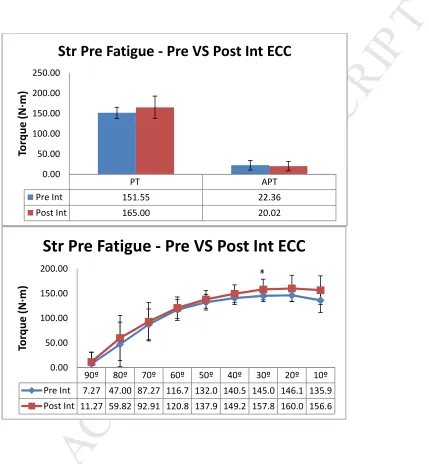
For the STR group, Pre-Fatigue: hamstring EccPT and APT showed no significant difference
pre vs post intervention; angle specific hamstring eccentric torque increased significantly pre
vs post-intervention at 30 degrees (p< 0.05; d= .75, r=.35) but showed no significant
difference at all other angles. (Figure 7).
Post-Fatigue Eccentric STR
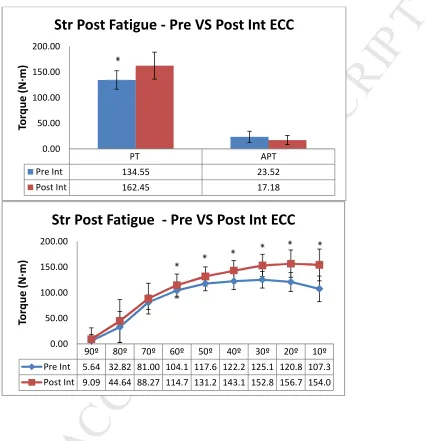
For the STR group, Post-Fatigue: hamstring EccPT increased significantly pre- vs
post-intervention (p<0.001; d=1.24, r=0.53). APT showed no significant difference; angle specific
hamstring eccentric torque increased significantly pre vs post intervention at 60˚ (p<0.05;
d=.57 , r=.28 ), 50˚ (p<0.001; d=.83 , r=.38 ), 40˚ (p<0.001; d=1.16 , r=.50 ), 30˚ (p<0.001;
M
AN
US
CR
IP
T
AC
CE
PT
ED
(Figure 8).
Between group comparisons
No differences were observed for all variables of interest pre- to post- intervention between
the END and STR groups.
Discussion
The aim of this study was to investigate the effect of a 45-minute fatiguing protocol on the
torque angle profile of competitive soccer players and then to investigate two separate
hamstring training protocols to determine which was most effective at mitigating the decline
in eccentric hamstring strength previously observed with fatigue (Cohen et al., 2015). These
were: a typical strength training protocol - high load/low repetitions – and a typical muscle
endurance training protocol - low load/high repetitions.
Results showed a reduction in EccPT and a shift in the torque angle profile following fatigue,
whereby torque at the longer muscle lengths declined more than the shorter lengths. The
reduction in EccPT with fatigue observed in this study has previously been observed by Hoff
Jan & Helgerud Jan., (2004), Small et al. (2010), and Cohen et al., (2015) although it should
M
AN
US
CR
IP
T
AC
CE
PT
ED
studies (Cohen et al., 2015; Small et al., 2010; Lorde et al., 1992; Delextrax et al., 2010). The
effect sizes reported (Cohen’s d = .71) for the fatigue induced changes in EccPT indicate a
medium to large effect size. For the torque angle profile, the effect size rises from .45 at 60°,
.76 at 50°, .95 at 40°, .96 at 30°, 1.16 at 20° and 1.12 at 10° indicating that, at the longer
muscle lengths, the effect of fatigue is greater. The angle specific changes in torque observed
after a 45 minute fatigue protocol appear to mimic results previously observed after 90
minutes (Cohen et al., 2015). These observed changes in angle specific torque, and the
reduction in EccPT observed by this study and Small et al (2010), after only 45 mins of
soccer specific fatigue, may provide an explanation for the increase in HSI observed towards
the end of 45 minutes of play (Woods et al., 2004; Ekstrand et al 2011).
Following the 4 week intervention period, both STR and END conditions showed significant
improvements post-fatigue for EccPT and a shift in the torque angle profile, whereby the
athletes were able to maintain higher eccentric hamstring torque at the longer lengths
associated with injury. Between group comparisons revealed no differences in the
effectiveness of the intervention between the STR and END groups. These results suggest
that short-term hamstring conditioning programs (4 weeks), with either a maximum strength
or a muscular endurance emphasis can significantly reduce the fatigue induced loss of EccPT
and the preferential loss of eccentric hamstring strength observed at longer muscle lengths.
This is relevant for the clinician as NHC are often difficult for some athletes to perform,
imposing eccentric loads that are at or near maximum, and resulting in the performance of
either partial or incomplete repetitions and often leading to delayed onset muscle soreness
following the initial workouts (Sebelien et al., 2014). The END protocol used in this study,
M
AN
US
CR
IP
T
AC
CE
PT
ED
NHC and allows a more endurance focussed protocol (higher repetition/lower load training)
to be used. The assisted NHC may therefore provide a more suitable introduction to NHC,
particularly if a NHC training intervention is introduced during a competitive season, where
muscle soreness can impact performance. Moreover, the full range achieved through every
repetition of an assisted NHC allows the muscles to be trained over a greater range and
possibly strengthen ranges that some in the STR group could not have reached. This may
partly explain why the END protocol in this study appears to be equally effective in
mitigating the loss of eccentric strength with fatigue when compared to STR.
Although changes in APT were not significant for either group, there does appear to be a
trend following the intervention. Both the END and STR groups appear to shift the APT
towards a more extended knee position, which has previously been suggested to be
advantageous in terms of injury prevention (Brockett et al., 2004; Proske et al., 2004).
Whilst NHC training has previously been reported to increase eccentric hamstring strength
(Mjølsnes et al., 2004; Anastasi et al., 2011), these results suggest that both strength and
muscle endurance training protocols are effective in maintaining eccentric hamstring strength
in the post-fatigue condition, particularly at the longer muscle length associated with HSI.
With HSI occurring in the final 15 minutes of a each half or towards the end of a game
(Rahnama et al., 2003; Woods et al., 2004; Small et al., 2009), it is possible that the
maintenance of eccentric strength under conditions of fatigue, observed in this study, may
M
AN
US
CR
IP
T
AC
CE
PT
ED
We did not specifically control for training volume between the two groups and recognise
that the endurance group were likely performing a higher training volume than the strength
group. Whilst we acknowledge this as a potential limitation, the aim of this research was to
apply typical training protocols that are designed to increase strength (5 sets x 4 repetition x
4RM) or endurance (5 sets x 12 repetitions x 12RM) in the real world. We also acknowledge
that the training intervention was conducted on males. As such, we advise caution when
extrapolating these results to females.
It is interesting to note that the 4-week training period appears to be sufficient to positively
change torque angle profile, which may in turn contribute to a lower risk of HSIs. Previous
research has focussed on longer intervention periods of up to 10 weeks (Mjølsnes et al., 2004;
Anastasi et al., 2011). Whilst it is possible that the magnitude of change would have been
higher if the study was carried out for longer, the significant improvements observed after 4
weeks suggests that a NHC training programme can be easily incorporated into a typical
pre-season training phase.
Conclusion
This study appears to show that 45 minutes of soccer specific fatigue is enough to show
reductions in EccPT and changes in the torque angle profile, with greater effect sizes
observed at the longer muscle lengths. Moreover, both strength and muscle endurance
M
AN
US
CR
IP
T
AC
CE
PT
ED
hamstring muscles, particularly under conditions of fatigue, and may both be useful tools to
mitigate the risk of HSI in the future.
References
1. Anastasi, S. & Hamzeh, M. (2011). Does the eccentric Nordic Hamstring exercise
have an effect on isokinetic muscle strength imbalance and dynamic jumping
performance in female rugby union players? Isokinetics & Exercise Science, 19 (4)
251-260.
2. Arnason, A., Andersen, T. E., Holme, I., Engebretsen, L. & Bahr, R. (2008).
Prevention of hamstring strains in elite soccer: an intervention study. Scandinavian
Journal of Medicine & Science in Sports, 18(1), 40-48.
3. Askling, C., Karlsson, J. & Thorstensson, A. (2003). Hamstring injury occurrence in
elite soccer players after preseason strength training with eccentric overload. /
M
AN
US
CR
IP
T
AC
CE
PT
ED
football apres une pre-saison comportant un entrainement de force avec une surcharge
excentrique. Scandinavian Journal of Medicine & Science in Sports, 13(4), 244-250.
4. Bahr R. & Holme I. (2003). Risk factors for sports injuries – a methodological
approach. British Journal Of Sports Medicine. 2003; 37; 384-392
doi:10.1136/bjsm.37.5.384.
5. Baltzopoulos,V. (2008). Isokinetic dynamometry. In Biomechanical Evaluation of
Movement in Sport and Exercise: BASES Guidelines (pp. 103-128), Routledge,
London
6. Bennell, K., Wajswelner, H., Lew, P., Schall-Riaucour, A., Leslie, S., Plant, D. &
Cirone, J. (1998). Isokinetic strength testing does not predict hamstring injury in
Australian Rules footballers. / Levaluation de la force isocinetique ne permet pas de
predire les blessures des ischio-jambiers chez des joueurs de football australien.
British Journal of Sports Medicine, 32(4), 309-314.
7. Brito, J., Figueiredo, P., Fernandes, L., Seabra, A., Soares, J. M., Krustrup, P. &
Rebelo, A. (2010). Isokinetic strength effects of FIFA's "The 11+" injury prevention
training programme. Isokinetics & Exercise Science, 18(4), 211-215.
8. Brockett, C. L., Morgan, D. L. & Proske, U. (2004). Predicting hamstring strain injury
in elite athletes. Medicine & Science in Sports & Exercise, 36(3), 379-387.
M
AN
US
CR
IP
T
AC
CE
PT
ED
prevention of hamstring muscle injuries in professional rugby union. AmJSports Med,
34 (8); 1297-306.
10.Burkett, L., Alvar, B. & Irvin, J. (2002). Determining the Optimal Knee Angle for
Testing Maximal Isometric Hamstring Peak Torque on an Isokinetic Dynamometer.
International Sports Journal, 6, (1) 171.
11.Chumanov, E., Heiderscheit, B. & Thelen, D. (2007). The effect of speed and
influence of individual muscles on hamstring mechanics during the swing phase of
sprinting. Journal Of Biomechanics, 40, (16) 3555-3562.
12.Clarke, H. H. (1950). Improvement of objective strength tests of muscle groups by
cable tension methods. Research Quarterly, 21, 399-417.
13.Cohen, D., Bingnan, Z., Okwera, B., Matthews, M. & Delextrat, A. (2015).
Angle-Specific Eccentric Hamstring Fatigue After Simulated Soccer. International Journal
Of Sports Physiology & Performance, 10 (3), 325-331.
14.Croisier, J. Ganteaume, S. Binet, J. Genty, M. & Ferret, J. (2008). Strength
Imbalances and Prevention of Hamstring Injury in Professional Soccer Players.
American Journal Of Sports Medicine, 36, (8,) 1469-1475.
15.Delextrat, A., Baker, J., Cohen, D. D, & Clarke, N. D. (2013). Effect of a simulated
M
AN
US
CR
IP
T
AC
CE
PT
ED
players. Scandinavian Journal of Medicine & Science in Sports, 23(4), 478-486.
16.Delextrat, A., Gregory, J. & Cohen, D. (2010). The Use of the Functional H: Q Ratio
to Assess Fatigue in Soccer. International Journal of Sports Medicine, 31(3),
192-197.
17.Drezner, J.A. (2003). Practical management : hamstring muscle injury. Clin J Sport
Med, 13(1): 48-52.
18.Ekstrand J., Hagglund M. & Walden M. (2011). Epidemiology of muscle injuries in
professional football (soccer). AmJSports, 39(6):1226-32.
19.Fröhlich M., Emrich E., Pieter A. & Stark R. (2009). Outcome Effects and Effects
Sizes in Sport Sciences. International Journal of Sports Science and Engineering, 3
(3) 175-179
20.Gabbe, B., Bennell, K., Finch, C., Wajswelner, H. & Orchard, J. (2006). Predictors of
hamstring injury at the elite level of Australian football. Scandinavian Journal Of
Medicine & Science In Sports, 16 (1) 7-13.
21.Greig, M. & Siegler, J. (2009). Soccer-Specific Fatigue and Eccentric Hamstring
Muscle Strength. Journal Of Athletic Training (National Athletic’ Association), 44 (2)
M
AN
US
CR
IP
T
AC
CE
PT
ED
22.Haekkinen, K. & Komi, P. (1985). Effect of explosive type strength training on
electromyographic and force production characteristics of leg extensor muscles during
concentric and various stretch-shortening cycle exercises. Scandinavian Journal Of
Sports Sciences, 7 (2), 65-76.
23.Hamada, T., Sale, D. G., MacDougall, J. D. & Tarnopolsky, M. A. (2003). Interaction
of fibre type, potentiation and fatigue in human knee extensor muscles. Acta
Physiologica Scandinavica, 178(2), 165-173.
24.Hamilton, B. (2012). Hamstring muscle strain injuries: what can we learn from
history? British Journal Of Sports Medicine, 46 (13) 900-903.
25.Henderson, G., Barnes, C. & Portas, M. (2010). Factors associated with increased
propensity for hamstring injury in English Premier League soccer players. Journal Of
Science & Medicine In Sport, 13 (4) 397-402.
26.Hickey, J., Shield, A., Williams, M. & Opar, D. (2014). The financial cost of
hamstring strain injuries in the Australian Football League. British Journal Of Sports
Medicine, 48 (8), 1-2.
27.Hoff, J. & Helgerud, J. (2004). Endurance and Strength Training for Soccer Players:
Physiological Considerations. Sports Medicine, 34(3), 165-180.
M
AN
US
CR
IP
T
AC
CE
PT
ED
between the hamstring muscles. Journal Of Electromyography & Kinesiology, 22 (4)
520-526.
29.Koulouris, G., Connell, D., Bourke, F. & Young, D. (2002). Imaging findings of acute
injuries to the hamstring muscle complex. (Abstract), Journal Of Science & Medicine
In Sport, 5 (4 Suppl.) 105.
30.Lieber, R.L. & Friden, J. Functional and clinical significance of skeletal muscle
architecture. (2000). Muscle Nerve, 23(11):1647-66.
31.Lord, J., Aitkens, S., McCrory, M. & Bernauer, E. (1992). Isometric and isokinetic
measurement of hamstring and quadriceps strength. Archives Of Physical Medicine &
Rehabilitation, 73 (4), 324-330.
32.Lysholm, J. & Wiklander, J. (1987). Injuries in runners / Les lesions des coureurs a
pied, American Journal of Sports Medicine, 15(2), 168-171.
33.Matthews, M., Jones, P., Cohen, D. & Matthews, H. (2015). The Assisted Nordic
Hamstring Curl. Strength & Conditioning Journal, 37 (1), 84-87.
34.Mjolsnes, R., Arnason, A., Osthagen, T., Raastad, T. & Bahr, R. (2004). A 10-week
randomized trial comparing eccentric vs. concentric hamstring strength training in
well-trained soccer players. Scandinavian Journal of Medicine & Science in Sports,
M
AN
US
CR
IP
T
AC
CE
PT
ED
35.Opar, D., Williams, M. & Shield, A. (2012). Hamstring Strain Injuries: Factors that
Lead Injury and Re-Injury. Sports Medicine, 42 (3), 209-226.
36.Orchard, J., Seward, H., Orchard, J. & Driscoll, T. (2013). The speed-fatigue trade off
in hamstring etiology: analysis of 2011 AFL injury data. Sport Health, 31(3), 53-57.
37.Petersen, J., Thorborg K., Nielsen M.B., Budtz-Jørgensen E. & Hölmich P. (2011).
Preventive effect of eccentric training on acute hamstring injuries in men's soccer: a
cluster-randomized controlled trial. Am J Sports Med, 39(11):2296-303.
38.Petersen, J., & Hölmich, P. (2005). Evidence based prevention of hamstring injuries
in sport. British Journal Of Sports Medicine, 39 (6), 319-323.
39.Proske U., Morgan D.L., Brockett C.L. & Percival P. (2005) Identifying athletes at
risk of hamstring strains and how to protect them. Proceedings of the Australian
Physiological and Pharmacological Society, 34: 25-30
40.Rhea, M.R. (2004). Determining the magnitude of treatment effects in strength
training research through the use of the effect size. Journal of Strength and
Conditioning Research, 18(4): 918-920
41.Schmitt, B., Tyler, T. & McHugh, M. (2012). Hamstring Injury Rehabilitation and
Prevention of Re-injury Using Lengthened State Eccentric Training: A New
M
AN
US
CR
IP
T
AC
CE
PT
ED
42.Schuermans, J. Van Tiggelen, D., Danneels, L. & Witvrouw, E. (2014). Biceps
femoris and semitendinosus—teammates or competitors? New insights into hamstring
injury mechanisms in male football players: a muscle functional MRI study. British
Journal Of Sports Medicine, 48 (22), 1599-1606.
43.Sconce, E., Jones, P., Turner, E., Comfort, P. & Graham-Smith, P. (2015). The
Validity of the Nordic Hamstring Lower for a Field-Based Assessment of Eccentric
Hamstring Strength. Journal Of Sports Rehabilitation, 24 (1), 13-20.
44.Sebellien, C., Stiller, C.H., Maher, S.F. and Qu, X.(2014). Effects of implementing
Nordic hamstring exercises for semi-professional soccer players in Akershus,
Norway. Orthopaedic Physical Therapy Practice, 26(2), 90-97
45.Small, K., McNaughton, L., Greig, M. & Lovell, R. (2010). The effects of
multidirectional soccer-specific fatigue on markers of hamstring injury risk. Journal
of Science & Medicine in Sport, 13(1), 120-125.
46.Small, K., McNaughton, R., Greig, M., Lohkamp, M. & Lovell, R. (2009). Soccer
Fatigue, Sprinting and Hamstring Injury Risk. International Journal of Sports
Medicine, 30(8), 573-578.
47.Thorborg, K. (2012). Why hamstring eccentrics are hamstring essentials. British
M
AN
US
CR
IP
T
AC
CE
PT
ED
48.Timm, K. (1987). Investigation of the physiological overflow effect from
speed-specific isokinetic activity. Journal Of Orthopaedic & Sports Physical Therapy, 9 (3),
106-110.
49.Van der Horst, H., Wouter Smits, D., Petersen, J., Goeghart, E. & Backx, F. (2014).
The preventive effect of the Nordic hamstring exercise of hamstring injuries in
amateur soccer players: study protocol for a randomised controlled trial. Injury
Prevention, 20 (4), 1-5.
50.Williams, J. D., Abt, G. & Kilding, A. E. (2010). Ball-port Endurance and sprint test
(BEAST90): Validitiy and reliability of a 90-minute soccer performance test. Journal
of Strength & Conditioning Research, 24(12), 3209-3218.
51.Woods, C., Hawkins, R. D., Maltby, S., Hulse, M., Thomas, A. & Hodson, A. (2004).
The Football Association Medical Research Programme: an audit of injuries in
professional football - analysis of hamstring injuries. British Journal of Sports
M
AN
US
CR
IP
T
AC
CE
PT
ED
M
AN
US
CR
IP
T
AC
CE
PT
ED
M
AN
US
CR
IP
T
AC
CE
[image:30.595.83.520.111.700.2]PT
ED
M
AN
US
CR
IP
T
AC
CE
PT
ED
Fig 2: Pre-intervention results for eccentric PT, APT and Torque at nine specific angles, before and after fatigue for all participants. An Asterisk (*) denotes a significant difference (p<0.005).
PT APT
Pre Fat 138.35 24.86
Post Fat 123.90 23.20
-20.00 30.00 80.00 130.00 180.00 To rq u e ( N ·m )
Pre Fat vs Post Fat ECC
90º 80º 70º 60º 50º 40º 30º 20º 10º
Pre Fat 7.95 40.00 74.10 103.0 121.7 129.6 133.2 134.9 128.3
Post Fat 4.50 28.10 67.75 91.55 106.5 111.8 115.8 113.7 103.2 0.00 20.00 40.00 60.00 80.00 100.00 120.00 140.00 160.00 To rq u e ( N ·m )
[image:31.595.75.496.105.516.2]M
AN
US
CR
IP
T
AC
CE
PT
ED
Graphs for Endurance Group Post Intervention/ Before and After Fatigue
Fig.3: Post-intervention results for eccentric PT, APT and Torque at nine specific angles, before and
after fatigue for the Endurance Group. An Asterisk (*) denotes a significant difference (p<0.005).
PT APT
Pre Fat 137.56 16.08
Post Fat 139.11 18.64
0.00 20.00 40.00 60.00 80.00 100.00 120.00 140.00 160.00 180.00 To rq u e ( N ·m )
End- Pre Fat vs Post Fat ECC
90º 80º 70º 60º 50º 40º 30º 20º 10º
Pre Fat 5.00 36.44 64.56 102.0 120.0 129.4 134.4 137.5 131.4
Post Fat 0.00 27.78 73.00 95.33 118.2 128.2 132.8 137.5 133.6 0.00 20.00 40.00 60.00 80.00 100.00 120.00 140.00 160.00 To rq u e ( N ·m )
M
AN
US
CR
IP
T
AC
CE
PT
ED
Graphs for Strength Group Post Intervention/ Before and After Fatigue
Fig.4: Post-intervention results for eccentric PT, APT and Torque at nine specific angles, before and after fatigue for the Strength Group. An Asterisk (*) denotes a significant difference (p<0.005).
PT APT
Pre Fat 165.00 20.02
Post Fat 162.45 17.18
0.00 50.00 100.00 150.00 200.00 250.00 To rq u e ( N ·m )
Str- Pre Fat vs Post Fat ECC
90º 80º 70º 60º 50º 40º 30º 20º 10º
Pre Fat 11.27 59.82 92.91 120.82 137.91 149.27 157.82 160.09 156.64
Post Fat 9.09 44.64 88.27 114.73 131.27 143.18 152.82 153.73 154.00 0.00 50.00 100.00 150.00 200.00 To rq u e ( N ·m )
M
AN
US
CR
IP
T
AC
CE
PT
ED
[image:34.595.76.498.112.563.2]Effects of Intervention of Endurance Pre Fatigue Graphs
Fig 5: Pre-fatigue results for eccentric PT, APT and Torque at nine specific angles, before and after intervention for the Endurance Group. An Asterisk (*) denotes a significant difference (p<0.005).
PT APT
Pre Int 122.22 27.96
Post Int 137.56 16.08
0.00 50.00 100.00 150.00 200.00 To rq u e ( N ·m )
End Pre Fatigue - Pre VS Post Int ECC
90º 80º 70º 60º 50º 40º 30º 20º 10º
Pre Int 8.78 31.44 58.00 86.33 109.1 116.3 118.6 121.1 119.0
Post Int 5.00 36.44 64.56 102.0 120.0 129.4 134.4 137.5 131.4 0.00 20.00 40.00 60.00 80.00 100.00 120.00 140.00 160.00 180.00 To rq u e ( N ·m )
M
AN
US
CR
IP
T
AC
CE
PT
ED
Effects of Intervention of Endurance Post Fatigue Graphs
Fig 6: Post-fatigue results for eccentric PT, APT and Torque at nine specific angles, before and after intervention for the Endurance Group. An Asterisk (*) denotes a significant difference (p<0.005).
PT APT
Pre Int 110.89 22.81
Post Int 139.11 18.64
0.00 20.00 40.00 60.00 80.00 100.00 120.00 140.00 160.00 180.00 To rq u e ( N ·m )
End Post Fatigue - Pre VS Post Int ECC
90º 80º 70º 60º 50º 40º 30º 20º 10º
Pre Int 3.11 22.33 51.56 76.11 93.00 99.00 104.4 105.1 98.22
Post Int 0.00 27.78 73.00 95.33 118.2 128.2 132.8 137.5 133.6 0.00 20.00 40.00 60.00 80.00 100.00 120.00 140.00 160.00 To rq u e ( N ·m )
M
AN
US
CR
IP
T
AC
CE
PT
ED
[image:36.595.70.499.178.642.2]Effects of Intervention of Strength Pre Fatigue Graphs
Fig 7: Pre-fatigue results for eccentric PT, APT and Torque at nine specific angles, before and after intervention for the Strength Group. An Asterisk (*) denotes a significant difference (p<0.005).
PT APT
Pre Int 151.55 22.36
Post Int 165.00 20.02
0.00 50.00 100.00 150.00 200.00 250.00 To rq u e ( N ·m )
Str Pre Fatigue - Pre VS Post Int ECC
90º 80º 70º 60º 50º 40º 30º 20º 10º
Pre Int 7.27 47.00 87.27 116.7 132.0 140.5 145.0 146.1 135.9
Post Int 11.27 59.82 92.91 120.8 137.9 149.2 157.8 160.0 156.6 0.00 50.00 100.00 150.00 200.00 To rq u e ( N ·m )
M
AN
US
CR
IP
T
AC
CE
PT
ED
[image:37.595.70.501.179.620.2]Effects of Intervention of Strength Post Fatigue Graphs
Fig 8: Post-fatigue results for eccentric PT, APT and Torque at nine specific angles, before and after
intervention for the Strength Group. An Asterisk (*) denotes a significant difference (p<0.005).
…………...
PT APT
Pre Int 134.55 23.52
Post Int 162.45 17.18
0.00 50.00 100.00 150.00 200.00 To rq u e ( N ·m )
Str Post Fatigue - Pre VS Post Int ECC
90º 80º 70º 60º 50º 40º 30º 20º 10º
Pre Int 5.64 32.82 81.00 104.1 117.6 122.2 125.1 120.8 107.3
Post Int 9.09 44.64 88.27 114.7 131.2 143.1 152.8 156.7 154.0 0.00 50.00 100.00 150.00 200.00 To rq u e ( N ·m )
M
AN
US
CR
IP
T
AC
CE
PT
ED
Strength and endurance training reduces the loss of eccentric hamstring torque observed after soccer specific fatigue
Additional individuals who helped in the completion of this study.
Steve Horton and Laura Smith from the University of Salford human Performance laboratory
M
AN
US
CR
IP
T
AC
CE
PT
ED
Forty-five minutes of simulated soccer activity leads to reduced eccentric hamstring torque.
Eccentric hamstring torque declined preferentially at longer muscle lengths
Strength or muscular endurance training reduces fatigue-induced loss of strength over this time period.
M
AN
US
CR
IP
T
AC
CE
PT
ED
Strength and endurance training reduces the loss of eccentric hamstring torque observed after soccer specific fatigue
Ethical Approval for the above title was gained from the Research Governance and Ethics
Committee (RGEC): College of Health and Social Care, University of Salford – approval
number 1314-260