Journal of Criminal Law and Criminology
Volume 31
Issue 4
November-December
Article 5
Winter 1940
Recidivism and Intelligence
A. A. Hartman
Follow this and additional works at:
https://scholarlycommons.law.northwestern.edu/jclc
Part of the
Criminal Law Commons,
Criminology Commons, and the
Criminology and Criminal
Justice Commons
This Article is brought to you for free and open access by Northwestern University School of Law Scholarly Commons. It has been accepted for inclusion in Journal of Criminal Law and Criminology by an authorized editor of Northwestern University School of Law Scholarly Commons.
Recommended Citation
RECIDIVISM AND INTELLIGENCE
1. Introduction
A. A. Hartman= 2
The purpose of this study is to ex-amine quantitatively the general.rela-tionship between recidivism and intelli-gence. To what extent are different degrees of criminality associated with variations in intellectual capacity?
The wider problem of the psychologi-cal nature of the persistent offender has long been a focus for theories of crime causation, particularly those theories which emphasize constitu-tional rather than environmental fac-tors. Until recently many such ex-planations were phrased entirely in terms of mental retardation or defi-ciency, so-called feeble-mindedness. Present day criminologists have, how-ever, outgrown these facile uni-factor theories. The concept of the multiple approach to the understanding of hu-man behavior is becoming as much a credo for research as it is a clinical working basis in criminology. Never-theless, controlled analysis of single factors, such as intelligence, still re-mains a valuable scientific method in this complex field.
'Studies from the Division of the Crimin-ologist, State of Illinois, Paul L. Schroeder, M.D.; Series A, No. 103.
This report was prepared under the super-vision of Robert H. Gault of Northwestern Uni-versity. I am indebted to him for his advice and criticism and to Mr. Sol Z. Rosenbaum for his generous assistance in the statistical analysis. To inmates E. T., C. L., and J. L. who gave much time to tabulating data, I wish a speedy oppor-tunity to demonstrate their non-recidivism.
A survey of the scientific literature on the relationship of intelligence to recidivism reveals a confusing mixture of conclusions and speculations, with little adequate data in evidence. It is a commentary on the status of this problem that conflicting opinions are supported by leading criminologists in the United States. Gillin,3
for example, declares, "Every study of recidivism shows that repetition of crime increases as the average mentality lowers." Sutherland,4
more cautiously, finds the evidence inconclusive but tending
".... to justify the generalization that the relationship between intelligence and recidivism is very slight."
The fact is that in the past twenty years only a few studies of adult re-peated offenders have included detailed consideration of intellectual factors. Goring, and the early psychological criminologists such as Adler, Haines, Miner, Doll, and Goddard, produced little material bearing directly upon re-cidivism. Murchison' was one of the first to deal specifically with this
prob-2 Psychologist, Diagnostic Depot, Joliet. Now at Cook County Juvenile Court.
3 John L .Gillin, Social Pathology. N. Y., The Century Co., 1933, p. 557.
4 Edwin H. Sutherland, Mental Deficiency and Crime. Chapter XV in Social Attitudes, edited
by Kimball Young, New York. Holt and Co., 1931, p. 371.
5 Carl Murchison, Criminal Intelligence. Wor-cester, Mass., Clark University Press, 1926, p. 95.
A. A. HARTMAN
lem. A chapter of his "Criminal In-telligence" is devoted to a comparison of 660 recidivists and 979 first offend-ers. The principal finding was that 33.6% of recidivists are above and 35% below an Army Alpha grade of C, as compared respectively with 34.3% and 42.6% of first offenders. He concluded tentatively that, "recidivists seem more intelligent than are first offenders, in so far as differences exist."
Erickson's6 study of 1690 white male prisoners in Wisconsin illustrates a neutral point of view. Although he found in general "a very definite rela-tionship between criminality and in-telligence . . . .," he nevertheless con-cluded that, "recidivism appears un-related to the intellectual endowment since it occurs with essentially the same frequency among the mentally deficient offenders as among those of better in-tellectual capacities."
Frank, on the other hand, finds "a direct relationship between the mental level and recidivism" in a group of 401 cases at Rahway, New Jersey Reforma-tory. Mental levels were diagnosed not only on the basis of psychometrics but also upon social history and ob-servation of personality traits. "Thirty-three per cent of the feeble-minded were recidivists .... as compared to a range of 17 to 20% for the three upper groups (inferior, average, and super-ior) ."
In the Gluecks" first follow-up study
r Milton Hyland Erickson, Study of the Rela-tionship between Intelligence and Crime. Jour. of Crim. Law and Criminol., 19: 592-635, 1928-29. 7Benjamin Frank, Mental Level as a Factor in Crime. J. Juvenile Res.. 15, 192-197, July, 1931.
of 500 graduates of the Massachusetts Reformatory for Men, "eighty-five
%
of those of lower intelligence con-tinued to recidivate as compared to 80% of those of higher intelligence." In the second five year follow-up period9 there was actually a greater proportional increase in non-delin-quency among the borderline and feeble-minded group. These differ-ences may, however, be due entirely to the greater proportion of non-delin-quents of foreign-birth (who generally score low on intelligence tests) in both periods. The small number of cases, the mixed racial composition of the groups, and the crudeness of the in-tellectual scale used limit the value of their results for this particular problem. Tulchin's'° monograph, "Intelligence and Crime," contains probably the most objective treatment of this sub-ject which has appeared. His results, based upon psychological examinations given to about 10,000 Illinois prisoners during 1920-1927, show that "... the men with records of previous commit-ments make higher median Alpha scores than do the men serving their first sentence . . . ." Unfortunately, as he points out himself, at the time of his investigation information on criminal history was of questionable accuracy since it was based upon in-mates' unverified statements.It is evident that the question of the relationship between intelligence and
8 Sheldon and Eleanor T. Glueck, 500 Criminal Careers. N. Y., A. A. IXnopf, 1930.
9 -, Later Criminal Careers. N. Y., The
Commonwealth Fund, 1937, p. 99.
recidivism is still in a controversial state. This is not surprising when we consider the youth of the intelligence testing movement and the difficulties of criminal statistics. The present study, taking advantage of the development of clinical psychology and the progress of professional criminology in the Illi-nois prisons, attempts to solve this problem by analyzing a large, carefully studied group of offenders.
II Data and Methods
The subjects for this investigation were 4188 native-born white felons, the total of such offenders committed by courts in the northern counties of Illi-nois from July 1, 1934 to July 1, 1939. These men were admitted for classifica-tion to the Joliet Diagnostic Depot and received the usual psychological, socio-logical, and psychiatric examinations over a three to six-week period. The data used here are based upon these examinations, as described below.
Data on intelligence levels are de-rived entirely from the results of the standard psychological examinations given to all admissions. The majority of prisoners receive only the group Army Alpha test; where an additional individual test had been given this latter rating was used. Those who re-ceived two individual tests such as the Stanford-Binet and the Arthur Per-formance Scale were assigned the higher of the two mental ages obtained. All group and individual test ratings were equated in terms of mental-ages and intelligence quotients, on the basis
11 Memoirs, The National Academy of Science,
Vol. 15, 1921, p. 195.
of the equivalent scale described in the Army Memoirs."' For example, the I. Q. range 100-109 includes Army Al-pha test scores 78 through 101, and in-dividual test mental ages from fifteen years through sixteen years five
months.
The term recidivism as employed here refers to the formal record of offenses. This is given in the criminal history obtained by the sociologist, and is verified by social history correspond-ence and Federal Bureau of Identifica-tion reports. The following six point scale of previous criminal record was used:
I. No previous record H. Arrests only III. Minor Record
IV. One previous reformatory or
prison term
V. One previous reformatory or prison term plus a minor record
VI. Two or more previous reformatory or prison terms
Each convict was classified in but one of these six categories. Group III includes any case without a previous prison record, in which one or more of the following items was recorded: juve-nile correctional school, chain gang, prison farm, probation, suspended sen-tence, or jail. A notation of one or more of these when accompanied by a history of one previous reformatory or prison term would be classified in Group V. Otherwise one prison or re-formatory term without any minor rec-ord would be considered Group IV.
A. A. HARTMAN
TABLE I
PERCENTAGE DISTRIBUTION OF INTELLIGENCE QUOTIENTS or 4,188 NATIVE WHITE CONVICTS WITH VARIOUS DEGREES OF CRIMINAL RECORD
Previous Criminal Record
I II I1 IV V VI
Intelligence Quotient
130 and over ... 120-129 ... 110-119 ... 100-109 ...
90-99 ...
80-89 ... 70-79 ... 60-69 ... 50-59 ... 40-49 ... Total ... Number of Cases .... Average IQ ... S.D . ...
None .5 9.8 23.9 23.1 20.2 13.8 6.6 1.6 .3 .2 100.0 610 101.85 15.51 Arrests Only .3 10.3 21.7 21.1 21.5 13.3 10.0 1.1 .7 100.0 669 100.71 16.00
the usual, somewhat arbitrary, legal categories: robbery, larceny, burglary, murder, sex and a miscellaneous group.
III Results
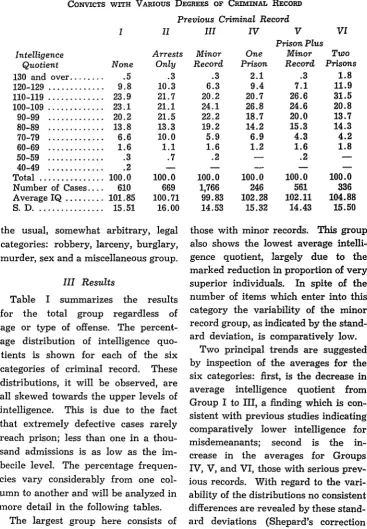
Table I summarizes the results for the total group regardless of age or type of offense. The percent-age distribution of intelligence quo-tients is shown for each of the six categories of criminal record. These distributions, it will be observed, are all skewed towards the upper levels of intelligence. This is due to the fact that extremely defective cases rarely reach prison; less than one in a thou-sand admissions is as low as the im-becile level. The percentage frequen-cies vary considerably from one col-umn to another and will be analyzed in more detail in the following tables.
The largest group here consists of
Minor Record .3 6.3 20.2 24.1 22.2 19.2 5.9 1.6 .2 100.0 1,766 99.83 14.53 One Prison 2.1 9.4 20.7 26.8 18.7 14.2 6.9 1.2 100.0 246 102.28 15.32 Prison Plus
Minor Two
Record Prisons
.3 1.8
7.1 11.9 26.6 31.5
24.6 20.8 20.0 13.7 15.3 14.3
4.3 4.2
1.6 1.8 .2
100.0 100.0 561 336 102.11 104.88
14.43 15.50
those with minor records. This group also shows the lowest average intelli-gence quotient, largely due to the marked reduction in proportion of very superior individuals. In spite of the number of items which enter into this category the variability of the minor record group, as indicated by the stand-ard deviation, is comparatively low.
[image:5.454.47.415.66.596.2]for coarseness of grouping has been used throughout).
In Table II the total cases have
TABLE II
PERCENTAGE DISTRIBUTION OF INTELLIGENCE QUOTIENTS OF FIRST OFFENDERS
AND RECIDVSTS
Intelligence Quotient
130 and over ...
120-129 ...
110-119 ... 100-109 ...
90-99 ... 80-89 ...
70-79 ... 60-69 ...
50-59 ... 40-49 ... Total ... Number of Cases... Average I.Q ... S.D ...
First Offenders
.3 8.0 21.1 23.3 21.7
16.8
7.0 1.6 .2
100.0
3,045 100.43
15.08
Recidivists
1.2 9.0 27.0 23.9
17.8
14.7 4.8 1.6
100.0 1,143 102.96
15.00
been divided into two groups on the basis of degree of criminal record: 1) first offenders, corre-sponding to the combined first three categories of the preceding table, and 2) recidicists, corresponding to the last three categories. This division con-forms with the most commonly ac-cepted usage according to which a re-cidivist is a convict who has previously served time in a reformatory or prison. Of the total 4188 admissions, 1143 or 28.3% are classed as recidivists.
Differences between the two groups are evident. For each of the I. Q. levels above 100 the recidivists show consistently higher proportions; con-versely, the percentage of recidivists in each of the I. Q. levels below 100 is equal to or less than that of first of-fenders. The difference in average
I. Q. is 2.51 points which is highly significant considering the size of the
groups. The critical ratio Difrnce
for this difference is 4.86; in terms of probability this means that the odds against the occurrence of a difference as great or greater than this are over a million to one. At the same time the standard deviations for these two groups are practically identical.
The Chi-square test was also applied to the data of Table II yielding a meas-ure of the significance of association between the two attributes intelligence and recidivism. A four-fold table was used as suggested by Pearl,12
the com-binations being: recidivist, non-recidi-vist (first offender), above 100 I. Q., and below 100 I. Q. Chi-square was found to be 22.1; this value of Chi-square for one degree of freedom yields a probability of close to .000061; the odds against the chance occurrence of a difference as great as or greater than the one found here are again about a million to one.
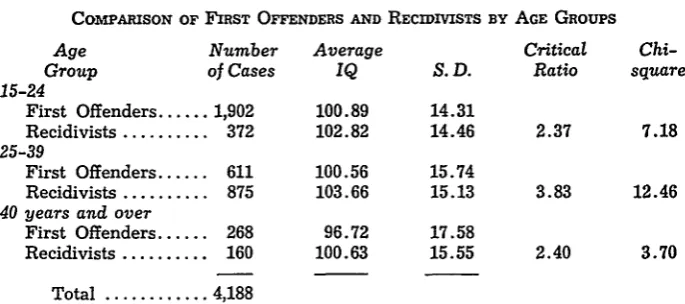
A further comparison taking into account age differences is given in Table III. Here also the recidivists show a consistently higher I. Q. than first offenders in each of the age groups. Apparently, differences appear in all of the age samples but are of greatest intensity in the middle-age group. The critical ratio for this group is definitely above the accepted level of significance. In view of the fact that differences in the other groups are
A. A. HARTMAN
TABLE III
COMPARISON OF FIRST OFFENDERS AND RECIDIVISTS BY AGE GRouPs
Age Number Average Critical
Group of Cases IQ S. D. Ratio
15-24
First Offenders ... 1,902 100.89 14.31
Recidivists ... 372 102.82 14.46 2.37
25-39
First Offenders ... 611 100.56 15.74
Recidivists ... 875 103.66 15.13 3.83
40 years and over
First Offenders ... 268 96.72 17.58
Recidivists ... 160 100.63 15.55 2.40 Total ... 4,188
Chi-square
7.18
12.46
3.70
fairly high and in the same direction, it may be concluded that the relation-ship between recidivism and intelli-gence is probably independent of age. This conclusion is supported by con-sideration of the Chi-squares in the last column. For the younger and middle-age groups the Chi-square values are distinctly beyond the one per cent level of significance, i. e., these values of Chi-square for one degree of freedom would be exceeded in less than one per cent of all similar random samples. For the older age group the Chi-square value obtained would be exceeded by about 5% of all random samples.
Table III also demonstrates some other important age differences which no doubt affect these findings. First is the well-known reduction in the pro-portion of older offenders. Second is the marked difference in proportions of recidivists in each age group; these are as follows: 16% of the younger age group, 59% of the middle-age group, and 37% of the older age group. There is also an apparent trend towards
'3 Paul L Schroeder, Criminal Behavior in the
Later Period of Life. Am. J. of Psychiatry, 92,
greater heterogeneity with age, as in-dicated by the standard deviations. However, the only appreciable differ-ence between the recidivists and first offenders with respect to variability ap-pears in the older age-group. This is explained by the fact that first of-fenders over 40 include some of the most superior individuals such as em-bezzlers, as well as some of the more senile and intellectually deteriorated, particularly in the sex offense group.13 These age relationships in criminality are very complex and should be studied separately.
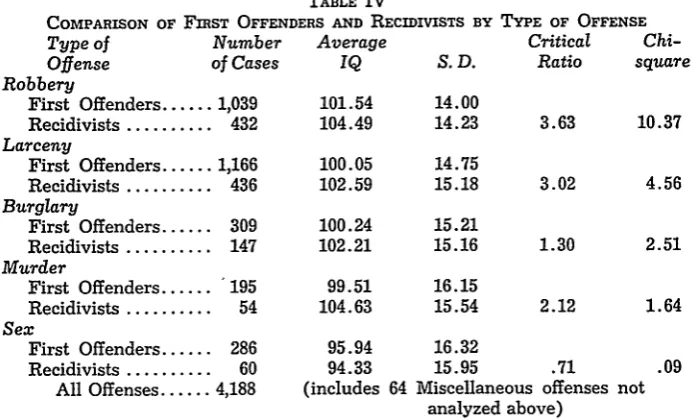
Table IV presents a comparison of recidivists and first offenders in each of the general offense categories. The former group is seen to have a higher average I. Q. for all types of offense except sex. The differences in average I. Q. are statistically significant for robbery and larceny and doubtfully significant for burglary and murder. Likewise, on the basis of the Chi-square test recidivism appears signifi-cantly Ielated to intelligence in the
[image:7.454.62.405.50.202.2]TABLE IV
COMPARISON OF FIRST OFFENDERS AND RECIDIVISTS BY TYPE OF OFFENSE
Type of Number
Offense of Cases Robbery
First Offenders ... 1,039 Recidivists ... 432
Larceny
First Offenders ... 1,166 Recidivists ... 436
Burglary
First Offenders ... 309 Recidivists ... 147
Murder
First Offenders ... 195 Recidivists ... 54
Sex
First Offenders ... 286 Recidivists ... 60 All Offenses ... 4,188
Average Critical
Chi-IQ S. D. Ratio square
101.54 104.49
100.05 102.59
100.24 102.21
99.51
104.63
95.94 94.33 (includes
robbery and larceny group. No signifi-cant relationship is found for the sex group.
In tables II, III, and IV the differenti-ating line for first offenders and recidi-vists was placed at one previous penal or reformatory term. A separate analysis was made of the data using another criterion. Those prisoners with two or more previous prison or reformatory sentences (Group VI of Table I) were considered as a recidivist group and contrasted with the total re-maining (Groups I through V). The average I. Q. for this new recidivist group was 104.88; for the non-recidi-vists, 100.79. The critical ratio in this case (4.65) as well as the Chi-square (18.12) indicates that this difference is highly significant. When these same groups were compared in each of the three age divisions it again appeared th-at the differences in intelligence
be-14 Donald Clemmer, The Prison Community, Boston, Christopher Publishing House, 1940, p. 57.
14.00 14.23
14.75
15.18 15.21 15.16 16.15
15.54
16.32
15.95
3.63
3.02
1.30
2.12
64 Miscellaneous offenses not analyzed above)
10.37
4.56
2.51
1.64
.09
tween the recidivists and non-recidi-vists are independent of age.
It has been assumed here that in dealing with a large group of offenders recidivism can be best defined in terms of degree of criminal record. The criti-cism might be raised that this fails to take into account recidivism in the sociological sense which denotes an in-dividual of confirmed anti-social or criminal proclivities. As Clemmer,14 the senior sociologist at Joliet points out, " . .. .the professional staff
diag-noses recidivism, not acocrding to pre-vious record alone, but largely on the basis of personality make-up. Thus, a 'two-time loser' may not be designated a recidivist, and, conversely, a man who has never been arrested before may be diagnosed as a recidivist." Al-though it would have been valuable to include such a sociological or
[image:8.454.50.397.43.253.2]sub-A. sub-A. HARTMAN
jective evaluation made by a number of staff members.
A partial answer to this point was, however, possible. For the year 1935 a separate count was kept of cases in which any of the following sociological notations appeared: recidivist, recidi-vous, potentially recidivistic, con-firmed offender, habitual offender. There were in all 297 such sociologic-ally diagnosed recidivists. A check was then made of their official criminal rec-ords which showed that only one had no previous record whatsoever, two had records of arrests only, 78 had minor records, 134 had one previous prison or reformatory term, and 84 had served two or more previous sentences. The average intelligence quotient for this group was 103.31 and the standard deviation 14.68. These results tend to bear out the validity of the objective criterion of recidivism used here, as well to confirm the principal finding of higher intelligence for the recidivist group.
IV Discussion
The problem may be restated at this point as an attempt to discover the re-lationship between two characteristics, intelligence and recidivism, as mani-fested in a selected criminal group. Both intellectual capacity and degree of criminality are recorded here as ob-jectively, it is believed, as present psy-chological and sociological science per-mits. With reference to intelligence, the nature of this group and the condi-tions of psychological testing at the prison made it certain that valid
differ-ences in native capacity are revealed. Likewise the term recidivism has been defined here on the basis of reliable recorded information and there is evi-dence that these categories actually dif-ferentiate degress of criminality.
An attempt has also been made to eliminate the more frequent sources of error in criminological research. First, this group represents a total popula-tion, i.e., all native white offenders committed by the courts during a given period. No selective element is present, other than the obvious fact that con-victed offenders are only a proportion (probably fairly constant) of the total criminal population. Second, a rela-tively homogeneous group racially has been studied, since it is known that Ne-groes and foreign-born offenders pre-sent special problems with respect to both criminality and intelligence.
Most related studies in this field have been based upon comparisons of the in-telligence of prison groups with that of the general population. The Army test results have been used almost exclu-sively for standards of adult male in-telligence. This has given rise to con-siderable controversy over the relia-bility of the Army norms and the com-parability of prisoners and draft-army samples. These difficulties are over-come here by attacking the problem in terms of equivalent groups selected from a single prison population on which uniform data are available.
offenders are brighter than first offend-ers must then be considered a partial refutation of current popular and
scien-tific opinion. Popular belief has held consistently to a negative correlation
between intelligence and criminality. A recent expression of this view which characteristically is unsupported by evidence is Hooton's5 statement that,
".... .stupidity and mental defect are more potent factors in crime causation than inferior physique and impover-ished environment . ." Scientific opinion, more conservatively, has shifted toward the position that intelli-gence has little causative significance in criminality.
The complexity of these factors pre-cludes evaluation of the causative na-ture of the relationship between
intelli-gence and recidivism. Reckless,' somewhat humorously, has pointed out the limitations in the application of the concept of causation to social phenom-ena such as criminal behavior, a phe-nomenon so involved that "it may even
be a cause of some of the causes which are supposed to cause it." Certain
in-ferences are nevertheless indicated by these results. It would seem to follow, for example, that defective intelligence
is not associated directly with criminal
behavior at any level since it does not
appear significant at the most extreme
degrees of such behavior. On the
con-trary the evidence points to a positive correlation between level of brightness
and degree of criminality.
We may observe that this group of
ia Ernest G. Hooton, The American Criminal. Cambridge, Mass., Harvard Univ. Press, 1939,
p. 307.
adult offenders corresponds on the basis of color and nativity to the stand-ardization group selected by Terman for the recent revision of the Stanford-Binet. Although the intelligence quo-tients in the present study were de-rived from an equivalent scale it is at least suggestive that the average for the total group, 101.13, approximates closely the average for Terman's group. When we consider that some of the more intelligent criminals probably es-cape arrest or conviction (not to speak of Sutherland's "white-collar crim-inals" who remain at large), we may infer that adult white offenders are well up to or above the intelligence level of the general population.
The belief that ethical conduct is ra-tionally determined is at least as old as Socrates, who held that the wise man is also a virtuous one. The theory which stresses biological determinants in criminal behavior is an extension of this belief in the rational basis for hu-man motivation. Recidivism is often defined as a tendency to relapse into criminality; this implies the presence of factors, pathological in nature, inher-ent in the individual. Actually, contin-ued anti-social behavior appears to be more characteristic of brighter individ-uals, who are presumably better en-dowed biologically. It is more logical to assume that both ethical and unethical conduct are to some extent a product of reason. The fact may be that it is the more intelligent individual who re-acts to inequalities or injustices in our
A. A. HARTMAN
present social order, and who protests most persistently. This would support the theory that crime is a cultural product, a symptom of social rather than individual disorganization. The provocative possibility is raised that re-cidivists are the criminal correlates of the political insurgents, the radicals, and the non-conformists of more polite society.
V Summary
The records of 4188 native-born white convicts committed by court to the Illinois State Penitentiary at Joliet from 1934 to 1939 were examined with reference to the relationship between intelligence and recidivism. Test rat-ings of prisoners on standard psycho-logical examinations were compared with verified criminal histories. A sta-tistical analysis was made taking into account the factors of age and type of offense. The principal findings were as follows:
1) The average intelligence rating of recidivists is significantly above that of first offenders.
2) Differences between the two groups are found at all levels of the intel-lectual scale; the recidivists show a greater proportion of superior and very superior individuals and fewer at the retarded levels (dull and borderline); the proportion of men-tal defectives in the two groups is practically the same, however. 3) The differences in intelligence
be-tween recidivists and first offenders appear to be independent of age. 4) Recidivists show higher average
in-telligence ratings in all of the of-fense categories except sex; the most marked differentiation is found in the robbery and larceny cases. 5) Within the first offender group, those
with records of previous arrests or misdemeanors tend to be lower in in-telligence than those with no record whatsoever.