Workflow
-
A
Unifying Technology for
Operational Support Systems
V. P. Wade T. Riclzardson
Head of Knowledge & Dute Engineering Group, Managing Director, Department of Computer Science,
Trinity College Dublin, Liaison Director,for Dublin 2, Ireland TeleManugeiizent Forum Vincent. W d e @ cs. tcd. ie s t s @an eiiiinet. co.uk
System Technology Solutions Ltd,.
Abstract
A crucial issue facing Telecommunications Service Providers is the need to provide flexible, cost effective, management systems, which can rapidly adapt to changing customer requirements and inarket opportunities. A recent trend, which attempts to address this need, has been the development of management solutions comprising (building block) re-usable management components. Frequently the integration of such components requires hard coding and scripting to provide an integrated solution. This paper proposes worktlow technology, coupled with distributed infrastructures, as a more cost effective, tlexible environment for management component integration. The paper highlights the business and system benefits of such a solution, reviews the current state of worktlow technology and standardisation, and presents a case study using CORBA based workflow technology to demonstrate its application in telecoms management. The case study examines a workflow engine based integration of a number of service accounting components within an existing telecoms infrastructure. Finally the paper evaluates the applicability of worktlow based telecoms management solutions and identifies important elements required in their successful development.
Keywords
Telecommunication Service Management, Worktlow, Business Processes
1
Introduction
In the competitive environment of the Telecommunications industry, Service Providers (SPs) must increasingly save costs and reduce their time to market, whilst at the same time deliver ever higher qualities of service to their customers. Although this is an extremely difficult challenge, there are some important industry trends which may be applied to assist in this endeavour. Of particular note are the benefits to be gained in the SP’s Business Context through the application of standardised (management) Business Processes and Information Flows - such as those being defined by the TeleManagement Forum. In addition, the SP may also gain in their Systems Context by supporting these business processes through
232 Session Five Architectures and Frameworks
increased use of re-useable Application Components and off the shelf Advanced Information Technologies - such as Worktlow.
Individually, each of the above items may assist i n providing a more efficient environment for the SP. However, used i n correct combination, the mix of agreed business processes, application components and integrating worktlow technology can dramatically improve the productivity and competitiveness of the SP and help to provide a future-proof OSS environment.
This paper has been developed from the results obtained from two ACTS projects: FlowThru[ I] and DIFFERENCE[2], both of which have developed solutions based upon the coinbination of the above three industry trends. In addition, this work has been developed in close co-operation with the work programme of the TeleManagement Forum. This paper examines the principle factors behind the competitive improvements to be gained in the business and systems contexts and reviews, i n particular, the critical role to be played by worktlow technology as the common unifying ingredient. The paper investigates the use of workflow technology for automating telecommunications management business processes and presents a case study i n accounting management systems for telecommunication services. The case study illustrates how workflow can be used to tlexibly integrate management components. Finally the paper evaluates the effort required in realising such systems and identifies important elements required in their successful development.
2
The Telecom Business Environment
In today’s Telecom environment the impact of increased competition is causing Service Providers (SPs) to look increasingly mot-e critically at cost reductions in supply of Telecommunication services to their customers. Major factors in this cost reduction may be considered under two broad headings, Business Context and Systems Context
2.1
Business
ContextWorkjlow - A Unifying Technology 2 3 3
Fulfillment Assurance Billing
I
Handling Handling
L
Custoher Care Processes IJ
I I
Service Develdpment and Operations Procksses
I I I I
-
‘I - 1 [image:3.612.178.431.121.291.2]I
Network and Systehs 1 Managementi Processes’I
IFigure 1 TMF Operations Map
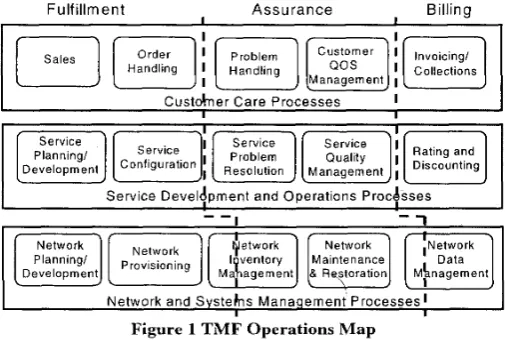
These Flow-Through processes, which are defined in the TeleManagement Forum’s Telecom Operations Map[3], are required to be supported by the SP business environment to provide services to customers. These processes identify the need to:
Fulfil all the items needed to provide service to customers
Assure that the service remains up and continues to support customer needs
Bill the service provided to the customer
Defining and agreeing such business process frameworks within the Telecom industry provides a number of cost benefits to the SP:
It facilitates better integrated business process interactions between the SP and their customers; also with other SPs and network technology providers.
It allows build/buy decisions to be made whereby the SP can perhaps choose to procure Operational Support Systems (OSS) components which support appropriate parts of the business process framework and associated information tlows.
It provides a ready means to drive process automation within the SP environment.
2.1.1
Further detail of business process automation and flow through is demonstrated in the Figure 2 below.
234 Session Five Architectures and Framewurkr
... ...
Figure 2 TeleManagement Forum Fulfilment Business Process
This figure shows the high level detail of one of the three Flow Through process defined by the TM Forum in the Telecom Operations Map. In this instance the high level details of the Fulfilment process are presented. The figure shows interactions and information flows between the various business processes, which collectively form the complete Fulfilment Process.
This
level of process detail begins to identify the activities, which need to be supported to execute the process steps. It also identifies that technology is needed to provide the sequence of interactions shown in the figure - and thereby assist in providing process automation and flow through. Both of these items are discussed in more detail in the next section.2.2
Systems Context
The Systems Context is concerned with the design and implementation of the Operational Support Systems (OSSs i.e. Management Systems) which are needed to support the various aspects of the Business Context (outlined above). Issues of principle concern are:
Increased use of Application Components.
Workflow - A Unifying Technology 2 3 5
Application Components
A component based architecture for Telecom applications provides a number of benefits:
Components inay he re-used acro everal business solutions. Components may be bought-in from third party developers.
System solutions will become more modular and thereby easier to construct, maintain and upgrade.
Advanced Information Technology
Advanced IT (AIT
-
including items such as distributed transaction processing, workflow, object oriented solutions, etc.) reduce costs because system solutions are no longer special to the Telecom sector. This is important for a number of reasons:Telecom specific technologies are usually more expensive to develop. Telecom specific technology skills are in much shorter supply and are therefore much more expensive (i.e. more Java and CORBA programmers than those with CMIP and GDMO experience).
AITs are more mainstream, and are therefore receiving constant upgrades and are increasingly tuned to future processing environments (e.g. client/server, object oriented application environments).
Development experience can he more readily imported from other sectors (e.g. finance, transport, government etc.)
For all the above reasons, the Telecom industry is increasingly interested in the use of AIT to complement the use of Telecom specific technologies (such as CMIP/GDMO, SNMP/SMI) in future OSS solutions. For example the TM Forum is developing a ‘Technology Integration Map’ for these IT selections which presents their usage in future OSS developments[4].
2.3
Integration of both the Business Context and Systems Context outlined above will lead to an extremely flexible and cost effective environment for OSS solutions. Agreed business processes may he used io define the environment for- business, and re-usable application components may then be applied to deliver this environment in system form. The missing ingredient is a general-purpose technology which can be used to link these application components together to deliver the business processes in a flexible and readily deployable fashion. Such a capability is provided by Workflow technology [ 5 ] .
Integration of Business and Systems Context
3
Workflow
enabled Management Application Integration
236 Session Five Architectures and Frameworks
requirements [6]:
Improved efficiency, leading to lower costs or higher workload capacity Improved control, resulting from standardisation of processes
Improved ability to manage processes; identification and analysis of
Reduced Costs (e.g. labour)
Increased quality or capacity while controlling costs
Construction of unique customised business processes to deal with specialised management work practices
Improved information distribution, and elimination of the delays caused by the need to move hard copy information around the organisation
Thus workflow management can be considered a very attractive technology for integration and interrelation of telecommunication management components. There are many differences between the architectures, which are used by workflow systems. However most of the worktlow systems fall into one of two broad categories [6]: (i) Forms and messages based worktlow systems which performs electronic routing of forms to users’ e-mail in-boxes and (ii) Engine based workflow systems, which communicate with humans or components via specialised middleware. It is the worktlow engine based approach, which this paper will focus upon to achieve management component integration.
problems
3.1
Workflow Standardisation
The standardisation of worktlow systems has been on-going since 1993 with the formation of the workflow Management Coalition WtMC (an industrial consortium which set about standardising an architecture for workflow engine based systems, and several interfaces for application invocation, process definition, process management and system interoperability). In 1998, the OMG ratified the definition of a workflow facility, which was based on the WtMC standards
3.2
Workflow Engines
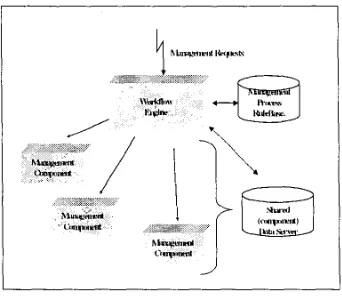
A Workflow Management System (WFMS), as defined by the Workflow Management Coalition, (WtMC) [7] is a system that defines, creates, and manages the execution of worktlows through the use of software, running on one or more workflow engines, which is able to interpret the process definition, interact with worktlow participants and, where required, invoke applications (or components). A workflow engine is the basic workflow management control software. This software is often distributed across a number of computer platforms to cope with processes, which operate on a wide geographic basis. The workflow engine controls the flow of work through the system (sequences of management activities which form a management business process) by interpreting the management process rules to determine the scheduling of required activities, and invoking the relevant management components. The engine is responsible for:
Workjlow - A Unifying Technology 237
Control of the activity schectuling within an operational (business) process.
Interaction with management components and/or human resources (which execute the required management activities).
[image:7.612.212.383.219.373.2]Monitoring and control of the management processes in execution. Figure 3 illustrates a generalised workflow engine, which accepts a (management service) request and based on its process rule-base, invokes the correct sequence of components. The components pass application specific values (input and output parameters) via the shared (component) data server.
Figure 3. General Workflow Architecture
However, workflow should not be considered as a stand-alone technology. Rather it should be viewed as a 'value added' technology - building upon the services provided by other distribution technologies. Worktlow adds the capability of intelligent enactment of application component operation to support an overall business process definition. In order to fully achieve this enactment, a number of other technology services will be needed. Examples include:
Distributed Processing - To give an underlying software process distribution mechanism. This may be achieved i n a number of different ways and will be used by the workflow engine to invoke application components, which reside upon remote machines. Technologies, which may be used for this purpose, include CORBA, DCOM and Open Group/DCE.
23 8 Session Five Architectures and Frameworks
process-supporting environment.
Security
-
As application components become more distributed they will reside in a variety of environments which will each have a different degree of trust associated with them. If application components are to be linked together across these different trust domains, then appropriate security mechanisms will need to be put in place (e.g. Authentication, Access Control etc.). The exact set of mechanisms will be dependent upon the security policy defined for the overall systemSystems Management - The WtMC framework has as one of its defined interfaces an Administration Interface. However, a complete system will consist of many other services, which must also be managed. Examples include management of the Distribution Technology (e.g. CORBA), management of the Operating Systems, management of the individual Application Components etc. Hence, Administration of the Worktlow Engine should ideally be fitted within this wider Systems Management Framework.
3.3 Workflow
in operation
There are a great many products and research projects which offer support for workflow management. In April 1996, 250 products claimed to support workflow features and/or workflow inanagement[g]. This constituted a market size of more than one billion dollars. The number of products has risen since then.
Many of the products simply provided a means of graphically representing a business process using techniques such a s datatlow, digraph, flowchart, network, orgcharts, pertcharts etc. e.g. Zippen [91. Others are data management systems, which use e-mail, imaging, databases, electronic forms, engineering drawings etc. to collaboratively process documents or data. Groupware also forms part of this group, Lotus Notes being a good example.
All of these systems have an emphasis on office processes, e.g. imaging, document routing, enhanced mail. However a number of limitations are evident with these types of workflow systems [IO].
I .
Lackof
support for heterogeneous computer systems 2. Incompatibility between workflow products3. Failure to capture distributed/true nature of infrastructure in business model
4. Scalability not achieved
5 . Very little support given towards fault-tolerance and reliability.
Workj7ow
-
A Unihing Technology 239of the problems mentioned above.
CORBA and Workflow, CORBA is used in varying degrees within many workflow research prototypes. In the simplest case, CORBA is used for database access or as a wrapper around legacy applications. The Mentor project uses CORBA to provide a uniform interface to heterogeneous invocable applications [
121.
The WebFlow system communicates with legacy applications, a relational database and a document management system through CORBA [ 131.The WorkWeb project uses a network of CORBA-based agents, where each agent represents a resource or a participant[ 141. These agents collaborate and vie for resources. In OrbWork, again based on METEOR2, transactional concepts are implemented using CORBA to achieve fault tolerance[ 151. It includes a layer of CORBA-based system components and failure detection mechanisms, which increase availability and allow recovery. Persistence and scalability are other key requirements, which led to the use of CORBA.
The OrbWork project is a CORBA-based workflow engine which contains a ‘Workflow Model Repository’, a task manager (combining the duties of the scheduler and dispatcher), a monitor (holding state for the system as a whole) and tasks (wrappers around legacy applications).
3
3.4 Design and Implementation of Telecommunications Management Workflow Engine (TMWE)
This section describes the design and implementation of a distributed, component- based telecommunication management workflow engine, which has been developed to support the integration of management components.
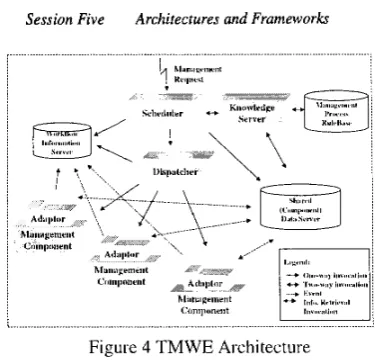
The engine itself consists of a scheduler, which accepts management requests and initiates instances of management processes. The scheduler uses a Knowledge server to interrogate the management process rule base and determines the next activity to be enacted. The scheduler is implemented a s a multi-threaded process in order to deal with concurrent management requests. When the scheduler initiates work, this work is logged within a Worktlow Information Server (WIS). Ttiis WIS server maintains the state of all management process instances (i.e. all instances of management requests currently being executed within the management system). Once the next activity to be enacted as part of a management process has been identified, the scheduler passes this information to the workflow dispatcher.
240 Session Five Architectures and Frameworks
,... ...
$
h h h T Ct
I \
[image:10.612.210.398.79.260.2]i ... :
Figure 4 TMWE Architecture
The dispatcher is likewise multi-threaded to support concurrent component invocations. Typically before a component can be invoked, some input parameters have to be retrieved. Such parameters inay be configuration information, or may be outputs from the execution of other component invocations.
The dispatcher could potentially become congested if it must perform this information gathering as well as carry out concurrent component invocations. Also, the implementation of the dispatcher may become very complex if it has to know or interpret the information (parametric) requirements of each component.
For these reasons component adaptors were developed which interface the workflow engine to the components. The adaptor source code is over 80% generic as the interface to the workflow engine is standardised across all workflow adaptors and only workflow control data is passed between the engine and adaptor(s). The management component specific part of the adaptor is responsible for retrieving the information required to invoke a management component. This information is stored in the Shared (Component) Data Server, the interface to which is again common for all adaptors. The adaptor is also responsible
for
placing any resultant information, which is required to he shared, into the Shared Data Server. A ‘wrapper’ object, either remote or running in the virtual memory space of the adaptor, performs the actual interaction with the management component.The adaptor lets the workflow engine know that specific management activities have been completed, by sending events or one way asynchronous calls to the Workflow Information Server (WIS). The WIS has a number of registered receivers, which require to be notified of such completions. These include, but are not necessarily limited to, the scheduler and dispatcher.
The use of asynchronous invocations (or events) between the adaptor, WIS, Scheduler, and Dispatcher allows greater degree 01’ concurrency, less chance of activity blocking and more flexible integration of the worktlow engine itself.
Workflow - A UnifLing Technology 24 1
platform for the workflow engine.
4
Case Study
-
Using Workflow Engine within CORBA based
Telecommunications Management Architecture
The ACTS FlowThru[2] project is currently evaluating the component integration technologies mentioned above, across a range of TeleManagement Forum related business processes, namely Service Fulfilment, Service Accounting and Service Assurance. In the area of Service Accounting, FlowThru is integrating a CORBA compliant service management platform with a workflow engine.
The system developed is based on a Service Provider offering multimedia services to a user, but sourcing network connectivity and multimedia content from two other providers (network provider and content provider) [ 161. Figure 5 depicts the 'Use Case' model of the system, which identifies the external actors of the management system, (namely the Multimedia Service Customer Administrator, Multimedia Service User, Multimedia Service Retailer, ATM Network Provider Retailer). The Use Case diagram below identifies the management business processes supported by the system. UML Use Case diagrams were used to depict the actors at the system boundaries because of its expressive power and because UML is fast becoming one of the most important 'standard' software modelling notations. UML Use Cases also provided the high degree of abstract required at this level of description.
iwtlmedm A i l 4
serrtre user Flrwinrk
Provider Retailel Figure 5: Accounting Trial
-
Use Case Summary [image:11.612.203.400.357.501.2]242 Session Five Architectures and Frameworks
Business Process modelling was collated from several sources [ 171, [ 181, [ 191. This criteria included being able to represent both IT systems and people equally well. In addition strong support for the representation of (i) control and data flow (ii) all objects, activities and transitions (iii) role responsibilities. Other criteria includes the ease by which it could be understand by both managers and developers; allow flexibility (of model element addition/reinoval); the support for different levels of abstraction; the identification of bottlenecks and deadlocks; the production of non ambiguous models; the support for concurrency; and the ability to capture both manual or automated activities.
[image:12.616.197.399.265.395.2]For the telecoms accounting system, i t was decided to adhere to UML based notations. There are no specific worktlow notations within UML. However, UML activity diagrams (Figure 6) and UML Collaboration diagrams were investigated and were adapted to provide the required descriptive capability.
Figure 6 Representing Control Flow in Business Process
The next step was
to
map the accounting activities involved in the business processes onto accounting components. A range of accounting components were available from previously developed (TINA-C compliant) prototype systems, e.g. tariff control component and User Metering Management. However, new components were required to support some of' the required accounting functionality.Workflow - A Unifying Technology 243
(Shared) Component Data Server offered a generic interface for the temporary storage of information flows between the various accounting components. No application (accounting) data was passed through the workflow dispatcher and scheduler. Rather, the (Shared) Component Data Server acted as a intelligent persistence service for the information flows. This was important for robustness of the distributed system as well as reliability.
4.1
Integrating the Workflow based Management system within an
existing Telecommunications Management Architecture
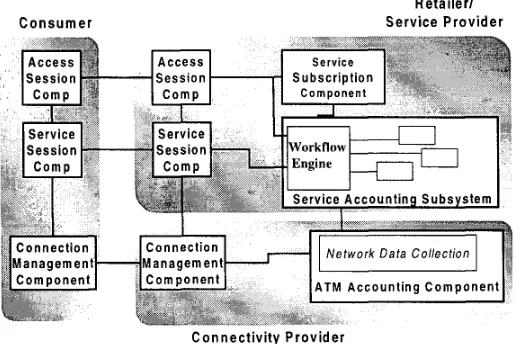
The accounting system was integrated within an existing telecommunications management infrastructure. This infrastructure had previously been developed and adhered to the TINA-C architecture. Within the accounting system, the workflow engine integrated, a range of TINA-C related accounting components. e.g. Account Manager, Tariffs Control, Bill Control, Charge Control, User Metering Management etc. Figure
7
depicts the several TINA-C architecture components and illustrates how the workflow engine was sited within the architecture.C o n s u m e r
Reta ilerl Service P r o v i d e r
[image:13.619.195.460.290.462.2]Connectivity Provider
Figure 7. TINA based Service architecture using Workflow engine based Accounting Component Integration
244 Session Five Architectures and Frameworks
(e.g. get bill etc.) to the other TINA components, and maps these functions to worktlow business process invocations to be used by the worktlow engine. All component interfaces were specified in CORBA IDL and components were executed within a CORBA based infrastructure.
The use of the engine to support the accounting system allowed the easy introduction of new accounting components without disruption or changes to other accounting components. On introducing a new component into the accounting system, the operator needed to either compose new, or amend existing, business process rules (accounting management). This composition/amendment is required
a s the engine uses these business rules to decide which accounting components to invoke to satisfy a management request.
5
Conclusions on
Workflow for
Telecoms
OSS
Experience gained from research designing and realising worktlow based telecommunications operational support systems, suggests that worktlow (coupled with distributed systems) technology offers a very powerful and tlexible basis for implementing automated telecominunicatioii inanageinent tasks. As an integration technology, i t adds the capability of’ intelligent enactment of application components, whilst also supporting both control and data requirements of the components. In terms of the business context, Worktlow can
process automation and flow-through. In terms of systems context support, worktlow will increasingly become an off-the-shelf systems technology supporting an application component architecture. Worktlow engines will become increasingly embedded on top of distributed management platforms.
The full power of worktlow will not be realised without the support of a well-defined application component architecture. As the software industry moves to a ‘componentized’ approach to systems construction, worktlow is well placed to offer significant benefits to automated and managed component integration. However, such component catalogues and repositories are only emerging.
The granularity of these application components is crucial in gaining the full benefit of workflow technology. Worktlow based component integration does not suit very fine grained object integration a s the complexity of data sharing and control tlow are too great. Alternatively, if the application components are too course grained, the concurrency control offered by the workflow system may be under utilised. However, sometimes the concurrency is not the reason for using worktlow technology. Worktlow based approaches have been used successfully for the integration of legacy systems and ‘new’ components. The wot-ktlow engine can handle the gradual ‘re-engineering’ of the legacy system access and its integration with new (or replacement) components. This is one of the reasons why workflow technology has enabled Business Process Re-Engineering within organisations.
Workflow - A Unifying Technology 245
Acknowledgment
The authors would like to gratefully acknowledge that this research was partly funded under the EU ACTS programme.
References
European Commission ACTS Project - Flow Thru AC33S European Commission ACTS Project - DIFFERENCE AC207
SMART TMN - Telecom Operations Map GB910 - Evaluation version Release I - October 1998
Reference 2 SMART TMN - Technology Integration MapGB 909 - Issue I . I - October 1998
M Rusinkiewicz, A Hela1 "Worktlow Management Systems", published in Journal of Intelligent Information Systems, Vol IO, Number 2, March 1998 Stark H, "Ovum Evaluates: Worktlow" - Heather Stark, Laurent Lachal, ISBN 1898972605, Ovum, 95.
Reference 5 Worktlow Management Coalition (WtMC) Web site - htLp//www. wi'nic.org
Amit Sheth, "State of the Art of Commerc$ Technology and Research in Workflow Management" DARPAJISO Workshop on collective Action Tools - April IO, 1996
Zippin Project Homepages, Stefania Castellani, Xerox Grenoble,
http://www.rxrc.xerox.com/research/ct/prototypes/aippin/home.html
[ IO] Amit Sheth, "From Contemporary Workflow Process Automation to Adaptive and Dynamic Work Activity Coordination and Collaboration", University of Georgia SIGGROUP Bulletin, Vol. 18, No 3, December 1997
[ 1 I] G Alonso et al, "Functionality and Limitations of Current Workflow Management Systems", IEEE Expert, Vol 12, No. 5, Spet/Oct I997
[ 121 J Weissenfels, D Wodtke, G Weikum, A Kotz Dittrich, http://paris.cs.uni- sh.de/public_html/papers/mentor. html
[ 131 Antonietta Grasso, Jean-Luc Meunier, Xerox, WebFlow Homepage, http://www.xrce.com/research/ct/prototypes/webtlow/home.html [ 141 H Tarumi, K Kida, Y Ishiguro, K Yoshifu, T Asakura, "WorkWeb Systems -
Multi Worktlow Management in a Multi Agent System", SIGGROUP 1997 [IS] S Das et al, "ORBWork: A Reliable Distributed CORBA-Based Workflow
Enactment System for METEOR2", Technical Report #UGA-CA-TR-97-001, Department of Computer Science, University of Georgia, Feb. I997
[ 161 P. Hellermans, C Redmond, K Daenen, D Lewis, "Accounting Management in a TINA-Based Environment", IS&N'99, Barcelona, I999
[ 171 J Bernard, "Business Process Modelling", The Open University BPM, htt~://rncs.ol~cn.ac.uk/illh33/hl,iii.t~~rnl, October 1997
[I81 T Allweyer, P Loos, "Process Orientation in UML through Integration of Event Driven Process Chains, UML Conference, France 1998
246 Session Five Architectures and Frameworks
Vincent Wade is head of the Knowledge and Data Engineering Research Group in the Computer Science Department, Trinity College Dublin. He received his BSc from University College Dublin, Ireland and a MSc from Trinity College Dublin, Ireland. His research group is active in the area of telecommunications management and distributed information systems, broadband information services and virtual environments. He currently leads several EU and industrial research projects in these areas and is author of over seventy technical papers in international conference and research journals.