2019 International Conference on Information Technology, Electrical and Electronic Engineering (ITEEE 2019) ISBN: 978-1-60595-606-0
Research of “Silk Road” Knowledge Teaching Mode
Based on Human-Computer Virtual Interaction
Ya-nan LIN
1,*, Shi-jue ZHENG
1, Rui-wei XIAO
1, Min WANG
2,
Zhi-han YAO
1and Yi-lin PENG
11
School of Computer Science, Central China Normal University, Wuhan, Hubei, China
2
School of Educational Information Technology, Central China Normal University, Wuhan, Hubei, China
*Corresponding author
Keywords: Human-computer interaction, Silk road, Kinect, Virtual teaching.
Abstract. With the implementation of “One Belt One Road” strategy, cultural relics on Silk Road have been introduced to classes. Aiming at the disadvantages of traditional history education such as monotonous mode and insufficient intuitiveness, this paper combines Kinect sensor with cultural relics on Silk Road and explores a multilingual virtual teaching mode of cultural relics which supports somatosensory interaction. It changes the past teaching mode which is dull and abstract and injects new, economical and practical vitality into Silk Road culture, which can help with the inheritance and development of Silk Road culture in the new era.
Introduction
The cultural relics unearthed along the ancient Silk Road in China bear the historical memory of communication between different civilizations, which are important material evidence of the history of “Belt and Road”. In the background of new era, how to introduce these historical relics into classes is the key to helping the inheritance of Silk Road culture [1]. However, most of the cultural relics are non-renewable and precious. Any movement or touch may cause irreparable damage to them. Therefore, most of the traditional cultural relic appreciation classes are mainly multimedia presentations. Students have few opportunities to get close to these historical relics, and their perception of cultural relics are also one-sided.
In order to enhance the authenticity of historical relic appreciation, many domestic researches have explored virtual display modes of historical relics. By image processing and artificial intelligence technology, Lu Dongming et al. [2] used Dunhuang cultural relics as an example to realize the functions of virtual wandering of Dunhuang Grottoes. Du Fengyi [3] discussed the interactive application of augmented reality technology in museum artifacts. Shao Yaqin et al. [4] proposed the tomb virtual reconstruction scheme based on virtual reality technology with the tomb of Guishan as the research object. Most of the researches above are based on commercial needs. If these methods are directly applied to education, there will be problems such as high cost, single language, and inconvenient promotion. Based on the above background, this article takes the teaching of cultural relics of ancient Chinese Silk Road as an example, and uses Kinect sensor to design a multilingual cultural relic virtual teaching system that supports somatosensory interaction—”Silk Road Treasure”.
Overview of “Silk Road Treasure” System
Teaching Content
including “Gold Cup with Red Agates inlaid and a Tiger Handle”, “Tri-colored Glazed Camel carrying Musicians”,” Tri-colored Glazed Ceramic Mule” and so on. The archaeological period of cultural relics spans from Han and Tang Dynasties to Ming and Qing Dynasties.
System Structure
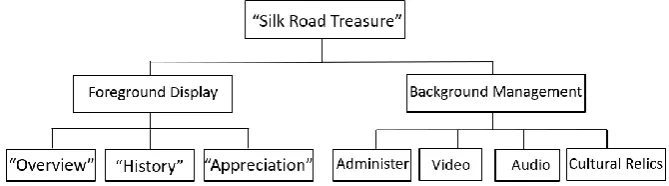
[image:2.595.129.464.176.269.2]The “Silk Road Treasure” system is divided into two parts: foreground display and background management. The functional structure of the system is shown in Fig.1.
Figure 1. System structure.
(1)Foreground Display
The foreground display part includes three functional modules: “Overview”, “History” and “Appreciation”. “Overview” part selects delicate cultural relics unearthed from provinces along the Silk Road for information display. The somatosensory gestures of this part include dragging scroll bars by right hand and Y-shaped gestures. “History” introduces the historical and cultural knowledge of the provinces along the Silk Road, covering the historical records of the trade, geographical location and other information. In this part, the interface can be controlled by the right hand. “Appreciation” is a comprehensive sense of physical features of featured cultural relics. In this module, 3D models of cultural relics are accurately restored, and users can use hand movements to perform a 360-degree visual object appreciation, including zoom -in and zoom-out functions as well as the rotation of cultural relics.
(2) Background Management
In the background management part, MySQL database is used to manage system resources. With database, functions such as inserting, deleting, and updating of administrator, cultural relics, video, and audio are realized. The database table of the “Silk Road Treasure” system is shown in Table 1.
Table 1. System database table.
Table Name Colomn Name Primary Key
admin Id, adminname, password Id
cultural_relic
Id, Chinese, English, German, Russian,
Arabic, province
Id
video Id, name, address, crid Id
Audio Id, name, address,
crid, language Id
Development Environment
(1)Xbox One Kinect 2.0 Sensor
Figure 2. The teaching mode of “Silk Road Treasure” system.
(2) Unity3D Engine
The system is based on the Unity3D engine for somatosensory development. Unity3D engine is a cross-platform professional development engine that can directly output products for iPhone, Android, Windows, XBox360 and other platforms. It supports a variety of software imported 3D models, such as 3dsMax, Maya and so on. As for scripts, it supports JavaScript, C# and Python Boo language. In the “Silk Road Treasure” system, this engine is mainly used for construction and visual display of historical relics’ virtual 3D models.
Development Process of “Silk Road Treasure” System
The implementation of the system is divided into four steps.The design procedure of the system is shown in Fig.3.
Figure 3. System design flow chart.
(1) Collection of Information
Through the visits of provincial museums and the enquiries of the literature, relevant materials of cultural relics are collected, including pictures, texts and audio. In the end, a number of featured cultural relics are selected as the basic materials. In the “Overview” module, Photoshop is used to make the pop-ups of cultural relics’ introduction. In the “Appreciation” module, Maya is used to construct the 3D model of cultural relics.
(2)Cultural Relic Modeling
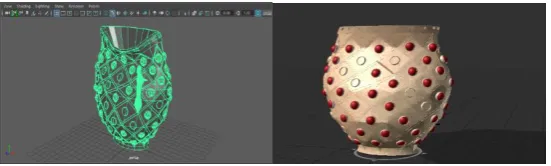
The 3D artifact model is constructed by adding techniques such as surround line, extrusion, and nonlinear deformer. Take the relic “ Gold Cup with Red Agates inlaid and a Tiger Handle “ as an example - the exterior of the object is inlaid with an oval red agate, and the surface is uneven. By re-wiring and adding lines using the split polygon tool, the faces of the model after rewiring are squashed, and the bumps of the model can be completed. The modeling process of “Inlaid Red Agate Tiger Gold Cup” is shown in Fig.4.
[image:3.595.161.437.678.761.2](3) Kinect Development
The somatosensory interaction part of the system includes real-time acquisition of color maps and depth maps, scaling and rotation of artifact models. In order to present the user's color map and depth map on the interface, the color data stream and the depth data stream captured by the Kinect device are respectively obtained. Next, the obtained data stream is assigned to the texture of the raw image component. Finally, the depth map and realistic color image of the user can be displayed on the interface.
(4) Testing and Publishing
After the system is completed, the executive file is exported and published on the computer. By testing, the system has good response speed and accurate gesture recognition.
System Advantage of “Silk Road Treasure”
Multilingual Display
[image:4.595.56.537.343.407.2]According to the utilization frequency of languages along the “Belt and Road” countries, the system mainly uses Chinese, English, German, Russian and Arabic to compare the five languages, so that students of different language backgrounds can better understand the Silk Road civilization of China. Fig. 5 shows the five-language storage table of artifact information in the MySQL database.
Figure 5. Five-language database table of cultural relics.
Teaching Mode of Somatosensory Interaction
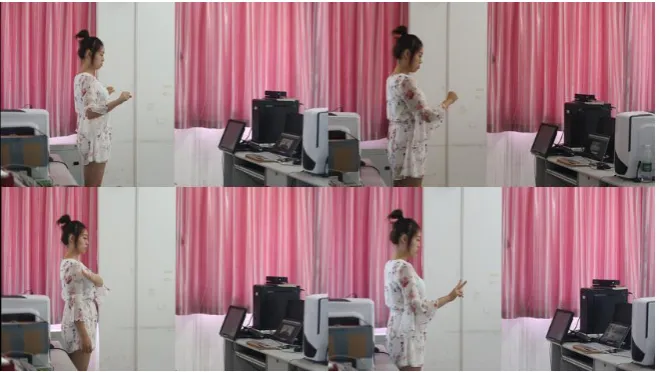
When students use the “Silk Treasure” teaching system, they can perform interface control, mouse dragging and clicking as well as 360-degree cultural relics appreciation with body postures. Fig. 6 shows some of the somatosensory gestures supported by the system.
Figure 6. Somatosensory gestures supported by “Silk Road Treasure” system.
[image:4.595.134.464.516.702.2]Summary
In this paper, the “Silk Road Treasure” system which is based on human-computer interaction is introduced. The virtual teaching mode makes combination of body sensation instrument and the unearthed cultural relics on the ancient Silk Road in China, which effectively increases the enjoyment of teaching process and overcomes the shortcomings of traditional teaching mode such as the monotony of content and the single of language. What’s more, the multilingual teaching content also guarantees its suitability and practicability. In terms of application, the virtual teaching system which supports somatosensory interaction can be applied to classes of cultural relics and displays of museum collection.
To sum up, with the characteristics of friendly human-machine interaction, simple operation, convenient promotion and good compatibility, the virtual teaching system “Silk Road Treasure” has a broad prospect of application and can help with the inheritance and development of Silk Road civilization.
Acknowledgement
This research was financially supported by the project of National Social Science Fund of China: Innovative Model of AR Teaching in Chinese as a Foreign Language from the Perspective of ”One Belt One Road” (No. 17BYY111).
References
[1] X.Y. Wang, J. Liu, L. Luo, et al. Observation and Cognition of Cultural Heritage Protection and Utilization along the Belt and Road Initiative, Proceedings of the Chinese Academy of Sciences, 2016, 31(05): 550-558.
[2] D.M. Lu, Y.H. Pan, R. Chen. Virtual Reproduction and Mural Restoration Simulation of Dunhuang Grottoes, Journal of Surveying and Mapping, 2002(01): 12-16.
[3] F.Y. Du. Application of Augmented Reality in Cultural Relics Display, University of Electronic Science and Technology, 2009.
[4] Y.Q. Shao, Y.J. Wang, Y. Liu. Research on Virtual Reconstruction of Guishan Han Tomb Based on Virtual Reality, Bulletin of Surveying and Mapping, 2008(02): 11-15.
[5] P. Wu, M. Xie. Application of Kinect 2.0 Gesture Control in Multimedia Teaching, Software Guide, 2017(04):83-85.
[6] B. Evgenia. Kinect in Education: A Proposal for Children with Autism, Procedia Computer Science, 2016.