Business Administration Dissertations Programs in Business Administration
5-5-2012
An Experiment on the Effect of Construal Level and Small Wins
An Experiment on the Effect of Construal Level and Small Wins
Framing on Environmental Sustainability Goal Commitment
Framing on Environmental Sustainability Goal Commitment
James O'Connor
Georgia State University
Follow this and additional works at: https://scholarworks.gsu.edu/bus_admin_diss
Recommended Citation Recommended Citation
O'Connor, James, "An Experiment on the Effect of Construal Level and Small Wins Framing on Environmental Sustainability Goal Commitment." Dissertation, Georgia State University, 2012. https://scholarworks.gsu.edu/bus_admin_diss/5
PERMISSION TO BORROW
In presenting this dissertation as a partial fulfillment of the requirements for an advanced degree from Georgia State University, I agree that the Library of the University shall make it available for inspection and circulation in accordance with its regulations governing materials of this type. I agree that permission to quote from, to copy from, or publish this dissertation may be granted by the author or, in his/her absence, the professor under whose direction it was written or, in his absence, by the Dean of the Robinson College of Business. Such quoting, copying, or publishing must be solely for the scholarly purposes and does not involve potential financial gain. It is
understood that any copying from or publication of this dissertation which involves potential gain will not be allowed without written permission of the author.
All dissertations deposited in the Georgia State University Library must be used only in accordance with the stipulations prescribed by the author in the preceding statement.
The author of this dissertation is:
James W. O’Connor 4 Oak Knob Court Simpsonville, SC 29681
The director of this dissertation is:
Mark Keil
Department of Computer Information Systems Robinson College of Business
Georgia State University P.O. Box 4015
An Experiment on the Effect of Construal Level and Small Wins Framing on Environmental Sustainability Goal
Commitment
BY
James Walter O’Connor
A Dissertation Submitted in Partial Fulfillment of the Requirements for the Degree Of
Executive Doctorate in Business In the Robinson College of Business
Of
Georgia State University
GEORGIA STATE UNIVERSITY ROBINSON COLLEGE OF BUSINESS
Copyright by James Walter O’Connor
This dissertation was prepared under the direction of the James Walter O’Connor Dissertation Committee. It has been approved and accepted by all members of that committee, and it has been accepted in partial fulfillment of the requirements for the degree of Executive Doctorate in Business in the J. Mack Robinson College of Business of Georgia State University.
H. Fenwick Huss, Dean
DISSERTATION COMMITTEE
J. MACK ROBINSON COLLEGE OF BUSINESS
DISSERTATION:
AN EXPERIMENT ON THE EFFECT OF CONSTRUAL LEVEL AND
SMALL WINS FRAMING ON ENVIRONMENTAL
SUSTAINABILITY GOAL COMMITMENT
Dissertation Committee
Mark Keil (Chair)
Steve Olson
Detmar Straub
1
Table of Contents
2 Tables ... 4
3 Figures ... 4
4 Abstract ... 5
5 Introduction ... 6
5.1 Research Domain ... 6
5.2 Research Perspective ... 7
5.3 Research Questions ... 9
5.4 Research Model ... 10
5.5 Research Approach ... 11
6 Construal Level Theory ... 12
7 Small Wins Strategy ... 19
8 Environmental Concern ... 24
9 Control Variables... 31
9.1 Goal Difficulty ... 31
9.2 Organizational Efficacy ... 32
9.3 Demographic Data ... 33
10 Goal Commitment ... 34
11 Research Methodology ... 35
11.1 Research Setting ... 35
11.2 Experimental Design ... 36
12 Data Analysis ... 39
12.1 Evaluation of the Constructs ... 39
12.1.2 Goal Difficulty ... 41
12.1.3 Goal Commitment ... 42
12.2 Evaluation of the Model ... 42
13 Results ... 45
13.1 Interaction Terms, Simple Slopes Analysis and Interaction Graphs ... 45
13.2 Other Regression Terms ... 48
13.3 Evaluation of the Hypotheses... 49
13.4 Modified Model ... 51
14 Discussion and Conclusions ... 52
15 Implications and Contributions ... 55
15.1 Implications for Theory ... 55
15.1.1 Contribution to the Application of Construal Level Theory ... 55
15.1.2 Contribution to the Application of Small Wins Strategy ... 55
15.1.3 Contribution to the Use of Environmental Concern ... 55
15.2 Implications for Practice ... 56
16 Limitations and Future Research ... 57
17 References ... 59
18 Appendix A – The Experimental Manipulations ... 65
18.1.1 Treatment Combination One (Low Construal / Using SWS) ... 67
18.1.2 Treatment Combination One (Low Construal / Using SWS) ... 68
18.1.3 Treatment Combination One (Low Construal / Using SWS) ... 69
18.1.4 Treatment Combination One (Low Construal / Using SWS) ... 70
19 Appendix B – The Environmental Concern Construct ... 71
2
TABLES
Table 1 - Research Contribution ... 12
Table 2 - Experiment Design Matrix ... 39
Table 3 - Hierarchical Regression Results ... 44
Table 4 - Simple Slopes ... 45
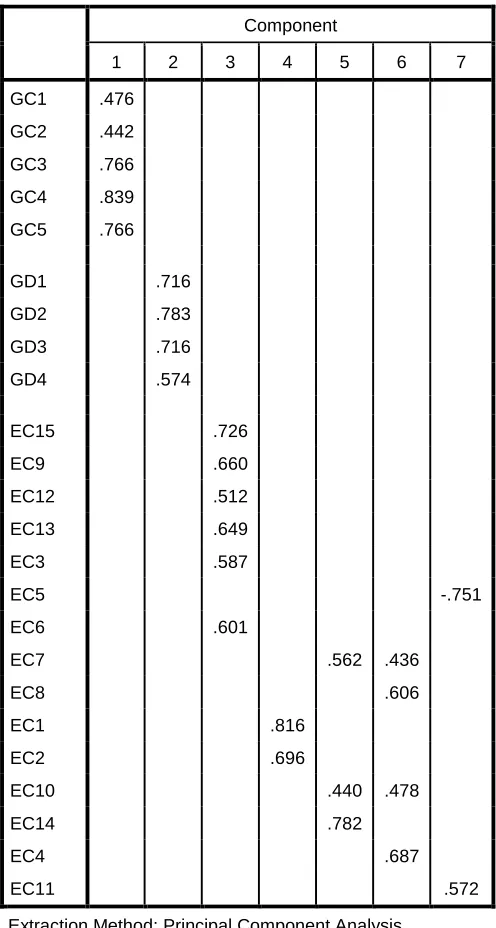
Table 5 - Factor Analysis with All Constructs ... 76
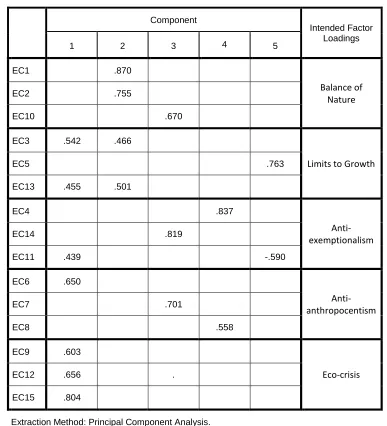
Table 6 - Environmental Concern Construct Factor Analysis ... 77
Table 7 - Goal Commitment Construct Factor Analysis ... 78
Table 8 - Goal Difficulty Construct Factor Analysis ... 78
3
FIGURES
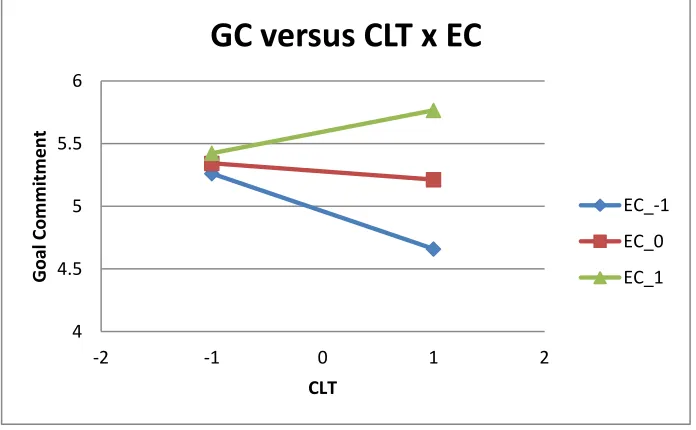
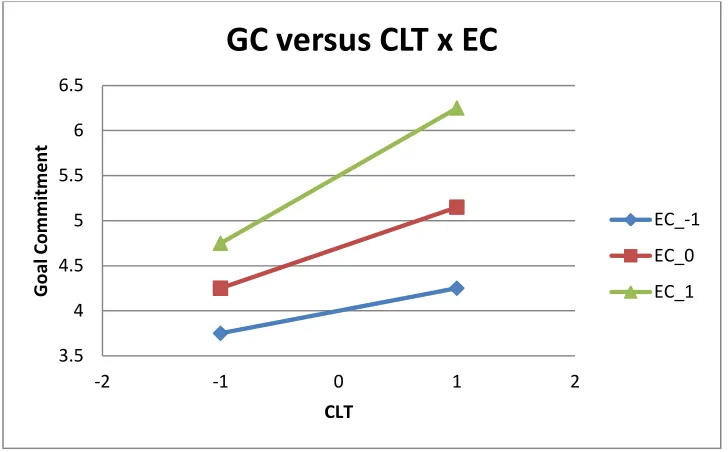
Figure 1- EC x SWS Interaction Graph ... 46Figure 2 - EC x CLT Interaction Graph ... 46
An Experiment on the Effect of Construal Level and Small Wins Framing on Environmental Sustainability Goal Commitment
4
ABSTRACT
Companies are under increasing pressure from every category of stakeholder, from government
and community to supply chain and consumer, to improve the environmental sustainability of
their operations, products and services. To be most successful with environmental
sustainability improvement initiatives, a company must have the commitment and effort of its
employees. The purpose of this research is to study the effect of the company’s approach to
the initiative on the level of employee commitment to the company’s environmental
sustainability goals.
This research was conducted with a two-factor, factorial experiment. The experimental factors
were construal level and small wins framing. Each of these factors had two levels, creating a
2x2 design with four treatment level combinations. A third study factor was environmental
concern. Four other variables, goal difficulty, perceived organizational efficacy, gender and age,
were included in the model as control variables. The dependent variable was goal
commitment. Approximately 150 participants were recruited for the experiment and randomly
assigned to one of the four fixed, treatment combinations. Hierarchical regression was used to
estimate the factors’ main and interaction effects, as well as the significance of the control
Neither of the two manipulated variables, construal level and small wins, was found to have a
significant main effect on goal commitment. There were, however, significant interactions
between environmental concern and construal level, and between environmental concern and
small wins framing, on goal commitment. At high levels of environmental concern, the effects
of construal level and small wins were as hypothesized, but at low levels of environmental
concern, the effects of construal level and small wins were opposite of what was expected.
Additionally, both organizational efficacy and gender were found to significantly affect one’s
goal commitment.
Key words: Environmental Sustainability, Construal Level Theory, Small Wins Strategy,
Environmental Concern, Goal Commitment
5
INTRODUCTION
5.1
Research Domain
The world community is increasingly focused on the natural environment and humanity’s role
in affecting its condition. This focus includes the impact of business with its use of natural
resources and resulting waste streams. The focus also extends to the products produced and
the impact of their lifecycles on the environment, especially their energy requirements and
ultimate disposal. The need to make business more environmentally sustainable has been
embraced by every category of stakeholder from government and community to business and
In response, companies are implementing initiatives to reduce energy and raw material use,
eliminate waste streams and harmful chemicals, and develop more environmentally sustainable
processes, products and services. In addition to meeting stakeholder demands, many
companies are finding that pursuing environmental sustainability initiatives provide economic
and other benefits.
As companies implement sustainability initiatives, as with any company initiative, success
depends on the support and action of employees (Podsakoff, Ahearne and MacKenzie, 1997;
Walz and Niehoff, 2000; Podsakoff, et. al., 2000; Gould-Williams and Davies, 2005). This
research will study the effect of construal level, small wins framing and environmental concern
on employee commitment to act in alignment with the organization’s environmental
sustainability goals, as manifested in an environmental sustainability improvement project.
5.2
Research Perspective
This research is focused on improving the effectiveness of organizations implementing
environmental sustainability initiatives through better understanding of what elicits employee
goal commitment. Three factors were studied for their effect on employee commitment to act
in alignment with the organization’s environmental sustainability goals.
First, Construal Level Theory (CLT) describes how people perceive or construe an issue. This
perspective informs this research topic because how an organization frames a project affects
communication is to persuade people regarding environmental sustainability and to motivate
them to commit to act.
CLT describes how framing the psychological distance of an object affects one’s perception of it.
Psychological distance is a subjective mental construction of how near or distant an object is
from the self in the present. Distance can be spatial distance, but also temporal distance, social
distance or hypotheticality (likelihood or probability of occurrence). These four distances have
a similar effect on one’s construal and therefore a similar effect on one’s conceptions and
decisions. The effect on construal is that the more distal an issue or object is from the self, the
higher and more abstract the level of construal of that issue or object. The higher and more
abstract the construal of an issue, the more it connects with the idealistic, value-oriented inner
self, and the more persuaded a person will be by a message regarding what that person values.
This research measured the effect of construal level in attaining commitment to support the
organization’s environmental sustainability goals.
Second, Small Wins Strategy (SWS) also provides a perspective on how people perceive or
construe an issue. SWS focuses on the psychological effect of framing the magnitude of a
problem and its solution. Problems defined as very large exceed one’s bounded rationality, or
cognitive limit, causing an incapacitating level of stress. The strategy of using small wins
redefines large problems to smaller ones, allowing people to approach a problem creatively and
with confidence and energy (Weick, 1984). When presented with the magnitude of global
problem, and less likely to believe they can contribute to a solution. By defining the problems
and solutions of environmental sustainability as much smaller in magnitude, people will be
more persuaded by a message regarding environmental sustainability.
This research measured the effect of framing the initiative and communication in terms of small
wins on the willingness of organization members to commit to act in support of environmental
sustainability goals as manifested in an environmental sustainability initiative.
A third factor, environmental concern, was included to study its effect on goal commitment,
and also to study its moderating effect of the CLT and SWS factors. A person’s preexisting level
of concern for the environment and mankind’s effect on it may influence that person’s
commitment to be engaged in the organization’s environmental sustainability initiatives.
5.3
Research Questions
This research is focused on studying whether CLT, SWS and environmental concern influence
employee commitment to organizational environmental sustainability goals.
Therefore the research questions are:
RQ1: Does using a Construal Level Theory perspective to frame environmental
sustainability initiatives elicit more goal commitment?
RQ2: Does using a Small Wins Strategy to pursue environmental sustainability
RQ3: Does the level of one’s environmental concern affect the level of goal
commitment to environmental sustainability goals?
RQ4: Does the level of one’s environmental concern moderate the effects of
construal level and small wins framing on goal commitment to environmental
sustainability goals?
5.4
Research Model
Construal Level
Small Wins Framing
Control Variables
Goal Difficulty
Organizational Efficacy Gender
Age
Environmental Concern
5.5
Research Approach
In this research, participants were exposed to communication from an organization in which
they are a member about an environmental sustainability initiative. The communication was
intended to elicit a commitment to act in support of the initiative. The purpose of this research
was to study potential factors that influence the degree of willingness of participants to support
and work toward the environmental sustainability goals of their organization. Two of the
factors are cognitive in nature and relate to the manner in which the environmental initiative is
communicated. One factor is the temporal construal of the environmental initiative. A second
factor is the description of the magnitude of the environmental sustainability problem and
solution. A third factor, environmental concern, was studied for its direct effect on
environmental sustainability goal commitment, and also as a moderating factor.
Undergraduate students of the Johnson College of Business at the University of South Carolina
Upstate were recruited for the study. They were told that participating would help the
research of someone in the university system, and received no compensation. Each participant
was randomly assigned to one of four scenarios describing the university system’s
environmental sustainability goals and initiative strategy. Each participant then completed a
questionnaire verifying the manipulation of the two cognitive factors, measuring the
participant’s environmental concern, and measuring the commitment level of the participant to
support the organization’s environmental sustainability initiatives. Four control variables were
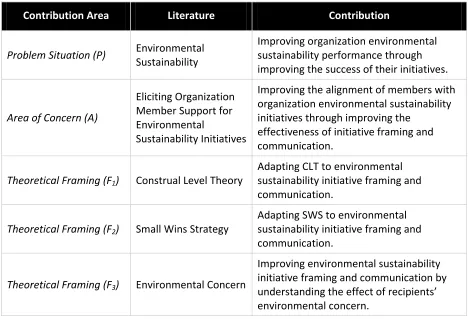
Contribution Area Literature Contribution
Problem Situation (P) Environmental
Sustainability
Improving organization environmental sustainability performance through improving the success of their initiatives.
Area of Concern (A)
Eliciting Organization Member Support for Environmental
Sustainability Initiatives
Improving the alignment of members with organization environmental sustainability initiatives through improving the
effectiveness of initiative framing and communication.
Theoretical Framing (F1) Construal Level Theory
Adapting CLT to environmental sustainability initiative framing and communication.
Theoretical Framing (F2) Small Wins Strategy
Adapting SWS to environmental sustainability initiative framing and communication.
Theoretical Framing (F3) Environmental Concern
[image:18.612.72.542.99.418.2]Improving environmental sustainability initiative framing and communication by understanding the effect of recipients’ environmental concern.
Table 1 - Research Contribution
6
CONSTRUAL LEVEL THEORY
The purpose of this research was to study project and communication factors and their
influence on organization member commitment to an environmental sustainability initiative.
Construal Level Theory is an appropriate lens with which to gain insight into attaining
organization member commitment because one’s construal heavily influences one’s
perception, conception and decision-making about an issue.
Construal Level Theory (CLT) focuses on the psychological distance between the self and the
object or issue being perceived. Psychological distance is a subjective mental construction of
but also temporal distance, social distance or hypotheticality (likelihood or probability of
occurrence). These four distances have a similar effect on one’s construal and therefore a
similar effect on one’s conceptions and decisions. The effect on construal is that the more
distal an issue or object is from the self, the higher and more abstract the level of construal of
that issue or object (Trope and Liberman, 2010).
Proximal objects are perceived in more concrete and specific terms than more distal ones.
Distal objects prompt high-level construals that are “relatively abstract, coherent and
superordinate as compared to low-level construals” (Trope and Liberman, 2010). For example,
a proximal construal of driving to work in your personal automobile includes its make, model,
age, color, condition, gas mileage, etc. If you shift perspective to a more distal one, say 20
years from now, you abstract beyond your current automobile. The construal loses the
specificity of the particular automobile you are driving. Indeed, this distal construal may not be
an automobile at all but perhaps just “transportation” that includes all manner of modes and
technologies with which you could personally travel.
These distal construals “tend to be simpler, less ambiguous, more coherent, more schematic,
and more prototypical than concrete representations. High-level construals are also more likely
than low-level construals to remain unchanged as one gets closer to an object or farther away
from it” (Liberman and Trope, 2008). High level construals emphasize “core features of events
and omit incidental features that may vary without significantly changing the meaning of
representations that include subordinate and incidental features of events deemed secondary
in the high-level construals” (Liberman and Trope, 2008).
CLT and Evaluation
In the behavioral sciences, intertemporal discounting states that the value of an outcome
reduces as the temporal distance to the outcome increases. The prediction from CLT, however,
is that increased psychological distance, including temporal, shifts the attractiveness of an
outcome toward its high-level construal value and away from its low-level construal value.
Thus, the value of the outcome is dependent on how well it aligns with its construal. When the
high-level value of an outcome is more positive than the low-level value, the outcome should
be more attractive in the distant future (Liberman and Trope, 2008).
CLT and Decision-making
“We make predictions, evaluations, and choices with respect to our construal of objects rather
than the objects themselves. These construals depend not only on the actual attributes of the
objects, but also on their psychological distance” (Liberman and Trope, 2008). According to
CLT, central, goal-related features of outcomes constitute a high-level construal of these
outcomes, whereas peripheral, goal-irrelevant features of outcomes constitute a low-level
construal. Distancing an outcome should therefore increase the weight of central features
relative to peripheral features (Liberman and Trope, 2008).
When making a decision about an action, one contrasts the costs and benefits, or the feasibility
Feasibility involves the means used to achieve the end state, a low-level construal (Trope,
Liberman and Wakslak, 2007). Kivetz and Tyler (2007) state this concept in terms of pragmatic
concerns and idealistic values. They state that a distal time perspective fosters an emphasis on
the idealistic, value-oriented inner self. A proximal time perspective fosters a focus on the
practicality and more immediate costs and benefits. Therefore in decision-making, desirability
concerns receive greater weight over feasibility concerns as psychological distance increases.
Also, people emphasize identity attributes over instrumental attributes when making decisions
framed in a distant future perspective, and emphasize instrumental attributes for decisions
framed in a near future perspective. As Agerström and Björklund (2009) state it, “people view
present behavior as being influenced more by contextual factors while they perceive future
behavior as being governed more by stable personality characteristics.”
CLT and Values-based Decisions
Values are relatively abstract and decontextualized, and inherently have a high construal.
When making decisions about distal situations, people’s values take priority. As people get
psychologically closer to the situation, their decisions are increasingly influenced by more
specific attitudes and incidental social influences; value concern priorities are weakened as
more specific concerns become more prominent (Trope and Liberman, 2010). High-level
construals promote attunement to what is consistent about an object across multiple contexts,
allowing individuals to transcend the particularities of the present situation and act according
which include the concrete and contextualized aspects of an object” (Trope and Liberman,
2010).
Eyal et al. (2009) found that the relationship between values and behavioral intentions
depended on how the behavior was construed. Higher correspondence was found when
behaviors are construed on a higher level and when behavior is planned for the more distant
future than when the same behavior is construed on a lower level or is planned for the more
proximal future. Since perceptions of distant future situations highlight more abstract,
high-level features than near future situations, they are more influenced by high-high-level constructs
such as values. “People’s values are better reflected in their intentions for the distant future
than in their intentions for the immediate future or their actual behavior. Values predicted
participants’ intentions for the distant future; feasibility concerns were more predictive of their
intentions for the near future” Eyal et al. (2009).
Agerströni and Björklund (2009) extended the study of CLT to the effect of temporal distance
on people's moral concerns in situations where selfish motives clash with altruistic
considerations. In their results, “people indicated they would be more likely to choose altruistic
over selfish behaviors, reported they would feel more guilty about engaging in selfish behavior,
thought acting selfishly would be more immoral, and were more likely to commit to altruistic
Persuasiveness of Value-Based Messages
Fujita, et. al. (2008) examined the persuasiveness of advertising that included values in the
context of near future versus distant future framing. Participants were shown advertisements
for a sale of DVD players. Some of the DVD players were on sale that week (near future
condition) and some were on sale in three months (distant future condition). They read seven
arguments endorsing a particular DVD player. Six of these arguments were identical for all
participants. For the seventh argument, half of the participants received an argument that
stressed an additional positive value-based feature (the DVD player is made of
environmentally-friendly materials). The other half of the participants received a seventh argument that
stressed an additional value-neutral feature (the manual is easy to use).
The study’s authors found that people emphasized the value aspects (in this case,
environmental impact) of the product when considering a purchase in the distant future
(high-level construal). When participants considered the purchase in the near future (low-(high-level
construal), the value aspects of the product had no impact on the potential purchase. The
conclusion, consistent with CLT, is that value-based persuasive arguments appear to be more
persuasive for temporally distant objects as opposed to temporally near objects. The authors
state “it is argued that the temporal distance of attitude objects systematically changes how
the object is mentally represented, and thus influences the strength of particular persuasive
In another study, Thompson and Stoutemyer (1991) found that focusing on the long-term
environmental consequences of home water conservation improved families’ water
conservation performance versus focusing solely on the personal economic benefits that could
be gained from conservation.
Relating CLT to the current research, Fujita, et. al. (2008) state that “there has been little
research examining directly whether the temporal distance of an attitude object affects
persuasion processes.” I have found no research on how construal level affects employee goal
commitment. In the specific context of environmental sustainability communication, framing
the focus at a high-level construal is counter to current approaches. Indeed, it is intuitive that
to motivate people to action on the environment, one should stress the urgency, immediacy
and local effect of the problem, decreasing its psychological distance. However, this is opposite
of the approach consistent with CLT.
Framing environmental communication in a psychologically distal manner will foster a change
in employees’ mental construal, changing the aspects of the issue attended to and perceived as
relevant. The activation of high-level construals by increasing psychological distance should
facilitate attention to high-level (primary, abstract, desirability, goal-relevant, values-based)
versus low-level (incidental, concrete, feasibility, goal-irrelevant) aspects of the issue.
Hypothesis
H1: Environmental sustainability initiatives that are framed in a psychologically distal manner
7
SMALL WINS STRATEGY
Like Construal Level Theory, Small Wins Strategy is an appropriate lens with which to gain
insight into people’s decision to support the goals of their organization. Small Wins Strategy
(SWS) focuses on the psychological effect of defining the magnitude of a problem. Problems
defined as very large exceed one’s bounded rationality or cognitive limit causing a dysfunctional
level of arousal. The strategy of using small wins redefines large problems to smaller ones,
allowing people to approach a problem creatively and with confidence and energy (Weick,
1984).
The Yerkes-Dodson Law
According to the Yerkes-Dodson (YD) Law, there is an inverted “U” shaped relationship between
the level of stress or arousal and the level of performance. If problems are defined as too small,
they will be perceived as trivial and will not motivate action. If problems are defined as too
large, people become overwhelmed, mentally incapacitated and incapable of action
(Broadhurst, 1959).
High levels of stress or arousal cause one’s coping responses to become more primitive in at
least three ways: “(1) people who try to cope with problems often revert to more dominant,
first learned actions; (2) patterns of responding that have been learned recently are the first
ones to disappear, which means that those responses that are most finely tuned to the current
similar to older stimuli than in fact they are, so that clues indicating change are missed” (Staw,
Sandelands, and Dutton, 1981).
This means that very large problems such as environmental degradation that are relatively new
are hard for people to perceive and appropriately respond to. “Highly aroused people find it
difficult to learn a novel response, to brainstorm, to concentrate, to resist old categories, to
perform complex responses, to delegate, and to resist information that supports positions they
have taken” (Holsti, 1978).
Individual Capabilities
Stress is also related to individual capabilities. Low levels of stress occur when the problem or
goal is easy relative to one’s capability. High levels of stress occur when the problem or goal is
difficult relative to capability. Relating this to solving problems, if one feels that he or she is
incapable of solving the problem, stress level will rise. If one knows how to solve the problem
or knows a means to develop a solution, then one feels capable. Even in the context of a very
difficult problem, levels of stress will not be psychologically debilitating if one has the capability
to address the problem, and the challenge of the problem may improve performance.
If one does not have the capability to address a problem, reducing the perceived difficulty of
the problem will reduce the stress level from debilitating levels. If stress level is too high,
attention to the details of the problem becomes more selective and edited, and people
overlook the minor leverage points from which the problem might be attacked (Weick, 1984).
to allow for the practice of relatively complex skills. To keep problem-related arousal at modest
intensities, people need to work for small wins (Weick, 1984).
The objective is to define the problem such that people see that their capabilities exceed what
is required for success but not by too great a margin. There is a middle ground in the YD
inverted “U” curve in which stress is sufficiently motivating to promote action but not so much
as to cause incapacity.
Applying the Small Wins Strategy
Applying the SWS focuses primarily on the problem definition and secondarily on the problem
resolution. Problems are defined to operate in the center of the YD curve, optimizing peoples’
capabilities and level of response. This approach has the additional benefit of helping
determine a solution “because the content of appropriate solutions is often implied by the
definition of what needs to be solved” (Weick, 1984).
The strategy is to redefine a large problem as a smaller, less difficult problem. This approach
promotes innovative approaches and resolution of the problems. The small wins strategy does
not attempt to solve the large problem in one step, a single win, but in a series of small wins,
creating a pattern of solutions and success. This is not to imply that each problem is solved
initially and the approach is not predicated on having no failures. However, the failure of a
moderately-sized problem is not severe, and in the failure may come the knowledge and
implicit theories about resistance and opportunity and uncover both resources and barriers
that were invisible before the situation was stirred up” (Weick, 1984).
In addition to the cognitive benefits of reducing the size of the problems, it also has the benefit
of making the problems more manageable. If the size of the problem is smaller, its solution is
also smaller, easier to implement, and more immediate in its visible success. It is difficult to
have a sustained effort, especially a complex one. Having solutions that are quicker to
implement facilitates success, and having more immediate feedback fosters more effort.
Additionally, reducing the size of the problem often reduces the scope to a more local one. This
allows for better tailoring a solution to a more specific contextual environment.
The hypothesized benefits of SWS go beyond the individual level. As problems are solved, the
nature of their smaller size and the fact that there has been success makes it more likely to
attract support and less likely to attract opposition to further progress. With each successive
success, more inertia is created, motivating further effort and fostering future wins.
The SWS does not take a large problem and merely break it into a set series of smaller steps or
pieces, planning the solution to the large problem from start to finish. “Small wins do not
combine in a neat, linear, serial form, with each step being a demonstrable step closer to some
predetermined goal” (Weick, 1984). “More common is the circumstance where small wins are
scattered and cohere only in the sense that they move in the same general direction or all move
away from some deplorable condition. Ideals, broad abstract ends, and lasting ambitions are
articulating the specific trade-offs that occur when each one improves something at the
expense of something else” (Lindblom, 1979). SWS “enables firms to develop an emergent
pathway of successful actions that, linked together, build momentum to become a cohesive and
progressive response” (Haigh and Griffiths, 2008).
Also, “small” is relative. “Rather than be deemed ‘small’ by any objective measure, small wins
are small relative to the scale of the issue and the entity addressing it. Incremental change
strategies are by no means new; they have been the core of change processes utilized in
organization development and quality management approaches. However, the strength of the
small wins method is that it provides a tailored outcome-oriented method that enables
complex and often conflict-laden issues to be directly addressed and actively managed within a
firm’s specific context. This is in contrast with other incremental change programs that have
focused on process ahead of results, or have prescribed specific actions ahead of understanding
the context” (Haigh and Griffiths, 2008).
Reducing the level of stress through a small wins strategy allows for a more sophisticated
response rather than a primitive one. Responses that are more complex, more recently
learned, and more responsive to more stimuli in changing situations usually have a better
chance of producing a lasting change in dynamic problems. “The potential attractiveness of a
small win is that it operates simultaneously on importance, demands, and resources and
defines situations away from the ‘close calls’ where higher uncertainty and higher stress reduce
access to the very resources that can insure more positive outcomes” (Weick, 1984).
Sometimes problem solving suffers from too little arousal. When people think too much or feel
too powerless, issues become depersonalized. This lowers arousal, leading to inactivity or
apathetic performance. The prospect of a small win has an immediacy, tangibility, and
controllability that could reverse these effects (Weick, 1984).
Hypothesis
H2: Environmental sustainability initiatives that are framed in terms of small wins will elicit
higher levels of goal commitment.
8
ENVIRONMENTAL CONCERN
Given that the focus of this research is finding factors within organization environmental
sustainability initiative framing and communication that will improve the effectiveness with
which the organization elicits goal commitment, it is hypothesized that a person’s concern for
the environment may be an important factor. Someone with a high level of environmental
concern may inherently be more willing to commit than one who has a low level of
environmental concern. Additionally, one’s level of environmental concern may moderate the
effect of the CLT and SWS factors.
Environmental Concern
The term ‘environmental concern’ has referred to a wide range of environmentally related
cognitions, affects, perceptions, emotions, beliefs, knowledge, attitudes, values, ecological
Since the 1970’s, researchers have worked to develop constructs and measurements for
environmental concern. In 1973, Maloney and Ward, in prescient recognition, stated that
“technology has won battles in the past, in the arenas of medicine, transportation, and
automation, but the solution to (the ecological crisis) does not lie in traditional technological
approaches but rather in the alteration of human behavior. In short, the ecological crisis is a
crisis of maladaptive behavior.” Maloney and Ward developed an Ecological Scale to facilitate
research into this area. Their scale consisted of four subscales - verbal commitment, actual
commitment, affect (emotionality related to ecological issues), and knowledge (Maloney and
Ward, 1973).
In 1978, Weigel and Weigel developed an Environmental Concern Scale as a research tool to
measure an “individual’s relatively enduring beliefs and feelings about ecology” (Weigel and
Weigel, 1978). Also in 1978, Dunlap and Van Liere developed their New Environmental
Paradigm (NEP) instrument intended to measure an individual’s environmental beliefs by
contrasting the “dominant social paradigm” of “individualism, laissez-faire government, beliefs
in progress, material abundance and the goodness of growth, faith in the efficacy of science and
technology, and a view of nature as something to be subdued” with a paradigm of “existence of
ecological limits to growth, importance of maintaining the balance of nature, and rejection of
the anthropocentric notion that nature exists primarily for human use” (Dunlap and Van Liere,
There have been other environmental attitude scales developed, but these three have been the
only ones that have been widely used (Hawcroft and Milfont, 2010). However, both the
Ecological Scale and the Environmental Concern Scale include items referring to specific
environmental topics that have become dated as new issues emerge (Dunlap and Jones, 2002).
“The NEP Scale avoids this issue by measuring general beliefs about the relationship of human
beings to the environment” (Hawcroft and Milfont, 2010). Xiao (2011) states that the NEP Scale
has “become the most widely used measure of general environmental beliefs.”
In 2000, Dunlap, et. al. (2000) revised the original scale, broadening the content of the measure
by expanding from three to five facets of an ecological worldview. These five facets are 1) the
fragility of nature’s balance (beliefs that human activities impact the balance of nature), 2) the
reality of limits to growth (the belief that the earth has limited resources), 3) rejection of
exemptionalism (beliefs that human beings are not exempt from the constraints of nature), 4)
anti-anthropocentrism (beliefs that human beings have the right to modify and control the
natural environment), and 5) the possibility of an eco-crisis (beliefs that humans are causing
detrimental harm to the physical environment). The revision expanded the scale from 12 items
to 15 items, with three items measuring each of these five hypothesized facets (Hawcroft and
Milfont, 2010; Amburgey and Thoman, 2011). The measures are shown in Appendix B – The
Environmental Concern as a Factor
Environmental concern as measured by the NEP scale measures a general ecological worldview
that influences attitudes, beliefs, and behavior intentions about specific environmental issues
(Dunlap, et. al., 2000). Bamburg (2003) states that “environmental concern is an important
indirect determinant of environmental behavior. As a general orientation pattern it influences
the definition of a specific situation that is the generation of situation-specific cognitions.”
Social psychological research has shown that this situation-specific cognition is a direct
determinant of a specific behavior (Ajzen and Fishbein, 1980; Bamburg, 2003)
General environmental concern has a substantive direct effect on the perception and
evaluation of specific situations. In determining the relevancy of issues and framing the
decision, general attitudes are important indirect determinants of specific behaviors. General
environmental concern is situation invariant, and cannot influence specific behaviors directly
(Bamburg, 2003).
Xiao and Dunlap (2007) frame the effect of environmental concern in terms of “concern for the
environment in general and that for more specific environmental problems.” Gray (1985)
theorizes that environmental concern consists of two groups of beliefs. ‘Primary beliefs’ such
as general environmental concern refer to the environment as a whole. ‘Derived beliefs’
address specific aspects of the environment. Xiao (2011) states that “the literature generally
agrees that more generalized environmental concern, such as ecological worldview, tends to
“Concern mediates specific concerns which impact intention which impacts behavior”
(Bamburg, 2003). “The most proximal predictors of behavior are behavioral intentions, which
in turn are anteceded by (a) the extent to which individuals hold a favorable attitude toward
the behavior, (b) individuals’ perceptions of the norms and conventions regarding the behavior
(i.e., subjective norms), and (c) the extent to which the individual perceives the behavior at
hand to be under his or her personal control (i.e., perceived behavioral control)” (Oreg and
Katz-Gerro, 2006). Bamberg (2003) also demonstrated in his model that intention precedes
behavior (r = 0.77). “Environmental values and environmental concern, can account for the
significant partial correlations between behaviors after controlling for background
characteristics” (Thogersen and Olander, 2006).
Measuring Environmental Concern
To measure environmental concern in this study, the New Environmental Paradigm (NEP) scale
developed by Dunlap et al. (2000) was used. The measures are shown in Appendix B – The
Environmental Concern Construct. Some researchers have treated the scale as unidimensional
(reflective) and some have treated the scale as correlated (formative) scales (Amburgey and
Thoman, 2011; Xiao and Dunlap, 2007). Dunlap, et. al. (2000) state that the scale’s 15
measures “can be treated as an internally consistent summated rating scale.” Xiao (2011) used
an eight-measure subset of the 15 NEP measures, measuring the facets “limits to growth,”
“anti-anthropocentrism,” and “exemptionalism.” Using a factor analysis, he found that the
eight measures “form a unidimensional measure of the NEP with adequate to very good
(NEP) is widely acknowledged as a reliable multiple-item scale to capture environmental
attitudes or beliefs.” Hawcroft and Milfont (2010) state that “the reliability and validity of both
the original and revised NEP Scales as a general measure of EA are well–established.”
Amburgey and Thoman (2011) conducted a study to understand the factor structure of NEP.
However, rather than conduct a factor analysis, they studied three models developed a priori.
They modeled the five facets as one fifteen-measure scale, a set of five independent scales,
each with three reflective measures, and a set of five correlated subscales, each with three
reflective measures. The authors found that “a second-order factor structure with five
interrelated dimensions provides a better fit for the data than a single factor structure or five
independent factors structure. Results show that the NEP is best represented as correlated
scales involving five facets.”
Some researchers have conducted factor analyses to study the NEP construct, with very
inconsistent results. Albrecht, et. al. (1982) used the 12-measure NEP instrument, and reported
that the factor analysis produced a three-factor model. Geller and Lasley (1985) conducted a
factor analysis on the 12-measure instrument. In their analysis, they deleted three measures
from the instrument, resulting in a nine-measure instrument that loaded into three factors.
The study conducted by Noe and Snow (1990) resulted in a seven-measure, two-factor model.
Scott and Willits (1994) produced a two-factor model from the 12-measure instrument. Lastly,
suspect. In his research, the results supported an eight-item, two-factor model of the scale. Ji
reported low reliability, as reflected by a Cronbach’s Alpha of 0.60 for the second factor.
With an instrument that is nearly 35 years old, there has been relatively little study of the factor
loadings. The few studies referenced above are about the extent of the studies found. While
its reliability is much-touted in the literature, it is clear that there is not much empirical support
for this confidence. Therefore, in this research, the environmental concern construct was
evaluated with a factor analysis and a reliability analysis. Given the lack of empirical evidence
supporting this scale’s factor loadings, this research is an opportunity to add to the
understanding of the NEP instrument.
Hypotheses
H3A: Individuals with a higher level of environmental concern with provide higher levels of goal
commitment to environmental sustainability goals.
H3B: Environmental concern moderates the relationship between construal level and goal
commitment for environmental sustainability goals such that the effect of construal level
will be greater at higher levels of environmental concern.
H3C: Environmental concern moderates the relationship between small wins framing and goal
commitment for environmental sustainability goals such that the effect of small wins will
9
CONTROL VARIABLES
9.1
Goal Difficulty
As discussed earlier, according to the Yerkes-Dodson (YD) Law, there is an inverted “U” shaped
relationship between the level of stress and the level of performance. If problems are
perceived as too small, they will be viewed as trivial and will not motivate action. If problems
are perceived as too large, people become overwhelmed, mentally incapacitated and incapable
of action (Broadhurst, 1959).
In the research about goal setting, “nearly 400 studies have shown that specific, difficult goals
lead to better performance” (Locke and Latham 1990), including a meta-analysis by Tubbs
(1986) and a study by Wright (2004) finding that there is a relationship between goal difficulty
and work motivation, with the more difficult or challenging goals motivating employees more.
Given the strong relationship between goal difficulty and work motivation reported in
literature, a measure of goal difficulty was included in the questionnaire, and included in the
data analysis as a control variable. One might even view this as an attempt at a direct measure
of where the project is perceived to fall on the YD curve. Work or goal motivation will then be
defined and measured in this research as goal commitment.
A five-measure instrument was developed to measure goal difficulty by Wright (2004). This
instrument was based on Locke and Lantham (1990), Lee, et. al. (1991), and Steers (1976).
Cronbach’s Alpha of 0.85. The measures are shown in Appendix C – The Questionnaire, labeled
(GD).
9.2
Organizational Efficacy
Closely related to goal difficulty is efficacy. A goal is difficult or easy in relation to one’s
capability (Lee and Bobko, 1992; Wright, 1992). The same goal can be given to two different
people, and based on their capabilities, be perceived as very easy by one and unachievable by
the other.
Relating this perception of goal difficulty to motivation, confidence in one’s abilities, called
self-efficacy, influences one’s motivation to achieve the goal. Both non-challenging goals and too
challenging goals, relative to one’s capability, engender lower motivation than goals that are
challenging and achievable (Wright, 2004). Durham, et. al. (1997) state that people with higher
self-efficacy are motivated to adopt higher goals than people who have lower self efficacy. A
person is motivated by a difficult goal if that person perceives that he or she has the ability to
achieve the goal.
Bandura (1986) first conceived that efficacy is as important at the group level as at the
individual level. Guzzo, et. al. (1993) defined group efficacy as an individual’s belief that a
group can perform successfully. Organizational efficacy serves a similar function to that of
Greenlees, et. al. (2000) studied organizational efficacy and goal setting, and found that the
organizational efficacy which an individual possesses in their team will influence the goals they
select for that team. Other researchers have found the same result (Silver and Bufanio, 1996;
Durham, et. al., 1997; Knight, et. al., 2001; Quigley, 2003).
Durham, et. al. (1997) conducted an experiment in which they hypothesized that team efficacy,
in addition to influencing the difficulty of the goals that the team sets for itself, also influences
the commitment to that goal. In the experiment, the authors used a very similar scale to what
was used in this research for measuring goal commitment (see the Goal Commitment section).
They found that there was a significant correlation between team efficacy and goal
commitment.
With the relationship between efficacy and goal selection and goal commitment documented
by other researchers, a measure of the organization efficacy the participant perceives was
included in the data gathered in the research questionnaire. A self-developed, single measure
for organizational efficacy was used in this research, and is shown in Appendix C – The
Questionnaire, labeled (OE).
9.3
Demographic Data
Demographic data were gathered from the participants to be included as control variables to
10
GOAL COMMITMENT
Many models of environmental behavior show that intention immediately precedes behavior
(Ajzen and Fishbein, 1980; Hines et al., 1986; Ajzen, 2001; Armitage and Conner, 2001). As a
measure of intention, I will use the construct goal commitment developed by Hollenbeck, et. al.
(1989) and modified by Klein, et. al. (2001) as the dependent variable. Goal commitment is
defined as “one’s determination to reach a goal” (Locke & Latham, 1990). The conception of
goal commitment is the intention to extend effort toward attaining the goal, persistence in
pursuing the goal over time, and an unwillingness to lower or abandon that goal (Hollenbeck &
Klein, 1987).
In 1989, Hollenbeck, et. al. sought to develop an “efficient, construct-valid measure of goal
commitment.” This was in response to goal commitment measurement inconsistency and the
use of single item measures. Hollenback, et. al. developed a nine item scale (HWK scale) that
showed significant reliability and was consistently related to performance. This scale and its
derivatives became the most commonly used measures of goal commitment (Klein, et. al.,
2001).
Despite this wide use, some researchers raised questions about the dimensionality of the scale.
To address this issue, Klein, et. al. (2001) conducted research with a combination of
meta-analysis and structural equation analyses to assess the HWK scale. The goal was to identify a
“unidimensional measure of goal commitment” that was “construct valid and demonstrated
considerations relevant to the focus of this research was to ensure that the scale produced
equivalent results across tasks of varying complexity, across the timing of the measurement,
and across the origin of the goal (self or other party imposed) (Klein, et. al., 2001).
The research determined that a five-item scale subset of the original nine-item scale best
represented a unidimensional measure of one’s determination to reach a goal. The scale was
concluded to be practically significant, psychometrically sound, construct relevant, robust, and
widely generalizable. Regarding the equivalence of the scale with respect to measurement
timing, goal origin, and task complexity, the scale was equivalent and unidimensional across
subgroups of different levels of these variables (Klein, et. al., 2001). The measures are shown in
Appendix B – The Questionnaire, labeled (GC).
11
RESEARCH METHODOLOGY
11.1
Research Setting
In this research, the participants were sophomore, junior and senior-level students at the
Johnson College of Business at the University of South Carolina Upstate. There were 89 men,
59 women, and two not reporting their gender. The age range was 19 to 63, with a mean of
23.7 and a median of 22. Of the 150 participants, 17 were excluded from the analysis due to
either not fully completing the questionnaire or failing the manipulation checks. A post hoc
power analysis showed that this sample size provided 81% power to detect, at a significance
detect an effect size f2 of 0.15 (medium effect size) was 99%. An analysis conducted when
including the participants who did not fully complete the questionnaire or failed the
manipulation checks produced similar results to that when those participants were excluded,
showing that the results are robust to this exclusion.
11.2
Experimental Design
The experiment was a two fixed factor, full factorial design with each factor having two factor
levels (22 or 2x2 design). This creates four combinations of the two factors and two factor
levels. The two fixed factors are Construal Level Theory (CLT) and Small Wins Strategy (SWS)
framing. There was a third random factor, Environmental Concern. Goal Difficulty,
Organizational Efficacy, Gender and Age were included as control variables.
To create the four combinations of fixed factor levels, scenarios were written describing the
construal level and the use or lack of use of small wins framing. The focus of the scenarios was
the adoption of an environmental sustainability improvement project to meet the
organization’s environmental sustainability goal. The CLT factor was used to frame the timing
of the environmental sustainability project, manipulating the psychological distance of the
project. The SWS framing was used to manipulate the size and scope of the environmental
sustainability project.
Participants were randomly assigned to one of the four scenarios with the constraint of
approximately equal number of participants assigned to each of the four scenarios. Each
initiative, and the approach to working on that initiative. The scenarios are shown in Appendix
A – The Experimental Manipulations.
After reading the scenario, each participant answered a questionnaire about the scenario,
about how they perceived the environmental sustainability issue, and how they think they
would act if actually put in that circumstance. Imbedded in the questionnaire were the
measures of environmental concern, goal difficulty, organizational efficacy, gender, age and
goal commitment. The measures are shown in Appendix B – The Questionnaire.
Construal Level Factor Levels
The two CLT factor levels framed the environmental sustainability issue in a high construal
(psychologically distant) level and in a low construal (psychologically proximal) level. In the high
construal level frame, the issues were described in temporally distant terms. In this framing,
the participants were told that the project would start “Fall Semester.” Fall Semester was six
months in the future, with an intervening summer break, from the time the experiment was
conducted. In the low construal level frame, the issues were described in temporally proximal
terms. In this framing, the participants were told that the project would start “Monday.” The
experiment was conducted on more than one day, so “Monday” was a somewhat variable
timeframe, but always at most a week away.
Small Wins Factor Levels
that people feel that their capabilities exceed what is required for success. The solution was
defined in terms that made the issue feel tangible and controllable. The project was defined as
“small” and would focus on “one aspect” at the local college campus’ environmental
performance. Participants were told that, if successful, “the project will make a small
improvement in the university systems’ environmental performance, but will lay the foundation
for more sustainability projects that will eventually have an impact throughout the system.”
Without a small wins framework, the problem was defined such that people feel the scope of
the problem and its solution is very large, perhaps exceeding their and the organization’s
capabilities. This approach is the typical manner in which environmental problems are
communicated in an effort to motivate people to act. In this research, for the framing without
small wins, the project was defined as “very large” and focused on “all aspects of
environmental performance.” The strategy was said to focus the project on “environmental
problems in all universities and all colleges” in the South Carolina University System in order to
“make a large improvement in the university systems’ environmental performance.”
Experiment Design Matrix
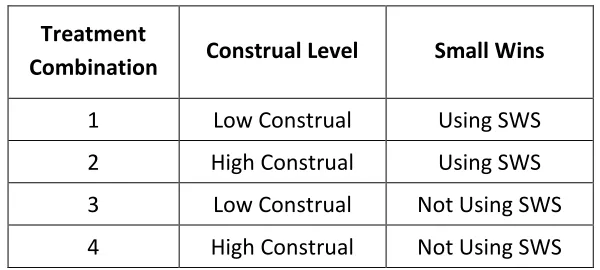
To better illustrate the structure of the experiment, below is a table of the four factor
Treatment
Combination Construal Level Small Wins
1 Low Construal Using SWS
2 High Construal Using SWS
3 Low Construal Not Using SWS
[image:45.612.86.386.98.233.2]4 High Construal Not Using SWS
Table 2 - Experiment Design Matrix
Environmental Concern
One random factor was included in the experimental design, environmental concern. Each
participant’s environmental concern was measured using the New Environmental Paradigm
(NEP) scale developed by Dunlap et al. (2000). The participants’ level of environmental
concern was not determined a priori, and so could not be used to make assignments to the four
scenarios. Given the sample size of 133 participants, it was determined post facto that there
was sufficient power (81% for f2 of 0.06 and 99% for f2 of 0.15) to test hypotheses associated
with environmental concern.
12
DATA ANALYSIS
SPSS Statistics software, Version 19 was used for the data analysis.
12.1
Evaluation of the Constructs
There are three constructs obtained from the literature and used in this research, Goal
Appendix D, the Goal Commitment construct measures loaded together and the Goal Difficulty
constructs loaded together. The measures for these two constructs loaded separately from
each other, showing good discrimination. However, the Environmental Concern construct did
not load as expected. Each construct’s factor analysis and reliability analysis is discussed below.
12.1.1
Environmental Concern
The Environmental Concern construct, taken from Dunlap et al. (2000), is intended to be a five
factor formative construct, with each factor being composed of three reflective measures,
resulting in fifteen total measures. Each of the five factors has a different environmental focus:
1) the balance of nature (belief that human activities impact the balance of nature), 2) limits to
growth (belief that the earth has limited resources), 3) anti-exemptionalism (belief that human
beings are not exempt from the constraints of nature), 4) anti-anthropocentrism (belief that
human beings do not have the right to modify and control the natural environment), and 5)
eco-crisis (belief that humans are causing harm to the physical environment). The measures
are shown in Appendix B – The Environmental Concern Construct.
As was discussed in Section 7 Environmental Concern, some researchers have noted problems
with this intended loading. Given the lack of empirical evidence supporting the scale’s intended
factor loadings, it should not be surprising, therefore, that the findings of my research are
inconsistent with the previous studies.
As can be seen in the initial factor analysis, Table 6 - Environmental Concern Construct Factor
the developers of this construct. Note that only one of the five factors loads as intended,
“eco-crisis.” It is a three-measure, reflective construct with measures 9, 12 and 15. These measures
load into one factor, with a Cronbach’s Alpha of 0.697 and a total variance explained of 62.7%,
and were used to measure environmental concern. The appeal of formulating the
environmental concern construct in this manner is primarily three-fold:
It matches one of the factors, Eco-crisis, in the measure from literature.
It matches my conceptualization of environmental concern.
It is a reflective measure.
For this research, the environmental concern construct was comprised of the following three
reflective measures:
Humans are severely abusing the environment.
The so-called "ecological crisis" facing humankind has been greatly exaggerated.
If things continue on their present course, we will soon experience a major ecological
catastrophe.
12.1.2
Goal Difficulty
The Goal Difficulty construct, taken from Wright (2004), is intended to be a four factor
reflective construct. The measures are shown in Appendix C – The Questionnaire, labeled (GD),
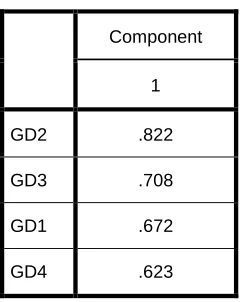
and the factor analysis is shown in Table 8 - Goal Difficulty Construct Factor Analysis. The four
variance explained of 50.7%. Therefore, for this research, the four measure, reflective
construct was used.
12.1.3
Goal Commitment
The Goal Commitment construct, taken from Klein, et. al. (2001), is intended to be a five factor
reflective construct. The measures are shown in Appendix C – The Questionnaire, labeled (GC).
The five measures are reflective and loaded into one factor. This can be seen in the factor
analysis results in Table 7 - Goal Commitment Construct Factor Analysis in Appendix D –
Evaluating the Constructs. The Cronbach’s Alpha was 0.787 with a total explained variance of
55.5%. Note that the Cronbach’s Alpha would be slightly increased to 0.811 by excluding the
second measure. However, since the five-measure construct matches literature and has a high
Cronbach’s Alpha value, all five measures were retained for this research.
12.2
Evaluation of the Model
The data were imported into SPSS. The constructs were calculated as defined in the last
section. The non-dichotomous independent and control variables were mean-centered to
reduce the effect of multicollinearity that may be present. Lastly, the interaction terms were
calculated.
Hierarchical regression was used, and the factors were loaded in three stages, the control
variables first (goal difficulty, organizational efficacy, gender and age), the main effects second
(the three two-way interactions between each of the three independent variables). The results
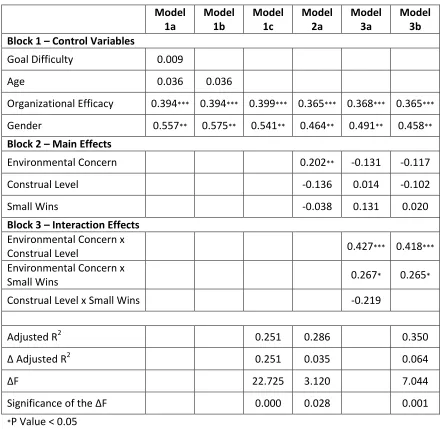
of the regression can be seen in Table 3 - Hierarchical Regression Results.
In Model 1, the hierarchical model was evaluated for the significance of the control variables.
Goal difficulty was removed in Model 1a due to lack of significance, and then age was removed
in Model 1c. Organizational efficacy and gender were retained.
In Model 2, the hierarchical model was evaluated for the significance of the factor main effects.
Only environmental concern was significant. However, CLT and SWS were retained because
they were involved in interactions.
In Model 3, the hierarchical model was evaluated for the significance of the interactions. The
Construal Level x Small Wins interaction was not significant and was removed in Model 3b. The
other two interactions, Environmental Concern x Construal Level and the Environmental
Concern x Small Wins were significant. Below is a summary of the model and the coefficients.
Note that when the interaction terms were added to the model, the environmental concern
Model 1a Model 1b Model 1c Model 2a Model 3a Model 3b Block 1 – Control Variables
Goal Difficulty 0.009
Age 0.036 0.036
Organizational Efficacy 0.394*** 0.394*** 0.399*** 0.365*** 0.368*** 0.365***
Gender 0.557** 0.575** 0.541** 0.464** 0.491** 0.458**
Block 2 – Main Effects
Environmental Concern 0.202** -0.131 -0.117
Construal Level -0.136 0.014 -0.102
Small Wins -0.038 0.131 0.020
Block 3 – Interaction Effects
Environmental Concern x
Construal Level 0.427*** 0.418***
Environmental Concern x
Small Wins 0.267* 0.265*
Construal Level x Small Wins -0.219
Adjusted R2 0.251 0.286 0.350
∆ Adjusted R2 0.251 0.035 0.064
∆F 22.725 3.120 7.044
Significance of the ∆F 0.000 0.028 0.001
*P Value < 0.05
**P Value < 0.01
[image:50.612.65.506.96.525.2]***P Value < 0.001
Table 3 - Hierarchical Regression Results
At the bottom of Table 3, one can see the effect of going from Model 1 to Model 2 to Model 3
in terms of change in Adjusted R2, change in F, and the significance of that change in F. The
change in each model is significant. As can be seen in the concluding Model 3b, 35% of the
13
RESULTS
The result of the hierarchical regression yields the following regression equation:
Y = 4.592 + 0.365XOE + 0.458XGender – 0.117XEC – 0.102XCLT + 0.020XSWS + 0.418XECXCLT + 0.265XECXSWS
To better understand the nature and significance of the interaction terms, simple slopes
analyses were performed.
13.1
Interaction Terms, Simple Slopes Analysis and Interaction Graphs
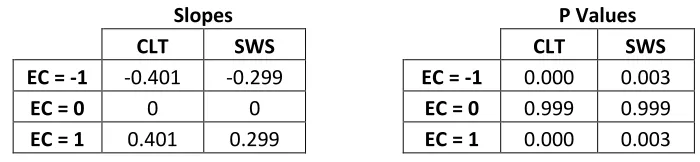
The simple slope analysis evaluates the XECXCLT and XECXSWS interaction terms at three different
levels of standardized environmental concern (-1, 0 and +1 standard deviations from the mean).
Below are the calculated slopes, and P values. The slopes at -1 and +1 standard deviations are
seen to be significant.
Slopes P Values
CLT SWS CLT SWS
EC = -1 -0.401 -0.299 EC = -1 0.000 0.003
EC = 0 0 0 EC = 0 0.999 0.999
[image:51.612.106.456.434.515.2]EC = 1 0.401 0.299 EC = 1 0.000 0.003
Table 4 - Simple Slopes
The interaction graphs are very similar for the two independent variables. At high levels of
environmental concern, moving from low to high construal, or moving from not using to using
small wins, results in an increase in commitment to the environmental sustainability
improvement initiative, and thus to meeting the organization’s environmental sustainability