R E S E A R C H A R T I C L E
Open Access
Managing stress and anxiety through qigong
exercise in healthy adults: a systematic review
and meta-analysis of randomized controlled trials
Chong-Wen Wang
1, Celia HY Chan
2, Rainbow TH Ho
1,2, Jessie SM Chan
1, Siu-Man Ng
2and Cecilia LW Chan
1,2*Abstract
Background:An increasing number of studies have documented the effectiveness of qigong exercise in helping people reduce psychological stress and anxiety, but there is a scarcity of systematic reviews evaluating evidence from randomized controlled trials (RCTs) conducted among healthy subjects.
Methods:Thirteen databases were searched for RCTs from their inception through June 2013. Effects of qigong exercise were pooled across trials. Standardized mean differences (SMDs) were calculated for the pooled effects. Heterogeneity was assessed using theI2test. The risk of bias was assessed using the Cochrane criteria.
Results:Seven RCTs met the inclusion criteria. Two RCTs suggested that qigong exercise immediately relieved anxiety among healthy adults, compared to lecture attendance and structured movements only. Four RCTs
suggested qigong exercise relieved anxiety (pooled SMD =−0.75; 95% CI, -1.11 to−0.40), and three RCTs suggested that qigong exercise reduced stress (pooled SMD =−0.88; 95% CI, -1.22 to−0.55) among healthy subjects following one to three months of qigong practice, compared to wait-list controls.
Conclusions:The available evidence suggests that qigong exercise reduces stress and anxiety in healthy adults.
However, given the limited number of RCTs and their methodological flaws, further rigorously designed RCTs are needed.
Keywords:stress, anxiety, qigong, systematic review, meta-analysis
Background
Stress is a problem worldwide. People of different ages and backgrounds face stress induced by such factors as workload, studyload, job instability, family responsibilities, conflicts, stressful life events, financial strain, and health problems. A recent survey showed that the majority of Americans were living with moderate or high levels of stress and that about 44% had experienced an increase in stress over the past five years [1]. In highly competitive cities such as Hong Kong, an overwhelming majority of people feel stressed [2].
A certain amount of life stress may be beneficial, but in-tense or prolonged stress can be harmful and make people feel overwhelmed [3]. The most common reaction to stress is anxiety, and unmanaged stress has a detrimental effect
on physical and mental health. It may reduce immune function and result in a range of health problems, such as depression, fatigue, insomnia, headache, stomachache, problematic eating, hypertension, cardiovascular disease, and even cancer [4]. Studies have found that stress con-tributes to 50% of all illnesses in the US, and that two-thirds of doctor visits were for stress-related illnesses [5].
The best way to manage stress and anxiety is through self-care [3]. In recent years, people have increasingly been using mind-body exercises (such as qigong, tai chi, and yoga) as complementary and alternative therapies to manage psychological stress or anxiety. Qigong exercise is an ancient form of martial arts that was developed in China and has been used in China for thousands of years to improve physical fitness and stamina [6]. The basic components of qigong exercise include concentration, relaxation, meditation, breathing regulation, body posture, and movement [6]. According to the philosophy of trad-itional Chinese medicine, qigong exercise aims to achieve * Correspondence:[email protected]
1Centre on Behavioral Health, The University of Hong Kong, 5 Sassoon Road, Pokfulam, Hong Kong, China
2Department of Social Work and Social Administration, The University of Hong Kong, Pokfulam Road, Hong Kong, China
© 2014 Wang et al.; licensee BioMed Central Ltd. This is an Open Access article distributed under the terms of the Creative Commons Attribution License (http://creativecommons.org/licenses/by/2.0), which permits unrestricted use, distribution, and reproduction in any medium, provided the original work is properly cited. The Creative Commons Public Domain Dedication waiver (http://creativecommons.org/publicdomain/zero/1.0/) applies to the data made available in this article, unless otherwise stated.
a harmonious flow of vital energy (qi) and regulate the functional activities of the body through regulated breath-ing, mindful concentration, and gentle movements. With regular practice and rehearsal of the structured move-ments, as well as concentration on mind and breath, prac-titioners can experience mood stabilization and improved strength and fitness. Qigong is an easily adaptable form of mind-body exercise that can be practiced any place and any time, without any special equipment. It is widely practiced not just to improve physical health, but also to manage stress and improve psychological well-being.
In recent years, an increasing number of studies have documented the effectiveness of qigong exercise in helping people improve their physical health and reduce perceived stress and anxiety. Existing systematic reviews have exam-ined the clinical evidence of the beneficial effects of qigong exercise on different medical conditions, such as cancer [7], hypertension [8], diabetes [9], chronic heart diseases [10], fibromyalgia [11], and movement disorders [12]. In the most recently published systematic review, our team exam-ined the overall effectiveness of qigong exercise on depres-sive and anxiety symptoms among patients with chronic illnesses [13]. The results suggested that qigong exercise re-duces depressive symptoms but not anxiety symptoms for patients with chronic illnesses. To date, the literature lacks a systematic review of the clinical trial evidence of the ef-fectiveness of qigong exercise on stress and anxiety among healthy people in particular. Thus, the purpose of this sys-tematic review is to summarize and synthesize the clinical evidence available from RCTs on the effectiveness of qigong exercise on stress and anxiety among healthy adults.
Methods
The literature search
The following electronic databases were searched: Pub Med/MEDLINE; CENTRAL; CINAHL; EMBASE; AMED; Qigong and Energy Medicine Database; China Academic Journals Full-text Database-Medicine/Hygiene Series; China Proceedings of Conference Full-text Database; China
Master’s Theses Full-text Database; China Doctoral
Dissertations Full-text Database; Taiwan Electronic Theses and Dissertation System; Taiwan Electronic Periodical Services; and Index to Taiwan Periodical Literature Sys-tem. The search terms included: qigong, qi-gong, qi gong, chi chung, chi gong, qi chung, qi-training, anxiety, anxious, stress, distress, mood, and emotion. Both traditional and simplified Chinese translations of these terms were used in Chinese databases. We searched the databases from their inception through June 2013 for articles containing these terms in the title, abstract, or keywords. We manu-ally searched the reference lists of all included studies and reviews for other articles.
Study selection
This study included all RCTs examining the effect of qigong exercise on stress reduction or anxiety relief among healthy adults (defined as those who may have psychological distress but not psychiatric symptoms or chronic illnesses). However, crossover RCTs were excluded because their results are subject to carryover bias. Nonran-domized controlled clinical trials (CCTs) and controlled, retrospective observational studies (ROS) were excluded due to their susceptibility to selection bias. Non-controlled observational studies and case reports were also excluded due to lack of significant evidence. Because the focus of this review was on psychological distress (including stress and anxiety), rather than on psychopathological symp-toms, this review excluded studies on patients with mental disorders or patients with elevated depressive and anxiety symptoms secondary to chronic illnesses such as cancer. The results of these studies have already been examined in our prior review [13]. Finally, studies among children and pregnant women were also excluded because our focus was on adults. For each included trial, we extracted data on the effect of qigong on any outcomes examined in the study, although the focus of this review is perceived stress and anxiety.
Data extraction and risk-of-bias assessment
Data were extracted by one main researcher and then veri-fied by another researcher. Any discrepancies were resolved by discussion. The risk of bias in each of the included trials was assessed using the Cochrane Collaboration’s assess-ment tool [14]. This tool assesses study quality based on seven criteria: adequate randomization; allocation conceal-ment; blinding of participants, personnel, and outcome assessors; incomplete outcome data reporting; intention-to-treat analysis; selective outcome reporting; and other bias. Since blinding both participants and personnel are generally impossible for studies of qigong exercise, we only assessed if the outcome assessors were blind to treat-ment allocation. A trial was considered to have used intention-to-treat analysis if all the participants were analyzed with no difference in number between pre- and post-intervention.“Other bias”was assessed mainly based on sample size justification and screening criteria for participants.
Data synthesis and analysis
Meta-analyses of the results were performed using Re-view Manager 5.2 (http://ims.cochrane.org/revman). Ef-fects sizes were calculated for each trial using Hedge’sg [15]. Standardized mean differences (SMDs) were calcu-lated for the pooled effects. We interpreted the SMDs using the following rule of thumb: 0.2 represents a small effect, 0.5 a moderate effect, and 0.8 a large effect [16].
Wanget al. BMC Complementary and Alternative Medicine2014,14:8 Page 2 of 9
A random-effects model was used for data synthesis when an outcome was measured by different measures, and a fixed-effects model was used when an outcome was measured by the same instrument in different studies [14]. A mixture of change-from- baseline scores and final value scores was used for meta-analyses [14]. Where an out-come was assessed by more than one tool in a trial, we only included the main outcome measure (identified as the first outcome reported in the results section or the outcome reported in the abstract) in the meta-analysis. Where both state anxiety and trait anxiety were assessed, we included the measure of state anxiety (anxiety at a mo-ment or about an event) only in the meta-analysis for evaluating the immediate effect of qigong exercise follow-ing a sfollow-ingle session of practice, and the measure of trait anxiety (anxiety experienced on a day-to-day basis) only in the meta-analysis for evaluating the effect of qigong exercise following a period of qigong practice.
For publications in which means and standard devia-tions of the outcome measures were not available, we contacted the correspondence authors for the data. The chi-squared statistic and the I2 statistic were used to assess heterogeneity. Studies with an I2statistic of >75% were considered to have a high degree of heterogeneity; studies with anI2statistic of 50-75% were considered to have a moderate degree of heterogeneity; and studies with an I2statistic of 25-50% were considered to have a low
degree of heterogeneity [16]. Sensitivity analyses were conducted by omitting one study in turn and evaluating the influence of a single study on the overall pooled effect. Publication bias was not examined due to the small num-ber of studies (< 10) included in each analysis.
Results
Results of the literature search
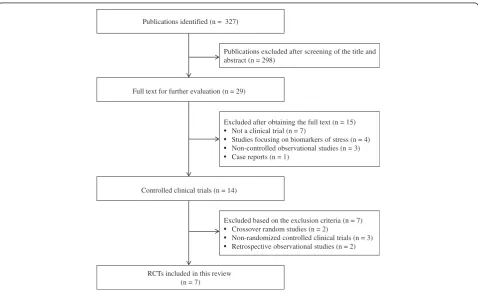
Our database searches identified 327 potentially relevant articles, of which 298 were excluded after screening the title and abstract. Full reports of 29 studies were acquired, and 22 were excluded based on the inclusion criteria (Figure 1).
Description of included studies
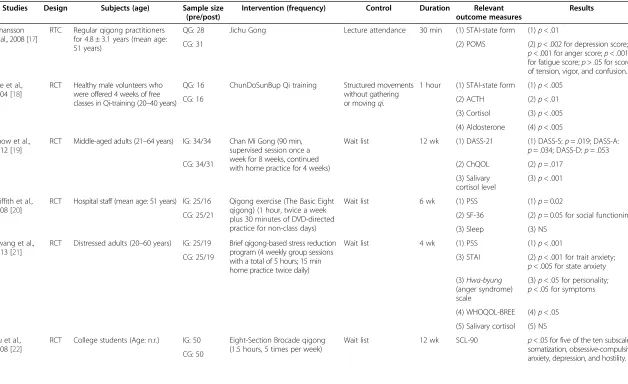
Seven RCTs [17-23] met the inclusion criteria. They were conducted in Australia [17], South Korea [18,21], Hong Kong [19], the USA [20], Mainland China [22], and Spain [23]. All of them were published in peer-reviewed journals with full texts. Six RCTs were published in English, and one [22] was published in Chinese. Table 1 presents the characteristics of the included studies.
Participants included regular qigong practitioners [17], healthy volunteers [18], middle-aged adults [19], hospital staff [20], distressed adults [21], and college students [22,23]. The sample sizes ranged from 32 to 100, with a total of 398 participants. This included 199 subjects in the qigong groups and 199 subjects in the control groups.
Publications identified (n = 327)
Full text for further evaluation (n = 29)
Publications excluded after screening of the title and abstract (n = 298)
RCTs included in this review (n = 7)
Excluded based on the exclusion criteria (n = 7) • Crossover random studies (n = 2)
• Non-randomized controlled clinical trials (n = 3) • Retrospective observational studies (n = 2) Excluded after obtaining the full text (n = 15) • Not a clinical trial (n = 7)
• Studies focusing on biomarkers of stress (n = 4) • Non-controlled observational studies (n = 3) • Case reports (n = 1)
[image:3.595.59.538.425.720.2]Controlled clinical trials (n = 14)
Figure 1Selection process for included studies.
Wanget al. BMC Complementary and Alternative Medicine2014,14:8 Page 3 of 9
Table 1 Summary of seven RCTs investigating the effects of qigong exercise among healthy or distressed individuals
Studies Design Subjects (age) Sample size (pre/post)
Intervention (frequency) Control Duration Relevant outcome measures
Results
Johansson et al., 2008 [17]
RTC Regular qigong practitioners for 4.8 ± 3.1 years (mean age: 51 years)
QG: 28 Jichu Gong Lecture attendance 30 min (1) STAI-state form (1)p< .01
CG: 31 (2) POMS (2)p< .002 for depression score;
p< .001 for anger score;p< .001 for fatigue score;p> .05 for scores of tension, vigor, and confusion.
Lee et al., 2004 [18]
RCT Healthy male volunteers who were offered 4 weeks of free classes in Qi-training (20–40 years)
QG: 16 ChunDoSunBup Qi training Structured movements without gathering or movingqi.
1 hour (1) STAI-state form (1)p< .005
CG: 16 (2) ACTH (2)p< .01
(3) Cortisol (3)p< .005
(4) Aldosterone (4)p< .005
Chow et al., 2012 [19]
RCT Middle-aged adults (21–64 years) IG: 34/34 Chan Mi Gong (90 min, supervised session once a week for 8 weeks, continued with home practice for 4 weeks)
Wait list 12 wk (1) DASS-21 (1) DASS-S:p= .019; DASS-A:
p= .034; DASS-D:p= .053
CG: 34/31 (2) ChQOL (2)p= .017
(3) Salivary cortisol level
(3)p< .001
Griffith et al., 2008 [20]
RCT Hospital staff (mean age: 51 years) IG: 25/16 Qigong exercise (The Basic Eight qigong) (1 hour, twice a week plus 30 minutes of DVD-directed practice for non-class days)
Wait list 6 wk (1) PSS (1)p= 0.02
CG: 25/21 (2) SF-36 (2)p= 0.05 for social functioning
(3) Sleep (3) NS
Hwang et al., 2013 [21]
RCT Distressed adults (20–60 years) IG: 25/19 Brief qigong-based stress reduction program (4 weekly group sessions with a total of 5 hours; 15 min home practice twice daily)
Wait list 4 wk (1) PSS (1)p< .001
CG: 25/19 (3) STAI (2)p< .001 for trait anxiety;
p< .005 for state anxiety
(3)Hwa-byung
(anger syndrome) scale
(3)p< .05 for personality;
p< .05 for symptoms
(4) WHOQOL-BREE (4)p< .05
(5) Salivary cortisol (5) NS
Liu et al., 2008 [22]
RCT College students (Age: n.r.) IG: 50 Eight-Section Brocade qigong (1.5 hours, 5 times per week)
Wait list 12 wk SCL-90 p< .05 for five of the ten subscales: somatization, obsessive-compulsive, anxiety, depression, and hostility. CG: 50
Wang
et
al.
BMC
Complemen
tary
and
Alternati
ve
Medicine
2014,
14
:8
Page
4
o
f
9
http://ww
w.biomedce
ntral.com/1
Table 1 Summary of seven RCTs investigating the effects of qigong exercise among healthy or distressed individuals(Continued)
Manzaneque et al., 2009 [23]
RCT College students (18–21 years) IG: 21/16 Eight-Section Brocade (Ba Duan Jin) qigong (30 minutes, 3 group sessions a week plus individual practice on the other days)
Wait list 1 mo (1) STAI-trait form (1)p< .01
CG: 18/16 (2) BAI (2) NS
(3) BDI (3)p< .01
(4) PSQI (4) NS
(5) TNF-α (5) NS
(6) TNF-γ (6) NS
CG, control group;QG, qigong group;RCT, randomized controlled trial.
ACTH, adrenocorticotropic hormone;ChQOL, the Chinese quality of life instrument;DASS, depression anxiety stress scales;DASS-A, DASS-anxiety subscale;DASS-D, DASS-depression subscale;DASS-S, DASS-stress subscale;PDS, psychological distress scale;POMS, profile of mood states;PSS, perceived stress scale;SF-36, 36-item short form health survey;STAI: State-trait anxiety inventory;WHOQOL-BREE, world health organization quality of life - Abbreviated version.
Wang
et
al.
BMC
Complemen
tary
and
Alternati
ve
Medicine
2014,
14
:8
Page
5
o
f
9
http://ww
w.biomedce
ntral.com/1
The types of qigong exercise included Jichu Gong [17], ChunDoSunBup Qigong [18], Chan Mi Gong [19], Eight-Section Brocade qigong [20,22,23], and a brief qigong-based stress-reduction program [21]. Durations of group qigong intervention ranged from a single group session of qigong practice to multiple group sessions plus home practice for 12 weeks. All of the studies used a two-armed, parallel-group design. In five prospective RCTs [19-23], qigong was compared to wait-list controls. In two single-session studies [17,18], qigong was compared to active controls.
Regarding outcome measures, perceived stress was as-sessed in three studies with the Perceived Stress Scale [20,21] and the Depression Anxiety Stress Scale [19]. Six studies assessed anxiety [17-19,21-23]. The anxiety scales included the State-Trait Anxiety Inventory [17,18,21,23], Depression Anxiety Stress Scale [19], and Symptom Checklist-90 [22]. One study reported change-from-base line scores [19], while others reported scores before and after the interventional program, except for one study [23].
Effects of qigong exercise on stress and anxiety
Two RCTs [17,18] examined the acute effects of qigong exercise following a single session of qigong practice. One RCT [17] compared qigong exercise to lecture at-tendance. Another RCT [18] compared qigong exercise to structured movements. Both studies suggested a fa-vorable effect of qigong exercise on state anxiety. Their results were not pooled due to heterogeneity of controls. Four RCTs [19,21-23] examined the effect of qigong exercise on anxiety—mainly trait anxiety—following a period of qigong practice. All of them suggested a bene-ficial effect of qigong exercise on anxiety immediately following the qigong intervention program compared to wait-list controls, and one study [19] suggested that the effect remained 4 weeks later. Their results were pooled, and the pooled SMD was−0.75 [−1.11, -0.40], indicating a significant effect (p< 0.001, Figure 2). There was a low
degree of heterogeneity (I2= 41%). Exclusion of any
single trial did not significantly alter the pooled effect [SMDs =−0.69 to−0.96,p< 0.001].
Three RCTs [19-21] examined the effect of qigong exercise on perceived stress following a period of qigong practice. All three studies suggested a desirable effect of qigong exercise on perceived stress immediately follow-ing the qigong intervention program compared to wait-list controls, and one study [19] suggested that the effect lasted 4 weeks. Their results were pooled; the pooled SMD was−0.88 [−1.22, -0.55], indicating a significant effect (p< 0.001, Figure 3). There was a high degree of homogeneity (I2= 0%). Excluding any single trial did not significantly alter the pooled effect [SMDs =−0.86 to−0.90,p< 0.001].
Risk of bias
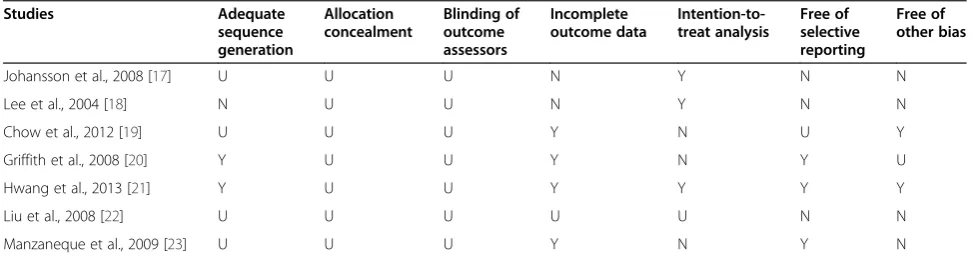
Table 2 presents the risk-of-bias assessment for each trial. Of the 7 RCTs, randomization method was reported in three trials [18,20,21], but only two used an adequate sequence-generation method for randomization [20,21]. Allocation concealment and blinding of outcome assessors were not used in any of the RCTs. Four studies reported the number of participants that did not complete the intervention program [19-21,23]. Of them, three did not perform intention-to-treat analyses [19,20,23]. One RCT [22] did not report the dropout rate, so we assumed that all participants in the study completed the intervention program. Inclusion and exclusion criteria were adequate in five trials [18-21,23], but only in two trials the partici-pants were screened by stress and anxiety level [19,21]. Sample-size estimation was calculated or justified in only one trial [21].
Discussion
This systematic review examined and statistically synthe-sized clinical trial evidence of the effectiveness of qigong exercise at relieving anxiety and reducing stress among healthy individuals. On the basis of the available evidence, our review demonstrated that qigong exercise significantly relieved anxiety and reduced stress among healthy people. Specifically, two RCTs suggested an immediate effect of
Study or Subgroup
Chow et al., 2012
Hwang et al., 2013
Liu et al., 2008
Manzaneque et al., 2009
Total (95% CI)
Heterogeneity: Tau² = 0.05; Chi² = 5.12, df = 3 (P = 0.16); I² = 41%
Test for overall effect: Z = 4.20 (P < 0.0001) Mean
4.1
41
1.43
11.3 SD
3.24
7.7
0.58
6.7 Total
34
25
50
16
125 Mean
9.29
49.8
1.62
18.7 SD
7.02
9.4
0.46
9 Total
31
25
50
16
122 Weight
26.4%
22.4%
34.4%
16.7%
100.0%
IV, Random, 95% CI
-0.95 [-1.47, -0.44]
-1.01 [-1.60, -0.42]
-0.36 [-0.76, 0.04]
-0.91 [-1.64, -0.18]
-0.75 [-1.11, -0.40]
Experimental Control Std. Mean Difference Std. Mean Difference
IV, Random, 95% CI
-2 -1 0 1 2
[image:6.595.56.538.592.716.2]Favours qigong Favours control
Figure 2Effects of qigong exercise on anxiety following a period of qigong practice among healthy subjects.
Wanget al. BMC Complementary and Alternative Medicine2014,14:8 Page 6 of 9
qigong exercise in reducing anxiety among healthy adults compared to listening to music and structured movements only (pooled SMD =−0.98; 95% CI, -1.42 to−0.54). Four RCTs suggested a favorable effect of qigong exercise on anxiety relief (pooled SMD =−0.75; 95% CI, -1.11 to−0.40) and three RCTs suggested a beneficial effect of qigong
exercise on stress reduction (pooled SMD =−0.88; 95%
CI, -1.22 to −0.55) among healthy subjects following
one to three months of qigong practice, compared to wait-list controls. These results may not be consistent with our findings in patients with depressive and anxiety symptoms secondary to chronic illnesses, which we re-ported elsewhere [13], but fit with previous systematic reviews of other stress-reduction techniques, such as tai chi [24], yoga [25] and mindfulness-based stress reduction [26] among healthy adults.
However, the results of this review should be inter-preted and generalized with caution due to the limited number of the studies and the high risk of bias inherent in the studies. First, qigong exercise was preferentially provided to the intervention groups in these studies as a group therapeutic modality, whereas a matched number of social contact hours with co-participants was not given to the control groups. Thus, a placebo effect might have occurred in participants who enjoyed participating in group activities and being in contact with other people.
Second, of the seven RCTs, only two used an appropriate sequence-generation method for randomization, and none reported adequate concealment of treatment allocation. This might have introduced selection bias. Moreover, blinding of outcome assessors was not used in any of the RCTs, and thus detection bias might have been introduced. Third, although details of dropouts and withdrawals were described in four RCTs, three studies did not perform intention-to-treat analysis, which might have lead to attri-tion bias. In addiattri-tion, only one study justified the sample size; hence, it was unclear if the samples were large enough to avoid Type-II errors for studies with small samples. Finally, most of the studies did not screen participants by stress and anxiety levels, which might have weakened the evidence. These design limitations need to be addressed in future studies.
Given the limited number of RCTs in the field, other controlled studies of the effect of qigong exercise on mood states and stress levels were also examined during the process of our literature review. Results of these studies should be assessed critically. One crossover RCT [27] in-vestigated whether longer qigong sessions have greater acute psychological benefits than shorter sessions. That study suggested that 30 minutes of qigong exercise is suffi-cient to provide psychological benefits, and it found no additional benefits after 60 minutes, which might provide Study or Subgroup
Chow et al., 2012
Griffith et al., 2008
Hwang et al., 2013
Total (95% CI)
Heterogeneity: Tau² = 0.00; Chi² = 0.05, df = 2 (P = 0.98); I² = 0%
Test for overall effect: Z = 5.16 (P < 0.00001)
Mean
9.18
-4.5
15.4
SD
4.95
6.6
3.8
Total
34
16
25
75 Mean
13.94
0.4
19.2
SD
5.92
4.9
4.2
Total
31
21
25
77 Weight
43.1%
24.2%
32.7%
100.0%
IV, Random, 95% CI
-0.87 [-1.38, -0.36]
-0.84 [-1.52, -0.16]
-0.93 [-1.52, -0.35]
-0.88 [-1.22, -0.55]
Experimental Control Std. Mean Difference Std. Mean Difference
IV, Random, 95% CI
-2 -1 0 1 2
[image:7.595.58.537.90.209.2]Favours qigong Favours control
Figure 3Effects of qigong exercise on perceived stress following a period of qigong practice among healthy subjects.
Table 2 Risk-of-bias summary for included randomized controlled trials
Studies Adequate
sequence generation
Allocation concealment
Blinding of outcome assessors
Incomplete outcome data
Intention-to-treat analysis
Free of selective reporting
Free of other bias
Johansson et al., 2008 [17] U U U N Y N N
Lee et al., 2004 [18] N U U N Y N N
Chow et al., 2012 [19] U U U Y N U Y
Griffith et al., 2008 [20] Y U U Y N Y U
Hwang et al., 2013 [21] Y U U Y Y Y Y
Liu et al., 2008 [22] U U U U U N N
Manzaneque et al., 2009 [23] U U U Y N Y N
N, not applied (high risk of bias);U, unclear (uncertain risk of bias);Y, yes (low risk of bias).
Wanget al. BMC Complementary and Alternative Medicine2014,14:8 Page 7 of 9
[image:7.595.55.543.595.724.2]complementary evidence on the beneficial effect of qigong exercise. Another study [28] with a crossover random design among 42 office workers from the same office suggested no significant effect of qigong exercise on stress reduction. However, the results carry little weight because it might have had carry-over effects and learn-ing effects [29], which could have contributed to the negative result.
We found three CCTs [30-32] and two ROSs [33,34]. Two CCTs [30,31] suggested no effect of qigong on stress reduction, possibly due to the sample size in each of the two trials (n < 20). One CCT [32] suggested a favorable effect of qigong exercise; however, the data were highly susceptible to bias due to the non-random design. Two ROSs [33,34] suggested a "dose–response" effect of qigong exercise in decreasing symptoms of stress, which might provide alternative evidence of the beneficial effects of qigong exercise for stress management. Unfortunately, such data were highly susceptible to bias and provided little scientific evidence.
Assuming that qigong exercise is effective for stress management, possible mechanisms may be of interest. Researchers have speculated that breath regulation and structured body movements during qigong exercise result in long and deep diaphragmatic and rhythmic breathing that could affect the autonomic nervous system (ANS) and the endocrine system, stabilize mood, and restore the homeostatic state by enhancing cardiac output, oxygen consumption, carbon dioxide exhalation, and plasticity of the ANS [24]. Researchers have also proposed three psy-chobiological pathways (monoamine neurotransmitters in the brain, the hypothalamic-pituitary-adrenal axis, and brain-derived neurotropic factors) to explain qigong exer-cise’s effects on stress and depression [35]. However, these hypotheses need to be further supported by scientific evidence, given inconsistent findings on stress-related biomarkers reported in three [18,19,21] of the seven RCTs examined in this review.
This review may be subject to several limitations. First is the potential incompleteness of the evidence reviewed, a common concern for any systematic review. The second is that we could not examine the effect of quality and dos-age of qigong exercise due to the limited number of RCTs. For the same reason, we could not compare the effect of qigong exercise compared to other intervention modal-ities, such as psychological education, social support, or aerobic exercise. Finally, we did not synthesize the effect of qigong exercise on other outcomes that may be related to stress, such as sleep quality, quality of life, and stress-related biomarkers due to the limited number of studies. As the number of studies increases, future reviews can ad-dress these issues. Despite these limitations, our review is the first to comprehensively and critically assess evidence of the effectiveness of qigong exercise on anxiety relief
and stress reduction among healthy subjects, which may provide insight for further studies.
Conclusions
In conclusion, evidence from a limited number of RCTs suggests that qigong exercise relieves anxiety and re-duces stress among healthy individuals. Given the high risk of bias and methodological problems in the RCTs, further rigorously designed RCTs that adhere to accepted standards of trial methodology with large, well-defined samples are warranted before recommending qigong exer-cise as an intervention option.
Competing interests
The authors declare that they have no competing interests.
Authors’contributions
CLWC was the project leader and initiated the study. CHYC and SMN contributed to the conception of the study. JSMC searched the literature and collected the data. CWW performed the meta-analysis and drafted the manuscript. CLWC, CHYC, RTHH, and SMN contributed comments for revision of the manuscript. All authors read and approved the final manuscript.
Acknowledgments
This research was partly supported by the Hospital Authority of Hong Kong (HA105/48 PT5). The sponsor had no further role in study design; in collection, analysis, and interpretation of data; in the writing of the report; and in the decision to submit the paper for publication.
Received: 16 September 2013 Accepted: 6 January 2014 Published: 9 January 2014
References
1. American Psychological Association:2010 Stress in America Report. http:// www.apa.org/news/press/releases/stress/national-report.pdf Accessed January 14, 2013.
2. Centre for Health Protection, Department of Health, Government of Hong Kong Special Administrative Region:Statistics on behavioral risk factors: stress coping method. http://www.chp.gov.hk/en/data/1/10/280/760.html. Accessed January 14, 2013.
3. Centers for Disease Control and Prevention:Managing stress. http://www. cdc.gov/Features/HandlingStress/. Accessed January 14, 2013.
4. Arnetz BB, Ekman R:Stress in Health and Disease.Weinheim, Germany: Wiley-VCH; 2006.
5. National Center for Health Statistics:Healthy People 2000 Final Review. Hyattsville, Maryland: Public Health Service; 2001.
6. Tsang HW, Cheung L, Lak DC:Qigong as a psychosocial intervention for depressed elderly with chronic physical illnesses.Int J Geriatr Psychiatry 2002,17(12):1146–1154.
7. Chan CL, Wang CW, Ho RT, Ng SM, Chan JS, Ziea ET, Wong VC:A systematic review of the effectiveness of qigong exercise in supportive cancer care.Support Care Cancer2012,20(6):1121–1133.
8. Lee MS, Pittler MH, Guo R, Ernst E:Qigong for hypertension: a systematic review of randomized clinical trials.J Hypertens2007,25(8):1525–1532. 9. Lee MS, Chen KW, Choi TY, Ernst E:Qigong for type 2 diabetes care: a
systematic review.Complement Ther Med2009,17(4):236–242. 10. Chan CL, Wang CW, Ho RT, Ho AH, Ziea ET, Taam Wong VC, Ng SM:A
systematic review of the effectiveness of qigong exercise in cardiac rehabilitation.Am J Chin Med2012,40(2):255–267.
11. Chan CL, Wang CW, Ho RT, Ng SM, Ziea ET, Wong VT:Qigong exercise for the treatment of fibromyalgia: a systematic review of randomized controlled trials.J Altern Complement Med2012,18(7):641–646. 12. Lee MS, Ernst E:Qigong for movement disorders: a systematic review.
Mov Disord2009,24(2):301–303.
13. Wang CW, Chan CL, Ho RT, Tsang HW, Chan CH, Ng SM:The effect of qigong on depressive and anxiety symptoms: a systematic review and meta-analysis of randomized controlled trials.Evid Based Complement Alternat Med2013,2013:716094.
Wanget al. BMC Complementary and Alternative Medicine2014,14:8 Page 8 of 9
14. Higgins JPT, Green S:Cochrane Handbook for Systematic Reviews of Interventions.Chichester, UK: Wiley-Blackwell; 2008.
15. Borenstein M:Effect sizes for continuous data. InThe Handbook of Research Synthesis and Meta-Analysis.2nd edition. Edited by Cooper H, Hedges LV, Valentine JC. New York, NY: Russell Sage Foundation; 2009. 16. Cohen J:Statistical Power Analysis in the Behavioral Sciences.Hillsdale, NJ:
Lawrence Erlbaum Associates, Inc.; 1988.
17. Johansson M, Hassmén P, Jouper J:Acute effects of qigong exercise on mood and anxiety.Int J Stress Manag2008,15(2):199–207.
18. Lee MS, Kang CW, Lim HJ, Lee MS:Effects of qi-training on anxiety and plasma concerntrations of cortisol, ACTH, and aldosterone: a randomized placebo-controlled pilot study.Stress and Health2004,20:243–248. 19. Chow YWY, Dorcas A, Siu AMH:The effects of qigong on reducing stress
and anxiety and enhancing body-mind well-being.Mindfulness2012, 3(1):51–59.
20. Griffith JM, Hasley JP, Liu H, Severn DG, Conner LH, Adler LE:Qigong stress reduction in hospital staff.J Altern Complement Med2008,14(8):939–945. 21. Hwang EY, Chung SY, Cho JH, Song MY, Kim S, Kim JW:Effects of a brief
Qigong-based stress reduction program (BQSRP) in a distressed Korean population: a randomized trial.BMC Complement Altern Med2013,13:113. 22. Liu H, An H, Meng F, Hu B, Wei Y, Meng F:A survey about the effect of
eight-section brocade to the mental health of students in medical college.Medicine Society2008,21:63–64.
23. Manzaneque JM, Vera FM, Rodriguez FM, Garcia GJ, Leyva L, Blanca MJ: Serum cytokines, mood and sleep after a qigong program: is qigong an effective psychobiological tool?J Health Psychol2009,14(1):60–67. 24. Wang C, Bannuru R, Ramel J, Kupelnick B, Scott T, Schmid CH:Tai Chi on
psychological well-being: systematic review and meta-analysis. BMC Complement Altern Med2010,10:23.
25. Chong CSM, Tsunaka M, Tsang HWH, Chan EP, Cheung WM:Effects of yoga on stress management in healthy adults: a systematic review.
Altern Ther Health Med2011,17(1):32–38.
26. Chiesa A, Serretti A:Mindfulness-based stress reduction for stress management in healthy people: a review and meta-analysis. J Altern Complement Med2009,15(5):593–600.
27. Johansson M, Hassmén P:Acute psychological responses to qigong exercise of varying durations.Am J Chin Med2008,36(3):449–458. 28. Skoglund L, Josephson M, Wahlstedt K, Lampa E, Norback D:Qigong
training and effects on stress, neck-shoulder pain and life quality in a computerised office environment.Complement Ther Clin Pract2011, 17(1):54–57.
29. Sibbald B, Roberts C:Understanding controlled trials. Crossover trials. BMJ1998,316(7146):1719.
30. Sousa CM, Goncalves M, Machado J, Efferth T, Greten T, Froeschen P, Greten HJ: Effects of qigong on performance-related anxiety and physiological stress functions in transverse flute music schoolchildren: a feasibility study. J Chin Integr Med2012,10(8):858–865.
31. Skoglund L, Jansson E:Qigong reduces stress in computer operators. Complement Ther Clin Pract2007,13(2):78–84.
32. Terjestam Y, Jouper J, Johansson C:Effects of scheduled qigong exercise on pupils’well-being, self-image, distress, and stress.J Altern Complement Med2010,16(9):939–944.
33. Lee MS, Jeong SM, Oh SW, Ryu H, Chung HT:Effects of chundosunbup Qi-training on psychological adjustments: a cross-sectional study. Am J Chin Med1998,26(2):223–230.
34. Lee MS, Ryu H, Chung HT:Stress management by psychosomatic training: effects of ChunDoSunBup Qi-training on symptoms of stress: a cross-sectional study.Stress and Health2000,16(3):161–166. 35. Tsang HW, Fung KM:A review on neurobiological and psychological
mechanisms underlying the anti-depressive effect of qigong exercise. J Health Psychol2008,13(7):857–863.
doi:10.1186/1472-6882-14-8
Cite this article as:Wanget al.:Managing stress and anxiety through qigong exercise in healthy adults: a systematic review and meta-analysis
of randomized controlled trials.BMC Complementary and Alternative Medicine201414:8.
Submit your next manuscript to BioMed Central and take full advantage of:
• Convenient online submission
• Thorough peer review
• No space constraints or color figure charges
• Immediate publication on acceptance
• Inclusion in PubMed, CAS, Scopus and Google Scholar
• Research which is freely available for redistribution
Submit your manuscript at www.biomedcentral.com/submit
Wanget al. BMC Complementary and Alternative Medicine2014,14:8 Page 9 of 9